INTRODUCTION
Antarctic notothenioid is the most dominant ich- thyo-fauna of the Southern Ocean. Their evolution for millions of years are remarkable examples of adaptation to extreme thermal environment (Clarke and Johnston, 1996; Eastman, 1993). Intensive studies over the last 50 years nototheniid fish from Antarctica have revealed Ant- arctic notothenioid as the most diverse notothenioid fam- ily. They possess distinct physiological and biochemical characteristics that have played an essential role in their adaptation to extreme conditions. Among them, acqui- sition of antifreeze glycoproteins has allowed to survive down to -1.9°C, the freezing point of seawater without intracellular ice formation (DeVries and Wohlschlag, 1969; DeVries and Cheng, 2005).
The two important populations, around the South
Oceans, black rockcod (Notothenia coriiceps) and mar- bled rockcod (Notothenia rossii) are regularly exploit- ed by commercial fishing industry (Duhamel, 1982). N.
coriiceps showed a circumpolar population distribution (DeWitt et al., 1990) and is one of the dominant fish spe- cies around the South Shetland Islands (Casaux et al., 1990). N. coriiceps is known as primarily a benthic pred- ator for its feeding on polychaetes, thaliaceans, gammar- id amphipods, molluscs (Blankley, 1982). N. rossii has been the object of several studies concerning the biology and the general aspects of populations (Shust and Pinska- ya, 1978; Freytag, 1980)
The first Antarctic station of Korea - Korea Polar Re- search Institute (KOPRI), based on King Sejong station, has achieved many remarkable results in the area of polar genomics since 1988 (Shin et al., 2012; Shin et al., 2014;
Ahn et al., 2016). However, physiological studies of fish have been limited by the shortage of facilities including aquarium to maintain live fishes. In order to overcome the problem, an aquarium having six tanks which has a
— 146 — http://www.fishkorea.or.kr
* Corresponding author: Jin-Hyoung Kim Tel: 82-32-760-5583, Fax: 82-32-760-5509, E-mail: [email protected]
ISSn: 1225-8598 (Print), 2288-3371 (online)
accepted: June 28, 2017
Length and Weight Relationship for Two Dominant Antarctic Notothenioid Fishes Caught in the Coastal Water off King Sejong Station, King George Island, Antarctica
By Hyun Park, Il-Chan Kim 1 , Seunghyun Kang, Bo-Mi Kim, Dong-Won Han 2 and Jin-Hyoung Kim*
Unit of Polar Genomics, Korea Polar Research Institute, Incheon 21990, Republic of Korea
1
Department of Life Sciences, Korea Polar Research Institute, Incheon 21990, Republic of Korea
2
King Sejong Station, Korea Polar Research Institute, Incheon 21990, Republic of Korea
ABSTRACT Length and weight relationship (LWR) for dominant Antarctic fishes was determined in two species of the family Nototheniidae; black rockcod (Notothenia coriiceps) and marbled rockcod (Notothenia rossii). Samples were caught in the offshore sea around King Sejong station located on King George Island, Antarctica in January, 2017. A total of 30 N. coriiceps and 7 N. rossii were caught by fishing rod and hook. Average total length was 266.0 mm for N. coriiceps and 275.4 mm for N.
rossii. Average total weight was 283.1 g for N. coriiceps and 290 g for N. rossii. In terms of LWR and b value, the results showed that both two species had positive allometries (b > 3) in good health. This size information of two dominant Antarctic fishes would be useful for future physiological studies to understand of adaptation mechanism and biological pathway of Antarctic marine organisms.
Key words: Length and weight relationship, Antarctic notothenioid, condition factor
capacity of 300 L and cooling system has been equipped successfully in the King Sejong station in January 2017.
Using the facility, we could collect Antarctic fish species and maintain them steadily to perform a variety of exper- iment.
Length-weight relationship (LWR) is very important factor in fishery assessments (Garcia et al., 1998; Hai- movici and Canziani, 2000). The LWR with age data is useful for the stock composition, age at maturity, life span, mortality, growth and production (Beyer, 1987;
Bolger and Connolly, 1989; King, 1996; Diaz et al., 2000). This short paper aims to determine length-weight relationship of two dominant Antarctic fishes, which would be a good start for those studies in order to im- prove understanding of adaptation mechanism and bio- logical pathway of Antarctic organisms.
MATERIALS AND METHODS
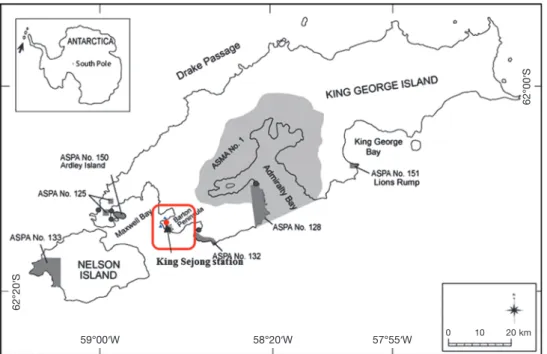
Fish samples were collected between January 15 th and 20 th , 2017 around King Sejong station, King George Island, Antarctica (Fig. 1). The coordination of two main points was 62°13′20.18″S 58°47′13.90″W and 62°14′24.60″S 58°45′43.01″W. Fishes were collected by rod and hook with sliced beef and shrimp as bait on the rigid-hulled inflatable boat. The net fish trap was not ap- propriate for numerous floating ice. Sampled fishes were
moved into the aquariums of the Sejong Aquazone and maintained in the seawater (temperature: 2°C, salinity: 35 psu).
For species identification, morphological character- istics of two fishes were used classification system de- scribed in (Balushkin, 1989).
Length-weight relationship (LWR) was estimated by using the equation W =aL b (Ricker, 1973). The rela- tionship was estimated via least square linear regression from the log transformed values of length and weight [log W=log a+b log L (Zar, 1984)]. The condition factor (K) was calculated by usual formula K=100 W/L 3 (Pauly, 1983); where W= weight in grams; L=total length (cm).
All data on LWR of the two fish species were subjected to t-test analysis at P < 0.05.
RESULTS AND DISCUSSION
A photograph of two fishes was shown in Fig. 2. Fig. 3 shows the length-frequency distribution of the two fishes.
The size range was similarly to the previous study (Calì et al., 2017). The characteristics of total length and total weight of two fishes were shown in Table 1. Average to- tal length of N. coriiceps and N. rossii was 266.0 mm and 275.4 mm, respectively. For total weight, N. coriiceps was 283.1 g and N. rossii was 290 g. There was no signif- icant size difference between two species while average
Fig. 1. Map of study site.
59°00 ′W 58°20′W 57°55′W
62 °20 ′S 62 °00 ′S
0 10 20 km
total length and total weight of N. coriiceps was higher than those of N. rossii (P < 0.05).
According to the previous study about age estimation for the species (Barrera-Oro and Casaux, 1992; Eastman, 2011; Calì et al., 2017), N. coriiceps and N. rossii in this study could be estimated to be about 5~8 years old and 3~4 years old, respectively. Different growth rate and maximum age of the population of N. coriiceps and N. rossii and were reported with the result that N. rossii grew larger size at a lower maximum age than N. corii- ceps, showing a higher growth rate and shorter age range (Linkowski, 1980; Calì et al., 2017).
The relationship parameters of total length and total weight were shown in Fig. 4 and Table 2. LWR were highly significant (P < 0.05) for two species. The deter- mination coefficients (R 2 ) were > 0.90 for N. coriiceps,
> 0.80 for N. rossii. In terms of b value, N. coriiceps was
Fig. 3. Length-frequency distribution for two Antarctic Notothenia fishes collected in the coastal water off King Sejong station in Janu- ary 2017.
n o. of specimens
N. coriiceps n =30 N. rossii
n =7
220 240 260 280 300
total length (mm) 2
1
0
8
6
4
2
0
Fig. 2. Photograph of A. Notothenia coriiceps and B. Notothenia rossii collected in the coastal water off King Sejong station in January 2017.
A
B
Table 1. Total length and weight characteristics for two dominant Antarctic notothenioid species caught in the coastal water off King Sejong station in January 2017
Species n Total length (mm) Total weight (g)
Mean Min Max Mean Min Max
Notothenia coriiceps 30 266.0 230 296 283.1 180 420
Notothenia rossii 7 275.4 255 291 290.0 235 380
n: sample size; Min: minimum; Max: maximum
3.404 and for N. rossii was 3.546, and the results showed that both two species had positive allometries (b > 3).
These values are similar with the result from other previ- ous studies regarding LWR of the two fish species (East- man and Sidell, 2002; Eastman, 2011). Average condi- tion factor (K) of N. coriiceps (1.482) was slightly higher than that of N. rossii (1.376) (P < 0.05), suggesting that N. coriiceps may be fatter than N. rossii. Higher K value of N. coriiceps than that of N. rossii was also reported in the previous study (Eastman et al., 2011). However, the difference in condition factor and LWR can be caused by the small sample size of N. rossii, thus further investiga- tion would be needed to improve the understanding of fish growth in extreme thermal environment.
ACKNOWLEDGEMENT
This study was supported by Korea Polar Research In- stitute (PE17080).
REFERENCES
Ahn, D.-H., S.H. Kang and H. Park. 2016. Transcriptome analysis of immune response genes induced by pathogen agonists in the Antarctic bullhead notothen Notothenia coriiceps. Fish Shellfish Immunol., 55: 315-322.
Balushkin, A.V. 1989. Morphological bases of the systematics and phylogeny of the nototheniid fishes. Oxonian Press Pvt, New Delhi-Calcutta.
Barrera-Oro, E. and R. Casaux. 1992. Age estimation for juvenile Notothenia rossii from Potter Cove, South Shetland Islands.
Antarct. Sci., 4: 131-136.
Beyer, J. 1987. On length-weight relationship. Part 1. Correspond- ing the mean weight of a given length class. Fishbytes, 5:
11-13.
Blankley, W.O. 1982. Feeding ecology of three inshore fish species at Marion Island (Southern Ocean). S. Afr. J. Zool., 17: 164- Bolger, T. and P.L. Connolly. 1989. The selection of suitable indices 170.
for the measurement and analysis of fish condition. J. Fish Biol., 34: 171-182.
Calì, F., E. Riginella, M. La Mesa and C. Mazzoldi. 2017. Life his- tory traits of Notothenia rossii and N. coriiceps along the southern Scotia Arc. Polar Biol., doi: 10.1007/s00300-016- 2066-z
Casaux, R.J., A.S. Mazzotta and E.R. Barrera-Oro. 1990. Seasonal aspects of the biology and diet of nearshore nototheniid fish at Potter Cove, South Shetland Islands, Antarctica. Polar Biol., 11: 63-72.
Clarke, A. and I.A. Johnston. 1996. Evolution and adaptive radia- tion of antarctic fishes. Trends Ecol. Evol., 11: 212-218.
DeVries, A.L. and C.H.C. Cheng. 2005. Antifreeze proteins and or- ganismal freezing avoidance in polar fishes. Fish Physiol., 22: 155-201.
DeVries, A.L. and D.E. Wohlschlag. 1969. Freezing resistance in some Antarctic fishes. Science, 163: 1073-1075.
DeWitt, H., P. Heemstra and O. Gon. 1990. Nototheniidae. In: Gon, O. and Heemstra P.C. (eds), Fishes of the Southern Ocean.
JLB Smith Institute of Ichthyology, Grahamstown, pp. 279- 331.
Diaz, L.S., A. Roa, C.B. Garcia, A. Acero and G. Navas. 2000.
Length-weight relationships of demersal fishes from the upper continental slope off Colombia. Naga, The ICLARM Quarterly, 23: 23-25.
Table 2. Parameters of length and weight relationship (LWR) for two dominant Antarctic notothenioid species caught in the coastal water off King Sejong station in January 2017
Species n Length-weight relationship (LWR) Condition factor (K)
a b R
2Range Mean
Notothenia coriiceps 30 2×10
-53.404 0.922 1.299~1.674 1.482
Notothenia rossii 7 6×10
-63.546 0.891 1.300~1.542 1.376
Fig. 4. Scattered diagram of length-weight, and their relationships for two dominant Antarctic Notothenia species collected in the coastal water off King Sejong station in January 2017.
total weight (g)
220 240 260 280 300
total length (mm) 450
400
350
300
250
200
150
tW =2×10
-5tl
3.404r
2=0.922
tW =6×10
-6tl
3.546r
2=0.891 N. coriiceps
N. rossii
Duhamel, G. 1982. Biology and population dynamics of Notothenia rossii rossii from the Kerguelen Islands (Indian sector of Southern Ocean). Polar Biol., 1: 141-151.
Eastman, J.T. 1993. Antarctic fish biology: evolution in a unique environment. Academic Press, New York, 322pp.
Eastman, J.T., E. Barrera-Oro and E. Moreira. 2011. Adaptive radi- ation at a low taxonomic level: divergence in buoyancy of the ecologically similar Antarctic fish Notothenia coriiceps and N. rossii. Mar. Ecol. Progr. Ser., 438: 195-206.
Eastman, J.T. and B.D. Sidell. 2002. Measurements of buoyancy for some Antarctic notothenioid fishes from the South Shetland Islands. Polar Biol., 25: 753-760.
Freytag, G. 1980. Length, age and growth of Notothenia rossii mar- morata, Fischer 1885 in the West Antarctic waters. Arch.
FischWiss, 30: 39-68.
Garcia, C.B., J.O. Duarte, N. Sandoval, D. Schiller, G. Melo and P. Navajas. 1998. Length-weight relationships of demersal fishes from the Gulf of Salamanca, Colombia. NAGA, 21:
30-32.
Haimovici, M. and G.V. Canziani. 2000. Length-weight relationship of marine fishes from Southern Brazil. Naga, The ICLARM Quarterly, 23: 14-16.
King, R.P. 1996. Length-weight relationships of Nigerian coastal water fishes. Naga, The ICLARM Quarterly, 19: 53-58.
Pauly, D. 1983. Some simple methods for the assessment of tropical fish stocks. FAO Fish. Tech. Pap., 234: 52.
Ricker, W.E. 1973. Linear regressions in fishery research. J. Fish.
Bd Can., 30: 409-434.
Shin, S.C., D.-H. Ahn, S.J. Kim, C.W. Pyo, H.S. Lee, M.-K. Kim, J.E. Lee, J.-E. Lee, H.W. Detrich, J.H. Postlethwait, D. Ed- wards, S.G. Lee, J.H. Lee and H. Park. 2014. The genome sequence of the Antarctic bullhead notothen reveals evolu- tionary adaptations to a cold environment. Genome Biol., 15: 468.
Shin, S.C., S.J. Kim, J.K. Lee, D.-H. Ahn, M.G. Kim, H.S. Lee, J.E.
Lee, B.-K. Kim and H. Park. 2012. Transcriptomics and comparative analysis of three Antarctic notothenioid fishes.
PLOS One, 7: e43762.
Shust, K.V. and I.A. Pinskaya. 1978. Age and rate of growth of six species of Notothenid fish (family Nototheniidae). J. Ich- thyol., 18:743-749.
Zar, J. 1984. Comparing simple linear regression equations. Biostat- ist. Anal., 2: 292-305.
남극 , 킹조지섬, 세종과학기지 연안에 우점하는 남극암치아속 어류 두 종의 길이와 무게의 관계
박