• 검색 결과가 없습니다.

Distribution Characteristics of Heavy Metals in Soil in the Vicinity of King Sejong Station, King George Island, Antarctica

N/A
N/A
Protected

Academic year: 2021

Share "Distribution Characteristics of Heavy Metals in Soil in the Vicinity of King Sejong Station, King George Island, Antarctica"

Copied!
4
0
0

로드 중.... (전체 텍스트 보기)

전체 글

(1)

ISSN 0367-6315

Korean J. Soil Sci. Fert.

45(1), 103-106 (2012)

Distribution Characteristics of Heavy Metals in Soil in the Vicinity of King Sejong Station, King George Island, Antarctica

Ik-Won Choi

, Dong-Chul Seo

, Se-Won Kang, Sang-Gyu Lee, Young-Jin Seo, Jong-Hak Han, Jong-Soo Heo

1

, and Ju-Sik Cho*

Department of Bio-Environmental Sciences, Sunchon National University, Suncheon, 540-742, Korea

1

Division of Applied Life Science (BK21 Program) & Institute of Agriculture and Life Science, Gyeongsang National University, Jinju, 660-701, Korea

These authors equally contributed to this paper

To investigate distribution characteristics of heavy metals in soils in the vicinity of King Sejong Station of King George Island, Antarctica, Fe, Mn, Cu, Zn, Pb, Co, Cd, Cr, Ni and Mo contents were investigated under different distances and directions from King Sejong Station. 13 sample sites were distributed from King Sejong Station. In site 4, the Cd content was higher than that in other sites. The Cr content was the highest in site 9, and the Ni and Mn contents were high in site 12. Cu, Co and Zn were highly contained in distance 1~2 km from King Sejong Station. Cd, Cr, Ni and Mo contents were lower, whereas Fe, Mn, Cu, Zn, Pb and Co contents were higher than other heavy metal contents at all sites.

Key words: King Sejong Station, King George Island, Antarctica, Heavy metals characteristics

Received : January 17. 2012 Accepted : January 30. 2012

*Corresponding author : Phone: +82617503297 E-mail: [email protected]

Introduction

Antarctica is the World’s fifth-largest continent measuring approximately 13.6 million km

2

, sixty fold of the Korean peninsula. Antarctic Peninsula has been exposed to contamination through increasing human activity at research stations and increased tourism.

King George Island that ten research stations are located is the largest island of the South Shetland Islands in West Antarctica. King Sejong Station, one of those ten research stations is located on Barton Peninsula. King George Island, the largest island of the South Shetland Islands, has a cold, oceanic climate characteristic of maritime Antarctica. Barton Peninsula is surrounded by Marian Cove to the north coast and Maxwell Bay to the southwest coast. Barton Peninsula is the exposed ground (about 20 km

2

) with melting snow when temperatures became warmer at above zero.

The ground is covered by soil, moraine of weathered rock, mosses and lichens (Lee, 1992; Chang 1997,

1999). Most of the ice-free area is covered by relatively abundant vegetation, dominated by cryptogamic species (Kim et al., 2007). The flora comprises two flowering plants, 33 bryophytes, and 62 lichens (Lee, 1992; Kim et al., 2006). Chottaebawi area on the southern coast of the peninsula contains one of the most important penguin colonies (Pygoscelis papua and Pygoscelis antarctica) in the maritime Antarctic region (Fig. 1).

The cape area near King Sejong Station is populated by flying seabirds, such as skuas. Previous studies have reported heavy metal concentrations in different components of King George Island, including snow-ice (Hong et al., 2002), soil (Choi et al., 2011; Santos et al., 2005), sediments (Andrade et al., 2001; Santos et al., 2005), and vegetation (Cho et al., 2008ab; Poblet et al., 1997; Hong et al., 1999; Osyczka et al., 2007).

The purpose of this study was to investigate distribution characteristics of heavy metals in soil of vicinity of King Sejong Station on Barton Peninsula of King George Island, Antartica.

Note

(2)

Ik-Won Choi et al.

104

Fig. 1. Sampling sites for soils in the vicinity of King Sejong Station.

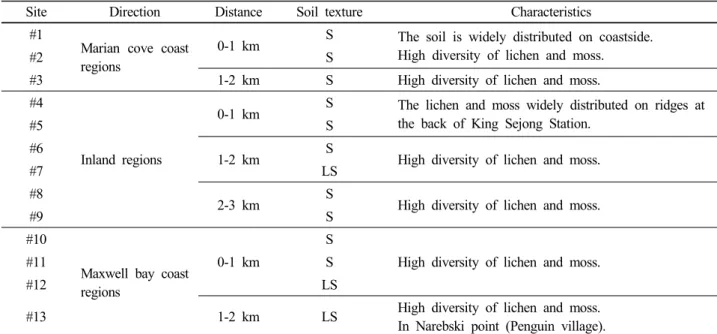
Table 1. Information of sampling sites for this study.

Site Direction Distance Soil texture Characteristics

#1 Marian cove coast regions

0-1 km S The soil is widely distributed on coastside.

High diversity of lichen and moss.

#2 S

#3 1-2 km S High diversity of lichen and moss.

#4

Inland regions

0-1 km S The lichen and moss widely distributed on ridges at the back of King Sejong Station.

#5 S

#6 1-2 km S

High diversity of lichen and moss.

#7 LS

#8 2-3 km S

High diversity of lichen and moss.

#9 S

#10

Maxwell bay coast regions

0-1 km

S

High diversity of lichen and moss.

#11 S

#12 LS

#13 1-2 km LS High diversity of lichen and moss.

In Narebski point (Penguin village).

S : Sand, LS : Loamy sand.

Materials and Methods

A field survey was conducted from January to February, 2008. Soil samples were collected from 13 sites in snow-free areas of the peninsula (Fig. 1).

Sample sites were distributed from the Sejong Cape (King Sejong Station) under different distances and directions. Soil samples were sieved by 2 mm mesh and oven-dried at 70℃ for 72 h. for transport to

laboratory. Soil texture was classified as sandy (10 sites) and loamy sand (3 sites) by USDA textural classification (Table 1). The concentrations of heavy metals in soil were analyzed by inductively coupled plasma-mass spectrometry (ICP-MS, Agilent 7500, Santa Clara, CA) following acid leaching with 0.1 N HCl according to Standard Method (NIAST, 2000).

Results and Discussion

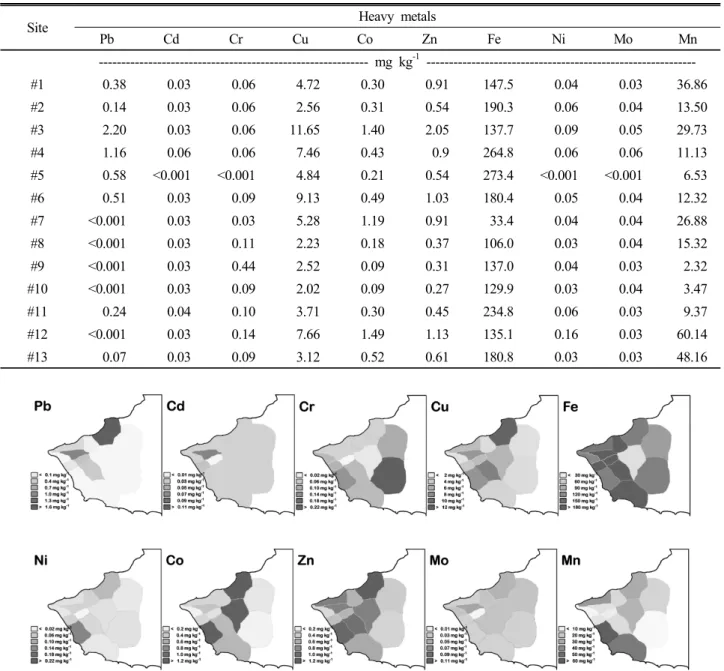
Cr, Cu, Zn, Cd, Pb, Mn, Fe, Co, Ni and Mo contents in soils in vicinity of King Sejong Station were investigated (Table 2, Fig. 2). Fe, Mn, Cu, Zn, Pb and Co contents were 33~273, 3.5~60.1, 2.02~

13.88, 0.3~2.05, 0.01~2.2 and 0.09~1.49 mg kg

-1

,

respectively. In the soils, Cd, Cr, Ni and Mo contents

were low, whereas Fe, Mn, Cu, Zn, Pb and Co

contents were high. The concentrations of heavy metals

were higher in the order of Fe (165.5 mg kg

-1

) ≫

Mn (21.2 mg kg

-1

) ≥ Cu (5.2 mg kg

-1

) > Zn (0.8 mg

kg

-1

) > Pb mg kg

-1

) > Co (0.54 mg kg

-1

) > Cr (0.11 mg

kg

-1

) > Ni (0.06 mg kg

-1

) > Cd (0.03 mg kg

-1

) = Mo

(0.03 mg kg

-1

). The concentration of Cd in site 4 was

higher than that in other sites. The concentration of

Cr was the highest in site 9. The concentrations of

Ni and Mn were high in site 12. Cu, Co and Zn were

highly contained in distance 1~2 km from King Sejong

Station. Pb was highly contained in vicinity of King

(3)

Distribution Characteristics of Heavy Metals in Soil in the Vicinity of King Sejong Station, King George Island, Antarctica 105

Table 2. Contents of heavy metals from soils in the vicinity of King Sejong Station in King George Island, Antarctic.

Site Heavy metals

Pb Cd Cr Cu Co Zn Fe Ni Mo Mn

--- mg kg

-1

---

#1 0.38 0.03 0.06 4.72 0.30 0.91 147.5 0.04 0.03 36.86

#2 0.14 0.03 0.06 2.56 0.31 0.54 190.3 0.06 0.04 13.50

#3 2.20 0.03 0.06 11.65 1.40 2.05 137.7 0.09 0.05 29.73

#4 1.16 0.06 0.06 7.46 0.43 0.9 264.8 0.06 0.06 11.13

#5 0.58 <0.001 <0.001 4.84 0.21 0.54 273.4 <0.001 <0.001 6.53

#6 0.51 0.03 0.09 9.13 0.49 1.03 180.4 0.05 0.04 12.32

#7 <0.001 0.03 0.03 5.28 1.19 0.91 33.4 0.04 0.04 26.88

#8 <0.001 0.03 0.11 2.23 0.18 0.37 106.0 0.03 0.04 15.32

#9 <0.001 0.03 0.44 2.52 0.09 0.31 137.0 0.04 0.03 2.32

#10 <0.001 0.03 0.09 2.02 0.09 0.27 129.9 0.03 0.04 3.47

#11 0.24 0.04 0.10 3.71 0.30 0.45 234.8 0.06 0.03 9.37

#12 <0.001 0.03 0.14 7.66 1.49 1.13 135.1 0.16 0.03 60.14

#13 0.07 0.03 0.09 3.12 0.52 0.61 180.8 0.03 0.03 48.16

Fig. 2. Distribution characteristics of heavy metals in soil in the vicinity of King Sejong Station.

Sejong Station. As suggested by Hong et al. (1999), the use of leaded gasoline and diesel oil in King Sejong Station are likely sources of Pb. However, additional environmental factors, such as geological characteristics of substratum and distance from the seashore, should also be considered to precisely assess the human influence on heavy metal concentrations in soils. At the same sites in vicinity of King Sejong Station, the amounts of heavy metal contents in soils were different with that in lichen. According to Lim et al. (2009), who investigated heavy metal contents in lichen in vicinity of King Sejong Station, heavy metal contents in lichen were lower as distant increased

from King Sejong Station. However, heavy metal contents in soils were low in comparison with heavy metal contents in lichen in this study. It could be not suitable for heavy metals to be adsorbed in soils compared as lichen because snows covering all of the areas interrupt adsorption.

References

Andrade, S., A. Poblet, M. Scagliola, C. Vodopivez, A. Curtosi, A. Pucci, and J. Marcovecchio. 2001. Distribution of heavy metals in surface sediments from an antarctic marine ecosystem.

Environ. Monit. Assess. 66:147-158.

(4)

Ik-Won Choi et al.

106

Chang, S.K. 1997. Characteristics of land surface in the vicinity of King Sejong Station, Korean Antarctic Research Station.

J. Kor. Earth Sci. Soc. 18(5):443-449.

Chang, S.K. 1999. Avifauna occurring around the King Sejong Station, King George Island, South Shetland Islands, Antarctic Peninsula. Bull. Kor. Inst. Orni. 7(1):19-35.

Cho, J.S., H.S. Lim, D.C. Seo, J.H. Kim, J.I. Lee, M.J. Han, Y.H.

Cheong, and J.S. Heo. 2008a. The contents of Na, Mg, K and Ca cation in lichen, Usnea aurantiacoatra of King George Island, West Antarctica. Korea J. Soil Sci. Fert. 41:139.

Cho, J.S., H.S. Lim, D.C. Seo, J.H. Kim, J.I. Lee, Y.J. Park, J.S.

Hur, Y.H. Cheong, and J.S. Heo. 2008b. Heavy metal contents in lichen, Usnea aurantiacoatra of King George Island, West Antarctica. Korea J. Soil Sci. Fert. 41:138.

Choi, I.W., Y.J. Park, D.C. Seo, S.W. Kang, W.T. Jeon, U.G.

Kang, H.H. Sung, T.Y. Hur, J.S. Heo, and J.S. Cho. 2011.

Physico-chemical characteristics of soil in the vicinity of King Sejong Station, King George Island, Antarctica. Korean J. Soil Sci. Fert. 44(5):709-716.

Hong, S., C.Y. Kang, and J. Kang. 1999. Lichen biomonitoring for the detection of local heavy metal pollution around King Sejong Station, King George Island, Antarctica. Korean J.

Polar Res. 10:17-24.

Hong, S.M., A. Lluberas, G.W. Lee, and J.K. Park. 2002. Natural and anthropogenic heavy metal deposition to the snow in King George Island, Antarctic Peninsula. Ocean and Polar Res.

24:279-287.

Kim, J.H., I.Y. Ahn, K.S. Lee, H. Chung, and H.G. Choi. 2007.

Vegetation of Barton Peninsula in the neighborhood of King Sejong Station (King George Island, maritime Antarctic).

Polar Biol. 30:903-916.

Kim, J.H., I.Y. Ahn, S.G. Hong, M. Andreev, K.M. Lim, M.J.

Oh, Y.J. Koh, and J.S. Hur. 2006. Lichen flora around the Korean Antarctic Scientific Station, King George Island, Antarctic. J. Microbiol. 44:480-491.

Lee, J.S. 1992. Vegetational distribution of lichens in Barton Peninsula, King George Island, Antarctica. Kor. J. Polar Res.

3:27-34.

Lim, H.S., M.J. Han, D.C. Seo, J.H. Kim, J.I. Lee, H. Park, J.S.

Hur, Y.H. Cheong, J.S. Heo, H.I. Yoon, and J.S. Cho. 2009.

Heavy metal concentrations in the Fruticose Lichen Usnea aurantiacoatra from King George Island, South Shetland Islands, West Antarctica. J. Korean Soc. Appl. Biol. Chem.

52(5):503-508.

NIAST. 2000. Methods of soil chemical analysis. National Institute of Agricultural Science and Technology, RDA, Suwon, Korea.

Poblet, A., S. Andrade, M. Scagliola, C. Vodopivez, A. Curtosi, A. Pucci, and J. Marcovecchio. 1997. The use of Epilithic Antarctic Lichens (Usnea aurantiacoatra and U. Antartica) to determine deposition patterns of heavy metals in the Shetland Islands, Antarctica. Sci. Total Environ. 207:187-194.

Santos, I.R., E.V. Silva-Filho, C. Schaefer, M.R. Albuquerque- Filho, and L.S. Campos. 2005. Heavy metal contamination in coastal sediments and soils near the Brazilian Antarctic Station, King George Island. Mar. Pollut. Bull. 50:185-194.

Osyczka, P., E.M. Dutkiewicz, and M. Olech. 2007. Trace elements concentrations in selected moss and lichen species collected within Antarctic Research Stations. Polish J. Ecol.

55:39-48.

수치

Fig. 1. Sampling sites for soils in the vicinity of King  Sejong Station.
Table 2. Contents of heavy metals from soils in the vicinity of King Sejong Station in King George Island, Antarctic.

참조

관련 문서

Heavy metal concentrations Fe, Mn, Pb, Zn, Cu, Cd, Ni, Cr and Co in washed and unwashed leaves of Ginkgo biloba in Seoul area RA; Rural area, IA; Industrialized area, RDA;

Distribution of Phytoavailable Heavy Metals in the Korean Agricultural Soils Affected by the Abandoned Mining Sites and Soil Properties Influencing on.. the

Annual gametogenesis of the Antarctic clam, Laternula elliptica from Marian Cove, King George

ABSTRACT The radiative convective equilibrium (RCE) temperature was calculated for the climate change study at King Sejong Station in West Antarctica. As a result of RCE

Liriope platyphylla was grown in soil containing three of heavy metals, Zn, Cd, and Pb under four different concentrations (0, 100, 250 and 500 mg/kg) to determine the

Abstract : For the purpose of understanding the cloud scattering effect of UV radiation at King Sejong station in West Antarctica, we analyzed the data measured by

In order to determine the distribution characteristics of the heavy metals in surface sediments of the eastern Yellow Sea, heavy metal concentrations (Cu, Pb, Zn, Cd, Cr, Mn,