Tensile, Thermal and Morphological Properties of Ballmilled Clay/Wood Flour Filled Polypropylene
Nanocomposites
Sun-Young Lee *✝ ․In-Aeh Kang * ․Sang-Jin Chun **
* Division of Environmental Material Engineering, Department of Forest Products Korea Forest Research Institute 57 Hoegi-Ro, Dongdaemun-Gu Seoul, 130-712, Korea
** Department of Chemical Engineering, University of Seoul Siripdae-Gil 13, Dongdaemun-Gu Seoul, 130-743, Korea (Received February 20, 2008 ; Accepted May 27, 2008)
Abstract : Nanocomposites with polypropylene/clay/wood flour were prepared by melt blending and injection molding. Thermal, mechanical and morphological properties were characterized. The addition of ballmilled clay, compatibilizer and wood flour significantly improved the thermal stability of the hybrids. The tensile modulus and strength of most hybrids was highly increased with the increased loading of clay, maleated polypropylene (MAPP) and wood flour (WF), compared to the PP/WF hybrids. The tensile modulus and strength of most hybrids were highly increased with the increased loading of ballmilled clay, MAPP and wood flour, compared to the hybrids with PP/WF. The transmission electron microscopy (TEM) photomicrographs illustrated the intercalated and partially exfoliated structures of the hybrids with ballmilled clay, MAPP and wood flour.
Keywords : Nanocomposites, nanoclay, MAPP, PP, wood flour
1. Introduction
Wood Plastic Composites (WPCs) have been manufactured by incorporating particulate fillers into a polymer matrix to fit the construction industry for decking, fencing, landscaping and window profile [1,2].
Lignocellulosic fillers such as wood flour, rice husk, hemp, jute and sisal have numerous advantages including low cost, biodegradability, easiness of processing,
✝ Corresponding author
(e-mail : [email protected])
flexibility and low density. Compatibilizers are used to improve bonding between wood and polymers by creating chemical bondings across the interfaces of the two materials [3,4]. Technically, compatibilizers increase tensile and flexural strength-often referred to as modulus of rupture (MOR) and modulus of elasticity (MOE). One of the best-known compatibilizers is a maleated polypropylene (MAPP).
Hybrid composites with structure and
composition at the nanoscale exhibit exhibited
highly improved mechanical properties and
high temperature endurance relative to
conventionally-scaled composites [5,6].
Layered silicates are commercially available and are used to improve flame retardancy, mechanical and barrier properties compared to the neat polymer matrix. They are widely used for incorporation in the composites because of their abilities to intercalate and exfoliate at the nanoscale in the thermoplastic matrix. The smectite group of clay minerals auch as montmorillonite (MMT) has been predominantly used because of its excellent intercalation abilities [7,8]. Thermoplastics such as polypropylene (PP) are hydrophobic and have poor miscibility with layered silicates. Therefore, nanoclay is usually organo-chemically modified with alkylammonium groups to facilitate its miscibility with thermoplastics. The miscibility between PP and nanoclay can be enhanced by the compatibilizers such as MAPP [8].
The sturctures in clay-polymer hybrids can be defined as intercalation and exfoliation. Intercalation is defined as the well-ordered and stacked multilayers that result from intercalated polymer chains within nanoclay layers. Exfoliation refers to formation of monolayers of clay dispersed in a continuous polymer matrix or individually distributed in the polymer matrix.
Accordingly, the intercalated and exfoliated hybrids exhibit improved strength and modulus, compared to the conventional composites [5,7,8].
The improved properties of the nanocomposites can be achieved at a clay loading level less than 5 wt.% clay [9]. Until the clay loading was 3 wt%, the mechanical and thermal properties were improved. At the clay content of 5 wt%, however, those properties were decreased due to the decrease of molecular weight. The dispersion of clay layers in polymers is due to face-to-face stacking in agglomerated tactoids and the conversion to a single platelet by complete exfoliation are not accomplished [10,11]. For non-polar polymers, an addition of a
compatibilizer is requested to enhance the diffusion of polymers into clay galleries.
High energy ball milling is an effective technique currently used in inorganic material synthesis and processing [12]. It consists of repeated events of energy transfer, promoted by the milling device, from the milling tools to the milled powder. During the milling the powder particles crack, clean surfaces are produced, atom diffusion and intimate mixing are promoted.
Although some studies have been conducted on the reinforcement effect of clay in thermoplastics such as PP, limited data is available on the wood flour/clay/plastic nanocomposites by melt compounding. With the presence of larger-size wood fibers, a synergetic combination of clay and compatibilizer is often required to achieve desired composite properties. The objective of this study was to examine the effect of wood flour, compatibilizer and clay with/without ball milling on mechanical and thermal properties of PP-based nanocomposites.
2. Materials and methods
2.1. Materials
Polypropylene (PP 5014, Mw = 180,000 g/mol) was obtained from the Korea Petrochemical Ind. Co., Korea. Neat PP was in the homopolymer powder form with a melt flow index of 3.2 g/10min and a density of 0.9 g/cm 3 . Wood flour (Lignocel C120, particle size of 100-120 mesh) was purchased from J.Retenmaier & Sohne Co. (Rosenberg, Germany). Maleated polypropylene (MAPP;
PH-200, Honam Petrochemical Co., Korea)
was used as a compatibilizer. The molecular
weight and maleic anhydride grafting level of
MAPP were 40,000 g/mol and 5%,
respectively. Nanoclay (Montmorillonite,
Cloisite® 15A), chemically-modified with a
quaternary ammonium salt was obtained from
Southern Clay Products, Inc. (Gonzales,
Sample No. PP (wt.%)
WF
(wt.%) MAPP (wt.%) Nanoclay (wt.%)
No ball-milling Ball-milling
1 100 - - - -
2 60 40 - - -
3 80 20 - - -
4 56 40 3 1 -
5 54 40 3 3 -
6 56 40 3 - 1
7 54 40 3 - 3
8 74 20 3 1 -
9 76 20 3 3 -
10 74 20 3 - 1
11 76 20 3 - 3
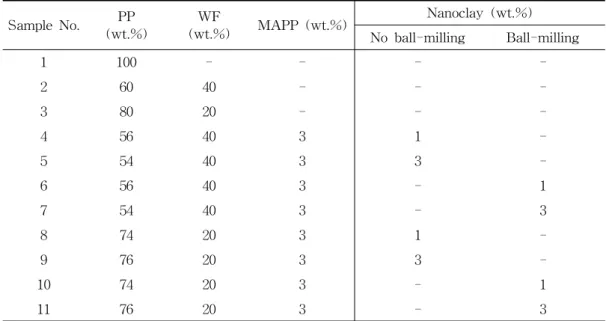
Table 1. Material formulations of the nanocomposites Texas, U.S.A.). Clay was a fine powder with a cation exchange capacity of 125 mequiv/100g. The density and layer distance of clay were 1.6 g/cm 3 and 30.3 Å, respectively. The clay was dried in a vacuum oven at 90 o C for 24 h. The wood flour was dried to 1-2% moisture content using an oven at 80 o C, and then stored in polyethylene bags.
2.2. Ballmilling
Ballmilling of clay was performed with a milling device (Pulverisette-6, Fritsch, Denmark) at 500 rpm for 24 h.
2.3. Melt compounding
The hybrids with wood flour/clay/PP were prepared with a co-rotating twin-screw extruder (Bautek Co, Korea). The extruder had a screw diameter of 19 mm with an L/D ratio of 40. A compounding temperature was 180 o C. The screw speed for compounding was in the range of 100-150 rpm. As shown in Table 1, the compounding formulations were WF (20 and 40 wt.%), clay (1 and 3 wt.%), and MAPP (3 wt.%). The neat PP,
PP/WF and PP/clay/MAPP/WF hybrids were compounded using a one-step method. The extrudate in the strand form was air-cooled and pelletized with a pelletizer (Bautek Co., Korea). The composite samples were dried at 80 o C for 24 h in a vacuum oven to remove the absorbed water before being injection molded at 190 o C and then cooled to room temperature.
2.4. Tensile properties
The tensile test for composites was performed according to ASTM D638 using an Universal Testing Machine (Zwick Testing Machine Ltd., Leomister, United Kingdom).
Dogbone test specimens were molded in a size of 3.18 x 9.53 x 3.00 mm. Tensile strength and modulus were determined with an extensometer at a crosshead speed of 10 mm/min. Five replicated specimens were tested for each treatment.
2.5. TGA data
Thermogravimetric analysis (TGA) was
performed with a SDT Q600
Thermogravimetric analyzer (TA Instrument
(a) 20 wt.% WF
0 500 1,000 1,500 2,000 2,500
PP80-WF20 PP76-WF20- MAPP3-NC1
PP74-WF20- MAPP3-NC3
PP76-WF20- MAPP3-
NC1B PP74-WF20-
MAPP3- NC3B
PP
Tensile modulus(MPa)
(b) 20 wt.% WF
0 10 20 30 40 50 60
PP80-WF20 PP76-WF20- MAPP3-NC1
PP74-WF20- MAPP3-NC3
PP76-WF20- MAPP3-NC1B
PP74-WF20- MAPP3-NC3B
PP
Tensile strength(MPa)
(c) 40 wt.% WF
0 500 1,000 1,500 2,000 2,500
PP60-WF40 PP56-WF40- MAPP3-NC1
PP54-WF40- MAPP3-NC3
PP56-WF40- MAPP3-
NC1B PP54-WF40-
MAPP3- NC3B
PP
Tensile modulus(MPa)
(d) 40 wt.% WF
0 10 20 30 40 50 60
PP60-WF40 PP56-WF40- MAPP3-NC1
PP54-WF40- MAPP3-NC3
PP56-WF40- MAPP3-
NC1B PP54-WF40-
MAPP3- NC3B
PP
Tensile strength(MPa)
Fig. 1. Tensile modulus (a and c) and strength of (b and d) of PP/WF/MAPP/clay composites.
Inc. New Castle, Deleware, U.S.A.). Tests were done under nitrogen at a scan rate of 10 o C/min from 30 to 600 o C. A sample of 5 to 10 mg was used for each run.
2.6. Transmission electron microscopy (TEM)
The morphology of the composites was imaged with a Phillips CM 30 transmission microscope (TEM, FEI Company, U.S.A.) with an acceleration voltage of 15kV.
Ultra-thin sections (70-90 nm) were cut from injection molded bars perpendicular to the flow direction under cryogenic conditions using a Nova CM-20 ultramicrotome and then placed on 300 mesh grids.
3. Results and discussion
3.1. Tensile properties
The tensile modulus and strength of neat PP were, respectively, 534 and 30.4 MPa (Fig. 1(a) and (b)). Fig. 1(a) to (d) show the effect of wood flour (WF), maleated polypropylene (MAPP) and clay with and without ballmilling on the tensile properties of hybrids. The addition of wood flour (20 and 40 wt.%) to PP increased the tensile modulus to 96.8% and 169.7% and increased the tensile strength to 24.3 to 15.8%, compared with those of neat PP. At the loading of 20 wt.% WF, the addition of MAPP (3 wt.%) and clay (1 and 3 wt.%) without ballmilling showed 20.2% and 24.7%
higher tensile modulus than PP80/WF20 composite (Fig. 1(a)). At the loading of 20%
WF, the addition of 3 wt.% MAPP and clay
(1 and 3 wt.%) without ballmilling increased the tensile strength 6.1% compared to the PP80/WF20 composite (Fig. 1(b)). At the same loading of WF, the addition of 1 wt.%
clay with ballmilling showed the 47.5%
higher tensile modulus and 11.2% higher tensile strength than that without ballmilling.
However, the addition of 3 wt.% clay with ballmilling decreased the tensile modulus and strength 25.8 and 31.6% lower than that 1 wt.% clay with ballmilling.
At the loading of WF (40 wt.%) and MAPP (3 wt.%), the addition of clay (1 and 3 wt.%) without ballmilling increased the tensile modulus 36.7% and decreased 7.9%
compared to PP60/WF40 composite, respectively (Fig. 1(c)). At the loading of 40% WF and 3 wt.% MAPP, the addition of clay (1 and 3 wt.%) without ballmilling increased the tensile strength 27.3 and 13.1%
compared to PP60/WF40 composite, respectively (Fig. 1(d)). At the same loading levels of WF and MAPP, the addition of clay with ballmilling decreased the tensile modulus 50.3% and 1.44% compared to the addition of clay without ballmilling (Fig. 1(c)). The increased tensile modulus may be attributed to the increased stiffness and brittleness of hybrid composites by the addition of clay and WF. On the other hand, the tensile strengths of composites by addition of clay with ballmilling increased 4.7% and 6.8% compared to the addition of clay without ballmilling (Fig. 1(d)). The increased tensile strength may be due to the intercalation and partial exfoliation of clay. The high tensile strength may be due to an intercalation of clay layers sand the increased bonding strength between wood flour and neat PP by MAPP.
3.2. Thermal properties
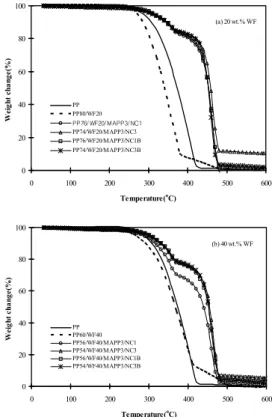
TGA curves of neat PP and PP/WF hybrid are shown in Fig. 2(a) and (b). The addition of WF (20 and 40 wt.%) to neat PP decreased the thermal stability of the composites, showing a single stage
decompostion curve. The decomposition temperature of composites at the loading of 40 wt.% WF was higher than that at the loading of 20 wt.% WF. The thermal decomposition of composites at the loading level of WF (20 and 40 wt.%) and MAPP (3 wt.%) showed the two stage curves.
(a) 20 wt.% WF
0 20 40 60 80 100
0 100 200 300 400 500 600
Temperature(oC)
Weight change(%)
PP PP80/WF20 PP76/WF20/MAPP3/NC1 PP74/WF20/MAPP3/NC3 PP76/WF20/MAPP3/NC1B PP74/WF20/MAPP3/NC3B
(b) 40 wt.% WF
0 20 40 60 80 100
0 100 200 300 400 500 600
Temperature(oC)
Weight change(%)
PP PP60/WF40 PP56/WF40/MAPP3/NC1 PP54/WF40/MAPP3/NC3 PP56/WF40/MAPP3/NC1B PP54/WF40/MAPP3/NC3B