ISSN 2288-0356(Online) Original Article
Tensile Properties and Thermal Stability of Cellulose Nanofibril/Clay Nanocomposites
Byung-Dae Park1,*, Adya P. Singh1, In Chul Um2
1Department of Wood Science and Technology, Kyungpook National University, Daegu, 702-201, Republic of Korea
2Department of Bio-fibers and Materials Science, Kyungpook National University, Daegu, 702-701, Republic of Korea
Abstract
This work attempted to fabricate organic/inorganic nanocomposite by combining organic cellulose nanofibrils (CNFs), isolated by 2,2,6,6-tetramethylpiperidine-1-oxy radical (TEMPO)-mediated oxidation of native cellulose with inorganic nanoclay. The morphology and dimension of CNFs, and tensile properties and thermal stability of CNF/clay nanocomposites were characterized by transmission electron microscope (TEM), tensile test, and thermogravimetry (TG), respectively. TEM observation showed that CNFs were fibrillated structure with a diameter of about 4.86±1.341 nm. Tensile strength and modulus of the hybrid nanocomposite decreased as the clay content of the nanocomposite increased, indicating a poor dispersion of CNFs or inefficient stress transfer between the CNFs and clay. The elongation at break increased at 1% clay level and then continuously decreased as the clay content increased, suggesting increased brittleness. Analysis of TG and derivative thermogravimetry (DTG) curves of the nanocomposites identified two thermal degradation peak temperatures (Tp1and Tp2), which suggested thermal decomposition of the nanocomposites to be a two steps-process.
We think that Tp1values from 219.6℃ to 235℃ resulted from the sodium carboxylate groups in the CNFs, and that Tp2values from 267℃ to 273.5℃
were mainly responsible for the thermal decomposition of crystalline cellulose in the nanocomposite. An increase in the clay level of the CNF/clay nanocomposite predominately affected Tp2values, which continuously increased as the clay content increased. These results indicate that the addition of clay improved thermal stability of the CNF/clay nanocomposite but at the expense of nanocomposite’s tensile properties.
Keywords:Cellulose nanofibril, Clay, Nanocomposite, Tensile properties, TEMPO, Thermal stability
Introduction1)
In recent years, cellulose nanofibrils (CNFs) have attracted much attention for preparing high performance nanocomposites as they were highly crystalline bio-nanofibers environmentally compatible, and in addition have many unique and desirable features. Thus, cellulose-based nanomaterials are being employed for fabricating a wide variety of nanocomposites by combining with polymers, and the developments are benefitting from rapid advances in nanoscience and nanotechnologies (Samir et al. 2005; Eichhorn et al. 2010). Preparations and characterizations related to CNFs-based nanocomposites have been extensively investigated in anticipation of many desirable property contributions from CNFs, such as high strength, high stiffness, biodegradability and lightweight.
Among the natural biomaterials, cellulose is the most abundant, renewable and biodegradable polymer in the world. Cellulose fibrils consist of different hierarchical microstructures. Parallel and long cellulose chains are stabilized laterally by hydrogen
bonds between hydroxyl groups, resulting in high structural strength and stiffness. The reported elastic modulus of native cellulose Ι crystal is 167.5 GPa (Tashiro and Kobayashi 1991) and that of tunicin whiskers is 143 GPa (Sturcová et al. 2005).
Because of its excellent properties, nanocellulose has generated a great deal of interest as nanometer size reinforcement agent for a range of biocomposites.
Natural cellulose-based nanocomposites have been prepared by solution casting of various matrixes and nano-sized reinforcements. Favier et al. (1995) first observed significant reinforcing effect of tunicin nanocellulose whisker, with a width 10-20 nm and several micrometer length, in copolymer of styrene and butyl acrylate. CNFs-based nanocomposites have been prepared and characterized in several other studies (Leitner et al. 2007 Cheng et al. 2007 Cheng et al. 2009 Zimmermann et al. 2004 Sriupayo et al. 2005 Kvien et al. 2005 Lu et al.
2008). For example, Leitner et al. (2007) prepared nanocomposite based on nanofibril from sugar beet cellulose Received: March 4, 2013 / Revised: March 25, 2013 / Accept: March 25, 2013
*Corresponding Author: Byung-Dae Park, Tel. 82-53-950-5797, Fax. 82-53-950-6751, Email. [email protected]
This work was supported by Kyungpook National University Research Fund, 2011. This work was also financially supported by the Ministry of Education Science and Technology (MEST) and The Korean Federation of Science and Technology Societies (KOFST).
©2012 College of Agricultural and Life Science, Kyungpook National University
and polymerby solution casting and showed tensile strength to improve with an increase in nanofibril content. Zimmermann et al. (2004) observed significant reinforcement of polymer-based nanocomposite from nano-sized cellulose fibrils isolated by mechanical treatment of sulfite pulp. Peterson et al. (2007) reported improved thermal properties of cellulose whisker-reinforced polymer nanocomposite. Cho and Park (2011) also reported improved thermal stability and mechanical properties of polyvinyl alcohol-based nanocomposite reinforced with cellulose nanowhiskers.2)
In last two decades, the 2,2,6,6-tetramethylpiperidine-1-oxy radical (TEMPO), a water-soluble, commercially available and stable nitroxyl radical, paved a way for a new field of efficient and selective conversion chemistry of alcoholic hydroxyl groups to aldehydes, ketones and carboxyl groups under mild conditions (de Nooy et al. 1995; de Nooy et al. 1996). TEMPO was employed for cellulose nanofibers from several wood pulps and cotton linters (Fukuzumi et al. 2009; Saito et al. 2006). Many related studies on wood cellulose have been extensively carried out in the last few years (Saito et al. 2006 Saito et al. 2007), and have been reviewed in detail (Isogai et al. 2011). Combined with mechanical disintegration, aqueous dispersions of individual cellulose nanofibers can be obtained from TEMPO-oxidation of native cellulose (Isogai et al. 2011). CNFs prepared by TEMPO-mediated oxidation of native celluloses and successive mechanical disintegration of the oxidized celluloses in water have also been extensively used for fabricating nanocomposites (Isogai et al. 2011).
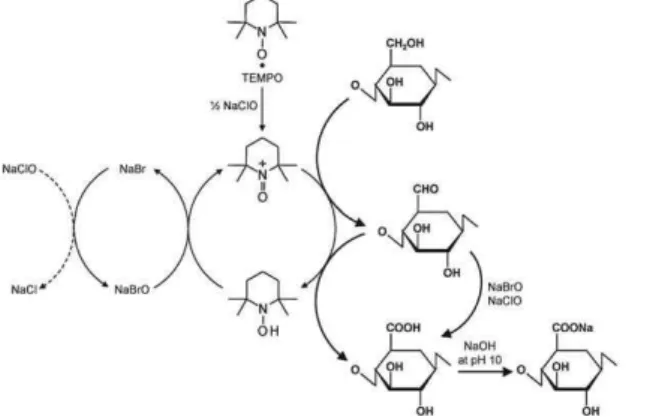
According to the scheme shown in Figure 1, the C6 primary hydroxyls of cellulose are expected to be oxidized to C6 carboxylate groups by TEMPO/NaBr/NaClO oxidation in water at pH 10–11. The oxidation process can be monitored from the pattern of aqueous NaOH consumption, which is continuously added to the reaction mixture to maintain the pH at 10~11 during the oxidation. Thus the CNFs obtained by the TEMPO-oxidation have a high crystallinity, mostly uniform widths (3~4 nm), and large aspect ratios (>50) compared with other nanocelluloses (Saito et al. 2006, 2007; Shinoda et al.
2012). Moreover, these CNFs can be completely dispersed at the individual nanofibril level in water by electrostatic repulsion and/or osmotic effects due to anionically charged sodium carboxylate groups densely present on their surfaces surface (Saito and Isogai 2004).
Organic/inorganic nanocomposites are also promising materials that are taking advantages of the properties of organic and inorganic materials, which can be used to produce light and strong composites and other materials. For example, natural
nacre consisting of a hierarchical structure of chitin nanofibrils and hard calcium carbonate is a lightweight, layered nanocomposite with good mechanical properties. Organic/
inorganic hybrid nanocomposites are finding wide ranging applications into novel and high performance products over the last several years. As expected, there has also been considerable research on nanocomposites, using inorganic nanomaterials, such as carbon nanotube (CNT) (Coleman et al. 2006; Shen et al. 2007), nanoclay (Tjong 2006; Ray and Okamoto 2003;
Pavlidou and Papaspyrides 2008), and organic nanofibers (Cheng et al. 2009; Prolongo et al. 2009).
Figure 1. Regioselective oxidation of C6 primary hydroxyls of cellulose to C6 carboxylate groups by TEMPO/NaBr/
NaClO oxidation in water at pH 10–11 (Isogai et al. 2011) In the case of artificial organic/clay hybrid materials, clay-reinforced polymer composites have their roots in the pioneering work of researchers at Toyota (Kojima et al. 1993;
Usuki et al. 1993). They first reported on the improvement in the properties of nylon nanocomposites by incorporating nanoclay into the polymer matrix. Subsequently, a great deal of work has been done on nanocomposite materials based on a variety of polymers (Ray and Okamoto 2003). It has been shown that the mechanical and thermal properties of polymeric materials can be improved by adding <10 wt % nanoclay, i.e., montmorillonite (MTM) nanoplatelets to polymer matrices.
MTM belongs to smectite-type clays, approximately 1 nm in thickness, and MTM nanoplatelets have net negative surface charges in neutral water. However, both negative and positive charges are generated on the surface and at the edge, respectively, of each MTM nanoplatelet.
Although many works have been done on the CNFs-reinforced polymer nanocomposites, there is still very limited work on the fabrication of organic/inorganic nanocomposites by combining CNFs with nanoclay to take advantage of the unique
properties of each component in the resultant nanocomposirtes.
Therefore, this work was undertaken to characterize tensile properties and thermal stability of CNFs/clay nanocomposites as organic/inorganic hybrid nanocomposites.
Materials and methods Materials
A sample of hardwood bleached kraft pulp (HW-BKP) was obtained from Moorim Paper Co. Ltd., Korea and stored in humidity chamber at 25℃ before use. TEMPO, sodium bromide (NaBr), sodium hypochlorite (NaOCl) solution and other chemicals were purchased from Sigma-Aldrich and used as received. Particles of nanoclay, a natural montmorillonite (Cloisite®-Na, Southern Clay Products Inc., Texas, USA) with a density of 2.86 g/cm3, were purchased and used without any further treatment. Moisture content of these nanoclays was 4
~9%, and their sizes were 2~13μm.3) CNFs isolation
CNFs were isolated from cellulose pulp according to a modified procedure of the TEMPO-oxidation method (Saito et al. 2006).
In brief, the kraft pulp sample (2 g of cellulose content) was suspended in water (150 mL) containing TEMPO (0.025 g) and sodium bromide (0.25 g). The TEMPO-mediated oxidation of the cellulose slurry was initiated by adding 5 mmol of 13%
NaClO per gram of cellulose and carried out at room temperature under gentle agitation. The pH was maintained at 10.5 by adding 0.5 M NaOH. When no more decrease in pH was observed, the reaction was finished and pH was adjusted to 7 by adding 0.5 M HCl. The TEMPO-oxidized product was thoroughly washed with water by filtration and physically fibrillated by ultra-sonication with a sonicator (Sonosmasher, Jeio Tech, Korea) for 20 min. The suspension was then centrifuged at
(a) (b)
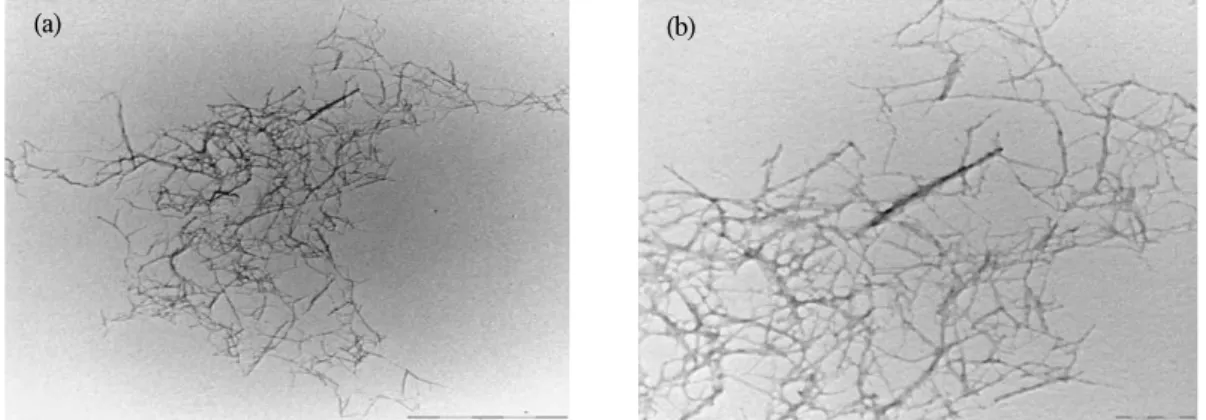
Figure 2. TEM images of the prepared CNFs at different magnifications. (a) x40,000 and (b) x100,000
5000 rpm two to three times for 30 minutes each. The supernatant was decanted and collected as the CNFs suspension. The yield of CNFs was calculated as a percentage of the initial weight of CNFs suspension after drying in a drying oven at 105℃.
The final concentration of the CNFs was adjusted to 0.1% by weight/volume.
Preparation of CNF/clay nanocomposites
The clay nanoplatelets were dispersed in distilled water in order to obtain 2% solution. A pre-determined volume of the 2%
clay solution was added to the 0.1% CNF dispersion at various weight contents (1%, 3%, 5%, and 10% w/v) under stirring.
After stirring for 1 h, the CNFs/clay dispersion was poured in an aluminum dish with 30 mm diameter and vacuum-dried at 50℃ for 24 hours. The CNFs/clay composite film formed was peeled off and stored at 25℃ and 50% relative humidity.
Characterization of CNFs
Transmission electron microscopy (TEM) (H-7600, Hitachi, Japan) was performed at an acceleration voltage of 100 kV.
The sample was diluted to a concentration of 0.01 % w/v. To examine the morphology of the CNFS, three droplets of suspension were placed on Cu-grids coated with a thin carbon film and then allowed to dry at 30℃ for 10 min. To enhance the contrast in the TEM, the grids were floated on drops of a 3 wt% solution of uranyl acetate for 3 minutes and then dried at 70℃ for 10 min. The particle dimensions were obtained by measuring at least 10 individual nanocelluloses from the TEM micrographs.
Characterization of CNF/clay nanocomposites
Tensile tests were performed using a universal testing machine (OTT-003, Oriental TM, Korea) with a 3 kgf load cell. The cross head speed was 5 mm/min. The specimens were cut with
a width of 5 mm and a length of 40 mm. The thickness of the samples was measured before the test. The gauge between top and bottom clamp was 30 mm.
Thermal stability of CNFs/clay nanocomposites was investigated using a thermogravimetry (TG) (SDT Q600, TA Instruments, USA). The samples (~10 mg) were heated from 25℃ to 600℃ at a heating rate of 10℃/min. and a nitrogen flow of 100 mL/min. Thermograms of the nanocomposites were analyzed using the software (Universal Analysis, TA Instruments, USA). 4)
Results and Discussion
TEM images of the CNFs prepared by the TEMPO-oxidation method at different magnification levels are depicted in Figure 2. The majority of CNFs were fibrillated, but some were not fully fibrillated into nano-scale structure (black arrows in Figure 2, a and b). As determined by TEM, an average diameter of fibrillated CNFS was about 4.86±1.341 nm, a value that matches other measurements (Shinoda et al. 2012). The fibrillated CNFs is expected to provide an efficient reinforcement of the resultant nanocomposites, while unfibrillates or macrofibrils could cause poor dispersion of CNFs, resulting in inefficient stress transfer between the components of the nanocomposites.
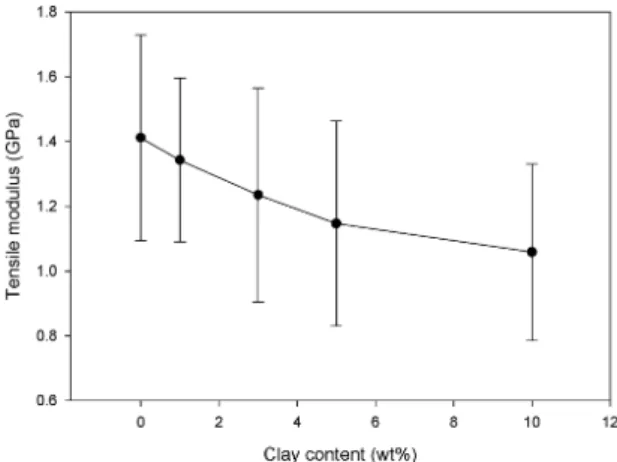
Tensile strength and modulus of the nanocomposites with the clay at 1, 3, 5, and 10 wt% loading are shown in Figures 3 and 4. As shown in Figure 3, the tensile strength of the nanocomposite gradually decreased up to 5% clay level, and then slightly increased at 10% nanoclay level, which indicates that increasing level of clay deteriorate tensile strength of the CNFs/nanoclay nanocomposites. A decrease in the tensile strength can be attributed to a number of different factors, such as the dispersion of nanoclay, interfacial adhesion between CNFs
Figure 3. Tensile strength of CNF/clay nanocomposites as a function of clay level
and nanoclay, distribution of defects, or stress-transfer efficiency under tensile stress (Piggott 1987). The clay used in this study is hydrophilic in nature, and is compatible with hydrophilic CNFs dispersed in distilled water. However, a net negative surface charge of the nanoclay and anions of sodium carboxylate or aldehyde groups on the CNFs surface could generate repulsive forces during the preparation of CNF/clay nanocomposites, resulting in a poor dispersion of nanoclay in the composites, and subsequent reduction in tensile strength.
Tensile modulus of the nanocomposites as a function of the clay content (Figure 4) gradually decreased with an increase in the clay content, indicating that the stiffness of nanocomposites decreased due to an increase in the brittleness of the nanocomposite caused by increasing clay platelets levels.
This result is also compatible with the elongation at break of the nanocomposites when the clay content is increased.
Figure 4. Tensile modulus of CNF/clay nanocomposites as a function of clay level
Figure 5. Elongation at break of CNF/clay nanocomposites as a function of clay level
The elongation at break of the nanocomposites as a function of clay content (Figure 5) slightly increased at 1% clay level, while, as expected, it gradually decreased with an increase in the clay content. In other words, the brittleness of the nanocomposite increased with increasing clay content due to their high mechanical properties and inorganic nature of the clay.
In general, the addition of inorganic clay into polymer matrix improves thermal stability of the resultant mixtures (Tjong 2006). Thus, we attempted to improve thermal stability of CNFs-based nanocomposites by adding hydrophilic clay.
Typical TG thermograms of the nanocomposites at different clay contents are shown in Figure 6. All thermograms of pure CNFsand the CNFs/clay nanocompopsites displayed thermal degradation between 200℃ and 400℃. However, the influence of clay addition into the nanocomposites was not clearly observed. Thus, derivative thermogravimetry (DTG) curves were obtained by analyzing TG curves. A typical DTG curve
5)
Figure 6. TGA curves of CNF/clay nanocomposites as a function of clay level
Figure 7. A TG and DTG curve of the nanocomposite with 1% clay level
of the nanocomposite at 1% clay content is shown in Figure 7. The DTG curve clearly displayed two peak temperatures (designated as Tp1and Tp2) during the thermal degradation of the nanocomposites, which suggests the thermal degradation process of the nanocomposites to be a two-step process.
Tp1 values of the nanocomposites as a function of the clay content are displayed in Figure 8. As the clay content increased, in fact, Tp1values occurred between 219.6℃ and 235℃ during thermal degradation of the nanocomposites. Tp1value of pure CNFs was occurred 219.6℃ and then it slightly increased asthe clay content increased to 5% followed a rapid increase at 10%
clay level. This temperature is consistent with the level reported earlier (Fukuzumi et al. 2010). Thus, as shown in Figure 1, the formation of sodium carboxylate groups from the C6 primary hydroxyls of CNFs surfaces produced by TEMPO-oxidation leads to a significant decrease in the thermal degradation point (Fukuzumi et al. 2010). In other words, the decreased thermal
Figure 8. Change of Tp1 value of CNF/clay nanocomposites as a function of clay level
Figure 9. Change of Tp2 value of CNF/clay nanocomposites as a function of clay level
degradation temperature of pure CNFs could be attributed to the influence of sodium carboxylate groups present on the surface of the CNFs which were thermally more unstable than hydroxyl group on the surface of the fibrillated CNFs (Fukuzumi et al. 2010).6)
Changes of Tp2values of the nanocomposites (Figure 9) occurred between 267℃ and 273.5℃ during thermal degradation of the nanocomposites, continuously increasing as the clay content increased except at 1% clay level. We think that Tp2 values are mainly responsible for the decomposition of crystalline cellulose itself in the nanocomposite. As the clay content increased, the Tp2value continuously increased except 1% level, suggesting that the addition of clay into the nanocomposites greatly improved the thermal decomposition temperature of crystalline cellulose, and thus the thermal stability of the nanocomposites, owing to the inorganic nature of the clay.
Therefore, adding clay into CNFs-based nanocomposites could overcome lower thermal stability of CNFs, which has been one of the drawbacks in practical applications of TEMPO-oxidized cellulose fibers. However, Tp2 values of pure CNFs and nanocomposites were clearly lower than the value recorded for control cellulose (342℃) (Poletto et al. 2012; Park and Kadla 2013). This result could also be due to the effect of thermally more unstable anhydroglucuronate units present in the CNFs used in this work than the native and crystalline cellulose (Fukuzumi et al. 2010).
Conclusions
This study reports tensile properties and thermal stability of CNFs/nanoclay nanocomposites fabricated by combining organic CNFs isolated by 2,2,6,6-tetramethylpiperidine-1-oxy radical (TEMPO)-oxidation of native cellulose with inorganic nanoclay. Morphology and dimension of CNFs were characterized by transmission electron microscope (TEM), while tensile properties and thermal stability of CNFs/clay nanocomposites were characterized by using tensile test and thermogravimetry (TG). The following conclusions are drawn from the results obtained:
1. TEM observation showed that CNFs were fibrillated structures in a aggregated form with a diameter of about 4.86±1.341 nm.
2. Tensile strength and modulus of the CNF/claynanocomposite decreased as the clay content increased, whilethe elongation at break increased at 1% clay level and then continuously decreased, indicating an increased brittleness of the nanocomposites.
3. The analysis of DTG curves noted two peak temperatures
of thermal decomposition (Tp1 and Tp2) occurring during thermal degradation process of the nanocomposites. Tp1 values ranged from 219.6℃ to 235℃, while Tp2value ranged from 267℃ to 273.5℃. The addition of clay greatly influenced the Tp2that had resulted mainly from the thermal degradation of crystalline cellulose in the nanocomposite.
Thermal stability of the nanocomposite improved by adding clay except for 1% clay addition.
4. These results indicate that the addition of clay improves thermal stability of the CNF/clay nanocomposites but at the expense of their tensile properties.
Acknowledgement
This work was supported by Kyungpook National University Research Fund, 2011. This work was also financially supported by the Ministry of Education Science and Technology (MEST) and The Korean Federation of Science and Technology Societies (KOFST).
References
Cheng Q, Wang S, Rials TG, Lee SH (2007) Physical and mechanical properties of polyvinyl alcohol and polypropylene composite materials reinforced with fibril aggregates isolated from regenerated cellulose fibers. Cellulose 14:
593-602.
Cheng Q, Wang S, Rials TG (2009) Poly (vinyl alcohol) nanocomposites reinforced with cellulose fibrils isolated by high intensity. Composites: Part A40: 218-224.
Cho MJ, Park BD (2011) Tensile and thermal properties of nanocellulose-reinforced poly(vinyl alcohol) nanocomposites.J Indust Eng Chem17: 36-40.
Coleman JN, Khan U, Blau WJ, Gun’ko YK (2006) Small but strong: A review of the mechanical properties of carbon nanotube-polymer composites. Carbon44: 1624-1652.
Eichhorn SJ, Dufresne A, Aranguren M, Marcovich NE, Capadona JR, Rowan SJ, Weder C, Thielemans W, Roman M, Renneckar S, Gindl W, Veigel S, Keckes J, Yano H, Abe K, Nogi M, Nakagaito AN, Mangalam A, Simonsen J, Benight AS, Bismarck A, Berglund LA, Peijs T (2010) Review: current international research into cellulose nanofibres and nanocomposites. J Mat Sci 45: 1-33.
Favier V, Canova GR, Cavaille JY, Chanzy H, Dufresne A, Gauthier C (1995) Nanocomposite materials from latex and cellulose whiskers. Polym Adv Tech 6: 351-355.
Fukuzumi H, Saito T, Iwata T, Kumamoto Y, Isogai A (2009).
Transparent and high gas barrier films of cellulose nanofibers prepared by TEMPO-mediated oxidation.Biomacromolecules
10(1): 162-165.
Fukuzumi H, Saito T, Okita Y, Isogai A (2010) Thermal stabilization of TEMPO-oxidized cellulose.Polym Degrad Stab 95: 1502~150.8
Isogai A, Saito T, Fukuzumi H (2011) TEMPO-oxidized cellulose nanofibers Nanoscale 3: 71-85
Kojima Y, Usuki A, Kawasumi M, Okada A, Kurauchi T, Kamigaito O (1993) Synthesis of nylon 6-clay hybrid by montmorillonite intercalated with e-caprolactam. J Polym Sci, Part A: Polym Chem31: 983-986.
Kvien I, Tanem BS, Oksman K (2005)Characterization of cellulose whiskers and their nanocomposites by atomic force and electron microscopy.Biomacromolecules6: 3160-3165.
Leitner J, Hinterstoisser B, Wastyn M, Keckes J, Gindle W (2007) Sugar beet cellulose nanofibril-reinforced composites. Cellulose 14: 419-425.7)
Lu J, Wang T, Drzal L (2008) Preparation and properties of microfibrillated cellulose polyvinyl alcohol composite materials. Composites: Part A3: 738-746.
de Nooy AEJ, Besemer AC, van Bekkum H (1995) Highly selective nitroxyl radical-mediated oxidation of primary alcohol groups in water-soluble glucans.Carboh Res269, 89-98.
de Nooy AEJ, Besemer AC, van Bekkum H (1996) On the Use of Stable Organic Nitroxyl Radicals for the Oxidation of Primary and Secondary Alcohols.Synthesis10: 1153–
1174.
Park BD, Kadla JF (2012) Thermal degradation kinetics of resole phenol-formaldehyde resin/multi-walled carbon nanotube/
cellulose nanocomposite.Thermochim Acta 540: 107-115.
Pavlidou S. Papaspyrides CD (2008) A review on polymer- layered silicate nanocomposite. Prog Polym Sci 33:
1119-1198.
Petersson L, Kvien I, Oksman K (2007) Structure and thermal properties of poly(lactic acid)/cellulose whiskers nanocomposite materials. Compos Sci Tech 67: 2535-2544.
Piggott MR (1987) Load Bearing Fibre Composites, 2nd Ed.
Pergamon Press, Toronto
Poletto M, Zattera AJ, Forte MMC, Santana RMC (2012) Thermal decomposition of wood: Influence of wood components and cellulose crystallite size.Bioresor Tech109:
148-153.
Prolongo SG, Campo M, Gude MR, Chaos-MoranR, Urena A (2009) Thermo-physical characterization of epoxy resin reinforced by amino-functionalized carbon naonofibers.
Compos Sci Tech 69: 349-357.
Ray SS, Okamoto M (2003) Polymer/layered silicate
nanocomposite: A review from preparation to processing.
Prog Polym Sci 28: 1539-1641.
Saito T, Nishiyama Y, Putaux JL, Vignon M, Isogai A (2006) Homogeneous suspensions of individualized microfibrils from TEMPO-catalyzed oxidation of native cellulose.
Biomacromolecules 7: 1687-1691.
Saito T, Kimura S, Nishiyama Y, Isogai A (2007) Cellulose nanofibers prepared by TEMPO-mediated oxidation of native cellulose. Biomacromolecules 8: 2485-2491.
Saito T, Isogai A (2004) TEMPO-mediated oxidation of native cellulose. The effect of oxidation conditions on chemical and crystal structures of the water-insoluble fractions.
Biomacromolecules 5: 1983-1989.
Samir MASA, Alloin F, Dufresne A (2005) Review of recent research into cellulosic whiskers, their properties and their application in nanocomposite field.Biomacromolecules 6:
612-626.
Shen J, Huang W, Wu L, Hu Y, Ye M (2007) Thermo-physical properties of epoxy nanocomposite reinforced with amino-functionalized multi-walled carbon nanotubes.
Composite: Part A. 38: 1331-1336.
Shinoda R, Saito T, Okita Y, Isogai A (2012) Relationship between length and degree of polymerization of TEMPO-oxidized cellulose nanofibrils.Biomacromolecules 13: 842-849.
Sturcová A, Davies GR, Eichhorn SJ (2005)Elastic modulus and stress transfer properties of tunicate cellulose whiskers.
Biomacromolecules 6: 1055-1061.
Tashiro K., Kobayashi M (1991) Theoretical evaluation of three dimensional elastic constants of native and regenerated cellulose: role of hydrogen bonds.Polymer 32: 1516-1526.
Tjong SC (2006) Synthesis and structure-property characteristics of clay-polymer nanocomposite, In: Tjong SC (ed), Nanocrystalline Materials, (Elsevier Ltd., The Netherlands) pp. 311-348.
Usuki A, Kojima Y, Kawasumi M, Okada A, Fukushima Y, Kurauchi T, Kamigaito O (1993) Synthesis of nylon 6-clay hybrid. J Mat Res 8: 1179-1184.
Zimmermann T, Pohler E, Geiger T (2004) Cellulose fibrils for polymer reinforcement. Adv Eng Mat 6: 754-761.