• 검색 결과가 없습니다.

Effect of Chlorella Supplementation on Survival and Larval Growth of the Edible Beetles, Protaetia brevitarsis and Allomyrina dichotoma

N/A
N/A
Protected

Academic year: 2021

Share "Effect of Chlorella Supplementation on Survival and Larval Growth of the Edible Beetles, Protaetia brevitarsis and Allomyrina dichotoma"

Copied!
6
0
0

로드 중.... (전체 텍스트 보기)

전체 글

(1)

Effect of Chlorella Supplementation on Survival and Larval Growth of the Edible Beetles, Protaetia brevitarsis and Allomyrina dichotoma

Myung-Ha Song, Kwanho Park, Eunsun Kim and Yongsoon Kim*

Industrial Insect Division, National Institute of Agricultural Sciences, Rural Development Association, 166 Nongsaengmyeong-ro, Wanju, Jeollabuk-do 55365, Korea

Received July 9, 2019 /Revised September 23, 2019 /Accepted September 24, 2019

Edible insects are reported to be rich in protein, minerals and vitamins, and much attention has been paid to them as a future food source. In Korea, they were massively reared and sold. In order to en- hance the market value of edible insects for industrialized mass production, it is important to develop the safe and nutritious feed sources for rearing them are needed. In this study, a chlorella-free control feed (Exp1) and six experimental feeds supplemented with 0.5~2.0% liquid or powder types of chlor- ella were formulated. Protaetia brevitarsis and Allomyrina dichotoma, registered as food ingredients in Korea, were fed with the designed feeds and parameters of growth including larval survivorship, larv- al body weight, and larval period were analyzed. When chlorella added, larval survivorship was in- creased 2~13%(p>0.05) and 9~22%(p<0.05) in each beetle compared to the control. Interestingly, the larval period of chlorella powder-added groups was shortened by 24 days (Exp3, p<0.05) in P. brevi- tarsis and 19 days (Exp4, p<0.01) in A. dichotoma. Meanwhile, some parameters, crude protein, crude fiber, copper, zinc, potassium, magnesium, and phosphorous, in chlorella-added groups of P. brevi- tarsis were also higher than the control group. Therefore, chlorella could promote the larval growth performance of these two beetles and be used as a feed additive in rearing them.

Key words : Allomyrina dichotoma, chlorella, edible insect, growth, Protaetia brevitarsis

*Corresponding author

*Tel : +82-63-238-2992, Fax : +82-63-238-3833

*E-mail : [email protected]

This is an Open-Access article distributed under the terms of the Creative Commons Attribution Non-Commercial License (http://creativecommons.org/licenses/by-nc/3.0) which permits unrestricted non-commercial use, distribution, and reproduction in any medium, provided the original work is properly cited.

Journal of Life Science 2019 Vol. 29. No. 9. 996~1001 DOI : https://doi.org/10.5352/JLS.2019.29.9.996

Introduction

The world population is expected to reach 9 billion by the year of 2050[7]. It was thought that global agriculture will need to increase output over 70% compared with cur- rent food requirements. Thus, alternative sources of protein such as insects will be required [1, 7, 8, 9]. Insects are consid- ered highly nutritional [5, 20, 21, 23, 31, 32]. They have short generation times [31], require little land or water [13], and produce small amounts of greenhouse gas emissions [21, 31].

Protaetia brevitarsis and Allomyrina dichotoma are part of the family of Scarabaeidae belonging to the order Coleoptera.

The larvae of them have been traditionally used for treat- ment of inflammatory disease, breast cancer, and liver-re- lated diseases such as hepatic cancer, liver cirrhosis, and hepatitis [14, 24, 30, 34]. Several researches demonstrated

that P. brevitarsis and A. dichotoma have pharmacological functions, including anti-cancer, anti-cytotoxic, and anti-oxi- dant activities [15, 28, 29, 35]. In Korea, they have been ap- proved as general food ingredients by Ministry of Food and Drug Safety [17, 18]. The Korean government deregulated legislation on the edible insects and then domestic edible insect market is significantly growing. The domestic insect market is expected to expand 1.8 times, from 300 billion won in 2015 to 500 billion won in 2020. However, almost farmers rearing edible insects are small business. First of all, stand- ardization of insect quality is essential in order to produce massively. Feed is considered to be an important factor for the developmental and reproductive performance of insects [27].

Chlorella is a genus of unicellular green algae, belonging

to the phylum Chlorophyta. It contains high levels of im-

portant nutrients, including essential amino acids, protein,

chlorophyll, vitamins, minerals, and bioactive substances [2,

4, 25]. Chlorella is popularly supplemented as a nutritious

feed additive for animals and showed antioxidant, anti-in-

flammatory, antilipidemic, and antiatherosclerotic activities

[10, 22, 24, 26]. These benefits of chlorella could show great

potential as a source of insect feeds. In addition, no studies

have attempted to mix chlorella with fermented oak sawdust

(2)

Table 1. Composition of different feed ingredients

Name of feed Ingredients

Exp1 Exp2 Exp3 Exp4 Exp5 Exp6 Exp7

100% fermented oak sawdust

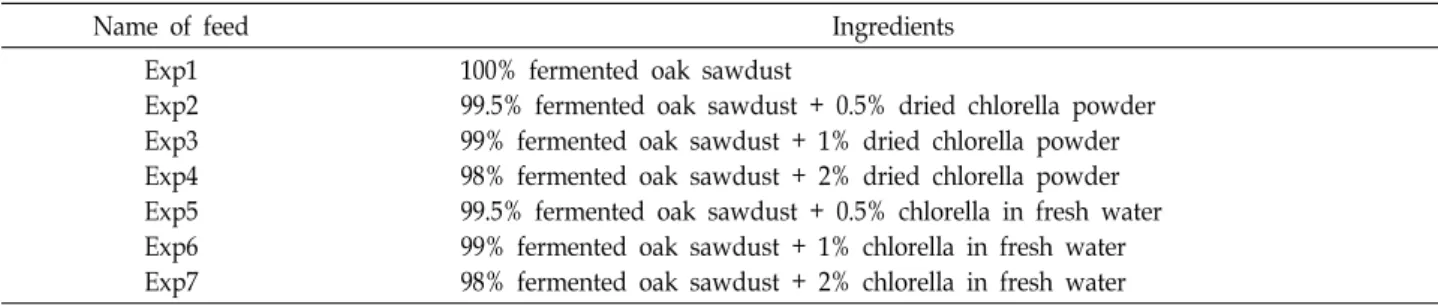
99.5% fermented oak sawdust + 0.5% dried chlorella powder 99% fermented oak sawdust + 1% dried chlorella powder 98% fermented oak sawdust + 2% dried chlorella powder 99.5% fermented oak sawdust + 0.5% chlorella in fresh water 99% fermented oak sawdust + 1% chlorella in fresh water 98% fermented oak sawdust + 2% chlorella in fresh water as an additive of insect feeds to improve larval growth.

Thus, the present study investigated the effect of dried pow- der or liquid type of chlorella on larvae growth of P. brevi- tarsis and A. dichotoma.

Materials and Methods Insects

The larvae of P. brevitarsis and A. dichotoma in experiments were purchased from private sellers (Gimje-si, Jeollabuk-do, Korea and Siheung-si, Kyunggi-do, respectively). They were kept in insect rearing facilities at National Institute of Agricultural Science at 25±1℃ with 40~60% relative humidity.

For P. brevitarsis, we individually reared newly hatched lar- vae to the adult on different dietary treatments and checked once a week. The larvae were used the third instar of A.

dichotoma because of longer larval period compared to the first or second instar and checked every ten days. For each group of two beetles, 20 larvae were tested and each treat- ment was repeated three times.

Experimental feeds

The dried powder and liquid Chlorella were purchased from Daesang Corp., Seoul, Korea. Chlorella contains 60.0%

crude protein, 1.8% crude fat, 13.2% crude fiber, 5.4% crude ash, 166.7 mg% potassium, 3,128.5 mg% phosphorus. Liquid type is produced by removing the precipitate by lowering the pH so as not to produce the precipitate, and then, hot water extraction and filtration. Powder type is produced by extracting hot water without pretreatment and then concen- trating, filtration, and freeze drying. After chlorella mixed with fermented oak sawdust, they were fermented for longer than 1 month. Fermented oak sawdust was used as the basic feed for rearing the larvae. Seven combinations of powder or liquid type of chlorella and fermented oak sawdust were formulated at different ratios based on Table 1.

Proximate analysis

The moisture, protein, fat, fiber, and ash were based on standard methods of the Association of Official Analytical Chemists (AOAC) [3]. The moisture content was determined by drying the samples in an air-circulating oven at 105℃.

The crude protein content was determined by the Kjeldahl method. The crude fat content was determined using the Soxhlet fat extraction method. Crude fiber was measured af- ter boiling 5 g of defatted sample in sulphuric acid and so- dium hydroxide. Ash content was estimated by burning the samples at 550℃ overnight. The carbohydrates content was calculated with the following formula: total carbohydrates (% FW) = 100 - (% moisture + % protein + % fat + % ash).

The results show total carbohydrates as g/100 g FW.

Analyses of minerals and heavy metals

Mineral and trace elements were determined by direct current plasma emission spectrometry. And dry sample was digested by adding HNO

3

and HF and used for analysis of heavy metals by atomic absorption spectroscopy.

Statistical analysis

The mean and standard deviation (SD) of each experiment were compared to control. Statistical differences at p<0.05 between the groups were analyzed by one-way ANOVA analysis followed by Tukey’s multiple comparison test.

Results and Discussion

The survivorship was checked until all larvae pupated or died. The mortality of P. brevitarsis and A. dichotoma larvae for the seven experimental feeds was shown in Table 2. The survival rate of all the chlorella-treated groups from two bee- tle species was higher than that of each control group. This showed that chlorella-mixed feeds were useful for rearing both of two beetles.

For P. brevitarsis, the larval weight for the group with

(3)

0.0 0.5 1.0 1.5 2.0 2.5 3.0 3.5 4.0

0 1 2 3 4 5 6 7 8 9 10 11 12 13 14 15 16 17

Average larval weight (g/Ind.)

Experimental period (week)

Exp1 Exp2 Exp3 Exp4 Exp5 Exp6 Exp7

0 5 10 15 20 25 30 35

0 10 20 30 40 50 60 70 80 90 100

Average larval weight (g/Ind.)

Experimental period (day)

Exp1 Exp2 Exp3 Exp4 Exp5 Exp6 Exp7
A.

.

A

B

Fig. 1. Larval body weight of P. brevitarsis (A) and A. dichotoma (B) over the duration of the study. Larvae were fed with liquid or powder of chlorella treated with 0.5, 1, 2%

w/w. Values presented were the mean ± SD of three independent experiments.

Table 2. Mortality of two species of larvae by experimental feeds

Feed No. of P. brevitarsis larvae

% mortality No. of A. dichotoma larvae

% mortality Start of the trial End of the trial Start of the trial End of the trial

Exp1 Exp2 Exp3 Exp4 Exp5 Exp6 Exp7

60 60 60 60 60 60 60

53 54 54 56 54 54 60

11.7 10 10 6.7 10 10 0

60 60 60 60 60 60 60

46 50 52 56 42 48 52

23.3 16.7 13.3 6.7

30 20 13.3 Initial number of larvae in each treatment was 20. Each treatment contained three replicates.

Table 3. Average length of the larval period from different feeds

Feed Larval period of 3rd instar (day) P. brevitarsis A. dichotoma Exp1

Exp2 Exp3 Exp4 Exp5 Exp6 Exp7

79.4±9.7

a

66.2±6.2

b

55.6±12.6

c

67.9±12.9

b

70.1±4.6

b

77.2±4.6

b

67.8±6.3

b

94.5±10.2

a

83.3±4.8

ab

77.5±6.6

c

75.4±7.8

c

86.4±5.1

b

83.1±4.5

ab

85.5±4.2

b

Values presented were the mean ± SD of three independent experiments. The mean values followed by different super- script letters within each column indicate that they were sig- nificantly different (Tukey’s multiple comparison test, p<

0.05).

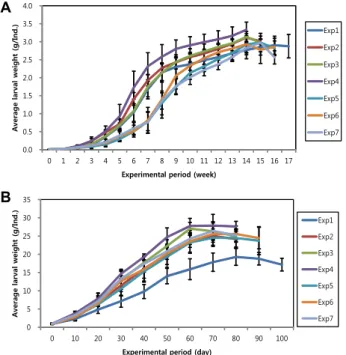
chlorella powder (Exp2, 3, and 4) was significantly higher than that for the control group (Exp1) during the ex- perimental period (Fig. 1A). However, the larval weight for the Exp5, 6, and 7 were lower than that for Exp1. This was probably due to the loss of some nutrients in the pretreat- ment for the production of liquid type of chlorella. The larval weight of A. dichotoma with chlorella addition was highly increased compared to the control during the experimental period (Fig. 1B). Especially, Exp4 in both beetles showed the highest body weight as 3.87 g (p<0.05) and 31.78 g per in- dividual (p<0.05), respectively.

In both two beetles, all groups added chlorella had shorter

larval period than the control group, Exp1 (Table 3). When chlorella powder-mixed feeds were fed to P. brevitarsis (Exp2 to 4), the larval period was 12~20% less than the chlorella liquid-treated groups and the control group (p<0.05). For the larval period of A. dichotoma, all chlorella-added groups (Exp2 to 7) showed 0.80~0.91 times shorter than the control (p<0.05). And the pupation rate was 100% for all treatments.

Therefore, feed with chlorella would be beneficial for farms rearing these beetles to reduce the rearing costs.

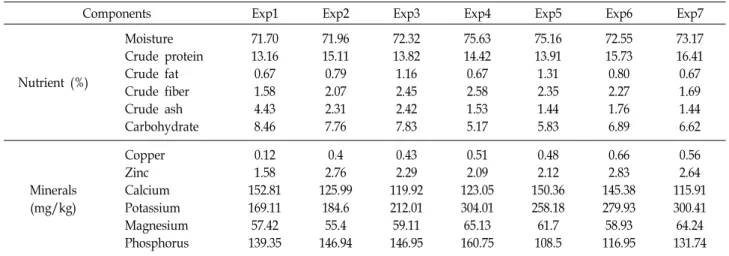
Nutritional analysis results were summarized in Table 4.

Chung et al. [6] reported that P. brevitarsis contained 57.86%

crude protein per 100 g of dry weight. Considering that the

nutritional analysis performed in this study was based on

the wet weight, the protein contents of Exp1 was estimated

to be similar to the reported results. The crude protein con-

tent of Exp2, 4, 6, and 7 was higher than that of eggs, de-

termined to be 9~14%[33]. In particular, Exp7 had 1.3 times

more proteins than the control Exp1. And Exp4 including

2% of chlorella powder had the highest moisture and crude

fiber content.

(4)

Table 4. Proximate composition and mineral contents of P. brevitarsis with different feeds

Components Exp1 Exp2 Exp3 Exp4 Exp5 Exp6 Exp7

Nutrient (%)

Moisture Crude protein Crude fat Crude fiber Crude ash Carbohydrate

71.70 13.16 0.67 1.58 4.43 8.46

71.96 15.11 0.79 2.07 2.31 7.76

72.32 13.82 1.16 2.45 2.42 7.83

75.63 14.42 0.67 2.58 1.53 5.17

75.16 13.91 1.31 2.35 1.44 5.83

72.55 15.73 0.80 2.27 1.76 6.89

73.17 16.41 0.67 1.69 1.44 6.62

Minerals (mg/kg)

Copper Zinc Calcium Potassium Magnesium Phosphorus

0.12 1.58 152.81 169.11 57.42 139.35

0.4 2.76 125.99

184.6 55.4 146.94

0.43 2.29 119.92 212.01 59.11 146.95

0.51 2.09 123.05 304.01 65.13 160.75

0.48 2.12 150.36 258.18 61.7 108.5

0.66 2.83 145.38 279.93 58.93 116.95

0.56 2.64 115.91 300.41 64.24 131.74

Among minerals, Cu and Zn were the highest in Exp6 (0.66 and 2.83 mg/kg, respectively). The highest contents of K, Mg, and P in Exp4 were found individually to be 304.01, 65.13, and 160.75 mg/kg. Minerals are involved in multiple biological processes including energy utilization, protein metabolism, inflammation, oxygen transport, and immune function [19]. All chlorella-added groups contained high lev- els of minerals except for calcium, and thus chlorella is a beneficial feed additive for P. brevitarsis. Moreover, these lar- vae feeding chlorella-added feeds could act as a food in- gredient for new food and functional food products.

Heavy metals and their accumulation has become a public problem [12]. Arsenic, cadmium, mercury, and lead were not detected in all investigated samples. This meant that the lar- vae fed chlorella-added feed were safe, and thus farms would immediately be able to apply the formulating feed with chlorella to rearing this beetle. In addition, it would be possible to utilize the larvae of P. brevitarsis with chlor- ella-added feed as sources for human foods.

Microalgae are rich in proteins and vitamins, and can serve as the alternative protein source for poultry and other food-producing animals. In the present study, we found that the dietary adding chlorella could enhance the growth per- formance of the beetles, e.g. the body weight of P. brevitarsis and A. dichotoma larvae nearly increased 135% and 127%, respectively, in the group of adding 2% chlorella powder.

Meanwhile, the larval weights in chlorella liquid-mixed groups were lower than those in the control. So we recom- mended that the dried chlorella powder was appropriate for rearing both of two beetles.

Many reports were proved that chlorella in feeds could have the anti-oxidant and immune modulating properties

in rat or rabbit [10, 22, 24, 26]. The larvae with chlorella were rich in minerals including copper, zinc, potassium, magnesium, and phosphorus. Copper is a constituent of var- ious oxidizing enzymes [11]. Zinc has a wide range of func- tions such as enzyme activity, structure, and regulation of gene expression [16]. Phosphorus and magnesium are im- portant components of bone and muscle. Therefore, the lar- vae fed chlorella-added feeds might be a useful source of dietary minerals. However, to the best of our knowledge, this is first study about the effect of chlorella supplementa- tion in rearing edible insects. There needs to be investigated further studies on fecundity from the studied generation and succeeding generations.

In conclusion, our results demonstrated that supplemen- tation of dried chlorella powder at the level of 2% could promote the growth and nutrient value in rearing the larvae of P. brevitarsis and A. dichotoma when compared with the control without its supplementation. Dietary chlorella might be useful as a feed additive in rearing the beetles because of its effect of promoting larval growth.

Acknowledgement

This work was supported by a grant from the National Institute of Agricultural Sciences, Rural Development Admi- nistration, Republic of Korea (Project No.: PJ014215042019).

References

1. ABC News 2018. Would Eating Worms Bug You? Researcher Wants to Put Grubs on the Dinner Table. http://www.

abc.net.au/news/2018-03-04/mealworms-edible-insects-re-

search-qld-gold-coast/9459496

(5)

2. Ajiboye, O. O., Yakubu, A. F. and Adams, T. E. 2012. A perspective on the ingestion and nutritional effects of feed additives in farmed fish species. World J. Fish Mar. Sci. 4, 87-101.

3. AOAC. 2010. Official methods of analysis, 18th ed. Associa- tion of Official Analytical Chemists, Washington DC, USA.

4. Borowitzka, M. A. 1988. Vitamins and fine chemicals from micro-algae. In: Borowitzka LJ, editor. Micro-algal biote- chnology. New York: Cambridge University Press, p. 153.

5. Bukkens, S. G. F. 2005. Insects in the human diet: Nutritiona- laspects. In M. G. Paoletti (Ed.), Ecological implications of mini livestock; role of rodents, frogs, snails, and insects for sustainable development. pp. 545-577. New Hampshire:

SciencePublishers.

6. Chung, M. Y., Hwang, J. S., Goo, T. W. and Yun, E. Y. 2013.

Analysis of general composition and harmful material of Protaetia brevitarsis. J. Life Sci. 23, 664-668.

7. Food and Agricultural Organization of the United Nations 2016. Insects for Food and Feed. [cited 19 Sept 2016] Avail- able from URL: http://www.fao.org/edible-insects/en/

8. Gander, K. 2017. The Independent 16 February. The bug-eat- ing kit that may help humanity survive future global food shortages. http://www.independent.co.uk/life-style/food- and-drink/a-designer-has-created-a-bug-eating-kit-to-save- humanitya7583071.html

9. Gerrard, B. 2017. The Daily Telegraph 17 April. Could edible insects soon be flying off the shelves? http://www.tele- graph.co.uk/business/2017/04/16/could-edible-insects- soon-flying-shelves/

10. Guzman, S., Gato, A., Lamela, M., Freire-Garabal, M. and Calleja, J. M. 2003. Anti-inflammatory and immunomodul- atory activities of polysaccharide from Chlorella stigmato- phora and Phaeodactylum tricornutum. Phytother. Res. 17, 665-670.

11. Halfdanarson, T. R., Kumar, N., Li, C. Y., Phyliky, R. L.

and Hogan, W. J. 2008. Hematological manifestations of cop- per deficiency: A retrospective review. Eur. J. Haematol. 80, 523-531.

12. Handly, M. A., Hall, C., Sanford, E., Diaz, E., Gonzalez- Mendez, E., Drace, K., Wilson, R., Villalobos, M. and Croughan, M. 2007. Globalization, binational communities, and imported food risks: result of an outbreak investigation of lead poisoning in Monterey Country, California. Am. J.

Public Health 97, 900-906.

13. Hoekstra, A. and Chapagain, A. K. 2006. Water footprints ofnations. Water use by people as a function of their con- sumption pattern. Water Resour. Manag. 21, 35-48.

14. Kang, I. J., Chung, C. K., Kim, S. J., Nam, S. M. and Oh, S. H. 2001. Effects of Protaetia orientalis (Gory et Perchlon) larva on the lipid metabolism in carbon tetrachloride ad- ministered rats. Appl. Microsc. 31, 9-18.

15. Kim, D. S., Huh, J., You, G. C., Chae, S. C., Lee, O. S., Lee, H. B., Lee, J. B. and Kim, J. S. 2007. Allomyrina dichotoma larva extracts protect streptozotocin-induced oxidative cyto- toxicity. J. Environ. Toxicol. 22, 349-355.

16. Kuby, J. 1994. Immunology. New York: WH Freeman and

Company.

17. Ministry of Food and Drug Safety. 2010. Guideline for safety evaluation of new food materials.

18. Ministry of Food and Drug Safety. 2016. Food Sanitation Act, revised notice (2016-18).

19. Misner, B. 2006. Food alone may not provide sufficient mi- cronutrients for preventing deficiency. J. Int. Soc. Sports Nutr. 3, 51-55.

20. Nakagaki, B. J. and Defoliart, G. R. 1991. Comparison of die- tsfor mass-rearing Acheta domesticus (Orthoptera: Gryllidae) asa novelty food, and comparison of food conversion effi- ciencywith values reported for livestock. J. Econ. Entomol.

84, 891-896.

21. Oonincx, D. G. A. B., van Itterbeeck, J., Heetkamp, M. J.

W., Van denBrand, H., Van Loon, J. J. A. and van Huis, A. 2010. An explo-ration on greenhouse gas and ammonia production by insectspecies suitable for animal or human consumption. PLoS One 5, e14445.

22. Otles, S. and Pire, R. 2001. Fatty acid composition of Chlorella and Spirulina microalgae species. J. Aoac. Int. 84, 1708-1714.

23. Rumpold, B. A. and Schlüter, O. K. 2013. Nutritionalcompo- sition and safety aspects of edible insects. Mol. Nutr. Food Res. 57, 802-823.

24. Sano, T. and Tanaka, Y. 1987. Effects of dried powdered Chlorella vulgaris on experimental atherosclerosis and ali- mentary hypercholesterolemia in cholesterol-fed rabbit.

Artery 14, 76-84.

25. Schubert, L. E. 1988. The use of spirulina and chlorella as food resource for animals and humans. In: Round FE, Chapman DJ, editors. Progressing physiological research.

Bristol, U.K.: Biopress Ltd, p. 237.

26. Shibata, S., Natori, Y., Nishihara, T., Tomisaka, K., Matsu- bara, K., Sanawa, H. and Nguyen, V. C. 2003. Antioxidant and anticataract effect of Chlorella on rats with streptozoto- cin-induced diabetes. J. Nutr. Sci. Vitaminol. 49, 334-339.

27. Stockoff, B. A. 1993. Ontogenic change in dietary selection for protein and lipid by gypsy moth larvae. J. Insect Physiol.

39, 677-686.

28. Suh, H. J. and Kang, S. C. 2012. Antioxidant activity of aque- ous extracts of Protaetia brevitarsis Lewis (Coleoptera:

Scrabaedia) at different growth stage. Nat. Prod. Res. 26, 510- 517.

29. Suh, H. J., Kim, S. R., Lee, K. S., Park, S. and Kang, S. C.

2010. Antioxidant activity of various slovent extracts from Allomyrina dichotoma (Arthropoda: Insecta) larvae. J. Pho- tochem. Photobiol. 99, 67-73.

30. Taketa, K., Ichikawa, E., Umetsu, K. and Suzuki, T. 1986.

Allomyrina dichotoma lectin-nonreactive α-fetoprotein in hepatocellular carcinoma and other tumors: Comparison with Ricinus communis agglutinin-1. Cancer Lett. 31, 325- 331.

31. Van Huis, A. 2013. Potential of insects as food and feed in assuringfood security. Annu. Rev. Entomol. 58, 563-583.

32. Van Huis, A., Van Itterbeeck, J., Klunder, H., Mertens, E.,

Halloran, A., Muir, G. and Vantomme, P. 2013. Edible in-

sects: Future prospects forfood and feed security (No. 171).

(6)

초록:흰점박이꽃무지와 장수풍뎅이 유충에 대한 사료 첨가제로서 클로렐라의 효과 송명하․박관호․김은선․김용순*

(농촌진흥청 국립농업과학원 곤충산업과)

국제연합식량농업기구(FAO)의 보고에 따르면, 미래의 식량문제 해결 방안으로 식용곤충을 지목하였다. 식용곤 충은 단백질을 비롯한 무기질과 비타민 등의 함량이 풍부하여 영양학적 가치가 높은 것으로 평가된다. 따라서 국내 곤충산업의 확대를 위해서는 안정적인 대량사육 시스템의 개발과 안전한 식용곤충 전용 사료의 개발 등에 대한 연구가 요구된다. 본 연구에서는 액상과 분말 클로렐라를 식용곤충종인 흰점박이꽃무지와 장수풍뎅이의 사 료 첨가제로 이용하여 각 유충의 생육에 미치는 효과를 분석하였다. 두 곤충 모두에서 클로렐라 액상과 분말을 첨가했을 때 유충의 생존율이 대조구보다 높았다(흰점박이꽃무지; p>0.05, 장수풍뎅이; p<0.05). 클로렐라 분말을 첨가한 사료를 급여했을 때 흰점박이꽃무지와 장수풍뎅이 유충의 3령 기간이 각각 최대 24일(p<0.05)과 19일 (p<0.05) 단축되어 곤충 사육농가의 노동력 절감 효과를 기대할 수 있을 것으로 생각된다. 또한, 장수풍뎅이는 주 로 학습애완용으로 판매되는 것에 비해 식용 소재로 활발히 활용되고 있는 흰점박이꽃무지 실험구에 대하여 영양 성분 분석을 실시하였다. 그 결과, 클로렐라 액상 및 분말 첨가 처리구에서 수분, 조단백질, 조섬유 및 구리, 아연, 마그네슘과 같은 무기질의 함량이 높았고, 납과 카드뮴, 수은 및 비소 등 중금속은 모든 실험구에서 검출되지 않 았다. 이러한 연구결과를 바탕으로 흰점박이꽃무지와 장수풍뎅이 사육 시 사료 첨가제로서 클로렐라가 활용될 수 있을 것으로 기대된다.

Food and agriculture organi-zation of the United nations (FAO).

33. Yoo, J. M., Hwang, J. S., Goo, T. W. and Yoon, E. Y. 2013.

Comparative analysis of nutritional and harmful compo- nents in Korean and Chinese mealworms (Tenebrio molitor).

J. Kor. Soc. Food Sci. Nutr. 42, 249-254.

34. Yoo, Y. C., Shin, B. H., Hong, J. H., Lee, J. L., Chee, H.

Y., Song, K. S. and Lee, K. B. 2007. Isolation of fatty acids with anticancer activity from Protaetia brevitarsis larva. Arch.

Pharm. Res. 30, 361-365.

35. Young, I. S. and Woodside, J. V. 2001. Antioxidants in health

and disease. J. Clin. Pathol. 54, 176-186.

수치

Table  1.  Composition  of  different  feed  ingredients
Table  2.  Mortality  of  two  species  of  larvae  by  experimental  feeds
Table  4.  Proximate  composition  and  mineral  contents  of  P.  brevitarsis  with  different  feeds

참조

관련 문서

1 John Owen, Justification by Faith Alone, in The Works of John Owen, ed. John Bolt, trans. Scott Clark, &#34;Do This and Live: Christ's Active Obedience as the

Micro- and nano-sized pores were formed on the surface of the alloy using PEO and anodization methods, and the pore shape change according to the Zr

Ryu EM, Effect of Sparassis crispa extracts on hair growth and inhibition of hair-removed C57BL/6 mice, Department of Beauty and Cosmetic Graduate School of Industry

HPLC profile of cell culture supernatant of Methylosinus JR31 (a), and effect of HPLC fractions on the growth of vitamin-requiring Methylomonas JR29...

The main effects of rooting medium composition, growth regulators and node parts of shoot on rooting and growth of plug plantlets using stem cuttings of

Effect of planting date on growth and seed yield of Danfa black

In this study, two experiments were conducted to understand the effects of additional charge on the detailed growth mechanism of Alq 3 and to determine the effect of

Effect of caloric restriction on the expression of PGC-1 and PPARs mRNA in liver of Otsuka Long-Evans Tokushima Fatty Rats.. Long-lived growth hormone