• 검색 결과가 없습니다.

An analysis of patients referred to the advanced general hospital pain clinic center: multicenter study in province of Jeollabuk-do, Korea

N/A
N/A
Protected

Academic year: 2021

Share "An analysis of patients referred to the advanced general hospital pain clinic center: multicenter study in province of Jeollabuk-do, Korea"

Copied!
6
0
0

로드 중.... (전체 텍스트 보기)

전체 글

(1)

An analysis of patients referred to the advanced general hospital pain clinic center: multicenter study in province of Jeollabuk-do,

Korea

Yeon-dong Kim

1

, Cheolhyeong Lee

2*

1

Professor, Wonkwang University School of Medicine, Wonkwang University

2

Clinical Professor, Department of Anesthesiology and Pain Medicine, Wonkwang University Hospital

3차 병원 통증 클리닉에 의뢰되어 오는 환자들의 특성 분석:

전라북도 지역의 다기관 연구

김연동

1

, 이철형

2*

1

원광대학교 의과대학 교수,

2

원광대학교 의과대학 병원 마취통증의학과 임상조교수

Abstract The number of patients referred to pain clinic is increasing. The purpose of this study was to describe and understand characteristic of patients referred to the tertiary pain clinic. This study was conducted on 587 patients who had been referred to pain clinics at three university hospitals in the Jeollabuk-do region from January 2011 to December 2015. The data was retrospectively collected on a record sheet prepared in the clinic. we analyzed these patients according to their age, sex, chief complaint, pain location, coexisting disease, referring department, referral causes. There were various medical problems addressed by a pain clinic consultation. It is reasonable to develop standardized guidelines for pain management. To do so, it is necessary to identify the characteristics of the patients.

A study with more patients in another area will be helpful in characterizing the patients referred to the pain clinic in Korea.

Key Words : Pain, Pain clinics, Advanced general hospital, Characteristics of patients, Medical referrals 요 약 통증클리닉에 의뢰되어 오는 환자들의 수는 증가하는 추세에 있다. 본 연구는 3차 병원의 통증클리닉에 의뢰되 어 오는 환자들을 분석하여 그 특성을 파악하고자 시행되었다. 2011년 1월부터 2015년 12월까지 전라북도 지역의 3개 대학병원 통증클리닉에 의뢰되어 온 환자 587명을 대상으로 연구를 수행하였다. 데이터는 외래 진료 기록지를 참고하여 후향적으로 수집되었다. 이들 환자를 연령, 성별, 주된 증상, 통증 위치, 동반 질환, 의뢰 부서, 의뢰 원인에 따라 분석하였다. 통증 클리닉에서는 많은 의학적 문제에 봉착하게 된다. 따라서 통증클리닉에서 표준화된 진료지침이 필요하며, 이를 위해서는 환자들의 특성을 파악할 필요가 있다. 더 많은 환자를 대상으로 한 전국단위의 연구가 이루어 진다면, 환자들의 특성을 더욱 정확히 파악할 수 있을 것으로 생각된다.

주제어 : 통증, 통증치료, 종합병원, 환자 특성, 진료 의뢰

*Corresponding Author : Cheolhyeong Lee([email protected]) Received December 24, 2020

Accepted February 20, 2021 Revised January 19, 2021

Published February 28, 2021

(2)

In recent years, due to the prolongation of the average life expectancy and the improvement of the living standard, interest in pain is increasing, and various pain treatment methods are being attempted accordingly. Also, pain is the most common reason for patients to visit primary health care[1].

But the patients with chronic pain cannot be easily treated due to the psychosocial characteristics of pain, and they go through several hospitals, which increases social costs. For this reason, the number of patients referred to general hospital is increasing[2,3].

As a result, pain clinics tend to see patients with chronic pain that are more complex than primary care settings, but the characteristics of the patients seen may vary among practice. The purpose of this study was to describe and understand characteristics of patients referred to pain clinics in advanced general hospital.

We analyzed various characteristics of patients and based on these characteristics, we would like to find a way to improve the efficiency and quality of patient treatment in pain clinics.

2. Methods

We reviewed 587 new patients who referred to Wonkwang university hospital, Jeonbuk national university hospital and Presbyterian medical center pain clinic from January 2011 to December 2015. The data was retrospectively collected on a record sheet prepared in the clinic. we analyzed these patients according to their age, sex, chief complaint, pain location, pain duration, treatment method after visiting

and referred to surgery.

The referral cause was classified into 5 groups based on medical referral. The department that referred to the pain clinic was also investigated through medical referrals.

We classified patients into two groups according to their age. And the correlation between age and pain area was analyzed.

comorbid diseases were classified by the organ affected by the disease.

3. Results

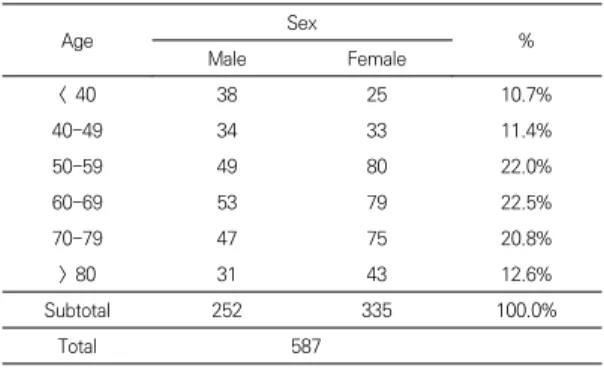
There were 252 male patients and 335 female patients, 56% of whom were in their 60s or older.

The distribution of patients by age is shown in Table 1.

Age Sex

Male Female %

< 40 38 25 10.7%

40-49 34 33 11.4%

50-59 49 80 22.0%

60-69 53 79 22.5%

70-79 47 75 20.8%

> 80 31 43 12.6%

Subtotal 252 335 100.0%

Total 587

Table 1. Distribution of patients’ age and sex.

As show in Fig.1, according to the requested

specialty, orthopedic surgery was the most

common with 28%, followed by family medicine

and anesthesia and pain medicine. In addition,

some patients were referred from oriental clinics,

public health centers, neurosurgery, dermatology,

and rehabilitation medicine.

(3)

Fig. 1. Specialty of request.

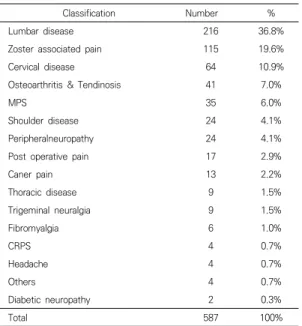
When looking at the causes of the pain clinic referral, patients with lumbar spine disease were the most common(36%), followed by zoster-related pain(19.6%) and cervical pain(10.9%). Other causes of referral to the pain clinic are listed in Table 2.

Classification Number %

Lumbar disease 216 36.8%

Zoster associated pain 115 19.6%

Cervical disease 64 10.9%

Osteoarthritis & Tendinosis 41 7.0%

MPS 35 6.0%

Shoulder disease 24 4.1%

Peripheralneuropathy 24 4.1%

Post operative pain 17 2.9%

Caner pain 13 2.2%

Thoracic disease 9 1.5%

Trigeminal neuralgia 9 1.5%

Fibromyalgia 6 1.0%

CRPS 4 0.7%

Headache 4 0.7%

Others 4 0.7%

Diabetic neuropathy 2 0.3%

Total 587 100%

Table 2. The causes of the pain clinic referral.

Fig. 2 shows relation between age and pain area. In any age group, lumbar pain was the most common cause, but the proportion of head and neck or shoulder pain was relatively higher in people under 60 years of age compared to those over 60 years old.

Fig. 2. Relation between age and pain area.

As shown in Fig. 3, “Medication but no effect”

was the first reason for the referral. The second reason was “intervention but no effect”, and there were cases that were referred for “additional examinations” or because of the patients’ needs.

The number of cases that patients want or are referred for additional examinations has been steadily increasing since 2011.

Fig. 3. Reasons of referral to pain clinic.

Fig. 4 shows the treatment methods performed on patients referred to the pain clinic. Peripheral nerve block was the most common treatment for patients referred to the pain clinic, followed by fluoroscopy guide injection and medication. This suggests that the patients had severe pain that could not be resolved with medication alone.

The number of patients with comorbid diseases was 305 out of 587, accounting for 52%.

As shown in Fig. 5, Cardiovascular disease (i.e.

HTN) and endocrinal disease (i.e. DM) were the

most common comorbid disease among referred

patients.

(4)

Fig. 4. Treatments performed on patients referred to the pain clinic.

Fig. 5. The number of patients with comorbid diseases.

4. Discussion

Traditionally, pain has been accepted as a warning sign of abnormal conditions in the body.

The traditional view of pain has made it a secondary by-product of disease, and it has been recognized that pain disappears naturally when abnormal conditions in the body are corrected.

However, with the development of medicine, pain itself has begun to be recognized as a disease, and it has been found that active treatment is required for excessive acute pain or chronic pain that lasts for a long time. Therefore, pain clinics were created for professional and systematic management of such pain[4].

In addition, as patients' interest in pain medicine increased and the population became aging, more and more patients visited not only the primary clinic but also the pain clinic of the university hospital.

In this study, 56% of the patients who were referred to the pain clinic were found to be aged 60 years or older. Currently, the number of elderly people worldwide is increasing, and accordingly, elderly patients complaining of chronic pain are also increasing. However pain may be underestimated as some elderly patients incorrectly believe that pain is a normal process of aging[5].

As a result of this pain, it leads to impaired daily life or ambulation, and causes depression and a burden on the economy[6]. Therefore, it is thought that the pain physician should improve the understanding of pain in elderly patients.

In this study, the majority of patients were referred from orthopedic surgery, which is the most visited specialty by patients with degenerative diseases. This may reflect the fact that chronic pain manifests in many degenerative diseases[7]. Also, the symptom that patients complained the most was lumbar pain. Lumbar disease is most often caused by degenerative changes either.

The high ratio of patients with lumbar disease who are referred to a pain clinic may reflect other clinician’s and many patients’ prejudiced impression that the main function of a pain clinic is to remedy backache[8]. These results are similar to those of studies conducted in other countries. In Canada, about 25% of patients referred to pain clinics complained of back pain[9].

From 2011 to 2015, the number of patients

who were referred at the request of patients was

continuously increasing. It can be seen as

suggesting that patients' interest and knowledge

about pain clinic are gradually increasing.

(5)

The most frequent of the requested reasons is that the pain was not resolved with medication.

It can be considered as a request for intervention, such as a nerve block, performed in a pain clinic. Nerve block is a common practice in pain clinics[10].

Pain physician usually perform nerve blocking intervention when encountering pain that is not responsive to medications. Likewise in this study, the most frequently performed treatment for referred patients was the peripheral nerve block.

A small number of patients were referred to surgery part. In these cases, the physician must know exactly the indications for surgery, and do not delay the surgery of the patients.

Since more than half of the patients are aged 60 years or older, the proportion of patients with comorbid diseases is also high at 52%. In particular, the proportion of patients with chronic diseases such as high blood pressure and diabetes was high, and pain physician need to pay attention to these disease. In hypertensive patients, a sudden drop in blood pressure may occur when a nerve block is performed, and diabetes is a factor that exacerbates chronic pain diseases[11].

Patients with chronic pain with comorbid disease often consume a variety of medication. It is important to know about the medications patients are currently taking[12].

In addition, primary care physicians may encounter a broad range of problems and therefore they should have knowledge of red flag signs. In patients with back pain, they should be evaluated about cancer, infection, cauda equina syndrome, or vertebral fracture. In patients with headache, the possibility of tumor, stroke or hemorrhage should be checked. And also the unrelieved pain should raise a red flag that attracts the attention of the interdisciplinary team[13].

Standardized referral guidelines are indispensable for discriminating against these diseases and also

to prevent pain from being under addressed and undertreated[14]. International organizations such as WHO are also providing guidelines on when to refer to an expert for pain management, but there are still no guidelines for pain referrals in Korea[15].

The limitation of this study is that only 3 hospitals in the Jeollabuk-do region do not represent the entire population of Korea. It is expected that more accurate results will be obtained nationwide if similar studies are conducted and converged in more regions in the future.

5. Conclussion

This study was the first study in Korea on the characteristics of patients who were referred to a pain clinic in a advanced general hospital. The number of patients referred to the pain clinic is on an increasing trend, and they have been referred to various diseases and causes. Also, many patients were elderly and had comorbid disease. In order to perform optimal treatment for these patients, research on the characteristics of patients should be preceded. In this regard, this study is of great value.

REFERENCES

[1] D. Niv & M. Devor. (2007). Position paper of the European Federation of IASP Chapters (EFIC) on the subject of pain management. European Journal of Pain, 11(5), 487-9.

DOI : 10.1016/j.ejpain.2007.03.005

[2] E. J. Dansie & D. C. Turk. (2013). Assessment of patients with chronic pain. British Journal of Anesthesia, 111(1), 19–25.

DOI : 10.1093/bja/aet124

[3] R Sinatra. (2010). Causes and consequences of inadequate management of acute pain. Pain medicine, 11(12), 1859-71.

DOI : 10.1111/j.1526-4637.2010.00983.x.

[4] D. R. Burkey. (2001). Practical Management of Pain,

(6)

[7] H. Joe, K. H. Oh, J. J. Song & Y. J. Han. (1995). Pain Clinic 10 Years at Chonbuk National University. The Korean Journal of Pain, 8(1), 110-116.

[8] K. L. Lim, B. K. Kim & H. S. Sohn. (1998). A Clinical Survey of the Patients of Pain Clinic. The Korean Journal of Pain, 11(2), 288-293.

[9] A. Mailis-Gagnon et al. (2007). Pain characteristics and demographics of patients attending a university-affiliated pain clinic in Toronto, Ontario.

Pain Research and Management, 12(2), 93-9.

DOI : 10.1016/j.ejpain.2007.03.005

[10] W. A. Chambers. (2008). Nerve blocks in palliative care. British Journal of Anaesthesia, 101(1), 95-100.

DOI : https://doi.org/10.1093/bja/aen105

[11] O. Liberman, R. Peleg & P. Shvartzman. (2014).

Chronic pain in type 2 diabetic patients: a cross-sectional study in primary care setting. The European Journal of General Practice, 20(4), 260-267.

DOI : 10.3109/13814788.2014.887674.

[12] P. Sarzi-Puttini, R. Vellucci, S. M. Zuccaro, P.

Cherubino, R. Labianca & D. Fornasari. (2012). The appropriate treatment of chronic pain. Clinical Drug Investigation, 32, 21-33

DOI : 10.2165/11630050-000000000-00000 [13] R. P. J. C. Ramanayake1 & B. M. T. K. Basnayake.

(2018). Evaluation of red flags minimizes missing serious diseases in primary care. Journal of Family Medicine and Primay Care, 7(2), 315-318.

DOI : 10.4103/jfmpc.jfmpc_510_15

[14] P. Cameron & C. Ryan. (2015). Core Standards for pain management services in the UK: Physiotherapists.

UK : CSPMS UK.

[15] World Health Organization. (2020). WHO revision of pain management guidelines. WHO.

https://www.who.int/news/item/13-01-2020-update- who-revision-of-pain-management-guidelines.

학과 (의학박사)

․ 2018년 9월 ~ 현재 : 원광대학교 의 과대학 의학과 부교수

․ 관심분야 : 마취통증의학, 통증의학, 만성통증관리

․ E-Mail : [email protected]

이 철 형(Cheolhyeong Lee) [정회원]

․ 2014년 2월 : 원광대학교 의과대학 의 학과(의학사)

․ 2019년 2월 : 원광대학교 병원 전공의 (마취통증의학과)

․ 2019년 2월 ~ 현재 : 원광대학교 병원 임상조교수

․ 관심분야 : 마취통증의학, 통증의학

․ E-Mail : [email protected]

수치

Table  1.  Distribution  of  patients’  age  and  sex.
Table  2.  The  causes  of  the  pain  clinic  referral.
Fig.  4.  Treatments  performed  on  patients  referred  to  the  pain  clinic.

참조

관련 문서

1 John Owen, Justification by Faith Alone, in The Works of John Owen, ed. John Bolt, trans. Scott Clark, &#34;Do This and Live: Christ's Active Obedience as the

Abstract: This study was aimed to investigate the adhesion control standards of pain relieving patch (PRP) drugs and to survey it′s adverse effects on the skin of patients

Depending on Tennis Forehand Stroke with elbow pain and without elbow pain Kinematic Analysis of

In this study, to investigate how applying a critical pathway to stomach cancer patients affects their recovery and treatment, the clinical effect of the critical

The data from the questionnaire survey were analyzed to prove the effects of Myung Power Therapy on such scales of the relaxation of pain as improvement

Comparison of pain scale between the conventional and 2-step needle insertion technique according to the injection area ··· 11... The combination of pain scale and

The purpose of this study was to identify the frequency and related factors of advanced airway management for patients with cardiac arrest by the

The purpose of this study was to provide primary material in discussing methods to activate the treatment effects of diabetes and reduce the rate of