Tuberc Respir Dis 2010;69:411-417
CopyrightⒸ2010. The Korean Academy of Tuberculosis and Respiratory Diseases. All rights reserved.
호흡기내과 의사를 위한 천식 리뷰
연세대학교 원주의과대학 내과학교실
김상하Asthma Year in Review
Sang-Ha Kim, M.D.
Department of Internal Medicine, Yonsei University Wonju College of Medicine, Wonju, Korea
This review highlights articles pertaining to the following 5 topics: the relationship between asthma, allergic and non-allergic rhinitis; the novel asthma phenotypes using cluster analysis; the diagnostic properties of inhaled dry-powder mannitol for the diagnosis of asthma; the value of mepolizumab therapy in exacerbations of refractory eosinophilic asthma; the role of bronchial thermoplasty in the treatment of severe asthma.
Key Words: Asthma; Rhinitis; Cluster analysis; Mannitol; mepolizumab
Address for correspondence: Sang-Ha Kim, M.D.
Department of Internal Medicine, Yonsei University Wonju College of Medicine, 162, Ilsan-dong, Wonju 220-701, Korea Phone: 82-33-741-1234, Fax: 82-33-741-0928
E-mail: [email protected] Received: Jun. 29, 2010
Accepted: Jun. 29, 2010
서 론
천식과 관련된 논문들 중에서 최근 1년 동안 주요 학술 지인 Lancet, New England Journal of Medicine, Ameri- can Journal of Respiratory and Critical Care Medicine, Journal of Allergy and Clinical Immunology 등에 발표되 어 임상적으로 중요할 것으로 생각되는 연구들을 검색하 여 소개하고자 한다. 소개된 논문들은 각각 역학 및 병인 기전, 진단, 치료 분야에 관한 내용으로 모두 5편을 선정 하였다.
역학 및 병인기전
1. Rhinitis and onset of asthma: a longitudinal pop- ulation-based study
1천식과 알레르기비염은 몇몇 역학적, 임상적 단면연구 에서 아토피와 같은 위험인자들을 공유하며 서로 밀접하 게 관련되어 있다는 것이 보고되었다2. 비염은 종종 천식
에 선행하여 발생되기도 하는 점을 들어 천식의 위험인자 로 간주되기도 하였다3,4.
이 연구는 유럽 14개 나라의 29개 센터에서 8.8년 동안 추적조사한 자료(European Community Respiratory Heal- th Survey, ECRHS)로 분석되었다. 인구집단을 대상으로 한 추적연구로 무작위 추출된 15,716명의 전체 대상 인구 에서 피부단자시험을 통한 아토피의 유무와 비염 및 천식 에 대한 자료가 확보된 10,827명으로 시작하여 67.4%인 7,326명에 대한 추적조사가 가능하였다. 이들 중 처음 조 사 당시에 천식이 없었던 6,461명을 대상으로 분석되었으 며, 4개의 군, 즉 대조군(no atopy, no rhinitis, 3,163명), 아토피군(atopy, no rhinitis, 704명), 비알레르기비염군 (rhinitis, no atopy, 1,377명), 알레르기비염군(atopy, rhi- nitis, 1,217명)으로 나누어 비교되었다. 추적기간 8.8년 동안 대상 인구에서 의사에게 진단된 천식의 누적 발생률 은 2.2% (140명)이었으며, 네 군에서 각각 1.1%, 1.9%, 3.1%, 4.0%로 유의한 차이를 보였다(p<0.0001). 천식에 대한 상대위험도(adjusted relative risk, adjusted RR)를 국 가, 성별, 나이, 체질량지수, FEV1, IgE, 천식의 가족력, 흡 연 등의 변수로 보정하였을 때, 아토피가 1.63 (95% CI, 0.82∼3.24), 비알레르기비염이 2.71 (95% CI, 1.64∼
4.46), 알레르기비염이 3.53 (95% CI, 2.11∼5.91)으로 확 인되었다. 감작된 알레르겐에 관련해서는 집먼지 진드기 에 감작된 알레르기비염에서만 adjusted RR가 2.79 (95%
Figure 1. Reduction of the original 628 variables in the SARP database. The 17 composite variables from the ques- tionnaire data incorporate answers from 63 individual questions. The 34 final variables in the cluster analysis include 23 variables from the questionnaire data, 6 related to lung function and 5 markers of atopy. Following the cluster analysis, stepwise discriminant analysis identified 11 significant predictors of cluster assignment. Three of these variables (Baseline and Maximal FEV1 % predicted, age of disease onset) were used in the Tree analysis.
CI, 1.57∼4.96)로 천식 발생에 높은 위험도를 보였다.
성인에서 비염과 천식의 관련성을 확인하였던 이전의 전향적인 연구들에 비하여 이 연구는 더 많은 인구를 대상 으로 전향적인 추적연구가 진행되었다는 점과 피부단자 시험을 시행하여 아토피 유무에 따른 분석이 가능하였다 는 점이 중요하다. 하지만 이 연구의 중요한 결과 중 하나 인 ‘추적기간 중에 발생한 천식’의 정의를 ‘해당 의사가 내린 진단’으로 한 것은 가벼운 증상의 경증 천식이 진단 되지 않아서 본래보다 발생률이 낮게 평가되었을 가능성 이 있다.
이 연구를 통하여 비염은 성인천식(adult-onset asth- ma) 발생의 강력한 예측인자이며, 비알레르기비염도 알 레르기비염보다는 낮지만 천식의 위험도를 높인다는 것 을 알 수 있다. 알레르기비염이 동반된 천식환자를 대상 으로 하는 몇몇 임상연구에서 알레르기비염의 치료가 천
식 증상의 감소와 관련이 있다는 것이 관찰된 바 있으나, 알레르기비염의 치료가 천식의 발생을 감소시키는데 효 과적인지에 대한 결론을 얻기 위해서는 향후 이에 대한 전향적인 중재연구가 필요하다.
FURTHER READINGS: Association between asthma and rhinitis according to atopic sensitization in a pop- ulation-based study5.
2. Identification of asthma phenotypes using cluster
analysis in the Severe Asthma Research Program
6 천식은 다양한 자극들에 의해 유발되는 간헐적인 호흡 기 증상을 보이는 이른바 ‘임상적인 증후군(clinical syn- drome)’으로 정의된다. 천식의 중증도를 정확하게 평가 하는 것은 천식으로 인한 위험을 예측하고 적절한 치료를Figure 2. Tree analysis. Using three variables (baseline FEV1 [with a bronchodilator withhold], maximal "Max"
FEV1 after six to eight puffs of albuterol, and age of onset of asthma), subjects can be assigned to the five clusters that range from milder asthma (Cluster 1) to more severe disease (Clusters 4 and 5).
제공하는데 필수적이다. National Asthma Education and Prevention Program (NAEPP), global initiative for asth- ma (GINA) 가이드라인 등에서 제시하는 천식 중증도의 평가는 폐기능(FEV1), 주간과 야간증상, 증상완화제의 사 용빈도 등에 따라 구분하고 있다. 하지만 이러한 접근들 은 천식환자 인구집단에서 관찰되는 이질적인 성격들이 제대로 반영되어있지 않다. 천식의 원인을 더 잘 이해하 고 부작용 없이 천식조절을 더 향상시키기 위해서는 천식 의 이질성(heterogeneity)을 규명하고 천식을 표현형 (phenotype)에 따라 구분하는 것이 필요하다. 이 연구는 cluster분석을 이용하여 새로운 천식의 표현형을 규명하고 자 하였다.
지속성 천식환자가 포함된 severe asthma research program (SARP) 코호트의 726명 환자를 대상으로 cluster 분석이 이루어졌다. 불필요한 수는 제거하고 범주형 변수 는 순위형 복합변수로 변환하여 처음의 628개 변수에서 주요변수 34개로 줄였다(Figure 1).
Cluster 분석을 통하여 총 다섯 개의 군으로 구분되었다 (Figure 2). Cluster 1 환자들은(110명) early-onset atopic asthma로 대부분이(82%) 2개 이하의 증상완화제로 정상 폐기능이 유지되며 의료시설사용이 적었다. Cluster 2 환 자들은(321명) early-onset atopic asthma로 정상 폐기능 은 유지되지만 29%는 3개 이상의 약물이 필요하며 의료 시설사용이 증가하였다. Cluster 3 환자들은(59명) late- onset nonatopic asthma로 특별히 대부분 나이 많은 비만
한 여자였고, FEV1은 중등도로 감소되어 있으며 급성악화 를 치료하기 위한 경구 스테로이드제를 자주 사용한다.
Cluster 4 환자들은(120명) 심한 기도폐쇄가 관찰되지만 약 40% 환자에서는 albuterol에 의해 거의 정상범위로 회 복되며 대부분 early-onset (72%) atopic (83%) asthma이 다. Cluster 5 환자들은(116명) 심한 기도폐쇄가 있으며 94%에서 환자에서 FEV1가 80% 미만에 머문다. Cluster 4에 비해 later-onset (69%) less atopic (66%) asthma이 다. 전신적 스테로이드제는 Cluster 4에서 39%의 환자가, Cluster 5에서 47%의 환자가 사용한다.
결론적으로 천식환자의 형질을 5개의 clusters로 나누 어 분류하는 것은 천식 질환의 이질성을 뒷바침하는 중요 한 근거가 되며 cluster에 따른 서로 다른 천식의 병인기전 의 가능성, 향후 치료적인 접근에 활용될 가능성 등을 열 어 줄 수 있을 것이다.
FURTHER READINGS: Characterization of the severe asthma phenotype by the National Heart, Lung, and Blood Institute’s Severe Asthma Research Program7.
진 단
1. Diagnostic properties of inhaled mannitol in the diagnosis of asthma: a population study
8 기도과민성은 천식환자에서 관찰되는 중요한 특성이 다. 기관지유발시험은 이러한 기도과민성을 규명하여 천 식의 임상적인 진단을 돕는다. 기관지유발시험은 작용기 전에 따라 직접 기관지유발시험과 간접 기관지유발시험 으로 나뉜다. 직접 기관지유발시험은 일반적으로 예민도 가 높고 특이도는 낮으며, 메타콜린과 히스타민으로 시행 한다9. 간접 기관지유발시험은 비교적 특이도가 높아서 기도염증을 잘 반영하는 반면 예민도는 낮으며, 만니톨, 아데노신, 고장성 식염수 등으로 시행한다10-12. 최근 19개 의 만니톨이 들어있는 캡슐과 흡입용 장치가 들어있는 흡 입용 만니톨 기관지유발시험 방법이 소개된 바 있으며, 현재까지는 제한된 범위에서 진행된 환자-대조군 연구가 전부이다.이 연구는 덴마크의 코펜하겐에 14∼24세 사이의 젊은 성인 총 978명에게 천식과 비염 진단을 위한 20개 문항의 설문지를 보내어 응답을 받은 448명(45.8%) 중에서 연구 에 참여하기로 자원하고 검사를 시행한 238명(24.3%)을 대상으로 진행되었다. 흡입용 만니톨로 기관지유발시험
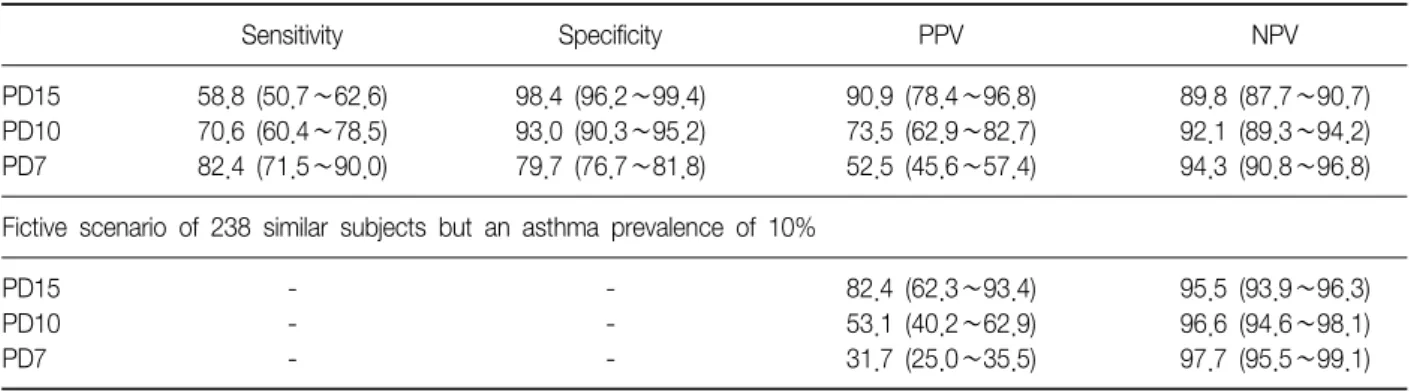
Table 1. Diagnostic properties of inhaled mannitol at 3 cutoff points in 238 randomly selected subjects
Sensitivity Specificity PPV NPV
PD15 58.8 (50.7∼62.6) 98.4 (96.2∼99.4) 90.9 (78.4∼96.8) 89.8 (87.7∼90.7)
PD10 70.6 (60.4∼78.5) 93.0 (90.3∼95.2) 73.5 (62.9∼82.7) 92.1 (89.3∼94.2)
PD7 82.4 (71.5∼90.0) 79.7 (76.7∼81.8) 52.5 (45.6∼57.4) 94.3 (90.8∼96.8)
Fictive scenario of 238 similar subjects but an asthma prevalence of 10%
PD15 - - 82.4 (62.3∼93.4) 95.5 (93.9∼96.3)
PD10 - - 53.1 (40.2∼62.9) 96.6 (94.6∼98.1)
PD7 - - 31.7 (25.0∼35.5) 97.7 (95.5∼99.1)
Values are presented as 95% confidence interval (range). PD15, PD10, and PD7 represent the percentage decrease in FEV
1(15%, 10%, or 7% respectively) at a 635-mg cumulative dose of mannitol.
을 시행하였고 그 결과를 알지 못하는 호흡기전문의가 호 흡기 증상, 폐기능 검사 결과, 아토피 유무, 호기 NO, 베타 2 항진제에 대한 반응도 등을 고려하여 천식을 구분하였 다. 이 결과를 가지고 만니톨 기관지유발시험의 예민도, 특이도, 예측도 등을 산출하였으며, ROC 곡선 분석을 통 해 정확도를 산출하였다. 대상인원에서 51명(21.4%)이 현 증 천식으로 진단되었다. 만니톨에 대한 기도과민성을 보 인(만니톨 635 mg 이하에서 FEV1이 기저치에 비해 15%
이상 감소) 33명 중에서 30명이 현증 천식이었다. 만니톨 기관지유발시험의 천식 진단에 대한 특이도는 98.4%, 예 민도는 58.8%였으며, 양성예측도 90.9%, 음성예측도는 89.8%였다. ROC 곡선의 AUC는 0.89였다(Table 1).
천식 진단에 있어서 gold standard 방법이 없는 상황에 서 한 명의 검사자가 검사를 시행하고 한 명의 전문의가 천식 진단을 한 이 연구는 천식 진단의 일관성은 유지될 수 있었으나 정확도의 측면에서는 한 명의 검사자로 시행 된 그 자체가 bias를 제공하였을 것이다. 또한 기관지유발 시험 결과에 영향을 고려하여 흡입용 스테로이드제는 6개 월 동안은 중단되어야 한다. 하지만 이 연구에서는 흡입 용 스테로이드제를 사용하고 있던 환자에서 윤리적인 이 유로 12시간 이상 중단하지 못하였다. 그럼에도 불구하고 흡입용 스테로이드제를 사용하고 있던 8명의 환자에서 만 니톨 기관지유발시험에 6명이 양성반응을 보였다. 이로써 만니톨 기관지유발시험 결과에 미치는 흡입용 스테로이 드제의 영향은 적은 것을 알 수 있다. 결론적으로 흡입용 만니톨 기관지유발시험은 젊은 성인의 천식진단에 있어 서 매우 높은 특이도를 보이는 검사로 사용될 수 있을 것 이다.
치 료
1. Mepolizumab and exacerbations of refractory eosi- nophilic asthma
13천식의 악화는 천식으로 인한 이환율, 사망률과 관련이 높으며, 천식으로 인한 의료시설의 사용에도 영향을 미친 다. 이러한 악화를 예방하는 것은 천식치료에 중요한 목표 이다. 기도의 호산구성 염증반응이 악화의 위험인자라는 근 거들이 있으며14-17, 이 연구는 refractory eosinophilic asth- ma가 있으면서 심한 악화가 반복되었던 환자 61명을 대상 으로 IL-5에 대한 monoclonal antibody인 mepolizumab 투 여를 randomized, double-blind, placebo-controlled, paral- lel-group study로 진행하였다. Mepolizumab을 사용한 18세 이상의 성인 29명과 대조군 32명은 모두 고용량의 스테로이드제의 치료에도 불구하고 연구시행 2년 이내에 객담 호산구가 3% 이상으로 확인된 것이 1회 이상 있으면 서, 1년 이내에 prednisolone의 치료가 필요했던 악화가 2회 이상 있었던 환자들이었다. Primary outcome은 50주 의 치료기간 동안 환자당 발생한 심한 천식악화의 횟수였 으며, secondary outcome은 천식증상의 변화, asthma quality of life questionnaire (AQLQ) 점수, 기관지확장제 사용 후의 FEV1, 기도과민성, 혈액과 가래의 호산구 수치 등이었다.
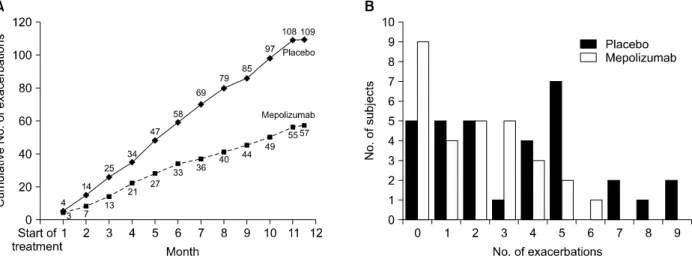
총 50주의 기간 동안 mepolizumab 750 mg을 12회 정 맥주사한 것이 대조군과 비교하였을 때 환자당 평균 악화 횟수가 각각 2.0회, 3.4회로 의미있게 빈도가 줄었다 (relative risk=0.57; 95% CI, 0.32∼0.92) (Figure 3). 또한 mepolizumab의 투여는 평균 AQLQ점수를 의미있게 향 상시켰으며(0.55 vs. 0.19), 혈액(p<0.001)과 가래(p=
Figure 3. Severe exacerbations during the course of the study. (A) shows the cumulative number of severe exacerbations that occurred in each study group over the course of 50 weeks. (B) shows the distribution of the number of exacerbations among subjects in each study group during the treatment period of the study. The mean number of exacerbations per subject over the course of the 50-week treatment period was 2.0 in the mepolizumab group, as compared with 3.4 in the placebo group (relative risk, 0.57; 95% confidence interval, 0.32 to 0.92; p=0.02).
0.002)의 호산구수치도 의미있게 감소시켰다. 하지만 두 군 간의 증상, 기관지확장제 사용 후의 FEV1, 기도과민성 등의 차이는 없었다. 투여기간 동안의 유일한 serious ad- verse event는 급성 중증천식으로 입원한 경우였으며, 약 제투여로 인한 국소적인 이상반응은 없었고 첫 번째 주사 후 24시간 이내에 발생한 발진으로 인해 한 명의 환자가 탈락되었다.
이 연구를 통하여 IL-5의 humanized monoclonal anti- body인 mepolizumab은 refractory eosinophilic asthma 가 있으면서 반복되는 악화소견을 보이는 환자에게 투여 하였을 때 천식악화의 빈도를 줄이고 이로 인한 스테로이 드의 사용을 감소시켜서 천식관련 삶의 질을 향상시킨다 는 것이 확인되었다. 반면 mepolizumab 치료가 천식증상 이나 호기 NO, 폐기능 변화에 영향을 미치지는 못했다.
이로써 천식증상이나 호기 NO, 폐기능 등이 기도의 호산 구성 염증과는 관련없이 다른 기전, 즉 기도평활근과 침윤 된 비반세포간 상호작용의 변화에 의할 가능성이 있다.
Mepolizumab과 같은 염증반응의 선택적 길항제의 사용 을 통해 관찰된 치료효과는, 앞으로 여러가지 다양한 기도 반응에 대한 병인기전들을 밝혀내는데 사용될 수 있으며 천식의 보다 구체적인 형질규명을 통한 치료적인 접근도 가능하게 할 것으로 기대된다.
FURTHER READINGS: Mepolizumab for prednisone- dependent asthma with sputum eosinophilia18.
2. Effectiveness and safety of bronchial thermoplasty in the treatment of severe asthma: a multicenter, randomized, double-blind, sham-controlled clinical trial
19Bronchial thermoplasty (BT)는 기관지 내시경으로 기 도 벽에 열에너지를 가하여 평활근을 감소시킨다20,21. 이 연구는 흡입용 고용량 스테로이드제(ICS>1,000 μg/d beclomethasone or quivalent)와 지속성 베타2 항진제의 사용이 필요한 18∼65세의 성인을 대상으로 류코트리엔 조절제나 omalizumab, 10 mg/d 이상의 경구용 스테로이 제 등의 약물사용은 허용한 상태로 BT의 효능과 안전성을 입증하기 위하여 multicenter, randomized, double-blind, sham-controlled study로 진행되었다. 3주일 이상의 간격 으로 세차례의 기관지 내시경을 통한 시술을 BT군과 sham군에 각각 시행하였고, sham군에서는 시술 중에 ra- diofrequency energy가 없이 시각적, 청각적인 신호만 발 생하도록 하였다. 각각 마지막 시술 6주 후부터 52주 사이 에는 시술 후 치료기간을 두고 3, 6, 9, 12개월마다 평가를 하였다. 연구의 primary outcome은 치료시작 시점과 비 교한 AQLQ점수의 차이였으며, 안정성을 확인하기 위해 유해반응과 의료시설사용 등을 평가하였다. 6개 국가의 30개 병원에서 진행되었으며, 580명이 검토되어 297명이 BT군과 sham군으로 2 : 1 무작위 배정되었다. 이중에서 1회 이상 기관지 내시경의 시술이 이루어진 대상은 BT군
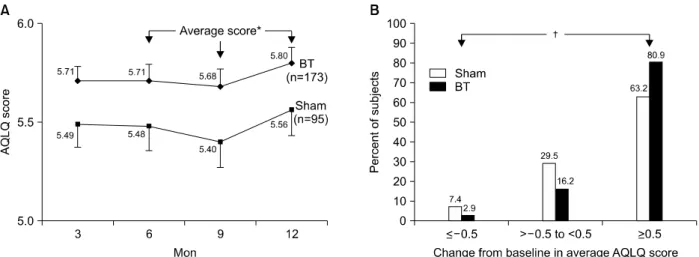
Figure 4. Change in asthma quality of life by treatment group. (A) Change in AQLQ score over 12 months after treatment with BT (diamonds) or sham control (squares) in the per protocol population. (B) Percentage of subjects achieving an AQLQ score change of 0.5 or greater (the minimal important difference), -0.05 to less than 0.5, and 20.5 after treatment with BT (black) or sham control (white) in the per protocol population. *Posterior probability of superiority 5 97.9%,
†Posterior probability of superiority 5 100.0% for "Net" benefit ([proportion improving-proportion deteriorating in the BT group]-[proportion improving-proportion deteriorating in the sham group]). BT: bronchial thermoplasty; AQL: asthma qual- ity of life questionnaire.
Figure 5. Healthcare utilization events during the post- treatment period. Severe exacerbations (exacerbation re- quiring treatment with systemic corticosteroids or dou- bling of the inhaled corticosteroids dose), emergency de- partment visits, and hospitalizations occurring in the post- treatment period. Open bars, sham; shaded bars, bron- chial thermoplasty. All values are means 6 SEM. *Poste- rior probability of superiority 5 95.5%, †Posterior proba- bility of superiority 5 99.9%.
190명, sham군 98명이었다.
결과는 BT군(1.35±1.10)에서 sham군(1.16±1.23)에 비하여 AQLQ 점수가 기저치에 비해 유의한 향상을 보였
으며, BT군에서는 79% 환자에서 sham군에서는 64% 환 자에서 AQLQ 점수가 0.5 이상 향상된 것이 관찰되었다 (Figure 4). 심한 천식악화의 빈도는 BT군이 sham군과 비 교하여 32% 감소된 것으로 관찰되었다. 또한 치료 후 기 간 동안에도 천식으로 인한 활동의 제한이나 학교나 직장 의 결석도 BT군이 보다 적었다.
대부분의 호흡기 유해반응은 기관지 내시경 시행 1일 이내에 발생하여 7일 이내에 호전되었다. BT군에서는 16 명(8.4%)에서 호흡기증상으로 19회의 입원이 있었는데, 각각 천식의 악화(12회), segmental atelectasis (3회), 하 기도감염(1회), 낮은 FEV1 (1회), 객혈(1회), 의치의 흡인 (1회) 등이 원인이었다. 19회의 입원 중 10회는 시술 당일 에 발생하였으며 표준적인 치료에 모두 호전되었다.
Sham군은 2명(2.0%)에서 2회의 입원이 있었으며, 모두 천식의 악화로 인한 것이었다.
환자가 보고한 천식의 악화소견은 BT군이 sham군에 비 하여 36%의 risk reduction이, 호흡기증상으로 인한 응급 실 방문도 84%의 risk reduction이 관찰되었다(Figure 5).
결론적으로 중증천식 환자에서 BT를 시행하는 것은 심 한 악화를 줄이고 치료 후 기간 동안의 의료시설사용을 감소시켜서 천식과 관련된 삶의 질을 향상시킨다. 향후 중증천식의 이환을 줄이기 위해서 현재 사용되고 있는 흡 입용 고용량 스테로이드제와 지속성 베타2 항진제의 복합
사용에다가 BT의 추가적인 치료를 고려할 수 있을 것으로 기대된다.
FURTHER READINGS: Safety and efficacy of bron- chial thermoplasty in symptomatic, severe asthma22
참 고 문 헌
1. Shaaban R, Zureik M, Soussan D, Neukirch C, Heinrich J, Sunyer J, et al. Rhinitis and onset of asthma: a longi- tudinal population-based study. Lancet 2008;372:1049- 57.
2. Bousquet J, Van Cauwenberge P, Khaltaev N; Aria Workshop Group; World Health Organization. Allergic rhinitis and its impact on asthma. J Allergy Clin Immu- nol 2001;108:S147-334.
3. Guerra S, Sherrill DL, Martinez FD, Barbee RA. Rhinitis as an independent risk factor for adult-onset asthma.
J Allergy Clin Immunol 2002;109:419-25.
4. Plaschke PP, Janson C, Norrman E, Björnsson E, Ellbjär S, Järvholm B. Onset and remission of allergic rhinitis and asthma and the relationship with atopic sensitiza- tion and smoking. Am J Respir Crit Care Med 2000;162:
920-4.
5. Leynaert B, Neukirch C, Kony S, Guénégou A, Bous- quet J, Aubier M, et al. Association between asthma and rhinitis according to atopic sensitization in a pop- ulation-based study. J Allergy Clin Immunol 2004;113:
86-93.
6. Moore WC, Meyers DA, Wenzel SE, Teague WG, Li H, Li X, et al. Identification of asthma phenotypes using cluster analysis in the Severe Asthma Research Pro- gram. Am J Respir Crit Care Med 2010;181:315-23.
7. Moore WC, Bleecker ER, Curran-Everett D, Erzurum SC, Ameredes BT, Bacharier L, et al. Characterization of the severe asthma phenotype by the National Heart, Lung, and Blood Institute's Severe Asthma Research Program. J Allergy Clin Immunol 2007;119:405-13.
8. Sverrild A, Porsbjerg C, Thomsen SF, Backer V. Dia- gnostic properties of inhaled mannitol in the diagnosis of asthma: a population study. J Allergy Clin Immunol 2009;124:928-32.
9. Brusasco V, Crimi E. Methacholine provocation test for diagnosis of allergic respiratory diseases. Allergy 2001;
56:1114-20.
10. de Meer G, Marks GB, Postma DS. Direct or indirect stimuli for bronchial challenge testing: what is the rele- vance for asthma epidemiology? Clin Exp Allergy 2004;
34:9-16.
11. Anderson SD. Provocative challenges to help diagnose and monitor asthma: exercise, methacholine, ad- enosine, and mannitol. Curr Opin Pulm Med 2008;
14:39-45.
12. Porsbjerg C, Brannan JD, Anderson SD, Backer V.
Relationship between airway responsiveness to man- nitol and to methacholine and markers of airway in- flammation, peak flow variability and quality of life in asthma patients. Clin Exp Allergy 2008;38:43-50.
13. Haldar P, Brightling CE, Hargadon B, Gupta S, Mon- teiro W, Sousa A, et al. Mepolizumab and exacerba- tions of refractory eosinophilic asthma. N Engl J Med 2009;360:973-84.
14. Jatakanon A, Lim S, Barnes PJ. Changes in sputum eosi- nophils predict loss of asthma control. Am J Respir Crit Care Med 2000;161:64-72.
15. Deykin A, Lazarus SC, Fahy JV, Wechsler ME, Boushey HA, Chinchilli VM, et al. Sputum eosinophil counts predict asthma control after discontinuation of inhaled corticosteroids. J Allergy Clin Immunol 2005;115:720-7.
16. Green RH, Brightling CE, McKenna S, Hargadon B, Parker D, Bradding P, et al. Asthma exacerbations and sputum eosinophil counts: a randomised controlled trial. Lancet 2002;360:1715-21.
17. Jayaram L, Pizzichini MM, Cook RJ, Boulet LP, Lemière C, Pizzichini E, et al. Determining asthma treatment by monitoring sputum cell counts: effect on exacerbations.
Eur Respir J 2006;27:483-94.
18. Nair P, Pizzichini MM, Kjarsgaard M, Inman MD, Efthimiadis A, Pizzichini E, et al. Mepolizumab for pre- dnisone-dependent asthma with sputum eosinophilia.
N Engl J Med 2009;360:985-93.
19. Castro M, Rubin AS, Laviolette M, Fiterman J, De Andrade Lima M, Shah PL, et al. Effectiveness and safe- ty of bronchial thermoplasty in the treatment of severe asthma: a multicenter, randomized, double-blind, sham-controlled clinical trial. Am J Respir Crit Care Med 2010;181:116-24.
20. Cox PG, Miller J, Mitzner W, Leff AR. Radiofrequency ablation of airway smooth muscle for sustained treat- ment of asthma: preliminary investigations. Eur Respir J 2004;24:659-63.
21. Danek CJ, Lombard CM, Dungworth DL, Cox PG, Miller JD, Biggs MJ, et al. Reduction in airway hyper- responsiveness to methacholine by the application of RF energy in dogs. J Appl Physiol 2004;97:1946-53.
22. Pavord ID, Cox G, Thomson NC, Rubin AS, Corris PA, Niven RM, et al. Safety and efficacy of bronchial ther- moplasty in symptomatic, severe asthma. Am J Respir Crit Care Med 2007;176:1185-91.

![Figure 2. Tree analysis. Using three variables (baseline FEV 1 [with a bronchodilator withhold], maximal "Max"](https://thumb-ap.123doks.com/thumbv2/123dokinfo/4870447.287508/3.892.97.427.145.394/figure-analysis-using-variables-baseline-bronchodilator-withhold-maximal.webp)