• 검색 결과가 없습니다.

Risk Factors for Mechanical Ventilation in Patients with Scrub Typhus Admitted to Intensive Care Unit at a University Hospital

N/A
N/A
Protected

Academic year: 2021

Share "Risk Factors for Mechanical Ventilation in Patients with Scrub Typhus Admitted to Intensive Care Unit at a University Hospital"

Copied!
6
0
0

로드 중.... (전체 텍스트 보기)

전체 글

(1)

Risk Factors for Mechanical Ventilation in Patients with Scrub Typhus Admitted to Intensive Care Unit at a University Hospital

Kyoung Min Moon, M.D., Min Soo Han, M.D., Ph.D., Ch`ang Bum Rim, M.D., Jun Ho Lee, M.D., Min Seok Kang, M.D., Ji Hye Kim, M.D., Sang Il Kim, M.D., Sun Young Jung, M.D. and

Yongseon Cho, M.D.

Department of Internal Medicine, Eulji University School of Medicine, Daejeon, Korea

Background: The purpose of this study was to evaluate the risk factors for mechanical ventilation in the patients with scrub typhus admitted to intensive care unit (ICU) at a university hospital.

Methods: We retrospectively selected and analyzed clinical data from the medical records of 70 patients (32 men, 38 women) admitted to the ICU with scrub typhus between 2004 and 2014. The patients had a mean±standard deviation age of 71.2±11.1 years and were evaluated in two groups: those who had been treated with mechanical ventilation (the MV group, n=19) and those who had not (the non-MV group, n=51). Mean ages of the MV group and the non-MV group were 71.2±8.3 years and 71.2±11.1 years, respectively.

Results: Significant differences between the two groups were observed with respect to acute respiratory failure (p=0.008), Acute Physiology and Chronic Health Evaluation (APACHE) II score (p=0.015), Sequential Organ Failure Assessment (SOFA) score (p=0.013), death (p=0.014), and ICU duration (p<0.01). Multivariate analysis indicated that the following factors were significantly associated with mechanical ventilation: acute respiratory failure (p=0.011), SOFA score (p=0.005), APACHE II score (p=0.011), platelet count (p=0.009), and lactate dehydrogenase (LDH) (p=0.011).

Conclusion: Thus, five factors—acute respiratory failure, SOFA score, APACHE II score, platelet count, and LDH—can be the meaningful indicators for mechanical ventilation for the patients with scrub typhus admitted to ICU.

Keywords: Scrub Typhus; Mechanical Ventilations; Intensive Care Units; APACHE; Blood Platelets; Lactate Dehydrogenase

Introduction

Scrub typhus is an acute febrile illness caused by Orientia tsutsugamushi. It is endemic to the ‘tsutsugamushi triangle,’

which areas of South East Asia, the Indian subcontinent, Sri Lanka, Indian Ocean islands, Papua New Guinea, and North Queensland

1,2

. It is characterized by fever, headache, mental confusion, a macular rash, and an eschar. The majority of patients can recover with early diagnosis and proper manage- ment.

But, in spite of the availability of treatment such as doxycy- cline, scrub typhus with severe complication is still regarded as a fatal disease. As previous reports

3-5

, the mortality rate of scrub typhus ranges from 16.7% to 30% in Southeast Asia.

Severe complications can be manifested by acute respiratory distress syndrome, encephalitis, interstitial pneumonia, myo- carditis, acute renal failure, and acute hepatic failure

6

. In case

Address for correspondence: Min Soo Han, M.D., Ph.D.

Department of Internal Medicine, Eulji University Hospital, Eulji University School of Medicine, 95 Dunsanseo-ro, Seo-gu, Daejeon 35233, Korea

Phone: 82-42-611-3178, Fax: 82-42-259-1162 E-mail: [email protected]

Received: Aug. 19, 2015 Revised: Oct. 4, 2015 Accepted: Nov. 19, 2015

cc
It is identical to the Creative Commons Attribution Non-Commercial License (http://creativecommons.org/licenses/by-nc/4.0/).

Copyright © 2016

The Korean Academy of Tuberculosis and Respiratory Diseases.

All rights reserved.

(2)

of accompanying acute respiratory failure, the patients have to admit to intensive care unit (ICU) and should be treated with mechanical ventilation. The prognostic risk factors for mechanical ventilation in those patients may provide a timely initiation of appropriate therapy, reduce a respiratory arrest and the mortality rate of scrub typhus.

To our knowledge, there has been few study on the risk fac- tors for mechanical ventilation in patients with scrub typhus.

Therefore, we conducted this study to evaluate the risk factors for mechanical ventilation in the patients with scrub typhus admitted to ICU at a university hospital for the last 10 years.

Materials and Methods

1. Study population and data collection

We retrospectively analyzed data of 70 patients who were consecutively admitted to ICU of Eulji Universivy Hospital, Daejeon, Republic of Korea and diagnosed with scrub typhus between May 2004 and December 2014. The diagnosis of scrub typhus was based on the World Health Organization’s criteria

7

. When an immunofluorescent antibody assay (IFA) titer against O. tsutsugamushi increased more than four times or an indirect IFA IgM titer against O. tsutsugamushi to ≥1:80, scrub typhus was confirmed.

The following data were collected from medical records:

age, gender, vital signs, months at admission, reasons for ICU admission, comorbidities, symptoms, and laboratory findings at admission, transfusion, inotropic agent, eschar, death, cause of death, total duration of hospitalization, duration of ICU stay, Acute Physiology and Chronic Health Evaluation (APACHE) II score, and Sequential Organ Failure Assessment (SOFA) score.

2. Definitions

In this study, we divided study patients into the following two groups: the mechanical ventilation group (MV group) and the non-mechanical ventilation group (non-MV group).

We considered mechanical ventilation if patients were treated with mechanical ventilation, whether the time of diagnosis was before or after mechanical ventilation. Sepsis was defined by the present of both infection and systemic inflammatory response syndrome (SIRS). SIRS was considered if patients fullfilled at least two of the following criteria: body tempera- ture <36

o

C or >38

o

C, heart rate >90 beats per minute, respi- ratory rate >20 breaths per minute, leukocyte count <4,000 or >12,000 cells/L or the presence of more than 10% band forms. Neurologic problem was defined by the presence of central nervous system (CNS) related symptoms such as confusion, seizure, or coma. Acute respiratory failure was de- fined not only by the result that hypoxemia, hypercapnia, or

both cannot be maintained within normal ranges, but also by the presence of symptoms and signs resulted in the need for mechanical ventilation, pneumonia, pleural effusion, pulmo- nary edema, or acute respiratory distress syndrome. Cardiac problem was defined by the presence of symptoms and signs result in pericardial effusion, ischemic heart failure, and ar- rhythmia such as atrial fibrillation, ventricular tachycardia, and complete atrioventicular block. Acute renal failure was defined as at least 50% reduction in glomerular filtration rate using the abbreviated modified diet in renal disease equation.

3. Statistical analysis

Continuous variables were compared using the two-tailed Student’s t test. Categorical data were analyzed using the chi- square test. Factors associated with mechanical ventilation were analyzed by binary linear regression models. Univariate binary logistic regression analysis was done. Then, multi- variate analysis was done with the significant factors in the univariate analysis. Results were reported as mean±standard deviation or number (%). Data was collected in Microsoft EX- CEL (Microsoft Excel 2007; Microsoft Corp., Seattle, WA, USA) and all statistical analysis were performed using SPSS version 14.0 (SPSS Inc., Chicago, IL, USA). All p-values were 2-tailed and statistical significance was considered when p-value was less than 0.05.

4. Ethics statement

This study was conducted in compliance with the World Medical Association Declaration of Helsinki and was ap- proved by the Institutional Review Board (IRB) of Eulji Uni- versity Hospital (IRB File No. EMC 2014-08-007). Informed consent was waived by the board.

Results

1. Clinical features of the patients with scrub typhus admitted to ICU

A total of 70 patients, 32 (45.7%) were males, 15 (21.4%) had

rash, 35 (50.0%) had eschar, and seven (10%) were dead. The

mean age of patients was 71.2±11.1 years (Table 1). The antibi-

otic treatment between 69 patients and one non-mechanical

ventilation patient were doxycycline and flumoxef plus clar-

ithromycin, respectively. The most common reasons of the

patients admitted to ICU were acute respiratory failure in MV

group and sepsis in non-MV group. Statistically significant dif-

ferences were observed in acute respiratory failure between

the two groups (p=0.008). Clinical features were analyzed

between MV group and non-MV group (Table 1). The mean

of peak airway pressure, positive end-expiratory pressure,

(3)

fraction of inspired oxygen (FiO

2

), and tidal volume in MV group were 14.6±3.2 mm Hg, 5.6±3.8 mm Hg, 71.6±21.2%, and 437.4±68.7 mL, respectively. There were statistically significant differences in APACHE II score (p=0.015), and death (p=0.014) between two groups. In comparison of laboratory features between two groups, there was no statistically significant dif- ference (Table 2).

2. Factors associated with mechanical ventilation in the patients with scrub typhus admitted to ICU

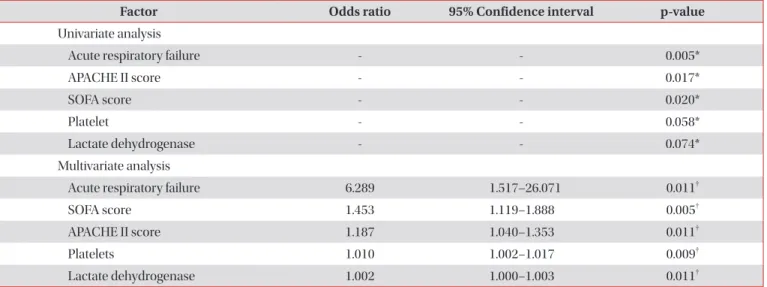
We analyzed factors associated with mechanical ventilation in the patients with scrub typhus admitted to ICU. In univari- ate analysis, acute respiratory failure at admission to ICU (p=0.005), APACHE II score (p=0.017), SOFA score (p=0.020), Table 1. Clinical characteristics of patients with scrub typhus, according to treatment with or without mechanical ventilation

Characteristic Total

(n=70)

Mechanical ventilation p-value (

2

test) Yes (n=19) No (n=51)

Age, yr 71.2±11.1 71.2±8.3 71.2±11 0.990*

Male 32 (45.7) 10 (52.6) 22 (43.1) 0.592

Reasons for ICU admission

Acute respiratory failure 16 (22.9) 9 (47.4) 7 (13.7) 0.008

Neurologic problem 21 (30.0) 4 (21.1) 17 (33.3) 0.390

Sepsis 22 (31.4) 3 (15.8) 19 (37.3) 0.146

Cardiac problem 7 (10.0) 3 (15.8) 4 (7.8) 0.379

Gastrointestinal bleeding 3 (4.3) 0 3 (5.9) 0.557

Acute renal failure 1 (1.4) 0 1 (2.0) 1.000

Comorbidity

None 22 7 (36.8) 15 (29.4) 0.573

Hypertension 32 8 (42.1) 24 (47.1) 0.791

Diabetes mellitus 19 5 (26.3) 14 (27.5) 1.000

Cerebrovascular disease 7 1 (5.3) 6 (11.8) 0.665

Chronic liver disease 4 1 (5.3) 3 (5.9) 1.000

COPD 3 1 (5.3) 2 (3.9) 1.000

Old pulmonary tuberculosis 2 1 (5.3) 1 (2.0) 0.472

PF ratio of acute respiratory failure 160.2±120.6 134.5±114.5 193.3±128.9 0.351*

Rash 15 (21.4) 1 (5.3) 14 (27.5) 0.053

Eschar 35 (50.0) 8 (42.1) 27 (52.9) 0.592

Transfusion 11 (15.7) 5 (26.3) 6 (11.8) 0.140

Inotropic agent 18 (25.7) 5 (26.3) 13 (25.5) 1.000

APACHE II score 14.9±4.8 17.3±4.7 14.1±4.6 0.015*

,†

SOFA score 6.0±2.7 7.3±2.9 5.5±2.4 0.013*

,†

Death 7 (10.0) 5 (26.3) 2 (3.9) 0.014

Cause of death

Respiratory failure 4 (5.7) 3 (15.8) 1 (2.0) 0.058

Cardiac arrest 2 (2.9) 1 (5.3) 1 (2.0) 0.472

Multi-organ failure 1 (1.4) 1 (5.3) 0 0.271

Values are presented as mean±standard deviation or number (%).

*Student’s t test.

p<0.05.

The total number of comorbidities may be more than 70, because the parameters are overlapped.

ICU: intensive care unit; COPD: chronic obstructive pulmonary disease; PF: the ratio of arterial oxygen partial pressure to fractional inspired

oxygen; APACHE: Acute Physiology and Chronic Health Evaluation; SOFA: Sequential Organ Failure Assessment.

(4)

platelet count (p=0.058), and lactate dehydrogenase (LDH) (p=0.074) were statistically significant factors (Table 3). In multivariate analysis, acute respiratory failure at admission to ICU (odds ratio [OR], 6.289; 95% confidence interval [CI], 1.517–26.071; p=0.011), SOFA score (OR, 1.453; 95% CI, 1.119–

1.888; p=0.005), APACHE II score (OR, 1.187; 95% CI, 1.040–

1.353; p=0.011), platelet count (OR, 1.010; 95% CI, 1.002–1.017;

p=0.009), and LDH (OR, 1.002; 95% CI, 1.000–1.003; p=0.011) were independent significant factors associated with mechan- ical ventilation in the patients with scrub typhus admitted to ICU (Table 3).

3. Various periods and chronological orders of the patients with scrub typhus admitted to ICU between me chanical ventilation and non-me chanical ventilation

We analyzed various periods of the patients with scrub

typhus between MV group and non-MV group. There was statistically significant differences in the duration of ICU stay between two groups (p=0.028). However, there were no statis- tically significant differences in the duration of hospitalization, and doxycycline treatment before admitting to ICU between two groups (Table 4).

Discussion

In this study, the mortality rate of patients with scrub typhus admitted to ICU was 10.0%. As previous reports performed in ICU

3-5

, the mortality rate of scrub typhus ranges from 16.7% to 30% in Southeast Asia. The mortality rate of ICU in our study was lower than that of previous reports

3-5

; however, the reason was not understood exactly. We found that the patients with mechanical ventilation represented 27.1% of all patients with scrub typhus admitted to ICU. Acute respiratory failure was Table 2. Laboratory features of patients with scrub typhus, according to treatment with or without mechanical ventilation

Laboratory test Total

(n=70)

Mechanical ventilation p-value (t test)

Yes (n=19) No (n=51)

C-Reactive protein, mg/dL 14.0±6.9 17.3±10.1 12.8±9.3 0.082

White blood cell count, ×10

3

/L 12.6±11.1 17.2±19.3 10.9±4.9 0.178

Platelet count, ×10

3

/L 168.2±101.7 207.2±139.0 153.1±80.7 0.128

Thrombocytopenia 18 (25.7) 6 (31.6) 12 (23.5) 0.545*

AST, IU/L 118.5±176.8 107.6±96.3 122.5±199.4 0.765

ALT, IU/L 63.5±50.1 66.6±61.9 62.3±45.6 0.775

Total bilirubin, mg/dL 1.2±1.8 1.1±1.1 1.3±2.0 0.812

GGTP, IU/L 97.4±108.7 93.1±74.1 98.9±119.3 0.848

ALP, IU/L 134.9±87.2 152.3±103.5 128.4±80.5 0.312

Albumin, g/dL 3.0±0.5 3.0±0.6 3.0±0.4 0.844

Protein, g/dL 6.2±0.7 6.4±0.7 6.1±0.7 0.255

LDH, IU/L 1,033.5±999.7 1,516.2±1,785.2 863.1±403.0 0.142

Calcium, mg/dL 8.2±0.7 8.2±0.6 8.1±0.7 0.533

Phosphorus, mg/dL 3.2±1.2 3.0±0.9 3.3±1.3 0.420

BUN, mg/dL 29.2±18.9 26.3±14.6 30.2±20.3 0.439

Creatinine, mg/dL 1.3±0.8 1.2±0.5 0.3±0.9 0.484

Sodium, mEq/L 134.1±6.1 133.7±7.7 134.3±5.4 0.679

Potassium, mEq/L 3.9±0.6 3.8±0.6 3.9±0.5 0.834

Uric acid, IU/L 5.4±2.6 5.5 ±2.2 5.4±2.7 0.926

INR 1.2±0.1 1.2±0.1 1.2±0.1 0.363

Prothrombin time, sec 14.8±1.3 14.9±1.4 14.7±1.2 0.484

Values are presented as mean±standard deviation or number (%).

*

2

test.

AST: aspartate aminotransferase; ALT: alanine transaminase; GGTP: -glutamyl transpeptidase; ALP: alkaline phosphatase; LDH: lactate

dehydrogenase; BUN: blood urea nitrogen; INR: international normalized ratio.

(5)

the most common reason of ICU admission in MV group (47.4%). The mortality rate of MV group and non-MV group were 26.3% and 3.9%, respectively. The results of the present study revealed that the factors leading patients with scrub ty- phus to mechanical ventilation were acute respiratory failure, SOFA score, APACHE II score, platelet count, and LDH. By logistic regression analysis, they were defined as significant variables associated with mechanical ventilation.

There were a few reports of clinical features, laboratory find- ings, and risk factors leading to fatal outcome associated with severe scrub typhus

2,6,8,9

. However, to our knowledge, there was few report of risk factors leading to mechanical ventilation in patients with scrub typhus admitted to ICU.

Previous studies

2,6,8,9

have reported that the risk factors for severe scrub typhus were age ≥60 years, CNS dysfunction, white blood cell (WBC) counts >10,000/L, total bilirubin >2

mg/dL, albumin ≤3.0 g/dL, creatinine ≥2 mg/dL, APACHE II score, and SOFA score. In our study, the population, patients with scrub typhus admitted to ICU, fulfilled the results of pre- vious studies as showing that age was 71.2±11.1 years, WBC counts was 12,600/L, and albumin was 3.0±0.5 g/dL. But, the parameters of CNS dysfunction, total bilirubin, and creatinine were different from previous studies (Tables 1, 2)

2,6,8,9

.

In multivariate analysis, the parameters which can be the meaningful indicators of mechanical ventilation for the pa- tients with scrub typhus admitted to the ICU were SOFA score (p=0.005), platelet count (p=0.009), acute respiratory failure (p=0.011), LDH (p=0.011), and APACHE II score (p=0.011).

It was surprising to find that LDH was significantly associat- ed with mechanical ventilation for patients with scrub typhus admitted to ICU by multivariate analysis. LDH has been one of medical significant indicators, because it is extensively found Table 3. Factors associated with mechanical ventilation in patients with scrub typhus: results of univariate and mul- tivariate logistic regression analysis

Factor Odds ratio 95% Confidence interval p-value

Univariate analysis

Acute respiratory failure - - 0.005*

APACHE II score - - 0.017*

SOFA score - - 0.020*

Platelet - - 0.058*

Lactate dehydrogenase - - 0.074*

Multivariate analysis

Acute respiratory failure 6.289 1.517–26.071 0.011

SOFA score 1.453 1.119–1.888 0.005

APACHE II score 1.187 1.040–1.353 0.011

Platelets 1.010 1.002–1.017 0.009

Lactate dehydrogenase 1.002 1.000–1.003 0.011

*p<0.1.

p<0.05.

APACHE: Acute Physiology and Chronic Health Evaluation; SOFA: Sequential Organ Failure Assessment.

Table 4. Mean±standard deviation days in hospital, in intensive care unit, and on doxycycline therapy for patients with scrub typhus, according to treatment with or without mechanical ventilation

Period, day Total (n=70) Mechanical ventilation p-value

(t test) Yes (n= 19) No (n=51)

Hospital stay 18.6±27.4 20.9±15.4 17.7±30.8 0.666

ICU stay 5.0±7.0 10.0±11.4 3.3±3.0 0.028*

Doxycycline therapy

Total

11.2±4.6 9.9±4.9 11.6±4.4 0.162

Doxycycline therapy

Pre-ICU

1.5±1.5 (n=52) 1.2±0.6 (n=13) 1.6±1.7 (n=39) 0.465

Doxycycline therapy

Pre-MV

- 2.6±1.2 (n=7) - -

*p<0.05. Student’s t test.

ICU: intensive care unit; Doxycycline therapy

Total

: period of doxycycline therapy during hospitalization; Doxycycline therapy

Pre-ICU

: period of

doxycycline therapy before admitting to ICU; Doxycycline therapy

Pre-MV

: period of doxycycline therapy before mechanical ventilation.

(6)

in body tissues, such as heart muscle and blood cells. Because it is released during tissue damage, it can be a marker of inju- ries and disease. Ogawa et al.

10

reported that elevated levels of LDH was observed in 91%. Tachibana et al.

11

reported that se- vere type scrub typhus seemed to have the higher mean value of LDH. Venkategowda et al.

12

reported that increase LDH was statistically significant (p<0.0001) in scrub typhus patients group with acute respiratory distress syndrome. In our study, the mean levels of LDH were 1,516.2 IU/L in MV group, and 863.1 IU/L in non-MV group (Table 2). So, the levels of LDH can be the one of meaningful indicators of mechanical ventila- tion for the patients with scrub typhus admitted to ICU.

The association between acute respiratory failure and mechanical ventilation are not surprising. The patients with scrub typhus admitted to ICU should be carefully monitored, and the intensivists should prepare to mechanical ventilation, if they initially had complication of acute respiratory failure.

Griffith et al.

8

reported that APACHE II scores were signifi- cantly higher (p=0.007) in patients with scrub typhus who needed invasive mechanical ventilation (21.32±8.6) when compared with those requiring non-invasive ventilation (16.63±7.24). In our study, it is different from point of view that we compared APACHE II scores between MV group and non- MV group (p=0.015).

There was statistically significant differences in the dura- tion of ICU stay between MV group and non-MV group in our study (p=0.028) (Table 4). However, in case of MV group, the duration of ICU stay included the duration of mechanical ventilation. So, when the duration of only non-mechanical ventilation between two groups was analyzed, we found that significant differences were not observed (p=0.782).

There are few limitations in this study. First, our study was retrospectively designed from a single medical center, such as the bias in selection of patient or mechanical ventilation.

So, the results of our study may not be extrapolated as gen- eral. Second, specific circumstance of our institution and geographic distribution of O. tsutsugamushi might affect clini- cal feature, laboratory, and treatment of scrub typhus. Third, we could not analyze the difference in virulence accord- ing to genotypes of O. tsutsugamushi. As previous report

13

, genotypes may be related to the virulence of scrub typhus in patients with scrub typhus admitted to ICU. So, we thought that the genotypes would be one of risk factors to increase the admission of ICU, acute respiratory failure, and mechanical ventilation. Therefore, prospectively designed, a large number of patients, and multi-center studies should be performed to overcome these limitations.

In conclusion, we found that acute respiratory failure, SOFA score, APACHE II score, platelet count, and LDH can be the meaningful indicators of mechanical ventilation for the pa- tients with scrub typhus admitted to ICU.

Conflicts of Interest

No potential conflict of interest relevant to this article was reported.

References

1. Cowan G. Rickettsial diseases: the typhus group of fevers: a review. Postgrad Med J 2000;76:269-72.

2. Varghese GM, Trowbridge P, Janardhanan J, Thomas K, Peter JV, Mathews P, et al. Clinical profile and improving mortality trend of scrub typhus in South India. Int J Infect Dis 2014;23:

39-43.

3. Wang CC, Liu SF, Liu JW, Chung YH, Su MC, Lin MC. Acute respiratory distress syndrome in scrub typhus. Am J Trop Med Hyg 2007;76:1148-52.

4. Thap LC, Supanaranond W, Treeprasertsuk S, Kitvatanachai S, Chinprasatsak S, Phonrat B. Septic shock secondary to scrub typhus: characteristics and complications. Southeast Asian J Trop Med Public Health 2002;33:780-6.

5. Parola P, Miller RS, McDaniel P, Telford SR 3rd, Rolain JM, Wongsrichanalai C, et al. Emerging rickettsioses of the Thai- Myanmar border. Emerg Infect Dis 2003;9:592-5.

6. Lee CS, Hwang JH, Lee HB, Kwon KS. Risk factors leading to fatal outcome in scrub typhus patients. Am J Trop Med Hyg 2009;81:484-8.

7. World Health Organization (WHO). WHO recommended surveillance standards. 2nd ed. [Internet]. Bethesda: World Health Organization; 2004 [cited 2015 Oct 1]. Available from:

http://www.who.int/csr/resources/publications/surveil- lance/whocdscsr992.pdf.

8. Griffith M, Peter JV, Karthik G, Ramakrishna K, Prakash JA, Kalki RC, et al. Profile of organ dysfunction and predictors of mortality in severe scrub typhus infection requiring intensive care admission. Indian J Crit Care Med 2014;18:497-502.

9. Kim DM, Kim SW, Choi SH, Yun NR. Clinical and laboratory findings associated with severe scrub typhus. BMC Infect Dis 2010;10:108.

10. Ogawa M, Hagiwara T, Kishimoto T, Shiga S, Yoshida Y, Fu- ruya Y, et al. Tsutsugamushi disease (scrub typhus) in Japan:

clinical features. Kansenshogaku Zasshi 2001;75:359-64.

11. Tachibana N, Shishime E, Murai K, Tsuda K. Clinical and etio- logical studies of tsutsugamushi disease in Miyazaki district:

correlation of serological type of R. tsutsugamushi to clinical feature. Kansenshogaku Zasshi 1990;64:76-9.

12. Venkategowda PM, Rao SM, Mutkule DP, Rao MV, Taggu AN.

Scrub typhus: clinical spectrum and outcome. Indian J Crit Care Med 2015;19:208-13.

13. Park SW, Lee CS, Lee CK, Kwak YG, Moon C, Kim BN, et al.

Severity predictors in eschar-positive scrub typhus and role

of serum osteopontin. Am J Trop Med Hyg 2011;85:924-30.

수치

Table 4. Mean±standard deviation days in hospital, in intensive care unit, and on doxycycline therapy for patients with  scrub typhus, according to treatment with or without mechanical ventilation

참조

관련 문서

period was prolonged unavoidably, (3) by explaining the risk factors associated with the failure to patients honestly, and subsequently performing

The purpose of this study was to identify the frequency and related factors of advanced airway management for patients with cardiac arrest by the

The median concentrations of FDP were significantly elevated ( p= 0.02) and the median concentrations of fibronogen were decreased ( p= 0.021) in abnormal bleeding patients

It results that ideal cut-off value to diagnose scrub typhus for acute febrile patients is over 1:64 on lgG(sensitivity/specificity 67.5%/88.1%) and 1:16

Kim DM, Yu KD, Lee JH, Kim HK, Lee SH:Controlled trial of a 5-day course of telithromycin versus doxycycline for treatment of mild to moderate scrub typhus. Scrub

ventilation unit at the top and a hydrogen charging station with a ventilation unit at the bottom by using it, the flame and temperature generated inside the

(Method) Among 102 patients with metastatic liver carcinoma due to colorectal cancer who were treated at Chosun University Hospital from January 2003 to

Note: N means patients number according to each 4 severity grades in 112 scrub typhus patients without antibiotics treatment