online©ML Comm
□ 원 저 □
생물정신의학 Vol. 14, No. 3, August 2007
광장 공포증 유무에 따른 공황장애의 임상 양상 차이
이호상*·한상우**·임세원*·오강섭*†
A Comparison of the Clinical Features between Panic Disorder with and without Agoraphobia
Ho-Sang Lee, M.D.,* Sang-Woo Hahn, M.D., Ph.D.**
Se-Won Lim, M.D.,* Kang-Seob Oh, M.D., Ph.D.*†
bjectives:This study was performed to investigate the differences of the clinical feature between panic disorder with agoraphobic patients and panic disorder without agoraphobic patients.
Methods:Two hundred nine patients meeting the criteria of DSM-IV panic disorder were recruited. One group was panic disorder with agoraphobia(n=78, 42 male(53.8%), mean age 37.6±9.9 years), another was panic disorder without agoraphobia(n=131, 81 male(61.8%), mean age 40.5±10.3 years). The numbers and frequency of panic symptoms were compared between two groups with t-test, and the logistic regression analysis were used for predicting panic disorder with agoraphobia.
Results:The number of panic symptoms during panic attack was significantly higher in the group of panic disorder with agoraphobia than the group of panic disorder without agoraphobia(p<0.05).‘Sweating’,‘nausea or abdominal distress’,‘fear of losing control of going crazy’,‘chills or hot flushes’were more frequent in the group of panic disorder with agoraphobia(p<0.05). Among panic symptoms on logistic regression analysis,‘swea- ting’,‘nausea or abdominal distress’,‘fear of losing control or going crazy’turned out to correlate significan- tly with risk of development of agoraphobia in panic disorder.
Conclusion:These results suggest that the frequency of some symptoms during panic attack may be a pre- dictor of agoraphobia in patients with panic disorder.
KEY WORDS:Panic disorder·Agoraphobia.
O
ABSTRACT
*성균관대학교 의과대학 강북삼성병원 정신과학교실
Department of Psychiatry, Kangbuk Samsung Hospital, Sungkyunkwan University School of Medicine, Seoul, Korea
**순천향대학교병원 신경정신과
Department of Psychiatry, Soonchunhyang University Hospital, Seoul, Korea
†교신저자:오강섭, 110-746 서울 종로구 평동 108
전화) (02) 2001-2481, 전송) (02) 2001-2211, E-mail) [email protected]
서 론
DSM-Ⅲ(Diagnostic and Statistical Manual of Mental Disorders, third edition)에서 최초로 분류된 공황장애는 불안장애의 하나로서, 예측할 수 없고 반복적으로 발생하 는 공황발작(panic attack)과 이러한 공황발작이 사라지 고 난 후에도 다시 발작이 일어나지 않을까 걱정하게 되는 예기불안(anticipatory anxiety)을 중요한 특징으로 한 다.1) 공황장애 환자는 종종 광장공포증을 동반하게 되는데, DSM-Ⅲ에서는 공황발작을 동반한 광장공포증과 동반하 지 않은 광장공포증, 공황장애로 분류되었다. 그 후 광장 공포증은 대체로 공황발작의 합병증으로 발생한다는 대부 분의 공황장애 연구자의 결과를 받아들인 DSM-Ⅲ-R (Diagnostic and Statistical Manual of Mental Disor- ders, third edition, Revised)이 발간되면서,2) 광장공포 증을 동반한 공황장애, 광장공포증을 동반하지 않은 공 황장애와 공황발작이 없는 광장공포증으로 분류되었고 DSM-Ⅳ(Diagnostic and Statistical Manual of Mental Disorders, fourth edition)에서도 그 분류체계를 따르고 있다.3) 공황발작은 공황장애 외에 특정공포증, 사회공포 증, 외상후 스트레스 장애와 같은 다른 불안장애에서도 나 타나며, 이러한 다른 불안장애의 공황발작은 상황과 연 관되어 어떤 특정 상황에서만 나타나는 것으로, DSM-Ⅳ 는 공황장애와 독립적으로 공황발작의 정의를 명백히 하 여 이런 혼돈을 막았다.4)
광장 공포증은 도피하기 어려울 것 같은 장소나 상황, 또 는 예기치 못한 공황발작이 일어났을 때 도움을 받기 어려 울 것 같은 장소나 상황에 처하는 것에 대한 불안과 공 포이며, 그로 인해 환자들은 혼자 외출하거나 복잡한 장 소에 가는 것, 운전, 버스 및 기차 등의 교통시설 이용을 피하게 된다.3) 광장공포증은 공황장애 환자의 약1/3내지 1/2에서 동반되며,5) 광장공포증을 동반한 공황장애환자는 그렇지 않은 경우의 환자에 비해 직장이나 사회생활에서 더 큰 제한을 겪게 된다.6)7) 또한 우울증을 더 잘 동반하 게 되고, 관해율이 낮다고 알려져 있다.8)
공황장애와 광장공포증 사이의 관계는 광장공포증이 공 황장애의 하나의 아형이라고 하는 견해와 광장공포증이 공 황장애와는 관계없는 하나의 별개의 장애라는 서로 다른 주장이 있다.9) 또한 광장공포증을 동반한 공황장애와 동 반하지 않은 공황장애, 그리고 공황장애의 병력이 없는 광
장공포증 사이의 관계는 원인, 치료 및 진단분류의 측면 에서 복잡한 문제를 가지고 있다.10)
많은 공황발작 증상들은 여러 연구들에서 공황발작 동 안 나타나는 빈맥, 심계항진, 호흡곤란, 땀흘림, 어지러움, 떨림, 얼굴 화끈거림 등의 흔한 증상들과 질식감, 흉부통증, 감각 이상, 오한, 이인증과 비현실감 등의 덜 흔한 증상들 로 구분할 수 있는데,11-13) Stacevic 등14)은 이를 각각 일 급 증상과 이급 증상으로 명명하기도 하였다. 그동안 공 황증상 표현의 이같은 다양성을 감안하여 공황발작을 증 상에 따라 아형으로 구분하려는 시도들이 이루어져 왔으 며, Bass 등15)은 공황장애 환자들을 과호흡 증상, 뇨 증 상, 위장관 증상, 안전정(oculovestibular) 증상에 따라 아형으로 나누었고, Briggs 등16)은 공황장애 환자들을 호 흡기 관련 증상군과 그 이외의 증상군으로 나누어 각각의 형태와 효과적인 약물 치료가 다르다고 하였다. 이러한 연 구결과들은 임상에서 다양한 공황장애 환자들이 경험하는 공황발작이 서로 이질성이 있음을 시사하나, 이와 달리 한 개인에 있어서 공황발작 간의 증상 양식들은 안정적이고 동질적이라는 연구도 있다.17)
한편 특정 공황증상들과 광장공포증 발생 간의 관련성을 언급한 연구들이 있었으나11-14)18) 명확한 인과관계는 밝 혀진 바 없으며, 공황장애와 광장공포증 간의 관계를 밝 히기 위해 광장공포증을 동반한 공황장애와 광장공포증을 동반하지 않은 공황장애 환자간의 비교 연구가 많이 이 루어졌다.
대체적으로 공황장애 환자들의 인구통계학적 특성,10) 공 황병력의 기간,19) 공황의 빈도와 심각도20)21)는 광장공포 를 동반한 공황장애 환자와 동반하지 않은 환자 군에서 유 의한 차이가 없었다. 또 공황발작 시 공황증상의 양상과 수에 대해서는 일관된 연구결과를 보이지 않았다.10)22)23)
국내의 경우 공황장애의 공황발작 증상에 관한 연구들 은 상당수가 있으나, 광장공포증 유무에 따라 공황장애 환 자들의 공황발작 증상을 서로 비교한 연구들은 드물었다.
따라서 광장공포증을 동반한 공황장애 환자와 동반하지 않 은 환자에서 공황발작 시 공황증상의 양상과 수를 비교 검 토하는 것은 두 그룹간의 진단적 실체를 비교한다는 측면 에서 중요한 의미가 있을 것으로 생각된다.
이에 본 연구에서 저자들은 광장공포증을 동반한 공황 장애 환자와 동반하지 않은 공황장애 환자 사이에서 인구 통계학적 요소, 공황발작의 수, 공황발작의 양상을 비교하 고 특정 공황증상이 광장공포증의 발생에 관련되는 지를
관찰함으로써 공황장애와 광장공포증간의 관계를 살펴보 고자 하였다.
방 법
1. 연구대상
강북삼성병원 정신과에 내원한 환자들 중 DSM-Ⅳ 진 단기준에 따른 정신과 전문의의 임상면담에 의해 공황장 애가 진단되고, 구조화된 면담도구인 Mini International Neuropsychiatric Interview(MINI)를 시행하여 진단이 확인되며 공존질환 여부가 파악된 환자만을 대상으로 하 였다. 현재 주된 진단명이 공황 장애인 경우에만 연구대 상으로 하였고, 그 외에 주요 우울증, 범불안장애 등과 같 은 공존 질환이 있는 경우에는 연구에서 배제하였다. 모 든 연구대상으로부터 서면동의를 받았으며 강북삼성병원 IRB의 승인을 받았다. 총 209명의 공황장애 환자가 선정 되었다. 이들 중 광장공포증을 동반한 공황장애 환자군 (이하 광장공황군)과 동반하지 않은 공황장애 환자군(이 하 비광장공황군)은 각각 78명과 131명이었다. 각 대상 환 자들에게 구조화된 면담도구인 MINI를 이용하여 DSM-
Ⅳ 진단기준에 포함되는 13가지 공황발작 증상항목들에 대해 조사하였다.
2. 통계방법
통계분석은 SPSS 13.0(window version, Chicago, U.S.A)을 사용하였고, 통계적 유의성은 p<.05 수준으로 선정하였다.
우선 인구통계학적 변인들 중 연령에 대한 비교는 t- test를 실시하였고, 성별과 결혼 상태의 비교에서는 χ2 test 를 실시하였다. 두 집단간의 공황증상의 빈도를 알아보기 위해서 χ2 test를 실시하였으며, 다중 비교를 위해 Bon- ferroni correction을 적용하였다. 공황발작 시 공황증상 수의 차이는 t-test를 사용하여 분석하였으며, 특정한 공 황증상이 광장공포증 동반 여부에 영향을 미치는 위험인 자인지를 알아보기 위해 로지스틱 회귀분석(logistic re- gression analysis)을 실시하였다.
결 과
1. 인구통계학적 특성
광장공황군과 비광장공황군의 평균연령은 각각 각각
37.6±9.9세와 40.5±10.3세로 광장공황군이 다소 낮았 으나 통계적 유의성은 없었다(p=.051). 성별분포를 보면 광장공황군은 78명 중 남자 42명(53.8%), 여자 36명 (46.2%)이었고 비광장공황군은 131명 중 남자 81명 (61.8%), 여자 50명(38.2%)으로써 두 군간에 성별 차 이는 없었다(p=.257). 결혼상태의 비교에 있어서 결혼 력의 유무에 따라 나누었을 경우, 광장공황군은 한 번도 결혼한 적이 없는 경우가 21명(26.9%), 결혼력이 있는 경 우가 57명(73.1%)였으며, 비광장공황군은 각각 35명 (26.7%), 96명(73.3%)으로써 양 군간에 유의한 차이는 보이지 않았다(p=.974).
2. 공황증상의 빈도 비교
공황발작의 증상 수는 전체공황장애 환자에서 평균 7.6±
2.6개였고, 그룹별 비교에서는 광장공황군이 8.3±2.7개로 비광장공황군 7.2±2.5개보다 유의하게 많았다(p=.002).
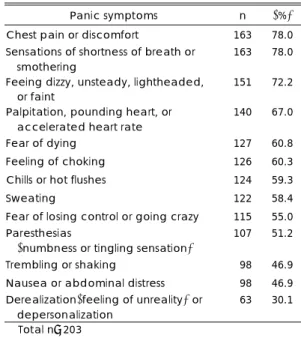
전체 환자를 대상으로 할 때 가장 높은 빈도를 나타내 는 공황증상은‘흉통 또는 가슴 답답함’(78%)과‘숨가 쁜 느낌 또는 숨막히는 느낌’(78%)이었으며, 다음으로‘현 기증, 불안정감, 머리 띵함, 또는 어지럼증’(72.2%),‘심계 항진, 심장의 두근거림, 또는 심장 박동수의 증가’(67.0%) 등의 순이었다(표 1).
그룹 간 공황증상의 빈도의 비교에서‘땀흘림’은 비 광장공황군과 광장공황군에서 각각 67명(51.1%), 55
Table 1. Frequency of panic symptoms of total subjects
Panic symptoms n (%)
Chest pain or discomfort 163 78.0 Sensations of shortness of breath or
smothering
163 78.0 Feeing dizzy, unsteady, lightheaded,
or faint 151 72.2
Palpitation, pounding heart, or accelerated heart rate
140 67.0
Fear of dying 127 60.8
Feeling of choking 126 60.3
Chills or hot flushes 124 59.3
Sweating 122 58.4
Fear of losing control or going crazy 115 55.0 Paresthesias
(numbness or tingling sensation)
107 51.2
Trembling or shaking 098 46.9 Nausea or abdominal distress 098 46.9 Derealization(feeling of unreality) or
depersonalization
063 30.1 Total n=203
명(70.5%)으로 통계적으로 유의한 차이가 있었으며 (p=.006),‘오심 또는 복부 불편감’(비광장공황군/광장 공황군 50명(38.2%)/48명(61.5%) p=.001),‘자제력 상실에 대한 두려움 또는 미칠 것 같은 두려움’(비광장공 황군/광장공황군 64명(48.9%)/51명(65.4%) p=.020),
‘오한 또는 얼굴이 화끈 달아오름’(비광장공황군/광장공 황군 69명(52.7%)/55명(70.5%) p=.011) 또한 두 그
룹 간에서 유의한 차이를 보였다. 모든 경우에 있어서 광 장공황군에서의 증상 빈도가 더 높았다(표 2).
이 중‘오심 또는 복부 불편감’항목에서의 두 그룹 간 차이는 Bonferroni correction 후에도 계속 그 유의성이 유지되었다(p<.0038).
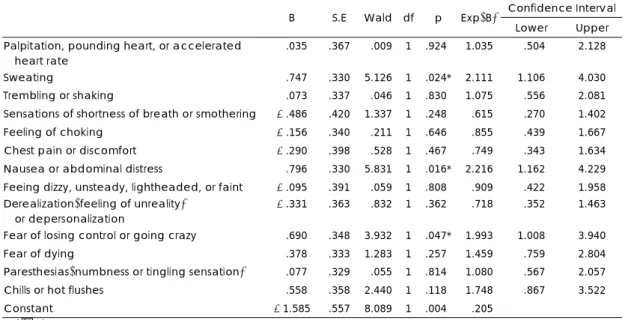
로지스틱 회귀 분석 결과 13개의 공황증상 중 광장공 포증의 동반에 대한 위험인자로서 통계적 유의성을 보인
Table 2. Comparison of panic symptoms frequency between panic disorder with and without agoraphobia Without agoraphobia
(n=131)
With agoraphobia (n=78)
N % N % χ2
(df=1) p Palpitation, pounding heart, or accelerated
heart rate
087 66.4 53 67.9 00.052 .819*†
Sweating 067 51.1 55 70.5 07.547 .006*†
Trembling or shaking 056 42.7 42 53.8 02.418 .120*†
Sensations of shortness of breath or smothering 105 80.2 58 74.4 00.956 .328*†
Feeling of choking 078 59.5 48 61.5 00.081 .775*†
Chest pain or discomfort 103 78.6 60 76.9 00.083 .774*†
Nausea or abdominal distress 050 38.2 48 61.5 10.723 .001*† Feeing dizzy, unsteady, lightheaded, or faint 091 69.5 60 76.9 01.356 .244*† Derealization(feeling of unreality)
or depersonalization
039 29.8 24 30.8 00.023 .879*†
Fear of losing control or going crazy 064 48.9 51 65.4 05.398 .020*†
Fear of dying 075 57.3 52 66.7 01.818 .178*†
Paresthesias(numbness or tingling sensation) 062 47.3 45 57.7 02.102 .147*†
Chills or hot flushes 069 52.7 55 70.5 06.449 .011*†
*:p<.05, †:p<.0038 after Bonferroni correction
Table 3. Logistic regression analysis for possible risk factor of agoraphobia
Confidence Interval
B S.E Wald df p Exp(B)
Lower Upper Palpitation, pounding heart, or accelerated
heart rate
-.035 .367 0.009 1 .924* 1.035 0.504 2.128
Sweating -.747 .330 5.126 1 .024* 2.111 1.106 4.030
Trembling or shaking -.073 .337 0.046 1 .830* 1.075 0.556 2.081 Sensations of shortness of breath or smothering -.486 .420 1.337 1 .248* 0.615 0.270 1.402 Feeling of choking -.156 .340 0.211 1 .646* 0.855 0.439 1.667 Chest pain or discomfort -.290 .398 0.528 1 .467* 0.749 0.343 1.634 Nausea or abdominal distress -.796 .330 5.831 1 .016* 2.216 1.162 4.229 Feeing dizzy, unsteady, lightheaded, or faint -.095 .391 0.059 1 .808* 0.909 0.422 1.958 Derealization(feeling of unreality)
or depersonalization
-.331 .363 0.832 1 .362* 0.718 0.352 1.463
Fear of losing control or going crazy -.690 .348 3.932 1 .047* 1.993 1.008 3.940
Fear of dying -.378 .333 1.283 1 .257* 1.459 0.759 2.804
Paresthesias(numbness or tingling sensation) -.077 .329 0.055 1 .814* 1.080 0.567 2.057 Chills or hot flushes -.558 .358 2.440 1 .118* 1.748 0.867 3.522
Constant -1.585 .557 8.089 1 .004* 0.205
*:p<.05
것은‘땀흘림’,‘오심 또는 복부 불편감’,‘자제력 상실 에 대한 두려움 또는 미칠 것 같은 두려움’이었다. 이들의 비교 위험도는 각각 2.111, 2.216, 1.993으로서‘오심 또 는 복부 불편감’이 가장 높게 나타났다. 본 로지스틱 회귀분 석의 설명력은 17.2%였으며(Nagelkerke R2=.172), Hos- mer와 Lemeshow 검정결과를 통한 모델의 적합도 검정 에서, 유의확률이 0.372로서(p>.05) 본 모델은 적합하다 고 할 수 있다(표 3).
고 찰
본 연구는 광장공포증의 동반 유무에 따른 공황장애의 임상적 차이를 살피고자 하였으며, 광장공황군이 비광장공 황군에 비해 증상의 수가 더 많고‘땀흘림’,‘오심 또는 복부 불편감’,‘자제력 상실에 대한 두려움 또는 미칠 것 같은 두려움’,‘오한 또는 얼굴이 화끈 달아오름’의 증상 이 더 흔하게 나타난다는 결과를 얻었다.
Bass 등15)이 공황발작의 증상들이 생리적으로 일괄적 이지 않고, 기저의 병태생리가 공통적이지 않다고 한 주장 의 측면에서 보자면, 공황장애 환자를 진단적으로 보다 세 분화함으로써 질병의 경과와 예후를 이해함에 있어 도움 이 될 뿐더러, 치료적 접근을 다양하게 모색해 볼 수 있 다는 점에서 중요하다.
본 연구 결과 인구통계학적 특성에 있어 광장공황군과 비광장공황군은 차이가 없었으며 이는 공황장애 환자들의 인구통계학적 특성이 광장공포증 동반 유무에 따른 비교 에서 차이가 없다고 보고한 국내외의 연구결과와 일치하
였다.24-29) 각 환자에게서 나타내는 공황발작의 수에서
는 전체 공황환자에서 평균 7.6개로 Kim30)의 연구 결과 (10.9개)보다 적었으나, Lee CT와 Lee SP,31) Cho 등,29) Dick 등,32) de Beurs 등33)의 연구에서 보고한 6~8개의 증상 수와는 비교적 일치하였다.
광장공황군과 비광장공황군의 비교에서 본 연구에서는 광장공황군(8.3개)이 비광장공황군(7.2개)보다 유의하게 많았다. 이러한 결과는 일부 선행연구 결과들과 일치하는 것으로 Cho 등29)의 연구에서는 광장공황군 8.6개, 비광장 공황군 7.4개로 본 연구와 유사하였으며, Lee CT와 Lee SP31)의 연구에서도 광장공황군이 6.1개, 비광장공황군이 5.3개로써 유의한 차이를 보였다. 외국의 경우 Goisman 등27)은 광장공황군이 9.2개, 비광장공황군이 7.9개로 유 의한 차이를 보였으며, Starcevic 등14)의 연구에서도 광
장공황군(36.14개)이 비광장공황군보다(29.31개)유의하 게 많은 증상 수를 보였다. 그러나 두 군 사이에 공황발 작시 공황증상 수의 차이는 없다고 보고한 Vermilyea34) 나 Telch 등23)의 연구 결과와는 일치하지 않는다.
공황발작 증상의 표현 빈도를 볼 때, 우선 첫째로 전체 공황환자를 대상으로 한 경우 본 연구에서 높은 빈도를 나 타낸 증상은‘흉통 또는 가슴 답답함’(78.0%),‘숨가쁜 느낌 또는 숨막히는 느낌’(78.0%),‘현기증, 불안정감, 머리 띵함, 또는 어지럼증’(72.2%),‘심계항진, 심장의 두 근거림, 또는 심장 박동수의 증가’(67.0%),‘죽음에 대한 두려움’(60.8%) 등이고, 낮은 빈도를 나타낸 증상은‘감 각 이상’(51.2%),‘오심 또는 복부 불편감’(46.9%),‘떨 림 또는 전율’(46.9%),‘비현실감 또는 이인증’(30.1%) 였다. 이와 같은 증상 분포는 Starcevic 등14)이 명명한 이 급 증상에 해당하는‘흉통’이 본 연구에서 가장 높은 빈 도를 차지했다는 점을 제외하면 전반적으로 공황장애 증 상에 대한 국내, 국외 연구결과와 비슷한 결과이다.35-38) 또한 광장공황군과 비광장공황군을 비교하면, 13개의 공 황증상 중‘땀흘림’,‘오심 또는 복부 불편감’,‘자제력 상 실에 대한 두려움 또는 미칠 것 같은 두려움’,‘오한 또는 얼굴이 화끈 달아오름’의 증상이 비광장공황군에 비해 광 장공황군에서 유의하게 더 흔히 표현되었다. 외국의 연구 결과를 보면 Telch 등23)은 어지러움과 기절할 것 같은 느 낌이 광장공황군에서 더 많았다고 보고하였고, Goisman 등27)은‘어지러움’,‘숨이 막히는 느낌’,‘이인감’,‘자제 력상실에 대한 두려움 혹은 미칠 것 같은 두려움’등의 증 상이 광장공황군에서 더 많았다고 보고하였다. 또한 Segui 등38)은 광장공황군에서‘어지러움’이 더 흔히 나타난다 고 하였으며, Langs 등39)은 광장공황군에서‘오한 또는 얼 굴이 화끈 달아오름’,‘자제력 상실에 대한 두려움 또는 미칠 것 같은 두려움’이 더욱 흔하다고 하여 본 연구와 유 사한 결과를 보고하였다. Starcevic 등14)은 광장공황군에 서‘숨이 막히는 느낌’,‘오심’,‘복부 불편감/통증’,‘감각 이상’,‘떨림/전율’,‘이인증’,‘비현실감’,‘무망감’,‘두 통’,‘혈관이 펄떡거림’,‘시야 흐림’,‘창백해짐’등의 12가지 증상이 더 많다는 결과를 보고하였다. 국내 연구 의 경우를 보면, Cho 등29)의 연구에서는‘호흡곤란’이 광 장공황군에서 유의하게 흔한 것으로 나타났고, Lee CT 와 Lee SP31)의 연구에서는‘어지러움’과‘질식감’이 광 장공황군에서 유의하게 흔하게 나타났다. 이처럼 두 군간 의 증상 빈도의 비교에 있어 일관되지 않은 결과를 보이는
데는 증상의 표현 방식이 환자가 속해 있는 문화와 밀접 히 관련이 될 수 밖에 없는 횡문화적 차이와, 증상의 빈도 를 평가하는 데 이어 서로 다른 방법의 사용 등을 생각 해 볼 수 있을 것이다.
끝으로 본 연구에서의 logistic 회귀분석 결과, 공황발작 의 13개 증상 중 광장공포증의 동반에 대한 위험인자로 서‘땀흘림’,‘오심 또는 복부 불편감’,‘자제력 상실에 대 한 두려움 또는 미칠 것 같은 두려움’이 통계적 유의성이 있었다. 이 같은 결과의 의미를 해석하자면, 공황장애 환 자에서 상기 증상들이 존재할 경우 광장공포증의 동반 가 능성을 예측하게 할 수 있다는 점에서 임상적 의의가 있 다 하겠다. 특히‘오심 또는 복부 불편감’은 가장 높은 비 교 위험도를 나타냈는데(2.216), Kumano 등40)의 연구 에서 과민성 장증후군을 갖고 있을 경우 광장공포증의 동 반이환율이 유의미하게 높음을 보고하여 본 연구의 결과 와 유사성을 찾을 수 있겠으나, 그 이유 및 기전에 대해 밝혀진 바는 없다. 하지만 Pavlov41)의 실험에서 밝혀진 바와 같이 오심은 중립적 자극 및 연관 자극과 관련되어 쉽게 조건화되는 것으로 알려져 있으며, Hinton 등42)은 위 장관계의 증상이 복부 감각에 대한 파국적 인지(catastro- phic cognitions)를 통해 공황증상을 발생시킨다고 보고한 바 있다. 이러한 점을 고려해 볼 때 오심 및 복부 불편감 등의 증상과 함께 공황발작을 경험한 경우 당시 경험에 대 한 부정적 인지왜곡이 조건화됨으로써 광장공포증의 불안 및 회피행동을 더욱 악화시킬 것으로 유추해 볼 수 있을 것이다. 따라서‘오심 또는 복부 불편감’증상이 환자에게 서 관찰될 경우에는 광장공포증 동반의 위험성이 높음을 반드시 염두에 두고 치료적 개입을 고려해야 할 것이다.
본 연구의 제한점으로는 첫째로 공황장애 증상에 대한 단면적 연구라는 점이다. 때문에 본 연구의 결과에서 유의 한 차이를 보였던 증상이 광장공포증에 대한 일차적 요인 인지 광장공포증 발생 후의 이차적인 결과적 요소인지 판 단하기 어렵다. 이 점에 대해서는 de Beurs 등33)이 제안 한 지속적 감찰과 같은 종단적 연구가 필요하겠다. 두 번 째로, 광장공포증 유무에 따른 공황장애 환자의 임상적 차 이를 살피는 데 있어서 증상의 심한 정도(severity)를 측 정하지 못한 점이다. 향후 연구에서는 공황장애 심각도를 측정하기 위한 표준화된 척도를 이용한 비교 분석이 추 가되어야 할 것이다. 또한 향후 연구에서 광장공포증 발 생과 관련 가능성 있는 다양한 요소들(성격, 인지적 요소, 불안 민감도, 우울감 등)을 함께 고려한다면 보다 다양하
고 포괄적인 연구가 될 수 있을 것이다.
이러한 제한점에도 불구하고 본 연구는 한국인 공황장 애 환자에서 광장공포증이 동반된 경우‘땀흘림’,‘오심 또 는 복부 불편감’,‘자제력 상실에 대한 두려움 또는 미칠 것 같은 두려움’,‘오한 또는 얼굴이 화끈 달아오름’의 증 상이 비광장공포군에 비해 더 흔히 관찰됨을 보고하였으 며, 기존의 국내외 연구에 비해 비교적 큰 수(209명)의 연 구대상을 통해 얻어진 결과라는 점과 광장공포증의 발생 에 대해 특정 증상의 위험요인으로서의 관련성을 제시했 다는 점에서 의의를 찾을 수 있을 것이다. 향후 종단적 연 구 설계 및 증상의 심각도를 포함한 다양한 요인을 포괄하 는 연구의 필요성이 제기되며, 이를 통해 공황장애와 광 장공포증의 현상학에 대한 이해를 더욱 높일 수 있는 계 기가 마련되기를 기대한다.
중심 단어:공황장애·광장공포증.
참 고 문 헌
1. American Psychiatric Association. Diagnostic and Sta- tistical Manual of Mental Disorders. 3rd ed. Washington DC: American Psychiatric Press;1980. p.225-239.
2. American Psychiatric Association. Diagnostic and Statis- tical Manual of Mental Disorders. 3rd rev. Washington DC: American Psychiatric Press;1987. p.235-253.
3. American Psychiatric Association. Diagnostic and Statis- tical Manual of Mental Disorders. 4rd ed. Washington DC: American Psychiatric Press;1994. p.393-444.
4. Hale RE, Yudofsky SC, Talbott JA. Textbook of Psy- chiatry. 2nd ed. Washington DC: American Psychiatric Press;1994. p.495-497.
5. Nutt DJ, Ballenger JC, Lepine JP. Panic Disorder: Cli- nical diagnosis, management and mechanism. London:
Martin Dunitz;1999. p.28.
6. Noyes R Jr, Reich J, Christiansen J, Suelzer M, Pfohl B, Coryell WA. Outcome of panic disorder. Arch Gen Psychiatry 1990;47:809-818.
7. Buller R, Maier W, Goldenberg IM, Lavori PW, Ben- kert O. Chronology of panic avoidance, age of onset in panic disorder, and prediction of treatment response: A report from the cross-national collaborative panic study.
Eur Arch Psychiatry Clin Neurosci 1991;240:163-168.
8. Warshaw MG, Massion AO, Shea MT, Allsworth J, Kel- ler MB. Predictors of remission in patients with panic with and without agoraphobia: prospectives 5-year fol- low-up data. J Nerv Ment Dis 1997;185:517-519.
9. Maier W, Roth M, Buller R, Argyle N, Rosenber R, Brandon S, et al. Agoraphobia in panic disorder: an in- dicator of the severity of panic disorder or a distinct diag-
nostic entity? Psychiatr Ann 1991;21:374-381.
10. Goisman RM, Rogers MP, Steketee GS, Warshaw MG, Cunco P, Keller MH. Utilization of behavioral methods in a multicenter anxiety disorder study. J Clin Psychiatry 1993;54:213-218.
11. Arson TA, Logue CM. Phenomenology of panic attack: a descriptive of panic disorder patient’s self-reports. J Clin Psychiatry 1988;49:8-13.
12. Borden JW, Turner SM. Is panic a unique emotional experience? Behav Res Ther 1989;27:263-268.
13. Norton GR, Dorward J, Cox BJ. Factors associated with panic attack in nonclinical subjects. Behav Ther 1986;
17:239-252.
14. Starcevic V, Kellner R, Uhlenhuth EH, Pathak D. The phenomenology of panic attack in panic disorder with and without agoraphobia. Compr Psychiatry 1992;34:
36-41.
15. Bass C, Kartsounis L, Lelliott P. Hyperventilation and its relationship to anxiety and panic. Integr Psychiatry 1987;5:274-291.
16. Briggs AC, Stretch DD, Brandon S. Subtyping of panic disorder by symptom profile. Am J Psychiatry 1993;163:
201-209.
17. Zoellner LA, Craske M, Rapee R. Stability of catastro- phic cognitions in panic disorder. Behav Ther 1996;34:
399-402.
18. Cassano GB, Petracca A, Perugi G, Toni C, Tundo A, Both M. Derealization and panic attack: a clinical eva- luation on 150 patients with panic disorder/agoraphobia.
Compr Psychiatry 1989;30:5-12.
19. Craske MG, Barlow DH. A review of the relationship between panic and avoidance. Clin Psychol Rev 1988;
8:667-685.
20. Fleming B, Faulk A. Discriminating factors in panic disorder with and without agoraphobia. J Anxiety Disord 1989;3:209-219.
21. Cox BJ, Endler NS, Swinson RP, Norton GR. Situa- tions and specific coping strategies with clinical and nonclinical panic attacks. Behav Res Ther 1992;30:67-69.
22. Starcevic V, Uhlenhuth EH, Kellner R, Patbak D. Co- morbidity in panic disorder: II. Chronology of appearance and pathogenic cormorbidity. Psychiatry Res 1993;46:
285-293.
23. Telch MJ, Brouillard M, Telch CF, Agras WS, Taylor CB. Role of cognitive appraisal in panic-related avoi- dance. Behav Ther 1998;27:373-383.
24. Clum GA, Knowles SL. Why do some people with pa- nic disorders became avoidant? A review. Clin Psychol Rev 1991;11:295-313.
25. Faravelli C, Pallanti S, Blondi F, Patemniti S, Scarpato MA. Onset of panic disorder. Am J Psychiatry 1992;149:
827-828.
26. Faravelli C, Pallanti S, Blondi F, Patemniti S, Scarpato MA. 5-year prospective, naturalistic follow-up study of panic disorder. Compr Psychiatry 1992;36:271-277.
27. Goisman RM, Washaw MG, Peterson LG, Rogers MP, Cunco P, Hunt MF, et al. Panic, agoraphobia, and pa- nic disorder with agoraphobia, Data from a multicenter anxiety disorder study. J Nerv Ment Dis 1994;182:72-79.
28. Kim JH, Kim CJ. A comparison of panic disorder pati- ents with and without agoraphobia. J Korean Soc Biol Ther Psychiatry 1997;3:112-122.
29. Cho JY, Lee YS, Lee KH. The clinical differences bet- ween panic disorder with agoraphobia and panic disorder without agoraphobia. J Korean Neuropsychiatr Assoc 1995;34:937-946.
30. Kim YC. A comparison of panic and psychiatric symp- toms between patients with panic disorder and generalized anxiety disorder. J Korean Neuropsychiatr Assoc 1996;
35:268-277.
31. Lee CT, Lee SP. A comparison on symptoms of the generalized anxiety disorder and the panic disorders. J Korean Neuropsychiatr Assoc 1991;30:720-727.
32. Dick CL, Bland RC, Newman SC. Epidemiology of psy- chiatric disorder in Edmonton, panic disorder. Acta Psy- chitr Scand Suppl 1994;376:45-53.
33. de Beurs E, Garssen B, Buikhuisen M, Lange A, van Balkom A, van Dyck R. Continuous monitoring of pa- nic. Acta Psychiatr Scand 1994;90:38-45.
34. Vermilyea JA. A comparison of anxiety in “normal” and anxiety disordered populations. Unpublished doctoral dissection, The University of Albany, State University of New York;1986.
35. Lim KY, Kim CK, Noh JS. The characteristics of panic attack symptoms in panic disorder patients. J Korean Neuropsychiatr Assoc 1996;35:839-847.
36. Min SK, Lee HY. A clinical study on panic attack. J Ko- rean Neuropsychiatr Assoc 1985;24:483-489.
37. Cox BJ, Endler NS, Swinson RP. Clinical and noncli- nical panic attacks: an empirical test of panic-anxiety continuum. J Anxiety Disord 1991;5:21-24.
38. Segui J, Salvaor-Carulla L, Garcia L, Canet J, Oritz M, Farre JM. Semiology and subtyping of panic disorder.
Acta Psychiatr Scand 1998;97:272-277.
39. Langs G, Quehenberger F, Fabisch K, Klug G, Fabisch H, Zapotoszky HG. The development of agoraphobia in panic disorder: a predictable process? J Affect Disord 2000;58:43-50.
40. Kumano H, Kaiya H, Yoshiuchi K, Yamanaka G, Sasaki T, Kuboki T. Comorbidity of irritable bowel syndrome, panic disorder, and agoraphobia in a Japanese represen- tative sample. Am J Gastroenterol 2004;99:370-376.
41. Pavlov IV. Conditioned reflexes: an investigation of the physiological activity of the cerebral cortex. London:
Oxford University Press;1927.
42. Hinton DE, Chhean D, Fama JM, Pollack MH, McNally RJ. Gastrointestinal-focused panic attacks among Cam- bodian refugees: associated psychopathology, flashbacks, and catastrophic cognitions. J Anxiety Disord 2007;21:
42-58.