• 검색 결과가 없습니다.

Report on Two Cases of Treatment of Anxiety Disorder with Panic Attacks-on the Basis of Breath-Counting Meditation (Anapanasati)

N/A
N/A
Protected

Academic year: 2021

Share "Report on Two Cases of Treatment of Anxiety Disorder with Panic Attacks-on the Basis of Breath-Counting Meditation (Anapanasati)"

Copied!
10
0
0

로드 중.... (전체 텍스트 보기)

전체 글

(1)

Report on Two Cases of Treatment of Anxiety Disorder with Panic Attacks-on the Basis of Breath-Counting Meditation (Anapanasati)

Song-Wun Yoo, Dong-Uk Kim, Se-Jin Park

Department of Korean Neuropsychiatry, Dong-Seo Korean Medical Center

Received: February 24, 2015 Revised: March 10, 2015 Accepted: March 10, 2015

Objectives: The purpose of this study was to evaluate the effect of breath-counting meditation on anxiety disorder patients with panic attack.

Methods: Two anxiety disorder patients with panic attack were treated with Breath-counting Meditation, acupunctures, and herb-medications. The patients have been predicted for anxiety dis- order with panic attack through Dignosis and Statistical Manual (DSM-IV), Panic Disorder Severity Scale (PDSS), BDI (Beck Depression Inventory), and BAI (Beck Anxiety Inventory) on their 1st and 6th treatments.

Results: After the treatments, both the physical and psychological symptoms have decreased.

Conclusions: This study suggests that the breath-counting meditation is an effective way for treating patients who are suffering from anxiety disorder with panic attack.

Key Words: Breath-counting meditation (Anapanasati), Anxiety disorder, Panic attack, MBSR.

Correspondence to Se-Jin Park Department of Korean

Neuropsychiatry, Dong-Seo Korean Medical Center, 365-14 Seonsan-ro, Seodeamun-gu, Seuol, Korea.

Tel: +82-2-337-1110 Fax: +82-2-320-7917 E-mail: [email protected]

Copyright © 2015 by The Korean Society of Oriental Neuropsychiatry. All rights reserved.

CC
This is an open access article distributed under the terms of the Creative Commons Attribution Non-Commercial License (http://creativecommons.org/licenses/by-nc/3.0) which

permits unrestricted non-commercial use, distribution, and reproduction in any medium, provided the original work is properly cited.

(2)

I. INTRODUCTION

One of the recent trends in the clinical fields of Korean Medicine (KM) is the application of various meditation techniques centering on Jon Kabat-Zinn’s Mindfulness-Based Stress Reduction (MBSR) to KM psy- chotherapy

1)

.

Most meditation techniques attach great importance to the process of breathing

2)

; in particular, Breath-count- ing meditation (Anapanasati, 隨息觀; BCM) is a medi- tation technique focusing on counting while breathing in and out, i.e., the breath itself is the object of medi- tation in this technique. BCM has a long tradition in Buddhism, primarily intended to help the meditator concentrate. As the name suggests, BCM involves look- ing at (觀) what happens in one’s own body and mind while counting(隨) one’s breath (息)

3)

. In most cases, regular and calm abdominal breathing, in which the exhalation time is longer than the inhalation time, is maintained while mentally counting through the dura- tion of the breath (1, 2, 3...)

4)

.

In previous studies related to BCM in KM neuro- psychiatry, Chung

5)

performed a neuro-feedback-based analytic comparison between pre-and post-BCM mem- ory and concentration abilities, and Jung

6)

and Lee

7)

in- vestigated the effects of BCM on psychological and physiological states. While there are case studies on representative medication therapy applying MBSR

19,20)

, cases on the clinical application of BCM have not been reported yet.

With this background, the author reports two cases of successful application of BCM for the treatment of patients with anxiety disorder accompanied by panic attacks, and explores the efficacy of BCM in clinical applications.

II. CASES

1. Patients and treatment methods

Two patients with symptoms meeting the Diagnostic

and Statistical Manual (DSM-IV) criteria for anxiety disorder with panic disorder underwent BCM-based KM psychiatric treatments and other KM treatments including herbal medicine and acupuncture. The ther- apeutic effects were evaluated.

The patients were instructed to meditate for 10 min while listening to a record of guided BCM in “Qi-sup- ported 15-minute Meditation”

8)

by Prof. Kim Jong-Woo of the Department of Neuropsychiatry, Kyung Hee University Korean Medicine Hospital at Gangdong.

The patients were provided with the sound file with the instruction to practice BCM at home every day be- fore falling asleep. They were also instructed to calm down by counting their breaths using the BCM techni- que whenever they feel the symptoms of panic attacks, such as intense fear and discomfort with palpitations and shortness of breath, breathlessness, and pressure on the chest. Their BCM practice consisted of counting from one to ten and repeating the count at each unit of in-and-out breathing.

Cheon-Wang-Bo-Sim-Dan (天王補心丹; HANPOONG PHARM Co. Ltd.) was prescribed to be taken twice a day, and acupuncture (0.25 mm×30 mm disposable acu needle; Haeng Lim Seo Won) was administered during each clinic visit. Needle retention time was set at 15 min, and acupuncture was performed using a plunger on 中衝 (PC9), 大敦 (LR1), 曲澤 (PC3), 陰谷 (KI10), 內關 (PC6), 少府 (HT8), 太衝 (LR3).

2. Instruments of evaluation

1) PDSS (Panic Disorder Severity Scale)

9)

The author used the Korean version of the Panic

Disorder Severity Scale (PDSS). This assessment tool

with proven reliability and validity was adapted by

Kim et al. in 2001 based on the original PDSS devel-

oped by Shear et al. PDSS measures the severity of

panic disorder and comorbidity using 7 items. Each

item is rated on a 5-point scale ranging from 0 to 4

(3)

and the total score is calculated to indicate the degree of panic disorder symptoms.

2) BDI (Beck Depression Inventory)

10)

This self-report questionnaire, which was devel- oped by Aaron T. Beck to assess the presence and se- verity of depression symptoms, comprises of 21 items pertaining to cognitive, emotional, motivational, and somatic components of depression. Each item is rated on a 4-point scale (0∼3), and a total score is calcu- lated to determine the presence and severity of de- pression; 0∼9 indicates absence of depression, and 10∼

15, 16∼23, and 24∼63 points indicate mild, moder- ate, and serious depression, respectively.

3) BAI (Beck Anxiety Inventory)

11)

This 21-item questionnaire consists of 21 items per- taining to cognitive, emotional, and somatic compo- nents of anxiety. Each answer is given a point ranging from 0 to 3, and a total score is calculated to determine the severity of anxiety; 22∼26, 27∼31, and ≥32 points indicate moderate to severe (requiring observation and intervention), very severe, and extremely severe levels of anxiety, respectively.

3. Case 1

1) Sex/Age/Occupation Female/20 years/College student

2) Chief complaints

(1) Extreme fear, shortness of breath, and pressure on the chest from the imagined presence of insects

(2) Constant fear and panic about insects (3) Insomnia

3) Onset of symptoms September 12, 2013

4) Medical history and family medical history None

5) Current medical history

This 20-year-old female patient had no noticeable medical history and family medical history. The fear of insects began after an insect crept into her ear on September 12, 2013. She cannot enter a room where she sees dust or fruit seeds for fear of insects hiding somewhere in the room. Thinking of or seeing insects results in pressure on the chest and shortness of breath, and she has been to the emergency room three times for extremely severe, life-threatening symptoms.

The constant anxiety about being attacked by insects makes her use earplugs to prevent insects from creep- ing into the ear while she is sleeping. She also suffers from insomnia because of the use of earplugs, which gives her some comfort, but disturbs her sleep, and if she does not use them, she cannot sleep for fear of insects. She also complained of other comorbid symp- toms such as lack of appetite, headache, dizziness, and loose stools.

After the diagnosis of phobic anxiety disorder caused by a specific phobia at Hospital S during end-September 2013, she had been medicated (Alprazolam tab 0.5 mg tid). She voluntarily discontinued the medication and visited the emergency room three times with severe symptoms of pressure on the chest and shortness of breath.

6) Social history

She gets easily scared. She tends to follow advice

or instruction given by people around her, and has

smooth relationships with friends. She has been under

stress since the beginning of the summer holidays due

to work unjustly imposed by a senior student.

(4)

7) Anamnesis (1) 158 cm/50 kg

(2) Appetite and digestion

no appetite and uncomfortable feeling of fullness in stomach

(3) Excretion

- Frequency of defecation and stool form: 1∼2 times/day, loose

- Frequency of urination: 7∼8 times/day, feeling of incomplete emptying of the bladder

(4) Duration of sleep

1∼2 h/day due to difficulties in falling asleep and stridor

(5) Tongue diagnosis

red sore tongue with a thin white coating (舌紅苔薄 白), teeth marks around the tongue (舌邊齒痕)

(6) Pulse diagnosis

slow and weak floating pulse (脈浮緩無力) (7) Cold-heat pattern

cold hands and feet, head flushed (8) Tactile diagnosis

tender points on 膻中 (CV17), 中脘 (CV12), and 關元 (CV4)

8) Catamnesis (clinical course and outcome) (1) November 22, 2013

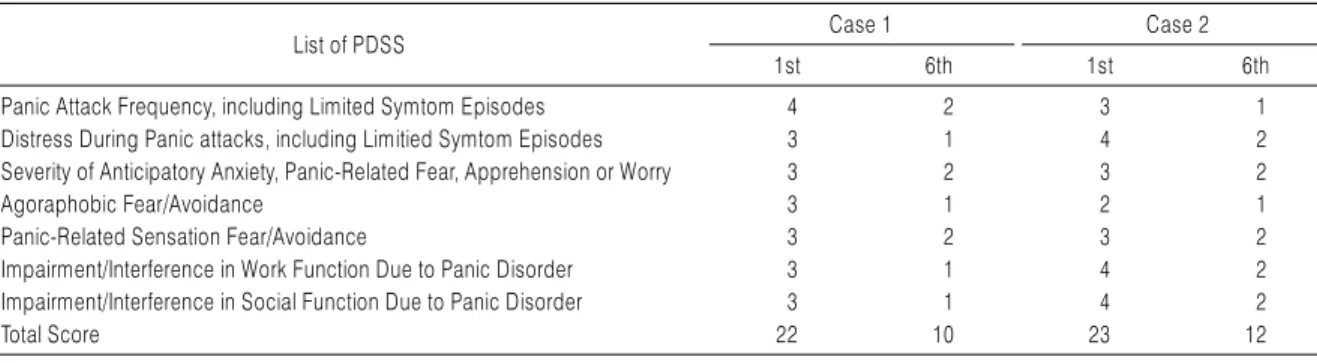
After the review and evaluation of personal history, we aimed to establish relationships through empathy and encouragement. The patient scored 22 points on the PDSS, demonstrating severe symptoms of panic attack. The BDI and BAI scores of 19 and 22 points, respectively, indicated high degrees of anxiety disorder and depression.

The patient reported that despite a slight mitigation of symptoms, she discontinued the Alpram tablets for fear of feeling alienated from herself and getting de- pendent on the medication. I suggested that she should not be afraid of taking Western or traditional

medicine. The medication dosage could be adjusted if side effects appeared, and the symptoms would be gradually relieved.

She was taught how to slow down her breathing through BCM whenever overwhelmed by panic attacks during daily activities, and instructed to practice BCM by listening to the recorded sound file every day be- fore sleeping.

(2) November 25, 2013

The patient reported that breath counting alone calmed her breathing, and expressed her surprise and satisfaction. I encouraged her with praise and em- pathy, and explained that the recurrence of symptoms can be managed by using the same method. She was instructed to rest in a comfortable posture and breath- ing pattern, and imagine and imprint a safe place in mind. After counseling, she practiced BCM by listening to the recorded guide. She was encouraged to con- tinue the daily meditation before sleeping.

(3) November 29, 2013

The patient reported that the face muscle tension and insomnia disappeared. She thought less about in- sects and could sleep well despite short disturbances.

Since thinking of insects rendered her less anxious now, she underwent disassociation therapy in which she imagined that an insect approaching the house from the sky was captured and wrapped in a handker- chief, and put in a well-covered corner of the house.

(4) December 2, 2013

The patient reported that the frequency of thinking about insects had reduced and symptoms of shortness of breath and pressure on the chest were considerably less intense. The moment she felt her breathing be- coming faster, she applied BCM and counted her breaths, which worked well and made her life much easier.

(5) December 6, 2013

The patient reported that her digestion had im-

proved and she ate more comfortably with fewer in-

(5)

cidences of anxiety. She still had occasional anxious moments, but the overall state was stabilized. The next visit was set to take place a month later because of her personal circumstances. I encouraged her to con- tinue the daily meditation before sleeping.

(6) January 6, 2014

The patient reported that she discontinued the medication because her feeling of anxiety had almost disappeared and her daily activities were not affected by it. Seeing insects did not elicit any anxiety, and whenever she felt uneasy, she habitually applied BCM.

She also reported that she was practicing BCM every day before sleeping. Her PDSS score fell to 10 points, and BDI and BAI were reduced to 6 and 7 points, respectively.

4. Case 2

1) Sex/Age/Occupation Male/38 years/Buddhist monk

2) Main complaints

Sudden anxieties, shortness of breath, pressure on the chest, and palpitations

3) Onset date End-February 2014

4) Medical history and family medical history No noticeable medical history; father with stomach cancer

5) Current medical history

This 38-year-old male patient had his first panic attack at the end of February 2014 while taking a break from physical exercise after a weight reduction dietary meal. He had a sudden feeling of something being terribly wrong and experienced a state of pro- fuse sweating, shortness of breath, pressure on the

chest, and weak and unsteady legs. He was over- whelmed by the thought of dying from a heart attack.

In Hospital C, he underwent a thorough examination including electrocardiogram and echocardiography, which did not yield any particular findings. During the ensuing 3 weeks, he had three recurrences of the same symptoms while he was taking a meal or a break. He was referred to the Department of Neuropsychiatry of Hospital C, where he was diagnosed with panic dis- order with symptoms of panic attack, and received a prescription for medication (Alprazolam tab 5 mg, Fluoxetine 20 mg tid). Three days before he presented to our department, he had the same symptoms of a panic attack with the same feeling that he was about to die. He visited the emergency department of Hospital C, but no particular clinical abnormalities could be confirmed.

6) Social history

Celibate, calm, and clean, he has good relationships with people around him, and has not been recently exposed to any stressful situations.

7) Anamnesis (1) 169 cm/70 kg

(2) Appetite and digestion poor appetite, indigestion (3) Excretion

tendency of constipation (4) Sleep

sufficient length but of poor quality (5) Tongue diagnosis

thin white coat on tongue (舌紅苔薄白) (6) Pulse diagnosis

fine floating wiry pulse (浮緩細) (7) Cold-heat pattern head flushed

(8) Tactile diagnosis

tender points on 膻中 (CV17) and 中脘 (CV12)

(6)

8) Catamnesis (clinical course and outcome) (1) March 31, 2014

After the review and evaluation of personal history, we aimed to establish relationships through empathy and encouragement. The patient scored 23 points on the PDSS, indicating highly-severe symptoms. The BDI and BAI scores of 14 and 23 points, respectively, dem- onstrated an obviously high degree of anxiety disorder and depression.

The patient reported that although the prescribed tablets helped whenever the symptoms appeared and he was in a critical state, he discontinued the medi- cation for fear of not waking up the next morning after the intake of the tablet before sleeping. I encouraged the continuation of medication, assuring him that the side effects were controllable.

He was instructed to do BCM every day before sleeping by listening to the record and to do the BCM breath count whenever he feels palpitations and life-threatening suffocation.

(2) April 4, 2014

The patient reported that he could overcome a sud- den panic attack that occurred while showering by applying the BCM. I encouraged him to continue his daily BCM before sleeping, take enough food along with the BCM practice, and reduce excessive physical exercise because the panic attack began after the diet and exercise intervention. I suggested that the diet and exercise intervention he started to improve his health should be replaced by sufficient food intake and rest considering the current body conditions. I instructed him to do BCM with listening to the record.

(3) April 7, 2014

The patient reported that he did not suffer any pan- ic attacks and felt more comfortable than before. He was still worried about heart failure, especially be- cause he was told during the last heart checkup that a coronary artery stricture was suspected although his

heart condition was normal. I comforted him by assur- ing him that a state of perfectly clean coronary arteries is rather rare and the heart never stops by panic at- tacks, and no sudden death would occur.

(4) April 11, 2014

The patient reported that he could sleep a lot more comfortably and he could calm strange feelings of pre-panic attack in the chest by using the BCM method. He was worried about the possible depend- ence on the tablets prescribed at Hospital C, which he was taking intermittently. I assured him that there was no reason for worrying about medication because the dose might be gradually reduced to minimize its effect on the body, and BCM could be used for controlling the symptoms.

(5) April 16, 2014

The patient reported that he still felt anxious, albeit significantly lesser than earlier, but indigestion and his appetite had not improved. I pointed out that all such comorbid symptoms would disappear by controlling the panic attack symptoms and that continuing the counteractive behaviors was more important than pay- ing attention to the level of anxiety. I also suggested that he should continue his daily BCM practice before sleeping, and once familiar with it, he should try to expand the breath control to sensitizing the awareness of other body parts and calming the mind.

(6) April 21, 2014

The patient described his current condition as hav- ing gradually decreasing anxiety and improved quality of sleep, appetite, and digestion. Since the previous pre-panic attack feelings, no similar symptoms had appeared. PDSS score fell to 12 points, and BDI and BAI scores improved to 6 and 10 points, respectively.

Despite the improvement in the symptom scales,

further treatment of residual symptoms and follow-up

examination of the clinical course was considered

necessary; however, the treatment could not be con-

tinued due to the patient’s personal circumstances. I

(7)

recommended a visit at a later time and continuation of BCM.

III. DISCUSSION

A panic attack, a representative symptom of anxiety disorder, can occur in many mental health conditions, such as panic disorder, social phobia, specific phobia, post-traumatic stress disorder, and acute stress disorder.

Its key characteristic is experiencing an unexpected extreme fear or discomfort at irregular intervals, with at least 4 of the 13 comorbid somatic or cognitive symptoms such as palpitations, shortness of breath, cold sweats, shivering, breathlessness, suffocation, pressure on the chest, and fear of death. After a sud- den onset, the anxiety generally reaches its peak with- in 10 min. The patients usually try to escape from such conditions and express their overwhelming sense of fear arising from such attempts; for example, they were about to die or believed that they had suffered a heart attack or cerebral hemorrhage

12)

.

In KM, anxiety disorder falls under the categories of fright palpitations (驚悸), fearful throbbing (怔忡), and fear and fright (恐驚), and is interpreted as pattern of deficiency with timidity of heart and gall bladder (心膽 虛怯), heart blood deficiency (心血虧損), heart qi defi- ciency (心氣不足), liver-kidney yin deficiency (肝腎陰 虛), phlegm-fluid retention (痰飮內停), and heart blood stasis (血脈瘀阻)

13)

.

The two cases reported above fall under the scope of anxiety disorder involving panic attack symptoms such as palpitations, shortness of breath, breath- lessness, suffocation, pressure in the chest, abdominal discomfort, fear of losing self-control, and fear of death. Both patients underwent a BCM-based KM psy- chiatric treatment supplemented with acupuncture and herbal medicine.

Case 1 was diagnosed with a combined disorder of heart blood deficiency (心血虧損) and phlegm-fluid re-

tention (痰飮內停) caused by heart qi deficiency (心氣不 足) based on the symptoms of panic attack caused by insect phobia, generalized fear, insomnia, indigestion, and tender points on 膻中 (CV17), 中脘 (CV12), and 關 元 (CV4). Case 2 demonstrated heart blood deficiency (心血虧損) in relation to insufficient food intake and excessive exercise. Therefore, Cheon-Wang-Bo-Sim-Dan (天王補心丹; HANPOONG PHARM Co. Ltd.), which has a therapeutic effect for heart blood deficiency (心血虧 損) was administered to both patients.

For acupuncture treatment, given that both cases were confirmed to have a tender point around 膻中 (CV17), which is a 募穴(alarm point) of the 手厥陰心 包經 (pericardium meridian: PC), 中衝 (PC9), 大敦 (LR1), 曲澤 (PC3), 陰谷 (KI10) corresponding to the Sim-Po-Jeong-Kyeok (心包正格) treatment, known to mitigate anxiety

14)

were selected as basic acupoints. 內 關 (PC6), 少府 (HT8), and 太衝 (LR3), which are the 原 穴 (source point with meridian qi flow) of the 手厥陰心 包經 (pericardium meridian: PC), 火穴 (fire point) of the 手少陰心經 (heart meridian: HT), and 原穴 (source point) of the 足太陰肝經 (spleen meridian: SP), re- spectively, were selected as supplementary acupoints to strengthen the tonify the heart yin (補心陰).

The therapy for Case 1 focused on the psychological dissociation of the event and the specific phobia-in- ducing object from “I” to sever the psychological link, aiming at freeing the mind from the fear of insects by inducing a comfortable state of mind in the presence of insects. In Case 2, focus was on dissociating the ex- cessive link between physical symptoms and heart dis- ease by resolutely supporting the anxiety, and not the disease, as the cause of the somatic symptoms.

The underlying principle of psychiatry in KM is

I-Jeong-Byeon-Gi therapy (移情變氣療法), which means

changing (變) qi (氣) by moving (移) essence (精). It is

defined as “achieving the therapeutic goal by changing

the patient’s state of mind and repairing the confused

state of qi function using the given method”

15)

. It is

(8)

Table 2. Changes of Beck Depression Inventory (BDI), Beck Anxiety Inventory (BAI) Scores

Case 1 Case 2

1st 6th 1st 6th

BDI 19 6 14 6

BAI 22 7 23 10

Table 1. Changes of Panic Disorder Severity Scale (PDSS)

List of PDSS Case 1 Case 2

1st 6th 1st 6th

Panic Attack Frequency, including Limited Symtom Episodes 4 2 3 1

Distress During Panic attacks, including Limitied Symtom Episodes 3 1 4 2

Severity of Anticipatory Anxiety, Panic-Related Fear, Apprehension or Worry 3 2 3 2

Agoraphobic Fear/Avoidance 3 1 2 1

Panic-Related Sensation Fear/Avoidance 3 2 3 2

Impairment/Interference in Work Function Due to Panic Disorder 3 1 4 2

Impairment/Interference in Social Function Due to Panic Disorder 3 1 4 2

Total Score 22 10 23 12

largely divided into two categories: dissipating the pa- tient’s mental activities in different directions using communicative methods such as language and music (精神轉移法) and inducing the desired emotive state us- ing non-communicative methods such as meditation and self-discipline (情緖導引法). Meditation, belonging to the latter category, aims at achieving and maintain- ing a healthy body and mind by psychological stability and physical relaxation. It is efficient in reducing anxi- ety, anger, and stress and thus, used in a wide range of therapies. This is consistent with the holistic view- point of the mind-body (心身) medicine representing the KM principle that human physiology and pathol- ogy is closely associated with human mental activities.

It is also in good agreement with the use of KM psy- chiatry as a method of stabilizing essence (精), qi (氣), and mind (神) and controlling the mind (調神) through sensitization of seven emotions (七情) of joy, anger, sorrow, fear, love, hate, and desire

16,17)

.

Among many meditation techniques, BCM has breath as the object of complete focus. In BCM applied in KM, the attention is entirely focused on one’s own breath while repeatedly counting the exhalations, while fully sensitized to the sensation of the air passing

through the nose, the freshness of the inhaled breath, and the warm temperature of the exhaled breath. A cycle of counting from one to ten is repeated con- tinuously

3)

. In this process, if the exhalation becomes naturally longer than inhalation, the body is automati- cally (without any further efforts) relaxed and abdomi- nal breathing takes place. This is conducive to the sen- sitization of the inner state of body and mind; as a re- sult, the relaxation of the body and self-contemplation takes place simultaneously

18)

.

BCM was applied to these two cases by training the patients to practice it during each visit and instructing them to continue it at home every day before sleeping.

MBSR, a meditation method most widely applied as a meditation therapy, and BCM applied to the two cases in this report focus on breathing during meditation

2)

and are known to be efficient in reducing stress

7)

. In both cases, the comparison of pre-and post-inter- vention PDSS scores (Table 1) demonstrated the im- provement of clinical symptoms, and its general stress-reducing effects could be confirmed by the re- duced BDI and BAI scores (Table 2).

Cases of MBSR application to somatic and psycho-

logical symptoms of Hwabyung

19)

and post-traumatic

(9)

stress disorder (PTSD)

20)

have been reported pre- viously, but no case reports have been published to date on panic attack symptoms. This report is different from the currently available MBSR-based case reports in that it deals with panic attacks as the primary complaint. In both cases in this report, a therapy alter- native to medication was necessary because the pa- tients refused or were hesitant to take the medications prescribed by the hospitals that initially treated them due to the discomfort after intake and fear of sub- stance dependence. This was despite the fact that they suffered not only from panic attacks, but also from symptoms related to anticipatory anxiety. Given that meditation is generally performed in orderly and calm environments, unpredictable situations such as panic attacks may be considered difficult to apply. In con- trast, BCM applied in the described cases was verified to be efficient because its method of breath counting can directly help shortness of breath, one of the main symptoms of a panic attack. This method can be spon- taneously applied in any urgent situations and during any activities

7)

. The patients were instructed to count from one to ten at every exhalation using BCM in whatever body posture they were in;as a result, its ef- fects in calming the symptoms of panic attack could be verified. While it is well-known that various medi- tation methods including BCM can reduce psycho- logical anxieties and tensions, primary attention has been focused on the effects of continuous and dis- ciplined meditation practice

4)

and no cases of sponta- neous application of meditation to sudden symptoms such as panic attacks have ever been reported.

Therefore, this case report is considered significant in that it presents the possibility of clinical application of BCM by different methods.

The efficacy of BCM is dependent on the total con- centration on sensitizing the process of breathing.

Breathing is an instinctive and involuntary bodily proc- ess, and in its pure sense, is not associated with desire

or thought. Therefore, the BCM method using breath- ing is not complicated or abstract and easy to teach and practice, and thus, suitable for people without any meditation experience

7)

. Desires and thoughts are by nature paradoxically resilient to attempts at controlling them and effacing them from the mind. Therefore, in- stead of indulging in a tug-of-war against such recalci- trant desires and thoughts, directing the attention away from them to the bodily senses is considered to prove more efficient in controlling them.

The comparison between BCM applied in this case report and MBSR applied in previous case reports re- veals that MBSR centers on inducing an objective con- templation of “I” on one’s own behaviors, feelings, and thoughts while keeping the distance between “I”

and the object. On the other hand, BCM focuses on sensitizing the breathing instead of contemplation, and thus, helps “I” empty the mind of desires and thoughts occupying it. This mind-emptying feature of BCM may also be useful in the practice of MBSR because BCM can help the MBSR meditator keep an objective dis- tance from the object of contemplation instead of be- ing attracted to the desires and thoughts arising in re- lation to specific circumstances. Furthermore, the sim- ple method, enabling beginners to practice BCM with- out special training or exercise

7)

, is also suitable as the first stage of MBSR in which the physical and mental senses and emotions encountered during meditation are accepted as they are and contemplated, thus help- ing patients achieve the therapeutic goals. Based on this, a variety of new and efficacious meditation pro- grams tailored to specific needs can be developed.

As limitations of this report, it should be pointed out

that an exclusive BCM therapy was not possible in

these cases. Case 1 could not be followed up although

positive therapeutic effects were found to be constant

even during the last (fifth) visit after a month’s interval,

and Case 2 could not be observed following therapy

termination after 6 visits. Given that anxiety disorders

(10)

usually have prolonged courses and varying out- comes

12)

, continuous follow-ups are necessary includ- ing a follow-up study with a larger sample size and controls.

IV. CONCLUSION

The following results were observed in the two cas- es after applying BCM for anxiety disorder treatment:

1. BCM significantly reduced the anxiety level in pa- tients with a clinical anxiety disorder.

2. BCM can be effectively used for counteracting panic attacks appearing in a clinical anxiety disorder.

3. BCM has a potential to be efficiently used in the Korean Medicine psychiatry in combination with MBSR with mutually complementing effects.

REFERENCES

1. Kim JW, Whang WW. Autogenic Training and Psychother- apy in Oriental Medicine. Journal of Oriental Neuropsy- chiatry. 2001;12(1):59-65.

2. Jun JS. Breathing in Mindfulness Program: It’s Physio- logical and Psychological Mechanisms. The Korean Association of Meditation Healing. 2010;1(1):113-31.

3. Kang NH. The Effect of Breath-Counting Meditation on Patients’BDI, BAI, ANQ-N Level. Department of Psychology Graduate School Pusan National University. 2005.02.

4. Yun HG. Health Effect of Zen Breath of Awareness Meditation. The Korean Seon Study 18th 2007;18(4):105-32.

5. Chung SY, Seo JW, Kim JW, Whang WW. The Effects of Breath Meditation With Neurofeedback on Memory and Concentration of Healthy Adult Volunteers. Journal of Oriental Neuropsychiatry. 2008;19(2):15-39.

6. Jung DJ, Lee JH. The Study on Effects of Breath- Counting Meditation According ro Personal Characteristics.

Journal of Oriental Neuropsychiatry. 2014;25(1):39-46.

7. Lee JH. A Pilot Study on the Psychological and Physical Responses of Breath-Counting Meditation. Journal of

Oriental Neuropsychiatry. 2014;25(1);47-54.

8. Kim JW. 15 Minutes Meditation with Qi. Paju:Jipmoon- dang. 2011:223-33, 271-75.

9. Kim JB. Development of the Korean Version of the Panic Disorder Severity Scale. Korean Journal of Psychopa- thology. 2001;10(2):140-6.

10. Lee YH, Song JY. A Study of the Reliability and the Validity of the BDI, SDS, and MMPI-D Scales. Korean Journal of Psychology. 1991;10(1):98-113.

11. Yook SP, Kim ZS. A Clinical Study on the Korean Version of Beck Anxiety Inventory : Comparative Study of Patient and non-Patient. Korean Journal of Clinical Psychology.

1997;16(1):185-97.

12. American Psychiatric Association. Diagnostic and Statistical Manual of Mental Disorder, Fourth Edition. Seoul:Hana medical publishing. 1995;514-6.

13. Jung IC, Lee SY. The Clinical Analysis on 19 Cases of Anxiety Disorder. Journal of Oriental Neuropsychiatry 1998;9(2):161-9.

14. Choi WJ. Lee SG, Son IB, Sun SH. The effects of Sa-am Acupuncture Simpojeongkyeok Treatment on Hwa-by- ung : Randomized, patient-assessor blind, placebo-con- trolled acupuncture, pilot clinical trial. Journal of Oriental Neuropsychiatry. 2011;22(2):1-13.

15. The textbook Compilation Committee of Neuropsychiatry of oriental medical school in nation, The Neuropsychiatry of Oriental medicine. Seoul. Jipmoon-Dang. 2007:404-15, 511-5, 682-5.

16. Kim JW. Korean Medicine Based on Psychotherapy for Healing the Sprit. Seoul: Hakjisa. 2006:53-60, 135-55, 205-32.

17. Kim JW, Kim JH, Whang WW. Korean Medicinal Under- standing of Stress. Journal of Oriental Neuropsychiatry.

1993;4(1):19-26.

18. Hendricks G. Conscious Breathing: Breathwork for Health, Stress Release, and Personal Mastery. 1st rev.ed. Random House LLC. 2010:4-18.

19. Park SH, Seok SH, Kim GW, Koo BS. An Improved Case by Operating the Traditional Oriental Medical Remedy with Mindfulness to the Hwe-Byung Patient Suffering from Insomnia and Physical Symtoms. Journal of Oriental Neuropsychiatry. 2008;19(3):231-44.

20. Park JM, Lee GE, Sue JH, Bae DB, Choi SY, Kang HW. A Case Report for PTSD Patients Based on Mindfulness&

I-Jeong-Byeun-Gi Therapy. Journal of Oriental Neuro-

psychiatry. 2014;25(1):73-84.

수치

Table 2. Changes of Beck Depression Inventory (BDI), Beck Anxiety Inventory (BAI) Scores

참조

관련 문서

Objective : The purpose of this paper is to report the effect of Daehamhyung-tang(DHHT) on tinnitus with panic disorder from the disease pattern identification diagnostic system

본 의료진은 환자의 증상 호전을 파악하기 위해 환자가 골프 중 카트에서 떨어져 외상성 뇌출혈이 발생하였으며, 당시의 기억을 회상 하는 것에 대한 불안감, 현재

According to this study traditional Korean medical treatment is effective for the cure of insomnia, depression and anxiety disorder and breathing meditation