바이오디젤-CNG 혼소엔진에서 파일럿 분사량이 연소 및 배기 특성에 미치는 영향
유 경 현
†
Effects of Pilot Injection Quantity on the Combustion and Emissions Characteristics in a Diesel Engine using Biodiesel-CNG Dual Fuel
Kyunghyun Ryu
Key Words: Biodiesel(바이오디젤), CNG(압축천연가스), Pilot Injection Quantity(파일럿 분사량), Dual Fuel Combustion (혼합 연소), Exhaust Emission(배기배출물)
Abstract
The effect of pilot injection quantity on the combustion and emissions characteristics of a compression ignition engine with a biodiesel-compressed natural gas (CNG) dual fuel combustion (DFC) system is studied in this work. Biodiesel is used as a pilot injection fuel to ignite the main fuel, CNG of DFC. The pilot injection quantity is controlled to investigate the char- acteristics of combustion and exhaust emissions in a single cylinder diesel engine. The injection pressure and injection timing of pilot fuel are maintained at approximately 120 MPa and BTDC 17 crank angle, respectively. Results show that the indi- cated mean effective pressure (IMEP) of biodiesel-CNG DFC mode is similar to that of diesel-CNG DFC mode at all load conditions. Combustion stability of biodiesel-CNG DFC mode decreased with increase of engine load, but no notable trend of cycle-to-cycle variations with increase of pilot injection quantity is discovered. The combustion of biodiesel-CNG begins at a retarded crank angle compared to that of diesel-CNG at low load, but it is advanced at high loads. Smoke and NOx of biodiesel-CNG are simultaneously increased with the increase of pilot fuel quantity. Compared to the diesel-CNG DFC, how- ever, smoke and NOx emissions are slightly reduced over all operating conditions. Biodiesel-CNG DFC yields higher CO2 emissions compared to diesel-CNG DFC over all engine conditions. CO and HC emissions for biodiesel-CNG DFC is decreased with the increase of pilot injection quantity.
1. 서 론
온실가스의 증가와 더불어 화석연료의 고갈문제로 인 해 내연기관에서 사용할 수 있는 저공해 대체연료들에 대한 다양한 연구들을 진행하여 왔다(1~4). 이러한 연구 들은 특히 높은 열효율과 경제성을 갖고 있는 디젤엔진
을 중심으로 엔진의 성능 향상과 배기배출물 저감에 초 점을 두고 이루어져 왔으며, 그 중에서도 열효율을 증가 시키면서 동시에 배기배출물을 저감시킬 수 있는 기술 들에서 많은 연구가 이루어지고 있다(5~9).
최근 주목받고 있는 기술 중의 하나는 경유연료를 착 화연료로 사용하고 압축천연가스(CNG, compressed natural gas)를 주 연료로 사용하는 혼소(dual fuel com- bustion) 엔진시스템이다. 이러한 혼소엔진 시스템은 비 교적 값싸고 깨끗한 연료인 천연가스를 높은 압축비를 갖는 압축착화엔진에 사용할 수 있어 환경적인 측면뿐 만 아니라 연비측면에서 유리한 장점을 갖고 있고, 현재
(Recieved: 16 May 2016, Recieved in revised form: 6 June
2016, Accepted: 7 June 2016)
†
책임저자, 회원, 군산대학교 기계자동차공학부 E-mail : [email protected]
TEL : (063)469-4871 FAX : (063)469-4727
96
/JOURNAL OF ILASS-KOREA VOL. 21 NO. 2 (2016)운행 중인 대형 및 소형 디젤기관자동차를 개조하면 바 로 적용할 수도 있어 운행차 배출가스 저감에도 매우 효과적인 기술로 평가받고 있다(10,11).
그동안 혼소엔진시스템에 대한 연구의 대부분이 파일 럿 연료로 경유를 사용하는 경유-CNG혼합연료에 중심 을 두고 진행되어 왔으나 최근에는 많은 연구자들이 매 연과 NOx의 동시 저감을 목적으로 파일럿 연료로 바이 오디젤을 사용하는 바이오디젤-CNG 혼합연소에 관한
연구들(12~14)을 실시하여 왔다. 바이오디젤은 연료속에
약 10% 정도의 산소를 함유하고 있기 때문에 경유를 사 용한 경우보다 매연을 저감시킬 수 있으며, 바이오디젤 의 세탄가가 높기 때문에 착화지연기간을 단축할 수 있 어 초기 연소과정 중의 NOx 생성을 억제할 수 있는 연 료로 평가되어 많은 관심을 받고 있는 실정이다(15~19).
Bo Yang 등(20)은 경유-CNG 혼합연소에서 파일럿 분 사시기가 진각되면 연소음이 증가하였으나 입자상물질 수와 질량 농도는 감소될 수 있다고 보고하였으며, Yoshimoto 등(21)은 고부하에서 혼합연소를 위해서는 45 이상의 세탄가를 갖는 파일럿연료가 필요하다고 보고하 였다. 또한, 혼합연소엔진에서의 노킹은 엔진부하 및 회 전속도, 연소온도, 파일럿 연료/가스 비율, 그리고 연소 실내에서의 난류에 의존하여 발생된다(22)고 보고되기도 하였다.
한편, 바이오디젤-CNG의 연구에서는 파일럿 분사시 기가 진각되면 매연이 감소하나 NOx는 증가된다(23)고 보고되었으며, 파일럿연료의 분사압력이 증가함에 따라 서는 연소가 일찍 시작되고 빠르게 종료되며, 착화지연 기간이 단축되었고 연소안정성이 개선되었다(24)고 보고 되기도 하였다.
이처럼 많은 연구자들이 혼합연소엔진에 있어서 여러 인자들이 엔진의 성능, 연소 및 배기배출물에 미치는 영 향에 관해 다양한 연구를 진행하여 왔으나, 혼소엔진시 스템의 안정적인 운전조건 확립을 위해서는 더욱 폭넓 고 다양한 인자들에 대해 많은 연구가 필요한 실정이다.
본 연구에서는 디젤엔진에서 바이오디젤을 착화 연료 로 사용하는 바이오디젤-CNG 혼합 연소 엔진시스템 기 술을 고찰하고자 하였다. 특히, 바이오디젤-CNG 혼소 엔진시스템에서 파일럿 분사량이 혼소엔진시스템의 연 소 및 배출가스 특성에 미치는 영향을 파악하고, 파일럿 연료로 경유를 사용하는 경유-CNG 혼합연소와 비교·
분석하여 바이오디젤-CNG 혼소엔진시스템의 기초 기 술을 확립하고자 한다.
2. 실험 장치 및 방법
2.1 실험 장치 및 실험 연료
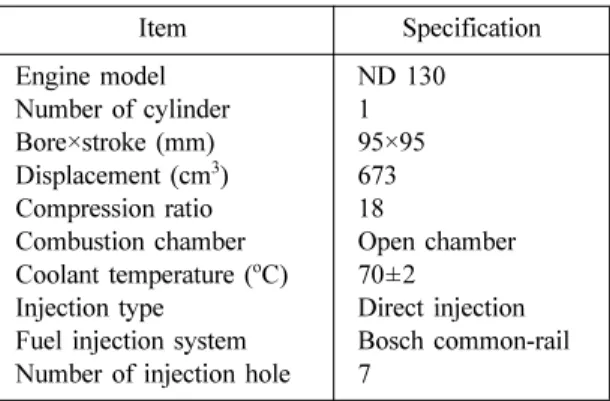
본 연구에서는 혼소엔진시스템을 구현하기 위하여 단 기통, 수냉식, 4행정 직접분사식 상용 디젤기관을 사용 하였으며, eddy current type 엔진 동력계(110 kW)를 이 용하여 기관부하와 기관 회전속도를 제어하였다. Table 1 은 본 연구에 사용된 엔진의 주요 사양을 나타낸 것이다.
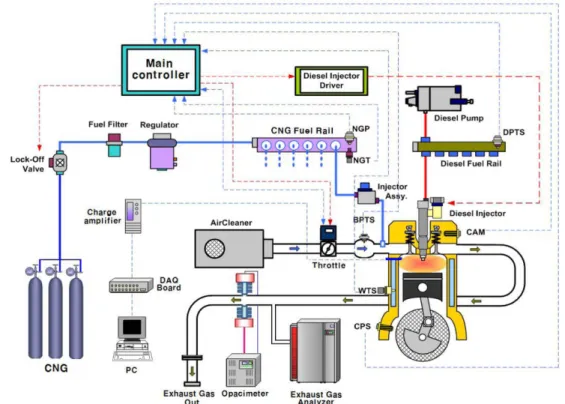
주 연료인 CNG를 착화시키기 위한 파일럿(pilot) 연 료 공급시스템은 상용 고압펌프를 이용하여 커먼레일 (common-rail)에 연료를 가압하고, 레일압력제어기를 사 용하여 설정 압력을 일정하게 유지할 수 있는 커먼레일 시스템을 사용하였다. 파일럿 분사기는 7-hole 솔레노이 드 인젝터를 사용하였으며 파일럿연료의 분사량은 1500 rpm의 엔진속도에서 µs 단위로 제어하였다.
주 연료인 압축천연가스(compressed natural gas, CNG) 는 흡입행정시에 공급할 수 있도록 흡기관에 CNG 인젝 터를 장착하였고, 고압연료탱크에서 공급된 천연가스는 레귤레이터를 통하여 0.6 MPa의 일정한 압력으로 CNG 레일로 공급되도록 하였으며, 메인 제어기에서 CNG 인 젝터로 연료 공급량에 맞게 펄스를 발생하는 방법으로 CNG의 분사량을 제어하였다. 또한, CNG의 공급량은 천연가스 전용 질량 유량계(TSM-140, MKP)를 사용하 여 측정하였으며, 경유 pilot 연료량은 별도로 설치된 계 량병을 이용하여 측정하였다.
한편, 실린더 헤드에 설치된 피에조 압력센서(6051B1, Kistler)를 이용하여 실린더내의 압력신호를 검출하고 charge amplifier(5015A, Kistler)와 DAQ 보드(PCI-6143, National Instrument)를 거쳐 연소변동해석을 위한 연소 실 압력을 측정하였다.
Table 1 Specifications of test engine Item Specification Engine model
Number of cylinder Bore×stroke (mm) Displacement (cm3) Compression ratio Combustion chamber Coolant temperature (oC) Injection type
Fuel injection system Number of injection hole
ND 130 1 95×95 673 18
Open chamber 70±2
Direct injection Bosch common-rail 7
배출가스는 엔진동력계에 장착된 실험용 엔진의 배기 다기관으로부터 후방 2 m 위치에 설치된 배기가스 분석
기(Vario plus, MRU)와 Opacimeter(OP-130, EplusT)를 이용하여 배기가스를 채취하고 분석·평가하였다. Fig.
1은 실험장치의 개략도를 나타낸 것이다.
Table 2는 실험에 사용된 pilot 연료인 경유와 바이오 디젤, 그리고 주 연료인 CNG의 물성치를 각각 나타낸 것으로, 경유, 바이오디젤, 그리고 CNG의 발열량은 각 각 43.116 MJ/kg, 40.001 MJ/kg, 43.58 MJ/Nm3이었다.
2.2 실험 방법
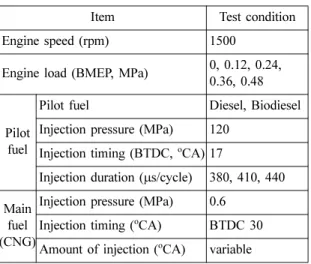
실험은 엔진 냉각수 온도는 70±2oC로 일정하게 제어 한 상태에서, 엔진 회전수를 1500 rpm으로 일정하게 설 정해 놓고 엔진부하를 제동평균유효압력(brake mean effective pressure, BMEP) 0, 0.12, 0.24, 0.36, 0.48 MPa 의 범위로 변화시켜 가면서 수행하였다. 파일럿 분사량 은 엔진회전속도 1500 rpm과 파일럿 연료의 분사압력 120 MPa 상태에서 1사이클 당 혼합연소가 가능한 최소 연료량(0.12 mg/cycle)을 기준으로 파일럿연료의 분사지 속기간을 380 µs, 410 µs, 440 µs로 변화시켜가면서 조 절하였다. 엔진 회전수 및 부하의 제어는 주 연료인 CNG의 공급량을 변화시켜가면서 조절하였다. 일반적으 로 혼소시스템의 경우, 람다(Lambda) 값을 1.6~1.9의 범 Table 2 Properties of fuels used in this study
Item Unit Diesel fuel Biodiesel CNG Flash Point PM, oC 72 78 -
Kinematic
Viscosity 40oC, mm2/s 2.52 4.2 -
Sulfur mg/kg 8 1 -
Cetane index - 54 54 < - Density 15oC, kg/m3 826 882 - Lower Heating
value MJ/kg 43.116 40.001 - Net heating
value MJ/Nm3 - - 43.58
Specific gravity
compare to
Air - - 0.55
Burning range % - - 5~15
Ignition temperature
oC - - 537
Fig. 1 Schematic diagram of experimental apparatus
98
/JOURNAL OF ILASS-KOREA VOL. 21 NO. 2 (2016)위에서 조정하나 본 연구에서는 쓰로틀을 전개한 상태 (wide-open throttle, WOT)에서 실험을 수행하였으며, 그 상태에서 람다 값의 변화를 고찰하였다. Table 3은 실험 조건을 정리하여 나타낸 것이다.
3. 실험 결과 및 고찰
3.1 파일럿 분사율에 따른 연소 특성
Fig. 2는 1500 rpm의 엔진회전속도, 120 MPa의 파일 럿 연료 분사압력, 그리고 410 µs의 파일럿 분사량에서 엔진부하 변화에 따른 혼합연료연소시스템에 대한 도시 평균유효압력(indicated mean effective pressure, IMEP) 과 도시평균유효압력의 연소변동(coefficient of variations, COV)을 나타낸 것이다. 엔진부하가 증가할수록 도시평 균유효압력은 증가하는 일반적인 특성을 보였으나 파일 럿연료의 종류에 따라서는 특별한 경향이 나타나지 않 았다. 하지만, 연소변동 측면에서는 일반적으로 안정적 인 연소변동 특성을 3%이하로 볼 때(25), 무부하에서는 경유-CNG와 바이오디젤-CNG 혼소시스템 모두에서 약 간 높은 특성을 나타냈으며, 엔진부하가 증가할수록 COV는 매우 안정적인 특성을 나타냈다. 이는 엔진부하 가 증가할수록 엔진연소실 온도가 상승하여 파일럿연료 의 착화를 촉진시켰기 때문으로 판단된다. 한편 파일럿 연료의 종류에 따라서는 연소변동의 차이가 나타나지 않음을 알 수 있었다.
Fig. 3은 1500 rpm의 엔진회전속도에서 바이오디젤- CNG 혼합연소시 파일럿 연료의 분사량에 따른 도시평
균유효압력의 연소변동을 나타낸 것이다. 무부하에서는 파일럿 연료가 증가할수록 연소변동이 증가하는 특성을 보였으나 엔진부하가 증가할수록 전체적으로 연소변동 이 작아지는 특성을 보였으나 파일럿연료의 분사량에 따라서는 특별한 연소변동의 특성을 나타내지 않았다.
이는 엔진부하 증가로 인한 연소실 온도 상승이 파일럿 연료의 분사량 증가로 인한 것보다 연소변동에 더 큰 영향을 미쳤기 때문으로 판단되며, 엔진부하의 증가로 인해 연소실 온도가 상승함에 따라 연료의 착화가 안정 적으로 이루어진 반면 무부하에서는 연소실 온도가 상 대적으로 낮기 때문에 연소안정성이 떨어진 것으로 판 단된다.
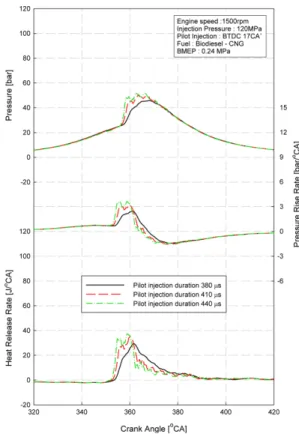
Fig. 4와 5는 엔진부하 BMEP 0.24 MPa에서 파일럿 연료의 분사량 증가에 따른 경유-CNG 혼합연소와 바이 오디젤-CNG 혼합연소의 압력, 압력상승율 및 열발생율 을 각각 나타낸 것이다. 두 연소시스템 모두의 경우에서 파일럿 연료의 분사량이 증가함에 따라 연소의 시작점 이 진각됨을 알 수 있었고, 최고 연소압력, 최고 압력상 Table 3 Test conditions
Item Test condition Engine speed (rpm) 1500
Engine load (BMEP, MPa) 0, 0.12, 0.24, 0.36, 0.48
Pilot fuel
Pilot fuel Diesel, Biodiesel Injection pressure (MPa) 120
Injection timing (BTDC, oCA) 17
Injection duration (µs/cycle) 380, 410, 440 Main
fuel (CNG)
Injection pressure (MPa) 0.6 Injection timing (oCA) BTDC 30 Amount of injection (oCA) variable
Fig. 2 IMEP and COVimep of dual fuel combustion modes versus various engine loads
Fig. 3 COVimep of Biodiesel-CNG dual fuel combustion mode versus various engine loads according to pilot injection rates
승율, 그리고 최고 열발생율이 더 크게 증가됨을 알 수 있었다. 이는 파일럿 연료의 양이 증가함에 따라 주 연 료인 CNG의 연소를 위한 착화에너지가 증가하였고 연 소실 내로의 분무관통길이가 길어져 주 연료로의 더 빠 른 화염전파속도를 이끌었기 때문으로 사료된다.
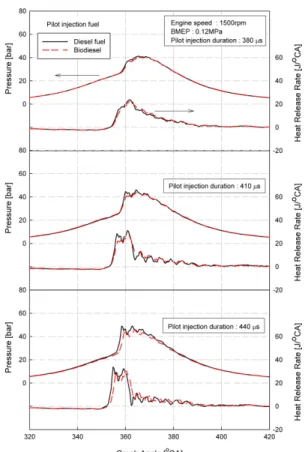
Fig. 6과 7은 엔진부하 BMEP 0.12 MPa과 0.48 MPa 에서 파일럿 연료의 분사량 증가에 따른 경유-CNG 혼 합연소와 바이오디젤-CNG 혼합연소의 압력과 열발생 율을 각각 비교하여 나타낸 것이다. 저부하(Fig. 6)에서 는 파일럿 연료로 바이오디젤을 사용한 경우보다 경유 를 사용한 경우에서 연소가 더 빠르게 시작됨을 알 수 있고, 파일럿 분사량이 증가할수록 연소진각이 더 크게 나타났다. 하지만, 고부하(Fig. 7)에서는 파일럿 연료나 파일럿 연료의 분사량에 따라서 특별한 차이가 없이 거 의 동일한 연소압력과 열발생율 곡선을 나타냈다. 이는 발열량이 더 높은 경유가 저부하에서는 주 연료인 CNG 의 연소를 더 크고 빠르게 착화시켰기 때문으로 판단되
고, 고부하에서는 부하증가에 따른 연소실내 분위기 온 도 상승으로 착화연료의 효과가 적게 나타나 연소특성 이 비슷하게 나타난 것으로 사료된다.
3.3 파일럿 분사율에 따른 배기배출물 특성 Fig. 8은 경유-CNG와 바이오디젤-CNG 혼소시 파일 럿 연료의 분사량 증가에 따른 매연의 배출특성을 나타 낸 것이다. 전체적으로 엔진부하와 파일럿 연료가 증가 할수록 매연의 배출량은 증가하는 전형적인 특성으로 보였으나, 파일럿 연료로 경유를 사용한 경우보다는 바 이오디젤을 사용한 경우가 더 낮은 매연 배출특성을 보 였다. 이는 바이오디젤이 연료속에 산소를 함유하고 있 어 연소를 더 활발하게 촉진시켰기 때문으로 사료된 다.(17~19)
Fig. 9는 BMEP 0.12MPa의 엔진부하에서 경유-CNG 와 바이오디젤-CNG 혼소시 파일럿 연료의 분사량 증가 에 따른 NOx, CO, HC, 그리고 CO2의 배출특성을 나타 Fig. 4 Characteristic of cylinder pressure, pressure rise
rate, and heat release rate versus pilot injection rates in Diesel-CNG Dual fuel Combustion at engine load of BMEP 0.24 MPa and engine speed of 1500 rpm
Fig. 5 Characteristic of cylinder pressure, pressure rise rate, and heat release rate versus pilot injection rates in Biodiesel-CNG Dual fuel Combustion at engine load of BMEP 0.24 MPa and engine speed of 1500 rpm
100
/JOURNAL OF ILASS-KOREA VOL. 21 NO. 2 (2016)낸 것이다. NOx의 경우, 두 혼소시스템에서 파일럿 연 료의 분사량이 증가할수록 증가하는 특성을 나타냈고, 전체적으로 파일럿 연료로 경유를 사용한 경우가 바이
오디젤을 사용한 경우보다 높게 배출하였으나 파일럿분 사량 증가측면에서는 일반적으로 나타나는 매연과의 상 반관계(trade-off relationship)는 나타나지 않았다.
Fig. 6 Comparison of diesel fuel and biodiesel fuel as a pilot injection fuel according to pilot injection rates in Dual fuel Combustion at engine load of BMEP 0.12 MPa
Fig. 7 Comparison of diesel fuel and biodiesel fuel as a pilot injection fuel according to pilot injection rates in Dual fuel Combustion at engine load of BMEP 0.48 MPa
Fig. 8 Effect of pilot injection rates on smoke at (a) diesel-CNG and (b) biodiesel-CNG dual fuel combustion modes
이는 파일럿 연료의 양이 증가함에 따라서 착화에너 지가 증가하여 주 연료인 CNG의 연소를 활발하게 촉진 시켰기 때문에 NOx가 증가하고, 매연의 주 생성원인이 파일럿 연료의 양에 기인하기 때문으로 판단된다.
CO와 HC 배출량은 파일럿 연료의 종류에 따라서는 특정한 경향을 보이지 않았으나 파일럿 연료의 분사량 이 증가함에 따라서는 CO와 HC의 배출이 감소하는 특 성을 나타냈다. CO2의 경우 파일럿 분사량이 증가할수 록 약간씩 증가하는 경향을 나타냈으며, 파일럿 연료로 경유를 사용한 경우보다는 바이오디젤을 사용한 경우가 더 높은 CO2를 배출하였다. 이는 바이오디젤이 연료속 에 산소를 함유하고 있어 연소가 더욱 활발하게 일어났 기 때문으로 분석된다.
4. 결 론
단기통 디젤기관에서 바이오디젤-CNG 혼합연료 연
소시 파일럿 연료의 분사량에 따른 연소 특성 및 배기 특성을 살펴본 결과 다음과 같은 결과를 얻었다.
1) 엔진 부하가 증가할수록 파일럿 연료나 파일럿 분 사량의 변화에서는 특별한 경향이 나타나지 않았으며, 무부하를 제외하고는 파일럿 연료나 파일럿 분사량에 상관없이 연소변동이 매우 작음을 알 수 있었다.
2) 파일럿 연료의 분사량이 증가함에 따라 연소의 시 작점이 진각됨을 알 수 있었고, 최고 연소압력, 최고 압 력상승율, 그리고 최고 열발생율이 더 크게 증가됨을 알 수 있었다.
3) 매연의 배출량은 파일럿 연료의 분사량과 엔진부 하가 증가할수록 증가하는 전형적인 특성으로 보였으 나, 파일럿 연료로 바이오디젤을 사용한 경우가 더 낮게 배출함을 알 수 있었다. NOx의 경우, 두 혼소시스템에 서 파일럿 연료의 분사량이 증가할수록 증가하는 특성 을 나타냈고, 전체적으로 파일럿 연료로 경유를 사용한 경우가 바이오디젤을 사용한 경우보다 높게 배출하였으 나 파일럿 분사량 증가와 관련해서는 일반적으로 나타나 Fig. 9 Effect of pilot injection rates on (a) NOx, (b) CO, (c) HC and (d) CO2 emissions
102
/JOURNAL OF ILASS-KOREA VOL. 21 NO. 2 (2016)는 매연과의 상반관계가 나타나지 않음을 알 수 있었다.
4) CO와 HC 배출량은 파일럿 연료의 분사량이 증가 함에 따라서는 감소하는 특성을 나타냈으며, CO2의 경 우 파일럿 연료로 바이오디젤을 사용하고 파일럿 분사 량이 증가할수록 증가하는 경향이 있음을 알 수 있었다.
후 기
이 논문은 2014년도 군산대학교 대학자체 학술공모 과제 연구비지원에 의해 연구되었음.
참고문헌
(1) N. Lubbe and U. Sahlin, “Benefits of biofuels in Swe- den: A probabilistic re-assessment of the index of new cars' climate impact”, Applied Energy, Vol. 92, pp.
473~479, 2012.
(2) S. Kimura, O. Aoki, Y. Kitahara and E. Aiyoshizawa,
“Ultra-Clean Combustion Technology Combining a Low-Temperature and Premixed Combustion Concept for Meeting Future Emission Standards”, SAE Paper 2001-01-0200, 2001.
(3) S. J. Kim, “A Special Law for the Environmental Improvement of Air Quality in the Metropolitan Area and a Policy for the Supply of Low Emission Vehi- cles”, Fall Conference Special Session Proceedings, KSAE, pp. 31~43, 2004.
(4) J. M. Lopez, A. Gomez, F. Aparicio and F. J. Sanchez,
“Comparison of GHG emissions from diesel, biodiesel and natural gas refuse trucks of the City of Madrid”, Applied Energy, Vol. 86, No. 5, pp. 610~615, 2009.
(5) A. Pfeifer, M. Smeets, H. Herrmann, D. Tomazic, F.
Richert and A. Schlober, “A New Approach to Boost Pressure and EGR rate Control Development for HD Truck Engines with VGT”, SAE Paper 2002-01-0964, 2002.
(6) 이석환, 김홍석, 이진욱, 조규백, 홍순철, “LNG-디젤 혼소엔진의 성능 및 실차 적용성 연구”, 한국액체미 립화학회지, 제16권, 제2호, pp. 97~103, 2011.
(7) R. A. B. Semin, “A Technical Review of Compressed Natural Gas as an Alternative Fuel for Internal Com- bustion Engines”, American Journal Engineering Applied Science, Vol. 1, No. 4, pp. 302~311, 2008.
(8) R. A. Erickson, K. Campbell and D. L. Morgan, “Appli- cation of Dual-Fuel Engine Technology for On-High- way Vehicles, ASEM Internal Combustion Engine Division”, 2003 Spring Technical Conference, ICES2003- 586, 2003.
(9) 이선엽, 김영민, 이장희, “디젤 분사 특성이 Biogas-디 젤 혼소엔진 성능에 미치는 영향”, 한국액체미립화학 회지, 제15권, 제4호, pp. 195~201, 2010.
(10) Taeheun Joo, Changjun Lee, Pyungchul Na, Gangchul Kim, Youngdug Pyo and Youngjae Lee, “Engine Per- formance and Exhaust Characteristics of 2.5 ton Retro- fit CNG Truck”, Fall Conference Proceedings, KSAE, Vol. I, pp. 340~345, 2004.
(11) J. Kusaka, T. Okamoto, Y. Daisho, R. Kihara and T.
Saito, “Combustion and exhaust gas emission charac- teristics of a diesel engine dual-fueled with natural gas”, JSAE Review, Vol. 21, pp. 489~496, 2000.
(12) Mohamed Y. E. Selim, “Effect of engine parameters and gaseous fuel type on the cyclic variability of dual fuel engines”, Fuel, Vol. 84, pp. 961~971, 2005.
(13) R. G. Papagiannakis, C. D. Rakopoulos, D. T. Hounta- las and D. C. Rakopoulos, “Emission characteristics of high speed, dual fuel, compression ignition engine operating in a wide range of natural gas/diesel fuel pro- portions”, Fuel, Vol. 89, pp. 1397~1406, 2010.
(14) W. A. Abdelghaffar, “Performance and Emissions of a Diesel Engine Converted to Dual Diesel-CNG Fuel- ling”, European Journal Scientific Research, Vol. 56, No. 2, pp. 279~293, 2011.
(15) E. G. Varuvel, N. Mrad, M. Tazerout and F. Aloui,
“Experimental analysis of biofuel as an alternative fuel for diesel engines”, Applied Energy, Vol. 94, pp.
224~231, 2012.
(16) E. Mancaruso and B. M. Vaglieco, “Premixed combus- tion of GTL and RME fuels in a single cylinder research engine”, Applied Energy, Vol. 91, No. 1, pp. 385~394, 2012.
(17) G. Knothe, “Dependence of biodiesel fuel properties on the structure of fatty acid alkyl esters”, Fuel Process Technology, Vol. 86, pp. 1059~1070, 2005.
(18) K. Ryu and Y. Oh, “Combustion characteristics of an agricultural diesel engine using biodiesel fuel”, KSME International Journal, Vol. 18, pp. 709~717, 2004.
(19) K. Ryu, J. Park and K. Choi, “Performance and Emis- sion Characteristics of Dual-fuel(Diesel-CNG) Com- bustion in a Diesel Engine”, KSAE, Vol. 18, No. 4, pp.
132~139, 2010.
(20) Bo Yang, Long Wang, Le Ning and Ke Zeng, “Effects of pilot injection timing on the combustion noise and particle emissions of a diesel/natural gas dual-fuel engine at low load”, Applied Thermal Engineering, Vol. 102, pp. 822~828, 2016.
(21) Y. Yoshimoto, E. Kinoshita, S. Luge and T. Ohmura,
“Combustion Characteristics of a Dual Fuel Diesel Engine with Natural Gas (Lower limit of Cetane Num- ber for Ignition of the Fuel)”, SAE International Jour- nal Fuels Lubricants, Vol. 5, No. 3, pp. 1165~1173, 2012.
(22) O. M. I. Nwafor, “Knock characteristics of dual-fuel
combustion in diesel engines using natural gas as pri- mary fuel”, SADHANA, Vol. 27, Part 3, pp. 375~382, 2002.
(23) K. Ryu, “Effects of pilot injection timing on the com- bustion and emissions characteristics in a diesel engine using biodiesel-CNG dual fuel”, Applied Energy, Vol.
111, pp. 721~730, 2013.
(24) K. Ryu, “Effects of pilot injection pressure on the com- bustion and emissions characteristics in a diesel engine using biodiesel-CNG dual fuel”, Energy Conversion and Management, Vol. 76, pp. 506~516, 2013.
(25) J. Heywood, Internal Combustion Engine Fundamen- tals, McGraw-Hill, 1988.