• 검색 결과가 없습니다.

Chlorophyll Fluorescence Characteristics and Rapid Light Response Curves of Alpine Rhododendron Species across Elevation Gradients

N/A
N/A
Protected

Academic year: 2021

Share "Chlorophyll Fluorescence Characteristics and Rapid Light Response Curves of Alpine Rhododendron Species across Elevation Gradients"

Copied!
10
0
0

로드 중.... (전체 텍스트 보기)

전체 글

(1)

Received: November 3, 2018 Revised: April 17, 2019 Accepted: May 16, 2019

OPEN ACCESS

HORTICULTURAL SCIENCE and TECHNOLOGY 37(4):463-472, 2019

URL: http://www.kjhst.org pISSN : 1226-8763 eISSN : 2465-8588

This is an Open Access article distributed under the terms of the Creative Commons Attribution Non-Commercial License which permits unrestricted non-commercial use, distribution, and reproduction in any medium, provided the original work is properly cited.

Copyrightⓒ2019 Korean Society for Horticultural Science.

This study was financially supported by grant 2017YFC0505204 from the National Key Research and Development Project of China and grants 31560224, 31870529, and 51869032 from the National Natural Science Foundation of China, the Young Academic and Technical Leader Raising Foundation of Yunnan Province (2018HB035) and the Program for Excellent Young Talents, Yunnan University.

Chlorophyll Fluorescence Characteristics and Rapid Light Response Curves of Alpine Rhododendron Species across Elevation Gradients

Yuan-Huan Liu 1† , Fang-Li Liu 1† , Bo Long 1† , Xiong-Li Zhou 1 , Xue Zhang 1 , Yue Zhang 1 , Wen-Li Wang 2 , and Shi-Kang Shen 1*

1

School of Life Sciences, Yunnan University, Kunming 650091, China

2

School of Ecology and Environmental Sciences, Yunnan University, Kunming 650091, China

*Corresponding author: [email protected]

These authors contributed equally to this work.

Abstract

The aim of this study was to determine the photosynthetic adaptability of Rhododendron species to alpine environments. The chlorophyll fluorescence parameters and rapid light response curves of eight Rhododendron species were determined under field conditions across elevation gradients (at elevations of 2,950, 3,560, 3,660, 3,770, and 4,030 m) in the Jiaozi Mountain National Natural Reserve, Yunnan Province, southwestern China. The effect of different elevations, species, and their interactions significantly affected most of the chlorophyll fluorescence and rapid light response curve parameters. The variable to maximum fluorescence ratio (F

v

/F

m

) ranged from 0.78 to 0.81 at the five elevation gradients. This result indicated that the studied species were well grown and adapted to the current environment. The correlation analysis indicated that the elevation was positively significantly correlated with the photochemical efficiency of photosystem II, electron transport rate, maximum electron transport rate, light saturation coefficient (E

k

), and chlorophyll relative content (SPAD: leaf chlorophyll content index) and was negatively significantly correlated with photochemical quenching, nonphotochemical quenching, and linear initial slope values. Although no significant relationship was observed between the elevations and F

v

/F

m

, the apparent difference in F

v

/F

m

both at elevation gradients and elevation × species levels indicated that the Rhododendron species demonstrated species-specific adaptation to the environment at different elevations. Our results provided evidence that Rhododendron species exhibit variations in photosynthetic activities in an alpine environment at different elevations. These differences may improve the understanding of the physiological adaptation variations of Rhododendron species across elevation gradients in association with climate change in the mountains of southwestern China.

Additional key words: adaptation, alpine environment, climate change, eco-evolution, plant physiology

Introduction

Rhododendron L. is one of the largest woody plant genera and comprises at least 1,025 species

globally. This genus is widely distributed from the northern temperate zone, throughout tropical

Southeast Asia, to northeastern Australia (Chamberlain et al., 1996). Rhododendron species are

(2)

major components of alpine and subalpine vegetation; they play critical roles in forest composition, functional processes, and ecosystem stability and are also famous as woody ornamental plants worldwide (Shen et al., 2015; Zhang et al., 2017).

They thrive at different elevation gradients from the tropics to the alpine areas (Shrestha et al., 2017). Complex changes in environmental factors, such as light, temperature, nutrient, water availability, and UV-B radiation, occur over short distances associated with elevation, leading to distinct changes in the selection pressures imposed on plant adaptation (Vetaas and Grytnes, 2002; Kofidis et al., 2007; Wang et al., 2014; Gong et al., 2018). Thus, elevation gradients provide a unique and perfect “natural laboratory” to study the morphological and physiological responses of plants to environmental changes (Körner, 1999; Reinhardt et al., 2011; Villemereuil et al., 2018).

Chlorophyll fluorescence analysis is an effective approach in measuring photosystem II (PSII) activity and a commonly used technique in plant physiology. It is nondestructive and noninvasive and hence has a wide range of applications, such as rapid identification of injuries in leaves without visual symptoms and detailed analysis of causes of changes in photosynthetic capacity (Schreiber et al., 1995; Matysiak, 2004; Bhandari et al., 2018). Chlorophyll fluorescence analysis is a useful tool in understanding the fundamental mechanisms of photosynthesis, responses of plants to environmental change, genetic variation, and ecological diversity (Rascher et al., 2000; Murchie and Lawson, 2013; Pollastrini et al., 2017;

Sancho-Knapik et al., 2018). PSII photochemical activity plays a significant role in the photosynthetic response to external environmental factors, such as temperature, water availability, and UV-B radiation; it has been widely studied using chlorophyll fluorescence analysis (Fracheboud et al., 1999; Kalaji et al., 2016). The acclimatization or adaptation ability of species has also been proposed. For example, Osório et al. (2010) investigated the acclimation of the micropropagated plants of Rhododendron ponticum subsp. baeticum to different irradiances and their recovery after exposure to high irradiance using chlorophyll fluorescence analysis. Matysiak (2004) assessed the effect of light intensity on the growth and physiological responses of Rhododendron microcuttings during acclimatization. Zhou et al. (2017) studied the physiological adaptation mechanism of R. agastum in response to shading through chlorophyll fluorescence measurements.

Although chlorophyll fluorescence analysis is a useful tool in assessing the acclimatization and adaptation of plants in changing environments (Harris et al., 2006), it is rarely used to study the photochemical properties of trees in forests under multiple environmental factor changes, especially at the interspecific levels in the field. Thus, this study was designed to explore the responses of the Rhododendron species to different elevations and associated multiple environmental changes in the field. The chlorophyll fluorescence parameters and rapid light response curves of eight Rhododendron species at five elevation gradients were measured and analyzed, and their relationship with elevation was also discussed. We hypothesized that Rhododendron species would exhibit variations in photosynthetic activities related to species-specific adaptation in an alpine environment at different elevations. Specifically, the aims of this study were (1) to assess the photosynthetic adaptability of Rhododendron species at different elevations by examining the species’ chlorophyll fluorescence parameters and rapid light response curves and (2) to determine the effect of elevation on the photosynthetic adaptability of Rhododendron species.

Materials and Methods

Study Sites

(3)

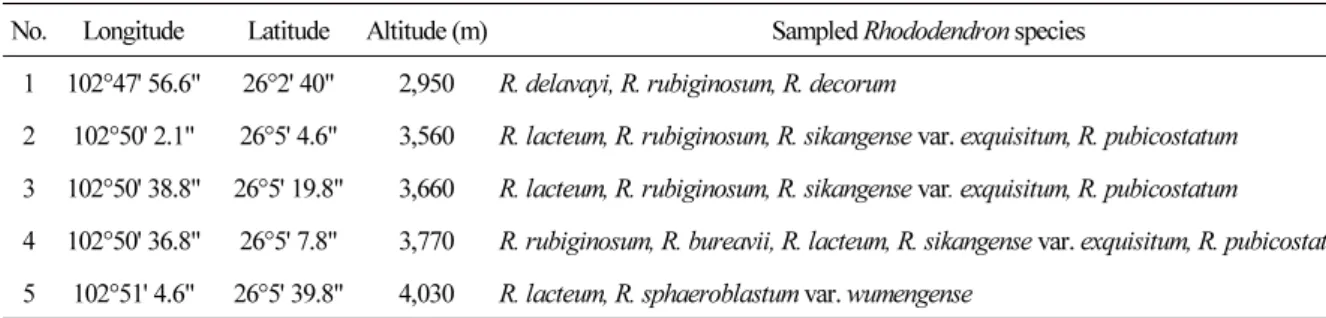
northern Kunming, Yunnan Province, southwestern China. This site has a distinct plateau monsoon climate, and the elevation ranges from 2,300 to 4,300 m. The annual rainfall is ~1,800 mm, and the annual average temperature is 2- to 6°C. Based on a previous survey, the main vegetation of this forest is broad-leaved trees, in particular alpine Rhododendron and Sabina squamata species. A great variety of Rhododendron species (~20) were also found in the same nature reserve. Five elevation gradients (at elevations of 2,950, 3,560, 3,660, 3,770, and 4,030 m) were selected as the experimental sample plots. Different Rhododendron species were collected as the test materials from the five sample plots. GPS was used to record the latitude and longitude of each sample plot. The five different elevational plots and sampled Rhododendron species are shown in Table 1 .

Table 1. Details of sample plots and species along different elevation gradients in this study

No. Longitude Latitude Altitude (m) Sampled Rhododendron species

1 102°47' 56.6" 26°2' 40" 2,950 R. delavayi, R. rubiginosum, R. decorum

2 102°50' 2.1" 26°5' 4.6" 3,560 R. lacteum, R. rubiginosum, R. sikangense var. exquisitum, R. pubicostatum 3 102°50' 38.8" 26°5' 19.8" 3,660 R. lacteum, R. rubiginosum, R. sikangense var. exquisitum, R. pubicostatum

4 102°50' 36.8" 26°5' 7.8" 3,770 R. rubiginosum, R. bureavii, R. lacteum, R. sikangense var. exquisitum, R. pubicostatum 5 102°51' 4.6" 26°5' 39.8" 4,030 R. lacteum, R. sphaeroblastum var. wumengense

Chlorophyll Fluorescence Test

The Rhododendron leaves were collected from the same cardinal points in June 2017. After sampling, the branches were immediately placed in hermetic plastic bags. The branches in the plastic bags were humidified to avoid leaf dehydration until they reached the laboratory on the same day (Pollastrini et al., 2017). Nine mature leaves from three individual plants (three branches were selected from each plant, and one leaf was selected from each branch) for each species were harvested for the analysis of the chlorophyll fluorescence parameters and chlorophyll relative content (SPAD: leaf chlorophyll content index). Average values were calculated. The SPAD of the leaves was measured using the SPAD-502Plus meter (Konica Minolta, Tokyo, Japan).

To prepare for the analysis, the leaves were dark adapted for at least 20 min. The chlorophyll fluorescence parameters

were measured using a portable fluorometer (MINI-PAM, Walz, Effeltrich, Germany) at ambient temperature (18 -

25°C). The maximum photochemical efficiency of PSII was estimated using the variable to maximum fluorescence ratio

(F

v

/F

m

= (F

m

- F

0

)/F

m

) calculated from the basal fluorescence (F

0

) and maximum fluorescence (F

m

), with variable

fluorescence (F

v

) = F

m

- F

0

. The leaves were irradiated with actinic radiation (333 µmol·m

-2

·s

-1

) until stable photosynthesis

occurred. The steady-state fluorescence (F

s

) was recorded; subsequently, a saturating flash was imposed to determine the

maximum level in the light-adapted state (F

m

'). The actinic light was removed, and the leaves were irradiated with far-red

light to obtain F

0

adapted to light (F

0

'). The nonphotochemical quenching (q

N

), photochemical quenching (q

P

), electron

transport rate (ETR), and actual photochemical efficiency of PSII ( Φ

PSII

) were calculated as 1 - (F

m

' - F

0

')/(F

m

- F

0

), 1 - (F

s

- F

0

')/(F

m

' - F

0

'), Φ

PSII

× PAR (photosynthetic active radiation) × 0.84 × 0.5, and (F

m

' - F

s

)/F

m

', respectively (Osório et al.,

2010).

(4)

Rapid Light Response Curves

The rapid light response curves were measured using a MINI-PAM fluorometer (Walz, Effeltrich, Germany). The actinic illumination was applied in eight steps (134, 229, 333, 453, 663, 895, 1,340, and 1,964 µmol·m

-2

·s

-1

); each step lasted for 10 s. The parameters, namely, the maximum electron transport rate (ETR

max

), light saturation coefficient (E

k

), and linear initial slope ( α), were obtained using the rapid light response curve fitting formula: ETR = ETR

max

* (1-e

-α*PAR/ETR

) *e

-β*PAR/ETRmax

, E

k

= ETR

max

/ α (Platt et al., 1980).

Statistical Analysis

The influence of the elevation and species on the chlorophyll fluorescence and leaf chlorophyll content was analyzed with general linear models (GLMs) using R and sequential (type I) sums of squares (Schmid et al., 2002). The elevations and species were regarded as fixed factors. The variance was related to the main treatments and the interaction between them. For post hoc analysis, Tukey’s multiple comparison test was used (p < 0.05).The relationships between chlorophyll fluorescence and elevations and between the rapid light response curves and elevations were determined using Pearson’s correlation analysis. All statistical analyses were performed using SPSS version 13.0 software (SPSS Inc., Chicago, IL, USA).

Results

Characteristics of Chlorophyll Fluorescence Parameters

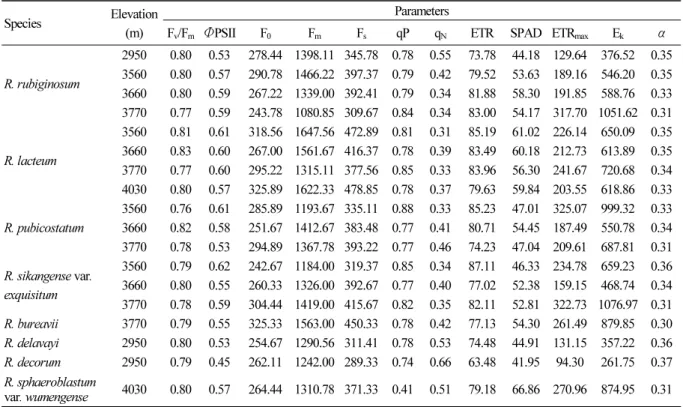
The average values of the chlorophyll fluorescence parameters of the Rhododendron species across the five elevation gradients in Jiaozi Mountain are shown in Fig. 1 . The F

v

/F

m

ranged from 0.78 to 0.81 at the five elevation gradients. The Φ

PSII

ranged from 0.51 to 0.60; the lowest and highest values were recorded at elevations of 2,950 and 3,560 m, respectively (Table 2) . Significant differences in F

v

/F

m

and Φ

PSII

at the five elevation gradients were detected (p < 0.05).

No significant difference in F

m

or slight difference in F

0

at the five elevations was noted, whereas a significant difference in F

s

at the five elevations was observed. The q

P

and q

N

values ranged from 0.59 to 0.83 and from 0.35 to 0.58, respectively. The elevation significantly affected both q

P

and q

N

(Table 3) . The lowest q

P

was detected at 4,030 m, whereas the highest q

N

occurred at 2,950 m. The lowest ETR was detected at 2,950 m. However, the ETR values decreased when the elevation increased from 3,560 to 4,030 m. In general, the SPAD increased as the elevation increased and reached the highest value of 63.35 at 4,030 m (Table 2) .

Rapid light Response Curves Parameters

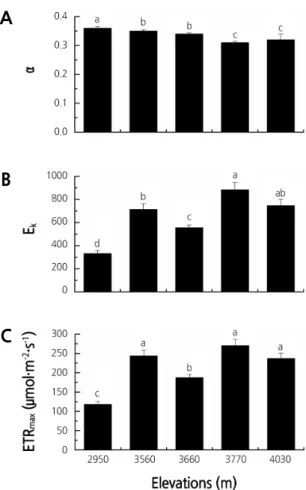
Fig. 2 shows the rapid light response curve parameters of the Rhododendron species at the five elevation gradients in

Jiaozi Mountain. The elevations significantly affected the rapid light response curve parameters of the Rhododendron

species (Fig. 2 and Table 3) . The ETR

max

and E

k

exhibited a similar change tendency; that is, the highest and lowest values

occurred at 3,770 and 2,950 m, respectively. The α ranged from 0.31 to 0.36 and decreased with increasing elevation.

(5)

B

A C

E

D F

H

G I

Fig. 1. Characteristics of chlorophyll fluorescence parameters of Rhododendron species at five elevation gradients on Jiaozi Mountain. (A) Variable to maximum fluorescence ratio (F

v

/F

m

), (B) Actual photochemical efficiency of PSII (ΦPSII), (C) Basal fluorescence (F

0

), (D) Maximum fluorescence (F

m

), (E) The steady-state fluorescence (F

s

), (F) The photochemical quenching (qP), (G) The nonphotochemical quenching (q

N

), (H) The electron transport rate (ETR), (I) The chlorophyll relative content (SPAD). Different letters indicate statistically significant differences at p ≤ 0.05.

Table 2 Characteristics of chlorophyll fluorescence (Chl) and rapid light response curve (RLC) parameters of Rhododendron species at each elevation

Species Elevation

(m)

Parameters

F

v

/F

m

ΦPSII F

0

F

m

F

s

qP q

N

ETR SPAD ETR

max

E

k

α

R. rubiginosum

2950 0.80 0.53 278.44 1398.11 345.78 0.78 0.55 73.78 44.18 129.64 376.52 0.35 3560 0.80 0.57 290.78 1466.22 397.37 0.79 0.42 79.52 53.63 189.16 546.20 0.35 3660 0.80 0.59 267.22 1339.00 392.41 0.79 0.34 81.88 58.30 191.85 588.76 0.33 3770 0.77 0.59 243.78 1080.85 309.67 0.84 0.34 83.00 54.17 317.70 1051.62 0.31

R. lacteum

3560 0.81 0.61 318.56 1647.56 472.89 0.81 0.31 85.19 61.02 226.14 650.09 0.35 3660 0.83 0.60 267.00 1561.67 416.37 0.78 0.39 83.49 60.18 212.73 613.89 0.35 3770 0.77 0.60 295.22 1315.11 377.56 0.85 0.33 83.96 56.30 241.67 720.68 0.34 4030 0.80 0.57 325.89 1622.33 478.85 0.78 0.37 79.63 59.84 203.55 618.86 0.33

R. pubicostatum

3560 0.76 0.61 285.89 1193.67 335.11 0.88 0.33 85.23 47.01 325.07 999.32 0.33 3660 0.82 0.58 251.67 1412.67 383.48 0.77 0.41 80.71 54.45 187.49 550.78 0.34 3770 0.78 0.53 294.89 1367.78 393.22 0.77 0.46 74.23 47.04 209.61 687.81 0.31 R. sikangense var.

exquisitum

3560 0.79 0.62 242.67 1184.00 319.37 0.85 0.34 87.11 46.33 234.78 659.23 0.36 3660 0.80 0.55 260.33 1326.00 392.67 0.77 0.40 77.02 52.38 159.15 468.74 0.34 3770 0.78 0.59 304.44 1419.00 415.67 0.82 0.35 82.11 52.81 322.73 1076.97 0.31 R. bureavii 3770 0.79 0.55 325.33 1563.00 450.33 0.78 0.42 77.13 54.30 261.49 879.85 0.30 R. delavayi 2950 0.80 0.53 254.67 1290.56 311.41 0.78 0.53 74.48 44.91 131.15 357.22 0.36 R. decorum 2950 0.79 0.45 262.11 1242.00 289.33 0.74 0.66 63.48 41.95 94.30 261.75 0.37 R. sphaeroblastum

var. wumengense 4030 0.80 0.57 264.44 1310.78 371.33 0.41 0.51 79.18 66.86 270.96 874.95 0.31

(6)

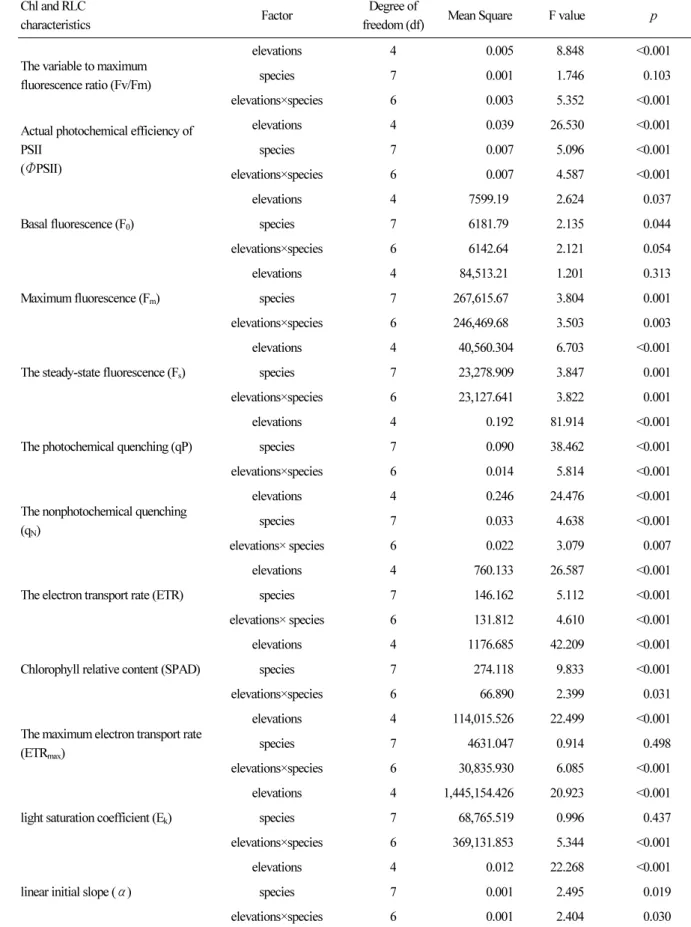
Table 3. Summary of GLMs for the effect of elevations, species, and their interactions on chlorophyll fluorescence (Chl) and rapid light response curve (RLC) parameters

Chl and RLC

characteristics Factor Degree of

freedom (df) Mean Square F value p

The variable to maximum fluorescence ratio (Fv/Fm)

elevations 4 0.005 8.848 <0.001

species 7 0.001 1.746 0.103

elevations×species 6 0.003 5.352 <0.001

Actual photochemical efficiency of PSII

( ΦPSII)

elevations 4 0.039 26.530 <0.001

species 7 0.007 5.096 <0.001

elevations×species 6 0.007 4.587 <0.001

Basal fluorescence (F

0

)

elevations 4 7599.19 2.624 0.037

species 7 6181.79 2.135 0.044

elevations×species 6 6142.64 2.121 0.054

Maximum fluorescence (F

m

)

elevations 4 84,513.21 1.201 0.313

species 7 267,615.67 3.804 0.001

elevations×species 6 246,469.68 3.503 0.003

The steady-state fluorescence (F

s

)

elevations 4 40,560.304 6.703 <0.001

species 7 23,278.909 3.847 0.001

elevations×species 6 23,127.641 3.822 0.001

The photochemical quenching (qP)

elevations 4 0.192 81.914 <0.001

species 7 0.090 38.462 <0.001

elevations×species 6 0.014 5.814 <0.001

The nonphotochemical quenching (q

N

)

elevations 4 0.246 24.476 <0.001

species 7 0.033 4.638 <0.001

elevations× species 6 0.022 3.079 0.007

The electron transport rate (ETR)

elevations 4 760.133 26.587 <0.001

species 7 146.162 5.112 <0.001

elevations× species 6 131.812 4.610 <0.001

Chlorophyll relative content (SPAD)

elevations 4 1176.685 42.209 <0.001

species 7 274.118 9.833 <0.001

elevations×species 6 66.890 2.399 0.031

The maximum electron transport rate (ETR

max

)

elevations 4 114,015.526 22.499 <0.001

species 7 4631.047 0.914 0.498

elevations×species 6 30,835.930 6.085 <0.001

light saturation coefficient (E

k

)

elevations 4 1,445,154.426 20.923 <0.001

species 7 68,765.519 0.996 0.437

elevations×species 6 369,131.853 5.344 <0.001

linear initial slope ( α)

elevations 4 0.012 22.268 <0.001

species 7 0.001 2.495 0.019

(7)

A

B

C

Fig. 2. Rapid light response curve parameters of the Rhododendron species at the five elevation gradients on Jiaozi Mountain. A: linear initial slope (α), B: light saturation coefficient (E

k

), C: the maximum electron transport rate (ETR

max

).

Different letters indicate statistically significant differences at p ≤ 0.05.

Elevation and Species Modifications of the Chlorophyll Parameters

The GLM analysis showed that the effect of the elevations and the interaction of the elevation and species were significant for all the chlorophyll fluorescence and rapid light response curve parameters, except for the effect of the elevations on F

0

and F

m

. Species also exerted a significant effect on the chlorophyll fluorescence parameters, except for F

v

/F

m

and F

0

. However, species exerted no significant effect on ETR

max

and E

k

(Table 3) . The correlation analysis also indicated that the elevation was significantly correlated with most of the chlorophyll fluorescence and rapid light response curve parameters (F

v

/F

m

, F

s

, Φ

PSII

, ETR, ETR

max

, E

k

, and SPAD), except for F

m

and F

0

. Elevation was negatively significantly correlated with q

P

, q

N

, and α.

Discussion

Alpine ecosystems are “fragile” due to carbon limitation and therefore are highly susceptible to environmental changes

(Körner, 1999; Sherman et al., 2008). Alpine plants are subjected to relatively low temperature, high irradiance, and

strong drought conditions associated with high elevations (Streb et al., 1998; Benito et al., 2011; Perera-Castro et al.,

2017). Chlorophyll fluorescence provides insights into the mechanisms of tolerance to environmental stresses and

(8)

information on the contribution of the interspecific differences in response to environmental heterogeneity to the mechanisms of species coexistence and maintenance of biodiversity (Ball et al., 1995; Körner, 1999; Maxwell and Johnson, 2000). Thus, this study on the chlorophyll fluorescence variations across different elevations elucidates how species adapt to environmental changes.

The F

v

/F

m

ratio is one of the most important fluorescence parameters that reflect the maximum quantum efficiency of PSII photochemistry (Hwang and Choo, 2016; Sancho-Knapik et al., 2018). The F

v

/F

m

of dark-adapted leaves is an indicator of the potential photochemical efficiency of PSII and quantum yield (Harris et al., 2006; Kalaji et al., 2016).

Healthy photosynthetic tissues of most plant species exhibit a mean F

v

/F

m

of 0.75 to 0.85 (Bjorkman and Demmig, 1987).

In this study, the F

v

/F

m

ranged from 0.79 to 0.81. This finding indicated that studied species were well grown and adapted to the current environmental conditions. However, the apparent difference in F

v

/F

m

both at elevation gradients and elevation × species levels indicated that the Rhododendron species exhibited species-specific adaptation to the environment at different elevations.

The light energy absorbed by the chlorophyll molecules in leaves drives photosynthesis (q

P

), is dissipated as heat (q

N

), or is re-emitted as chlorophyll fluorescence (Maxwell and Johnson, 2000; Fu et al., 2012). Hence, the changes in q

P

and q

N

reflect the intensity of photosynthesis to some extent. In this study, the Rhododendron species exhibited relatively higher Φ

PSII

and q

P

and lower q

N

at 3560 m than at other elevations. Thus, the Rhododendron species at 3,560 m exhibited stronger adaptability than those at other elevations on Jiaozi Mountain. The species also demonstrated adaptive strategies to the different environments. For instance, the species showed increased q

N

and decreased ETR at 2,950 m and distinctly increased SPAD at 4,030 m to adapt to the corresponding elevations.

Rapid light response curves provide detailed information on the saturation characteristics of electron transport and the overall photosynthetic performance of a plant (White and Critchley, 1999; Ralph and Gademann, 2005; Serôdio et al., 2013). The elevation effect is a proxy for environmental factors, including CO

2

pressure, air temperature, solar irradiance, precipitation, and wind exposure. Each of these factors across the elevation gradient can significantly affect the physiological adaptation of species (Körner, 1999; Wang et al., 2014). Alpine species across elevation gradients need to adapt to the different levels of irradiance and temperature under natural conditions. In some alpine plants, photosynthesis is highly efficient at cool temperatures; they are also adapted to high irradiance (Streb et al., 1998; Körner, 1999). Osório et al. (2010) found that R. ponticum subsp. baeticum exhibits high ETR

max

and E

k

when grown under high irradiance during species acclimation. In this study, significant positive relationships between the ETR

max

and E

k

and the elevations were observed. This finding indicated that the Rhododendron species could increase their ETR

max

and E

k

and could decrease their α as adaptive responses to adverse environmental conditions related to high elevations.

Analysis of the selected chlorophyll parameters and rapid light response curves may be useful for studying the

photosynthetic responses and physiological adaptation variations of alpine Rhododendron species to environmental

changes across elevation gradients. In summary, this study provided evidence that Rhododendron species exhibit

species-specific adaptation to environmental changes at different elevations. Future research should aim to elucidate the

precise mechanism of the responses of Rhododendron species to natural environmental changes.

(9)

Literature Cited

Ball MC, Butterworth JA, Roden JS, Christian R, Egerton J, Wydrzynski TJ (1995) Applications of chlorophyll fluorescence to forest ecology. Funct Plant Biol 22:311-319. doi:10.1071/pp9950311

Benito B, Lorite J, P eñas J (2011) Simulating potential effects of climatic warming on altitudinal patterns of key species in mediterranean-alpine ecosystems. Clim Chang 108:471-483. doi:10.1007/s10584-010-0015-3

Bhandari SR, Kim YH, Lee JG (2018) Detection of temperature stress using chlorophyll fluorescence parameters and stress-related chlorophyll and proline content in paprika (Capsicum annuum L.) seedlings. Hortic Sci Technol 36:619-629. doi:10.12972/kjhst.

20180062

Bjorkman O, Demmig B (1987) Photon yield of O2 evolution and chlorophyll fluorescence characteristics at 77 K among vascular plants of diverse origins. Planta 170:489-504. doi:10.1007/BF00402983

Chamberlain D, Hyam R, Argent G, Fairweather G, Walter KS (1996) The genus Rhododendron: its classification and synonymy. Royal Botanic Gardens Edinburgh, Oxford, UK, pp 1-22

Fracheboud Y, Haldimann P, Leipner J, Stamp P (1999) Chlorophyll fluorescence as a selection tool for cold tolerance of photosynthesis in maize (Zea mays L.). J Exp Bot 50:1533-1540. doi:10.1093/jxb/50.338.1533

Fu W, Li P, Wu Y (2012) Effects of different light intensities on chlorophyll fluorescence characteristics and yield in lettuce. Sci Hortic 135:45-51. doi:10.1016/j.scienta.2011.12.004

Gong J, Zhang Z, Zhang C, Zhang J, Ran A (2018) Ecophysiological responses of three tree species to a high-altitude environment in the southeastern Tibetan plateau. Forests 9:48. doi:10.3390/f9020048

Harris GC, Antoine V, Nevidomskyte D, Koniger M (2006) Seasonal changes in photosynthesis, protein composition and mineral content in Rhododendron leaves. Plant Sci 170:314-325. doi:10.1016/j.plantsci.2005.08.024

Hwang JS, Choo YS (2016) Solute patterns and diurnal variation of photosynthesis and chlorophyll fluorescence in Korean coastal sand dune plants. Photosynthetica 55:1-14. doi:10.1007/s11099-016-0232-8

Kalaji HM, Jajoo A, Oukarroum A, Brestic M, Zivcak M, Samborska IA (2016) Chlorophyll a, fluorescence as a tool to monitor physiological status of plants under abiotic stress conditions. Acta Physiol Plant 38:102. doi:10.1007/s11738-016-2113-y

Kofidis G, Bosabalidis AM, Moustakas M (2007) Combined effects of altitude and season on leaf characteristics of Clinopodium vulgare (Labiatae). Environ Exp Bot 60:69-76. doi:10.1016/j.envexpbot.2006.06.007

Körner C (1999) Alpine plant life: functional plant ecology of high mountain ecosystems. Springer Verlag, Berlin, Heidelberg, Germany, pp 1-165. doi:10.1007/978-3-642-98018-3_1

Matysiak B (2004) Effect of light intensity on growth and chlorophyll fluorescence of Rhododendron microcuttings during acclimatization.

Folia Hortic 16:107-114

Maxwell K, Johnson GN (2000) Chlorophyll fluorescence-a practical guide. J Exp Bot 51:659-668. doi:10.1093/jexbot/51.345.659 Murchie EH, Lawson T (2013) Chlorophyll fluorescence analysis: a guide to good practice and understanding some new applications. J

Exp Bot 64:3983. doi:10.1093/jxb/ert208

Osório ML, Osório J, Romano A (2010) Chlorophyll fluorescence in micropropagated Rhododendron ponticum, subsp. baeticum, plants in response to different irradiances. Biol Plant 54:415-422. doi:10.1007/s10535-010-0076-1

Perera-Castro AV, Brito P, González-Rodríguez ÁM (2017) Light response in alpine species: different patterns of physiological plasticity.

Flora 234:165-172. doi:10.1016/j.flora.2017.07.007

Platt T, Gallegos CL, Harrison WG (1980) Photoinhibition of photosynthesis in natural assemblages of marine phytoplankton. Astron Soc Jpn 57:341-345

Pollastrini M, Nogales AG, Benavides R, Bonal D, Finer L, Fotelli M, Gessler A, Grossiord C, Radoglou K, et al. (2017) Tree diversity affects chlorophyll a fluorescence and other leaf traits of tree species in a boreal forest. Tree Physiol 37:199-208. doi:10.1093/treephys/

tpw132

Ralph PJ, Gademann R (2005) Rapid light curves: a powerful tool to assess photosynthetic activity. Aquat Bot 82:222-237. doi:10.1016/

j.aquabot.2005.02.006

Rascher U, Liebig M, Lüttge U (2000) Evaluation of instant light-response curves of chlorophyll fluorescence parameters obtained with a portable chlorophyll fluorometer on site in the field. Plant Cell Environ 23:1397-1405. doi:10.1046/j.1365-3040.2000.00650.x Reinhardt K, Castanha C, Germino MJ, Kueppers LM (2011) Ecophysiological variation in two provenances of Pinus flexilis seedlings

across an elevation gradient from forest to alpine. Tree Physiol 31:615-625. doi:10.1093/treephys/tpr055

Sancho-Knapik D, Mendoza-Herrer Ó, Gil-Pelegrín E, Peguero-Pina J (2018) Chl fluorescence parameters and leaf reflectance indices allow monitoring changes in the physiological status of Quercus ilex L. under progressive water deficit. Forests 9:400. doi:

10.3390/f9070400

Schmid B, Hector A, Huston MA, Inchausti P, Nijs I, Leadley PW, Tilman D (2002) The design and analysis of biodiversity experiments. In M Loreau, S Naeem, P Inchausti, eds, Biodiversity and Ecosystem Functioning: Synthesis and Perspectives. Oxford University Press, Oxford, UK, pp 61-75

Schreiber U, Bilger W, Neubauer C (1995) Chlorophyll fluorescence as a nonintrusive indicator for rapid assessment of in vivo photosynthesis. Ecophysiology of photosynthesis. Springer Berlin Heidelberg, Germany, pp 49-70. doi:10.1007/978-3-642-79354-7_3 Serôdio J, Ezequiel J, Frommlet J, Laviale M, Lavaud J (2013) A method for the rapid generation of nonsequential light-response curves

of chlorophyll fluorescence. Plant Physiol 163:1089-1102.doi:10.1104/pp.113.225243

(10)

Shen SK, Wu FQ, Yang GS, Wang YH, Sun WB (2015) Seed germination and seedling emergence in the extremely endangered species Rhododendron protistum var. giganteum - the world’s largest Rhododendron. Flora 216:65-70. doi:10.1016/j.flora.2015.08.006 Sherman R, Mullen R, Li H, Fang Z, Wang Y (2008) Spatial patterns of plant diversity and communities in alpine ecosystems of the

Hendguan mountains, northwest Yunnan, China. J Plant Ecol 1:117-136. doi:10.1093/jpe/rtn012

Shrestha N, Su X, Xu X, Wang Z (2017) The drivers of high rhododendron diversity in south-west china: does seasonality matter? J Biogeogr 45:438-447. doi:10.1111/jbi.13136

Streb P, Shang W, Feierabend J, Bligny R (1998) Divergent strategies of photo-protection in high-mountain plants. Planta 207:313-324.

doi:10.1007/s004250050488

Vetaas OR, Grytnes JA (2002) Distribution of vascular plant species richness and endemic richness along the himalayan elevation gradient in Nepal. Global Ecol Biogeogr 11:291-301. doi:10.1111/1365-2745.12955

Villemereuil PD, Mouterde M, Gaggiotti OE, Till-Bottraud I (2018) Patterns of phenotypic plasticity and local adaptation in the wide elevation range of the alpine plant Arabis alpina. J Ecol 106:1952-1971. doi:10.1111/1365-2745.12955

Wang R, Yu G, He N, Wang Q, Xia F, Zhao N, Ge J (2014) Elevation-related variation in leaf stomatal traits as a function of plant functional type: evidence from Changbai mountain, China. PLoS One 9:e115395. doi:10.1371/journal.pone.0115395

White AJ, Critchley C (1999) Rapid light curves: a new fluorescence method to assess the state of the photosynthetic apparatus.

Photosynth Res 59:63-72. doi:10.1023/a:1006188004189

Zhang Y, Zhang X, Wang YH, Shen SK (2017) De novo assembly of transcriptome and development of novel EST-SSR markers in Rhododendron rex Levl. through illumina sequencing. Front Plant Sci 8:1664 doi:10.3389/fpls.2017.01664

Zhou Y, Huang L, Wei X, Zhou H, Chen X (2017) Physiological, morphological, and anatomical changes in Rhododendron agastum, in

response to shading. Plant Growth Regul 81:1-8. doi:10.1007/s10725-016-0181-z

수치

Table 1. Details of sample plots and species along different elevation gradients in this study
Table 2 Characteristics of chlorophyll fluorescence (Chl) and rapid light response curve (RLC) parameters of Rhododendron  species at each elevation
Table 3. Summary of GLMs for the effect of elevations, species, and their interactions on chlorophyll fluorescence (Chl) and  rapid light response curve (RLC) parameters
Fig. 2. Rapid light response curve parameters of the Rhododendron species at the five elevation gradients on Jiaozi  Mountain

참조

관련 문서