• 검색 결과가 없습니다.

Design and Implementation of Internal Multi-Band Monopole Antenna for Mobile Phones

N/A
N/A
Protected

Academic year: 2021

Share "Design and Implementation of Internal Multi-Band Monopole Antenna for Mobile Phones"

Copied!
6
0
0

로드 중.... (전체 텍스트 보기)

전체 글

(1)

Design and Implementation of Internal Multi-Band Monopole Antenna for Mobile Phones

Woon Geun Yang

*★

, Ling Zhi Cai

*

, Cheol Yong Yang

*

Abstract

In this paper, we proposed an internal multi-band monopole antenna for mobile phone that can be used for smart phones. The proposed antenna has a small volume of 38×8.5×5 mm

3

, ground size is 100×60 mm

2

, and covers the GSM900 (Global System for Mobile communications : 880-960 MHz), DCS (Digital Communications System : 1710-1880 MHz), K-PCS (Korea-Personal Communications Service : 1750-1870 MHz), US-PCS (US Personal Communications Service : 1850-1990 MHz), Bluetooth (2400-2483 MHz), Wibro (2300-2390 MHz) and WLAN (Wireless Local Area Network : 2400-2483.5 MHz) bands. The measured peak gains of the implemented antenna are 1.15 dBi at 920 MHz, 3.58 dBi at 1795 MHz, 3.46 dBi at 1810 MHz, 2.91 dBi at 1920 MHz, 5.18 dBi at 2345 MHz, 3.37 dBi at 2442 MHz.

Key words: Monopole, Multi-Band, Internal antenna, Folded

*

Dept. of Electronics Engineering, University of Incheon

Corresponding author

※ Acknowledgement

This work was supported by University of Incheon Research Grant in 2011.

Manuscript received Dec.12,2011;revised Dec.26, 2011 accepted Dec. 27, 2011

I. Introduction

With the development of the mobile communication technology, the function of the mobile phone has been changed more and more diverse. The essentially required characteristic is to support multiple frequency bands for the third generation mobile system[1-2]. In addition to multi-band capability, due to the modern mobile phone design, there are strong demands for small-sized, light weight, and compact mobile stations, easy to manufacture and flexible structure.

Various multi-band planar inverted-F antennas (PIFAs), monopoles, and slot antennas have been reported in the literature for mobile phone applications[1-5]. Monopole antennas have been employed widely in various mobile and

ground-based communication systems due to its simple topology, omnidirectional radiation pattern and moderate efficiency[6-8]. Number of frequency bands covered with a single antenna is increasing, and each design covers specific required frequency band set. For our case, smart phone size is also considered.

In this paper, we propose an internal monopole antenna for multi-band operation covering the GSM900 (Global System for Mobile communications : 880-960 MHz), DCS (Digital Communications System : 1710-1880 MHz), K-PCS (Korea-Personal Communications Service : 1750-1870 MHz), US-PCS (US Personal Communications Service : 1850-1990 MHz), Bluetooth (2400-2483 MHz), Wibro (2300-2390 MHz) and WLAN (Wireless Local Area Network : 2400-2483.5 MHz) with three branch lines.

Basic structure for the proposed antenna is described in chapter 2. Simulation and measurement results for the proposed antenna will be in chapter 3. Finally, conclusion follows in chapter 4.

II. Proposed Antenna

Fig. 1 depicts the proposed internal multi-band

(2)

monopole antenna. For the design studied here, the antenna volume of example design is 38×8.5×5 mm

3

, and it has folded structure. The ground size is 100

(a)

(b) Fig. 1. Proposed antenna

(a) Top and side view,

(b) Parameters of the proposed antenna

Table 1. Design parameters of the proposed antenna (unit : mm)

Parameter Length Parameter Length

L1 5.0 W1 2.5

L2 5.0 W2 11.0

L3 8.5 W3 7.0

L4 5.0 W4 4.0

L5 8.0 W5 31.0

L6 5.0 W6 19.0

L7 7.0 W7 10.0

L8 2.0 W8 13.0

L9 3.0 W9 3.0

L10 5.0 W10 29.0

L11 3.0 W11 2.0

L12 8.0 W12 3.0

L13 6.0 W13 24.0

L14 4.0 W14 27.0

L15 6.0 W15 24.5

L16 5.0

×60 mm

2

. The monopole is located at the left end corner of the FR-4 substrate with the dielectric constant of 4.4 and the substrate thickness of 1.6 mm.

Table 1 shows values of the design parameters which were derived through the simulation.

Ⅲ. Simulation and Measurment The commercial program HFSS (High Frequency Structure Simulator) based on the FEM (Finite Element Method) is used to obtain suitable values of parameters and analyze the behavior of the proposed antenna.

(a)

(b)

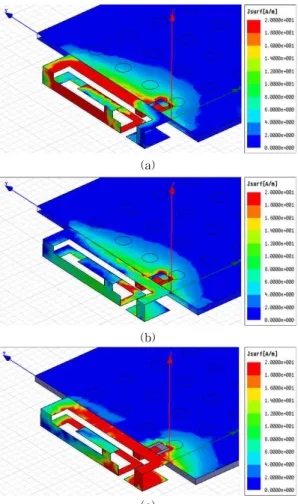
Fig. 2. Current distribution of the proposed antenna (c)

(a) at 920 MHz, (b) at 1795 MHz, (c) at 2442 MHz.

(3)

Fig. 2 shows the excited surface current distributions obtained from the HFSS simulation in

⒜ ⒝

⒞ ⒟

⒠ ⒡

Fig. 3 Simulated 3D radiation patterns of the proposed antenna

⒜ at 920 MHz, ⒝ at 1795 MHz, ⒞ at 1810 MHz,

⒟ at 1920 MHz, ⒠ at 2345 MHz, ⒡ at 2442 MHz.

the radiation element of the proposed antenna at 920 MHz, 1795 MHz, 2442 MHz. The proposed antenna has three branch lines. On the right side, the longest branch is the major radiation element for the proposed antenna at 920 MHz. On the left side, a short branch plays a major role for 2442 MHz.

Fig. 3 shows simulated 3D radiation patterns at 920 MHz,1975 MHz,1810 MHz,1920 MHz, 2345 MHz, 2441 MHz.

Fig. 4 shows the implemented antenna. Fig. 5 shows measurement and simulation results on the S

11

of the proposed antenna. The results show a good agreement between measurement and simulation. The implemented antenna satisfied

multiple operating bands including GSM900 (880-960 MHz), DCS (1710-1880 MHz), K-PCS (1750-1870

Fig. 4. Photo of the implemented antenna

Fig. 5. Simulated and measured S

11

MHz), US-PCS (1850-1990 MHz), Bluetooth (2400-2483 MHz), Wibro (2300-2390 MHz) and WLAN (2400-2483.5 MHz) bands.

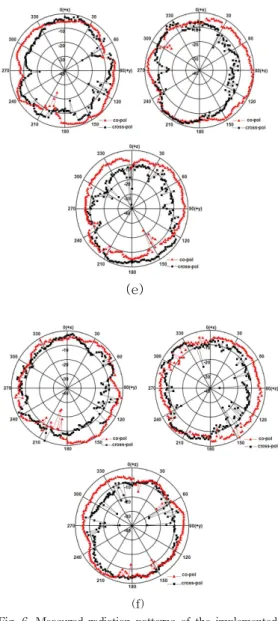
Fig. 6 shows the measured co-polarization and

cross-polarization normalized radiation patterns of

the implemented antenna in the x-y, z-y and x-z

planes at seven different frequencies.

(4)

(a)

(b)

(c)

(d)

(5)

(e)

(f)

Fig. 6. Measured radiation patterns of the implemented antenna

(a) at 920 MHz, (b) at 1795 MHz, (c) at 1810 MHz, (d) at 1920 MHz, (e) at 2345 MHz, (f) at 2442 MHz.

Table 2 shows the results of maximum peak gain and average gain measurement of the implemented the antenna. On each band, the peak gain is the maximum measured gain of the antenna. And average gain is the averaged value of the measured gain for each frequency band measurement.

Table 2. Antenna gain measurement Frequency Band Peak

Gain(dBi) Average Gain(dBi)

GSM900 1.15 -2.01

DCS 3.58 1.42

K-PCS 3.46 0.77

US-PCS 2.91 0.81

Bluetooth 5.18 1.16

Wibro/WLAN 3.37 -2.13

Through this table we can see that the maximum peak gain and average gain of GSM band are 1.15 dBi, -2.01 dBi, respectively. For the DCS band, the maximum peak gain and average gain are 3.58 dBi, 1.42 dBi, respectively. For the K-PCS band, the maximum peak gain and average gain are 3.46 dBi, 0.77 dBi, respectively. For the US-PCS band, the maximum peak gain and average gain are 2.91 dBi, 0.81 dBi, respectively. For the Bluetooth band, the maximum peak gain and average gain are 5.18 dBi, 1.16 dBi, respectively. For the Wibro and WLAN bands, the maximum peak gain and average gain are 3.37 dBi, -2.13 dBi, respectively.

Ⅳ. Conclusion

We proposed an internal multi-band folded monopole for mobile phone. We designed and fabricated the multi-band monopole for GSM, DCS, K-PCS, US-PCS, Bluetooth, bands with three branch lines and measurement showed suitable performance. The antenna has a small volume of 38×8.5×5 mm

3

, and ground size is 100×60 mm

2

. The proposed internal monopole antenna has proper gain performance and radiation pattern characteristics. We expect that the proposed monopole is applicable for multi-band mobile phone.

References

[1] Sung Min Kim, Ki Suk Yoon, Su Bin Park, Woon Geun Yang, Nam Ki Kim, and Jong Hyuk Lee, "Multi-band internal monopole antenna for mobile station", Microwave and Optical Technology Letters, Volume: 50, no. 1, 241-244, Jan. 2008.

[2] Hong, S., Kim, W., Kahng, S., and Choi, J.,

"Design of an internal multiresonant monopole

(6)

antenna for GSM900/DCS1800/US-PCS/SDMB operation", IEEE Trans. Antennas Propag., Volume:

56, no. 5, 1437-1443, May 2008.

[3] R. A. Bhatti and S. O. Park, "Octa-band internal monopole antenna for mobile phone applications", Electron. Lett., Volume: 44, no. 25, 1447–1448, Dec.

2008.

[4] Chia-Ling Liu, Yi-Fang Lin, Chia-Ming Liang, Shan-Cheng Pan, and Hua-Ming Chen, "Miniature Internal Penta-Band Monopole Antenna for Mobile Phones", IEEE Trans. Antenna and Propag., Volume: 58, no. 3, 1008-1011, March 2010.

[5] J.B.Yu and W.G. Yang, "Design and Implementation of Internal Multi-Band Folded Monopole Antenna for Mobile Handset Applications", KIMICS, Volume: 8, no. 6, 630-634, Dec. 2010.

[6] Marek Kitli_ski, Tomasz Borodo, "Improved compact low-profile quadband planar monopole antenna for mobile handsets", 2006 International Conference on Microwaves, Radar & Wireless Communications, (MIKON 2006), 736–739, May 2006.

[7] Jihui Gu, Xiaomin Zhou, Yifei Yang, Jianmin Fang, "A Multi-Band Compact Monopole Antenna for Mobile Handsets", Microwave and Millimeter Wave Technology, ICMMT 2008, International Conference on, Volume: 3, 1092-1094, April 2008.

[8] K.-L. Wong, G.-Y. Lee, and T.-W. Chiou,

"Monopole antenna for multiband operation of mobile handsets", IEEE Trans. Antennas Propag., Volume: 51, no. 1, 121-125, Jan. 2003.

BIOGRAPHY

Woon Geun Yang (Member)

1983 : BS degree in Electronics Engineering, Seoul National University.

1985 : MS degree in Electronics Engineering, Seoul National University.

1994 : PhD in Electronics Engineering, University of Incheon.

1997~2001 : Consulting Professor, LG Electronics Inc.

2004~2005 : Consulting Professor, LG Electronics Inc.

2001~2002 : Researcher, ETRI (Electronics and Telecommunications Research Institute)

Ling Zhi Cai (Member)

2008 : BS degree in Communication Engineering, YanTai University.

2010~ : MS course in Electronics Engineering, University of Incheon.

Cheol Yong Yang (Member)

2011 : BS degree in

Electronics Engineering, Hoseo University.

2010~ : MS course in

Electronics Engineering,

University of Incheon.

수치

Table 1 shows values of the design parameters which were derived through the simulation.
Fig. 6. Measured radiation patterns of the implemented antenna

참조

관련 문서

Fenn and Koichi Tanaka "for their development of soft desorption ionisation methods for mass spectrometric analyses of biological macromolecules" and the

See Section “Limitation and monitoring of exposure / Personal protective equipment” (>>> "Section 8" Page 171) for information on appropriate

2.1.15 "ITS" or "Intelligent Transport Systems" means the integration of information and communication technologies (ICTs) and applications that

Cohen, "A Rule Based System for Optimizing Combinational Logic," IEEE Design & Test of

Applying Design Thinking as a Method for Developing Multi Competencies of Technical High School Student..

Fiscal transparency should lead to better-informed public debate about the design and results of fiscal policy, make governments more accountable for the implementation

Owens, "The structural coloration of textile materials using self-assembled silica nanoparticles," Journal of Nanoparticles Research, vol.. Yang,

Mirzaeian, "Intelligent Automated Optimal Design of Switched Reluctance Motor Using Genetic-Fuzzy Algoritnms", Record of the 13th COMPUMAG Conference on