Korean J Androl. Vol. 29, No. 2, August 2011 http://dx.doi.org/10.5534/kja.2011.29.2.168
168
접수일자: 2011년 6월 2일, 수정일자: (1차) 2011년 7월 26일, (2차) 2011년 8월 4일, 게재일자: 2011년 8월 8일 교신저자: 문기학, 영남대학교 의과대학 부속병원 비뇨기과, 대구시 남구 대명5동 317-1 705-035
Tel: 053-620-3692, Fax: 053-627-5535, E-mail: [email protected]
전립선비대증 환자에서 경요도전립선절제술 후 급성요폐 발생에 영향을 미치는 인자
영남대학교 의과대학 부속병원 비뇨기과
양소전ㆍ지윤섭ㆍ송필현ㆍ김현태ㆍ문기학
Factors Causing Acute Urinary Retention after Transurethral Resection of the Prostate in Patients with Benign Prostate Hyperplasia
So Jun Yang, Yoon Seob Ji, Phil Hyun Song, Hyun Tae Kim, Ki Hak Moon Department of Urology, Yeungnam University College of Medicine, Deagu, Korea
= Abstract =
Purpose: Urologists occasionally experience some cases of voiding failure after transurethral resection of prostate (TURP). Preoperative and postoperative factors attributable to acute urine retention (AUR) after catheter removal in post-TURP patients were evaluated and analyzed to determine the causative factors for AUR.
Materials and Methods: From June 2004 to May 2008, a total of 172 patients who underwent TURP due to symptomatic benign prostatic hyperplasia (BPH) were divided into the AUR group (n=21) and the control group (n=151). The AUR group was defined as patients with voiding difficulty within 24 hours and whose residual urine volume was above 400 ml after catheter removal. The control group was defined as patients without AUR. Age, duration of symptoms, International prostate symptom score (IPSS), Quality of life score (QoL), uroflowmetry, post-void residual urine volume, preoperative serum prostate specific antigen (PSA) level, preoperative prostate volume, resected prostate volume, rate of prostate resection [resected prostate volume/preoperative prostate volume×100], operative time and duration of catheter were retrospectively analyzed to identify which of these were the factors related with AUR after catheter removal in post-TURP patients.
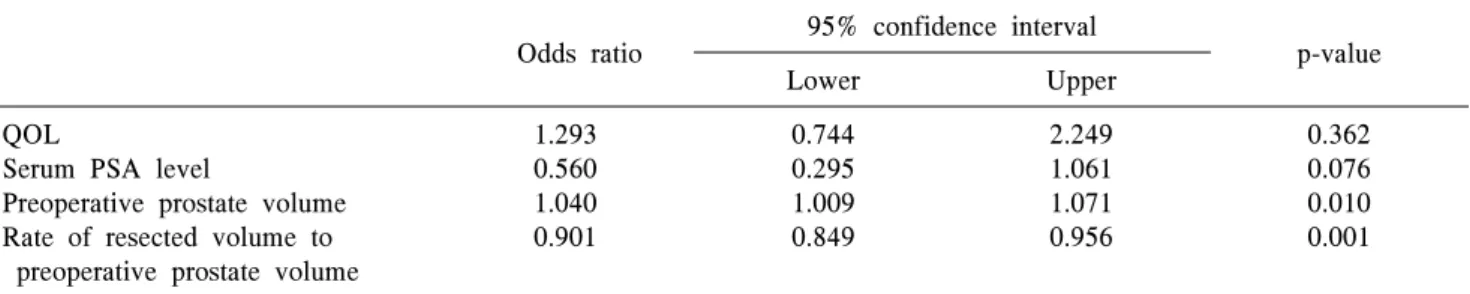
Results: Preoperative prostate volume was higher (90.7±50.4 vs 64.4±32.7, p=0.002) and rate of prostate resection was lower (38.8±8.1 vs 50.5±12.4, p<0.001) in AUR group compared to control group. And age, duration of symptoms, IPSS, QoL, uroflowmetry, post-void residual urine volume, preoperative serum PSA level, resected prostate volume, operative time and duration of catheter were not statistically significant in both groups. The multivariate analysis subsequently showed that preoperative prostate volume (p=0.010, OR=1.040) and rate of prostate resection (p=0.001, OR=0.901) were independent factors related with AUR after catheter removal in post-TURP patients.
Conclusions: The incidence of AUR after catheter removal was higher in post-TURP patients with high preoperative prostate volume and low rate of prostate resection. Therefore the surgeon’s effort to increase the rate of prostate resection, especially in patients with large prostate volume, may lower the incidence of postoperative AUR.
Key Words: Transurethral resection of prostate, Urinary retention, Benign prostatic hyperplasia
서 론
전립선비대증은 중년 이후 남성에 호발하는 질 환으로 일차적 약물치료에도 불구하고 일부에서는 수술적 치료를 요하는 경우가 있으며, Han 등1은 5 년간 12,452명의 전립선비대증 환자를 대상으로 7.1%에서 외과적 치료가 필요하였음을 보고하였 다. 전립선비대증은 전립선의 증식에 의하여 발생 하는 질병이므로 외과적인 방법으로 비대된 조직 을 제거하는 것이 이론적으로 가장 효과적이라 할 수 있다.2 Hugh Hampton Young이 cold-cut prostatic punch 수술법을 1909년에 고안한 이후부터 한 세기 동안 덜 침습적이고 효과적인 치료방법들이 개발 되고 있지만, 현재까지도 전립선비대로 인한 하부 요로막힘의 가장 대표적인 수술 방법은 경요도전 립선절제술이 표준치료법으로 선호되고 있다.3-5 경요도전립선절제술을 시행받은 전립선비대증 환자의 대부분은 술 후 자가배뇨가 가능하나 술 후 도뇨관 제거 직후의 급성요폐와 후기 합병증인 요 도협착의 사례가 일부에서 보고되고 있다.6 술 후 장기간 추적관찰 중 관찰되는 요도협착이나 배뇨 곤란의 경우 최근 여러 문헌에서 다양한 예후인자 들을 제시하고 있어 환자에게 술 전 설명이 동반될 수 있고, 추적기간 동안 임상 증상이 점진적으로 진 행하는 양상을 보인다.2 그러나 도뇨관 제거 직후의 급성요폐에 대한 확립된 병인과 예후인자에 대한 연구는 아직도 많지 않은 실정이며, 수술 직후 갑작 스럽게 발생한 경우 방광내압의 상승과 방광벽의 과신전으로 인해 대부분 심한 통증을 동반하여 환 자의 불안감을 야기할 수 있다. 이에 저자들은 본원 에서 경요도전립선절제술을 시행받은 전립선비대 증 환자들을 대상으로 술 후 급성요폐의 발생에 영 향을 미치는 요인을 분석하고자 하였다.
대상 및 방법
2004년 6월부터 2008년 5월까지 본원에서 양극성 경요도전립선절제술을 시행받은 환자 172명 중 술 후 도뇨관 제거 직후에 급성요폐를 호소하는 환자 21명을 급성요폐군으로, 급성요폐가 발생하지 않았 던 151명을 대조군으로 하였다. 이 연구에서 급성 요폐는 술 후 도뇨관을 제거한 후 24시간 이내에 배뇨곤란을 호소하여 다시 도뇨관 삽입술을 시행
하였을 때 잔뇨량이 400 ml 이상인 경우로 정의하 였다.
대상 환자의 의무기록지를 후향적으로 검토하여 나이, 전립선비대증의 유병기간, 국제전립선증상점 수 (International Prostate Symptom Score, IPSS), 삶의 질 점수 (Quality of life score, QOL), 요속검사 (Uro- flowmetry)와 배뇨후 잔뇨량 (Post-void residual urine, PVR), 전립선특이항원 (Prostate specific antigen, PSA), 술 전 전립선용적, 술 중 전립선절제량, 전립 선절제율, 수술시간, 술 후 도뇨관 삽입기간을 술 후 배뇨증상에 영향을 미칠 수 있는 인자로 선정하 고, 술 후 임상양상과의 유의성을 분석하였다. 전립 선비대증 유병기간은 증상이 발현한 시기부터 수 술을 시행받은 기간까지로 정의하였고, 전립선용적 은 술 전 시행한 경직장초음파검사를 통하여 확인 하였다. 전립선절제율은 술 전 초음파로 확인한 전 립선용적에 대한 술 중 절제한 전립선조직량을 이 용하여 백분율로 나타내었다. 술 전에 시행한 혈청 PSA가 4.0 ng/ml 이상인 환자 중 경직장초음파를 이용한 전립선조직검사를 통하여 전립선 암이 확 인된 경우는 대상에서 제외하였다. 또한 과거력에 서 신경인성 방광이 의심되는 경우 요역동학 검사 를 시행하였으며 신경인성 방광이 진단된 환자와 요로감염, 요도협착, 방광결석이 있는 환자 역시 대 상에서 제외하였다.
양 군의 평균 비교는 Student’s t-test를 사용하였 고, 각 요인들과 술 후 급성요폐 간의 연관성을 알 아보기 위해 다변량 로지스틱 회귀분석 (multiple logistic regression)을 이용하였다. 통계분석은 SPSS (17.0 KO for windows, Release 14.0; SPSS Inc., Chicago, IL, USA)를 이용하여 p값이 0.05 미만인 경 우를 통계적으로 유의한 것으로 판정하였다.
결 과
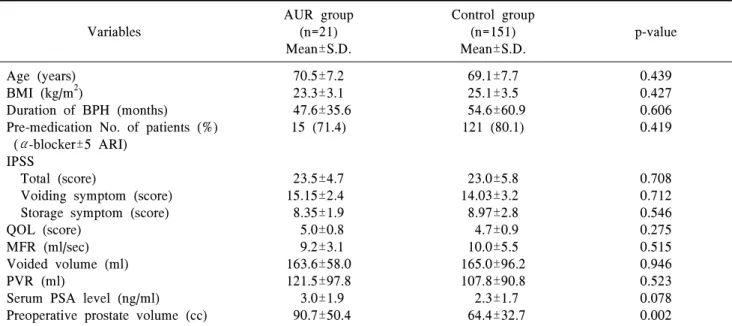
대상 환자들의 평균 연령은 급성요폐군 70.5±7.2 세, 대조군 69.1±7.7세였다. 전립선비대증의 유병기 간은 급성요폐군 47.6±35.6개월, 대조군 54.6±60.9 개월이었으며 (p=0.606), 술 전 알파차단제 단독 치 료 또는 5-알파환원효소억제제 병용 요법을 시행한 경우는 각각 15명 (71.4%), 121명 (80.1%)이었다 (p=0.419). 두 군에서 술 전 IPSS는 각각 23.5±4.7점 과 23.0±5.8점이었고 (p=0.708), QOL은 5.0±0.8점 및 4.7±0.9점이었다 (p=0.275). 술 전 시행한 요속검사
Table 1. Comparison of preoperative characteristics between AUR and control group Variables
AUR group (n=21) Mean±S.D.
Control group (n=151) Mean±S.D.
p-value
Age (years) BMI (kg/m2)
Duration of BPH (months)
Pre-medication No. of patients (%) (α-blocker±5 ARI)
IPSS
Total (score)
Voiding symptom (score) Storage symptom (score) QOL (score)
MFR (ml/sec) Voided volume (ml) PVR (ml)
Serum PSA level (ng/ml) Preoperative prostate volume (cc)
70.5±7.2 23.3±3.1 47.6±35.6
15 (71.4)
23.5±4.7 15.15±2.4 8.35±1.9 5.0±0.8 9.2±3.1 163.6±58.0 121.5±97.8 3.0±1.9 90.7±50.4
69.1±7.7 25.1±3.5 54.6±60.9 121 (80.1)
23.0±5.8 14.03±3.2 8.97±2.8 4.7±0.9 10.0±5.5 165.0±96.2 107.8±90.8 2.3±1.7 64.4±32.7
0.439 0.427 0.606 0.419
0.708 0.712 0.546 0.275 0.515 0.946 0.523 0.078 0.002
AUR: acute urinary retention, BMI: body mass index, BPH: benign prostate hyperplasia, 5ARI: 5 alpha reductase inhibitor, IPSS: international prostate symptom score, QOL: quality of life, MFR: maximumflow rate, PVR: post-void residual urine volume, PSA: prostate specific antigen.
Statistical significance was evaluated by Student's t-test, p<0.05.
Table 2. Comparison of intraoperative and postoperative characteristics between AUR and control group Variables
AUR group (n=21) Mean±S.D.
Control group (n=151) Mean±S.D.
p-value
Resected volume (cc)
Rate of resected volume to preoperative prostate volume (%)
Operative time (min)
Duration of postoperative catheterization
35.3±18.7 38.8±8.1 93.1±49.0
3.2±1.0
32.1±17.2 50.5±12.4 86.4±39.4 3.4±1.3
0.421
<0.001 0.481 0.701
AUR: acute urine retention, BPH: benign prostate hyperplasia, Rate of resected volume to preoperative prostate volume:
Resection volume/Prostate volume ×100.
Statistical significance was evaluated by Student's t-test, p<0.05.
에서 급성요폐군의 평균 최대요속은 9.2±3.1 ml/sec, 배뇨량은 163.6±58.0 ml였고, 대조군의 평균 최대요 속은 10.0±5.5 ml/sec, 배뇨량은 165.0±96.2 ml였다 (p=0.515, p=0.946). 배뇨 후 잔뇨량은 급성요폐군에 서 121.5±97.8 ml, 대조군에서 107.8±90.8 ml였다 (p=0.523). 술 전에 시행한 혈청 PSA는 급성요폐군 에서 3.0±1.9 ng/ml, 대조군에서는 2.3±1.7 ng/ml였고 (p=0.078), 술 전 전립선용적은 급성요폐군에서 90.7±
50.4 cc, 대조군에서는 64.4±32.7 cc였다 (Table 1, p=0.002).
술 중 전립선절제량은 급성요폐군에서 35.3±18.7 cc, 대조군에서 32.1±17.2 cc였고 (p=0.421), 전립선
절제율은 급성요폐군에서 38.8±8.1%, 대조군에서 50.5±12.4%였다 (p<0.001). 수술시간은 급성요폐군 에서 93.1±49.0분, 대조군에서 86.4±39.4분이었으며 (p=0.481), 수술 후 도뇨관 삽입기간은 급성요폐군 에서 3.2±1.0일, 대조군에서 3.4±1.3일이었다 (Table 2, p=0.701).
양 군에 대해 시행한 Student’s t-test에서 술 전 전 립선용적과 술 중 전립선절제율이 통계적으로 유 의하였으며, 그 외의 인자들은 유의하지 않았다 (p=0.002, p<0.001).
급성요폐와 독립적으로 관련된 위험인자를 알아 보기 위해 시행한 다변량 로지스틱 회귀분석의 결
Table 3. Multiple logistic regression analysis for independent variables for acute urinary retention after transurethral resection of prostate
Odds ratio 95% confidence interval
p-value
Lower Upper
QOL
Serum PSA level
Preoperative prostate volume Rate of resected volume to preoperative prostate volume
1.293 0.560 1.040 0.901
0.744 0.295 1.009 0.849
2.249 1.061 1.071 0.956
0.362 0.076 0.010 0.001
QOL: quality of life, PSA: prostate specific antigen, Rate of resected volume to preoperative prostate volume: Resection volume/Prostate volume ×100.
Fig. 1. Comparison of preoperative prostate volume between acute urine retention (AUR) and control group. Bars are mean±standard error of mean (*Statistical significance was evaluated by Multiple logistic regression analysis, p<0.05).
Fig. 2. Comparison of rate of resected volume to prostatic volume between acute urine retention (AUR) and control group.
Bars are mean±standard error of mean (*Statistical significance was evaluated by Multiple logistic regression analysis, p<0.05).
과, 술 전 전립선용적과 술 중 전립선절제율이 통계 적으로 유의하였다 (Table 3, Fig. 1, Fig. 2).
술 후 급성요폐를 보인 환자 21명의 경우 술 전 복용하였던 알파차단제를 사용하였고, 급성요폐 발 생 직후 도뇨관을 재유치하였으며 모두 48시간 이 내에 발관하였다. 20명의 환자는 퇴원 전 자가배뇨 가 가능하였으나 1명의 환자는 자가배뇨에 실패하 여 도뇨관을 재삽입하였으며, 7일 후 외래에서 자 가배뇨가 확인되었다.
고 찰
경요도전립선절제술은 마취기술의 발전, 수술기 구 및 술기의 향상에 따라 그 적용 범위가 점차 확 대되었으며, 최근에는 양극성 절제경이 개발되어 더 안전하면서도 효과적으로 전립선비대증 환자의 수술에 이용되고 있다.7 그러나 일부에서 수술 후에
도 지속적인 하부요로증상을 호소하는 환자들이 있으며, 특히 요도협착을 포함하여 많은 후기 합병 증에 대한 다양한 예후인자들이 여러 연구에서 제 시되었다.8-10 이런 후기 합병증과 함께 Rassweiler 등6은 경요도전립선절제술 후 초기 합병증으로서 3
∼9%의 급성요폐 발생률을 보고하였으며, 배뇨근 수축력의 일시적인 저하의 가능성을 제시한 바는 있으나, 아직까지 도뇨관 제거 직후 급성요폐의 다 양한 병인론에 대한 연구는 부족한 실정이다.
한편, 상당수의 전립선비대증 환자들이 여러 내과 적 질환이 동반 가능한 고령이라는 점을 고려할 때 수술시간이 길어질수록 내과적 합병증의 발생 가 능성도 커진다.3 경요도전립선절제술 시행 시 전립 선의 용적이 큰 경우 절제할 전립선비대증 조직의 양이 상대적으로 많아 수술시간이 길어질 수 있으 며 술자는 수술시간을 최소화하기 위해 노력하게 되고, 이에 따라 방광배출구의 통로화 (channeling)에
주력하여 비대된 이행대를 충분히 절제하지 못하 는 경우가 있다.3
경요도전립선절제술 시 전립선절제량과 술 후 배뇨증상과의 연관성에 대해서는 여러 연구에서 제시된 바 있다. Oh 등11은 42명을 대상으로 한 연 구에서 30 ml보다 큰 전립선의 경우 술 중 전립선절 제량이 클수록 술 후 배뇨증상이 더 좋다고 보고하 였으며, Hakenberg 등5 역시 경요도전립선절제술 시 절대적인 전립선절제량이 클수록 더 넓은 방광출 구를 확보함으로써 술 후 배뇨증상 개선효과에 영 향을 미칠 것이라고 보고하였다.
한편, Aagaard 등12은 최소절제, 즉 통로화를 한 경우 매년 재수술률은 2.5%, 완전 절제를 한 경우 매년 0.5%로 보고하여 절제의 정도가 재수술률과 상관이 있다고 보고한 바 있다. Chen 등13은 경요도 전립선절제술을 시행받은 40명을 대상으로 한 연 구에서 술 중 전립선절제율과 술 후 측정한 배뇨증 상점수 사이에 밀접한 상관관계가 있다고 하였다.
본 연구에서는 술 중 전립선절제량이 급성요폐 에 있어서 통계적으로 유의한 차이가 없었으나, 술 전 전립선용적과 술 중 전립선절제량을 백분율로 계산한 전립선절제율이 양 군에서 통계적으로 유 의한 차이가 있었다. 이는 급성요폐군에서의 술 전 전립선용적이 대조군에 비해 상대적으로 큰 경향 을 보인 반면에 두 군간 술 중 전립선절제량은 유의 한 차이가 없었기 때문으로 보이며, 이와 같은 결과 는 일부 전립선의 용적이 큰 환자의 경우, 술 중 수 술시간을 최소화하기 위해 선종의 완벽한 제거보 다 대칭적이고 표면을 평평하게 만들어 방광출구 의 통로화를 충분히 하는데 주력하게 되었기 때문 으로 생각한다.
물론, 전립선비대증에 기인한 급성요폐에 대해서 는 단순한 전립선 크기의 증가 이외에도 여러 기전 이 존재함에 따라 그 발생을 예측하기가 어렵기 때 문에 전립선비대증과 관련한 주관적 혹은 객관적 지표들을 대상으로 급성요폐를 예견할 수 있는 지 표에 대한 연구들이 진행되어 왔다.14 Jacobsen 등15 은 전립선비대증 환자에서 나이, IPSS, 전립선용적, 최대요속 등을 급성요폐의 예견지표로 제시하였 고,5 Chang 등14은 급성요폐군과 증상군의 비교에서 나이, 전체전립선용적, 전립선이행대용적, 전립선 이행대 용적지수, 신장률 (Elongation ratio; maximal anteroposterior diameter/transverse diameter of pros- tate)이 전립선비대증환자에서 급성요폐를 예측할
수 있는 지표가 될 수 있는 것으로 보고하였다. 본 연구에서는 경요도전립선수술을 시행받은 환자를 대상으로 하였다는 차이점이 있지만, 나이, IPSS, 최대요속은 급성요폐의 발생과 유의한 관계가 없 었으며, 전립선용적이 급성요폐의 유의한 예견지표 로 나타났다.
또한 비요로생식계에 대한 수술 후에도 급성요 폐는 발생할 수 있으며, 이는 수술시간과 수술 중 방광의 과팽창, 마취제나 진통제 등의 수술적, 마취 적 요인들이 상호 복잡하게 연관되어 발생하므로 관련 요인에 대한 해석이 어렵다.16 이러한 요인들 에 대한 자세한 분석이 이루어지지 않은 점은 본 연구의 한계점이라 할 수 있겠으나 양군에서 수술 시간의 유의한 차이가 없었으며, 본원의 일괄적인 처치 기준에 의해 수술 후 3일 이후에 도뇨관을 제 거함에 따라 도뇨관 삽입의 기간도 유의한 차이가 없었다. 따라서 관련 변수로서의 수술적, 마취적 요 인을 최대한 배제하고 결과를 분석하고자 하였다.
본 연구는 이전 보고들과는 다르게 경요도전립 선절제술 후 도뇨관 제거 직후에 발생하는 급성요 폐에 관련된 위험인자를 알아보기 위함이었으며, 술 중 전립선절제율이 술 직후 합병증인 급성요폐 와도 밀접한 관련이 있음을 알 수 있었다. 결국 술 전 전립선의 용적이 큰 경우 술 후 급성요폐의 발생 을 줄이기 위해서 술 중 전립선절제율을 높여 이행 대를 완전히 제거하려는 노력이 필요할 것으로 생 각한다.
술 후 급성요폐를 보인 환자의 대부분은 알파차 단제의 사용과 단기간의 도뇨관 재유치 후에 자가 배뇨가 가능하였으나, 이들의 장기간 추적관찰의 연구가 이루어진다면 전립선절제율과 경요도전립 선절제술 후 배뇨증상개선과의 관련성에 대해 더 정확한 평가가 이루어질 것으로 기대한다.
결 론
전립선비대증 환자에서 경요도전립선절제술 후 급성요폐 발생의 위험인자로는 술 전 전립선용적 과 술 중 전립선절제율이 의미가 있었다. 그러므로 경요도전립선절제술에서 술 후 급성요폐를 예방하 기 위해 전립선절제율을 높이는 것이 중요하고, 특 히 술 전 전립선 용적이 큰 경우 급성요폐의 발생이 증가함으로 술 중 전립선절제율을 높여 이행대를 완전히 제거하려는 노력이 필요할 것으로 생각한다.
REFERENCES
1) Han KS, Hong SJ, Chung BH. Changing trends in the management of benign prostatic hyperplasia dur- ing recent 5 years. Korean J Urol 2005;46:458-62 2) Kwak DY, Chang HS, Park CH, Kim CI. Long-term
results of transurethral resection of the prostate for large benign prostatic hyperplasia: a comparative study with open prostatectomy. Korean J Urol 2008;
49:31-6
3) Baek M, Paick SH, Lee BK, Kang MB, Lho YS, Jung SI, et al. The efficacy of bipolar transurethral resection of the prostate in patients with large pros- tates(>80 g) and analysis of the postoperative re- sults based on the resection ratio. Korean J Urol 2008;49:1087-93
4) Kim HG, Lee BK, Paick SH, Lho YS. Efficacy of bipolar transurethral resection of the prostate: com- parison with standard monopolar transurethral re- section of the prostate. Korean J Urol 2006;47:
377-80
5) Hakenberg OW, Helke C, Manseck A, Wirth MP. Is there a relationship between the amount of tissue re- moved at transurethral resection of the prostate and clinical improvement in benign prostatic hyperplasia.
Eur Urol 2001;39:412-7
6) Rassweiler J, Teber D, Kuntz R, Hofmann R.
Complications of transurethral resection of the pros- tate (TURP)--incidence, management, and prevention.
Eur Urol 2006;50:969-79
7) Bishop P. Bipolar transurethral resection of the pros- tate--a new approach. AORN J 2003;77:979-83 8) Reich O, Gratzke C, Bachmann A, Seitz M,
Schlenker B, Hermanek P, et al; Urology Section of the Bavarian Working Group for Quality Assurance.
Morbidity, mortality and early outcome of transure- thral resection of the prostate: a prospective multi- center evaluation of 10,654 patients. J Urol 2008;
180:246-9
9) Lim KB, Wong MY, Foo KT. Transurethral resection of prostate (TURP) through the decades--a compar- ison of results over the last thirty years in a single institution in Asia. Ann Acad Med Singapore 2004;
33:775-9
10) Starkman JS, Santucci RA. Comparison of bipolar transurethral resection of the prostate with standard transurethral prostatectomy: shorter stay, earlier cath- eter removal and fewer complications. BJU Int 2005;95:69-71
11) Oh CS, Choi KY, Park RJ. Relationship between the amount of tissue removed at transurethral resection of the prostate and clinical improvement in benign prostate hyperplasia. Korean J Urol 2003;44:866-70 12) Aagaard J, Jonler M, Fuglsig S, Christensen LL, Jorgensen HS, Norgaard JP. Total transurethral re- section versus minimal transurethral resection of the prostate--a 10-year follow-up study of urinary symp- toms, uroflowmetry and residual volume. Br J Urol 1994;74:333-6
13) Chen SS, Hong JG, Hsiao YJ, Chang LS. The corre- lation between clinical outcome and residual pro- static weight ratio after transurethral resection of the prostate for benign prostatic hyperplasia. BJU Int 2000;85:79-82
14) Chang HS, Park CH, Kim CI. Transitional zone vol- ume: a predictor of acute urinary retention in patients with benign prostatic hyperplasia. Korean J Urol 2005;46:259-63
15) Jacobsen SJ, Jacobson DJ, Girman CJ, Roberts RO, Rhodes T, Guess HA, et al. Natural history of pros- tatism: risk factors for acute urinary retention. J Urol 1997;158:481-7
16) Wein AJ. Lower urinary tract dysfunction in neuro- logic injury and disease. In: Wein AJ, Kavoussi LR, Novick AC, Partin AW, Peters CA, editors.
Campbell's urology. 9th ed. Philadelphia: Saunders;
2007;2040-1