Original Article
Received: Jan 19, 2017; Revised: Feb 15, 2017; Accepted: Feb 28, 2017 Correspondence to: Lütfi Canat
Department of Urology, Okmeydanı Training and Research Hospital, 34384 Şişli, Istanbul, Turkey.
Tel: +90-2122217777, Fax: +90-2122217800, E-mail: [email protected] Copyright © 2017 Korean Society for Sexual Medicine and Andrology
This is an Open Access article distributed under the terms of the Creative Commons Attribution Non-Commercial License (http://creativecommons.
org/licenses/by-nc/4.0) which permits unrestricted non-commercial use, distribution, and reproduction in any medium, provided the original work is properly cited.
Are There Relationships between Seminal Parameters and the Neutrophil-to-Lymphocyte Ratio or the Platelet-to-Lymphocyte Ratio?
Serdar Aykan1, Lütfi Canat2, Serkan Gönültaş1, Hasan Anıl Atalay2, Fatih Altunrende2
1Department of Urology, Bağcılar Training and Research Hospital, 2Department of Urology, Okmeydanı Training and Research Hospital, Istanbul, Turkey
Purpose: The aim of this study was to evaluate the relationship of seminal parameters with the neutrophil-to-lymphocyte ratio (NLR) and the platelet-to-lymphocyte ratio (PLR), which are inflammatory markers, in men with an abnormal semen analysis and men with normozoospermia.
Materials and Methods: Fifty-seven men with abnormal semen analyses and 59 men with normozoospermia were included in this cross-sectional study. A complete blood count was recorded, and the NLR and PLR were calculated from the hematologic parameters.
Results: The NLR was 1.84±0.78 in the normozoospermic group and 1.80±0.75 in the abnormal semen analysis group. The PLR was 95.32±35.47 in the normozoospermic group and 93.57±28.09 in the abnormal semen analysis group. No significant differences were found between the normozoospermic and the abnormal semen analysis group in the NLR (p=0.828) or the PLR (p=0.768). In addition, no seminal parameters were correlated with the NLR or the PLR (p>0.05).
Conclusions: We do not recommend using the NLR or the PLR as markers to screen for abnormal semen parameters or male infertility.
Key Words: Infertility; Lymphocytes; Neutrophils; Semen analysis
INTRODUCTION
Infertility is a common and complex reproductive health problem that is estimated to affect 10% to 15% of couples in industrialized countries, with about half of infertility problems attributable to male factors [1]. Male infertility is associated with a variety of factors itself, including envi-
ronmental and genetic factors. While the molecular mech- anisms underlying the etiology and pathophysiology of male infertility are still largely unknown, the relationship between the reproductive system and the immune system has been found to play an important role in the patho- physiology of male infertility. Fraczek and Kurpisz [2] re- ported that inflammatory pathologies are among the
https://doi.org/10.5534/wjmh.2017.35.1.51
well-known reasons for male infertility, accounting for 15% of cases. These systemic inflammatory diseases and inflammatory processes may alter sperm function through the production of elevated reactive oxygen species [3].
While the monitoring of cytokines in seminal plasma may improve our understanding of the process that leads to in- fertility [2], the technical difficulties and costs associated with the use of these inflammatory markers, such as inter- leukins, tumor necrosis factor-alpha (TNF-α), interferon gamma, and C-reactive protein, in routine clinical practice may limit their use. Alternatively, the neutrophil-to-lympho- cyte ratio (NLR) and platelet-to-lymphocyte ratio (PLR) can be rapidly and inexpensively obtained from a differential white blood cell (WBC) count. The NLR and PLR have al- ready been reported to play a role in inflammatory dis- eases [4-8], but their relationships with male infertility re- main unclear. Thus, the aim of our study was to evaluate the association between seminal parameters and in- flammation, as measured by the NLR and PLR, among men with abnormal semen analysis and men with normo- zoospermia.
MATERIALS AND METHODS
Cross-sectional data was collected on male patients from October 2015 to May 2016. The study was approved by the Institutional Review Board of Bağcılar Training and Research Hospital (No. 2015/420) and written informed consent was obtained from all participants. Participants were included if they were older than 18 years old and had either infertility or normozoospermia and a partner with female factor infertility. Patients with normozoospermia who had normal seminal parameters were not considered to be infertile in this study. Baseline characteristics were collected from each patient’s medical records and in- cluded data on age, body mass index (BMI), smoking, use of anabolic steroids, previous diseases, history of cryp- torchidism, medication, and comorbidities. Of the initial sample of 146 men, 18 men were excluded because they presented with varicocele and 12 men were excluded due to hypogonadism, retractile testes, karyotype anomalies, obstruction of spermatic ducts, history of chemotherapy and/or radiotherapy, male accessory gland infection, hem- atologic disorders, or current steroid therapy. The final
sample consisted of 116 participants who were classified into a normozoospermic group (n=59) or an abnormal se- men analysis group (n=57) based on the World Health Organization (WHO) guidelines [9].
Semen samples were obtained by masturbation after sexual abstinence for 48 to 72 hours and processed in ac- cordance with the WHO guidelines [9]. The leukocyte concentration was determined using the peroxidase stain- ing technique and sperm vitality was assessed in duplicate using the eosin-nigrosin staining technique [9,10]. All se- men samples that had one or more altered seminal param- eters were defined as abnormal, according to the WHO [9]. The complete blood count was obtained by a hematol- ogy analyzer (Coulter Gen-S Hematology Analyzer;
Beckman Coulter Corp, Hialeah, FL, USA). The total WBC was recorded, along with the neutrophil, platelet, and lymphocyte counts. The NLR and PLR were calculated by dividing the neutrophil count by the lymphocyte count and platelet count by the lymphocyte count, respectively.
The Number Cruncher Statistical System (NCSS) 2007 software (NCSS, Kaysville, UT, USA) was used for stat- istical analyses. Seminal parameters and baseline charac- teristics were expressed as mean±standard error of the mean. To compare continuous variables between the 2 groups, the independent t-test was used. For non-para- metrically distributed variables, the Mann-Whitney U-test was performed. The Kolmogorov-Smirnov test was used to check the distribution of parameters and the Pearson cor- relation test was used to assess the degree of correlation among continuous variables. A p-value of <0.05 was con- sidered to indicate statistical significance.
RESULTS
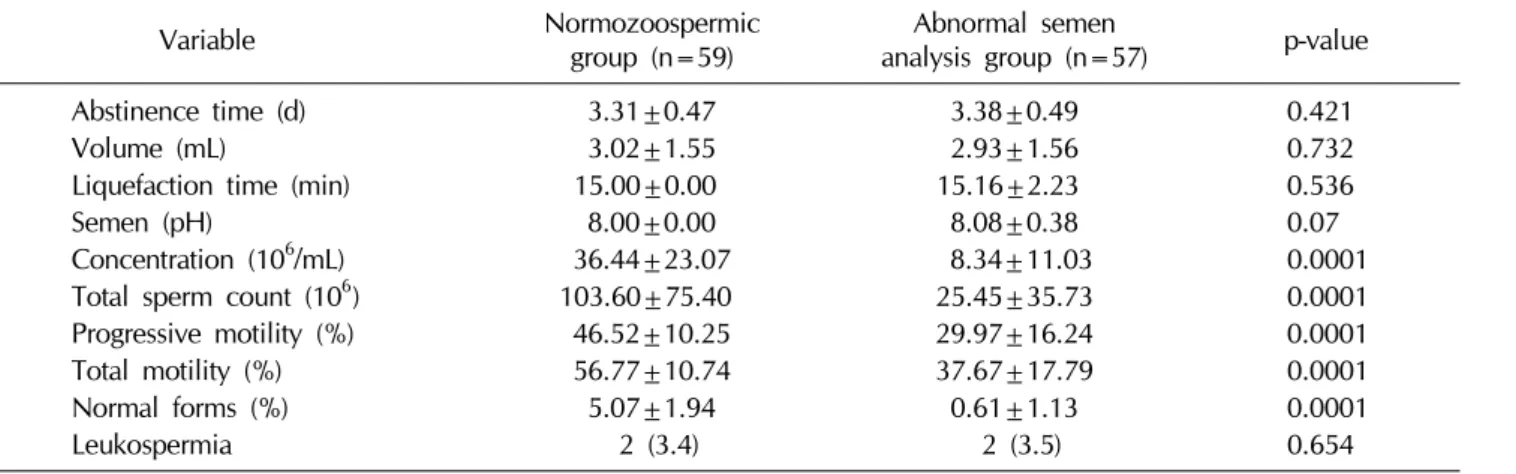
Data on the seminal parameters of study participants are shown in Table 1. There were no significant differences in abstinence time, semen volume, liquefaction time, semen pH, or leukospermia between the groups. Sperm concen- tration, total sperm count, progressive motility, total mo- tility, and normal sperm morphology were significantly greater in the normozoospermic group than in the abnor- mal semen analysis group (p<0.05).
The mean age was 31.04±6.63 years in the normozoo- spermic group and 30.76±5.81 years in the abnormal se-
www.wjmh.org Table 1. Conventional semen parameters of the participants enrolled in this study
Variable Normozoospermic
group (n=59) Abnormal semen
analysis group (n=57) p-value
Abstinence time (d) 3.31±0.47 3.38±0.49 0.421
Volume (mL) 3.02±1.55 2.93±1.56 0.732
Liquefaction time (min) 15.00±0.00 15.16±2.23 0.536
Semen (pH) 8.00±0.00 8.08±0.38 0.07
Concentration (106/mL) 36.44±23.07 8.34±11.03 0.0001
Total sperm count (106) 103.60±75.40 25.45±35.73 0.0001
Progressive motility (%) 46.52±10.25 29.97±16.24 0.0001
Total motility (%) 56.77±10.74 37.67±17.79 0.0001
Normal forms (%) 5.07±1.94 0.61±1.13 0.0001
Leukospermia 2 (3.4) 2 (3.5) 0.654
Values are presented as mean±standard error or number (%).
Table 2. Baseline characteristics and hematologic parameters
Variable Normozoospermic
group (n=59) Abnormal semen
analysis group (n=57) p-value
Age (yr) 31.04±6.63 30.76±5.81 0.794
BMI (kg/m2) 27.32±2.88 26.58±3.05 0.412
Smoker 21 (35.6) 22 (38.6) 0.125
WBC (103/mm3) 8.23±2.08 8.33±1.82 0.774
Platelet count (103/mm3) 245.03±57.49 251.88±60.28 0.548
Lymphocyte count (103/mm3) 2.66±0.67 2.77±0.72 0.393
Neutrophil count (103/mm3) 4.62±1.56 4.71±1.47 0.744
NLR 1.84±0.78 1.80±0.75 0.828
PLR 95.32±35.47 93.57±28.09 0.768
Values are presented as mean±standard error or number (%).
BMI: body mass index, WBC: white blood cell, NLR: neutrophil-to-lymphocyte ratio, PLR: platelet-to-lymphocyte ratio.
men analysis group. There were no significant differences between the groups with respect to age, BMI, or current smoking status (p>0.05). The NLR was 1.84±0.78 in the normozoospermic group and 1.80±0.75 in the abnormal semen analysis group. The PLR was 95.32±35.47 in the normozoospermic group and 93.57±28.09 in the abnor- mal semen analysis group. There were no significant dif- ferences between the groups with respect to NLR or PLR (p=0.828 and p=0.768, respectively). Likewise, no sig- nificant differences were found in the hematologic param- eters, including WBC count, neutrophil count, lympho- cyte count, and platelet count (p>0.05) (Table 2).
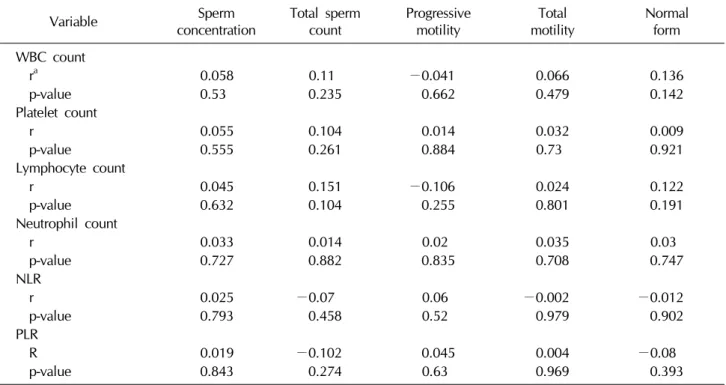
The correlation analysis indicated that no seminal pa- rameters were correlated with any hematologic parame- ters, and no correlations were found among these seminal parameters and the NLR or PLR (Table 3).
DISCUSSION
The current study is the first to investigate the relation- ships between seminal parameters and the NLR and PLR, which are inflammatory markers. The findings from our study show that these inflammatory markers are not suit- able for screening to identify patients with abnormal semi- nal parameters.
Previous studies have shown that systemic inflam- matory processes are associated with significant alter- ations in seminal plasma. Disruption of the blood-testis barrier by the inflammatory cytokines TNF-α and inter- leukin-6 have been found to significantly reduce sperm motility [11,12]. Another study revealed that TNF-α was significantly associated with decreased sperm count, sperm motility, and normal sperm morphology among in-
Table 3. Correlation between semen parameters and hematologic parameters
Variable Sperm
concentration Total sperm
count Progressive
motility Total
motility Normal form WBC count
ra 0.058 0.11 −0.041 0.066 0.136
p-value 0.53 0.235 0.662 0.479 0.142
Platelet count
r 0.055 0.104 0.014 0.032 0.009
p-value 0.555 0.261 0.884 0.73 0.921
Lymphocyte count
r 0.045 0.151 −0.106 0.024 0.122
p-value 0.632 0.104 0.255 0.801 0.191
Neutrophil count
r 0.033 0.014 0.02 0.035 0.03
p-value 0.727 0.882 0.835 0.708 0.747
NLR
r 0.025 −0.07 0.06 −0.002 −0.012
p-value 0.793 0.458 0.52 0.979 0.902
PLR
R 0.019 −0.102 0.045 0.004 −0.08
p-value 0.843 0.274 0.63 0.969 0.393
WBC: white blood cell, NLR: neutrophil-to-lymphocyte ratio, PLR: platelet-to-lymphocyte ratio.
aPearson correlation coefficient.
fertile patients [13]. While these inflammatory markers may improve our understanding of infertility, the techni- cal difficulties and costs associated with measuring them in routine clinical practice limit their use. Thus, the aim of the present study was to investigate the relationships be- tween seminal parameters and the NLR or the PLR, which can be determined rapidly and inexpensively.
Neutrophils have several potent effector mechanisms to combat and eventually kill spermatozoa. Oxidative mech- anisms that result in the production of reactive oxygen species, the release of several peptides or proteins, and the formation of neutrophil extracellular traps have detri- mental effects on seminal plasma [14]. Since neutrophilia and lymphocytopenia occur after systemic inflammation [4], the increase in NLR and PLR found in those with chronic inflammation may also affect seminal parameters.
Additionally, an increase in serum cytokines may have detrimental effects on the hypothalamic-pituitary-testis ax- is and may negatively modulate testicular function and fer- tility [15]. In the current study, hypogonadal participants were excluded from the study sample due to the effect of hypogonadism on seminal parameters. The impact of sys-
temic inflammation on these pathways requires further investigations.
The NLR and PLR have been used to detect inflam- mation in infectious diseases, cardiovascular diseases, various types of malignancies, and several other inflam- matory diseases [6-8,16-23]. However, these inflammatory markers have not previously been used to determine the association between inflammation and seminal para- meters. In this study, we did not find significant differences in the associations of any of the seminal parameters and the NLR or PLR between the normozoospermic group and the abnormal semen analysis group. Moreover, no sig- nificant between-group differences were found in the neu- trophil count or the lymphocyte count.
It is difficult to evaluate the reproductive potential of men based on routine seminal parameters alone. Lewis found that only 16% of infertile men and 5% of fertile men showed poor seminal parameters [24]. Systemic in- flammation may, therefore, be one cause of male infertility through unknown mechanisms. This study demonstrated that routine seminal parameters were not affected by the inflammatory markers that we studied. There were, how-
www.wjmh.org
ever, limitations to our study that are worth mentioning.
These include not having the specific fertility status of any of the study participants, as well as having a relatively small sample size. Further research on the associations of seminal parameters with the NLR and the PLR is required to verify the results of our study.
CONCLUSIONS
The NLR and PLR can be easily determined in routine practice. However, our study demonstrated that the NLR and PLR were not associated with seminal parameters, and we do not recommend using the NLR or the PLR as markers to screen for abnormal seminal parameters. Con- sequently, additional large, prospective studies are need- ed to support our findings and improve the data we have on the relationships of seminal parameters with the NLR and PLR.
CONFLICT OF INTEREST
No potential conflict of interest relevant to this article was reported.
REFERENCES
1. Aston KI, Krausz C, Laface I, Ruiz-Castané E, Carrell DT.
Evaluation of 172 candidate polymorphisms for association with oligozoospermia or azoospermia in a large cohort of men of European descent. Hum Reprod 2010;25:1383-97.
2. Fraczek M, Kurpisz M. Cytokines in the male reproductive tract and their role in infertility disorders. J Reprod Immunol 2015;108:98-104.
3. Hamada A, Esteves SC, Nizza M, Agarwal A. Unexplained male infertility: diagnosis and management. Int Braz J Urol 2012;38:576-94.
4. Zahorec R. Ratio of neutrophil to lymphocyte counts: rapid and simple parameter of systemic inflammation and stress in critically ill. Bratisl Lek Listy 2001;102:5-14.
5. Celikbilek M, Dogan S, Ozbakır O, Zararsız G, Kücük H, Gürsoy S, et al. Neutrophil-lymphocyte ratio as a predictor of disease severity in ulcerative colitis. J Clin Lab Anal 2013;27:72-6.
6. Kurtul BE, Ozer PA. The relationship between neutrophil-to- lymphocyte ratio and age-related macular degeneration.
Korean J Ophthalmol 2016;30:377-81.
7. Duksal F, Alaygut D, Güven AS, Ekici M, Oflaz MB, Tuncer R, et al. Neutrophil-lymphocyte ratio in children with fami-
lial Mediterranean fever: original article. Eur J Rheumatol 2015;2:20-3.
8. Imtiaz F, Shafique K, Mirza SS, Ayoob Z, Vart P, Rao S.
Neutrophil lymphocyte ratio as a measure of systemic in- flammation in prevalent chronic diseases in Asian popula- tion. Int Arch Med 2012;5:2.
9. World Health Organization (WHO). WHO Laboratory man- ual for the examination and processing of human semen.
5th ed. Geneva: WHO Department of Reproductive Health and Research; 2010.
10. Politch JA, Tucker L, Bowman FP, Anderson DJ. Concentra- tions and significance of cytokines and other immunologic factors in semen of healthy fertile men. Hum Reprod 2007;
22:2928-35.
11. Lampiao F, du Plessis SS. TNF-alpha and IL-6 affect human sperm function by elevating nitric oxide production. Reprod Biomed Online 2008;17:628-31.
12. Zhang H, Yin Y, Wang G, Liu Z, Liu L, Sun F. Interleukin-6 disrupts blood-testis barrier through inhibiting protein degra- dation or activating phosphorylated ERK in Sertoli cells. Sci Rep 2014;4:4260.
13. Zalata A, Atwa A, El-Naser Badawy A, Aziz A, El-Baz R, Elhanbly S, et al. Tumor necrosis factor-α gene polymor- phism relationship to seminal variables in infertile men.
Urology 2013;81:962-6.
14. Hermosilla C, Caro TM, Silva LM, Ruiz A, Taubert A. The intriguing host innate immune response: novel anti-parasitic defence by neutrophil extracellular traps. Parasitology 2014;
141:1489-98.
15. Hales DB. Testicular macrophage modulation of Leydig cell steroidogenesis. J Reprod Immunol 2002;57:3-18.
16. Yoon NB, Son C, Um SJ. Role of the neutrophil-lymphocyte count ratio in the differential diagnosis between pulmonary tuberculosis and bacterial community-acquired pneumonia.
Ann Lab Med 2013;33:105-10.
17. Wang GY, Yang Y, Li H, Zhang J, Jiang N, Li MR, et al. A scoring model based on neutrophil to lymphocyte ratio pre- dicts recurrence of HBV-associated hepatocellular carcino- ma after liver transplantation. PLoS One 2011;6:e25295.
18. Kaya H, Ertaş F, İslamoğlu Y, Kaya Z, Atılgan ZA, Çil H, et al. Association between neutrophil to lymphocyte ratio and severity of coronary artery disease. Clin Appl Thromb Hemost 2014;20:50-4.
19. Sunbul M, Gerin F, Durmus E, Kivrak T, Sari I, Tigen K, et al. Neutrophil to lymphocyte and platelet to lymphocyte ra- tio in patients with dipper versus non-dipper hypertension.
Clin Exp Hypertens 2014;36:217-21.
20. Liu CL, Lee JJ, Liu TP, Chang YC, Hsu YC, Cheng SP. Blood neutrophil-to-lymphocyte ratio correlates with tumor size in patients with differentiated thyroid cancer. J Surg Oncol 2013;107:493-7.
21. Yao Y, Yuan D, Liu H, Gu X, Song Y. Pretreatment neu- trophil to lymphocyte ratio is associated with response to therapy and prognosis of advanced non-small cell lung can- cer patients treated with first-line platinum-based chemo-
therapy. Cancer Immunol Immunother 2013;62:471-9.
22. Feng JF, Huang Y, Zhao Q, Chen QX. Clinical significance of preoperative neutrophil lymphocyte ratio versus platelet lymphocyte ratio in patients with small cell carcinoma of the esophagus. ScientificWorldJournal 2013. doi: 10.1155/
2013/504365.
23. Miglani RK, Bhateja N, Bhat RS, Kumar KV. Diagnostic role of platelet lymphocyte ratio (PLR) in pancreatic head masses.
Indian J Surg 2013;75:4-9.
24. Lewis SE. Is sperm evaluation useful in predicting human fertility? Reproduction 2007;134:31-40.