Introduction
In 2021, the Institute of Korean Medicine Education and Evaluation (IKMEE) proposed Korean Medicine Education Accreditation Standards (KAS2021)
1). These standards meet the basic medical education (BME) standards of the World Federation for Medical Education (WFME) and are
designed to improve the quality of Korean Medical education and train high-quality Korean medicine doctors (KMD). KAS2021 focuses on performance -based, competency-oriented assessments of Korean medical education and emphasizes the continuous improvement of education programs. The education programs covered by KAS2021 include basic science medicine, basic Korean Medicine, clinical
Analysis of the curriculum of medical humanities and social medicine in Colleges of Korean Medicine based on KAS2021
So-Youn Park1, Gwanwook Bang1, Seong-Hun Choi2, Su Jin Chae3*
1Department of Medical Education and Humanities, School of Medicine, Kyung Hee University
2Department of Anatomy and Histology, College of Oriental Medicine, Daegu Haany University
3Department of Medical Education, Catholic Kwandong University College of Medicine Review Article
⋅Received:12 April 2021 ⋅Revised:11 May 2021 ⋅Accepted:18 May 2021
⋅Correspondence to:Su Jin Chae Department of Medical Education
Simgokro 100Gil 25, Seo Gu, International St. Mary's Hospital Catholic Kwandong University, Incheon, Republic of Korea Tel:+82-32-290-3882, Fax:+82-32-290-3440, E-mail:[email protected]
Objectives: The purpose of this study was to examine the curriculum of the medical humanities and social medicine at 11 Colleges of Korean Medicine (CKM) based on the Korean Medicine Education Accreditation Standards 2021 (KAS2021) and suggest ways to improve the quality of Korean Medical education in the future.
Methods: The curricula for each grade were collected from the websites of 11 CKM. Based on KAS2021, medical humanities and social medicine courses were extracted and compiled. Courses offered, frequency of course offerings, time of offerings, credits, and course hours were investigated.
Results: Courses in languages and literature were most frequently offered in CKM. Most medical humanities and social medicine courses were offered in the pre-medical program and the fourth year of the medical program and were conducted as individual courses. Developing a curriculum that integrates conceptual definitions of the medical humanities and social medicine with basic and clinical studies is necessary.
Conclusion: Eleven CKM should reorganize and operate their medical humanities and social medicine curricula based on each college’s circumstances. This will allow each college to improve the quality of its educational offerings, creating a foundation for fostering excellent korean medicine doctors with professional medical skills and communication skills.
Key Words : KAS2021, Korean medical college, Korean medical education, Medical humanities, Social medicine
science medicine, clinical Korean Medicine, and medical humanities and social medicine. The present study focused on 'medical humanities and social medicine' in Colleges of Korean Medicine (CKM).
Although there is no official consensus on the terms 'medical humanities and social medicine', it is considered to be an academic field that explores human health and disease from a biological, psychological, and sociocultural perspective based on the exploration of human nature and an understanding and relationships with others
2). This field approaches medicine from a humanistic perspective using philosophy, literature, history, and ethics to explain health and medical problems from a social perspective. Forensic science, hospital administration, and public hygiene are used to find solutions.
Interest in the medical humanities and social medicine is a recent phenomenon in Korean medical education. However, CKM have expanded their offerings in this field based on global trends, and they have been included in the medical accreditation standards. But CKM do not have a clear concept of what medical humanities and social medicine entails, and have therefore not agreed about what to teach
3,4,5). KAS2021
1)defined several subfields as part of the medical humanities and social medicine, including: medical ethics, medical law, medical statistics, medical informatics, behavioral science, preventive medicine, epidemiology, public health, hygiene, community social medicine, international health, medical care, medical education, social medicine, sociology of medicine, anthropology of medicine, forensic medicine, medical psychology, history of medicine, philosophy,
art, language and literature, business administration, complementary and alternative medicine.
The KAS2021 require that at least one course or lecture in the medical humanities and social medicine be offered for each grade; each course must also include matters concerning medical professionalism and communication. The purpose of this study was to investigate the curriculum of medical humanities and social medicine at 11 CKM based on KAS2021 and to suggest how these schools should conduct medical humanities and social medicine education in the future.
Methods
1. Study design
This study investigated the pre-med and medical program curricula at 11 CKM for the second semester of 2020 and the first semester of 2021.
2. Data collection
Using the KAS2021, courses at each of the 11 CKM were classified into the following categories of the basic science medicine, basic Korean Medicine, clinical science medicine, clinical Korean Medicine, and medical humanities and social medicine
1). Course information was taken from each school’s website, department regulations, and from the curriculum mentioned in the Yearbook of Traditional Korean Medicine 2018
6).
3. Data analysis
Courses offered in the first and second years of
the pre-med program and the first to fourth years
of the medical program were examined, and those
classified as medical humanities and social
medicine were extracted. Information about the school name, course title, period of completion, number of credits, and number of course hours were analyzed.
Preventive medicine was classified as basic Korean Medicine because it is included by KAS2021 in basic Korean Medicine, basic science
medicine, medical humanities and social medicine, and but it was excluded from the medical humanities and social medicine analysis.
Results
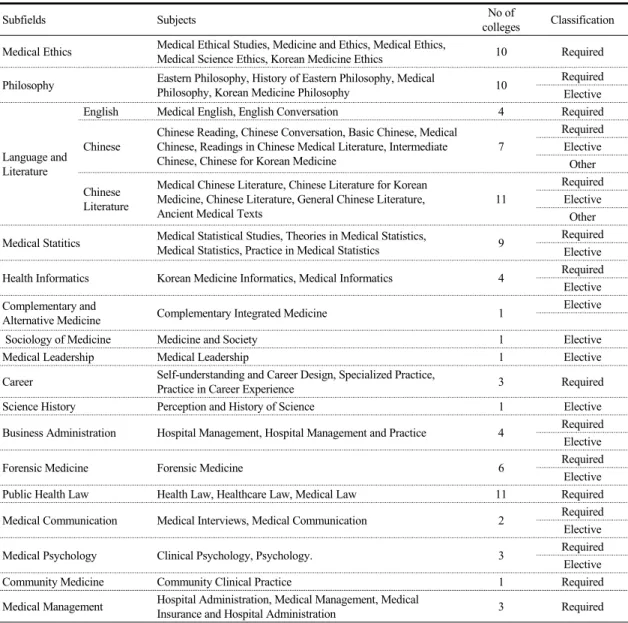
Table 1 shows the medical humanities and social
Table 1. Types of medical humanities and social medicine courses and the number of colleges that offer the courses
Subfields Subjects No of
colleges Classification Medical Ethics Medical Ethical Studies, Medicine and Ethics, Medical Ethics,
Medical Science Ethics, Korean Medicine Ethics 10 Required Philosophy Eastern Philosophy, History of Eastern Philosophy, Medical
Philosophy, Korean Medicine Philosophy 10 Required
Elective
Language and Literature
English Medical English, English Conversation 4 Required
Chinese
Chinese Reading, Chinese Conversation, Basic Chinese, Medical Chinese, Readings in Chinese Medical Literature, Intermediate Chinese, Chinese for Korean Medicine
7
Required Elective Other Chinese
Literature
Medical Chinese Literature, Chinese Literature for Korean Medicine, Chinese Literature, General Chinese Literature, Ancient Medical Texts
11
Required Elective Other Medical Statitics Medical Statistical Studies, Theories in Medical Statistics,
Medical Statistics, Practice in Medical Statistics 9 Required Elective Health Informatics Korean Medicine Informatics, Medical Informatics 4 Required Elective Complementary and
Alternative Medicine Complementary Integrated Medicine 1 Elective
Sociology of Medicine Medicine and Society 1 Elective
Medical Leadership Medical Leadership 1 Elective
Career Self-understanding and Career Design, Specialized Practice,
Practice in Career Experience 3 Required
Science History Perception and History of Science 1 Elective
Business Administration Hospital Management, Hospital Management and Practice 4 Required Elective
Forensic Medicine Forensic Medicine 6 Required
Elective
Public Health Law Health Law, Healthcare Law, Medical Law 11 Required
Medical Communication Medical Interviews, Medical Communication 2 Required
Elective
Medical Psychology Clinical Psychology, Psychology. 3 Required
Elective
Community Medicine Community Clinical Practice 1 Required
Medical Management Hospital Administration, Medical Management, Medical
Insurance and Hospital Administration 3 Required
medicine courses offered at the 11 CKM examined, as presented in KAS2021. The analysis showed that medical humanities and social medicine courses were offered, either as required or as elective courses, in all 11 CKM.
Table 2 shows the medical humanities and social medicine courses offered at the 11 CKM and their categories, years, credits, and course hours.
Students took medical humanities and social medicine courses most often in the second year of the pre-med program, followed by the first year of the pre-med program and fourth year of the medical program. The range of average credits and course hours for each course was 1.14-3.50 credits and 1.0-7.7 hours, respectively. The average number of medical humanities and social medicine courses was 5.3 for the pre-med program and 3 for the medical program. All 11 colleges offered public health law as a subject in the medical program.
Discussion
The World Health Organization (WHO) strives to establish accreditation mechanisms for health and medical training institutions in all countries.
Periodically, the WFME revises international standards for basic medical education to reflect the changing educational environment
7). Korean Medical education must also transform over time. KAS2021 proposed by the IKMEE was developed to reflect the current trends in medical education, including medical humanities and social medicine programs, which were the focus of this study. Based on the KAS2021
1), CKM must offer at least one medical humanities and social medicine course for each
grade, including content about medical professionalism and communication. In the present study, the authors examined the curriculum of the medical humanities and social medicine at CKM, and recommend how these schools should conduct medical humanities and social medicine education such that they meet KAS2021.
The analysis results and consequent suggestions are as follows.
First, in terms of the frequency of offered subjects, Chinese literature and medical law were most frequently offered, which were offered in all 11 CKM, followed by medical ethics and philosophy, which were offered in 10 colleges.
Chinese literature was offered as an 8 credit course, which was the largest number of credits offered. Although Language and Literature are classified under medical humanities and social medicine by KAS2021 standards, its place within this classification must be discussed. Medical humanities and social medicine can be defined in various ways, from ‘an interdisciplinary concept that encompasses humanties or social science subject matters relevant to facilitating the understanding and practice of medicine’ to ‘an approach to promote good medical practice’
8-10). Considering that medical humanities and social medicine aims to promote a comprehensive understanding and reflection on humanity, patient and disease, as well as the role of a doctor in Korean Medicine in society, there is a need for clear classification of what course can be included in this field.
Second, in terms of the offered timing, KAS2021
requires that 'at least one medical humanities and
social medicine course be offered for each grade',
Table 2. Educational Status of Medical Humanities and Social Science Courses in 11 Colleges of Korean Medicine (Number: credit, Parentheses: hours)
Subject areas Demensions A B C D E F G H I J K Average
of no courses
Medical Ethics
Pre Med
1 2(2) 2(2) 2(2)
2 1(2) 2(2) 1(2) 1(2) 2(2) 1(2)
Med 2 1(2)
Philosophy Pre
Med
1 1(2) 2(2) 2(4) 4(6) 2(2) 2(2)
2 2(4) 4(4) 1(2) 2(2)
Language and Literature
English Pre Med
1 2(2) 2(4) 2(4)
2 2(4)
Chinese Pre Med
1 2(4) 4(4) 2(4) 4(4)
2 2(4) 1(2) 4(4) 2(4) 4(4)
Chinese Literature
Pre Med
1 4(8) 4(8) 4(4) 2(4) 4(4) 4(4) 6(6) 4(4) 4(4)
2 4(8) 3(6) 2(4) 4(6) 2(4) 3(4) 4(4) 6(8) 2(4)
Med 1 1(2)
Medical Statitics Pre Med
1 2(2)
2 1(2) 1(2) 1(2) 2(2.5) 4(6) 1(2)
Med 2 2(2)
3 2(2)
Health informatics Pre Med
1 4(6)
2 1(2) 2(2)
Med 1 1(2)
Complementary and Alternative Medicine
Pre
Med 2 1(2)
Sociology of Medicine Pre
Med 2 1(2)
Medical Leadership Pre
Med 1 1(2)
Career
Pre
Med 1 1(1)
Med 2 1(2)
4 5(10.7)
History of science Pre
Med 1 1(2)
Business
Administration Med 4 1(2) 2(2) 1(2) 2(4)
Forensic Medicine Med
2 1(2) 1(2)
3 1(2) 1(2)
4 1(2) 2(2)
Public Health Law Med
2 1(2) 2(3)
3 2(4)
4 1(2) 2(4) 2(4) 2(2) 2(4) 4(4) 4(4) 2(2)
Medical
Communication Med 2 1(2) 1(2)
Medical Psychology Med 1 1(2) 1(2)
3 2(4)
Community Medicine Med 4 4(8)
Medical Management Med 4 1(2) 1(1) 2(2)
Total Pre-Med 6 7 7 4 5 5 5 5 5 5 5 5.36
Med 3 4 3 3 3 1 2 2 3 5 4 3.00
1) Pre Medical Course(Pre-med), Medical Course(Med)