Printed in the Republic of Korea https://doi.org/10.5012/jkcs.2020.64.2.79
Discovery of Epinastine-NSAID Hybrids as Potential Anti-inflammatory Agents:
Synthesis and In Vitro Nitric Oxide Production Inhibitory Activity Study
Hyeong Ryeol Woo, Kongara Damodar, Yeontaek Lee†, Soon-sung Lim‡, Sung Ho Jeon†,*, and Jeong Tae Lee*
Department of Chemistry and Institute of Applied Chemistry, Hallym University, Chuncheon 24252, Korea.
*E-mail: [email protected]
†Department of Life Science and Multidisciplinary Genome Institute, Hallym University, Chuncheon 24252, Korea.
*E-mail: [email protected]
‡Department of Food Science and Nutrition and Institute of Korean Nutrition, Hallym University, Chuncheon 24252, Korea.
(Received December 30, 2019; Accepted February 7, 2020)
ABSTRACT. A novel pharmacophore with epinastine (1) and NSAID moieties (2–5) was designed by molecular hybridization approach. The hybrid compounds 6–9 were synthesized by EDCI/HOBt or HATU-mediated coupling of 1 with salicylic acid (2), mefenamic acid (3), indomethacin (4) and naproxen (5), respectively, and were assessed for their inhibitory effect against NO production in LPS-induced RAW-264.7 macrophages in vitro. The Hybrids were found to exhibit significant NO production inhibitory effects with half-maximal inhibitory concentration (IC50) values ranging in between 15.96 ± 1.32 and 36.68 ± 2.53 µM and were non-cytotoxic to macrophages. Comparing the inhibition concentration (IC50), cytotoxicity concentration (CC50) and in vitro efficacy index (iEI), 6 (IC50= 17.97 ± 1.92 µM; iEI = 11.13) and 9 (IC50= 15.96 ± 1.32 µM; iEI = 12.53) were better suited than other hybrids as well as their parent compound. Our findings signify that hybrids 6 and 9 may serve as platforms for continued investigations for the development of more efficient anti-inflammatory agents.
Key words: Epinastine, NSAIDs, Hybrid molecules, Nitric oxide, Anti-inflammatory
Inflammation is an early biological response that helps our body heal and defends itself from harm, such as infec- tions, injuries, and toxins.1 This process involves the release of diverse pro-inflammatory cytokines and mediators, such as interleukin-1 beta (IL-1β), tumor necrosis factor alpha (TNF-α), IL-6, prostaglandins (PGs), and nitric oxide (NO), mainly by activated macrophages and increased blood flow to the damaged area.2 It usually turns off after a few hours or days and goes back to normal in the case of acute inflammation. However, uncontrolled or misdirected inflam- mation underlies chronic diseases, such as Parkinson’s dis- ease, Alzheimer’s disease, cancer and asthma.3 Hence, inflammation can be considered as a double-edged sword.
On this ground, the above-stated mediators have a vital role in inducing inflammatory-related disorders and may have the potential as therapeutic targets.4
Non-steroidal anti-inflammatory drugs (NSAIDs), steroids and antihistamines are the most frequently prescribed medicines for analgesia in primary health care. The major therapeutic effects as well as unwanted actions of NSAIDs are observed due to the inhibition of cyclo-oxygenase (COX) enzymes.5 Hence, beyond a certain limit, their usage is restricted because they are well known to affect the gastrointestinal tract, kidneys, liver, and cardiovascular system adversely.6
As a result, some NSAIDs were withdrawn from the global market. This has urged pharmaceutical companies and research institutions to continuously explore new pharmaco- phores with improved anti-inflammatory activity and low toxic profiles.
The ophthalmic second-generation antihistamine, epi- nastine hydrochloride (EH) (1) is used to treat allergic conjunctivitis without any CNS or cardiac complications compared to oral antihistamines.7 Its anti-inflammatory properties are also reported.8 During the last two decades, there has been increasing interest for hybrid molecular technique in the new drug discovery.9–12 As part of our ongo- ing investigations on the development of novel anti-inflam- matory agents,13 herein, we describe the synthesis of new anti-inflammatory agents 6–9 designed as hybrids of EH and NSAIDs such as salicylic acid (2), mefenamic acid (3), indomethacin (4) and (S)-2-(6-methoxynaphthalen-2- yl)propanoic acid (naproxen) (5) (Fig. 1) and evaluation of their in vitro NO production inhibition potential.
EXPERIMENTAL General Information
All starting materials and reagents were purchased
commercially and were used without any additional puri- fication. Solvents used for reactions were purchased Sigma- Aldrich and Alfa Aesar in sure seal bottles and used as received. Proton nuclear magnetic resonance (1H-NMR 400 MHz) spectra and proton decoupled carbon 13C (13C{1H}) NMR (100 MHz) spectra were recorded at 300 K on a JNM-ECZRS FT-NMR (JEOL Ltd., Tokyo, Japan) and deu- terated chloroform was used as a solvent. Chemical shifts were expressed in δ parts per million (ppm) relative to tetramethylsilane (TMS, δ 0.00 ppm) or the solvent res- onance (chloroform-d, δ 7.26 ppm for 1H NMR and δ 77.0 ppm for 13C NMR). The following pattern was employed for 1H-NMR data: chemical shift (multiplicity (singlet = s), (doublet = d), (triplet = t), (quartet = q), (doublet of dou- blet = dd) and (multiplet = m), integration, coupling con- stants (J) quoted in Hz). Low-resolution electron impact mass spectra [MS (EI)] and high-resolution electron impact mass spectra [HRMS (EI)] analyses were acquired on a JMS-700 (JEOL Ltd., Tokyo, Japan) spectrometer at the cen- tral laboratory of Kangwon National University. Routine monitoring of reactions was conducted by thin-layer chro- matography using Merck silica gel plates 60 F254. The spots were visualized by UV light (λ = 254 nm) or an appropriate reagent (7% ethanolic phosphomolybdic acid, p-anisaldehyde solution in H2SO4 followed by heating).
For open column chromatographic purifications, silica gel 60 (230−400 mesh size, Merck, Darmstadt, Germany) was utilized.
Synthesis
N-(9,13b-Dihydro-1H-dibenzo[c,f]imidazo[1,5-a]aze- pin-3-yl)-2-hydroxybenzamide (6). The product was pre- pared according to our previously reported method and the characterization data (1H and 13C-NMR and HRMS) of 6 were also in accordance with the reported values.13
N-(9,13b-Dihydro-1H-dibenzo[c,f]imidazo[1,5-a]aze- pin-3-yl)-2-((2,3-dimethylphenyl)amino)benzamide (7).14 Cooled solution of 3 (0.13 g, 0.52 mmol) in tetrahydro- furan (3 mL) was treated with EDCI (0.09 mL, 0.52 mmol) followed by HOBt (0.07 g, 0.52 mmol) under argon atmo- sphere and stirred for 20 min. In another round bottom flask, 1 (0.10 g, 0.35 mmol) in tetrahydrofuran (3 mL) was treated with DIPEA (0.24 mL, 1.40 mmol), stirred for 20 min at ambient temperature and added to 3 containing reac- tion mixture. The resultant mixture was stirred at ambient temperature for 6 h. The reaction solution was quenched by adding deionized water (10 mL) and the whole was extracted with ethyl acetate (3 × 20 mL). The combined organic phase was washed with deionized water (2 × 20 mL) and saturated aqueous sodium chloride solution (20 mL) successively, dried over sodium sulfate, and concentrated under reduced pressure. Purification of the resulting res- idue by column chromatography (petroleum ether/ethyl ace- tate, v/v, 2:1) gave 0.09 g of 7 (57%) as pale yellow solid.
Rf = 0.58 (petroleum ether/ethyl acetate = 2:1). 1H NMR (400 MHz, CDCl3) δ 1.79 (s, 3H), 2.26 (s, 3H), 3.51 (d, 1H, J = 14.4 Hz), 3.75 (t, 1H, J = 9.6 Hz), 4.29 (t, 1H, J = 9.4 Hz), 4.64 (d, 1H, J = 14.1 Hz), 5.21 (t, 1H, J = 10.1 Hz), 6.55 (d, 1H, J = 8.4 Hz), 6.59 (t, 1H, J = 7.7 Hz), 6.79 (t, 1H, J = 7.7 Hz), 6.92-7.04 (m, 5H), 7.10 (t, 1H, J = 8.6 Hz), 7.21 (t, 2H, J = 5.2 Hz), 7.25-7.27 (m, 2H), 7.46 (dd, 1H, J = 7.9 Hz, J = 1.0 Hz), 8.13 (dd, 1H, J = 8.0 Hz, J = 1.7 Hz), 9.29 (s, 1H), 10.19 (s, 1H); 13C NMR (100 MHz, CDCl3) δ 13.9, 20.7, 39.0, 50.6, 61.1, 115.7, 119.1, 124.0, 125.7, 126.2, 127.3, 127.5, 127.6, 127.8, 127.9, 128.0, 128.3, 130.6, 132.4, 132.8, 133.3, 135.9, 136.0, 136.6, 113.6, 137.6, 139.3, 140.0, 149.3, 162.6, 179.1; EI-MS m/z 472 ([M]+, base), 352, 194, 118; HRMS (EI) m/z calcd for C31H28N4O: 472.2263 ([M]+), found: 472.2262.
2-(1-(4-Chlorobenzoyl)-5-methoxy-2-methyl-1H-indol- 3-yl)-N-(9,13b-dihydro-1H-dibenzo[c,f]imidazo[1,5-a]aze- pin-3-yl)acetamide (8). DIPEA (0.12 mL, 0.70 mmol) was added to a stirred suspension of 1 (0.1 g, 0.35 mmol) in anhydrous N,N-dimethylformamide (DMF) (2 mL) at ambient temperature and stirred for 20 min under argon atmosphere. (1-[Bis(dimethylamino)methylene]-1H-1,2,3- Figure 1. Structures of epinastine (1), salicylic acid (2), mefenamic
acid (3), indomethacin (4), naproxen (5) and epinastine-NSAID hybrid compounds (6–9).
triazolo[4,5-b]pyridinium 3-oxide hexafluorophosphate (HATU) (0.16 g, 0.42 mmol) followed by DIPEA (0.12 mL, 0.70 mmol) were added to another round bottom flask containing a solution of indomethacin 4 (0.15 g, 0.42 mmol) in anhydrous DMF (2 mL), stirred for 10 min. and this solu- tion was transferred to 1 containing mixture via syringe.
The resultant reaction mixture was stirred for 2 h. After this period, deionized water (10 mL) was added and extracted with ethyl acetate (3 × 25 mL). The combined organic phases were washed with deionized water (3 × 20 mL) and saturated aqueous sodium chloride solution (20 mL), dried over sodium sulfate, and concentrated under reduced pres- sure. Purification of the crude material by silica gel col- umn chromatography (petroleum ether/ethyl acetate, v/v, 3:1) gave 0.03 g of 8 (16%) as pale yellow liquid. Rf = 0.24 (petroleum ether/ethyl acetate = 1:1). 1H NMR (400 MHz, CDCl3) δ 2.28 (s, 3H), 3.50 (d, 1H, J = 14.3 Hz), 3.64 (m, 3H), 3.76 (s, 3H), 4.14 (t, 1H, J = 9.4 Hz), 4.58 (d, 1H, J = 14.2 Hz), 5.07 (t, 1H, J = 9.4 Hz), 6.64 (dd, 1H, J = 9.4, 2.4 Hz), 6.93 (d, 1H, J = 8.8 Hz) 6.96 (m, 1H), 7.03 (d, 1H, J = 2.4 Hz), 7.18−7.25 (m, 5H), 7.28−7.33 (m, 2H), 7.44 (d, 2H, J = 8.4 Hz), 7.62 (d, 2H, J = 8.4 Hz), 8.96 (s, 1H); 13C NMR (100 MHz, CDCl3) δ 13.7, 36.7, 39.1, 49.9, 55.8, 61.3, 102.1, 111.4, 114.9, 116.1, 127.3, 127.4, 127.5, 127.7, 127.8, 128.0, 128.3, 129.1, 130.4, 131.0, 131.2, 131.7, 134.5, 135.4, 135.6, 135.8, 136.7, 138.8, 138.9, 156.0, 162.9, 168.4, 184.8; EI-MS m/z 588 ([M]+), 341, 249, 139 (base); HRMS (EI) m/z calcd for C35H29ClN4O3 588.1928 ([M]+), found: 588.1926.
(2S)-N-(9,13b-Dihydro-1H-dibenzo[c,f]imidazo[1,5-a]
azepin-3-yl)-2-(6-methoxynaphthalen-2-yl)propaamide (9).
DIPEA (0.25 mL, 1.4 mmol) was added to a stirred sus- pension of 1 (0.1 g, 0.35 mmol) in anhydrous tetrahydro- furan (2 mL) at ambient temperature and stirred for 20 min under argon atmosphere. HATU (0.19 g, 0.49 mmol) was added to another round bottom flask containing a solution of 5 (0.1 g, 0.42 mmol) in anhydrous tetrahydrofuran (2 mL), stirred for 10 min. and this solution was transferred to 1 containing mixture via syringe. The resultant reaction mixture was stirred for 2 h. After this period, deionized water (10 mL) was added and extracted with ethyl acetate (2 × 25 mL).
The combined organic phases were washed with deionized water (2 × 20 mL) and saturated aqueous sodium chloride solution (20 mL), dried over sodium sulfate, and concen- trated under reduced pressure. Purification of the crude material by silica gel column chromatography (petroleum ether/ethyl acetate, v/v, 3:1 to 1:1) gave 0.06 g of 9 (37%) as white solid. Rf = 0.62 (petroleum ether/ethyl acetate =
1:1). Major diastereomer 1H NMR (400 MHz, CDCl3) δ 1.54 (d, 3H, J = 7.2 Hz), 3.47 (d, 1H, J = 14.4 Hz), 3.62 (dd, 1H, J = 12.8, 3.2 Hz), 3.88 (q, 1H, J = 7.0 Hz), 3.91 (s, 3H), 4.11 (t, 1H, J = 8.8 Hz), 4.52 (d, 1H, J = 14.4 Hz), 5.06 (dd, 1H, J = 11.6, 9.2 Hz), 6.93–6.96 (m, 1H), 7.08–
7.11 (3H, m), 7.17–7.19 (m, 2H), 7.20–7.22 (m, 2H), 7.29 ((dd, 2H, J = 7.6, 1.6 Hz), 7.47 (dd, 1H, J = 8.4, 1.6 Hz), 7.63–7.67 (m, 3H), 8.89 (br s, 1H); Minor diastereomer
1H NMR (400 MHz, CDCl3) δ 1.51 (d, 3H, J = 7.2 Hz), 3.50 (d, 1H, J = 14.4 Hz), 3.59 (dd, 1H, J = 12.8, 3.2 Hz), 3.82 (q, 1H, J = 7.2 Hz), 3.92 (s, 3H), 4.09 (t, 1H, J = 8.8 Hz), 4.60 (d, 1H, J = 14.4 Hz), 4.97 (dd, 1H, J = 11.6, 9.2 Hz), 6.91–6.94 (m, 1H), 7.12–7.14 (m, 3H), 7.15–7.16 (m, 2H), 7.22–7.24 (m, 2H), 7.38 (2H, dd, J = 7.6, 1.6 Hz), 7.48 (dd, 1H, J = 8.4, 1.6 Hz), 7.66–7.71 (m, 3H), 8.93 (br s, 1H); 13C NMR (100 MHz, CDCl3) δ 17.6, 19.0, 39.0, 39.1, 49.6, 49.8, 50.2, 50.7, 55.2, 55.3, 61.2, 61.3, 105.5, 105.6, 118.3, 118.4, 126.1, 126.2, 126.4, 127.1, 127.2, 127.3, 127.4, 127.5, 127.6, 127.8, 127.9, 128.1, 128.2, 129.0, 129.1, 129.3, 130.2, 130.3, 133.3, 133.4, 135.5, 135.6, 135.7, 136.0, 136.9, 138.3, 138.4, 138.7, 138.8, 157.1, 157.2, 162.7, 162.9, 188.2, 188.8; EI-MS m/z 461([M]+), 277 (base), 234; HRMS (EI) m/z calcd for C30H27N3O2 461.2103 (M+), found: 461.2102.
Biology
Cell Culture and Cell Viability Assay. The murine macrophage cell line, RAW 264.7 was acquired from the Korea Cell Line Bank (Seoul, South Korea) and culti- vated in Dulbecco’s modified Eagle’s medium (DMEM;
Gibco, Carlsbad, CA, USA) containing 10% fetal bovine serum (FBS, Gibco) added with 2 mM glutamine and 100 units/mL penicillin-streptomycin.
Cell viability assay was carried out by using CellTiter 96® AQueous One solution cell proliferation assay kit (Promega, Fitchburg, WI, USA). To the cultured cells (5 × 10⁴ cells/well) on 96-well plates was added a series of dilu- tions of the samples. After 24 h incubation, MTS (tetrazolium salt) reagents were applied to the plates and incubated at 37 ºC for 1 h. Absorbance at 490 nm was recorded using a Microplate reader (Thermo Scientific, Waltham, MA, USA).
NO Assay. RAW264.7 cells (5 × 10⁴ cells/well on 96- well plates) were treated with various amounts of sample (approximately 0.78–100 μM) and prompted with LPS (100 ng/mL) for 24 h at 37 ºC. After incubation, the amount of nitrite (NO2−) in the culture supernatant was quantified through the Griess Reagent System (Promega Corporation).
RESULTS AND DISCUSSION
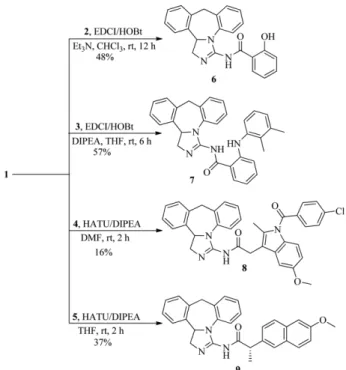
The synthetic pathway for the requisite epinastine-NSAID hybrids 6–9 is outlined in Scheme 1. 1-Ethyl-3-(3-dime- thylaminopropyl)carbodiimide (EDCI)/1-hydroxy-benzotri- azole (HOBt) or (1-[bis(dimethylamino)methylene]-1H- 1,2,3-triazolo[4,5-b]pyridinium 3-oxide hexafluoro-phos- phate (HATU) mediated amide coupling reaction was employed to synthesize the target hybrids. The initial reac- tion was conducted by the direct coupling of 1 with 2 in the presence of EDCI/HOBt and triethylamine in chloro- form at ambient temperature for 12 h to obtain the hybrid 6 in 48% yield.13 Whereas, HATU-mediated coupling using N,N-diisopropylethylamine (DIPEA) in N,N-dimethylfor- mamide offered 6 in 38% only. Next, EDCI/HOBt-pro- moted coupling of 1 with 3 in tetrahydrofuran proceeded smoothly to furnish 7 in 57% yield.14 Coupling of 1 with the NSAIDs 4 and 5 in the presence of HATU and DIPEA
afforded the desired hybrids 8 and 9 in 16% and 37% yields, respectively. Compound 9 was obtained as an inseparable diastereomeric mixture. Structures of these novel hybrids 6–9 were well characterized by their nuclear magnetic res- onance (1H- and 13C-NMR) and mass (MS) spectral data.
1H-NMR of all the hybrids showed a singlet/broad singlet peak with downfield chemical shift δ in the range of 8.89–
9.29 ppm, which designate that the amide bond was formed and in case of hybrid 6 the phenolic (-OH) proton and an additional amide (-CO-NH) proton of 7 were observed at δ 13.20 and 10.19 ppm, respectively. The high resolution mass spectrometry (HRMS) data of all hybrids were also in good agreement with the expected chemical structures.
Bioactivity
The novel epinastine-NSAID hybrids 6–9 were screened for their in vitro inhibitory activities against NO produc- tion in LPS-stimulated macrophages by 3-(4,5-dimeth- ylthiazol-2-yl)-2,5-diphenyltetrazolium bromide (MTT) assay (Table 1). The preliminary biological evaluation showed that the hybrids exhibited moderate to potent inhibitory potential with the half maximal inhibitory concentration (IC50) values in the range of 15.96 ± 1.32 and 36.68 ± 2.53 μM.
It is apparent from the IC50 values of the synthesized hybrids that hybrid 6 (IC50 = 17.97 ± 1.92 µM) and 9 (IC50
= 15.96 ± 1.32 µM) were more potent than the parent con- trol compound 1 (IC50 = 53.17 ± 2.21 µM). Toxicity levels were evaluated through MTT assay which indicated that none of the hybrids exhibited any significant toxicity against macrophages (CC50≥ 200 µM). It is worth mentioning that the in vitro efficacy index (iEI),15 the ratio of toxicity (CC50)/anti-inflammatory potency (IC50), values are sig- nificant for 6 (iEI = 11.13) and 9 (iEI = 12.53), when compare to the control (iEI = 2.29). Therefore, the present prelim- inary results provide a platform to consider hybrids 6 and 9, having salicylic acid and naproxen as NSAID units respectively, for further investigations and may shed light in exploring newer NSAID hybrids toward the develop- ment of new anti-inflammatory drugs with fewer toxicities.
Scheme 1. Synthesis of epinastine-NSAID hybrids 6–9.
Table 1. NO production inhibitory effects of epinastine-NSAID hybrids 6–9
Compound NO assay IC50 (μM)a Cell viability CC50 (μM)a iEI (CC50/IC50)
1 53.17 ± 2.21 121.92 ± 3.58 2.29
6 17.97 ± 1.92 ≥ 200.00 11.13
7 28.86 ± 0.98 ≥ 200.00 6.93
8 36.68 ± 2.53 ≥ 200.00 5.45
9 15.96 ± 1.32 ≥ 200.00 12.53
aThe results are reported as mean value ± SEM for n=3.
CONCLUSION
In this work, we designed and synthesized a series of hybrid compounds (6–9) of epinastine (1)-NSAID (2–5) as novel anti-inflammatory agents. The hybrid compounds were procured by direct linkage of 1 and the NSAID via an amide bond. The in vitro screening results indicated that some hybrid compounds showed better inhibitory effect against NO production without serious cytotoxicity towards macrophages. A notable observation from the results and in vitro efficacy index (iEI) values was that two hybrid com- pounds 6 (IC50= 17.97 ± 1.92 µM, iEI = 11.13) and 9 (IC50
= 15.96 ± 1.32 µM, iEI = 12.53) significantly inhibited NO production compared to positive control 1 (IC50 = 53.17 ± 2.21 µM, iEI = 2.29), and they are worthy of further exploitation.
Acknowledgments. This work was supported by the Hallym University Leading Research Group Support Pro- gram of 2017 (HRF-LGR-2017-0004).
Supporting Information. Additional supporting infor- mation may be found online in the Supporting Informa- tion section at the end of the article.
REFERENCES 1. Medzhitov, R. Nature 2008, 454, 428.
2. Hamidzadeh, K.; Christensen S. M.; Dalby, E.; Chan-
drasekaran, P.; Mosser, D. M. Annu. Rev. Physiol. 2017, 79, 567.
3. Chen, L.; Deng, H.; Cui, H.; Fang, J.; Zuo, Z.; Deng, J.;
Li, Y.; Wang, X.; Zhao, L. Oncotarget 2017, 9, 7204.
4. Kopf, M.; Bachmann, M. F.; Marsland, B. J. Nat. Rev.
Drug Discov. 2010, 9, 703.
5. Wongrakpanich, S.; Wongrakpanich, A.; Melhado, K.;
Rangaswami J. Aging Dis. 2018, 9, 143.
6. Waller D.; Sampson, A. Medical Pharmacology and Ther- apeutics; Elsevier: Oxford, U. K., 2017; p 363.
7. Mizoguchi, T.; Ozaki, M.; Ogino, N. Clin. Ophthalmol.
2017, 11, 1747.
8. Pradhan, S.; Abhishek, K.; Mah F. Expert Opin. Drug Metab. Toxicol. 2009, 5, 1135.
9. Meunier, B. Acc. Chem. Res. 2008, 41, 69.
10. Bosquesi, P. L.; Melo, T. R.; Vizioli, E.O.; Santos, J. L.;
Chung, M. C. Pharmaceuticals 2011, 4, 1450.
11. Shaveta; Mishra, S.; Singh P. Eur. J. Med. Chem. 2016, 124, 500.
12. Mohsin, N. A.; Ahmad, M. Turk. J. Chem. 2018, 42, 1.
13. Lee, J. M.; Damodar, K.; Lee, Y.; Lee, J. Y.; Jeon, S. H.;
Lee, J. T. Bull. Korean Chem. Soc. 2019, 40, 761.
14. Lee, J. M.; Damodar, K.; Lee, Y.; Woo, H. R.; Suh, H.
W.; Jeon, S. H.; Lee, J. T. Bull. Korean Chem. Soc. 2020, In press. https://doi.org/10.1002/bkcs.11990.
15. Mazzio, E. A.; Bauer, D.; Mendonca, P.; Taka, E.; Soliman, K. F. J. Neuroimmunol. 2017, 302, 10.