Journal of the Korean ChemicalSociety 2000, Vol.44, No. 3
Printed in the Republicof Korea
ab initio Calculations on Alkali Atom - Rare Gas Van Der Wads Clusters
Bosoon Lee and Sungyul Lee*
College of Environment and Applied Chemistry, Kyunghee Universi~, Kyungki-do 449-701, Korea (Received March 29, 2000)
o QF. M-Rg %! M-Rg4M=Li, Na, Rg=He, Ar) WG]E9A
%3-4%41 q% ‘)z}%3 2]’.%+
sj%}~+.
All-electron MP2(6-31 l++G(3df, 3pd))41 ~ ~}~ ~] ~~~ LiHe, LiAr ~ N*+ %% ~ <~ ~ ~~ @.~ ~]’~~]% ~~~~ %1 ~zl@%q. LiHe,, LiAr, %! NaArf’11LIId4 Z]-ilq %%%4 +1+1%= =q 214+-’%’=+.
ABSTACT. ab initio calculations are presented for M-Rg and M-Rg* (M=Li, Na, Rg=He, Ar) van der Waals clusters. Internuclear distances and binding energies of LiHe, LiAr and NaAr obtained by all-electron MP2/(6-31 l++G(3df, 3pd)) method are in good agreement with experimental vahres. Calculated properties of LiHe,, LiAr2, NaHe, and NaArz are also reported.
Van der Waals clusters have attracted considerable attention both experimentally”5 and theoretically&8 for a long time. Progress in molecular beam technology allowed large amounts of information on the structure and reactivity to be accumulated for various kinds of van der Waals clusters. Alkali metakwe gas clusters are the simplest and prototypical example. Besides their impor- tance in understanding the long range interactions, they began to be investigated as a good example for spin-orbit changing collision experiments.9 Theoretically, it has long been considered to be rather difficult to investigate the alkali metal-rare gas system by ab initio methods due to the long range nature of the interactions between atoms. Since the binding energy is usually less than 50 cm-’ for these systems, Hartree-Foek level of theory will certainly not be adequate. Some full CI calculations were carried out to give the geometry and binding ener- gies, which are in good agreement with experiments on
alkali metrd - rare gas diatomics, but will probably be too expensive to perform for polyatornics. A computation based on simulated annealing was tried for polyatotnic alkali metal-rare gas systems, but the geometry obtain- ed was only in partial agreement with experiments. In order to calculate the properties of the van der Waals sys- tem, such important factors as the long range dispersion forces and electron correlation should properly be incor- porated in quantum chemical calculations.
In this work, we employ all electron Moeller-Plesset (MP) methods to obtain the structures of the smaller alkali metal-rare gas van der Waals systems, and to ana- lyze the appropriateness of the methods and the basis sets employed. GAUSSIAN 94 suite of programs’” were used to carry out the calculations. We compute the equi- librium structures and blndlng energies. The calculated results are compared with experiments and other theo- retical calculations. We find that the all-electron MP2
190–
Alkali Atom Rme Gas VDW clusters 191
Table 1. Bond length and binding energy of NaArobtained by HF and al-electron MP2 methods
Bond Length Binding Energy
(A) (cm-’)
HF (6-3 I I+G**) 7.90 0.77
HF((6-31 l++G(3df, 3pd)) 7.60 0.90
MP2 (6-31 l+G**) 6.29 12.58
MP2 (6-311++G(3df, 3pd)) 5.13 45.43
calculations with large basis (6-3 11++G(3df, 3pd)) are needed to obtain the molecular parameters that are in good agreement with experiments.
lizble 1 presents equilibrium bond length and binding energy of NaAr obtained by Hartree-Fock and MP2 level of theory. Two basis sets, 6-31 I+G** and 6-311 ++G (3df, 3pd], are employed for both methods. It can be seen that the Hartree-Fock level of theory with large basis sets available in Gaussiass 94 gives bond length and binding energy that are in complete disagreement with experi- mental results. The binding energy is found to almost vanish, while the experimental value is about 40 cm-’. It should be noticed that even the bond length (7.6A) obtained by Hartree-Fock calculations is very different from the experimental one (about 5A) by more than 2 A.
Considering that the Hartree-Fock theory usually gives fairly accurate bond lengths in many molecules, it indi- cates that alkali metal-rare gas van der Waals system is indeed a very tricky molecule to treat theoretically. This is further verified in the MP2 calculations. The all -elec- tron MP2 calculations with pretty large basis 6-311 +G**
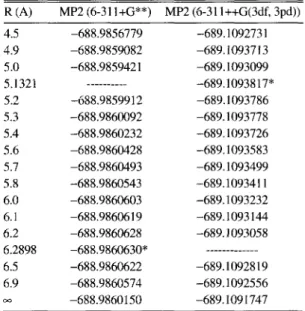
also result in poor bond length and binding energy (fro- zen core MP2 method would give results identical to the Wwtree-Fock calculations, since NaAr has only one valence electron). Changing the bcsis from 6-31 l+G** to 6- 31 l++G(3df, 3pd), however, leads to dramatic changes as presented in Table 1. The bond length and the binding energy are obtained to be 5.13 A and 45.43 cm-’,respec- tively. The difference between the calculations employ- ing the two basis sets is also presented in Table 2, where the energies are given near the minimum energy config- urations. These values agree very well with experimental values as shown in Table 3. The bond lengths obtained by all electron MP2 method using 6-31 l++G(3df, 3pd) basis in the present calculations (5.13A) are close to the experimental value””2 (about 5 A). Table 3 also pre-
2000,
vol.
44, No. 3Table2. Energy of NaAr calculated by all electron MP2 method using two basis sets (6-31I+G** and 6-31l+tG(3df, 3pd)) R (A) MP2 (6-31 I+G**) MP2 (6-31 l++G(3df, 3pd)) 4.5 –688.9856779 –689. 1092731 4.9 –688.9859082 –689. 1093713 5.0 –688.9859421 –689. 1093099
5.1321 .---.- –689,1093817*
5.2 –688.985991 2 –689.1093786
5.3 -688.9860092 –689.1093778
5.4 –688.9860232 –689.1093726
5.6 –688.9860428 –689.1093583
5.7 –688.9860493 –689. 1093499 5.8 –688.9860543 –689.109341 1
6.0 –688.9860603 –689.1093232
6.1 –688.9860619 -689.1093144
6.2 -688.9860628 –689. 1093058
6.2898 –688.9860630” ---
6.5 –688.9860622 –689.1092819
6.9 –688.9860574 –689.1092556
–688.9860150 –689.1091747
*Minimum energy point
Table 3. Bond lengths and binding energies of M-Ar (M=Li, Na)
Bond length Binding Energy
(A) (cIn”’)
LiAr
theoreticat(MP2) 5.08 (1) 36.98 (1) experimental 4.95 (2) 42,8 (2)
4.89 (3) 42.5 (3) NaAr
theoretical(MP2) 5.13 (1) 45.43 (1) mixed qoarrtudclasical 5.59 (4) 56.8 (4)
experimental 4.81 (5) 42 (5)
4.99 (6) 39 (6) 5.01 (2) 45 (2) (1) Present work (all electron MP2/6-31 l++G(3df, 3pd)).
(2) Ref. 12 (3) Ref. 13 (4) Ref. 8(a) (5) Ref. 11 (6) Ref. 1
sents similarly calculated results obtained for LiAr by employing all-electron MP2 method with 6-31 l++G (3df, 3pd) basis. The potential curves of the alkali metd- rare gas diatomics would be very useful to simulate the experiments on the alkali metal impurity in rare gas matrix’~” that motivated the present work, since they may be employed as pairwise potentials between the alkali metal and rare gas atoms.
Due to the small polarizability of the He atom, the
Table 4.Bond lengths and binding energies of M-He (M=LI, Na)
Bond length Binding Energy
(A) (cm”’)
L,iHe
Theor@ical(MP2) 6.10(1) 1.95(1)
experimental 6.03(2) 1.14(2)
6.20(3) 1.34(3)
NaHe
6.10(1) 2.54(1)
6.41(3) 1,~o(3)
(1) Present work (all electron MP2/6-311 ++G(3df, 3pd)) (2) Ref. 18. (3) Ref. 7.
bonding in metal - helium clusters are expected to be extremely weak. The bond distances of alkali metal - helium atom are known to be very large (about 6 A), and the binding energies are essentially nonexisting (about 1 Crl- ‘, see Table 4). Our calculations also verify these extremely weak bonding, as presented in Table 4. The calculated bond lengths of LiHe and NaHe (6.19 and 6.22 A, respectively) are larger than the corresponding metal-argon complexes by a little more than 1 A, indi- cating weaker bonding in the metal complexes with helium atom. Agreement with experiment’g (for LiHe) and other theoretical results’ (for NaHe) is very good. It should be added that the Hartee-Fock calculations employing the same large basis would give considerably larger bond distances for these diatomic clusters (by 2.47 A for the case of NaAr). One possible source of inaccuracy in theab irzitio computations for the binding energies of the very weakly bound van der Waals clusters may be due to the basis set superposition errors (BSSE).
Since the birding energies reported above are rather small (less than 50 cm-’), they may be prone to such errors, especially for NaHe and LiHe compounds. Since the correction procedures of the BSSE are quite arbitrary, however, and since the BSSE tends to get smaller when using larger basis set, we did not attempt to consider the BSSE here.
For polyatomic alkali metal-rare gas van der Waals clusters, there exists very little information. Simulated annealing calculations by Singer and coworkers seem to be the only work on these very interesting systems. Due to the difficulty of size-selecting the neutral clusters, no experimental data are available yet. We employ all-elec-
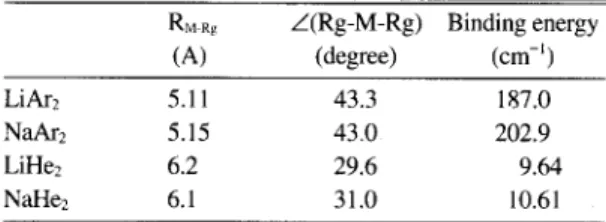
tron MP2 method to compute the structure of the smal- est polyatomic alkali metal-rare gas van der Waals clusters, that is, NaAr*, LiArZ, NaHe* and LeHeZ. In a theoretical work, Singer and coworkers founds(’)that the cluster is highly bent, with the Na-Ar distance of 5.4-5.5 A We find in the present calculations (see Table 5) ca- ried out under C*. symmetry constraint that the Na-Ar distance and the bond angle are 5.15 A and 43 degrees, respectively (The Hartree - Fock optimized values are 7.43 A and 40 degrees). Since the bond length of NaAr presented in this work is in good agreement with exper- iment, we believe that the bond length of 5.15 A obtained in the present calculations is close to the real bond length of NaAr,. The cluster seems to be very floppy, since the vibrational quantum for bending mode is found to be very small (10.3 cm-’). The distance between the two argon atoms in NaAr2 is 3.5 A. Since the bond length of Ar, is 4.82 A, the distance between the two argon atoms in NaAr* is significant y shorter.
This indicates that the sodium atom acts to increase the bonding of the two argon atoms in NaAr,. This three- body interaction in NaAr2 is also seen in the binding energy, which is obtained as the difference between the energy at the optimized geome~ and that of the fully dissociated system (a sodium atom and two argon atoms). The binding energy of NaArZ obtained in the present calculations is 202.9 cm-’, which is larger than the sum of the binding energies of pairwise interactions between a sodium atom and two argon atoms by about 30 cm-’. This difference amounts to the contribution of the three-body interaction in NaAr,. Table 5presents the calculated properties of LiAr*. The Ar-metal atom dis- tance and the bond angle of LiArZ are very similar to those of NaAr,.
Table 5 also presents the calculated properties of LiHe* and NaHe,, for which no data are available for
Table 5.Calculated properties of M-Rg, (M=Li, Na, Rg=Ar, He)
R,+., ,Z(Rg-M-Rg) Binding energy
(A) (degree) (cm-’)
Likj 5.11 43.3 187.0
Nakz 5.15 43.0 202.9
LIHe, 6.2 29.6 9.64
NaHe* 6.1 31.0 10.61
Journal qfthe Korean Chemical Soceie~
Alkali Atom - Rare GasVDW Clusters 193
comparison. We find in the present calculations carried out under Cz, symmetry constraint that LiHe2 and NaHeZ are highly bent, with bond angles of 29.6 and 3 I degrees, respectively. The Li-He and Na-He distances in L]HeZ and NaHeZ are very similar to those in LiHe and NaHe, being 6.2 A and 6.1 A, respectively. Smaller bond angles of these triatotnic clusters relative to those of M-Ar clus- ters (about 40 degrees) can be attributed to the smaller size of the helium atom. Binding energies of LiHez and NaHe, are very small, being 9.6 cm-’ and 10.6 cm-’, respectively. These binding energies are obtained as the energy difference between the optimized structures and the fully dissociated system (that is, a metal atom and two helium atoms). There may exist a small degree of three-body interactions that play to stabilize the LiHe, and NaHez chrsters as we have shown above for LiArz and NaArz. Since the magnitudes of the interactions are so small for the LiHez and NaHe* clusters, however, they are not expected to stabilize the clusters in the present case to any significant degree. The small binding ener- gies also indicate that the clusters will be extremely floppy. Although the vibrational frequencies of LiHe, and NaHez could not be obtained in the present calcu- lations, they are expected to be essentially vanishing.
Considering all of these theoretical predictions, alkali metal-helium clusters will be observed only at extremely low’ temperatures. Our calculated results will hopefully stimulate further experiments on these very interesting van der Wads clusters. Larger clusters will be investi- gated in the near future.
Ackmwkdgrnents. This work was supported by KOSEF-NSF binational program (1992). SL thanks Pro-
fessor S. J. Singer for many helpful comments.
REFERENCES
1. Smalley, R. E.; Auerbach, D. A.; Fitch, P. S. H.; Levy, D. H.; Wharton, L. J. Cherrr. Phy.r. 1977, 66, 3778.
2. Tellinghuisen, J; Ragone, A.; Kim, M. S.; Auerbach, D.
J.; Smalley, R. E.; Wharton, L.; Levy, D. H. J. Clrerrr.
PhyS. 1979, 71, 1283.
3. Bokelmann, F. B.; Zlmmertnann, D. J. C%errr.Phys.
1996, 104, 923.
4. Schriver, K. E.; Hahn, M. Y.; Persson, J. L.; LaVilla, M.
E.; Whetten, R. L. J. Phys. Chem. 1989, 93, 2869.
5. Whetten, R. L.; Schriver, K. E.; Persson, J. L.; Hahn, M. Y. J. Chem. Sot. Faraday Trans. 1990, 86, 2375.
6. Saxon, R. P.; Olson, R. E.; Liu, B. J. Chetn. Phys. 1977, 67, 2692.
7. Patil, S. H. J. Chem. Phys. 1991, 94, 8089.
8. (a) Tsoo, C.; Estrin, D. A.; Singer, S. J. J. Chem. Phys.
1990, 93, 7187. (b) Tsoo, C.; Estrin, D. A.; Singer, S.
J. J. Chem. Phys. 1992, 96, 7977.
9. de Vivie-Rledle, R.; Driessen, J. P. J.; Leone, S. R. J.
Cherrr. Phys. 1993, 98, 2038.
10. Frisch, M. J. et al. Gaussian, Inc.: Pittsburgh, PA, 1995.
11. Duren, R.; Raabe, G. P.; Schlier, Ch. Z. Phys. 1968, 214, 410.
12. Buck, U.; Pauly, H. Z. Phys. 1968, 208, 390.
13. Bnrhl, R.; Zimmerman, D. Chem. Phys. Mt. 1995, 233, 455.
14. Fajardo, M. E.; Carrick, P. G.; Kenney III, J. W. J.
Chem. Phys. 1991, 94, 5812.
15. Fajardo, M. E. 1 Cherrr. Phys. 1993, 98, 119.
16. Corbln, R. A.; Fajardo, M. E. J. Chem Phys. 1994, 101, 2678.
17. Boatz, J. A.; Fajardo, M. E. J. C/rem. Phys. 1994, 101, 3472.
18. Dehmer, P.; Wharton, L. J. Cl-rem.Phys. 1972,57,4821.
2000,vol. 44, No. 3