Received March 15, 2018, Revised June 28, 2018, Accepted for publication July 10, 2018
Corresponding author: Kwang Ho Kim, Department of Dermatology, Hallym University Sacred Heart Hospital, 22 Gwanpyeong-ro 170beon-gil, Dongan-gu, Anyang 14068, Korea. Tel: 82-31-380-3765, Fax: 82-31-386-3761, E-mail:
ORCID: https://orcid.org/0000-0001-5315-6031
This is an Open Access article distributed under the terms of the Creative Commons Attribution Non-Commercial License (http://creativecommons.
org/licenses/by-nc/4.0) which permits unrestricted non-commercial use, distribution, and reproduction in any medium, provided the original work is properly cited.
Copyright © The Korean Dermatological Association and The Korean Society for Investigative Dermatology
Ann Dermatol Vol. 30, No. 6, 2018 https://doi.org/10.5021/ad.2018.30.6.662
ORIGINAL ARTICLE
Increasing Prevalence of the Sensitization to Cat/Dog Allergens in Korea
Bok Won Park, Jun Yeong Park, Eun Byul Cho, Eun Joo Park, Kwang Ho Kim, Kwang Joong Kim
Department of Dermatology, Hallym University Sacred Heart Hospital, College of Medicine, Hallym University, Anyang, Korea
Background: Recently, the number of domestic pets has increased. As a consequence, sensitization to animal aller- gens, such as cat or dog allergens, has become a problem.
Objective: We studied the annual trends of sensitization to cats or dogs, and the characteristics of the patients. Methods:
We retrospectively analyzed the medical records of 7,469 patients who visited a dermatology clinic and underwent an allergic profile test, from January 2011 to December 2015.
Specific immunoglobulin E (IgE) levels to cat or dog antibody greater than 3.50 IU/ml were regarded as positive results.
Results: In all, 274 patients showed significant increase in levels of specific IgE antibody to dog, and 307 revealed in- crease in levels of of specific IgE antibody to cat. The preva- lence of these specific IgEs increased from 2011 to 2015.
Independent risks for sensitization to cat allergens were sen- sitization to dog, but not to house dust, Dermatophagoides pteronyssinus, and D. farinae. Independent risks for sensiti- zation to dog allergens were sensitization to cat, but not to house dust, D. pteronyssinus, and D. farinae. Total IgE level was not related to specific IgE level against either cats or dogs.
Conclusion: In conclusion, the prevalence of sensitization to cat or dog has increased. Sensitization to cat or dog is related to each other, but is irrelevant to the total IgE level. (Ann Dermatol 30(6) 662∼667, 2018)
-Keywords-
Atopic dermatitis, Cat, Dog, Specific immunoglobulin E
INTRODUCTION
The prevalence of allergic diseases has increased over re- cent decades1,2. As furry pet ownership, especially of cat or dog, increases in Korea, sensitization to pet allergens from domestic exposure is an increasingly important issue.
Indirect exposure as well as direct pet ownership can lead to sensitization to pet allergens and allergic disease. The risk of sensitization to pet allergen may be increased in people who do not own pets in areas with a high pro- portion of pet owners3.
In a survey performed by Seoul Development Institute in 20044, 17.2% of families had pets in their house, and the dog ownership (16.6%) was notably higher than cat own- ership (0.8%). Another survey collected by Korea pet food association5, 28.8% of adults replied that they were hav- ing pets in their house, and the proportion of dog owner- ship was 22.7%, which was higher than that of cat owner- ship (5.6%). In Korea, as the number of pets has in- creased, the possibility of more indirect exposure to pet al- lergens might have increased. This could lead to increased numbers of individuals who become sensitized to pet allergens. However, there are few studies about time trends of pet allergy. Thus, the purpose of this study was to investigate the trends of sensitization to pet allergens and characteristics of sensitized patients. For this purpose, we determined the annual sensitization rate to cat or dog allergens in Korea, and explored the associated in- dependent risk factors.
Table 1. Annual rates of sensitization to cats and dogs
Variable 2011 (n=1,437) 2012 (n=1,384) 2013 (n=1,237) 2014 (n=1,640) 2015 (n=1,771) Total (n=7,469) p-value
Dog 39 (2.71) 40 (2.89) 53 (4.28) 71 (4.33) 71 (4.01) 274 (3.67) 0.04*
Cat 35 (2.44) 49 (3.54) 54 (4.37) 69 (4.21) 100 (5.65) 307 (4.11) <0.001*
House dust 201 (13.99) 186 (13.44) 210 (16.98) 287 (17.5) 351 (19.82) 1,235 (16.54) 0.04*
D1 395 (27.49) 474 (34.25) 395 (31.93) 516 (31.46) 541 (30.55) 2,318 (31.03) 0.003*
D2 392 (27.28) 427 (30.85) 381 (30.8) 533 (32.5) 522 (29.47) 2,150 (28.79) 0.028*
Values are presented as number (%).
D1: Dermatophagoides pteronyssinus, D2: D. farina.
Annual rates are compared by chi-squre test, showing significant difference between each year *p<0.05.
Fig. 1. Annual rates of the sensitization to cat and dog from 2011 to 2015.
MATERIALS AND METHODS
Study subjects
The medical records of patients who underwent the ImmunoCAP® specific immunoglobulin E (IgE) test (Pharmacia Diagnostics, Uppsala, Sweden) for evaluation of various allergic skin diseases from January 2011 to December 2015 were reviewed retrospectively. The ImmunoCAP®
Specific IgE test is an in vitro test that detects serum specif- ic IgE antibody to specific antigen. It detects 45 common inhalant and food allergens, including house dust, Dermatophagoides pteronyssinus (D1), D. farina (D2), cat epithelium, and dog epithelium. It is less painful than the in vivo skin prick test (SPT) and has similar sensitivity6,7. In the ImmunoCAP® Specific IgE test, there are six classes of results according to antibody level. Class 0 is a specific IgE level of 0.00∼0.34 IU/ml. Classes 1, 2, 3, 4, 5, and 6 are respective antibody levels of 0.35∼0.69, 0.70∼3.49, 3.50∼17.49, 17.50∼49.99, 50.00∼99.99, and greater than 100.00 IU/ml. A result of class 3 or greater was con- sidered positive for sensitization to the specific antigen8. We focused on cat and dog allergens and reviewed the re- cords of patients with positive results for cat or dog allergens. Demographic data, pet ownership, and mode of exposure to each animal were reviewed, and additional information was gained through a phone call with each patient. Data concerning house dust, D1, and D2 were in- cluded to compare with cat or dog sensitization, because they are common sensitizing antigens.
Statistical analyses
Prevalence is expressed as a percentage and continuous variables are expressed as the mean±standard deviation.
Chi-square tests was performed to analyze annual rates of sensitization of each antigen between each year.
Independent risk factors for sensitization to each animal allergen were evaluated by chi-square tests, with results expressed as odds ratio (OR) with 95% confidence inter- vals (CIs). To evaluate the relationship between IgE level
and specific cat or dog IgE, Spearman correlation analysis was performed. A p-value <0.05 was considered as stat- istically significant. All statistical analyses were performed using SPSS version 12.0 (SPSS Inc., Chicago, IL, USA). The study was approved by the Institutional Review Board of the Hallym University Sacred Heart Hospital (IRB no.
2017-I138).
RESULTS
In total, 7,469 patients who underwent allergic profile testing from 2011 to 2015 were enrolled. Of these, 274 (3.67%) were sensitized to dog allergen and 307 (4.11%) were sensitized to cat allergen. We analyzed the annual trends of patients who were positive for cats, dogs, house dust, D1, or D2 among the patients who underwent aller- gic profile testing from 2011 to 2015 (Fig. 1). The most common clinical manifestation of cat group was atopic dermatitis (30.3%), followed by allergic urticarial (26.4%), prurigo (18.2%), allergic contact dermatitis (3.6%). The most common clinical manifestation of dog group was atopic dermatitis (40%), followed by allergic urticarial (18.7%), prurigo (7%), allergic contact dermatitis (16%).
Table 2. Clinical characteristics of subjects sensitized to cats or dogs
Variable Cat (n=307) Dog (n=274) Sex
Male 145 (47.2) 118 (43.1)
Female 162 (57.8) 156 (56.9)
Age (y) 24.6±16.5 25.84±17.4
Age<10 45 (14.7) 44 (16.1)
10≤Age<20 84 (27.4) 77 (28.1)
20≤Age<30 78 (25.4) 60 (21.9)
30≤Age<40 38 (12.4) 38 (13.9)
40≤Age<50 23 (7.5) 17 (6.2)
50≤Age<60 26 (8.5) 24 (8.8)
Age≥60 13 (4.2) 14 (5.1)
Family history of allergic disease 127 (41.4) 117 (45.5) Place of residence
Urban 298 (97.0) 262 (95.6)
Rural 9 (3.0) 12 (4.4)
Clinical diagnosis
Atopic dermatitis 93 (30.3) 103 (40.0) Allergic urticaria 81 (26.4) 48 (18.7)
Prurigo 56 (18.2) 18 (7.0)
Allergic contact dermatitis 11 (3.6) 41 (16.0)
Others 66 (21.5) 64 (23.4)
Values are presented as number (%) or mean±standard deviation.
Table 3. Type of exposure to cat or dog
Variable Cat (n=307) Dog (n=274)
Direct exposure 37 (12) 134 (48.9)
Past ownership 10 (3.3) 73 (26.6)
Present ownership 20 (6.5) 52 (19)
Occupational 7 (2.3) 9 (3.3)
Indirect exposure 28 (9.1) 37 (13.5)
No exposure 242 (78.8) 103 (37.6)
Values are presented as number (%).
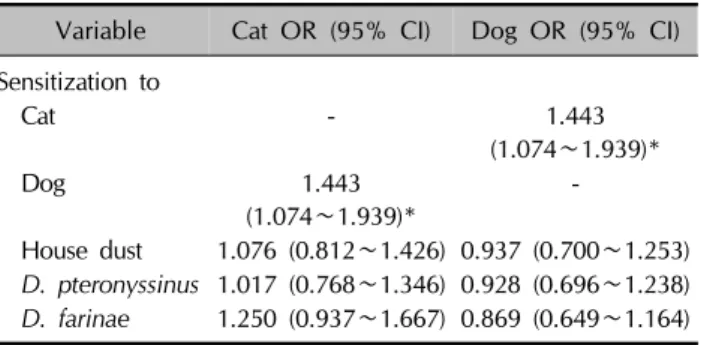
Table 4. Risk factors for sensitization to dog or cat Variable Cat OR (95% CI) Dog OR (95% CI) Sensitization to
Cat - 1.443
(1.074∼1.939)*
Dog 1.443
(1.074∼1.939)*
-
House dust 1.076 (0.812∼1.426) 0.937 (0.700∼1.253) D. pteronyssinus 1.017 (0.768∼1.346) 0.928 (0.696∼1.238) D. farinae 1.250 (0.937∼1.667) 0.869 (0.649∼1.164) OR: odds ratio, CI: confidence interval.
*Indicates p=0.015 chi-square tests were performed.
Annual trends of the number of sensitized patients are shown in Table 1. The number of patients sensitized to cats was 35 (2.44%) in 2011, 49 (3.54%) in 2012, 54 (4.37%) in 2013, 69 (4.21%) in 2014, 100 (5.65%) in 2015. The number of patients sensitized to dogs was 39 (2.71%) in 2011, 40 (2.89%) in 2012, 53 (4.28%) in 2013, 71 (4.33%) in 2014, 71 (4.01%) in 2015. The num- ber of cat-sensitized patients increased steadily until 2015.
The number of dog-sensitized patients increased until 2014 and decreased slightly in 2015. There were 1,235 (16.54%) patients sensitized to house dust. Their numbers increased steadily and gradually from 2011 to 2015.
Positive results for D1 and D2 were given by 2,318 (31.03%) and 2,150 (28.79%) patients, respectively, with no evident annual trends. By using chi-square test, annual rates of all antigens are showing significant differences be- tween each year (Cat, p=0.04; Dog, p=0.001; House dust, p=0.04; D1, p=0.003; D2, p=0.028).
The clinical characteristics of the patients sensitized to cat or dog allergen are shown in Table 2. The mean age was 24.6±16.5 years in the cat-sensitized group and 25.84±
17.4 years in the dog-sensitized group. In the cat- and dog-sensitized group, 127 (41.4%) and 117 (45.5%) pa- tients, respectively, had a family history of allergic disease.
Most of the patients were urban residents (97.0% for cat, 95.6% for dog). The most common clinical diagnosis of
both groups was atopic dermatitis, followed by allergic ur- ticaria, prurigo, and allergic contact dermatitis.
The proportion of direct exposure to the causative antigen was 48.9% in the dog-sensitized group, whereas 12% in the cat-sensitized group (Table 3). A ‘no exposure’ result to the causative antigen was 78.8% in the cat-sensitized group, whereas 37.6% in the dog-sensitized group.
Through the period of study, dogs were pets of 44.5% and 45.5% of patients sensitized to cat and dog respectively.
Independent risk factors for sensitization to each animal allergen were determined (Table 4). Risk factors for sensiti- zation to the cat allergen including sensitization to dog (OR=1.443, p=0.015), but not to house dust (OR=1.076, p=0.61), D1 (OR=1.017, p=0.906), and D2 (OR=1.250, p=0.128). Risk factors for sensitization to the dog allergen included sensitization to cat (OR=1.443, p=0.015), house dust (OR=0.937, p=0.659), D1 (OR=0.928, p=0.611), and D2 (OR=0.869, p=0.347). Spearman correlation analysis conducted to evaluate the association between specific IgE level to each animal allergen and total IgE lev- el did not reveal any significant relationship (rho=-0.019, p=0.705 for cat group and rho=-0.064, p=0.194 for dog group).
DISCUSSION
The prevalence of allergic disease like atopic dermatitis has been increasing worldwide, including Korea2. Avoid- ance of the causative allergen is important in allergic diseases. In this regard, the increasing interest in pet own- ership in Korea, especially for cats and dogs, is germane.
The increased popularity of dogs and cats as domestic pets has led to an increase in animal allergens in society.
The results of this study revealed that the number of pa- tients positive for dog and cat allergens has steadily in- creased since 2011. The most likely explanation is the in- creased number of cats and dogs in the community. In one survey performed in Korea5, the number of cat owner- ship has been sharply increased since 2010 compared to that of dog ownership. The number of cat ownership had been increased consistently since 2000 and showed steep increase since 2010, whereas that of the dog ownership showed plateau between 2000 and 2009, and showed mild increase since 2010 compared to that of cat ownership. Most of people who owned cat replied that they started cat ownership after 2010 (73.5%). That ex- plains the increasing trends of pet sensitization and the re- sult that cat sensitization kept increasing since 2011, whereas dog sensitization showed plateau since 2013 in our study. One study reported that the proportion of sensi- tization in pet shop workers was not increased compared to that in the control group9. Several studies revealed that sensitization to cats was reduced with low or high ex- posure to the Fel d 1 cat antigen, whereas the sensitization was highest with moderate exposure to Fel d 110,11. In con- trast, sensitization was increased in linear correlation in people exposed to house dust, cockroach, and rats11. Therefore, the overall increase in sensitization to cats or dogs seems to be due to the indirect moderate exposure, rather than direct and frequent exposure. The Fel d 1 cat antigen is considered a ubiquitous allergen. It has been found in many cat-free indoor private/public places, such as offices, hospitals, and schools12. Other studies revealed that cat allergens found in cat-free indoor environments were passively carried, mainly on the clothing of cat own- ers13,14. Consequently, the increased number of cats in so- ciety has led to increased indirect antigen transmission from cat owners and the ubiquity of the antigens, resulting in the rise of sensitization to cats12,15-17. Several studies de- scribed that the clothing of cat owners was the main con- tributor to the dispersal of cat allergen in cat-free places, indicating that a prevention strategy for allergies should in- clude the avoidance of direct cat exposure and also in- direct cat exposure from cat owners12,18. This indirect transmission concerns mainly the Fel d 1 antigen, because
cat allergens are relatively light particles that can be easily carried on clothing13,14,18.
This study was conducted with patients an overwhelming number of whom lived in urban areas (97.0%, 95.6% for cat and dog group, respectively). Pets in the city live in spaces where allergens can be readily present in in- sulation, carpets, and other household locations. Therefore, it may be easier to increase the ubiquity of antigens, lead- ing to higher sensitization rates. A study conducted in a rural setting could yield different findings.
In this study, the proportion of patients sensitized to cat or dog was 4.11% and 3.67%, respectively, which is lower than the recent sensitization rate of 9.1% for cat and 8.6%
for dogs reported in Korea19. The subjects of this study were confined to allergic patients who visited one derma- tology clinic. Patients with these allergic diseases tend to avoid pets20, which may explain this relatively lower sen- sitization rate.
Concerning the exposure modality, exposure to dog aller- gen was mostly direct, whereas sensitization to cat aller- gen tended to be indirect, without specific contact. This is consistent with the knowledge that the prevalence of sen- sitization to cats is relatively high in the Korean pop- ulation although cat ownership is very low4,5,19,21. The high number of stray cats and their high reproduction rate could explain the ubiquity of the cat allergen22.
In this study, sensitization to cat was a risk factor for sensi- tization to dog, and vice versa. Dog and cat allergens share a major epitope, and these major proteins exhibit cross-reactivity23,24. This cross-reactivity may explain the association of the clinical and clinical symptoms between dog and cat allergies. This possibility should be explained to patients who are clinically sensitized to dogs or cats.
However, house dust, D1, and D2 were not risk factors of cat or dog sensitization. Linneberg et al.25 reported that atopic dermatitis itself could be a risk factor for sensitiza- tion to cats. House dust, D1, and D2 are usually positive in atopic dermatitis patients, but no association was un- covered in this study.
The association of total IgE with specific IgE antibody titer to dogs or cats was not statistically significant in both groups. The specific IgE level for dogs or cats was rela- tively small when compared to total IgE level, so specific IgE level for dogs or cats did not affect total IgE level.
Erwin et al.26 investigated the association between total IgE and specific IgE levels, and reported that cats did not show any association with total IgE levels, whereas dust mites showed an association with total IgE levels. The pro- portion of mite-specific IgE level to total IgE is typically high; the major allergen of dust mites could be a potential enzyme that has a non-specific effect on IgE antibody
production. In addition, immunologic desensitization of pet allergen can cause this discordance. High exposure to cat antigen can cause desensitization, therefore the sensiti- zation can be highest with modest exposure to anti- gen10,11.
Our study has several limitations. It is a retrospective study and the modality of pet exposure was only studied in people sensitized to cats or dogs. Nearly all subjects were urban dwellers, which could cause bias. In addition, since a practical survey on pets and an accurate sample survey have not been done in Korea, it is difficult to know the actual number of domestic pets in Korea. Therefore, the relationship between the number of actual pets and the sensitization rate cannot be investigated.
In conclusion, allergies to animal allergens play an in- creasingly important role in allergic diseases. In in- dustrialized countries, such as Korea, the number of pets is increasing, which will increase the amount of pet aller- gens in public places and in pet-free settings. Increased ex- posure to direct and indirect antigens has led to an in- crease in the number of patients sensitized to dogs or cats annually since 2011. Since dog and cat antigens are cross- reactive, even if a patient is sensitized to one animal, at- tention should be paid to other species. However, specific IgE to dog and cat allergen is not associated with total IgE.
CONFLICTS OF INTEREST
The authors have nothing to disclose.
REFERENCES
1. Odhiambo JA, Williams HC, Clayton TO, Robertson CF, Asher MI. Global variations in prevalence of eczema sym- ptoms in children from ISAAC phase three. J Allergy Clin Immunol 2009;124:1251-1258.
2. Lee JH, Han KD, Kim KM, Park YG, Lee JY, Park YM.
Prevalence of atopic dermatitis in Korean children based on data from the 2008-2011 Korean national health and nutrition examination survey. Allergy Asthma Immunol Res 2016;8:79-83.
3. Plaschke P, Janson C, Norrman E, Björnsson E, Ellbjär S, Järvholm B. Association between atopic sensitization and asthma and bronchial hyperresponsiveness in Swedish adults:
pets, and not mites, are the most important allergens. J Allergy Clinl Immunol 1999;104:58-65.
4. Yoo KY, Cho SH, Gin Y, Lee YJ. Strategic guidelines to protect and manage pet animals in Seoul (SDI 04-R-21).
Seoul: The Seoul Institute, 2004.
5. Korean gallup. Pet ownership status and awareness survey in Korea. Seoul: Korea Pet Food Association; 2017. 58 p.
6. Calabria CW, Dietrich J, Hagan L. Comparison of serum- specific IgE (ImmunoCAP) and skin-prick test results for 53
inhalant allergens in patients with chronic rhinitis. Allergy Asthma Proc 2009;30:386-396.
7. Jung YG, Cho HJ, Park GY, Min JY, Kim HY, Dhong HJ, et al. Comparison of the skin-prick test and Phadia Immuno- CAP as tools to diagnose house-dust mite allergy. Am J Rhinol Allergy 2010;24:226-229.
8. Koh HS, Lee KS, Han DH, Rah YH, Choi SH. Relationship between serum total IgE, specific IgE, and peripheral blood eosinophil count according to specific allergic diseases.
Allergy Asthma Respir Dis 2013;1:123-128.
9. Yilmaz I, Oner Erkekol F, Secil D, Misirligil Z, Mungan D.
Cat and dog sensitization in pet shop workers. Occup Med 2013;63:563-567.
10. Custovic A, Hallam CL, Simpson BM, Craven M, Simpson A, Woodcock A. Decreased prevalence of sensitization to cats with high exposure to cat allergen. J Allergy Clin Immunol 2001;108:537-539.
11. Custovic A, Simpson BM, Simpson A, Hallam CL, Marolia H, Walsh D, et al. Current mite, cat, and dog allergen exposure, pet ownership, and sensitization to inhalant allergens in adults. J Allergy Clin Immunol 2003;111:402- 407.
12. Enberg RN, Shamie SM, McCullough J, Ownby DR.
Ubiquitous presence of cat allergen in cat-free buildings:
probable dispersal from human clothing. Ann Allergy 1993;
70:471-474.
13. D'Amato G, Liccardi G, Russo M, Barber D, D'Amato M, Carreira J. Clothing is a carrier of cat allergens. J of Allergy Clin Immunol 1997;99:577-578.
14. Patchett K, Lewis S, Crane J, Fitzharris P. Cat allergen (Fel d 1) levels on school children's clothing and in primary school classrooms in Wellington, New Zealand. J Allergy Clin Immunol 1997;100:755-759.
15. Almqvist C, Larsson PH, Egmar AC, Hedrén M, Malmberg P, Wickman M. School as a risk environment for children allergic to cats and a site for transfer of cat allergen to homes. J Allergy Clin Immunol 1999;103:1012-1017.
16. Custovic A, Simpson A, Chapman MD, Woodcock A. Allergen avoidance in the treatment of asthma and atopic disorders.
Thorax 1998;53:63-72.
17. Partti-Pellinen K, Marttila O, Mäkinen-Kiljunen S, Haahtela T. Occurrence of dog, cat, and mite allergens in public transport vehicles. Allergy 2000;55:65-68.
18. Chan-Yeung M, McClean PA, Sandell PR, Slutsky AS, Zamel N. Sensitization to cat without direct exposure to cats. Clin Exp Allergy 1999;29:762-765.
19. Kim TB, Kim KM, Kim SH, Kang HR, Chang YS, Kim CW, et el. Sensitization rates for inhalant allergens in Korea; a multi-center study. J Asthma Allergy Clin Immunol 2003;23:
483-493.
20. Svanes C, Zock JP, Antó J, Dharmage S, Norbäck D, Wjst M, et al. Do asthma and allergy influence subsequent pet keeping? An analysis of childhood and adulthood. J Allergy Clin Immunol 2006;118:691-698.
21. Kim J, Hahm MI, Lee SY, Kim WK, Chae Y, Park YM, et al.
Sensitization to aeroallergens in Korean children: a population- based study in 2010. J Korean Med Sci 2011;26:1165-1172.
22. Lee SE, Kim JY, Kim YA, Cho SH, Ahn HJ, Woo HM, et al.
Prevalence of Toxoplasma gondii infection in stray and household cats in regions of Seoul, Korea. Korean J Parasitol 2010;48:267-270.
23. Spitzauer S, Pandjaitan B, Mühl S, Ebner C, Kraft D, Valenta R, et al. Major cat and dog allergens share IgE epitopes. J Allergy Clin Immunol 1997;99:100-106.
24. Madhurantakam C, Nilsson OB, Uchtenhagen H, Konradsen J, Saarne T, Högbom E, et al. Crystal structure of the dog lipocalin allergen can f 2: implications for cross-reactivity to
the cat allergen Fel d 4. J Mol Biol 2010;401:68-83.
25. Linneberg A, Nielsen NH, Madsen F, Frølund L, Dirksen A, Jørgensen T. Pets in the home and the development of pet allergy in adulthood. The Copenhagen allergy study.
Allergy 2003;58:21-26.
26. Erwin EA, Rönmark E, Wickens K, Perzanowski MS, Barry D, Lundbäck B, et al. Contribution of dust mite and cat specific IgE to total IgE: relevance to asthma prevalence. J Allergy Clin Immunol 2007;119:359-365.