ABSTRACT
Background: Inpatient suicide is one of the major issues related with hospital patient safety.
Although there are many studies addressing suicide in the psychiatric unit, little is known about suicide in a medical setting. This study included the development and validation of a screening tool for the assessment of suicide risk, specialized for medical inpatients.
Methods: The preliminary questionnaire was based on review of previous suicide ideation scales, mood scales, and clinical experiences of psychiatrists and clinical psychologists in Korea. Initially, the questionnaire consisted of 12 questions. One hundred adult medical inpatients were asked to perform the questionnaire. Explorative factor analysis was used to examine construct validity. Concurrent validity was evaluated by comparison with the Korean versions of the Beck Scale for Suicide Ideation (BSI), the Beck Hopelessness Scale (BHS), and the Hospital Anxiety and Depression Scale (HADS).
Results: Five questions were removed from the preliminary questionnaire by explorative factor analysis and seven questions remained to comprise the Suicide Risk Scale for Medical inpatients (SRSM). Explorative factor analysis showed that the SRSM is composed of a single factor. SRSM was highly reliable in terms of internal consistency (Cronbach's alpha 0.91).
Concurrent validity with the BSI, BHS, and HADS was statistically significant. The proposed cut-off score of the SRSM was five.
Conclusion: In conclusion, the SRSM is a valid and reliable measure for screening suicide risks in medical inpatients.
Keywords: Suicide; Referral and Consultation Psychiatry; Chronic Disease; Primary Health Care
INTRODUCTION
One of the most important issues related to hospital safety is inpatient suicide. In the United States, inpatient suicide is the second most common sentinel event reported to the Joint Commission.1 Because inpatient suicide occurs in close proximity to medical staff, it is often considered a preventable accident. Thus, inpatient suicide can result in litigation, and the legal system tends to be strict about the responsibilities of the hospital in these cases.2 Additionally, inpatient suicide negatively impacts other patients and medical staff. News of
Original Article
Received: Aug 16, 2017 Accepted: Oct 21, 2017 Address for Correspondence:
Moon-Soo Lee, MD, PhD
Department of Psychiatry, Korea University of College of Medicine, 148 Gurodong-ro, Guro- gu, Seoul 08308, Korea.
E-mail: [email protected]
© 2018 The Korean Academy of Medical Sciences.
This is an Open Access article distributed under the terms of the Creative Commons Attribution Non-Commercial License (https://
creativecommons.org/licenses/by-nc/4.0/) which permits unrestricted non-commercial use, distribution, and reproduction in any medium, provided the original work is properly cited.
ORCID iDs Sang-Won Park
https://orcid.org/0000-0001-7725-4250 Jong-Ha Lee
https://orcid.org/0000-0003-0824-8564 Eun-Kyoung Lee
https://orcid.org/0000-0001-9550-3388 Jae-Jun Song
https://orcid.org/0000-0002-7831-8233 Hong-Seok Park
https://orcid.org/0000-0001-7287-2682 Soon-Young Hwang
https://orcid.org/0000-0003-0719-1834 Moon-Soo Lee
https://orcid.org/0000-0003-0729-6943 Funding
This research was supported by a grant of the Korea Health Technology R & D Project through
Sang-Won Park ,1 Jong-Ha Lee ,1 Eun-Kyoung Lee ,2 Jae-Jun Song ,3 Hong-Seok Park ,4 Soon-Young Hwang ,5 and Moon-Soo Lee 6
1Department of Psychiatry, Korea University Guro Hospital, Seoul, Korea
2Division of Clinical Psychology, Department of Psychiatry, Korea University Guro Hospital, Seoul, Korea
3Department of Otorhinolaryngology Head and Neck Surgery, Korea University College of Medicine, Seoul, Korea
4Department of Urology, Korea University College of Medicine, Seoul, Korea
5Department of Biostatistics, Korea University College of Medicine, Seoul, Korea
6Department of Psychiatry, Korea University College of Medicine, Seoul, Korea
Development of the Suicide Risk Scale for Medical Inpatients
Psychiatry & Psychology
suicides may cause other patients to become vulnerable to depression and anxiety.3 Medical staff may feel shock, fear, sadness, and guilt as a consequence of the suicide, and they may even feel that they are incompetent because they could not prevent the event.4 Thus, appropriate assessments and interventions that prevent inpatient suicide are needed for the safety of patients and favorable hospital environments. Although inpatient suicides occur more frequently in psychiatric units, suicides do occur in medical settings.5
These suicides also have devastating effects on patients, families, medical staff, and the hospital environment. Recent studies have suggested that suicides in medical settings and suicides in psychiatric units differ intrinsically. According to a review by Ballard et al.,5 patients who committed suicide in medical settings were typically older, more likely to be married and employed, and more likely to use certain methods of suicide compared with patients who committed suicide in psychiatric units.
The relationship between physical illness and suicide is well established. Several physical illnesses make patients more vulnerable to suicide. Patients with cancer, coronary heart disease,6 and central nervous system dysfunction7,8 are more likely to attempt or commit suicide. Other factors, such as pain,9,10 physical limitations,11 older age,12 financial
problems, social isolation, and hopelessness13,14 are also related to higher risks of suicide. In addition, depression is thought to facilitate the link between physical illness and suicide.6 Because suicides in medical settings have different and unique characteristics compared to suicides in psychiatric units, specific methods that assess suicide risk in medical settings are needed. Although a variety of suicide risk screening tools target patients with mental illnesses, few screening tools that are specialized for medical settings are available.
We aimed to develop a new screening tool that can be used to quickly assess suicide risk in a medical setting. We hypothesized that depression and hopelessness would be related to suicide ideation, and we were able to confirm the reliability and validity of the new screening tool based on the above factors.
METHODS
Gathering literature on suicidality
To develop the Suicide Risk Scale for Medical inpatients (SRSM), we examined existing scales for suicidal risk. Those scales included the modified SAD PERSONS Scale (MSPS),15 the Beck Scale for Suicide Ideation (BSI),16 and the Columbia Suicidality Severity Rating Scale (C-SSRS).17 After analysis of the contents of each scale, three Korean psychiatrists and one psychologist discussed the essential components of an SRSM. These components included factors known to affect suicidality. Based on the review of existing suicide risk scales, researchers included items related to depression, anxiety, hopelessness, previous suicidal idea, impulsivity, and illness perception in the screening questionnaire.
We examined different mental health scales that are known to assess each unique concept
— depression/anxiety,18 hopelessness,19 previous suicidal idea,16 impulsivity,20 and illness perceptions,21 and tried to extract one or two representative questions for each factors. These scales are listed as follows.
the Korea Health Industry Development Institute (KHIDI), funded by the Ministry of Health and Welfare, Republic of Korea (grant No. HI16C0237).
Disclosure
The authors have no potential conflicts of interest to disclose.
Author Contributions
Conceptualization: Park SW, Lee JH, Lee EK, Lee MS. Data curation: Park SW, Song JJ, Park HS, Lee MS. Formal analysis: Park SW, Lee EK, Hwang SY, Lee MS. Funding acquisition: Park HS. Investigation: Park SW, Lee JH, Lee EK, Lee MS. Writing - review & editing: Lee MS.
Hospital Anxiety and Depression Scale (HADS)
The HADS was developed to assess patient's anxiety and depression briefly in primary hospital setting. It consists of 14 items, and each item is rated from 0–3. Seven of 14 items are related with anxiety, and the rest seven items are related with depression. The Korean version of this scale has shown high reliability.22
Beck Hopelessness Scale (BHS)
The BHS was developed to assess patient's hopelessness about the future. It consists of 20 items, and each item can be answered as yes-no statements. Potential final scores of the BHS are ranging from 0–20 and score above 15 is considered as severe state. The Korean version of this scale has shown high reliability.23
BSI
The BSI was developed to assess patient's ideation about suicide. It consists of 5 screening items and 21 self-rated items. All 21 self-rated items are scored on a three-point scale ranging from 0 to 2, but score of last two items is excluded from the total score. There is no specified cut-off score in BSI. Increasing scores reflect increasing suicide risk, and any positive response merits investigation.24 The Korean version of this test has shown high reliability.25
Barratt Impulsiveness Scale (BIS)
The BIS was developed to assess patient's impulsivity. It consists of 30 items that are scored to yield three factors (attentional, motor, and non-planning impulsiveness). Each item is rated from 1–4. The Korean version of this scale has shown high reliability.26
Brief Illness Perception Questionnaire (Brief IPQ)
The Brief IPQ is developed to briefly evaluate cognitive and emotional representations of illness.21 It consists of 9 items. Contents of the scale are concerned with cognitive representation, emotional representation, illness comprehensibility, and perceived cause of illness. Each item is rated from 0–10 except last item which ask patients to list the three most important causal factors of their own illness. This scale is not validated in Korean.
Preliminary survey for the collection of information about suicidality among non-psychiatric inward patients
A preliminary survey of 100 adult patients admitted to the general ward of Korea University Medical Center, Guro Hospital, was performed. Patients under 19 years old or patients admitted for treatment of psychiatric illness were excluded from the survey. All participants provided written informed consent. The survey played an important role in developing the questions that comprise the SRSM. This survey asked inpatients a series of open-ended questions (i.e., Have you thought about suicide in the past three months? If so, please write down what you thought at that time). Based on this survey, we also included pain perception in the SRSM.
Preliminary item selection
Discussions within a research team of three psychiatrists and a clinical psychologist led to selection of 12 questions/items that were included in the preliminary version of SRSM.
Each item was representative of a suicide-related factor: depression/anxiety, hopelessness, previous suicidal ideation, impulsivity and illness perceptions. Three reverse-scoring items were included in the preliminary version of SRSM.
Main survey with the preliminary version of SRSM and other related scales
A total of 100 adult patients who were admitted to the general ward of Korea University Medical Center, Guro Hospital, participated in the survey. Patients who were under 19 years old or admitted for treatment of psychiatric illness were excluded from the survey. Patients who had participated in the preliminary survey previously were also excluded from the survey. All participants provided written informed consent. Trained psychologists evaluated participants using the preliminary version of the SRSM, along with questionnaires that are currently used to evaluate depression/anxiety (HADS), hopelessness (BHS), and previous suicidal ideation (BSI). Of the 100 total participants, 20 patients were asked to answer the preliminary version of SRSM again after two weeks.Reliability and validity
Reliability was measured in terms of internal consistency using Cronbach's alpha coefficient.
Exploratory factor analysis was performed to evaluate construct validity. Test-retest reliability was assessed using Pearson's correlation coefficient for 20 patient test and retest scores.
Concurrent validity was assessed using Pearson's correlation coefficient of SRSM scores and scales currently used to detect depression/anxiety (HADS), hopelessness (BHS), and previous suicidal ideation (BSI). All statistical analyses were performed using Statistical Package for the Social Sciences (SPSS) 22.0 (SPSS Inc., Chicago, IL, USA).
Comparison of mean score of SRSM according to different groups
We compared mean score of SRSM between two groups according to age, education level, marital status, employment status, and severity of medical illness, using independent sample t-test.
Calculating cut-off score
We calculated the optimal cut-off value of SRSM for screening suicide risk. Receiver operating characteristics (ROC) curve analysis was performed, reflecting sensitivity and 1-specificity of SRSM score, using a score of on the Korean version of BHS as a standard.
BHS was considered as the most appropriate standard in calculating cut-off score among available scales, because there is specific established score of suicide risk in BHS.19 Statistical analysis was performed using MedCalc software version 15.11.4 (MedCalc Software,
Mariakerke, Belgium).
Ethics statement
The present study protocol was approved by the Institutional Review Board of the Korea University Medical Center, Guro Hospital (KUGH16099), Seoul, Korea. All of the participants provided written informed consent.
RESULTS
Participants
There were 67 men and 33 women included in this study. The mean age of all participants was 58.20 ± 15.04 years old. The number of participants aged 65 or older was 33, and the number of participants under the age of 65 was 67. With regards to education level, 79 participants achieved high school graduation or less, while 21 participants had some form of post-secondary education. Of the participants, 73 were married, and 27 were unmarried,
divorced, or widowed. Thirty-nine of the participants were currently employed and 61 were unemployed. With regards to accompanying medical illness, we divided participants into two groups, severe disease group and mild disease group. In Korea, severe disease is classified in National Health Insurance Act (NHIA) which warrants specific financial support. According to NHIA of Korea, cancer, cerebrovascular disease, heart disease, chronic kidney disease, and many other chronic, intractable diseases are classified as severe disease. We used criteria in NHIA of Korea to classify severity of participant's medical illness. According to the criteria, 67 participants belonged to severe disease group and they had either cancer or chronic kidney disease, cerebrovascular disease, Crohn's disease. Other 33 participants were belonged to mild disease group and they had disease other than severe disease such as sinusitis, a non-severe fracture or a ureteral stone. The mean score of the preliminary version of SRSM was 7.34 ± 5.60. The HADS mean score was 15.12 ± 7.97, while the mean score of the anxiety subscale was 6.88 ± 4.24, and the mean score of the depression subscale was 8.24 ± 4.46. The BSI mean score was 1.75 ± 4.96, and the BHS mean score was 3.54 ± 5.24 (Table 1).
Construct validity and reliability
We conducted exploratory factor analyses of the preliminary version of the SRSM to uncover the internal structure of the scale. During exploratory factor analyses, questions about illness perception (item 2: anticipation for the effect of treatment), hopelessness (item 9:
things won't be bad all of the time), and impulsivity (item 12: ability to suppress emotion) were found to lower consistency of the scale, and were excluded. Exploratory factor analyses were then performed with remaining nine items. As a result of these analyses, a single factor Table 1. Demographic data and scores of each scale
Demographic parameters Value
Gender
Male 67 (67)
Female 33 (33)
Age, yr
≥ 65 33 (33)
< 65 67 (67)
Mean age 58.20 ± 15.04
Education
High school graduation or less 79 (79)
Post-secondary education 21 (21)
Marital status
Married 73 (73)
Unmarried, divorced, or widowed 27 (27)
Employment status
Employed 39 (39)
Unemployed 61 (61)
Severity of medical illness
Severe disease 67 (67)
Mild disease 33 (33)
Scores of each instrument
SRSM (preliminary version) 7.34 ± 5.60
SRSM (final version) 4.64 ± 5.04
HADS 36.59 ± 12.03
HADS-A 15.12 ± 7.97
HADS-D 8.24 ± 4.46
BSI 1.75 ± 4.96
BHS 3.54 ± 5.24
Values are presented as number of patients (%) or mean ± standard deviation.
SRSM = Suicide Risk Scale for Medical inpatients, HADS = Hospital Anxiety and Depression Scale, HADS-A = Anxiety subscale of Hospital Anxiety and Depression Scale, HADS-D = Depression subscale of Hospital Anxiety and Depression Scale, BSI = Beck Scale for Suicide Ideation, BHS = Beck Hopelessness Scale.
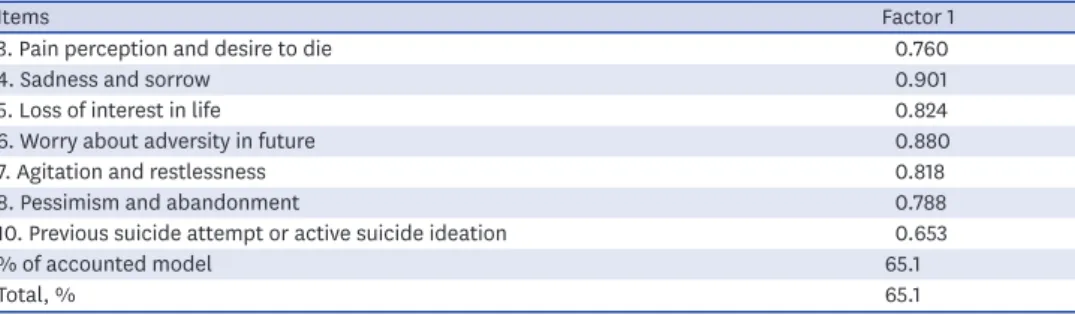
model was developed. Among the nine items, questions about illness perception (item 1:
effect of physical illness on mind), and impulsivity (item 11: acting without contemplation) showed low communalities (< 0.4). These items were also excluded. As a result, the final version of the SRSM consisted of seven items in single factor model, and this model accounted for 65.12% of total variation (Table 2). The Cronbach's alpha of the SRSM was 0.910, suggesting a high degree of internal consistency. The mean score of the SRSM was 4.64 ± 5.04 (Table 1).
Test-retest reliability
The Pearson's correlation coefficient of test and retest scores of the SRSM was r = 0.635 (P <
0.01), suggesting good test-retest reliability.
Concurrent validity
In this study, all 100 participants completed the HADS, BHS, and BSI. The Pearson's correlation coefficient of the SRSM and HADS scores was r = 0.727 (P < 0.001), suggesting strong positive correlation. The Pearson's correlation coefficient of SRSM scores and the scores of the HADS anxiety and depression subscales were r = 0.793 (P < 0.001) and r = 0.551 (P < 0.001), respectively, suggesting the anxiety subscale is more correlated with the SRSM. The Pearson's correlation coefficients of SRSM scores and BHS and BSI scores were r = 0.360 (P < 0.001) and r
= 0.584 (P < 0.001), respectively, suggesting significant positive correlation (Table 3).
Comparison of SRSM score between different groups
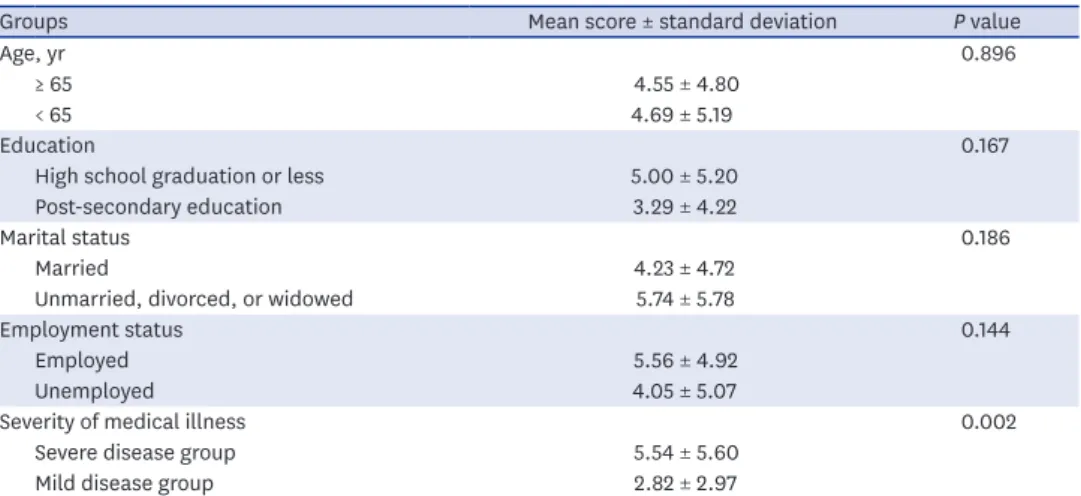
We compared the mean SRSM scores of different groups according to age (participants aged 65 years or older vs. those under 65 years), marital status (married participants vs. unmarried, divorced, or widowed participants), education level (participants who achieved high school graduation or less vs. those with post-secondary education), employment status (employed participants vs. unemployed participants), and illness (participants with severe disease vs.
those with mild disease). The SRSM mean score was significantly different only in the illness Table 2. Factor analysis of SRSM
Items Factor 1
3. Pain perception and desire to die 0.760
4. Sadness and sorrow 0.901
5. Loss of interest in life 0.824
6. Worry about adversity in future 0.880
7. Agitation and restlessness 0.818
8. Pessimism and abandonment 0.788
10. Previous suicide attempt or active suicide ideation 0.653
% of accounted model 65.1
Total, % 65.1
SRSM = Suicide Risk Scale for Medical inpatients.
Table 3. Correlation of scores of each scale with the total score of the SRSM
Scales SRSM HADS HADS-A HADS-D BHS BSI
SRSM 1.000
HADS 0.727a 1.000
HADS-A 0.793a 0.915a 1.000
HADS-D 0.551a 0.925a 0.692a 1.000
BHS 0.360a 0.530a 0.422a 0.550a 1.000
BSI 0.584a 0.574a 0.547a 0.510a 0.621a 1.000
SRSM = Suicide Risk Scale for Medical inpatients, HADS = Hospital Anxiety and Depression Scale, HADS-A = Anxiety subscale of Hospital Anxiety and Depression Scale, HADS-D = Depression subscale of Hospital Anxiety and Depression Scale, BHS = Beck Hopelessness Scale, BSI = Beck Scale for Suicide Ideation.
aP < 0.01.
groups. The SRSM mean score in the severe disease group was 5.54 ± 5.60 and the SRSM mean score in the mild disease group was 2.82 ± 2.97 (P < 0.010) (Table 4).
Diagnostic utility of the scale
ROC analysis was performed to test the diagnostic utility of this scale and to identify the appropriate cut-off score. Area under the curve of the SRSM was estimated as 0.797. We evaluated sensitivity and specificity at each cut-off score to calculate the optimal cut-off score. A score of five was determined as the optimal cut-off, with 71.4% sensitivity and 75.6%
specificity (Table 5). In this study, 36% of participants had an SRSM score that was higher than the cut-off score.
DISCUSSION
Inpatient suicide has a negative impact not only on the individual who committed suicide, but also on other patients and medical staff. Thus, careful attention to suicide prevention is important to guarantee a more favorable hospital environment. However, as far as we have found, recent studies have primarily focused suicide in psychiatric unit, and little is known about screening suicide risk in medical setting. The aim of our study was to develop a suicide risk-screening tool that can be applied to medical inpatients.
During the course of development of the SRSM, we considered three conditions as necessary for acceptable screening of suicide risk in inpatients. The first condition was brevity. In a Table 4. SRSM score according to different groups
Groups Mean score ± standard deviation P value
Age, yr 0.896
≥ 65 4.55 ± 4.80
< 65 4.69 ± 5.19
Education 0.167
High school graduation or less 5.00 ± 5.20
Post-secondary education 3.29 ± 4.22
Marital status 0.186
Married 4.23 ± 4.72
Unmarried, divorced, or widowed 5.74 ± 5.78
Employment status 0.144
Employed 5.56 ± 4.92
Unemployed 4.05 ± 5.07
Severity of medical illness 0.002
Severe disease group 5.54 ± 5.60
Mild disease group 2.82 ± 2.97
Severe disease group: patients in severe disease group are patients who diagnosed with disease which classified as ‘severe disease’ according to NHIA of Korea. Mild disease group: patients in mild disease group are patients who diagnosed with disease other than ‘severe disease’.
SRSM = Suicide Risk Scale for Medical inpatients, NHIA = National Health Insurance Act.
Table 5. Cut-off score of SRSM
Cut-off scores Sensitivity, % 1-specificity, % Specificity, %
3 78.57 39.53 60.47
4 71.43 30.23 69.77
5 71.43 24.22 75.78
6 64.29 19.77 80.23
7 57.14 17.44 82.56
SRSM= Suicide Risk Scale for Medical inpatients.
primary clinical setting, it is impossible for mental health professionals to assess the suicide risk of every inpatient. Furthermore, patients have a negative response to being questioned about suicide for a long period of time. Therefore, a screening tool for inpatient suicide risk should be brief enough that can be easily performed by primary physicians or nursing staff. The second condition was capacity to reflect a patient's physical illness appropriately.
Physical illness itself is an overwhelming life event which may cause psychiatric impairment to previous healthy individuals.5 Thus, an appropriate screening tool should contain items related to physical illness. For this purpose, we referred to a scale pertaining to illness perception, “Brief IPQ,” during development of the SRSM, though items extracted from the scale have been excluded during exploratory factor analysis. We also performed a preliminary survey with 100 patients and, after analyzing the results, included pain perception in the SRSM. The third condition was verified concurrent validity with previous scales. We selected three scales for verifying concurrent validity: the HADS, BSI, and BHS.
The HADS focuses on psychiatric symptoms commonly seen in hospital. The BSI and BHS are well known scales for assessing suicide risk. As there is no current standard instrument to evaluate suicide risk in medical inpatients, verifying concurrent validity with these three scales was the optimal method to test the validity of the SRSM. The SRSM was regarded as meeting the above three conditions.
During the course of exploratory factor analysis, a total of five items were removed from the preliminary version of the SRSM. Three of the items (item 2, item 9, and item 12) were excluded because they were found to lower the consistency of the scale. Interestingly, these were all reverse-scoring items, where a positive response means lower suicide risk, in contrast to other items. This finding suggests that reverse-scoring items may not suitable for this due to the characteristics of the medical inpatients questioned. A number of the patients participating in this study are older, have a lower education level, are socially inactive (unemployed), and have severe medical illnesses. It may be that these inpatients are less able to discriminate the delicate meaning of reverse-scoring items. The remaining survey items tend to be more simple and distinct in description. Two items were excluded owing to low communalities. Those two items were extracted from the Brief IPQ and BIS. The seven items that comprised the final version of the SRSM were items extracted from validated Korean versions of different mental health scales, or items adopted as the result of preliminary survey (Table 6, Supplementary Table 1).
Although items of SRSM were extracted and modified from various sources, exploratory factor analysis revealed that they consisted of a single factor. This could possibly be attributed to the characteristics of suicidality. Suicide is the result of the interaction of several different Table 6. Suicide Risk Scale for Medical inpatients
No. Statements Strongly disagree Disagree Agree Strongly agree
1 I feel too much pain, and it would be better to die.
2 I feel so sad and unhappy that I can't endure it.
3 My interest in and enthusiasm for life have declined compared to that before.
4 I am afraid that bad things will happen in the future.
5 I am restless and have trouble staying still.
6 I think my situation will not improve in the future, so it would be better to give up.
7 I have attempted suicide before, or I have a plan for committing suicide.
Score each item with the following points: strongly disagree, 0; disagree, 1; agree, 2; strongly agree, 3. The Suicide Risk Scale for Medical inpatients was developed in Korean. An English version of this scale has not yet been validated.
factors.27 If a mediator exists, linking those different factors, the factors may actually consist of a single factor. In our study, ‘emotion’ was suggested as the mediator of various factors.
The high Cronbach's alpha of the SRSM (0.910) supports the hypothesis that items in the scale are linked by strong mediator.
In our study, severity of illness was the only factor which showed discriminant suicide risk. Our finding suggests that clinician should be alert when treating patients with severe disease, even when he or she seems to be stable in regards to other demographic or socioeconomic aspects.
This study has several limitations. First, this study was designed, and its validity was tested, by showing correlation with previously validated scales, not by correlation with actual suicide attempts, successful or otherwise. Correlation with previously validated scales does not guarantee that SRSM can predict actual commitment of suicide. Second, the calculation of the cut-off score was based on the BHS score, and not on a suicide risk scale or other suicide risk assessment. The BSI has no established specific cut-off score, and any positive score warrants further evaluation.24 In contrast, the relationship between the BHS score and actual suicide are comparatively well established.28,29 A BHS score of 15 points indicates a severe level of hopelessness,19 and Cochrane-Brink et al.30 suggested that point as a cut-off score for suicide risk with 100% sensitivity and 71% specificity.As such, we considered the BHS as the best available standard tool for calculating the cut-off score of the SRSM.
To resolve these limitations, additional study is required. In a follow-up study, validity of the SRSM should be verified by its ability to predict actual suicide attempts, successful or otherwise. Similarly, the cut-off score of the SRSM should be reassessed based on suicide risk evaluation by psychiatrist, in both consultation and liaison settings.
SUPPLEMENTARY MATERIAL
Supplementary Table 1
Suicide Risk Scale for Medical inpatients (original version in Korean) Click here to view
REFERENCES
1. Summary data of sentinel events reviewed by the joint commission. http://www.jointcommission.org/
assets/1/18/2004_to_2014_4Q_SE_Stats_-_Summary.pdf. Updated 2015. Accessed March 28, 2017.
2. Knoll JL. Inpatient suicide: identifying vulnerability in the hospital setting. Psychiatr Times 2013;30:36.
3. Seeman MV. The impact of suicide on co-patients. Psychiatr Q 2015;86(4):449-57.
PUBMED | CROSSREF
4. Midence K, Gregory S, Stanley R. The effects of patient suicide on nursing staff. J Clin Nurs 1996;5(2):115-20.
PUBMED | CROSSREF
5. Ballard ED, Pao M, Henderson D, Lee LM, Bostwick JM, Rosenstein DL. Suicide in the medical setting. Jt Comm J Qual Patient Saf 2008;34(8):474-81.
PUBMED | CROSSREF
6. Webb RT, Kontopantelis E, Doran T, Qin P, Creed F, Kapur N. Suicide risk in primary care patients with major physical diseases: a case-control study. Arch Gen Psychiatry 2012;69(3):256-64.
PUBMED | CROSSREF
7. Jones JE, Hermann BP, Barry JJ, Gilliam FG, Kanner AM, Meador KJ. Rates and risk factors for suicide, suicidal ideation, and suicide attempts in chronic epilepsy. Epilepsy Behav 2003;4 Suppl 3:S31-8.
PUBMED | CROSSREF
8. Schoenfeld M, Myers RH, Cupples LA, Berkman B, Sax DS, Clark E. Increased rate of suicide among patients with Huntington's disease. J Neurol Neurosurg Psychiatry 1984;47(12):1283-7.
PUBMED | CROSSREF
9. Tang NK, Crane C. Suicidality in chronic pain: a review of the prevalence, risk factors and psychological links. Psychol Med 2006;36(5):575-86.
PUBMED | CROSSREF
10. Hooley JM, Franklin JC, Nock MK. Chronic pain and suicide: understanding the association. Curr Pain Headache Rep 2014;18(8):435.
PUBMED | CROSSREF
11. Kaplan MS, McFarland BH, Huguet N, Newsom JT. Physical illness, functional limitations, and suicide risk: a population-based study. Am J Orthopsychiatry 2007;77(1):56-60.
PUBMED | CROSSREF
12. Waern M, Rubenowitz E, Runeson B, Skoog I, Wilhelmson K, Allebeck P. Burden of illness and suicide in elderly people: case-control study. BMJ 2002;324(7350):1355.
PUBMED | CROSSREF
13. United States Public Health Service Office of the Surgeon General. The Surgeon General's Call to Action to Prevent Suicide. Washington, D.C.: Department of Health and Human Services, United States Public Health Service; 1999.
14. Goldsmith SK. Risk Factors for Suicide: Summary of a Workshop. Washington, D.C.: National Academy Press;
2001.
15. Warden S, Spiwak R, Sareen J, Bolton JM. The SAD PERSONS scale for suicide risk assessment: a systematic review. Arch Suicide Res 2014;18(4):313-26.
PUBMED | CROSSREF
16. Beck AT, Steer RA, Ranieri WF. Scale for Suicide Ideation: psychometric properties of a self-report version. J Clin Psychol 1988;44(4):499-505.
PUBMED | CROSSREF
17. Posner K, Brown GK, Stanley B, Brent DA, Yershova KV, Oquendo MA, et al. The Columbia-Suicide Severity Rating Scale: initial validity and internal consistency findings from three multisite studies with adolescents and adults. Am J Psychiatry 2011;168(12):1266-77.
PUBMED | CROSSREF
18. Spinhoven P, Ormel J, Sloekers PP, Kempen GI, Speckens AE, Van Hemert AM. A validation study of the Hospital Anxiety and Depression Scale (HADS) in different groups of Dutch subjects. Psychol Med 1997;27(2):363-70.
PUBMED | CROSSREF
19. Beck AT, Weissman A, Lester D, Trexler L. The measurement of pessimism: the hopelessness scale. J Consult Clin Psychol 1974;42(6):861-5.
PUBMED | CROSSREF
20. Stanford MS, Mathias CW, Dougherty DM, Lake SL, Anderson NE, Patton JH. Fifty years of the Barratt Impulsiveness Scale: an update and review. Pers Individ Dif 2009;47(5):385-95.
CROSSREF
21. Broadbent E, Petrie KJ, Main J, Weinman J. The brief illness perception questionnaire. J Psychosom Res 2006;60(6):631-7.
PUBMED | CROSSREF
22. Oh SM, Min KJ, Park DB. A study on the standardization of the hospital anxiety and depression scale for Koreans: a comparison of normal, depressed and anxious groups. J Korean Neuropsychiatr Assoc 1999;38(2):289-96.
23. Kim S, Lee EH, Hwang ST, Hong SH, Lee K, Kim JH. Reliability and validity of the Korean version of the Beck Hopelessness Scale. J Korean Neuropsychiatr Assoc 2015;54(1):84-90.
CROSSREF
24. Beck AT, Steer RA. BSI, Beck Scale for Suicide Ideation: Manual. San Antonio, TX: Psychological Corp.; 1991.
25. Lee HS, Kwon JH. Validation for the Beck Scale for suicide ideation with Korean university students.
Korean J Clin Psychol 2009;28(4):1155-72.
CROSSREF
26. Heo SY, Oh JY, Kim JH. The Korean version of the Barratt Impulsiveness Scale, 11th version: its reliability and validity. Korean J Psychol Gen 2012;31(3):769-82.
27. Dixon WA, Heppner PP, Rudd MD. Problem-solving appraisal, hopelessness, and suicide ideation:
evidence for a mediational model. J Couns Psychol 1994;41(1):91-8.
CROSSREF
28. Beck AT, Steer RA, Kovacs M, Garrison B. Hopelessness and eventual suicide: a 10-year prospective study of patients hospitalized with suicidal ideation. Am J Psychiatry 1985;142(5):559-63.
PUBMED | CROSSREF
29. Beck AT, Brown G, Berchick RJ, Stewart BL, Steer RA. Relationship between hopelessness and ultimate suicide: a replication with psychiatric outpatients. Am J Psychiatry 1990;147(2):190-5.
PUBMED | CROSSREF
30. Cochrane-Brink KA, Lofchy JS, Sakinofsky I. Clinical rating scales in suicide risk assessment. Gen Hosp Psychiatry 2000;22(6):445-51.
PUBMED | CROSSREF