INTRODUCTION
In radiofrequency catheter ablation (RFCA) for treatment of idiopathic left ventricular tachycardia (ILVT), termination of tachycardia with the delivery of radiofrequency (RF) ener- gy is considered to be a marker of successful energy delivery, and resultant non-inducibility of the tachycardia is accepted as a successful endpoint for RFCA (1, 2).
However, for patients with non-inducible ventricular tachy- cardia (VT) or patients in whom the re-induction of VT is difficult due to catheter-induced mechanical trauma, it is impossible to deliver RF energy during on-going VT. Fur- thermore, the evaluation of procedural success and the recur- rence of ILVT can be problematic.
In the practice of radiofrequency ablation for certain kinds of arrhythmias, the rhythm responses during energy delivery, such as junctional beats for atrioventricular nodal re-entrant tachycardia (AVNRT) and transient acceleration of the rate for right ventricular outflow tract tachycardia (RVOT VT),
are regarded as indirect markers of effective energy delivery (3-5). However, there are no reports describing the rhythm response during RF delivery for ILVT, especially with respect to energy delivery during sinus rhythm.
We have observed the ventricular rhythm changes during the delivery of RF energy in patients with ILVT. Herein we describe the significance of thermal response that shows repet- itive ventricular response exhibiting similar morphology to clinical VT.
MATERIALS AND METHODS Patients
The study subjects consisted of 11 patients with ILVT (10 males:1 female, age 31.6±8.3 yr) in whom RFCA was at- tempted during sinus rhythm, because of either repeated mechanical interruption of tachycardia while manipulating
868
Woo Seung Shin, Man Young Lee, Sung Won Jang, Ji Hoon Kim, Hee Jeoung Yoon, Seung Won Jin, Yong Seog Oh, Ki Bae Seung, and Tai Ho Rho
Division of Cardiology, Department of Internal Medicine, The Catholic University of Korea, School of Medicine, Seoul, Korea
Address for Correspondence Man Young Lee, M.D.
Division of Cardiology, Department of Internal Medicine, The Catholic University of Korea, School of Medicine, St. Mary’s Hospital, 49 Yuksam-gil, Yeongdeungpo-gu, Seoul 150-713, Korea
Tel : +82.2-3779-1114, Fax : +82.2-3779-1374 E-mail : [email protected]
The Significance of Repetitive Ventricular Responses Induced by Radiofrequency Energy Application for Idiopathic Left Ventricular Tachycardia
In radiofrequency (RF) ablation for idiopathic left ventricular tachycardia (ILVT), the termination of tachycardia during RF ablation is considered a hallmark of success.
However, in cases of patients with difficulty of induction of ventricular tachycardia (VT), the evaluation of procedural success can be problematic. We have observed thermal responses reflected as ventricular rhythm change to RF energy delivered on sinus rhythm for ILVT. We therefore describe the significance of repetitive ven- tricular responses. The study subjects were 11 ILVT patients for whom RF energy was delivered during sinus rhythm because of difficulty in re-induction of tachycar- dia. During each energy delivery, we focused on the occurrence of repetitive ven- tricular responses especially exhibiting a similar morphology to clinical VT. The repeti- tive ventricular responses were noted in 10 of 11 patients. Two patients received a second procedure due to the recurrence of ILVT. The mean follow-up period was 36.2±12.8 months. The clinical course of the remaining patients was favorable and without recurrence of ILVT. Based on the favorable clinical outcomes, abla- tion-induced repetitive ventricular responses with similar QRS morphology to clini- cal ILVT are useful markers for selecting an ablation site and could be used as an additional mapping method, termed as ‘‘thermal mapping’’.
Key Words : Tachycardia, Ventricular; Catheter Ablation; Purkinje Potential
Received : 13 July 2009 Accepted : 7 December 2009
ⓒ 2010 The Korean Academy of Medical Sciences.
This is an Open Access article distributed under the terms of the Creative Commons Attribution Non-Commercial License (http://creativecommons.org/licenses/by-nc/3.0) which permits unrestricted non-commercial use, distribution, and reproduction in any medium, provided the original work is properly cited.
the catheter or difficulty of re-induction of tachycardia. The cases consisted of the patients admitted to the 3 participat- ing hospitals (Gangnam St. Mary’s Hospital, Uijeongbu St.
Mary’s Hospital and Incheon St. Mary’s Hospital) between January 2004 and January 2007.
Clinical tachycardia was documented by a 12-lead surface electrocardiogram in all patients. The VTs showed typical right bundle branch block morphology with superior axis deviation. All patients had structurally normal hearts. Our Institutional Review Board approved this study (IRB No.
UC09RAS10084). Informed consent was obtained from all patients.
Electrophysiological study
After anti-arrhythmic drugs were withdrawn for at least five half-lives, all patients were placed under electrophysio- logical evaluation. Standard 6-Fr catheters were introduced into the right ventricular apex (RVA) and/or the right ventric- ular outflow tract (RVOT), and into the His bundle region via the femoral veins. Programmed stimulation was employed in an effort to induce sustained VT with a right bundle branch block morphology and a left axis deviation (Fig. 1).
The stimulation protocol consisted of programmed ven- tricular stimulation from the RVA and/or the RVOT at two drive cycle lengths with up to two extra stimuli and incre- mental pacing up to 250 ms. When sustained ILVT was not induced during the baseline state, the stimulation was repeat- ed after isoproterenol infusion (1 to 3 mg/min).
Endocardial earliest activation (EA) mapping
The ablation catheter was placed in the left ventricle cross- ing the aortic valve retrogradely. After the induction of ven- tricular tachycardia, left ventricular mapping was performed using a steerable catheter with a 4-mm electrode tip (Navi Star, Biosense Webster Inc., Diamond Bar, CA, USA). Bipo-
lar electrograms were recorded for an intracardiac electrogram using EA mapping (Prucka CardioLab 7000, GE Healthcare, Waukesha, WI, USA) and with the bandpass filter set at 10- 400 Hz.
This study subjects whose VTs were repeatedly terminat- ed by catheter manipulation and/or who were difficult to rein- duce by programmed stimulation. Therefore, RF energy was applied during sinus rhythm in these subjects.
The attempted site of RF ablation was selected as the area in which the tachycardia was presumed to be mechanically terminated with catheter manipulation and which showed Purkinje-potential (P-potential). In cases of difficulty of VT re-induction, we searched for sites with P-potential (Fig. 2) and attempted to start ablation from the site closest to the apical septum.
We focused on the rhythm change of the repetitive ventric- ular responses (>3 consecutive QRS beats) during RF appli- cation, especially showing similar morphology to clinical VT.
Unless a repetitive ventricular response was noted within
Fig. 1. Twelve-lead surface electrocardiograms of induced ventricular tachycardia for patients No. 4 and No. 10, showing RBBB and supe- rior axis.
RBBB, Right bundle branch block.
Patient No. 4 Patient No. 10
Fig. 2. An example of local electrocardiogram from an ablation catheter shows both the P-potential ( ) and sinus rhythm changes to wide QRS tachycardia with radiofrequency energy delivery.
P-potential, Purkinje-potential.
Ablation on
15 sec, the energy delivery was terminated. However, once the repetitive ventricular response showing similar morphol-
ogy to clinical VT appeared, the RF energy delivery was tried to be continuing for 60 sec from the distal electrode of the mapping catheter with a pre-selected temperature of 60℃. After each RF pulse, re-induction of ILVT was tried with pro- grammed stimulation.
The patterns and clinical implications of the repetitive ven- tricular response were evaluated with respect to the results of RFCA and the clinical course during the follow-up period.
RESULTS Repetitive ventricular responses
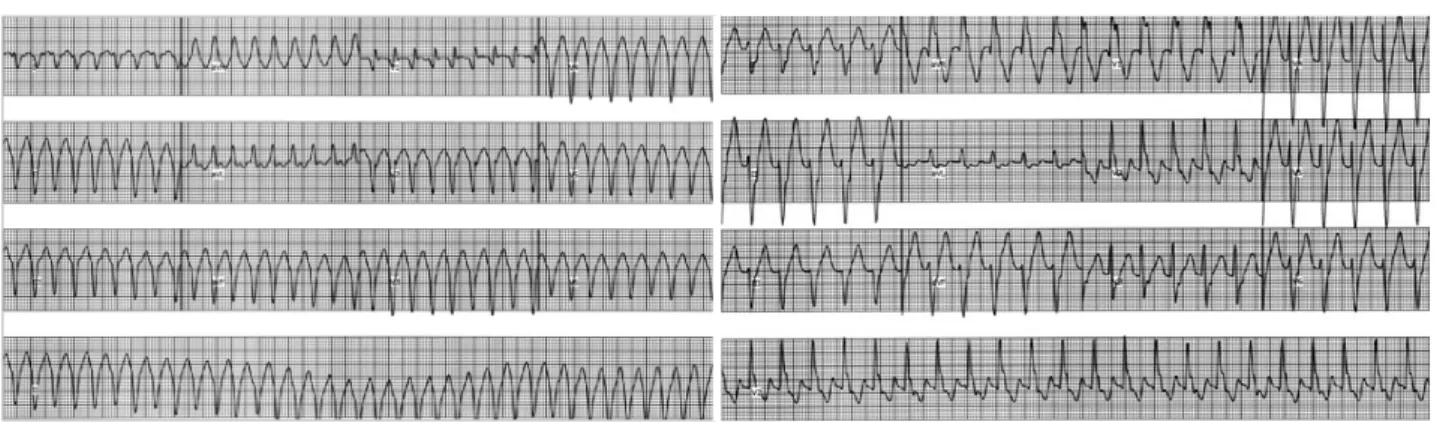
The pattern of ventricular rhythm response during RF ener- gy delivery varied according to the attempted site of ablation, including no rhythm change, repetitive ventricular prema- ture contractions (VPCs), non-sustained VT (Fig. 3), and sus- tained VT (Fig. 4). One case exhibited ventricular fibrillation (VF) during RF energy delivery.
Although a repetitive ventricular response did not occur with every RF application, repetitive ventricular responses
Fig. 4. The eletrocardiograms from patients No. 4 and No. 10 showing sudden rhythm change with the start of radiofrequency energy deliv- ery (arrow).
Patient No. 4 Patient No. 10
Fig. 3. During the repetitive ventricular response which occurred during radiofrequency energy delivery in patient No. 4, the P-poten- tials ( ) preceding wide QRS were noted. These repetitive ven- tricular responses were repeated during radiofrequency energy delivery.
P-potential, Purkinje-potential.
Patient No. 4
Fig. 5. The 12-lead eletrocardiograms showing repetitive ventricular response which occurred during radiofrequency energy delivery to patients No. 4 and No. 10. The morphology of these repetitive ventricular responses was quite similar to that of clinical idiopathic left ven- tricular tachycardia.
Patient No. 4 Patient No. 10
were usually repeated or sustained during the period of RF current application. With the exception of the one patient who had an occurrence of ventricular fibrillation, repetitive ventricular responses always disappeared immediately after cessation of energy delivery in all patients.
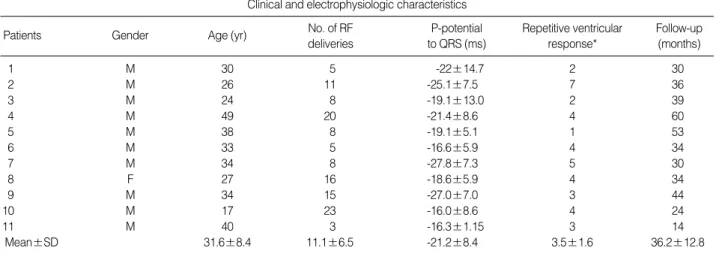
Analysis of 12-lead ECG patterns revealed that the QRS morphology of the repetitive ventricular response varied from a VPC of different morphology to VTs almost identical to clinical VT (Fig. 5). The repetitive ventricular response that was almost identical to clinical VT was noted more than once in 10 out of 11 patients (Table 1).
Results of RF ablation and follow-up
The mean number of RF applications was 11.1 (±6.5)/
patient (Table 1). Two patients received second procedures due to the recurrence of ILVT, one at three days after the ini- tial procedure and another, a year later. In the case of the for- mer, no repetitive ventricular response was observed during his first procedure, but it had been regarded as successful pro- cedure because there was no re-induction of VT. The mean follow-up period for all patients was 36.2±12.8 months. The clinical course of the remaining patients with repetitive ven- tricular responses was favorable without recurrence (Table 1).
DISCUSSION
RFCA could be considered as a potential first-line therapy for patients with ILVT because those VT can be eliminated by ablation in a high percentage of patients. In the practice of RFCA for ILVT, the termination of VT with RF energy delivery is considered a marker of successful energy delivery (1, 2). However, it is sometimes impossible to deliver RF ener-
gy during on-going VT, especially in patients with mechan- ical interruption of VT resulting from catheter-related mechan- ical trauma or with non-inducible VT. In those patients, the evaluation of procedural success and ILVT recurrences can be problematic.
In the present study, special focus was given to the ventricu- lar rhythm response that was noted with application of RF energy. The ventricular response triggered by RF current ap- plication was variable with the responses ranging from no rhythm change to repeated VPCs, non-sustained VTs or sus- tained VTs, and the morphology was also variable. Howev- er, the repetitive ventricular responses which we defined as more than 3 consecutive ventricular beats and also having a similar morphology to clinical VT were observed in most of the study subjects.
A similar response has been previously reported with RF ablation for AVNRT or automatic atrial tachycardia. This has also been observed, although rarely, in ablation for an acces- sory pathway, atrial flutter, or VT without underlying heart diseases (6, 7). The occurrence of junctional beats during slow pathway ablation for AVNRT could be an example. Accel- erated junctional tachycardia is accepted as a sensitive mark- er of successful ablation in cases of RF ablation of slow path- way potential in AVNRT (8). In my opinion though, there have been no such reports regarding the ILVT.
Successful ablation of ILVT can be performed at the site of the earliest Purkinje potential. However, these critical poten- tials have a limitation for evaluating procedural success, espe- cially for the patients who exhibit trouble with inducing the tachycardia repeatedly. We performed this study for the eval- uation of the significance of repetitive ventricular response in patients with ILVT. And the successful clinical course of the patients in this study could be a evidence that repetitive ventricular response during RF ablation is a successful pro-
*Number of instances of repetitive ventricular response (>3 consecutive QRS beats), especially showing similar morphology to clinical VT during RF application.
RF, radiofrequency; P-potential, Purkinje-potential; VT, ventricular tachycardia.
Clinical and electrophysiologic characteristics
Age (yr) Gender
Patients Repetitive ventricular
response*
Follow-up (months) P-potential
to QRS (ms) No. of RF
deliveries
1 M 30 5 -22±14.7 2 30
2 M 26 11 -25.1±7.5 7 36
3 M 24 8 -19.1±13.0 2 39
4 M 49 20 -21.4±8.6 4 60
5 M 38 8 -19.1±5.1 1 53
6 M 33 5 -16.6±5.9 4 34
7 M 34 8 -27.8±7.3 5 30
8 F 27 16 -18.6±5.9 4 34
9 M 34 15 -27.0±7.0 3 44
10 M 17 23 -16.0±8.6 4 24
11 M 40 3 -16.3±1.15 3 14
Mean±SD 31.6±8.4 11.1±6.5 -21.2±8.4 3.5±1.6 36.2±12.8
Table 1. Clinical and electrophysiologic characteristics
cedural end point rather than an epiphenomenon of the abla- tion.
The differences in electrophysiologic cellular characteris- tics between ablation sites with or without the repetitive ven- tricular response during RF applications were not evaluated in this study. However, these responses suggest that myocardi- um having an automaticity could be sensitive to heat. In ex- perimental studies, hyperthermia caused a progressive depo- larization of membrane potential, significant change in the action potential (AP) characterized by a temperature-depen- dent shortening of action potential duration (APD) and a decrease in the maximum rate of rise of the AP, and the devel- opment of abnormal automaticity. These electrophysiologic changes can be considered as mechanisms of RF current-in- duced tachyarrhythmia (9-13).
The underlying mechanism of ILVT is widely accepted as a reentry through the left ventricular Purkinje network (14- 16) and the cells comprising the Purkinje fibers have the char- acteristic of automaticity. Therefore it seems plausible that the Purkinje cells involved in re-entry of ILVT might exhib- it similar responses when exposed to heat by RF energy.
The repetitive ventricular responses varied by patient in their patterns, but were characterized by repetition or contin- uation throughout the whole period of the RF current appli- cations in most of the patients. In case where the slow con- duction zone of the reentry circuit is wide, the ablation of the entrance site of the circuit showed different QRS config- uration (17).
One study showed seven patients among 27 patients achi- eved successful ablation of tachycardia, and the pace map 12- lead ECG at site of successful ablation achieved was exhibit- ed a different QRS complex configuration from that seen dur- ing the tachycardia (17). However, all the patients in this study showed the QRS morphology of repetitive ventricular responses similar to the clinically documented tachycardia more than once during the ablation and we thought this res- ponse could be an evidence of energy delivery on the critical site adjacent to exit site. We did not count the exact the num- ber of appearance of repetitive ventricular responses with dif- ferent morphologies. It should be noted the repetitive ven- tricular responses with different morphologies were not rare.
But, we thought the repetitive ventricular responses with similar morphology with clinical tachycardia are clinically relevant.
Nakagawa et al. first reported the importance of P-potential in ablation for ILVT (18), while Tsuchiya et al. emphasized the significance of late diastolic potential and pre-systolic poten- tials in the VT circuit (19). Even though the successful abla- tion sites were different in these two research groups, the find- ings of these studies strongly suggest that the P-potential is an important marker of the critical site in LV tachycardia. On the other hand, these P-potentials were found over a relative- ly wide area, even where they were not actually incorporat- ed as critical components of VT circuits. This suggests that
the value of the P-potential could be more limited (20, 21).
However, despite of inherent limitation of P-potentials, the fact that the QRS morphology of the repetitive ventricular response noted in most of this study subjects was almost iden- tical to that of clinical VT could indicate that the repetitive ventricular response occurred from a site close to the origin of the VT.
There were case reports that successful ablation of idiopathic left ventricular tachycardia was achieved at site away from the tachycardia exit site, and even a site over the superior mid- left ventricular septum, away from the putative tachycardia exit site (17). But, in our cases, the successful sites were in the tachycardia exit site with a mean PP-QRS interval of 21.2 ms.
It is longer than that of the previous study (17) and we believ- ed there was no correlation between the PP-QRS interval and repetitive ventricular responses.
Recently study reported a case of idiopathic right ventric- ular tachycardia was repeated in which VF was triggered by a delivery of RF energy (22). Stimulation from temperature elevation and/or mechanical stress during the RF energy deliv- ery may cause VF in patients with idiopathic right ventric- ular arrhythmia. However, in the present study, we experi- enced only one case of VF during ablation, and we were uncer- tain whether this VF is induced by a delivery of RF energy or not.
Catheter-induced mechanical artifact seemed less likely to be the mechanism of repetitive ventricular response, because the repetitive ventricular response was observed only during the period of RF current application. Thus, this repetitive ventricular response could be explained by thermal response which is induced by ablating myocardium.
Thermal effect can enhance abnormal automatic activity.
Repetitive ventricular response has been observed in RF abla- tion for AVNRT and automatic atrial tachycardia. Meanwhile, there was no clear explanation regarding the cycle length of the repetitive ventricular responses and there was even a report that fast junctional tachycardia could be an impending AV block rather than a meaningful energy delivery for AVNRT (23). Considering this we thought the cycle length of repet- itive ventricular responses could be variable.
Iakobishvili et al. (24) reported the cycle length of accel- erated junctional rhythm during RF ablation of slow path- way was variable, and Chinushi et al. (7) reported that the appearance followed by a slowing and/or disappearance of repetitive ventricular responses during RF application was consistent with successful RF ablation in RVOT VT. We experienced the similar responses in our cases, so a slowing and/or disappearance of repetitive ventricular response dur- ing RF application might be another marker of successful ablation, but we need further studies with a larger number of patients.
The area heated by a standard 4 mm tip ablation catheter is known to be confined within a 5 mm radius. Considering the limited area affected by RF induced-heat, this response
which we herein term ‘‘thermal mapping’’ could provide bet- ter accuracy than pace mapping for selection of ablation site.
Many of the previously described mapping techniques are depending on inducibility of sustained VT. In that approach, targeting presystolic P-potential is useful in treating ILVT.
However, in cases of non-inducible ILVT or having trouble with repeated induction, it has limitation to assess the effi- cacy of the procedure. There are a few reports that ablation of ILVT was successful during sinus rhythm in patients with non-inducible or non-stable ILVT, but the number of the study subject was very small (25, 26).
In this study, we have followed up the patients for relative- ly long period. Most importantly, based on the favorable clin- ical outcomes of this study’s subjects, we conclude that ‘‘ther- mal mapping’’ reflected by repeated ventricular responses is useful for guiding RF ablation for ILVT, particularly in the circumstances of difficult VT induction.
The most significant limitation of the ‘‘thermal mapping’’
approach is the increase in the number of RF current appli- cations which must be applied in a somewhat blind fashion simply to target the P-potential. Nevertheless, we believe that the approach may be valuable for patients who other- wise would leave the catheterization lab without any treat- ment.
The number of patients in this study was small. Further studies with a larger number of patients and including basic experiments elucidating the heat effect on the myocardium will provide more precise and meaningful results.
In conclusion, in the practice of RF ablation for ILVT, the occurrence of a repetitive ventricular response triggered by RF current application, most specially a response with simi- lar morphology to clinical VT, is an indirect marker of effec- tive energy delivery to an appropriate site, at least for patients in whom the delivery of RF energy during on-going VT is not possible.
REFERENCES
1. Page RL, Shenasa H, Evans JJ, Sorrentino RA, Wharton JM, Prys- towsky EN. Radiofrequency catheter ablation of idiopathic recur- rent ventricular tachycardia with right bundle branch block, left axis morphology. Pacing Clin Electrophysiol 1993; 16: 327-36.
2. Coggins DL, Lee RJ, Sweeney J, Chein WW, Van Hare G, Epstein L, Gonzalez R, Griffin JC, Lesh MD, Scheinman MM. Radiofrequen- cy catheter ablation as a cure for idiopathic tachycardia of both left and right ventricular origin. J Am Coll Cardiol 1994; 23: 1333-41.
3. Lee MA, Morady F, Kadish A, Schamp DJ, Chin MC, Scheinman MM, Griffin JC, Lesh MD, Pederson D, Goldberger J, Calkins H, deBuitleir M, Kou WH, Rosenheck S, Sousa J, Langberg JJ. Catheter modification of the atrioventricular junction with radiofrequency ener- gy for control of atrioventricular nodal reentry tachycardia. Circu- lation 1991; 83: 827-35.
4. Jackman WM, Beckman KJ, McClelland JH, Wang X, Friday KJ,
Roman CA, Moulton KP, Twidale N, Hazlitt HA, Prior MI, Margo- lis PD, Calame JD, Overholt KD, Lazzara R. Treatment of supraven- tricular tachycardia due to atrioventricular nodal reentry by radiofre- quency catheter ablation of slow pathway conduction. N Engl J Med 1992; 327: 313-8.
5. Clyne CA, Athar H, Shah A, Kahr R, Rentas A. Thermal mapping of right ventricular outflow tract tachycardia. Pacing Clin Electro- physiol 2007; 30: 343-51.
6. Jentzer JH, Goyal R, Williamson BD, Man KC, Niebauer M, Daoud E, Strickberger SA, Hummel JD, Morady F. Analysis of junctional ectopy during radiofrequency ablation of the slow pathway in pati- ents with atrioventricular nodal reentrant tachycardia. Circulation 1994; 90: 2820-6.
7. Chinushi M, Aizawa Y, Ohhira K, Fujita S, Shiba M, Niwano S, Furushima H. Repetitive ventricular responses induced by radiofre- quency ablation for idiopathic ventricular tachycardia originating from the outflow tract of the right ventricle. Pacing Clin Electrophysi- ol 1998; 21: 669-78.
8. Li HG, Klein GJ, Stites HW, Zardini M, Morillo CA, Thakur RK, Yee R. Elimination of slow pathway conduction: an accurate indi- cator of clinical success after radiofrequency atrioventricular node modification. J Am Coll Cardiol 1993; 22: 1849-53.
9. Nath S, Haines DE. Biophysics and pathology of catheter energy delivery systems. Prog Cardiovsc Dis 1995; 37: 185-204.
10. Cote JM, Epstein MR, Triedman JK, Walsh EP, Saul JP. Low-tem- perature mapping predicts site of successful ablation while minimiz- ing myocardial damage. Circulation 1996; 94: 253-7.
11. Nath S, Lynch C 3rd, Whayne JG, Haines DE. Cellular electrophys- iological effects of hyperthermia on isolated guinea pig papillary muscle. Implantations for catheter ablation. Circulation 1993; 88:
1826-31.
12. Chinushi M, Aizawa Y, Ohhira K, Fujita S, Shiba M, Niwano S, Furushima H. Repetitive ventricular responses induced by radiofre- quency ablation for idiopathic ventricular tachycardia originating from the outflow tract of the right ventricle. Pacing Clin Electrophysi- ol 1998; 21: 669-78.
13. Yi KH, Han HS. Cellular electrophysiology of fast pathway ablation of rabbit atrioventricular node. J Korean Med Sci 2000; 15: 494-500.
14. Tomokuni A, Igawa O, Yamanouchi Y, Adachi M, Suga T, Yano A, Miake J, Inoue Y, Fujita S, Hisatome I, Shigemasa C. Idiopathic left ventricular tachycardia with block between Purkinje potential and ventricular myocardium. Pacing Clin Electrophysiol 1998; 21:
1824-7.
15. Kottkamp H, Hindricks G, Willems S, Haverkamp W, Wichter T, Breithardt G, Borggrefe M. Idiopathic left ventricular tachycardia:
New insights into electrophysiological characteristics and radiofre- quency catheter ablation. Pacing Clin Electrophysiol 1995; 18:
1285-97.
16. Tada H, Nogami A, Naito S, Tomita T, Oshima S, Taniguchi K, Aonuma K, Iesaka Y. Retrograde Purkinje potential activation dur- ing sinus rhythm following catheter ablation of idiopathic left ven- tricular tachycardia. J Cardiovasc Electrophysiol 1998; 9: 1218-24.
17. Wen MS, Yeh SJ, Wang CC, Lin FC, Wu D. Successful radiofrequen- cy ablation of idiopathic left ventricular tachycardia at a site away
from the tachycardia exit. J Am Coll Cardiol 1997; 30: 1024-31.
18. Nakagawa H, Beckman KJ, McClelland JH, Wang X, Arruda M, Santoro I, Hazlitt HA, Abdalla I, Singh A, Gossinger H, Sweidan R, Hirao K, Widman L, Pitha JV, Lazzara R, Jackman WM. Radiofre- quency catheter ablation of idiopathic left ventricular tachycardia guided by a Purkinje potential. Circulation 1993; 88: 2607-17.
19. Tsuchiya T, Okumura K, Honda T, Honda T, Iwasa A, Yasue H, Tabuchi T. Significance of late diastolic potential in verapamil-sen- sitive idiopathic left ventricular tachycardia. Circulation 1999; 99:
2408-13.
20. Wen MS, Yeh SJ, Wang CC, Lin FC, Wu D. Successful radiofrequen- cy ablation of idiopathic left ventricular tachycardia at a site away from the tachycardia exit. J Am Coll Cardiol 1997; 39: 1024-31.
21. Aizawa Y, Chinushi M, Kitazawa H, Washizuka T, Takahashi K, Shiba M, Ohhira K, Abe A, Shibata A. Spatial orientation of the reen- trant circuit of idiopathic left ventricular tachycardia. Am J Cardiol 1995; 76: 316-9.
22. Ito S, Tada H, Lee JD, Miyamori I. Ventricular fibrillation induced
by a radiofrequency energy delivery for idiopathic right ventricular outflow tachycardia. Int J Cardiol 2008; 128: e65-7.
23. Lipscomb KJ, Zaidi AM, Fitzpatrick AP, Lefroy D. Slow pathway modification for atrioventricular node re-entrant tachycardia: fast junctional tachycardia predicts adverse prognosis. Heart 2001; 85:
44-7.
24. Iakobishvili Z, Kusniec J, Shohat-Zabarsky R, Mazur A, Battler A, Strasberg B. Junctional rhythm quantity and duration during slow pathway radiofrequency ablation in patients with atrioventricular nodal re-entry supraventricular tachycardia. Europace 2006; 8:
588-91.
25. Lin D, Hsia HH, Gerstenfeld EP, Dixit S, Callans DJ, Nayak H, Russo A, Marchlinski FE. Idiopathic fascicular left ventricular tachycardia:
linear ablation lesion strategy for noninducible or nonsustained tachy- cardia. Heart Rhythm 2005; 2: 934-9.
26. Lee KT, Chu CS, Dai ZK, Wu JR, Sheu SH, Lai WT. Successful catheter ablation of idiopathic left ventricular tachycardia during sinus rhythm. Int J Cardiol 2007; 115: e74-7.