INTRODUCTION
Anti-Mullerian hormone (AMH) and inhibin B are mem- bers of the transforming growth factor βsuperfamily and both are expressed by the granulosa cells. Circulating levels of AMH and inhibin B are correlated with primordial folli- cle recruitment, suggesting that they may be potential clini- cal markers for ovarian reserve. Numerous studies have report- ed that basal serum levels of AMH (1-5) or inhibin B (5-7) are good predictor of ovarian response in patients undergo- ing ovarian hyperstimulation and in vitro fertilization (IVF).
Several reports also indicate that basal serum levels of AMH is a more discriminatory marker of ovarian response than basal follicle stimulating hormone (FSH), inhibin B, or estradiol (8-10).
However, there were few reports addressing the clinical significance of AMH and/or inhibin B levels measured at late follicular phase during ovarian hyperstimulation.
Serum and follicular AMH levels at the time of oocyte retrieval are positively correlated with the number of mature
follicles and oocytes retrieved (11). A recent report indicat- ed that serum AMH values at the time of human chorionic gonadotropin (hCG) administration are also correlated sig- nificantly with the number of mature follicles, number of oocytes retrieved and serum estradiol levels (12). Moreover, AMH levels are correlated significantly with a greater num- ber of 6-cell embryos and better embryo morphology score.
Serum inhibin B levels at ovulation triggering day and the levels in follicular fluids at the time of oocyte retrieval are strongly correlated with the number of oocytes retrieved (13). Serum (14) and follicular fluid (15) levels of inhibin B at ovum pick up are also correlated positively with the num- ber of oocytes collected and were predictive of clinical preg- nancy. Serum inhibin B levels measured around late follicu- lar phase during ovarian hyperstimulation could predict the number of oocytes retrieved both in normal and poor respon- der (16).
Since AMH is secreted mainly in preantral and early small antral follicle (17, 18), the circulating AMH level decreases through maturing follicle in normal menstrual cycle, and
657
Byung Chul Jee*, Seung Yup Ku�, Chang Suk Suh*,�, Ki Chul Kim�, Won Don Lee�, Seok Hyun Kim�, and On behalf of the Seoul National University College of Medicine Assisted Reproductive Technology (SMART) Study Group
Department of Obstetrics and Gynecology*, Seoul National University, Bundang Hospital, Seongnam;
Department of Obstetrics and Gynecology�, Seoul National University, College of Medicine, Seoul;
Hamchoon Women’s Clinics�, Seoul; Maria Infertility Clinics�, Seoul, Korea
Address for correspondence Seok Hyun Kim, M.D.
Department of Obstetrics and Gynecology, Seoul National University, College of Medicine, 28 Yeongeon- dong, Jongno-gu, Seoul 110-744, Korea
Tel : +82.2-2702-3773, Fax : +82.2-762-3599 E-mail : [email protected]
DOI: 10.3346/jkms.2008.23.4.657
Serum Anti-Mullerian Hormone and Inhibin B Levels at Ovulation Triggering Day Can Predict the Number of Immature Oocytes Retrieved in In Vitro Fertilization Cycles
The aim of this study was to investigate whether serum levels of anti-Mullerian hor- mone (AMH) and inhibin B at ovulation triggering day correlate with the number of immature oocytes obtained from stimulated in vitro fertilization (IVF) cycles. Fifty- nine consecutive cycles of ovarian hyperstimulation and IVF were selected from 45 women who had tubal (n=18) or unexplained infertility (n=27) and obtained at least one oocyte. Serum levels of AMH and inhibin B at ovulation triggering day were measured by enzyme-linked immunosorbent assay (ELISA). Univariate anal- ysis and multiple regressions revealed that serum AMH or inhibin B levels were significantly correlated with immature oocyte count and the correlation coefficients were higher compared to the mature oocyte count. Serum AMH and inhibin B lev- els on triggering day seems to be more closely related with the immature oocyte count and thus could be good predictors to determine the immature oocyte count in IVF cycle.
Key Words : Anti-Mullerian Hormone; Inhibin B; Immature Oocyte; Fertilization In Vitro
Received : 19 July 2007 Accepted : 27 December 2007
. .
. .
. .
. .
further decreases in FSH-treated cycles (19-21). In ovarian hyperstimulation and IVF cycles, however, continued recruit- ment of additional antral follicles during the stimulatory phase results in higher AMH levels, thus it may be related with the number of mature follicles and number of oocytes retrieved.
In contrast to AMH, inhibin B rises from early follicular phase to reach a peak during mid-follicular phase (22) but continues to increase during ovarian hyperstimulation (16).
This suggests that inhibin B is secreted by the developing cohort of antral follicles (23).
Follicular pool at late follicular phase encompasses various stages of follicular development during ovarian hyperstimu- lation. Therefore, AMH and inhibin B levels at late follicu- lar phase could reflect overall ovarian pool, including small and large antral and mature follicles. However, follicular AMH levels were reported to be three times higher in small follicles (<12 mm) than large follicles (>16 mm) and serum AMH levels were tightly correlated with the follicular lev- els (11). These findings suggest that serum AMH levels more reflect small antral follicular pool, thus we postulated serum AMH levels at ovulation triggering day could be related with the number of immature oocytes obtained. Although previ- ous studies by other researchers demonstrated that serum AMH (12) or inhibin B (13, 16) values at the time of hCG administration correlated significantly with the number of oocytes retrieved, they described only the number of total or mature oocytes. The aim of this study was to investigate whether serum levels of AMH and/or inhibin B at ovula- tion triggering day correlate with the number of immature oocytes obtained from stimulated IVF cycles.
MATERIALS AND METHODS
Fifty-nine IVF cycles from 45 infertile couples were recruit- ed in which at least one oocyte was obtained between May
2005 and November 2006. The characteristics of the study subjects were presented in Table 1. Only women with tubal (n=18) or unexplained infertility (n=27) were included.
Ovulatory factor such as polycystic ovary syndrome (PCOS) was entirely excluded since women with PCOS may have unusually higher serum AMH levels during ovarian hyper- stimulation (21). Patients with present or past history of ovarian endometriomas were also excluded. We obtained an approval from Institutional Review Board of Seoul National University Bundang Hospital for the measurement of AMH and inhibin B from patients’ frozen sera.
Ovarian hyperstimulation was performed using recombi- nant FSH (rFSH, Gonal-F�, Serono, Geneva, Switzerland) (31 cycles) or combination of rFSH with urinary hMG (Me- nogon�, Ferring, Malmo, Sweden in 11 cycles, and Perg- onal�, Serono in 15 cycles). Urinary hMG only were used in two cycles. The pituitary was suppressed only by GnRH antagonist. When mature leading follicle reached 14 mm in diameter, GnRH antagonist (Cetrotide�, Serono) 0.25 mg/
d was started until HCG administration. When mature lead- ing follicle(s) reached 19 mm in diameter, recombinant hCG (Ovidrel�, Serono) 0.25 mg was given for final ovulation trig- gering and then oocytes were retrieved 35-36 hr later. During the study period, almost all follicles over 10 mm in diameter were aspirated strictly.
In conventional IVF cycles (n=25), the maturity of oocytes was initially assessed by their morphological criteria in ref- erence of cumulus cells. When immature oocytes were sus- pected, they were treated with phosphated buffered saline (PBS) solution including 0.1% hyaluronidase (Cook, Bris- bane, Australia), and then, the cumulus cells were removed mechanically by pipetting. In intracytoplasmic sperm injec- tion (ICSI) cycles (n=34), cumulus-enclosed oocytes were treated with 0.1% hyaluronidase, and the cumulus cells were removed mechanically by pipetting. Finally, immature oocytes were defined by the absence of the first polar body, and then classified as germinal vesicle (GV) or metaphase I stage depend-
Mean SD Median Range
Female age (yr) 33.4 3.9 33.0 28-43
Duration of infertility (yr) 4.5 2.6 4.0 1-14
Basal FSH of female (mIU/mL) 5.9 4.3 4.9 1.5-18.9
Number of IVF cycle 1.9 1.9 1.0 1-13
Dose of gonadotropins (ampoules) 23.4 4.9 21.0 14-40
Estradiol concentration at ovulation triggering (pg/mL) 1017.2 640.4 947.0 177-2662
Number of total oocytes 7.2 4.0 7.0 1-21
Number of mature oocytes 4.8 2.8 4.0 1-11
Number of immature oocytes 2.4 2.4 2.0 0-10
Number of embryos transferred 2.6 0.8 3.0 1-5
AMH concentration at ovulation triggering (ng/mL) 0.90 0.83 0.67 0.05-2.99
Inhibin B concentration at ovulation triggering (pg/mL) 1013.2 984.6 755.1 34.4-4477.5
Table 1. The clinical characteristics of 59 IVF cycles from 45 infertile women including serum levels of anti-Mullerian hormone (AMH) and inhibin B
All numerical variables showed a normal distribution.
IVF, in vitro fertilization; FSH, follicle-stimulating hormone.
. . . .
ing on visible GV. The mature oocyte was determined as a presence of the first polar body under the stereomicroscope.
Mature oocytes were inseminated by conventional method or ICSI. Immature oocytes were cultured (MI oocytes for 4 hr and GV up to 44 hr) in organ culture dish containing 1 mL of each G2 medium (Vitrolife, Kungsbacka, Sweden) at 37℃, 5% CO2with high humidity. If matured, they were fertilized by ICSI. Normal fertilization was confirmed when two distinct pronuclei were present 16-18 hr later. The cleaved embryos with good quality, either from in vivo or in vitro matured oocytes, were transferred transcervically 3 days after insemination. Pregnancies were followed by serial serum β-hCG and ultrasonogram (USG).
Blood samples were collected on the day of hCG adminis- tration, and serum aliquots were immediately separated, then frozen at -80℃till assay. The concentrations of serum estra- diol were measured using a radioimmunoassay kit (TKE21, Diagnostic Products Corporation, U.S.A.). AMH and inhib- in B concentrations were measured by sensitive enzyme-link- ed immunosorbent assay (ELISA) (MIS/AMH; DSL-10-14400, Inhibin B; DSL-10-84100i, Diagnostic Systems Laborato- ries, Webster, Texas, U.S.A.). The sensitivity of AMH was
<0.017 ng/mL and the intra-assay coefficient of variation (CV) was 4.6% at 0.144 ng/mL. The sensitivity of inhibin B was <7 pg/mL and the intra-assay CV was 5.6% at 472 pg/mL.
Statistical analysis was performed using MedCalc (ver.
4.15, MedCalc Software, Mariakerke, Belgium). A p value
<0.05 was considered statistically significant.
RESULTS
Approximately one third of the retrieved oocytes were immature oocyte in our series (33.7%, 144/427). The over- all maturation and fertilization rate for immature oocyte was 56.9% (82/144) and 61.0% (50/82), respectively. Embryo transfer was possible in all study subjects except one cycle.
Up to five embryos were transferred and the resultant preg- nancy rate was 25.9% per transfer (15/58). Between pregnant and non-pregnant cycles, there were no differences in oocytes number and serum levels of AMH, inhibin B or estradiol.
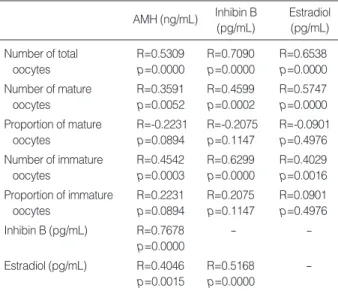
Univariate analysis revealed that the number of immature as well as mature oocytes was positively correlated with serum AMH, inhibin B and estradiol levels, respectively (Table 2).
In serum AMH and inhibin B, the correlation coefficients for immature oocyte were slightly higher than those for mature oocyte. AMH levels had a strong positive correlation with inhibin B. Either AMH or inhibin B levels were correlated positively with estradiol levels. There was no relation between mature and immature oocyte count.
Since serum levels of AMH, inhibin B and estradiol may reflect overall oocyte pool including mature (MO) and imma- ture oocytes (IM), we tested multiple regressions and the following equations were generated.
AMH (ng/mL)=0.1312+0.0874 [MO]+0.1417 [IM](r=
0.5424, p=0.008)
Inhibin B (pg/mL)=-188.7851+130.5844 [MO]+235.8635
[IM](r=0.7318, p=0.022)
Estradiol (pg/mL)=234.1401+118.9406 [MO]+87.0733
[IM](r=0.6593, p=0.014)
Multiple regressions showed that numbers of mature and immature oocytes were still independently correlated with three markers. Multiple regressions also indicated that all of three markers could reflect the combined pool of mature and immature oocytes with a statistical significance. These equa- tions also indicate serum AMH and inhibin B levels measured on triggering day were more closely related with the imma- ture oocyte count than mature oocyte count in IVF cycle.
DISCUSSION
Our results clearly demonstrated that the number of imma- ture as well as mature oocytes is independently correlated with serum AMH and inhibin B levels measured on ovula- tion triggering day. Very interestingly, the correlation coef- ficients from univariate analysis were higher in the number of immature oocytes than number of mature oocytes. This means that the number of immature oocytes have a better correlation with serum AMH and inhibin B levels. We could generate multiple regression equations in the hypothesis that number of retrieved oocytes represents follicular pool at the
IVF, in vitro fertilization; R, Pearson’s correlation coefficient; NS, not sig- nificant.
Proportions of mature or immature oocytes indicate the proportion of mature or immature oocytes per total number of oocytes per cycle.
AMH (ng/mL) Inhibin B (pg/mL)
Estradiol (pg/mL) Number of total R=0.5309 R=0.7090 R=0.6538
oocytes p=0.0000 p=0.0000 p=0.0000
Number of mature R=0.3591 R=0.4599 R=0.5747
oocytes p=0.0052 p=0.0002 p=0.0000
Proportion of mature R=-0.2231 R=-0.2075 R=-0.0901
oocytes p=0.0894 p=0.1147 p=0.4976
Number of immature R=0.4542 R=0.6299 R=0.4029
oocytes p=0.0003 p=0.0000 p=0.0016
Proportion of immature R=0.2231 R=0.2075 R=0.0901
oocytes p=0.0894 p=0.1147 p=0.4976
Inhibin B (pg/mL) R=0.7678 - -
p=0.0000
Estradiol (pg/mL) R=0.4046 R=0.5168 -
p=0.0015 p=0.0000
Table 2. Correlation analysis of serum anti-Mullerian hormone (AMH), inhibin B and estradiol at the time of ovulation triggering day relevant to number of oocytes retrieved in 59 IVF cycles
. .
time of oocyte retrieval. From the equations, we found again that number of immature oocytes could be a better contrib- utor to determine serum levels of AMH and inhibin B.
Although previous studies by other researchers demon- strated that serum values of AMH (12) or inhibin B (13, 16) at the time of ovulation triggering correlate significantly with the number of oocytes retrieved, they did not describe the number of immature oocytes separately. Our findings are in agreement with those of the previous studies in that serum AMH or inhibin B at ovulation triggering day have a signif- icant positive correlation with the number of total or mature oocytes collected. Moreover, we found for the first time that serum levels of AMH and inhibin B could be good predictors to determine the number of immature oocytes retrieved in IVF cycles.
At the time of ovulation triggering, follicular pool with various sizes exists within ovary. During ovarian stimulation, the oocyte population at the time of hCG may be heteroge- neous and this leads to retrieval of oocytes at different stages of maturation. Immature oocytes at the time of oocyte retrieval may be originated from small antral follicles or from large preovulatory follicles unresponsive to hCG. In one study, 61.8% of immature oocytes are obtained from small antral follicles (7-12 mm) and the remaining from larger follicles (>12 mm) (24).
In IVF cycles, 10-15% of oocytes are generally obtained as immature form. Although they represent a compromised group with low developmental competence, those are valu- able source for surplus oocytes if they can be matured in vitro.
The clinical use of oocytes matured in vitro for IVF is more important especially in poor responders; thereby the needs for development of in vitro maturation are increasing (25).
In the present study, 33.7% of oocytes were retrieved as imma- ture form. This higher rate might be principally attributed to our strict policy to puncture all follicles over 10 mm in diameter during the period of study. The selection of those who were used GnRH antagonist could be another factor. A slightly higher immaturity was reported in GnRH antago- nist cycles compared to GnRH agonist cycles (24).
We also found a strong positive correlation between serum concentrations of AMH and inhibin B at ovulation trigger- ing day. Serum estradiol levels also correlated positively with either serum AMH or inhibin B levels. These strong corre- lations indicate that growing follicular pool produces AMH, inhibin B as well as estradiol into the circulation, and thus suggest that serum AMH and inhibin B give no additive information over conventional measurement of serum estra- diol levels. Serum AMH and inhibin B may be valuable in that these protein markers represent preferentially imma- ture oocyte count, as shown by our study.
In the present study, the mean serum level of AMH at ovulation triggering day was 0.90 ng/mL (range: 0.05-2.99 ng/mL) and this was quite lower than 2.7 ng/mL (range: 0- 28.5 ng/mL) reported by Silberstein et al. (12) However, it
cannot be directly compared since the method of measure- ment was different. We used ELISA kits purchased from Diagnostic Systems Laboratories (DSL), and it was reported that AMH levels are almost 4.6-fold lower with the DSL kit compared to the Beckman Coulter kit (26). One study using the Beckman Coulter kit reported the median serum level of AMH was 1.44 ng/mL on the day of oocyte retrieval (range:
0.38-4.96 ng/mL) (11). Serum AMH levels on the day of oocyte retrieval may be lower than those in ovulation trig- gering day because hCG-induced luteinization curtails fol- licular AMH production (27). Therefore, serum AMH val- ues may be different according to the time of measurement and the ELISA kits used.
In conclusion, our study demonstrated that the number of immature as well as mature oocytes retrieved in stimulat- ed IVF cycles is independently correlated with serum AMH and inhibin B levels measured on ovulation triggering day.
Our results also indicate that serum AMH and inhibin B levels on triggering day are more closely related with imma- ture oocyte count, thus serum levels of AMH and inhibin B seem to be good predictors to determine the immature oocyte count in IVF cycle.
ACKNOWLEDGMENTS
The authors wish to thank Soo Ji Koh, B.Sc. for her tech- nical assistance.
REFERENCES
1. Van Rooij IA, Broekmans FJ, Te Velde ER, Fauser BC, Bancsi LF, De Jong FH, Themmen AP. Serum anti-Mullerian hormone levels:
a novel measure of ovarian reserve. Hum Reprod 2002; 17: 3065-71.
2. Seifer DB, MacLaughlin DT, Christian BP, Feng B, Shelden RM.
Early follicular serum mullerian-inhibiting substance levels are associated with ovarian response during assisted reproductive tech- nology cycles. Fertil Steril 2002; 77: 468-71.
3. Fanchin R, Taieb J, Lozano DH, Ducot B, Frydman R, Bouyer J.
High reproducibility of serum anti-Mullerian hormone measure- ments suggests a multi-staged follicular secretion and strengthens its role in the assessment of ovarian follicular status. Hum Reprod 2005; 20: 923-7.
4. Penarrubia J, Fabregues F, Manau D, Creus M, Casals G, Casamit- jana R, Carmona F, Vanrell JA, Balasch J. Basal and stimulation day 5 anti-Mullerian hormone serum concentrations as predictors of ovarian response and pregnancy in assisted reproductive technol- ogy cycles stimulated with gonadotropin-releasing hormone agonist- gonadotropin treatment. Hum Reprod 2005; 20: 915-22.
5. Muttukrishna S, McGarrigle H, Wakim R, Khadum I, Ranieri DM, Serhal P. Antral follicle count, anti-Mullerian hormone and inhibin B: predictors of ovarian response in assisted reproductive technolo- gy? BJOG 2005; 112: 1384-90.
. .
. .
. .
. .
. .
6. Seifer DB, Lambert-Messerlian G, Hogan JW, Gardiner AC, Blazar AS, Berk CA. Day 3 serum inhibin B is predictive of assisted repro- ductive technologies outcome. Fertil Steril 1997; 67: 110-4.
7. Creus M, Penarrubia J, Fabregues F, Vidal E, Carmona F, Casamit- jana R, Vanrell JA, Balasch J. Day 3 serum inhibin B and FSH and age as predictors of assisted reproduction treatment outcome. Hum Reprod 2000; 15: 2341-6.
8. De Vet A, Laven JS, de Jong FH, Themmen AP, Fauser BC. Antim- ullerian hormone serum levels: a putative marker for ovarian aging.
Fertil Steril 2002; 77: 357-62.
9. Fanchin R, Schonauer LM, Righini C, Guibourdenche J, Frydman R, Taieb J. Serum anti-Mullerian hormone is more strongly related to ovarian follicular status than serum inhibin B, estradiol, FSH and LH on day 3. Hum Reprod 2003; 18: 323-7.
10. Hazout A, Bouchard P, Seifer DB, Aussage P, Junca AM, Cohen- Bacrie P. Serum antimullerian hormone/mullerian-inhibiting sub- stance appears to be a more discriminatory marker of assisted repro- ductive technology outcome than follicle-stimulating hormone, inhib- in B, or estradiol. Fertil Steril 2004; 82: 1323-9.
11. Fanchin R, Louafi N, Mendez Lozano DH, Frydman N, Frydman R, Taieb J. Per-follicle measurements indicate that anti-Mullerian hormone secretion is modulated by the extent of follicular develop- ment and luteinization and may reflect qualitatively the ovarian fol- licular status. Fertil Steril 2005; 84: 167-73.
12. Silberstein T, MacLaughlin DT, Shai I, Trimarchi JR, Lambert- Messerlian G, Seifer DB, Keefe DL, Blazar AS. Mullerian inhibit- ing substance levels at the time of HCG administration in IVF cycles predict both ovarian reserve and embryo morphology. Hum Reprod 2006; 21: 159-63.
13. Fried G, Remaeus K, Harlin J, Krog E, Csemiczky G, Aanesen A, Tally M. Inhibin B predicts oocyte number and the ratio IGF-I/IGFBP- 1 may indicate oocyte quality during ovarian hyperstimulation for in vitro fertilization. J Assist Reprod Genet 2003; 20: 167-76.
14. Urbancsek J, Hauzman E, Klinga K, Rabe T, Papp Z, Strowitzki T.
Use of serum inhibin B levels at the start of ovarian stimulation and at oocyte pickup in the prediction of assisted reproduction treatment outcome. Fertil Steril 2005; 83: 341-8.
15. Ocal P, Aydin S, Cepni I, Idil S, Idil M, Uzun H, Benian A. Follicu- lar fluid concentrations of vascular endothelial growth factor, inhibin A and inhibin B in IVF cycles: are they markers for ovarian response and pregnancy outcome? Eur J Obstet Gynecol Reprod Biol 2004;
115: 194-9.
16. Eldar-Geva T, Margalioth EJ, Ben-Chetrit A, Gal M, Robertson DM, Healy DL, Diamant YZ, Spitz IM. Serum inhibin B levels measured
early during FSH administration for IVF may be of value in predict- ing the number of oocytes to be retrieved in normal and low respon- ders. Hum Reprod 2002; 17: 2331-7.
17. Durlinger AL, Gruijters MJ, Kramer P, Karels B, Ingraham HA, Nachtigal MW, Uilenbroek JT, Grootegoed JA, Themmen AP. Anti- Mullerian hormone inhibits initiation of primordial follicle growth in the mouse ovary. Endocrinology 2002; 143: 1076-84.
18. Weenen C, Laven JS, Von Bergh AR, Cranfield M, Groome NP, Visser JA, Kramer P, Fauser BC, Themmen AP. Anti-Mullerian hormone expression pattern in the human ovary: potential implica- tions for initial and cyclic follicle recruitment. Mol Hum Reprod 2004; 10: 77-83.
19. Fanchin R, Schonauer LM, Righini C, Frydman N, Frydman R, Taieb J. Serum anti-Mullerian hormone dynamics during controlled ovarian hyperstimulation. Hum Reprod 2003; 18: 328-32.
20. La Marca A, Malmusi S, Giulini S, Tamaro LF, Orvieto R, Levratti P, Volpe A. Anti-Mullerian hormone plasma levels in spontaneous menstrual cycle and during treatment with FSH to induce ovulation.
Hum Reprod 2004; 19: 2738-41.
21. Eldar-Geva T, Margalioth EJ, Gal M, Ben-Chetrit A, Algur N, Zyl- ber-Haran E, Brooks B, Huerta M, Spitz IM. Serum anti-Mullerian hormone levels during controlled ovarian hyperstimulation in women with polycystic ovaries with and without hyperandrogenism. Hum Reprod 2005; 20: 1814-9.
22. Groome NP, Illingworth PJ, O’Brien M, Pai R, Rodger FE, Mather JP, McNeilly AS. Measurement of dimeric inhibin B throughout the human menstrual cycle. J Clin Endocrinol Metab 1996; 81: 1401-5.
23. Lockwood GM, Muttukrishna S, Ledger WL. Inhibins and activins in human ovulation, conception and pregnancy. Hum Reprod Update 1998; 4: 284-95.
24. Nogueira D, Friedler S, Schachter M, Raziel A, Ron-El R, Smitz J.
Oocyte maturity and preimplantation development in relation to fol- licle diameter in gonadotropin-releasing hormone agonist or antag- onist treatments. Fertil Steril 2006; 85: 578-83.
25. Chian RC, Lim JH, Tan SL. State of the art in in-vitro oocyte matu- ration. Curr Opin Obstet Gynecol 2004; 16: 211-9.
26. Freour T, Mirallie S, Bach-Ngohou K, Denis M, Barriere P, Masson D. Measurement of serum anti-Mullerian hormone by Beckman Coul- ter ELISA and DSL ELISA: Comparison and relevance in assisted reproduction technology (ART). Clin Chim Acta 2007; 375: 162-4.
27. Feyereisen E, Mendez Lozano DH, Taieb J, Hesters L, Frydman R, Fanchin R. Anti-Mullerian hormone: clinical insights into a promis- ing biomarker of ovarian follicular status. Reprod Biomed Online 2006; 12: 695-703.
. .
. . . .
. .
. .
. .
. .
. .
. .
. .
. .
. . . .