Address for correspondence Ki-Suck Jung, MD
Division of Pulmonary and Critical Care Medicine, Department of Internal Medicine, Hallym University Sacred Heart Hospital, 896 Pyeongchon-dong, Dongan-gu, Anyang 431-070, Korea Tel : +82.31-380-3715, Fax : +82.31-380-3973 E-mail : [email protected]
INTRODUCTION
Chronic obstructive pulmonary disease (COPD) is character- ized by airflow limitation which is not fully reversible. COPD is a leading cause of morbidity and mortality worldwide and is the only major disease that is continuing to increase in both prevalence and mortality (1-4). Since early detection and inter- vention is currently the best approach to reduce the econom- ic and social burden of COPD, there has been a call for glob- al strategies to assess the prevalence of COPD (5).
Spirometry is essential for diagnosis in COPD. The ratio of forced expiratory volume in one second (FEV1) to forced vital capacity (FVC) is an acceptable indicator of the presence of airflow limitation. Unfortunately, there was no consensus on diagnostic criteria of COPD, every guidelines used their own diagnostic criteria recently (6-9). After the Global Ini- tiative for Chronic Obstructive Lung Disease (GOLD) was introduced in 2001, specific spirometric cut-point (e.g., post- bronchodilator FEV1/FVC <0.7) has been used for diagnos- ing COPD (1, 10).
A nationwide COPD prevalence survey in Korea in con- junction with the second Korean National Health and Nutri-
tion Examination Survey (Korean NHANES II) was conduct- ed from 2001 to 2002. Using GOLD criterion for defining airflow limitation, 17.2% of Korean adults over the age of 45 yr had COPD and most of them had mild disease (11).
However, the FEV1/FVC ratio decreases with age because the FEV1declines more rapidly with age than the FVC in nor- mal subjects, so the FEV1percentage of predicted will decrease with age because of the shrinking denominator of the per- centage of predicted index. Therefore, it is suggested that the use of fixed ratio may result in over-diagnosis of COPD in the elderly, especially with mild disease (12).
The Korean COPD prevalence survey showed that 35.0%
of adults over the age of 65 yr and 41.4% over the age of 70 yr (11) proved to have COPD. Even though more than half of them belonged to mild degree of COPD, the figure see- med to be over-exaggerated in elderly. Therefore, we need to apply a new criterion to correct overwhelming higher preva- lence of COPD in senior citizens. The lower limit of normal (LLN), based on the normal distribution, classify the bottom 5% of the healthy population as abnormal. When we use LLN criterion in the evaluation of FEV1/FVC, it could be one of alternatives to minimize the potential misclassification (1,
621
Yong Il Hwang, Chang Hwan Kim, Hye-Ryun Kang, Taerim Shin, Sang Myeon Park, Seung Hun Jang, Yong Bum Park, Cheol Hong Kim, Dong-Gyu Kim, Myung Goo Lee, In-Gyu Hyun, and Ki-Suck Jung
Department of Internal Medicine, College of Medicine, Hallym University, Chuncheon, Korea
DOI: 10.3346/jkms.2009.24.4.621
Comparison of the Prevalence of Chronic Obstructive Pulmonary Disease Diagnosed by Lower Limit of Normal and Fixed Ratio Criteria
The Global Initiative of Chronic Obstructive Lung Disease (GOLD) guidelines de- fine chronic obstructive pulmonary disease (COPD) in subjects with FEV1/FVC <0.7.
However, the use of this fixed ratio may result in over-diagnosis of COPD in the elderly, especially with mild degree of COPD. The lower limit of normal (LLN) can be used to minimize the potential misclassification. The aim of this study was to eval- uate the impact of different definitions of airflow obstruction (LLN or fixed ratio of FEV1/FVC) on the estimated prevalence of COPD in a population-based sample.
We compared the prevalence of COPD and its difference diagnosed by different methods using either fixed ratio (FEV1/FVC <0.7) or LLN criterion (FEV1/FVC below LLN). Among the 4,816 subjects who had performed spirometry, 2,728 subjects met new ATS/ERS spirometry criteria for acceptability and repeatability. The preva- lence of COPD was 10.9% (14.7% in men, 7.2% in women) by LLN criterion and 15.5% (21.8% in men, 9.1% in women) by fixed ratio of FEV1/FVC among subjects older than 45 yr. The difference of prevalence between LLN and fixed ratio of FEV1/ FVC was even higher among subjects with age ≥65, 14.9% and 31.1%, respec- tively. In conclusion, the prevalence of COPD by LLN criterion was significantly lower in elderly compared to fixed ratio of FEV1/FVC. Implementing LLN criterion instead of fixed ratio of FEV1/FVC may reduce the risk of over-diagnosis of COPD in elder- ly people.
Key Words : Pulmonary Disease, Chronic Obstructive; National Prevalence; Lower Limit of Normal; Spirometry
Received : 27 November 2007 Accepted : 29 September 2008
13). The objective of this study was to compare the preva- lence of COPD by using fixed ratio and LLN of FEV1/FVC for the presence of airflow limitation.
MATERIALS AND METHODS
This study was preformed as a part of a nationwide COPD prevalence survey. It was conducted in conjunction with the second Korean National Health and Nutrition Examination Survey (Korean NHANES II) from October 15, 2001 to Jan- uary 20, 2002. Spirometry was performed by specially train- ed technicians who conformed to the 1994 American Tho- racic Society (ATS) recommendations (11, 14). In 2005, ATS and European Respiratory Society (ERS) published a new statement on spirometry that changed the repeatability cri- teria (the difference between the largest and the next largest FEV1) from ≤0.2 L to ≤0.15 L (15). So the acceptability and repeatability criteria of the spirometry in this study were adopted from the 2005 new ATS/ERS recommendations (15).
A more detailed description of the nationwide COPD sur- vey methodology and spirometric procedures has been pre- viously published (11, 14).
Selection of new reference population
A reference equation for FEV1/FVC was developed in the Korean NHANES II (14). But as we mentioned, the repeata- bility criterion of the spirometry was changed in the new ATS/
ERS spirometry recommendations (15), a new reference equa- tion for FEV1/FVC was needed. The selection criteria of new reference population were similar to the previous study (14) except for the definition of the non-smoker. We defined the lifetime non-smoker as a subject who had never smoked (14).
And the acceptability and repeatability criteria of the spirom- etry were adopted from the new ATS/ERS spirometry rec- ommendations (15). Total 1,125 subjects met the selection criteria for new reference population. There were 183 male and 942 female in the new reference population.
New predictive equation for FEV1/FVC and LLN of the FEV1/FVC
A new prediction equation for FEV1/FVC was made by lin- ear regression analysis. The variables affecting the normal pre- dicted values of the FEV1/FVC for male and female were age and height. The new prediction equations were 125.77628- 0.36304×age (yr)-0.17146×height (cm) for Koreans male and 97.36197-0.26015×age (yr)-0.01861×height (cm) for Koreans female.
The observed values of FEV1/FVC were distributed nor- mally, so the lower limits of the normal range (LLN) for FEV1/ FVC were calculated for each subject using the new reference equations. These were based on the predicted value minus
1.645-times the standard error of the estimate (SEE) (16, 17) (Table 1).
Analysis
The new prediction equation from the present study was compared to the other prediction equations (14, 18-21). The differences between predictive values based on the prediction equations from the present study and others were divided by the predictive values from the present study or others and then multiplied by 100. The mean differences in percent were used to compare the equations.
The presence of airflow limitation was assessed by fixed ra- tio criterion and LLN criterion, each of which was defined as FEV1/FVC less than 0.7 or LLN, respectively. COPD was de- fined as presence of airflow limitation in persons aged 45 or older (11).
The crude prevalence rates of airflow limitation for every 100 persons per each age group from the study population were obtained and they were post-stratified to the Korean po- pulation as estimated by the Bureau of the Census 2001 (22) to adjust for unequal probabilities of selection. Then the age adjusted standardized prevalence rates of airflow limitation were calculated for the age group ≥18 and ≥45 yr.
The two criteria of airflow limitation (fixed ratio and LLN) were compared in terms of the crude prevalence of airflow limitation and the age adjusted standardized prevalence of COPD.
RESULTS Study populations
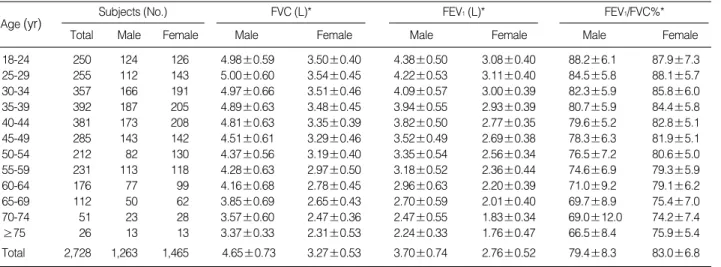
Total 4,816 subjects performed the spirometry. Among 4,816 subjects, 2,728 (men, 1,263, women, 1,465) subjects met the new ATS/ERS acceptability and repeatability criteria.
The median age of the study population was 41 yr. The mean
±SD FEV1/FVC % was 79.4±8.3 for men and 83.0±6.8 for women. There were 1,093 subjects aged 45 yr or older who met the new ATS/ERS acceptability and repeatability criteria. For the entire study population, there were 789 cur- rent smokers (men, 738, women, 51). Table 2 described the characteristics of the study population according to the age group.
*Ratio, FEV1/FVC×100%.
Ht, height in cm; R2, coefficient of determination; SEE, standard error of the estimate.
Equation R2 SEE
Male 125.77628-0.36304×Age-0.17146×Ht 0.4309 5.35 Female 97.36197-0.260154×Age-0.01861×Ht 0.2420 5.41 Table 1. New prediction equation of FEV1/FVC%* in adult Koreans
Comparison of new prediction equation of FEV1/FVC with other prediction equations
We compared the new predication equation of the present study with other equations (18-21) and that of the Korean NHANES II (14). The mean differences of predictive values were less than 1% except the equation for the women of Knudson’s study (19), which showed 1.09% difference (Table 3). The predictive values from the present study were slight- ly less than those from the original equation derived from the Korean NHANES II (14) for both men and women.
Crude prevalence rates of the airflow limitation by each criterion
Among the study population, total 240 subjects met LLN criterion for airflow limitation, whereas 186 subjects met fix- ed ratio criterion. Among Korean adults over age of 18 yr, the crude prevalence rate of airflow limitation was 8.7% (men 11.4%; women 6.3%) by using LLN criterion and 6.8% (men
10.8%; women 3.4%) by using fixed ratio criterion, respec- tively.
For the subjects aged 45 or more, the numbers of the sub- jects with airflow limitation were 117 for LLN criterion and 148 for fixed ratio criterion. So the crude prevalence rate of airflow limitation was 10.7% by LLN criterion and 13.5%
by fixed ratio criterion in that population. The crude preva- lence rates of airflow limitation increased as the age of pop- ulation increased (Table 4). The prevalence rate by LLN and fixed ratio in age ≥65 was 16.4% and 30.7%, respectively.
Prevalence rate of COPD among the subjects aged 45 or older
The age adjusted standardized prevalence rates of COPD were 10.9% (men, 14.7%; women, 7.2%) by LLN criterion and 15.5% (men, 21.8%; women, 9.1%) by fixed ratio cri- terion. This rate also increased as the age of population in-
*, mean±SD.
Total Male Female Male Female Male Female Male Female
18-24 250 124 126 4.98±0.59 3.50±0.40 4.38±0.50 3.08±0.40 88.2±6.1 87.9±7.3 25-29 255 112 143 5.00±0.60 3.54±0.45 4.22±0.53 3.11±0.40 84.5±5.8 88.1±5.7 30-34 357 166 191 4.97±0.66 3.51±0.46 4.09±0.57 3.00±0.39 82.3±5.9 85.8±6.0 35-39 392 187 205 4.89±0.63 3.48±0.45 3.94±0.55 2.93±0.39 80.7±5.9 84.4±5.8 40-44 381 173 208 4.81±0.63 3.35±0.39 3.82±0.50 2.77±0.35 79.6±5.2 82.8±5.1 45-49 285 143 142 4.51±0.61 3.29±0.46 3.52±0.49 2.69±0.38 78.3±6.3 81.9±5.1 50-54 212 82 130 4.37±0.56 3.19±0.40 3.35±0.54 2.56±0.34 76.5±7.2 80.6±5.0 55-59 231 113 118 4.28±0.63 2.97±0.50 3.18±0.52 2.36±0.44 74.6±6.9 79.3±5.9
60-64 176 77 99 4.16±0.68 2.78±0.45 2.96±0.63 2.20±0.39 71.0±9.2 79.1±6.2
65-69 112 50 62 3.85±0.69 2.65±0.43 2.70±0.59 2.01±0.40 69.7±8.9 75.4±7.0
70-74 51 23 28 3.57±0.60 2.47±0.36 2.47±0.55 1.83±0.34 69.0±12.0 74.2±7.4
≥75 26 13 13 3.37±0.33 2.31±0.53 2.24±0.33 1.76±0.47 66.5±8.4 75.9±5.4
Total 2,728 1,263 1,465 4.65±0.73 3.27±0.53 3.70±0.74 2.76±0.52 79.4±8.3 83.0±6.8 Table 2. Spirometry data of study population according to the age groups
Age(yr) Subjects (No.) FVC (L)* FEV1(L)* FEV1/FVC%*
*100×([predicted value of present study-predicted value of the major equation])/predicted value of present study); �100×([predicted value of present study-predicted value of the major equation])/predicted value of the other study).
Reference
Male Difference*
Mean (%)
Difference� Mean (%)
Female Difference*
Mean (%)
Difference� Mean (%)
Crapo (18) 0.36 0.48 -0.84 -0.81
Knudson (19) 0.32 0.47 -1.13 -1.09
CHS (20) -0.13 -0.11 0.98 0.99
BOND (21) -0.29 -0.06 0.73 0.81
KNHANESⅡ(14) -0.82 -0.81 -0.19 -0.19
Table 3. The difference between new predication equation and other equations
Age (yr)
By Fixed ratio Total
(%)
Male (%)
Female (%)
By LLN Total
(%)
Male (%)
Female (%)
18-24 1.6 0.8 2.4 8.4 6.5 10.3
25-34 1.5 2.2 0.9 7.8 10.1 6.0
35-44 3.2 5.0 1.7 7.0 10.0 4.4
45-54 5.8 9.3 2.9 8.0 9.8 6.6
55-64 15.0 26.8 4.6 11.3 17.9 5.5
65-74 29.4 43.8 17.8 16.0 21.9 11.1
≥75 38.5 53.8 23.1 19.2 30.8 7.7
≥18 6.8 10.8 3.4 8.7 11.4 6.3
≥45 13.5 22.2 6.3 10.7 15.2 6.9
≥55 20.0 32.6 9.1 13.1 19.9 7.2
≥65 30.7 45.3 18.4 16.4 23.3 10.7
Table 4. Crude prevalence rate of airflow obstruction by each criterion according to the age groups
creased. The prevalence rate of COPD by LLN and fixed ra- tio in age ≥65 was 14.9% and 31.1%, respectively.
Comparison of the presence of airflow limitation by LLN and fixed ratio
We made a table for different age groups to evaluate the concordance of the each criterion for the presence of airflow limitation. The discrepancy rates were around 5% in each age group.
There were total 146 subjects who were differently classi- fied according to the each criterion, 100 were classified as ha- ving airflow limitation by LLN criterion but not having air- flow limitation by fixed ratio criterion. The remaining 46 were classified as having airflow limitation by fixed ratio cri- terion but not having airflow limitation by LLN criterion.
For subjects aged less than 45 yr, 38 subjects had airflow limitation by both fixed ratio criterion and LLN criterion.
For subjects of age 65 or older, among the 31 subjects with airflow limitation by the LLN criterion, no one classified as without airflow limitation by the fixed ratio criterion. On the contrary, 27 subjects with airflow limitation by fixed ratio criterion did not show airflow limitation by LLN criterion.
Fig. 1 shows the proportion of subject with airflow limita- tion using both criteria in each age group. The percentage of subjects with airflow limitation by LLN criterion only decreased as the subjects’ age increased. On the contrary, the percentage of subjects with airflow limitation by fixed ratio alone increased as the subjects’ age increased. Among sub- jects older than 75 yr of age, half of the subjects with airflow limitation by fixed ratio criterion did not show airflow lim- itation by LLN criterion.
DISCUSSION
We analyzed 2,728 subjects who met new spirometry cri- teria for acceptability and repeatability from Korean nation-
al COPD survey. The age adjusted prevalence rate of COPD in the general population of Korea varies, according to the criterion used for its definition, from 10.9% with LLN cri- terion to 15.5% with fixed ratio criterion.
The ATS/ERS recently revised their spirometry recommen- dations, which included changes in spirometry acceptability and repeatability criteria (15). As the Korean NHANES II used the previous the ATS spirometry recommendations (16), we did not use the prediction equation that derived from Ko- rean NHANES II (14). Instead, we made a new prediction equation for FEV1/FVC. The mean differences between the predictive values of our new equation and other equations including the equation from the Korean NHANES II (14, 18-21) were about 1%, therefore it was reasonable to use our new equation.
There were 146 subjects who were differently classified according to each criterion. The discrepancy rate was 5.35%
of the study population. This discrepancy rate was greater in older age groups and more prominent as age increased. And, there was different pattern of discrepancy according to age groups. For the younger subjects, more subjects were classi- fied with airflow limitation by the LLN criterion. Contrari- ly, more subjects were classified with airflow limitation by fixed ratio criterion for the older subjects. These results im- plied that use of LLN may reduce the prevalence of COPD in elderly.
We previously reported 17.2% of the prevalence rate of COPD from the same nationwide COPD survey. But our pre- vious study was performed based on the 1991 ATS spirom- etry recommendations and analyzed subjective who under- went at least two spirometry measurements acceptable by the 1991 ATS criteria (11). Our present study reselected study population according to the new ATS/ERS spirometry rec- ommendations for the acceptability and repeatability (15).
The crude prevalence rate of airflow limitation in the present study was lower than that of our previous study in subjects aged 45 or more. The prevalence rate of COPD by the fixed ratio criterion of the present study was 15.5%, which was lower than previous results (11). This meant that use of more strict criteria for spirometry also may reduce the prevalence rate of COPD in the elderly.
Since there had been no consensus on the criteria for diag- nosis of COPD recently, a majority of national guidelines had their own diagnostic criteria of COPD (6-9, 23). The preva- lence rate of COPD population depends on the criterion for the definition of airflow limitation even in the same popula- tion (24). After the GOLD guideline was introduced in 2001, a consensus of the diagnostic criterion of COPD was made;
FEV1/FVC <0.7 (1, 11). But the definition of an obstructive pulmonary defect given in the recently published ATS/ERS spirometry recommendations contrasts with the definition suggested by the GOLD and ATS/ERS guidelines, in that FEV1is referred to vital capacity (VC) rather than just FVC and the cut-off value of this ratio is set at the 5th percentile
Fig. 1. Comparison of the number of subjects with airflow limitation of all age groups.
Fixed ratio (+), observed FEV1/FVC <0.7; LLN (+), observed FEV1/ FVC <LLN.
%
25
20
15
10
5
0 18-24 25-34 35-44 45-54 55-64 65-74 ≥75 Year
Fixed ratio (+) LLN (+) Fixed ratio (+) LLN (-) Fixed ratio (-) LLN (+)
of the normal distribution rather than at a fixed ratio of 0.7.
The advantage of using VC in place of FVC is that the ratio of FEV1to VC is capable of accurately identifying more ob- structive patterns than its ratio to FVC, because FVC is more dependent on flow and volume histories (13).
There were few studies comparing the lower limit of nor- mal (LLN) to fixed ratio for the detection of airflow limita- tion to diagnose COPD. Our present study showed that use of LLN criterion for the diagnosis of COPD decreased the pre- valence rate as much as 4.6% for the subject with aged ≥45 yr. This result corresponds with the earlier study by Celli et al., which evaluated the impact of five different definitions of airflow limitation on the estimated prevalence of COPD (17).
Our study also showed that 27 subjects (14.3%) with airflow limitation by fixed ratio criterion did not show airflow limi- tation by LLN criterion for subjects of age 65 or older. This figure was comparable to that of recent study by Hansen et al.
which reported that using fixed ratio criterion misidentified 11.3% of subject of age seventh and eighth decade as abnor- mal (25). But in contrary to our study, both studies used the 1994 ATS spirometry recommendations. We believe this study to be the only one which adopted new 2005 ATS/ERS spirometry recommendations to date.
This study has some limitations though. The spirometric definitions of COPD generally require post-bronchodilator measurement (1, 10), but the spirometry examination in this nationwide survey did not include a test of reversibility of ob- struction. While some subset of the study population had probability of having pure asthma, we believe the prevalence figure of airflow limitation is reasonable as a criterion of the prevalence of COPD especially after the age of 45 yr in this large epidemiologic survey. We understand that the reference equations using post-bronchodilator measurement of lung parameter are not validated (1, 26). The other limitation is that we did not use the LLN of the vital capacity (VC) re- commended by the ATS/ERS to differentiate the pure obstru- ctive defect from the mixed defect (13). The FVC is usually reduced more than IVC (inspiratory vital capacity) or SVC (slow vital capacity) in airflow obstruction (27). However, the effect of these differences on population estimates has not been studied (17). So the ratio of forced expiratory volume in one second (FEV1) to forced vital capacity (FVC) seemed to be reasonable indicator of the presence of the airflow lim- itation in this large epidemiologic survey.
Our study found that 10.9% of Korean adults over the age of 45 yr had COPD by LLN criterion, which reduced the prevalence rate of COPD by 4.6% point. More strict appli- cation of spirometry criteria for acceptability and repeatabil- ity also reduced the prevalence of COPD.
In conclusion, adopting LLN and more strict spirometry criteria revealed lower prevalence rate of COPD in elderly Korean population. Particularly, using LLN criterion might reduce the risk of over-diagnosis of COPD in the elderly.
REFERENCES
1. National Heart, Lung, and Blood Institute and World Health Orga- nization. Global initiative for chronic obstructive lung disease: glob- al strategy for the diagnosis, management, and prevention of chron- ic obstructive pulmonary disease. National Heart, Lung, and Blood Institute, National Institutes of Health, Bethesda, MD, USA [revised 2006; cited 25 January 2007]. Available from: URL: http://www.
goldcopd.com
2. Murray CJ, Lopez AD. Evidence-based health policy-Lessons from the global burden of disease study. Science 1996; 274: 740-3.
3. Murray CJ, Lopez AD. Global mortality, disability, and the contri- bution of risk factors: global burden of disease. Lancet 1997; 349:
1436-42.
4. Murray CJ, Lopez AD. Alternative projections of mortality and dis- ability by cause 1990-2020: global burden of disease study. Lancet 1997; 349: 1498-504.
5. Hurd SS. International efforts directed at attacking the problem of COPD. Chest 2000; 117: S336-8.
6. Snider GL. Nosology for our day-Its application to chronic obstruc- tive pulmonary pisease. Am J Respir Crit Care Med 2003; 167: 678- 83.
7. Siafakas NM, Vermeire P, Pride NB, Paoletti P, Gibson J, Howard P, Yernault JC, Decramer M, Higenbottam T, Postma DS, Rees J.
Optimal assessment and management of chronic obstructive pul- monary disease (COPD). Eur Respir J 1995; 8: 1398-420.
8. American Thoracic Society. Standards for the diagnosis and care of patients with chronic obstructive pulmonary disease. Am J Respir Crit Care Med 1995; 152: S77-121.
9. British Thoracic Society. BTS guidelines for the management of chron- ic obstructive pulmonary disease. The COPD Guidelines Group of the Standards of Care Committee of the BTS. Thorax 1997; 52: S1-28.
10. Celli BR, MacNee W. Standards for the diagnosis and treatment of patients with COPD: a summary of ATS/ERS position paper. Eur Respir J 2004; 23: 932-46.
11. Kim DS, Kim YS, Jung K, Chang JH, Lim C, Lee JH, Uh S, Shim JJ Lew WJ. Prevalence of chronic obstructive pulmonary disease in Korea. Am J Respir Crit Care Med 2005; 172: 842-47.
12. Hardie JA, Buist AS, Vollmer WM, Ellingsen I, Bakke PS, Morkve O. Risk of over-diagnosis of COPD in asymptomatic elderly never- smoker. Eur Respir J 2002; 20: 1117-22.
13. Pellegrino R, Viegi G, Brusasco V, Crapo RO, Burgos F, Casaburi R, Coated A, van der Grinten CP, Gustafsson P, Hankinson J, Jensen R, Johnson DC, MacIntyre N, McKay R, Miller MR, Navajas D, Ped- ersen OF, Wanger J. ‘‘ATS/ERS task force: standardisation of lung function testing’’ Interpretative strategies for lung function tests. Eur Respir J 2005; 26: 948-68.
14. Choi JK, Paek D, Lee JO. Normal predictive values of spirometry for Korean population. Tuberc Respir Dis (Korean) 2005; 58: 230-42.
15. Miller MR, Hankinson J, Brusasco V, Burgos F, Casaburi R, Coates A, Crapo R,k Enright P, vsn der Grinten CP, Gustafsson P, Jensen R, Johnson DC, MacIntyre N, McKay R, Navajas D, Pedersen OF, Pel- legrino R, Viegi G, Wanger J. ‘‘ATS/ERS task force: standardisation of lung function testing’’. Standardisation of spirometry. Eur Respir
J 2005; 26: 319-38.
16. American Thoracic Society. Lung function testing: selection of refer- ence values and interpretative strategies. Am Rev Respir Dis 1991;
144: 1202-18.
17. Celli BR, Halbert RJ, Isonaka S, Schau B. Population impact of dif- ferent definitions of airway obstruction. Eur Respir J 2003; 22: 268- 73.
18. Crapo RO, Morris AH, Gardner RM. Reference spirometric values using techniques and equipment that meet ATS recommendations.
Am Rev Respir Dis 1981; 123: 659-64.
19. Knudson RJ, Lebowitz MD, Holberg CJ, Burrows B. Changes in nor- mal maximal expiratory flow-volume curve with growth and aging.
Am Rev Respir Dis 1983; 127: 725-34.
20. Enright PL, Kronmal RA, Higgins M, Schenker M, Haponik EF.
Spirometry reference values for women and men 65 to 85 years of age. Cardiovascular Health Study. Am Rev Respir Dis 1993; 147:
125-33.
21. Langhammer A, Johnsen R, Gulsvik A, Holmen TL, Bjermer L.
Forced spirometry reference values for Norwegian adults: the Bron- chial obstruction in Nord-Trondelag study. Eur Respir J 2001; 18:
770-9.
22. Korean National Statistical Office. Estimated Korean population based on Bureau of the Census 2001 data. Available from: http://
www.nso.go.kr [accessed January 2007].
23. Iqbal A, Schloss S, George D, Isonaka. Worldwide guidelines for chronic obstructive pulmonary disease: a comparison of diagnosis and treatment recommendations. Respirology 2002; 7: 233-9.
24. Viegi G, Pedreschi M, Pistelli F, Pede FD, Baldacci S, Carrozzi L, Giuntini C. Prevalence of airways obstruction in a general popula- tion. European respiratory society vs American thoracic society defi- nition. Chest 2000; 117: S339-45.
25. Hansen JE, Sun XG, Wasserman K. Spirometric criteria for airway obstruction. Chest 2007; 131: 349-55.
26. Johannessen A, Lehmann S, Omenaas ER, Eide GE, Bakke PS, Gul- svik A. Post-bronchodilator spirometry reference values in adults and implication for disease management. Am J Respir Crit Care Med 2006; 173: 1316-25.
27. Brusasco V, Pellegrino R, Rodarte JR. Vital capacities in acute and chronic airway obstruction: dependence on flow and volume histo- ries. Eur Respir J 1997; 10: 1316-20.