본 논문은 동아대학교 교내연구비 지원에 의하여 연구되었음
*Corresponding Author : Kyuyoung Cho(Dong-A Univ.) email: [email protected]
Received September 25, 2020 Revised November 4, 2020 Accepted February 5, 2021 Published February 28, 2021
만성질환 진단이 노인의 우울수준에 미치는 영향:
주요 5대 만성질환의 초기 진단기를 중심으로
박민경1, 조규영2*
1메릴랜드 주립대학교 노년학과, 2동아대학교 기초교양대학
The Effect of Transition to Living with Chronic Diseases on Depressive Symptoms
Min Kyoung Park1, Kyuyoung Cho2*
1Gerontology, University of Maryland
2College of General Education, Dong-A University
요 약 본 연구는 노인인구의 급속한 증가에 따른 만성질환자 증가 추이를 고려하여, 만성질환에 의한 정신건강 악화에
대해 다루고자 하였다. 이를 위해, 한국인의 사망원인 중에서 상위를 차지하는 5가지의 주요 만성질환(당뇨병, 암, 만성 폐질환, 심장질환, 뇌혈관 질환)을 선정하였다. 1-2차년도 고령화연구패널조사(KLoSA)에 참여한 45세 이상의 중고령자 를 대상으로, 만성질환 진단자로의 전이와 우울 수준이 어떠한 관계가 있는지 살펴보았다. 연구방법은 SPSS 25.0을 사용 한 다중회귀분석을 실시하여, 만성질환자로 전이한 경우 및 5가지 각 질환별 전이한 경우가 우울에 어떠한 영향을 미치 는지 분석하였다. 본 연구결과에 따르면, 만성질환 진단자로 전이는 우울수준을 유의미하게 증가시키는 것으로 나타났 다. 질환별로 살펴보았을 때, 암, 만성 폐질환, 뇌혈관 질환이 진단된 중고령자는 우울 수준이 높아졌으나, 당뇨병과 심장 질환이 진단된 경우는 우울에 유의한 영향을 미친다는 증거가 발견되지 않았다. 본 연구결과를 바탕으로 만성질환자로의 전이와 우울관리에 대한 논의가 이루어졌다.
Abstract This study explored whether the transition to living with a chronic disease changes the level
of depression symptoms among middle-aged and older adults in South Korea. We hypothesize that the transition to living with chronic disease leads to a higher level of depressive symptoms. A nationally representative sample (N = 6,284) of adults 45 years and older from the Korean Longitudinal Study of Ageing (KLoSA) was analyzed. Multi-regression modeling was used to examine the association between the diagnosis of chronic disease and the level of depressive symptoms in patients. The findings highlight the need for policy makers, clinicians, as well as patients and their caregivers to become more aware of mental health risks in patients diagnosed with chronic diseases, particularly first-time patients. This study contributes to encouraging greater psychosocial support, including monitoring the level of depressive symptoms of patients who develop chronic conditions and providing appropriate treatments for those at the highest risk.
Keywords : Chronic Disease, Depressive Symptoms, Korea Longitudinal Study of Aging, Older Adults,
Mental Health
1. 서론
1.1 노인인구의 증가와 만성질환한국은 현존 국가 중 가장 빠른 속도로 인구의 14%
이상이 노인인구로 재편되는 급격한 변화를 겪으며 지난 2018년에 고령사회에 진입하였다. 더욱이, 고령사회로 진입한 지 채 10년도 되지 않아, 오는 2026년경에는 인 구의 20%이상이 노인 인구로 구성되는 ‘초고령 사회’로 탈바꿈할 전망이다. 이러한 가파른 변화세 속에서, 한국 은 10년을 주기로 평균 기대 수명이 5년 이상 증가하고 있다[1]. 노인인구의 이러한 급격한 증가는 개인수준에서 뿐만 아니라 사회적인 수준에서 예상치 못한 다양한 이 슈들을 동반할 것으로 보인다. 무엇보다 확실한 것은, 늘 어가는 고령인구와 더불어 건강상의 어려움을 겪는 노인 인구도 함께 증가하면서, 보다 많은 사람들이 만성질환을 경험할 것이라는 점이다[2]. 그러므로 노인의 만성질환을 둘러싼 여러 제반 사항들에 대한 논의가 시급한 실정이 다. 하지만, 지금까지의 연구들이 만성질환을 종합하여 연구하는 경향을 보이고 있으나, 실제로 질환에 따라 삶 에 미치는 영향이 다르게 나타날 수 있다는 점에서 본 연 구의 필요성이 제기된다고 하겠다.
1.2 만성질환과 우울
근미래에 세계적 수준의 초고령 사회로 진입할 경우, 한국은 만성질환으로 인한 높은 수준의 사회경제적 부담 을 얻게 될 것으로 보인다. 40세에서 61세 사이 인구의 51%가 만성질환 환자이며 65세 이상 인구에서는 89.5%
가 만성질환을 앓고 있는 실정이다. 또한 만성질환 환자 증가율은 각각 2.8%와 5.7%에 이른다[3]. 특히, 복합만 성질환 관리에 대한 우려가 커지고 있다. 50대 한국인의 68.7%가 적어도 하나의 만성질환을 보유하고 있으며 평 균적으로 이들은 2가지 이상의 만성질환을 겪는 것으로 나타나고 있다[4]. 65세 이상의 노인인구에서는 단지 10.5%의 인구만이 만성병이 없는 수준이다. 이들 중 1개 만성질환자는 16.5%, 2개 만성질환자는 22%, 3개 만성 질환자는 51%로 각각 조사된다. 즉, 노인인구의 4분의 3 이 2개 이상의 만성질환을 앓고 있는 것이다[5]. 게다가 한국인 10대 사망원인 중 7개는 만성질환인 것으로 조사 되며 이 7가지 만성질환으로 인한 사망비율은 81%에 이 르는 수준이다. 구체적으로는, 암, 뇌혈관질환, 심장질환, 당뇨병 및 폐호흡기 질환이 모든 사망의 53%을 차지한 다[6].
한편, 만성질환 환자의 증가는 노인의 신체적 쇠퇴뿐
만 아니라, 노년기 정신건강인 우울과도 높은 관련성을 가진다는 점에서 무엇보다 중요하게 다뤄져야 한다. 이미 많은 선행연구들이 만성질환자들이 높은 수준의 우울 증 상을 호소한다는 점을 보고해오고 있다[7-16]. 또한, 만 성질환의 수와 우울 중세 사이에 강력한 관계가 있는 것 으로 보고된다[17, 18]. 만성질환이 우울수준의 증가로 이어지는 이유로는, 구조적 및 신경화학적 뇌의 변화나 면역 체계 기능의 부족과 같은 생리학적 메커니즘이 거 론되기도 한다[19, 20]. 또한, 만성질환이 가져오는 신체 적 제한이나 기능의 상실, 독립성의 상실 및 절망감, 사회 적 관계의 제한 및 단절 등이 우울 수준을 높이는 원인으 로 알려져 있다[21, 22].
특히, 최근의 연구에서는 개별만성질환에 따라 우울수 준에 미치는 영향에 차이가 있음을 알리는 연구결과가 있다. 예를 들어, Valkanova와 Ebmeier (2017)[23]의 메타분석에 따르면, 심혈관 질환(Cardiovascular Disease), 당뇨병(Diabetes), 뇌졸중(Stroke)과 우울증 사이에는 강력한 관계가 발견되었으나, 프래밍험 뇌졸중 위험지수(Framingham Stroke Risk Score), 고혈압 (Hypertension), 이상지질혈증(Dyslipidemia)은 우울 증과 관련이 없는 것으로 보고된다.
한편, 병적으로 진단받은 우울사례가 정상군에 비해 만성질환자 사이에서 2~3배 높은 것으로 나타난다[24].
또한, 우울 증상 강화의 위험은 암이나 당뇨병, 고혈압, 뇌혈관 질환, 관절염과 같은 질병을 새로이 진단받은 후 증가한다는 연구 결과도 존재한다[9,11]. 특히, Polsky와 동료들(2005)[11]에 따르면 암 환자는 최초로 진단받은 2년 이내에 위험수준의 높은 우울 증상을 호소하는 것으 로 나타났다. 이러한 연구 결과들은 만성질환이 진단된 초기 기간의 우울 증상 관리에 대한 개입의 필요성을 역 설하고 있다. 그러나, 암 증상과 치료의 부작용이 종종 우 울증의 증상과 겹친다는 점 때문에 암을 앓고 있는 노인의 우울증을 진단하는 것은 매우 어려운 것이 현실이다[25].
홍콩의 대규모 코호트 연구 결과, 만성 폐질환 역시 더 높은 수준의 우울 장애와 관련이 있는 것으로 나타났다 [26]. 또한, 뇌혈관 질환과 우울증의 양방향적 관계가 밝 혀지고 있다. 특히, 일시적 허언 발작(Transient Ischemic Attack)과 기타 뇌혈관 질환은 우울증의 위험 을 높이는 것으로 알려지고 있다[27]. 타입2 당뇨병 역시 우울수준과 양방향적인 관계가 있는 것으로 보고된다. 타 입2 당뇨병 환자의 경우 그렇지 않은 경우보다 우울증의 위험이 2배 높은 것으로 나타난다[28, 29]. 반대로, 우울 증 역시 당뇨병의 위험을 증가시키는 것으로 보고된다
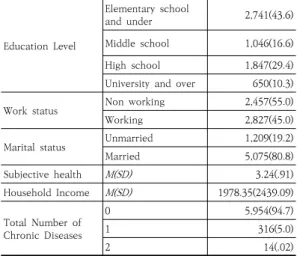
Variable N(%)
Gender Male 2,723(43.3)
Female 3,561(56.7)
Age
45~49 1,286(20.5)
50~59 1,986(31.6)
60~69 1,676(26.7)
70~79 994(15.8)
over 80 342( 5.4)
M(SD) 60.24(10.91)
Table 1. Demographic Characteristics of the Sample
Education Level
Elementary school
and under 2,741(43.6)
Middle school 1,046(16.6)
High school 1,847(29.4)
University and over 650(10.3)
Work status Non working 2,457(55.0)
Working 2,827(45.0)
Marital status Unmarried 1,209(19.2)
Married 5,075(80.8)
Subjective health M(SD) 3.24(.91)
Household Income M(SD) 1978.35(2439.09)
Total Number of Chronic Diseases
0 5,954(94.7)
1 316(5.0)
2 14(.02)
[30]. 한편, 심장질환과 우울수준의 관계에 있어서는, 높 은 우울수준이 심장질환의 위험성을 증가시키는 것으로 보고되고 있다[31].
이러한 연구 결과들에도 불구하고, 한국에서 만성질환 자로 전이하는 노인 환자의 우울수준에 대해 살펴본 연 구는 아직까지 존재하지 않는다. 따라서 본 연구는 한국 인 상위 사망원인의 50% 이상을 차지하는 5개 만성질환 (암, 심혈관 질환, 뇌혈관 질환, 당뇨병, 호흡기 질환)을 중심으로, 만성질환 진단자로의 전이가 우울수준에 어떠 한 영향을 미치는지 살펴보고자 한다. 연구문제는 다음과 같다.
1) 만성질환 진단자로의 전이가 우울수준의 변화와 관 련이 있는가?
2) 개별 만성질환 진단자(당뇨병, 암, 만성 폐질환, 심 장질환, 뇌혈관 질환)로의 전이가 우울수준 변화와 관련이 있는가?
2. 분석방법
2.1 연구대상본 연구는 1-2차년도(2006년~2008년) 고령화연구패 널조사(Klosa: Korean Longitudial Study of Ageing) 를 사용하였다. 고령화연구패널조사는 고령자의 사회, 경 제, 심리, 인구학적 형성 및 건강상태 등을 측정하고 파악 하여 효과적인 사회경제정책을 수립하기 위해서 조사되 었다. 원표본은 2006년 제주도를 제외한 전국의 만 45 세 이상자(1961년 이전 출생)중 임의 표집 된 10,254명 이고, 추적된 표본은 2차년도 8,688명이다. 본 연구대상 은 1~2차년도 조사에 모두 참여한 중고령자 중에서 연구 에 포함된 변수에 결측치가 없는 6,284명을 대상으로 하 였다. 연구대상에 대한 기술통계는 다음과 같다(Table 1).
2.1 연구변수 2.1.1 만성질환 진단
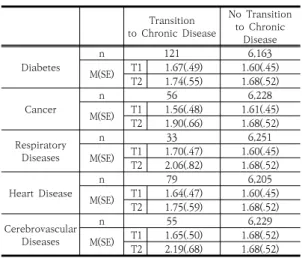
연구대상은 ‘의사로부터 만성질환(당뇨병, 암(악성종 양), 만성 폐질환, 심장질환, 뇌혈관 질환)이 있다는 진단 을 받으신 적이 있습니까?’라는 문항에서 1~2차년도 모 두 만성질환이 없는 경우를 준거집단으로 하고, 1차 년도 에는 만성질환이 없었으나 2차 년도에 만성질환이 진단 된 경우를 만성질환 진단자로의 전이로 하였다. 1~2차년 도 모두 만성질환이 유지된 경우는 제외하였다.
2.2.2 우울수준
우울은 한국판 CES-D 20 중 10개의 문항을 발췌하 여 사용(Anderson form)하였다. 문항은 ‘평소 아무렇지 도 않던 것들이 귀찮고 괴롭게 느껴졌다’, ‘정신을 집중하 기 힘들었다’ 등으로 구성되어 있으며, 1 = 잠깐 그런 생 각이 들었거나, 그런 생각이 들지 않았음 (하루미만), 2
= 가끔 그런 생각이 들었음 (하루 이틀 정도), 3 = 자주 그런 생각이 들었음 (3일~4일 정도), 4 = 항상 그런 생각 이 들었음 (5일~7일 정도)으로 코딩된다. 점수 범위는 4~40이며, 10문항에 대한 평균 값을 사용했으며, 점수 가 높을수록 우울 수준이 높은 것을 의미한다. 우울의 Cronbach's α는 .799(1차년도), .837(2차년도)이다. 만 성질환 진단자 및 비진단자 집단의 우울 점수는 다음과 같다(Table 2).
1 2 3 4 5 6 7 8 9 10 11 12 13 14
1 1
2 0.015 1
3 .040** 0.011 1
4 .052*** 0.006 0.017 1
5 0.015 -0.005 0.020 .031* 1
6 .091*** 0.012 0.009 -0.007 0.020 1
7 .133*** -0.004 -0.016 -0.012 0.001 -0.011 1 8 .293*** .044*** 0.002 .043** .026* .063*** .028* 1 9 -.263***-0.003 0.013 -0.021 0.004 -.036**-.280***-.483*** 1 10 -.207*** -.031* 0.020 -.039** -.039** -.033**-.361***-.397***.237*** 1 11 -.219*** -.026* 0.021 -0.015 0.001 -0.015-.260***-.350***.276*** .200*** 1 12 -.331***-0.024 0.010 -.046*** -.030* -.032* -.197***-.392***.399*** .256*** .244*** 1 13 -.157***-.037** -0.009 -.029* -0.022 -0.015 -.032* -.256***.294*** .148*** .121*** .229*** 1 14 .463*** 0.021 -0.010 0.016 0.009 0.009 .115*** .235***-.239***-.173***-.249***-.423***-.155*** 1 M 1.68 .02 .01 .01 .01 .01 .56 60.24 2.06 .44 .80 3.24 1978.35 1.61 SD .52 .13 .09 .07 .11 .09 .49 10.91 1.06 .49 .39 .91 2439.09 .45
***p < .001, **p < .01, *p < .05
Notes: 1 = Depression(T2); 2 = Diabetes; 3 = Cancer; 4 = Respiratory diseases; 5 = Heart disease; 6 = Cerebrovascular diseases; 7 = Gender; 8 = Age; 9 = Education Level;
10 = Work Status; 11 = Marital Status; 12 = Subjective Health; 13 = Household Income;
14 = Depression(T1)
Table 3. Correlation among Variables
Transition to Chronic Disease
No Transition to Chronic
Disease
Diabetes n 121 6,163
M(SE) T1 1.67(.49) 1.60(.45) T2 1.74(.55) 1.68(.52)
Cancer n 56 6,228
M(SE) T1 1.56(.48) 1.61(.45) T2 1.90(.66) 1.68(.52) Respiratory
Diseases
n 33 6,251
M(SE) T1 1.70(.47) 1.60(.45) T2 2.06(.82) 1.68(.52)
Heart Disease n 79 6,205
M(SE) T1 1.64(.47) 1.60(.45) T2 1.75(.59) 1.68(.52) Cerebrovascular
Diseases
n 55 6,229
M(SE) T1 1.65(.50) 1.68(.52) T2 2.19(.68) 1.68(.52) Table 2. Depressive Symptoms(Time 1~2) between
Groups
2.2.3 통제변수
본 연구의 통제변수로는 성별, 연령, 교육수준, 노동여 부, 결혼상태, 주관적 건강상태, 가구 총소득이 사용되었 다.
2.2 통계방법
본 연구는 만성질환 진단이 우울에 미치는 영향을 분 석하기 위해 SPSS 25.0을 사용하여 다중회귀분석을 실 시하였다.
3. 연구결과
3.1 변인간 상관관계만성질환 진단자로의 전이와 우울의 관계를 알아보기 위해 상관관계 분석을 실시하였다(Table 3).
3.2 만성질환 진단자로의 전이와 우울수준 만성질환 진단자로의 전이가 우울에 미치는 영향을 알 아보기 위해 다중회귀를 실시하였다. 만성질환은 당뇨병, 암, 만성 폐질환, 심장질환, 뇌혈관 질환의 합산 개수를 사용하였다(Table 4). 1단계 모형에서는 통제변수를 투 입하였고, 2단계 모형에서는 독립변수인 만성질환 진단 자로의 전이 변수를 포함하였다. 1단계의 회귀모형은 유 의하였고(F = 17.789, p < .001), 성별(B = .046, p < .01), 연령(B = .006, p < .001), 교육수준(B = -.016, p < .05), 결혼상태(B = .050, p < .01), 주관적 건강상태(B =
.057, p < .001)가 유의하였다. 2단계의 회귀모형은 유의 하였고(F = 18.759, p < .001), 만성질환 진단자로의 전 이는 우울 변화에 유의한 영향을 미쳤다(B = .135, p <
.001). 즉, 만성질환 진단자로 전이하는 것은 우울 변화 수준을 높이는 것으로 나타났다. 1단계 모형의 설명력 (R2 = .019)과 2단계 모형 설명력(R2 = .023)의 변화량 은 .004로 나타났다.
Depression Change Score (T2-T1)
Step 1 Step 2
B SE B SE
(Constant) -0.469*** 0.073 -0.469*** 0.073
Gender 0.046** 0.015 0.048** 0.015
Age 0.006*** 0.001 0.005*** 0.001
Education Level -0.016* 0.007 -0.017* 0.007
Work Status -0.021 0.015 -0.019 0.015
Marital Status 0.050** 0.018 0.049** 0.018 Subjective Health 0.057*** 0.008 0.058*** 0.008
Income -1.400E-6 0.000 -9.509E-07 0.000
Total Number of
Chronic Diseases 0.135*** 0.027
F 17.789*** 18.759***
R2 .019 .023
***p < .001, **p < .01, *p < .05
Table 4. Results of Multiple Regression (Total number of chronic diseases)
다음으로는 개별 만성질환 진단자로의 전이가 우울에 미치는 영향을 알아보기 위해 다중회귀분석을 실시하였
Depression Change Score (T2-T1)
Step 1 Step 2
B SE B SE
(Constant) -0.469*** 0.073 -0.465*** 0.073
Gender 0.046** 0.015 0.046** 0.015
Age 0.006*** 0.001 0.006*** 0.001
Education Level -0.016* 0.007 -0.016* 0.007
Work Status -0.021 0.015 -0.022 0.015
Marital Status 0.050** 0.018 0.048** 0.018 Subjective Health 0.057*** 0.008 0.057*** 0.008
Income -1.400E-6 0.000 -1.252E-6 0.000
Table 6. Results of Multiple Regression (Cancer)
Cancer 0.264*** 0.068
F 17.789*** 17.496***
R2 .019 .022
***p< .001, **p< .01, *p< .05
Depression Change Score (T2-T1)
Step 1 Step 2
B SE B SE
(Constant) -0.469*** 0.073 -0.473*** 0.073
Gender 0.046** 0.015 0.047** 0.015
Age 0.006*** 0.001 0.006*** 0.001
Education Level -0.016* 0.007 -0.016* 0.007
Work Status -0.021 0.015 -0.019 0.015
Marital Status 0.050** 0.018 0.050** 0.018 Subjective Health 0.057*** 0.008 0.058*** 0.008
Income -1.400E-6 0.000 -1.289E-6 0.000
Respiratory
Diseases 0.272** 0.088
F 17.789*** 16.773***
R2 .019 .021
***p< .001, **p< .01, *p< .05
Table 7. Results of Multiple Regression (Respiratory Diseases)
Depression Change Score (T2-T1)
Step 1 Step 2
B SE B SE
(Constant) -0.469*** 0.073 -0.470*** 0.073
Gender 0.046** 0.015 0.046** 0.015
Age 0.006*** 0.001 0.006*** 0.001
Education Level -0.016* 0.007 -0.016* 0.007
Work Status -0.021 0.015 -0.021 0.015
Marital Status 0.050** 0.018 0.050** 0.018 Subjective Health 0.057*** 0.008 0.057*** 0.008
Income -1.400E-6 0.000 -1.377E-6 0.000
Heart Disease 0.030** 0.057
F 17.789*** 15.599***
R2 .019 .019
***p< .001, **p< .01, *p< .05
Table 8. Results of Multiple Regression (Heart Disease) 다(Table 5~9). 만성질환은 당뇨병, 암, 만성 폐질환, 심
장질환, 뇌혈관 질환으로 측정하였으며, 1단계 모형에서 는 통제변수를 투입하였고, 2단계 모형에서는 각각의 독 립변수를 포함하는 다중회귀모형으로 분석하였다.
본 연구의 5가지의 회귀모형은 모두 유의하여(당뇨병:
F = 15.592, p < .001; 암: F = 17.496, p < .001; 만성 폐질환: F = 16.773, p < .001; 심장질환: F = 15.599, p < .001; 뇌혈관 질환: F = 20.876, p < .001) 우울을 설명하기에 적합하였으며, 설명력은 1.9~2.6%이다(당뇨 병: R2 = .019; 암: R2 = .022; 만성 폐질환: R2 = .021;
심장질환: R2 = .019; 뇌혈관 질환: R2 = .026).
각 회귀계수를 살펴보면, 암 진단자로의 전이(B = .264, p < .001), 만성 폐질환 진단자로의 전이(B = .272, p < .01), 뇌혈관 질환 진단자로의 전이(B = .441, p < .001)는 우울 변화에 유의한 영향을 미쳤다. 반면, 당뇨병 진단자로의 전이(B = -.022, ns), 심장질환 진단 자로의 전이(B = .030, ns)는 우울에 유의한 영향을 미친 다는 증거가 발견되지 않았다. 즉, 암, 만성 폐질환, 뇌혈 관 질환 진단자로의 전이할 경우 우울 변화 수준을 높이 는 것으로 나타났다.
Depression Change Score (T2-T1)
Step 1 Step 2
B SE B SE
(Constant) -0.469*** 0.073 -0.469*** 0.073
Gender 0.046** 0.015 0.046** 0.015
Age 0.006*** 0.001 0.006*** 0.001
Education Level -0.016* 0.007 -0.015* 0.007
Work Status -0.021 0.015 -0.021 0.015
Marital Status 0.050** 0.018 0.050** 0.018 Subjective Health 0.057*** 0.008 0.057*** 0.008 Income -1.439E-06 0.000 -1.439E-06 0.000
Diabetes -0.022 0.046
F 17.789*** 15.592***
R2 .019 .019
***p < .001, **p < .01, *p < .05
Table 5. Results of Multiple Regression (Diabetes)
Depression Change Score (T2-T1)
Step 1 Step 2
B SE B SE
(Constant) -0.469*** 0.073 -0.466*** 0.073
Gender 0.046** 0.015 0.048** 0.015
Age 0.006*** 0.001 0.005*** 0.001
Education Level -0.016* 0.007 -0.015* 0.007
Work Status -0.021 0.015 -0.019 0.015
Marital Status 0.050** 0.018 0.049** 0.018 Subjective Health 0.057*** 0.008 0.057*** 0.008
Income -1.400E-6 0.000 -1.488E-6 0.000
Cerebrovascular
Diseases 0.441*** 0.018
F 17.789*** 20.876***
R2 .019 .026
***p< .001, **p< .01, *p< .05
Table 9. Results of Multiple Regression (Cerebrovascular Diseases)
3. 결론
본 연구는 만성질환 진단자로의 전이가 우울에 미치는 영향을 살펴보기 위해, 한국인의 사망원인 중 과반수이상 을 차지하는 주요 5대 만성질환의 진단기를 중심으로 다 루었다. 본 연구 결과에 따르면, 만성질환 진단자로 전이 한 경우 우울 수준이 높아졌다. 질환별로 살펴보았을 때, 암, 만성 폐질환, 뇌혈관 질환이 진단한 중고령자는 우울 수준이 높아졌으나, 당뇨병과 심장질환이 진단한 경우는 우울에 유의한 영향을 미친다는 증거가 발견되지 않았다.
이와 같은 연구결과는 만성질환자 진단자로 전이하는 것 은 우울 수준을 높이지만, 만성질환의 종류에 따라 중고 령자의 정신건강에 미치는 영향이 다를 수 있음을 시사 한다. 어떤 질병은 다른 질병에 비해 더 우울증을 동반하 기 쉽다고 밝힌 Penninx와 동료들 (1996)의 연구[32]와 도 일맥상통한 연구 결과이다. 그러나, 본 연구에서는 각 만성질환별 사례수가 충분치 않다는 점에서 질병에 따른 진단과 우울의 관계에 대한 추가적인 연구가 이루어져야 할 것이다.
본 연구의 주요한 함의는 다음과 같다. 첫째, 노인인구 의 계속적인 증가는 만성질환자 규모의 증가를 동반할 것으로 예상되므로, 개인과 사회적 차원 모두에서 만성질 환 관리에 대한 대책 마련이 시급한 실정이다. 이에, 본 연구는 만성질환으로 동반되는 부정적 정신건강의 악화 에 대한 관심을 재고할 수 있는 구체적인 근거를 제공하 고 있다. 특히, 우울증은 자살생각과 자살시도의 주요한 예측요인인 점[33, 34], 더 나아가 한국노인의 자살률이 세계 최고 수준이라는 점[35]을 고려할 때 노인의 신체건 강 악화로 인한 정신건강의 문제를 간과해서는 안 될 것 이다. 즉, 만성질환의 진단과 치료과정에서 질병 자체에 대한 치료와 함께 우울과 같은 정신건강에 대한 주의가 요구된다고 하겠다.
둘째, 본 연구의 결과로 볼 때, 만성질환의 초기 진단 기는 신체적 질병으로 인한 삶의 변화로 인하여 정신건 강까지도 악화될 수 있는 중요한 기간이다. 따라서 초기 만성질환 환자를 대상으로 하는 중재 프로그램의 마련은 장기적 관점에서 이로 인한 사회적 비용을 절감할 수 있 는 최적의 시기라고 하겠다. 따라서 신체건강의 악화로 동반되는 우울증에 대한 경각심을 가지고 조기에 병적인 우울증을 예방, 혹은 치료할 수 있는 보건사회적 기반이 마련되어야 할 것이다.
셋째, 만성질환의 종류에 따라 우울 수준에 미치는 영 향이 다르다는 점에서, 초기 만성질환자에 대한 중재 프
로그램 마련에 있어서 암, 만성 폐질환, 뇌혈관 질환과 같 은 우울관련 고위험군에 대한 보다 적극적인 개입이 필 요할 것으로 보인다. 본 연구의 결과가 주는 함의는 국민 건강증진의 차원에서 적극적으로 고려할 사항이며, 더 나 아가 지속적인 추후 연구가 시행되어야 할 것이다.
References
[1] Statistics Korea, “Cause of death statistics”, 2017.
Available from:
http://kostat.go.kr/portal/korea/kor_nw (accessed Aug. 20, 2020)
[2] M.. W. Kim, "Impact of depression, comorbid chronic diseases, and ADL on health-related quality of life among community-dwelling elderly people in South Korea", Journal of the Korea Contents Association, Vol. 14, No. 5, pp. 190-198, 2014.
DOI: https://doi.org/10.5392/JKCA.2014.14.05.190 [3] J. E. Kim, J. W. Hwang, J. S. Park, D. S. Park, S. W.
Park, "An Analysis of the Current Status of Treatment and Use of Chronic Diseases in South Korea", Health Industry Brief, Vol. 203, pp. 1-16, 2015. Available from: https://www.khiss.go.kr (accessed Aug. 20, 2020)
[4] Y. H. Jung, Basic Analysis Report on the Korean Medical Panel. Korea Institute for Health and Social Affairs. National Health Insurance Service, 2010.
Available from: https://www.kihasa.re.kr (accessed Aug. 15, 2020)
[5] Y. K. Lee, "Health and Care of Older Adults in Korea", Health and Welfare Forum, Vol. 2018, No. 10, pp.
19-30, 2018. Available from:
https://www.kihasa.re.kr (accessed Aug. 15, 2020) [6] Korean Centers for Disease Control, Report on Cause
of Death Statistics, 2018. Available From:
http://kostat.go.kr/portal/korea/kor_nw (accessed Jul.
20, 2020)
[7] G. Deimling, B. Kahana, K. Bowman, M. Schaefer, "
Cancer survivorship and psychological distress in later life", Psycho-Oncology, Vol. 11, pp. 479–494, 2002.
DOI: https://doi.org/10.1002/pon.614
[8] P. He, Y. Hu, C. Li, D. Wu, S. Ge, T. Liu, "Predictors of Depressive Symptoms Among Mid-Aged and Older Men With Diabetes in China", Research and theory for nursing practice, Vol. 33, No. 1, pp. 6-22, 2019.
DOI: https://doi.org/10.1891/1541-6577.33.1.6 [9] C. Q. Huang, B. R. Dong, Z. C. Lu, J. R. Yue, Q. X. Liu,
"Chronic disease and risk for depression in old age: A meta-analysis of published literature", Ageing Research Reviews, Vol. 9, pp. 131–141, 2010.
DOI: https://doi.org/10.1016/j.arr.2009.05.005
[10] M. J. Massie, "Prevalence of depression in patients with cancer", Journal of the National Cancer Institute Monographs, Vol. 32, pp. 57–71, 2004.
DOI: https://doi.org/10.1093/jncimonographs/lgh014 [11] D. Polsky, J. Doshi, S. Marcus, D. Oslin, A. Rothbard,
N. Thomas, C. L. Thompson, "Long-term risk for depressive symptoms after a medical diagnosis", Archives of Internal Medicine, Vol. 165, pp. 1260–
1266, 2005.
DOI: https://doi:10.1001/archinte.165.11.1260 [12] F. Rotella, E. Mannucci, "Depression as a risk factor
for diabetes: A meta-analysis of longitudinal studies".
Journal of Clinical Psychiatry, Vol. 74, pp. 31–37, 2013.
DOI: https://doi.org/10.4088/JCP.12r07922
[13] J. Schnittker, "Chronic illness and depressive symptoms in late life", Social Science & Medicine, Vol.
60, pp. 13–23, 2005.
DOI: https://doi.org/10.1016/j.socscimed.2004.04.020 [14] A. L. Stanton, T. A. Revenson, H. Tennen, "Health
psychology: Psychological adjustment to chronic disease", Annual Review of Psychology, Vol. 58, pp.
565–592, 2007.
DOI: https://doi.org/10.1146/annurev.psych.58.110405.085615 [15] F. Talbot, A. Nouwen, "A review of the relationship
between depression and diabetes in adults: is there a link?", Diabetes care, Vol. 23, No. 10, pp. 1556-1562, 2000.
DOI: https://doi.org/10.2337/diacare.23.10.1556 [16] M. Wilson-Genderson, A. R. Heid, R. Pruchno, "Onset
of multiple chronic conditions and depressive symptoms: a life events perspective", Innovation in Aging, Vol. 1, No. 2, pp. 1-10, 2017.
DOI: https://doi.org/10.1093/geroni/igx022
[17] L. A. Palinkas, D. L. Wingard, E. Barrett-Connor,
"Chronic illness and depressive symptoms in the elderly: a population-based study", Journal of Clinical Epidemiology, Vol. 43, No. 2, pp. 1131-1141, 1990.
DOI: https://doi.org/10.1016/0895-4356(90)90014-G [18] S. A. Black, J. S. Goodwin, K. S. Markides, "The
association between chronic diseases and depressive symptomatology in older Mexican Americans", The Journals of Gerontology Series A: Biological Sciences and Medical Sciences, Vol. 53, No. 3, pp. M188-M194, 1998.
DOI: https://doi.org/10.1093/gerona/53A.3.M188 [19] K. Shimoda, R. G. Robinson, "The relationship
between poststroke depression and lesion location in long-term follow-up", Biological psychiatry, Vol. 45, No. 2, pp. 187-192, 1999.
DOI: https://doi.org/10.1016/S0006-3223(98)00178-4 [20] A. J. Zautra, M. H. Burleson, K. S. Matt, S. Roth, L.
Burrows, "Interpersonal stress, depression, and disease activity in rheumatoid arthritis and osteoarthritis patients", Health Psychology, Vol. 13, No. 2, pp. 139-148, 1994.
DOI: https://doi.org/10.1037/0278-6133.13.2.139 [21] J. Friedland, M. McColl, "Disability and depression:
some etiological considerations", Social Science &
Medicine, Vol. 34, No. 4, pp. 395-403, 1992.
DOI: https://doi.org/10.1016/0277-9536(92)90299-6 [22] E. Greenglass, L. Fiksenbaum, J. Eaton, "The
relationship between coping, social support, functional disability and depression in the elderly", Anxiety, stress, and coping, Vol. 19, No. 1, pp. 15-31, 2006.
DOI: https://doi.org/10.1080/14659890500436430 [23] V. Valkanova, K. P. Ebmeier, "Vascular Risk Factors
and Depression in Later Life: A Systematic Review and Meta-Analysis", Biological Psychiatry, Vol. 73, No. 5, pp. 406-413, 2013.
DOI: https://doi.org/10.1016/j.biopsych.2012.10.028 [24] W. J. Katon, "Epidemiology and treatment of
depression in patients with chronic medical illness", Dialogues in Clinical Neuroscience, Vol. 13, pp. 7–23, 2011. Available from:
https://www.ncbi.nlm.nih.gov/pmc/articles/PMC31819 64 (accessed Aug. 25, 2020)
[25] I. Spoletini, W. Gianni, L. Repetto P. Bria, C.
Caltagirone, P. Bossu, G. Spalletta, "Depression and cancer: An unexplored and unresolved emergent issue in elderly patients", Critical Reviews in Oncology/hematology, Vol. 65, pp. 143–155, 2008.
DOI: https://doi.org/10.1016/j.critrevonc.2007.10.005 [26] S. Y. Wong, J. Woo, H. S. Lynn, J. Leung, Y. N. Tang,
P. C. Leung, "Risk of depression in patients with chronic respiratory diseases: results from two large cohort studies in Chinese elderly from Hong Kong", International Journal of Geriatric Psychiatry: A Journal of the Psychiatry of Late Life and Allied Sciences, Vol. 21, No. 3, pp. 233-238, 2006.
DOI: https://doi.org/10.1002/gps.1447
[27] F. Göthe, D. Enache, L. O. Wahlund, B. Winblad, M.
Crisby, J. Lökk, D. Aarsland, "Cerebrovascular diseases and depression: epidemiology, mechanisms and treatment", Panminerva Medica, Vol. 54, No. 3, pp.
161-170. 2012. Available from:
https://www.researchgate.net/profile/F_Goethe/publi cation/229155613_Cerebrovascular_diseases_and_dep ression_Epidemiology_mechanisms_and_treatment/lin ks/55959b8508ae5d8f3930fc53/Cerebrovascular-disea ses-and-depression-Epidemiology-mechanisms-and-t reatment.pdf (accessed Aug. 25, 2020)
[28] S. Ali, M. A. Stone, J. L. Peters, M. J. Davies, K. Khunti,
"The prevalence of co-morbid depression in adults with Type 2 diabetes: a systematic review and meta-analysis", Diabetic Medicine, Vol. 23, No. 11, pp.
1165–73, 2006.
DOI: https://doi.org/10.1111/j.1464-5491.2006.01943.x [29] F. Rotella, E. Mannucci, "Diabetes mellitus as a risk
factor for depression. A meta-analysis of longitudinal studies", Diabetes Research and Clinical Practice, Vol.
99, No. 2, pp. 98–104, 2013.
DOI: https://doi.org/10.1016/j.diabres.2012.11.022 [30] M. R. Carnethon, M. L. Biggs, J. I. Barzilay, N. L. Smith,
V. Vaccarino, A. G. Bertoni, D. Siscovick,
"Longitudinal association between depressive symptoms and incident type 2 diabetes mellitus in older adults: the cardiovascular health study", Archives of Internal Medicine, Vol. 167, No. 8, pp.
802-807, 2007.
DOI: https://doi.org/10.1016/S0022-3999(02)00314-8 [31] A. A. Ariyo, M. Haan, C. M. Tangen, J. C. Rutledge, M.
Cushman, A. Dobs, C. D. Furberg, "Depressive symptoms and risks of coronary heart disease and mortality in elderly Americans". Circulation, Vol. 102, No. 15, pp. 1773-1779, 2000.
DOI: https://doi.org/10.1161/01.CIR.102.15.1773 [32] B. W. Pennix, A. T. Beekman, J. Ormel, D. M.
Kriegsman, A. J. P. Boeke, J. T. M. Van Eijk, D. J. Deeg,
"Pscychological status among elderly people with chronic diseases: does type of disease play a part?", Journal of psgchosomatic research, Vol. 40, No. 5, pp.
521-534, 1996.
DOI: https://doi.org/10.1016/0022-3999(95)00620-6 [33] Y. Conwell, P. R. Duberstein, E. D. Caine, "Risk factors
for suicide in later life", Biological psychiatry, Vol. 52, No. 3, pp. 193-204, 2002.
DOI: https://doi.org/10.1016/S0006-3223(02)01347-1 [34] H. O'Connell, A. V. Chin, C. Cunningham, B. A. Lawlor,
"Recent developments: suicide in older people", Bmj, Vol. 329, No. 7471, pp. 895-899, 2004.
DOI: https://doi.org/10.1136/bmj.329.7471.895 [35] OECD Data on Suicide Rates. Available From:
https://data.oecd.org/healthstat/suicide-rates.htm (accessed Jul. 20, 2020)
박 민 경(Min Kyoung Park) [정회원]
• 2013년 8월 : 연세대학교 일반대 학원 아동가족학과 (석사)
• 2019년 9월 ~ 현재 : 메릴랜드 주 립대학교 노년학과 박사과정
<관심분야>
노인정신건강, 노인부양, 노년기관계
조 규 영(Kyuyoung Cho) [정회원]
• 2009년 2월 : 연세대학교 아동가 족학과 (학사)
• 2011년 2월 : 연세대학교 아동가 족학과 (석사)
• 2014년 8월 : 연세대학교 아동가 족학과 (박사)
• 2014년 9월 ~ 2017년 2월 : 연세대학교 아동가족학과 시간강사 및 심바이오틱라이프텍 연구원
• 2017년 3월 ~ 현재 : 동아대학교 기초교양대학 조교수
<관심분야>
전생애발달의 가족관계, 노년기 인지기능, 융복합 가족연구