Expression Levels of Vascular Endothelial Growth Factors A and C in Patients with Peptic Ulcers and Gastric Cancer
Shirin Taghizadeh1, Mojtaba Sankian1, Abolghasem Ajami2,3, Mohsen Tehrani3, Nasim Hafezi3, Rajeeh Mohammadian3, Touraj Farazmandfar4, Vahid Hosseini5, Ali Abbasi6, and Maryam Ajami7
1Department of Immunology, Faculty of Medicine, Mashhad University of Medical Sciences, Mashhad, 2Molecular and Cell Biology Research Center, Mazandaran University of Medical Sciences, Sari, 3Department of Immunology, Faculty of Medicine, Mazandaran University of Medical
Sciences, Sari, 4Faculty of Advanced Medical Science Technology, Golestan University of Medical Sciences, Gorgan,
5Inflammatory Diseases of Upper GI Tract Research Center, Mazandaran University of Medical Sciences, Sari,
6Department of Pathology, Islamic Azad University, Sari Branch, Sari, 7 Department of Immunology, Faculty of Medicine, Tehran University of Medical Sciences, Tehran, Iran
Purpose: Vascular endothelial growth factor (VEGF) is one of the most important growth factors for metastatic tumors. To clarify the role of VEGF-A and C in patients with peptic ulcer disease (PUD) or gastric cancer (GC), we evaluated the expression levels of these two mol- ecules. We also analyzed the effect of Helicobacter pylori infection on VEGF-A and C expression levels.
Materials and Methods: Patients with dyspepsia who needed diagnostic endoscopy were selected and divided into three groups: non- ulcer dyspepsia (NUD), PUD, and GC, according to their endoscopic and histopathological results. Fifty-two patients with NUD, 50 with PUD, and 38 with GC were enrolled in this study. H. pylori infection was diagnosed by the rapid urease test. After RNA extraction and synthesis of cDNA, the expression levels of VEGF-A and C were determined by quantitative reverse transcriptase polymerase chain reac- tion.
Results: The VEGF-C expression level in the PUD and GC groups was significantly higher than that in the NUD group. Moreover, the VEGF-A expression level in the PUD and GC groups was higher than in the NUD group, although the differences were not statistically significant. Significant positive correlations were also observed between the expression levels of these two molecules in the PUD and GC groups. In addition, the expression levels of these two molecules were higher in H. pylori positive patients with PUD or GC than in H.
pylori negative patients of the same groups; however, these differences did not reach statistical significance.
Conclusions: Up-regulation of VEGF-C expression during gastric mucosal inflammation may play a role in the development of peptic ul- cers or GC.
Key Words: Vascular endothelial growth factor-A; Vascular endothelial growth factor-C; Stomach neoplasms; Peptic ulcer; Helicobacter pylori
Correspondence to: Abolghasem Ajami
Department of Immunology, Faculty of Medicine, Mazandaran University of Medical Sciences, Sari 48175-1665, Iran
Tel: +98-151-3543081, Fax: +98-151-3543248 E-mail: [email protected]
Received August 19, 2014 Revised September 9, 2014 Accepted September 21, 2014
Copyrights © 2014 by The Korean Gastric Cancer Association www.jgc-online.org
This is an open-access article distributed under the terms of the Creative Commons Attribution Non-Commercial License (http://creativecommons.org/
licenses/by-nc/3.0) which permits unrestricted noncommercial use, distribution, and reproduction in any medium, provided the original work is properly cited.
Introduction
Dyspeptic disorders such as gastroesophageal reflux, gastritis,
peptic ulcer disease (PUD), and gastric cancer (GC) are major medical conditions.1 PUD is usually associated with a reduced health-related quality of life, whereas GC is the fourth most com- mon cancer and the second leading cause of cancer-related deaths worldwide.2,3 Host factors such as genetics and nutrition, and en- vironmental factors such as Helicobacter pylori infection may be involved in the development of these conditions.1,4
H. pylori infection has been shown to be a major risk factor for the development of PUD and GC.5,6 However, despite several investigations, it is still not completely understood why the major-
ity of infected people (80%~90%) carry and spread the bacterium while they are asymptomatic, or why only a small percentage of infected people develop peptic ulcers, whereas others develop GC.6
Host immune responses against H. pylori can result in chronic inflammation in the gastric mucosa, which in turn leads to the de- velopment of pathological conditions including PUD and GC.5,6
Vascular endothelial growth factors (VEGFs) are glycopro- teins secreted by tumor cells that are the most important factors in angiogenesis and tumor metastasis.7 The VEGF family includes VEGF-A to F and placental growth factor.7,8 Studies have shown that VEGF-A and B play a key role in blood vessel growth, whereas VEGF-C and D are important for the growth of lymphat- ic vessels.9,10 The role of VEGFs, particularly VEGF-A, C, and D in promoting angiogenesis and metastasis of many cancers includ- ing GC, has been previously discussed.11,12 Moreover, inflammatory cytokines such as interleukin (IL)-1, IL-6, and tumor necrosis factor-alpha (TNF-α) are generally responsible for the epigenetic alteration of gastric epithelial cells.13 These cytokines induce the mediators of angiogenesis, including VEGF and IL-8, which pro- mote angiogenesis in cancer. These mediators also promote angio- genesis during chronic inflammation such as cardiovascular disease, rheumatoid arthritis, diabetic retinopathy, delayed-type hypersensi- tivity, and asthma.14 It has been shown that VEGF-A expression is up-regulated in response to H. pylori infection.15 Indeed, H. pylori activates the c-Jun N-terminal Kinases (JNK) signaling pathway, which leads to transactivation of the VEGF-A promoter. VEGFs promote angiogenesis, which is a pathophysiological mechanism that can result in inflammatory and ulcerative epithelial lesions and malignant tumor growth and metastasis.15
To understand the role of VEGFs in the pathogenesis of H.
pylori-related gastric abnormalities, the mRNA expression levels of VEGF-A and C were determined in patients with peptic ulcers or GC, and compared with those with non-ulcer dyspepsia (NUD).
Materials and Methods
1. Patients and sampling
Patients with dyspepsia who underwent esophagogastroduo- denoscopy at Imam Hospital or Tooba Outpatient Clinic (Mazan- daran University of Medical Sciences, Sari, Iran) were enrolled in the study. All samples were collected between January 2012 and December 2013. The study was approved by the ethics committee of Mazandaran University of Medical Sciences. Clinical history, demographic data, and written informed consent forms were ob- tained from all study subjects. None of the subjects had a history of
chronic inflammatory or autoimmune disorders or treatment with H.
pylori eradication therapy, nor did they receive any non-steroidal anti-inflammatory drugs for 2 weeks prior to enrollment. Among patients with GC, none had undergone surgery, radiotherapy, or chemotherapy, or received any other medical intervention before sample donation.
Based on the endoscopic and histopathological assessments, the patient samples were divided into three groups: NUD, PUD, and GC. The histological grade of the gastric tumors was determined based on the state of differentiation. PUD was defined as a circum- scribed mucosal break (>5 mm in diameter, with apparent depth) in the stomach or duodenum, covered with exudates. H. pylori infection was diagnosed by histopathological examination (includ- ing Giemsa staining) and a positive result on the rapid urease test performed on at least one additional biopsy sample. Patients were considered H. pylori positive if the results of one or both diagnostic methods were positive, and H. pylori negative if the results of both methods were negative. Patients in NUD group were then divided into two groups: H. pylori positive and H. pylori negative. Tissue samples were obtained from all patients during endoscopy and pre- served in RNALater (Qiagen, Phoenix, AZ, USA).
2. RNA isolation and cDNA synthesis
Each tissue specimen was homogenized using mortar and pestle at room temperature. Total RNA was extracted from the dissected tissues using commercial RNA extraction kits (RNeasy Minikit;
Qiagen), according to the manufacturer’s instructions. The quantity and quality of the extracted RNA were assessed using a nanodrop spectrophotometer (Thermo Fisher Scientific Inc., Waltham, MA, USA) and agarose gel electrophoresis, respectively. RNA (1 μg) was reverse-transcribed into complementary DNA (cDNA) using the RevertAidTM First-Strand cDNA Synthesis Kit (Fermentas, Pitts- burg, PA, USA) primed with random hexamers as per the manu- facturer’s instructions.
3. Quantitative reverse transcriptase-polymerase chain reaction (qRT-PCR)
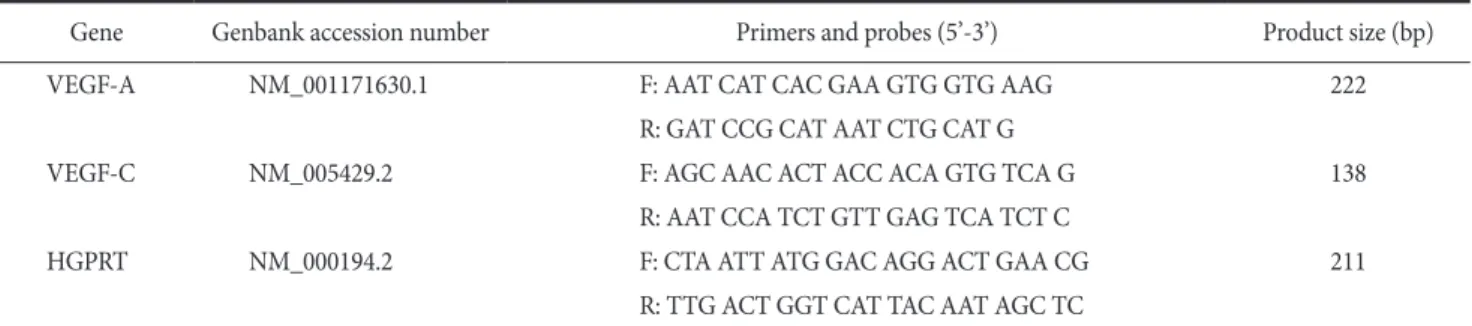
VEGF-A, VEGF-C and hypoxanthine-guanine phospho- ribosyl transferase (HGPRT, for normalization), sequences were obtained from the GenBank (Table 1). Primers for amplification of VEGF-A, VEGF-C, and HGPRT were designed using the Bea- con designer 7 software and synthesized by TIBmol (Germany) (Table 1).
qRT-PCR was performed using 96 well plates (Bio-Rad Labo- ratories Inc., Hercules, CA, USA) in a volume of 20 μl containing
Maxima SYBR Green/ROX qPCR Master Mix (2×) (Thermo Scientific, Delaware, PH, USA), 10 pmol of each of the forward and reverse primers, and the appropriate amount of cDNA. The samples were denatured at 95oC for 10 minutes, and then amplified during 40 cycles of: 95oC for 30 seconds, 55oC for 30 seconds, and 72oC for 30 seconds on an iQ5 real-time thermal cycler (Bio-Rad Laboratories Inc.). Each sample was assayed in duplicate, and cycle threshold (Ct) values (corresponding to the number of PCR cycles at which the fluorescence emission monitored in real time exceeded a threshold limit [×10 the standard deviation of the baseline inten- sity]) were measured. A mean Ct value for each duplicate measure- ment was calculated. Relative gene expression was then calculated using ‘ΔCt method using a reference gene’ in the following man- ner for each sample: Ratio (reference/target)=2Ct (reference)-Ct (target)
.
4. Statistical analysis
Statistical analysis was performed using the SPSS Statistical Package ver. 17 (SPSS Inc., Chicago, IL, USA). The results were evaluated by using the independent sample t-test, the Mann-Whit- ney U test, and the Pearson and Spearman correlation tests where
appropriate. Findings were considered significant when P-values were <0.05. The results presented in the text and tables represent the geometric mean in the case of 2-ΔΔCt, and the mean±standard error in the case of other variables.
Results
Fifty-two patients with NUD, 50 with PUD, and 38 with GC were enrolled in this study (Table 2). H. pylori infection was diag- nosed in 29 (55.7%) NUD patients, 34 (68.0%) PUD patients, and 21 (55.2%) GC patients.
1. Relative expression of VEGF-C
Gene expression levels of VEGF-C were determined using qRT-PCR and normalized to the expression level of HGPRT for each individual sample. The results show that the relative expres- sion levels of VEGF-C were higher in GC and PUD patients than in NUD patients (P<0.000 and P<0.000, respectively; Table 3, Fig. 1).
Table 1. Primers and probes used for real-time polymerase chain reaction quantification of mRNAs
Gene Genbank accession number Primers and probes (5’-3’) Product size (bp)
VEGF-A NM_001171630.1 F: AAT CAT CAC GAA GTG GTG AAG 222
R: GAT CCG CAT AAT CTG CAT G
VEGF-C NM_005429.2 F: AGC AAC ACT ACC ACA GTG TCA G 138
R: AAT CCA TCT GTT GAG TCA TCT C
HGPRT NM_000194.2 F: CTA ATT ATG GAC AGG ACT GAA CG 211
R: TTG ACT GGT CAT TAC AAT AGC TC VEGF = vascular endothelial growth factor; F = forward primer; R = reverse primer.
Table 2. Characteristics of the study subjects
Group NUD
(n=52) PUD
(n=50) GC (n=38)
Age (yr) 46.8±2.07 55.63±2.5 71.3±1.8
Sex Male 13 (25.0) 24 (48.0) 31 (81.57)
Female 39 (75.0) 26 (52.0) 7 (18.43) Helicobacter pylori Positive 29 (55.7) 34 (68.0) 21 (55.2)
Negative 19 (36.5) 15 (30.0) 16 (42.1) ND 4 (7.8) 1 (2.0) 1 (2.7) Values are presented as mean±standard deviation or number (%).
NUD = non-ulcer dyspepsia; PUD = peptic ulcer disease; GC = gastric cancer; ND = not defined.
Table 3. Relative gene expression levels of VEGF-A and VEGF-C in patients with PUD or GC compared to those with NUD
Group Relative expression
(2−∆∆CT) P-value*
VEGF-A expression NUD 3.48±0.77
PUD 13.17±3.46 0.217
GC 4.47±1.05 0.201
VEGF-C expression NUD 1.86±0.35
PUD 14.29±2.39 0.000
GC 6.53±1.09 0.000
Values are presented as mean±standard error. VEGF = vascular endothelial growth factor; PUD = peptic ulcer disease; GC = gastric cancer; NUD = non-ulcer dyspepsia. *Compared with NUD patients.
P≤0.05 considered as significant.
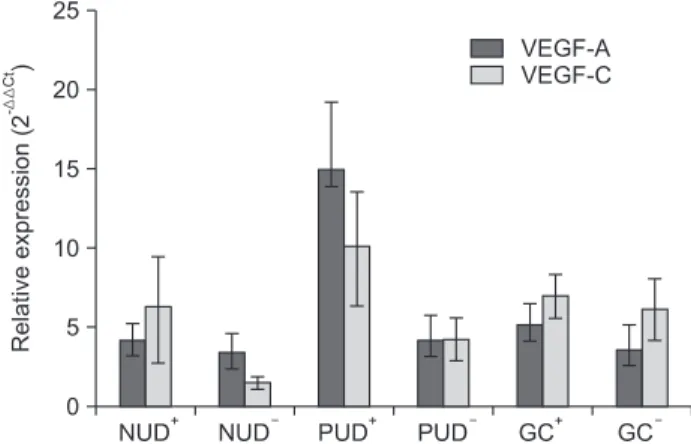
Furthermore, the relative gene expression levels of VEGF-C between the H. pylori positive and negative patients were not sig- nificantly different among the NUD, PUD, and GC patient groups (P=0.088, P=0.061, and P=0.714, respectively; Table 4, Fig. 2).
2. Relative expression of VEGF-A
Gene expression levels of VEGF-A were also measured using qRT-PCR and normalized to the expression level of HGPRT for
each individual sample. Patients with PUD or GC showed higher VEGF-A expression levels than patients with NUD, but the dif- ferences were not statistically significant (P=0.201 and P=0.217, respectively; Table 3, Fig. 1). Moreover, VEGF-A was expressed at higher levels in H. pylori positive patients than in H. pylori nega- tive patients in all three groups; however, these differences did not reach statistical significance (P=0.164, P=0.927, and P=1.000, re- spectively; Table 4 and Fig. 2).
3. Correlation between VEGF-A and VEGF-C expre- ssion
Positive correlation was found between VEGF-A and VEGF-C expression in patients with PUD (r=0.458, P<0.000) or GC (r=0.38, P<0.000), but not in patients with NUD (Table 5).
Discussion
This study evaluated the expression levels of VEGF-A and C in patients with PUD or GC compared with NUD patients as a con- Fig. 1. Relative gene expression levels (2-ΔΔCt) of VEGF-A and VEGF-C
in patients with NUD, PUD, and GC. *Denotes significant differences between groups. VEGF = vascular endothelial growth factor; NUD = non-ulcer dyspepsia; PUD = peptic ulcer disease; GC = gastric cancer.
Table 4. Relative gene expression levels of VEGF-A and VEGF-C in Helicobacter pylori+ patients compared to H. pylori− patients with
PUD, GC, and NUD
H. pylori
groups Relative expression
(2−∆∆CT) P-value*
VEGF-A expression NUD+
NUD− 4.1±1.11
3.4±1.15 0.164
PUD+
PUD− 14.9±4.25
4.1±1.73 0.927
GC+
GC− 5.1±1.39
3.5±1.65 1.000
VEGF-C expression NUD+
NUD− 6.1±3.35
1.5±0.35 0.088
PUD+
PUD− 10.0±3.58
4.2±1.36 0.061
GC+
GC− 6.9±1.40
6.1±1.98 0.714
Values are presented as mean±standard error. VEGF = vascular endothelial growth factor; PUD = peptic ulcer disease; GC = gastric cancer; NUD = non-ulcer dyspepsia. *No significant differences in VEGF-A and VEGF-C expression between H. pylori+ and H. pylori− patients with PUD, GC, and NUD.
Fig. 2. Relative gene expression levels VEGF-A and VEGF-C in Helico- bacter pylori+ patients compared to H. pylori− patients with PUD, GC, and NUD. No significant differences were observed between H. pylori+ and H. pylori− patients with PUD, GC and NUD. VEGF = vascular endothelial growth factor; NUD = non-ulcer dyspepsia; PUD = peptic ulcer disease; GC = gastric cancer.
Table 5. The correlation between the expression levels of VEGF-A and VEGF-C in patients with PUD or GC
Group Correlation P-value
PUD 0.677* 0.000
GC 0.616* 0.001
VEGF = vascular endothelial growth factor; PUD = peptic ulcer disease; GC = gastric cancer. *Correlation is significant at the 0.01 level (2-tailed).
trol group. The findings showed increased expression levels of both VEGF-A and C in patients with PUD or GC compared with those in patients with NUD, although only the differences in the VEGF- C expression levels were statistically significant.
VEGF-C is a glycoprotein secreted by tumor cells and binds to receptors such as VEGFR-2 and VEGFR-3 that are found on the surface of endothelial cells in the lymphatic vessels. The binding of VEGF-C to its receptors leads to dimerization of these recep- tors, activation of their tyrosine kinase tails, activation of the serine protease and plasminogen activator, and ultimately the production of collagenase, which results in angiogenesis, particularly in the lymphatics.16-18
Previous studies have shown the expression of VEGF-C in tis- sues such as the placenta, ovary, small intestine, skeletal muscle, colon, and spleen.19,20 Karpanen et al.21 showed that due to its as- sociation with the growth of lymphatic vessels around the tumor, VEGF-C can promote growth of cancer cells and metastasis to the lymph nodes. Several studies have also demonstrated the over- expression of VEGF-C in metastatic tumors of the head and neck, thyroid, prostate, stomach, colorectal, and lung.20,22-26 Another study examined the importance of blood and lymphatic vessel growth factors, especially VEGF-C, in the growth and metastasis of tumor cells in patients with GC, and showed that increased expression of the VEGF-C glycoprotein was associated with increased tumor size and lymph node metastasis.18 Furthermore, using inducible mouse tumor models, silencing of the VEGF-C gene resulted in a significant reduction of tumor size in the experimental mice com- pared to that in the control mice.18 In addition, several studies have shown that VEGFs produced by the tumor cells can suppress the maturation of antigen-presenting cells, especially dendritic cells, which may lead to immune evasion and tumor progression.27 In our study, similar to previous studies on GC,12,20 we found significantly higher VEGF-C expression levels in patients with GC than in those with NUD.
We also found a significant increase in the VEGF-C expres- sion levels in patients with PUD compared to those in patients with NUD. It has been shown that pro-inflammatory cytokines such as IL-1, IL-6, IL-8, and TNF-α can enhance the binding of nuclear factor-κB to the VEGF gene promoter leading to the increased expression of VEGF. This further increases the expres- sion of intercellular adhesion molecule-1 and vascular cell adhesion molecule-1 on the surface of vascular endothelial cells, and the migration of immune cells such as B cells, T cells, NK cells, and macrophages, which results in increased inflammation.28-30 Consis-
tent with the present study, another study evaluated the effects of the suppression of VEGF and angiopoietin expression in rats with peptic ulcers and found decreased production of pro-inflammatory cytokines, which resulted in reduced inflammation and wound se- verity, supporting the importance of VEGF and angiopoietin in the process of inflammation and ulceration.31
Because of the increased expression of VEGF-C in both GC and PUD patients, we assumed that expression of this glycopro- tein is increased not only during cancer metastasis but also during chronic inflammation.29,32 Thus, the factors that cause inflamma- tion, including infectious agents and carcinogens, may also lead to chronic inflammation by stimulating the production of pro- inflammatory cytokines and inducing production of VEGF-C.
Therefore, the production of VEGF-C in peptic ulcers can lead to the progression of inflammation and development of cancer.
VEGF-A, on the other hand, is an inducible cytokine that promotes the growth of blood vessels and is a heparin-binding glycoprotein. The binding of VEGF-A to its specific receptors, including VEGF 1 and 2, results in the induction of mitosis and angiogenesis in vascular endothelial cells. Moreover, VEGF-A has an important role in metastasis occurring via the blood vessels.33
Similar to our study, George et al.33 showed that VEGF-A expression levels were increased in the sera from patients with colorectal cancer, suggesting that VEGF-A was involved in the progression of this malignancy. Another study also showed in- creased VEGF expression level in the advanced stages of GC com- pared to that in the earlier stages.34
In our study, despite the increased expression of VEGF-A observed, the differences between GC patients and controls were not statistically significant. Our findings could be influenced by the fact that we enrolled patients who had recently been diagnosed with GC, most of whom had early-stage disease with typical lower VEGF-A expression levels.
In addition, our results showed that the expression levels of both VEGF-A and VEGF-C were higher in H. pylori positive patients with PUD or GC than in H. pylori negative patients of the same groups, although this increase was also not statistically significant. One study showed that H. pylori induced the expres- sion of VEGF-A via the phosphorylation of MEK/ERK trans- activators and the activation of the JNK cascade.35 In that study, the binding of SP1 and SP3 proteins to the VEGF-A gene promoter stimulated VEGF-A expression. Furthermore, the same study showed that H. pylori strains with the cytotoxicity-associated gene (cag) pathogenicity island can activate the JNK cascade, while cag-
negative strains cannot activate this pathway. Indeed, cag is a type IV secretion effector of H. pylori that is closely associated with the development of GC.35 These findings suggest an important role for cag-positive H. pylori strains in the production of angiogenic fac- tors that lead to cancer metastasis.15 Although we did not examine the presence of cag in our samples, the prevalence of cag positive H. pylori strains is approximately 57% in patients infected with H.
pylori, based on a 2012 study by Ajami et al.36 in the north of Iran.
In the present study, no significant increase in the VEGF-A and VEGF-C expression was found in the H. pylori positive patients compared with that in the H. pylori negative patients. This could be because our study did not differentiate between cag-positive and cag-negative strains of H. pylori. In addition, the unequal numbers of patients in the H. pylori positive and H. pylori negative groups might have biased the results.
The present study also determined the correlation between the expression levels of VEGF-A and VEGF-C by Pearson’s cor- relation coefficient, which showed a significant positive correlation between the two variables. In agreement with our results, several studies have shown that VEGF-A and C have a synergistic effect, such that that production of one factor can stimulate the produc- tion of the other.37 Moreover, a study performed on patients with colorectal cancer33 showed a significant correlation between these two glycoproteins.
In summary, we report that inflammation of the gastric mucosa may result in the up-regulation of VEGF-C expression, which in turn, plays a role in the development of gastritis, peptic ulcers, pre- malignant changes, and ultimately, GC. The use of other techniques such as immunohistochemistry in addition to real-time PCR would provide a more accurate assessment of VEGF-A and VEGF-C protein levels, and likely demonstrate the increased expression of these glycoproteins. There were no follow-up studies on these pa- tients, and thus we did not assess the expression of these glycopro- teins during the various disease stages.
Acknowledgments
This study was supported by Grant 91-293 from the research administration department of the Mazandaran University of Medi- cal Sciences. We thank the Mazandaran University of Medical Sci- ences for the assistance in ratifying and implementing this research project. We also thank the endoscopy department staff at the Imam Hospital for the biopsy sampling, and the personnel at the Im- munology Laboratory of MAZUMS for their contributions to the
laboratory studies.
References
1. Selgrad M, Bornschein J, Rokkas T, Malfertheiner P. Clinical aspects of gastric cancer and Helicobacter pylori--screening, prevention, and treatment. Helicobacter 2010;15 Suppl 1:40-45.
2. Mokrowiecka A, Jurek K, Pińkowski D, Małecka-Panas E.
The comparison of Health-Related Quality of Life (HRQL) in patients with GERD, peptic ulcer disease and ulcerative colitis.
Adv Med Sci 2006;51:142-147.
3. Houghton J, Wang TC. Helicobacter pylori and gastric cancer:
a new paradigm for inflammation-associated epithelial can- cers. Gastroenterology 2005;128:1567-1578.
4. Rad R, Dossumbekova A, Neu B, Lang R, Bauer S, Saur D, et al. Cytokine gene polymorphisms influence mucosal cytokine expression, gastric inflammation, and host specific colonisa- tion during Helicobacter pylori infection. Gut 2004;53:1082- 1089.
5. Portal-Celhay C, Perez-Perez GI. Immune responses to Helico- bacter pylori colonization: mechanisms and clinical outcomes.
Clin Sci (Lond) 2006;110:305-314.
6. Amieva MR, El-Omar EM. Host-bacterial interactions in Heli- cobacter pylori infection. Gastroenterology 2008;134:306-323.
7. McColm JR, Geisen P, Hartnett ME. VEGF isoforms and their expression after a single episode of hypoxia or repeated fluc- tuations between hyperoxia and hypoxia: relevance to clinical ROP. Mol Vis 2004;10:512-520.
8. Hoeben A, Landuyt B, Highley MS, Wildiers H, Van Oosterom AT, De Bruijn EA. Vascular endothelial growth factor and an- giogenesis. Pharmacol Rev 2004;56:549-580.
9. de Paulis A, Prevete N, Fiorentino I, Rossi FW, Staibano S, Montuori N, et al. Expression and functions of the vascular endothelial growth factors and their receptors in human baso- phils. J Immunol 2006;177:7322-7331.
10. Yuanming L, Feng G, Lei T, Ying W. Quantitative analysis of lymphangiogenic markers in human gastroenteric tumor. Arch Med Res 2007;38:106-112.
11. Zhang H, Wu J, Meng L, Shou CC. Expression of vascular endothelial growth factor and its receptors KDR and Flt-1 in gastric cancer cells. World J Gastroenterol 2002;8:994-998.
12. Liu XE, Sun XD, Wu JM. Expression and significance of VEGF-C and FLT-4 in gastric cancer. World J Gastroenterol 2004;10:352-355.
13. Oshima H, Ishikawa T, Yoshida GJ, Naoi K, Maeda Y, Naka K, et al. TNF-α/TNFR1 signaling promotes gastric tumorigenesis through induction of Noxo1 and Gna14 in tumor cells. Onco- gene 2014;33:3820-3829.
14. Angelo LS, Kurzrock R. Vascular endothelial growth factor and its relationship to inflammatory mediators. Clin Cancer Res 2007;13:2825-2830.
15. Strowski MZ, Cramer T, Schäfer G, Jüttner S, Walduck A, Schipani E, et al. Helicobacter pylori stimulates host vascular endothelial growth factor-A (vegf-A) gene expression via MEK/ERK-dependent activation of Sp1 and Sp3. FASEB J 2004;18:218-220.
16. Karkkainen MJ, Petrova TV. Vascular endothelial growth fac- tor receptors in the regulation of angiogenesis and lymphan- giogenesis. Oncogene 2000;19:5598-5605.
17. Unemori EN, Ferrara N, Bauer EA, Amento EP. Vascular en- dothelial growth factor induces interstitial collagenase expres- sion in human endothelial cells. J Cell Physiol 1992;153:557- 562.
18. Wang X, Chen X, Fang J, Yang C. Overexpression of both VEGF-A and VEGF-C in gastric cancer correlates with prognosis, and silencing of both is effective to inhibit cancer growth. Int J Clin Exp Pathol 2013;6:586-597.
19. Lee J, Gray A, Yuan J, Luoh SM, Avraham H, Wood WI. Vas- cular endothelial growth factor-related protein: a ligand and specific activator of the tyrosine kinase receptor Flt4. Proc Natl Acad Sci U S A 1996;93:1988-1992.
20. Ishikawa M, Kitayama J, Kazama S, Nagawa H. Expression of vascular endothelial growth factor C and D (VEGF-C and -D) is an important risk factor for lymphatic metastasis in undiffer- entiated early gastric carcinoma. Jpn J Clin Oncol 2003;33:21- 27.
21. Karpanen T, Egeblad M, Karkkainen MJ, Kubo H, Ylä-Hert- tuala S, Jäättelä M, et al. Vascular endothelial growth factor C promotes tumor lymphangiogenesis and intralymphatic tumor growth. Cancer Res 2001;61:1786-1790.
22. Neuchrist C, Erovic BM, Handisurya A, Fischer MB, Steiner GE, Hollemann D, et al. Vascular endothelial growth factor C and vascular endothelial growth factor receptor 3 expression in squamous cell carcinomas of the head and neck. Head Neck 2003;25:464-474.
23. Tsurusaki T, Kanda S, Sakai H, Kanetake H, Saito Y, Alitalo K, et al. Vascular endothelial growth factor-C expression in hu- man prostatic carcinoma and its relationship to lymph node
metastasis. Br J Cancer 1999;80:309-313.
24. Lee HS, Kim J. Constitutive expression of vascular endothelial cell growth factor (VEGF) gene family ligand and receptors on human upper and lower airway epithelial cells. Int Forum Al- lergy Rhinol 2014;4:8-14.
25. Kitadai Y, Amioka T, Haruma K, Tanaka S, Yoshihara M, Sumii K, et al. Clinicopathological significance of vascular endothe- lial growth factor (VEGF)-C in human esophageal squamous cell carcinomas. Int J Cancer 2001;93:662-666.
26. Hashimoto I, Kodama J, Seki N, Hongo A, Yoshinouchi M, Okuda H, et al. Vascular endothelial growth factor-C expres- sion and its relationship to pelvic lymph node status in invasive cervical cancer. Br J Cancer 2001;85:93-97.
27. Gabrilovich DI, Chen HL, Girgis KR, Cunningham HT, Meny GM, Nadaf S, et al. Production of vascular endothelial growth factor by human tumors inhibits the functional maturation of dendritic cells. Nat Med 1996;2:1096-1103.
28. Ferrara N, Davis-Smyth T. The biology of vascular endothelial growth factor. Endocr Rev 1997;18:4-25.
29. Chu SC, Tsai CH, Yang SF, Huang FM, Su YF, Hsieh YS, et al.
Induction of vascular endothelial growth factor gene expres- sion by proinflammatory cytokines in human pulp and gingi- val fibroblasts. J Endod 2004;30:704-707.
30. Melder RJ, Koenig GC, Witwer BP, Safabakhsh N, Munn LL, Jain RK. During angiogenesis, vascular endothelial growth fac- tor and basic fibroblast growth factor regulate natural killer cell adhesion to tumor endothelium. Nat Med 1996;2:992-997.
31. Jones MK, Kawanaka H, Baatar D, Szabó IL, Tsugawa K, Pai R, et al. Gene therapy for gastric ulcers with single local injection of naked DNA encoding VEGF and angiopoietin-1. Gastroen- terology 2001;121:1040-1047.
32. Brower V. Feeding the flame: new research adds to role of inflammation in cancer development. J Natl Cancer Inst 2005;97:251-253.
33. George ML, Tutton MG, Janssen F, Arnaout A, Abulafi AM, Eccles SA, et al. VEGF-A, VEGF-C, and VEGF-D in colorectal cancer progression. Neoplasia 2001;3:420-427.
34. Tian WY, Chen WC, Li R, Liu L. Markers CD40, VEGF, AKT, PI3K, and S100 correlate with tumor stage in gastric cancer.
Onkologie 2013;36:26-31.
35. Tsugawa H, Suzuki H, Saya H, Hatakeyama M, Hirayama T, Hirata K, et al. Reactive oxygen species-induced autopha- gic degradation of Helicobacter pylori CagA is specifically suppressed in cancer stem-like cells. Cell Host Microbe
2012;12:764-777.
36. Ajami A, Shadman M, Rafiei A, Hosseini V, TalebiBezmin Abadi A, Alizadeh A, et al. Prevalence of EPIYA motifs in He- licobacter pylori strains isolated from patients with gastroduo-
denal disorders in northern Iran. Res Mol Med 2013;1:30-35.
37. Kondo K, Kaneko T, Baba M, Konno H. VEGF-C and VEGF- A synergistically enhance lymph node metastasis of gastric cancer. Biol Pharm Bull 2007;30:633-637.