The balance between the risks versus benefits associ- ated with hormone replacement therapy (HRT) is contro- versial. Although there is a debate on the potential harm associated with breast cancer, it is commonly known that the relative benefits and safety of HRT changes as the duration of use increases. In other words, breast cancer is a primary concern among women on long-term or current HRT.(1-3) Many risks of developing breast cancer have hormonal components and a relationship to estro- gen in particular. In fact, epidemiological data suggest a dose-response relationship between the serum levels of endogenous sex hormones and the risk of breast can- cer.(4-6) Some types of breast cancer therapies, such as oophorectomy, natural menopause, and the use of estro- gen, strengthen the causal links between estrogen and breast cancer.(7-10) In addition, it is well known that an increase in caloric uptake and energy expenditure leads to a stimulation of adrenal androgen secretion, a decrease in sex hormone binding globulin (SHBG), and an elevated aromatization of androgens in the excessive fat tissue.
A significant correlation between the serum levels of total and free estradiol and the risk of breast cancer in post- menopausal women has been reported.(11-13)
The exact mechanism for the association between estro-
gen or progesterone and breast cancer has not been fully elucidated. The main theory argues that when estrogen binds estrogen receptors, it stimulates cellular prolifer- ation, and allowing for errors in DNA replication in each cell cycle. If the errors are not repaired, these mutations lead to transformation that results in breast cancer.(14, 15) Another theory states that the increased risks of breast cancer are more likely to be the result of accelerated growth with attendant earlier detection than that of primary tumor initiation.(9,16-20) This theory suggests that the metabolites of oral estrogen react with breast tissue DNA to have an oncological effect.(21) It is very possible that more than one of these mechanisms are involved in breast cancer development.(22)
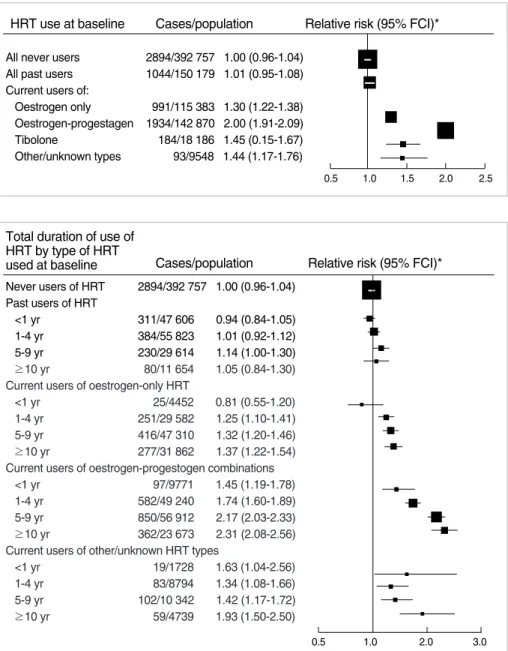
Many questions have been raised regarding the role of progesterone in breast cancer development. When combined estrogen-progesterone therapy (EPT) is used, the risk of breast cancer is consistently higher than that of therapy with estrogen alone (ET) (Figure 1).(16, 17) Regarding EPT, many studies have examined the type of progestin, method of administration, and whether the progestin is testosterone-derived, or not. Campagnoli et al.(23) suggest that the relative risks of continuous progestin are generally two to three times higher than that of cyclic progestin regimens. Continuous progestin inhibits the sloughing of mammary epithelium. This leads to amenorrhea, which in fact may increase medication adherence of patients, ultimately leading to a higher effective exposure to the drug.(24) Different derivatives of progesterone also seem to confer different risks. Some authors point to the non-progesterone properties of
Breast Cancer
E D I T O R I A L
Hormone Replacement Therapy and Breast Cancer: The Situation in Korea
Jae Bok Lee, Lee Su Kim
1Division of Breast and Endocrine Surgery, Korea University Guro Medical Center, Korea University College of Medicine, Seoul; 1Division of Breast and Endocrine Surgery, Hallym University Sacred Heart Hospital, Hallym University College of Medicine, Anyang, Korea
Correspondence: Lee Su Kim
Devision of Breast and Endocrine Surgery, Hallym University Sacred Heart Hospital, Hallym University College of Medicine, 896 Pyungchon-dong, Dongan-gu, Anyang 431-070, Korea Tel: 031-380-5930, Fax: 031-384-0208
E-mail: [email protected]
Received: July 8, 2010 Accepted: September 6, 2010 Jae Bok Lee and Lee Su Kim contributed equally to this work.
237
synthetic progestins that may potentiate breast tissue proliferation, decrease insulin sensitivity and increase insulin-like growth factor activity.(23,25) Testosterone- derived progestins have greater androgenic and estro- genic activities and, thereby, may confer an increased risk of breast cancer.(26,27) Maximum mitotic activity in breast tissue occurs in the mid to late luteal phase, when progesterone is at its highest level.(28)
According to the United Kingdom Public Assessment Report, the risk of breast cancer increases with increas- ing duration of the use (Figure 2). The HRT-associated increase in breast cancer risk drops rapidly after ceasing
use of HRT.(9,17) The risk of death from breast cancer is elevated in women who are currently using HRT.(17, 29) Use of HRT by women with a previous diagnosis of breast cancer increases the risk of recurrence.(30) Screen- ing mammography is less effective in women currently using HRT, with an increased number of false positives and a greater chance that breast cancers will be missed at screening.(18,22) The only factor found to significantly modify the effect of HRT is body size; HRT results in a larger increase in the risk of breast cancer in women who have a lower compared with a higher body mass index (BMI); specifically, thinner women on HRT have a higher
HRT use at baseline
All never users All past users Current users of:
Oestrogen only Oestrogen-progestagen Tibolone
Other/unknown types
2894/392 757 1.00 (0.96-1.04) 1044/150 179 1.01 (0.95-1.08)
991/115 383 1.30 (1.22-1.38) 1934/142 870 2.00 (1.91-2.09) 184/18 186 1.45 (0.15-1.67) 93/9548 1.44 (1.17-1.76)
0.5 1.0 1.5 2.0 2.5
Cases/population Relative risk (95% FCI)* Figure 1. Relative risk of incident invasive breast cancer in relation to recency and type of HRT used.
FCI=floated CI.
*Relative to never users of HRT, stratified by age, time since menopause, parity and age at first birth, family history of breast cancer, body-mass index, region, and deprivation index (From Beral V, et al. Lancet 2003;362:419-27, with permission from Elsevier).(17)
Figure 2. Relative risk of invasive breast cancer in relation to recen- cy, total duration of use, and type of HRT used at baseline.
FCI=floated CI.
*Relative to never users of HRT, stratified by age, time since menopause, parity and age at first birth, family history of breast cancer, body-mass index, region, and deprivation index (From Beral V, et al. Lancet 2003;362:
419-27, with permission from Elsevier).(17)
Total duration of use of HRT by type of HRT
used at baseline Cases/population Relative risk (95% FCI)*
Never users of HRT 2894/392 757 1.00 (0.96-1.04) Past users of HRT
<1 yr 311/47 606 0.94 (0.84-1.05) 1-4 yr 384/55 823 1.01 (0.92-1.12) 5-9 yr 230/29 614 1.14 (1.00-1.30)
≥10 yr 80/11 654 1.05 (0.84-1.30) Current users of oestrogen-only HRT
<1 yr 25/4452 0.81 (0.55-1.20) 1-4 yr 251/29 582 1.25 (1.10-1.41) 5-9 yr 416/47 310 1.32 (1.20-1.46)
≥10 yr 277/31 862 1.37 (1.22-1.54) Current users of oestrogen-progestogen combinations
<1 yr 97/9771 1.45 (1.19-1.78) 1-4 yr 582/49 240 1.74 (1.60-1.89) 5-9 yr 850/56 912 2.17 (2.03-2.33)
≥10 yr 362/23 673 2.31 (2.08-2.56) Current users of other/unknown HRT types
<1 yr 19/1728 1.63 (1.04-2.56)
1-4 yr 83/8794 1.34 (1.08-1.66)
5-9 yr 102/10 342 1.42 (1.17-1.72)
≥10 yr 59/4739 1.93 (1.50-2.50)
0.5 1.0 2.0 3.0
risk of breast cancer compared to women with a higher BMI who also take HRT. Consistent with this is the finding that the effect of HRT on breast cancer is greater in Europe than in North America, where average BMI levels are higher.(31)
HRT is highly effective in the treatment of menopausal symptoms such as hot flushes, night sweats,(32) and va- ginal dryness. Though it may seem difficult, women must balance the severity of these symptoms against the risk of serious disease attributable to the use of HRT. The effect of HRT on other non-life-threatening conditions, such as an increased risk of incontinence, gallbladder disease and reduced peripheral fractures, should also be considered.(33-35)
The Korean Society of Menopause 2007 referred to Women’s Health Initiative (WHI) 2002. Women reporting prior postmenopausal hormone use had higher hazard ratio (HR) for breast cancer associated with EPT than those who never used postmenopausal hormones (among never users, 114 vs. 102; HR, 1.06; 95% CI, 0.81-1.38; for women with 5 yr of prior use, 32 vs. 15; HR, 2.13; 95% CI, 1.15-3.94; for women with 5-10 yr of prior use, 11 vs. 2;
HR, 4.61; 95% CI, 1.01-21.02; and for women with 10 yr of prior use, 9 vs. 5; HR, 1.81; 95% CI, 0.60-5.43; test for trend, z=2.17).(16) And the 26% excess of breast cancer is consistent with estimates from pooled epidemiological data, which reported a 15% increase in the risk of breast cancer for women using EPT for less than 5 yr and a 53%
increase in the breast cancer risk for those using EPT more than 5 yr.(9) However, the incidence and developing aspect of breast cancer in Korea were different from the United States. According to the Korean Breast Cancer Society Breast Cancer Facts and Figures 2006-2008, the risk of breast cancer increased 24% per year for women using oral contraceptives and 2.3% per year for women using HRT, especially those on EPT. In comparing 1996 to 2006, it was reported that the rate of early menarche (menarche before 13 yr of age) increased from 8.0% to 15.1%; in other words, the number of patients with breast cancer risk factors increased. In addition, most breast cancer patients in Korea are in their 40s and premeno- pausal, but the number of breast cancer patients in the
West are postmenopausal, and their ages range from 60-70. Also, the breast cancer incidence among pre- menopausal women has reached approximately 60% in Korea.(36) Consequently, The Korean Society of Menopause and Korean Breast Cancer Society have different views on HRT and breast cancer than their Western counter- parts. When considering the use of HRT for postmeno- pausal symptoms, we would have more thorough breast examinations, including imaging studies, before starting HRT, because it is more common to find premenopausal women with breast cancer in Korea than in the Western countries.
The degree of association between breast cancer and postmenopausal HRT remains controversial. Women should be reassured that the possible risk of breast cancer associated with HRT is small, less than 0.1% per year.
The U.S. Food and Drug Administration (FDA), the U.K.
Medicines and Healthcare Products Regulatory Agency, and the Australian Therapeutic Goods Administration are in agreement that HRT should only be prescribed for the short-term treatment of menopausal symptoms.
Women considering the use of HRT must be informed of its risks and benefits, and HRT should not be used for the prevention of disease or as first-line treatment for osteoporosis. HRT should be used for as short a period of time as possible and, if continuous use is necessary, a breast examination should be performed every 6 months or annually.(37) We suggest that HRT be used for less than 5 yr. In addition, it is necessary to monitor patients having HRT every 6 months for breast cancer; these pa- tients should have complete breast examinations with imaging before starting HRT. Patients should also be given full information, including debates, on the topic.
HRT can improve the quality of women’s life, but the risk of breast cancer should be carefully considered before its initiation. We need a nationwide randomized controlled trial or well-designed observational study of HRT and breast cancer in Korea.
REFERENCES
1. Skouby SO, Al-Azzawi F, Barlow D, Calaf-Alsina Erdogan Ertüngealp
J, Gompel A, Graziottin A et al. Climacteric medicine: European Menopause and Andropause Society (EMAS) 2004/2005 position statements on peri- and postmenopausal hormone replacement therapy.
Maturitas 2005;51:8-14.
2. Kronenberg F. Hot flashes: epidemiology and physiology. Ann N Y Acad Sci 1990;592:52-86.
3. Schneider H. General aspects of world-wide HRT. In: Kato J, Mina- guchi H, Nishino Y, editors. Hormone Replacement Therapy and Osteoporosis. Berlin/New York: Springer; 2000. p.1-28.
4. Clemons M, Goss P. Estrogen and the risk of breast cancer. N Engl J Med 2001;344:276-85.
5. Key T, Appleby P, Barnes I, Reeves G; Endogenous Hormones and Breast Cancer Collaborative Group. Endogenous sex hormones and breast cancer in postmenopausal women: reanalysis of nine prospec- tive studies. J Natl Cancer Inst 2002;94:606-16.
6. Bernstein L, Ross RK. Endogenous hormones and breast cancer risk. Epidemiol Rev 1993;15:48-65.
7. Clarke M. Ovarian ablation in breast cancer, 1896 to 1998: milestones along hierarchy of evidence from case report to Cochrane review.
Br Med J 1998;317:1246-8.
8. Early Breast Cancer Trialists’ Collaborative Group. Ovarian ablation for early breast cancer: overview of the randomized trials. Lancet 1996;348:1189-96.
9. Collaborative Group on Hormonal Factors in Breast Cancer. Breast cancer and hormone replacement therapy: collaborative reanalysis of data from 51 epidemiological studies of 52705 women with breast cancer and 108411 women without breast cancer. Lancet 1997;350:
1047-59.
10. Fisher B, Costantino JP, Wickerham DL, Cecchini RS, Cronin WM, Robidoux A. et al. Tamoxifen for the prevention of breast cancer:
current status of the National Surgical Adjuvant Breast and Bowel Project P-1 Study. J Natl Cancer Inst 2005;97:1652-62.
11. Toniolo PG, Levitz M, Zeleniuch-Jacquotte A, Shore RE, Koenig KL, Banerjee S, et al. A prospective study of endogenous estrogens and breast cancer in postmenopausal women. J Natl Cancer Inst 1995;87:190-7.
12. Thomas HV, Key TJ, Allen DS, Moore JW, Dowsett M, Fentiman IS, et al. A prospective study of endogenous serum hormone con- centrations and breast cancer risk in postmenopausal women on the island of Guernsey. Br J Cancer 1997;76:401-5.
13. Cauley JA, Lucas FL, Kuller LH, Stone K, Browner W, Cummings SR. Elevated serum estradiol and testosterone concentrations are associated with a high risk for breast cancer. Ann Intern Med 1999;
130:270-7.
14. Liehr JG. Is estradiol a genotoxic mutagenic carcinogen? Endocr Rev 2000;21:40-54.
15. Kenemans P, Bosman A. Breast cancer and post-menopausal hor- mone therapy. Best Pract Res Clin Endocrinol Metab 2003;17:123-37.
16. Rossouw JE, Anderson GL, Prentice RL, LaCroix AZ, Kooperberg C, Stefanick ML, et al. Risks and benefits of estrogen plus progestin in healthy postmenopausal women: principal results from the Women’s Health Initiative randomized controlled trial. JAMA 2002;288:321-33.
17. Beral V; Million Women Study Collaborators. Breast cancer and
hormone-replacement therapy in the Million Women Study. Lancet 2003;362: 419-27.
18. Chlebowski RT, Hendrix SL, Langer RD, Stefanick ML, Gass M, Lane D, et al. Influence of estrogen plus progestin on breast cancer and mammography in healthy postmenopausal women: the Women’s Health Initiative Randomized Trial. JAMA 2003;289:3243-53.
19. Prentice RL, Chlebowski RT, Stefanick ML, Manson JE, Langer RD, Pettinger M, et al. Conjugated equine estrogens and breast cancer risk in the Women’s Health Initiative clinical trial and observational study. Am J Epidemiol 2008;167:1407-15.
20. Tjonneland A, Christensen J, Thomsen BL, Olsen A, Overvad K, Ewertz M, et al. Hormone replacement therapy in relation to breast carcinoma incidence rate ratios: a prospective Danish cohort study.
Cancer 2004;100:2328-37.
21. Newcomb PA, Titus-Ernstoff L, Egan KM, Trentham-Dietz A, Baron JA, Storer BE, et al. Postmenopausal estrogen and progestin use in relation to breast cancer risk. Cancer Epidemiol Biomarkers Prev 2002;11:593-600.
22. Banks E, Reeves G, Beral V, Bull D, Crossley B, Simmonds M, et al. Influence of personal characteristics of individual women on sen- sitivity and specificity of mammography in the Million Women Study. BMJ 2004;329:477.
23. Campagnoli C, Clavel-Chapelon F, Kaaks R, Peris C, Berrino F.
Progestins and progesterone in hormone replacement therapy and the risk of breast cancer. J Steroid Biochem Mol Biol 2005;96:95-108.
24. Doren M, Reuther G, Minne HW, Schneider HP. Superior compli- ance and efficacy of continuous combined oral estrogen-progestogen replacement therapy in postmenopausal women. Am J Obstet Gynecol 1995;173:1446-51.
25. Mccarty MF. Androgenic progestins amplify the breast cancer risk associated with hormone replacement therapy by boosting IGF-I activity. Med Hypotheses 2001;56:213-6.
26. Magnusson C, Baron JA, Correia N, Bergstrom R, Adami HO, Persson I. Breast-cancer risk following long-term oestrogen- and oestrogen- progestin-replacement therapy. Int J Cancer 1999;81:339-44.
27. Ross RK, Paganini-Hill A, Wan PC, Pike MC. Effect of hormone replacement therapy on breast cancer risk: estrogen versus estrogen plus progestin. J Natl Cancer Inst 2000;92:328-32.
28. Pike MC, Spicer DV, Dahmoush L, Press MF. Estrogens, progesto- gens, normal breast cell proliferation, and breast cancer risk. Epide- miol Rev 1993;15:17-5.
29. Banks E, Beral V, Reeves G; Million Women Study Collaborators.
Published results on breast cancer and hormone replacement therapy in the Million Women Study are correct. Climacteric 2004; 7:415-6.
30. Holmberg L, Anderson H; HABITS steering and data monitoring committees. HABITS (hormonal replacement therapy after breast cancer -- is it safe?), a randomized comparison: trial stopped. Lancet 2004;363:453-5.
31. MacLennan A, Broadbent J, Lester S, Moore V. Oral oestrogen and combined oestrogen/progestagen therapy versus placebo for hot flushes.
Cochrane Database Syst Rev 2004;(4):CD002978.
32. Hendrix S, Cochrane B, Nygaard I, Handa VL, Barnabei VM, Iglesia C, et al. Effects of estrogen with and without progestin on urinary
incontinence. JAMA 2005;293:935-48.
33. Simon JA, Hunninghake D, Agarwal SK, Lin F, Cauley JA, Ireland CC, et al. Effect of estrogen plus progestin on risk for biliary tract surgery in postmenopausal women with coronary artery disease. Ann Intern Med 2001;135:493-501.
34. Liu B, Beral V, Balkwill A, Green J, Sweetland S, Reeves G, et al.
Gallbladder disease and use of transdermal versus oral hormone replacement therapy in postmenopausal women: prospective cohort study. BMJ 2008;337:a386.
35. Cauley JA, Robbins J, Chen Z, Cummings SR, Jackson RD, LaCroix
AZ, et al. Effects of estrogen plus progestin on risk of fracture and bone mineral density: the Women’s Health Initiative Randomized Trial. JAMA 2003;290:1729-38.
36. Breast Cancer Facts & Figures 2006-2008. Korean Breast Cancer Society. http://www.kbcs.or.kr/journal/file/2006_2008_Breast_
Cancer_Facts_and_Figures_updated.pdf. accessed June 9th, 2010.
37. Banks E, C Karen, Reeves G. HRT and breast cancer: recent findings in the context of the evidence to date. Womens Health (Lond Engl) 2008;4:427-31.