Yonsei Med J 49(3):503 - 506, 2008 DOI 10.3349/ymj.2008.49.3.503
Yonsei Med J Vol. 49, No. 3, 2008
A Case of Multiple Endocrine Neoplasia Type 1 Combined
with Papillary Thyroid Carcinoma
Hai-Jin Kim, Jong-Suk Park, Chul-Sik Kim, Eun-Seok Kang, Bong-Soo Cha, Sung-Kil Lim, Kyung-Rae Kim, Hyun-Chul Lee, and Chul-Woo Ahn
Department of Endocrinology and Metabolism, Internal Medicine, Yonsei University College of Medicine, Seoul, Korea.
Received November 6, 2006 Accepted January 2, 2007
Reprint address: requests to Dr. Chul-Woo Ahn, Department of Endocrinology and Metabolism, Internal Medicine, Yonsei University College of Medicine, Yongdong Severance Hospital, 612 Eonjuro, Gangnam-gu, Seoul 135-720, Korea. Tel: 82-2-2019-3339, Fax: 82- 2-3463-3882, E-mail: [email protected]
This is the first report of papillary thyroid carcinoma com-bined with multiple endocrine neoplasia type 1 (MEN1) in Korea. MEN1 is a hereditary disease comprising neoplastic disorders such as pituitary, parathyroid and pancreatic neu-roendocrine tumor, such as gastrinoma. But papillary thyroid cancer was never regarded as its component before in Korea. Herein we present a 39-year-old woman who manifested typical features of MEN1 with a coincidental papillary thyroid carcinoma. Although the family history of MEN1 was definite, her genetic analysis of DNA had revealed no germline muta-tion in MEN1 gene locus. Unidentified culprit gene unable us further genetic study to find LOH (loss of heterogeneity) in 11q13, the possible explanation of papillary thyroid carcinoma as a new component of MEN1. As we have first experienced a case of MEN1 combined with papillary thyroid carcinoma in Korea, we report it with the review of literature.
Key Words: Multiple endocrine neoplasia type 1, papillary
thyroid carcinoma, prolactinoma, gastrinoma, parathyroid hyperplasia
INTRODUCTION
In 1903, Erdheim first reported concomitant parathyroid hyperplasia with pituitary adenoma and since 1954 when Wermer reported a family with multiple glandular disease, many attentions have been paid on the hereditary characteristics of the disease. The multiple endocrine neoplasia type 1 (MEN1) is a disease that is transmitted in an
autosomal dominant way with the incidence of 0.2 - 2 in 100,000 persons, without sexual pre-ference.1 The disease is made by the germline
mutation of a tumor suppressor gene on chromo-some 11 long arm 13 (11q13), which encodes menin protein, a transcriptional protein.2 MEN1 is characterized by coincidental, multiple endocrine tumors such as parathyroid, anterior pituitary and pancreatic islet cell tumor and less frequently, anterior thymoma, pheochromocytoma, cutaneous lipoma, facial fibroangioma, esophageal leio-myoma, thyroid adenoma may also occur.1-3 Speaking of the thyroid disease, it can be observed in over 25% of MEN1 patients,3,4 and it can be detected incidentally during parathyroid surgery in MEN1 patients. But so far, only two cases of thyroid carcinoma combined with MEN1 were reported, and they confirmed that papillary thyroid cancer did not correlate to MEN1.4,5
Our report which is the first case in Korea, with the following 2 cases above, is anticipated to pro-vide the important information for the characteri-zation of the developmental association of these two diseases.
CASE REPORT
A 39-year-old woman visited the hospital for evaluation of MEN1, as she had her two older brothers diagnosed of the disease one year before. The patient had no past history such as diabetes, hepatitis, hypertension, pulmonary tuberculosis and others. She had two children and normal menstrual cycle, but in recent two years, the cycle became irregular. She presented no particular
Hai-Jin Kim, et al.
504
Yonsei Med J Vol. 49, No. 3, 2008
Fig. 2. Sellar MRI shows 0.9 × 0.6 mm sized
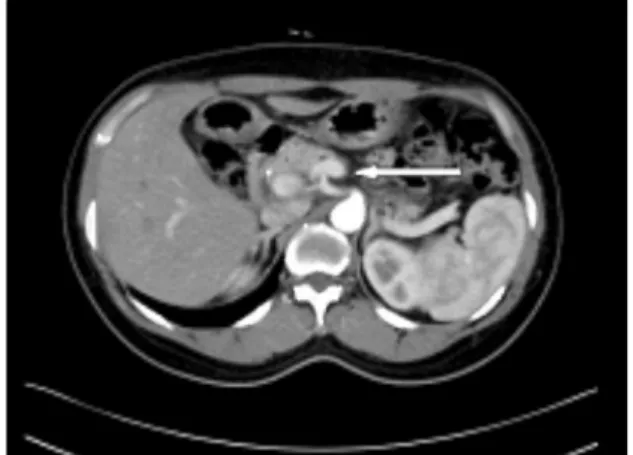
microade-noma in left portion of pituitary gland. Fig. 5. Histologic feature of thyroid papillary carcinoma showing inclusion body (H&E stain, × 100). Fig. 1. Thyroid US shows about 1.5 cm irregular mass at
upper pole of right thyroid gland. Fig. 4. Histologic feature of parathyroid hyperplasia (H&Estain, × 100). Fig. 3. Abdominal dynamic CT shows 0.68 cm sized arte-rial enhancing mass at pancreatic body.
symptoms except that on physical examination, a 1.5 cm sized nodule in her right thyroid lobe was palpated. Laboratory tests revealed no abnormal results except for increased PTH (201 ng/L, nor-mal value: 13 - 104 ng/L), calcium (2.77 nmol/L), prolactin (149 ug/L, normal value: 3.8 - 31.4 ug/L), and gastrin (555 ng/L, normal value: 0 - 90 ng/L) levels. On cervical ultrasonography, a 1.5 cm sized low density nodule was found on right posterior lobe of the thyroid (Fig. 1) and on sellar MRI, a 0.9 × 0.6 cm sized pituitary mass was seen on the left sellar wing (Fig. 2). Furthermore on abdomi-nal computed tomography (CT) scan, we found a 0.68 cm sized contrast-enhanced mass on pan-creatic body portion (Fig. 3). Based on these results, we could conclude that she had hyper-parathyroidism, gastrinoma and prolactinoma with thyroid tumor. She underwent
parathy-roidectomy, thyroidectomy and the pathologic results revealed bilateral parathyroid hyperplasia (Fig. 4) and a typical thyroid papillary cancer (T2N0M0) (Fig. 5). For the treatment of
pro-Relationship of MEN Type 1 and Papillary Cancer 505
Yonsei Med J Vol. 49, No. 3, 2008 lactinoma and gastrinoma, she is now taking
bromocriptin and proton-pump inhibitor daily. In the analysis of all coding exons of MEN1 of the patient, a silent mutation was detected in the exon 9 and polymorphism in the exon 10, however these results suggest no specific abnormality in MEN1 disease, reports from the Korean Heredi-tary Tumor Registration Center.
DISCUSSION
MEN1 is a familial disease that presents para-thyroid, pituitary and pancreatic islet cell tumor or hyperplasia. So far, 16 cases have been reported in Korea, and among them, the family history were confirmed in 5 cases.6 Our case is the first
report of thyroid papillary cancer combined with MEN1 in Korea, and the third case report world-wide.4,5
In the year of 1988, using the method of linkage analysis of polymorphic DNA sequencing,7 MEN1 gene was detected in chromosome 11q138 and
subsequently loss of heterogeneity in MEN1 gene was found.9 MEN1 gene is a tumor suppressor
gene that encodes the nuclear protein, menin, which regulates cell growth and cycle and when this protein deficit occurs, MEN1 develops. Tumors involved endocrine glands in MEN1 patients demonstrate loss of heterogeneity (LOH) at the locus of the MEN1 tumor suppressor gene. Menin, the protein encoded by Menin gene is ubiquitously expressed in endocrine tissues, and less commonly these patients can present with tumors of other endocrine glands including thyroid. To verify whether papillary thyroid can-cer is developed as a part of MEN1 disease, one should prove that allelic LOH of 11q13 in thyroid tissue be identical to that of leukocyte DNA.3,4 But
as in our case, the lack of obvious LOH of the MEN1 locus in the papillary carcinoma suggests that deletion of the MEN1 tumor suppression might not be etiologically related to the onco-genesis of the papillary thyroid carcinoma. Furthermore papillary thyroid carcinoma was found only in our patient and not in any of the family members involved MEN1. So the pos-sibility that thyroid carcinoma is etiologically associated with MEN1 seems to be low.
In the analysis of MEN1 genetic study, about 20% may have false negative results due to the diversity of the causative mutation and scattered position in the entire open reading frame. More-over approximately 10% new germline mutations are being detected in the overall MEN1 patients, which is the reason why the association of genotype and phenotype could not be identical in 10 - 30% of patients. Similarly, in our case, we could not find the causative mutation in the patient and family.
In Korea, among five MEN1 families, only four family germline mutations were found which are in concordance with other reports with 80% positive detection rate.6 Among mutations
dis-covered in Korea, three were new ones and the remaining one has already been revealed before.6
In the other hand, thyroid carcinoma has been reported in the range of 1.7% to 6% of patients with primary hyperparathyroidism.10-12 Hypotheses have been presented to address these findings, but no firm conclusions exist at this time regarding the etiology of synchronous thyroid and para-thyroid disease.13-15 Only one factor like prior exposure to radiation may play a role in the association. But in our case, the patient had no past history of radiation exposure. So there seems to be little correlation between the two diseases in our case.16
Our case suggests three possibilities of the development of thyroid papillary cancer as a component of MEN1. First possibility is the close association between the two genes. But no data exists supporting this hypothesis yet. Second, the possibility of the incidental occurrence of thyroid papillary cancer for it occurs with a high pre-valence. Presently, the opinion that these two diseases' occurrence is separate is prevalent. However, there exit two reports which have evidence for their intimate correlation. Finally, the possibility that it is a new type of familial disease causing two diseases by a genetic abnormality that is not characterized yet.
REFERENCES
1. Lairmore TC, Piersall LD, DeBenedetti MK, Dilley WG, Mutch MG, Whelan AJ, et al. Clinical genetic testing
Hai-Jin Kim, et al.
506
Yonsei Med J Vol. 49, No. 3, 2008
and early surgical intervention in patients with multiple endocrine neoplasia type1 (MEN1). Ann Surg 2004;239:637-45; discussion 645-7.
2. Chandrasekharappa SC, Guru SC, Manickam P, Olufemi SE, Collins FS, Emmert-Buck MR, et al. Positional cloning of the gene for multiple endocrine neoplasia type1. Science 1997;276:404-7.
3. Dong Q, Debelenko LV, Chandrasekharappa SC, Emmert-Buck MR, Zhuang Z, Guru SC, et al. Loss of heterozygosity at 11q13: analysis of pituitary tumors, lung carcinoids, lipomas, and other uncommon tumors in subjects with familial multiple endocrine neoplasia type1. J Clin Endocrinol Metab 1997;82:1416-20. 4. Desai D, McPherson LA, Higgins JP, Weigel RJ. Genetic
analysis of a papillary thyroid carcinoma in a patient with MEN1. Ann Surg Oncol 2001;8:342-6.
5. Vortmeyer AO, Lubensky IA, Skarulis M, Li G, Moon YW, Park WS, et al. Multiple endocrine neoplasia type 1: atypical presentation, clinical course, and genetic analysis of multiple tumors. Mod Pathol 1999;12:919-24. 6. Park JH, Kim IJ, Kang HC, Lee SH, Shin Y, Kim KH,
et al. Germline mutations of the MEN1 gene in Korean families with multiple endocrine neoplasia type 1 (MEN1) or MEN1-related disorders. Clin Genet 2003; 64:48-53.
7. Larsson C, Skogseid B, Oberg K, Nakamura Y, Nordenskjöld M. Multiple endocrine neoplasia type1 gene maps to chromosome 11 and is lost in insulinoma. Nature 1988;332:85-7.
8. Friedman E, Sakaguchi K, Bale AE, Falchetti A, Streeten E, Zimering MB, et al. Clonality of parathyroid tumors
in familial multiple endocrine neoplasia type1. N Engl J Med 1989;321:213-8.
9. Chandrasekharappa SC, Teh BT. Functional studies of the MEN1 gene. J Intern Med 2003;253:606-15.
10. Nishiyama RH, Farhi D, Thompson NW. Radiation exposure and the simultaneous occurrence of primary hyperparathyroidism and thyroid nodules. Surg Clin North Am 1979;59:65-75.
11. Prinz RA, Barbato AL, Braithwaite SS, Brooks MH, Emanuele MA, Gordon DL, et al. Simultaneous pri-mary hyperparathyroidism and nodular thyroid disease. Surgery 1982;92:454-8.
12. Attie JN, Vardhan R. Association of hyperparathyroi-dism with nonmedullary thyroid carcinoma: review of 31 cases. Head Neck 1993;15:20-3.
13. Hedman I, Tisell LE. Associated hyperparathyroidism and nonmedullary thyroid carcinoma: the etiologic role of radiation. Surgery 1984;95:392-7.
14. Smith MA, McHenry C, Oslapas R, Hofmann C, Hessel P, Paloyan E. Altered TSH levels associated with increased serum 1,25-dihydroxyvitamin D3: a possible link between thyroid and parathyroid disease. Surgery 1989;106:987-91.
15. Arem R, Lim-Abrahan MA, Mallette LE. Concomitant Graves' disease and primary hyperparathyroidism. Influence of hyperthyroidism on serum calcium and parathyroid hormone. Am J Med 1986;80:693-8. 16. Regal M, Páramo C, Luna Cano R, Pérez Méndez LF,
Sierra JM, Rodríguez I, et al. Coexistence of primary hyperparathyroidism and thyroid disease. J Endocrinol Invest 1999;22:191-7.