Received November 28, 2017, Revised December 10, 2017, Accepted December 11, 2017 Corresponding author: Ji-Eun Park
Mibyeong Research Center, Korea Institute of Oriental Medicine, 1672 Yuseongdae-ro, Yuseong-gu, Daejeon 34054, Korea Tel: +82-42-868-9496, Fax: +82-42-863-9464, E-mail: [email protected]
This study was supported by the Korea Institute of Oriental Medicine(K16093 & K17091).
CCThis is an open access article distributed under the terms of the Creative Commons Attribution Non-Commercial License (http://creativecommons.org/licenses/ by-nc/4.0) which permits unrestricted non-commercial use, distribution, and reproduction in any medium, provided the original work is properly cited.
비특이적 목 통증에 사용된 침구치료에 대한 체계적 문헌고찰
양창섭1ㆍ김익태2ㆍ김영은2ㆍ김보영1ㆍ서복남2ㆍ박지은2
1한국한의학연구원 임상연구부, 2한국한의학연구원 미병연구단
A Systematic Review of Acupuncture-Moxibustion Treatments for Nonspecific Chronic Neck Pain
Chang-Sop Yang1, Ick-Tae Kim2, Young-Eun Kim2, Bo-Young Kim1, Bok-Nam Seo2, Ji-Eun Park2
1Clinical Research Division, Korea Institute of Oriental Medicine,
2Mibyeong Research Center, Korea Institute of Oriental Medicine
Objectives : The aim of this study was to describe the details and to assess the clinical evidence of acupuncture and moxibustion for non-specific chronic neck pain. Methods : We searched seven databases including Korean, English, and Chinese databases through July 2016. Studies using acupuncture, moxibustion, pharmacopuncture, electroacupuncture, auricular-acupuncture, acupressure for non-specific chronic neck pain were included. Only controlled clinical trials or randomized clinical trials were assessed. Study design, number of subject, inclusion criteria, intervention, and results were extracted. In addition, details of intervention including needle type, retention time, acupoints were analyzed. Results : Total 64 studies(39 acupuncture, 9 laser, 6 pharmaco-acupuncture, 3 electro-acupuncture, 3 auricular-acupuncture, 3 moxibustion, 1 acupressure) were included. Among 39 acupuncture studies, 35 used acupuncture as sole intervention. Sham treatment was the most common intervention for control group, followed by no intervention. Various outcome including pain, disability, quality of life, range of motion was used as outcome measurement. The effect of acupuncture and moxibustion was different depending on the type of control and outcome measurement. The most commonly used method in acupuncture for neck pain was GB21, SI3, GB20, LI4, BL11 acupoints, 10∼30 mm insertion depth, 20∼30 retention time, and 1∼2 times per week. Conclusions : Analyzing the details of acupuncture and moxibustion treatment could be helpful for researches and clinics. Further studies should consider the characteristics of study design, intervention, and outcome to assess the effect of TKM.
Key words : Neck pain, acupuncture, moxibustion, electroacupuncture, systematic review, randomized controlled trials
서 론
한의학에서는 목에서 발생한 통증 즉, 경항부(頸項部에) 발생한 동통을 경항통(頸項痛)이라 한다. 서양의학에서는 목의 통증(neck pain) 또는 경추통(cervical pain)이라고 하며, 통증이 발생하는 원
인으로 경추의 골관절염, 경추간판탈출증, 외상, 종양, 감염, 근막통 증후군, 편도선염, 편타손상 등을 꼽는다1).
현재까지 보고된 연구들에 따르면, 전체 인구집단의 22∼70%가 일생에 한 번 이상 목 통증을 경험한 적이 있다2,3). 한국의 경우 건강보험심사평가원의 보고에 따르면 2016년 경추질환으로 병원
을 내원하여 치료받은 환자의 수는 약 200만 명으로 그 수가 매년 증가하는 추세를 보이고 있다4). 목 통증은 연령이 증가할수록 유병 률이 높아지며, 다수의 환자들이 재발하거나 만성화되는 경향을 보 이는데5), 이는 환자의 개인적인 삶의 질에 문제를 발생시킬 뿐만 아니라 근로 및 학습의 작업의 능률 저하 및 국가적으로 치료에 대한 비용부담 증가를 야기하여 사회 경제적인 측면에서 문제를 일으킬 수 있다6). 목 통증을 호소하는 다수의 환자들은 경추골절이 나 경추신경병증 등 심각한 병인이 발견되지 않는 이상 대부분 경 추신경뿌리의 문제나, 목의 구조적 이상으로 인한 비특이적 통증으 로 보고 약물치료와 통증 유발점 주사, 마사지와 물리치료 등으로 대부분 보존적인 치료를 받게 된다1).
2011년 발표된 한방의료이용 및 한약소비실태 조사에 따르면 2005년부터 2009년 국내 한방의료기관에서 건강보험 청구자료 기 준 다빈도 상병 4위가 경항통으로, 이에 대한 한방치료에 대한 수요 가 높은 것을 알 수 있다7). 이에 경항통, 혹은 비특이적 목 통증에 대한 침구치료의 효과를 평가하는 연구 결과가 지속적으로 수행되 고 있는데, 1999년 Adrian White는 목 통증에 대해 침 또는 레이 저침 치료와 일반 치료의 효과를 비교하고자 14편의 무작위대조군 비교 임상연구를 분석하였으나 대조군에 따라 치료효과가 달라 결 론을 내리기 힘들고, 전반적인 연구의 질을 보장할 수 없어 추가 연구를 제안하였다8). 이후 수행된 2009년 Fu 등의 문헌고찰 및 메타분석 연구에서는 14건의 임상연구를 분석하였고 비특이적 목 통증에 대한 침구치료의 3개월 미만의 단기효과가 가짜침에 비하 여 우수하지만 장기효과에 대한 연구는 추가적으로 수행되어야 한 다고 하였다9).
비특이적 목 통증에 대한 침구치료의 효과는 임상연구 디자인, 치료군의 중재방법, 대조군 설정 등에 따라 다르게 나타날 수 있다.
또한, 침구치료에 있어 혈위의 선택과 배오는 치료 상 중요한 비중 을 차지하며 침구치료의 상세 수행방법에서 기법, 횟수, 기간 등에 차이가 있다. 이러한 다양한 치료 방법은 효과의 차이를 유발할 것 으로 예상된다. 목 통증에 대해 침요법의 기존 체계적 문헌고찰에 서는 효과 및 안전성에 대한 양적 분석을 수행했으나, 혈위나 자침 깊이, 치료 빈도 등 치료법에 대한 구체적인 정보를 포함하고 있지 않다.
이에 본 연구에서는 비특이적 목 통증에 대한 침구요법 임상연 구의 연구설계, 대조군 설정, 효과변수를 포함한 연구디자인 방법 을 살펴보고, 사용된 치료기법 및 혈위, 치료횟수, 기간을 포함한 침구치료방법을 분석하여 향후 연구 설계 및 치료법 설정의 기초자 료로 활용하고자 한다.
대상 및 방법
1. 자료원 및 검색전략
본 연구목적에 의거하여 비특이적 만성 목 통증을 대상질환으로 사용하고, 이에 대해 경혈에 물리, 화학적 자극을 가하는 침구치료 를 검색하였다. 비특이적 만성 목 통증은 최소 3개월 이전에 발생하 여 통증이 목 또는 목을 포함한 인접부위에 지속되는 경우로 설정 하였고, 경추의 신경근병증(radiculopathy) 등 다른 질환에 의해 이차적으로 발생한 목 통증인 경우는 제외하였다. 또한 침, 뜸, 전침 등을 포함하여 경혈에 자극을 가한 치료법을 이용한 연구만을 연구 대상에 포함하였다. 대조군을 설정한 무작위 대조군 임상시험 (Randomized Controlled Trial, RCT) 및 비교임상연구(Con- trolled Clinical Trial, CCT)를 포함하였고, 대조군 처치를 제한하 지 않았다. 임상연구 평가변수 역시 별도의 제한을 두지 않았다.
동료 검토(peer review)된 학술지 논문만을 포함하고 학위논문 및 학술대회 초록 등 회색문헌은 제외하였다.
목 통증에 대한 침구요법 선행연구를 검색하기 위해 4개의 국제 학술논문 데이터베이스(MEDLINE, EMBASE, CENTRAL, CNKI)와 3개 국내학술논문 데이터베이스(NDSL, RISS, OASIS)를 활용하였 다. 검색어는 MEDLINE, CENTRAL 검색을 위해 [(neck pain) and (acup* or electroacupuncture or mox*)]를 사용하였고, EMBASE 검색을 위해 [‘neck’/exp OR neck AND(‘pain’/exp OR pain) AND(acup* OR ‘electroacupuncture’/exp OR electroacupu- ncture OR mox*) AND([article]/lim OR [article in press]/lim OR [review]/lim OR [short survey]/lim) AND [humans]/lim AND([embase]/lim)]를 사용하였다. NDSL, RISS, OASIS 검색을 위해서는 MEDLINE 검색식과 국문 용어로 검색하였고, CNKI에서 는 MEDLINE 검색식의 영어와 중국어로 검색하였다. 검색은 2016 년 3월 9일 1차 검색을 수행하였고, 2016년 6월 13일 2차 검색을 수행하였다. 논문 추출시 게재시점에 대한 제한은 없었고, 영어, 중 국어, 한국어로 발표된 논문만을 포함하였다.
검색된 문헌을 대상으로 제목(Title)과 초록(Abstract)으로 1차 로 분석대상을 선정하였다. 논문의 원문을 확보하여 각 논문의 전 문(Full Report)을 검토하여 2차로 분석대상을 선정하였고, 두 명 의 연구자가 독립적으로 검토 및 분석하였으며 연구자 간 의견이 불일치하는 경우 제 3의 연구자와의 협의를 통해 최종적으로 결정 하였다. 중국어로 발표된 논문의 경우 중국어를 모국어로 사용하는 중의학 전문가에게 자문을 얻어 자료를 분석한 후 검토하였다.
최종적으로 선정된 연구들에 대해 두 가지 카테고리로 나누어 개별 문헌으로부터 정보를 추출했다. 첫 번째로 연구디자인 분석을
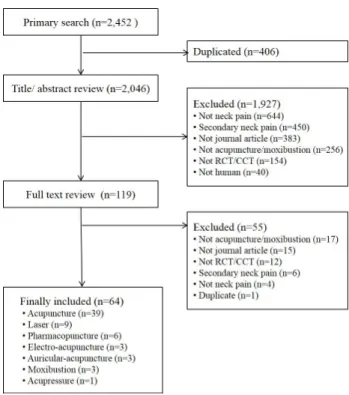
Fig. 1. Flowchart of literature review.
CCT : Controlled clinical trial, RCT : Randomized controlled trial.
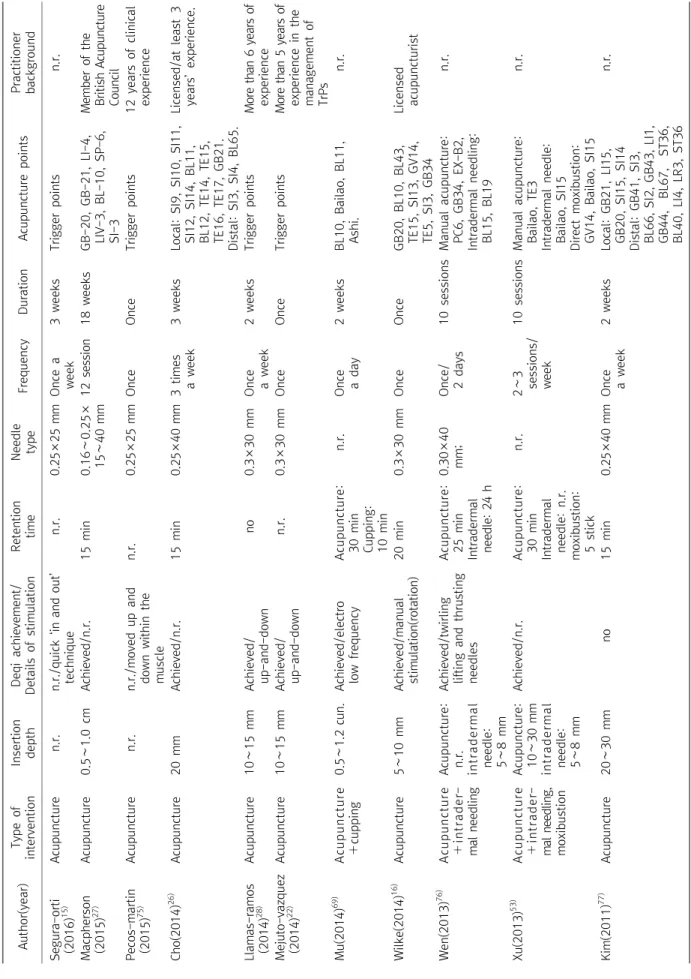
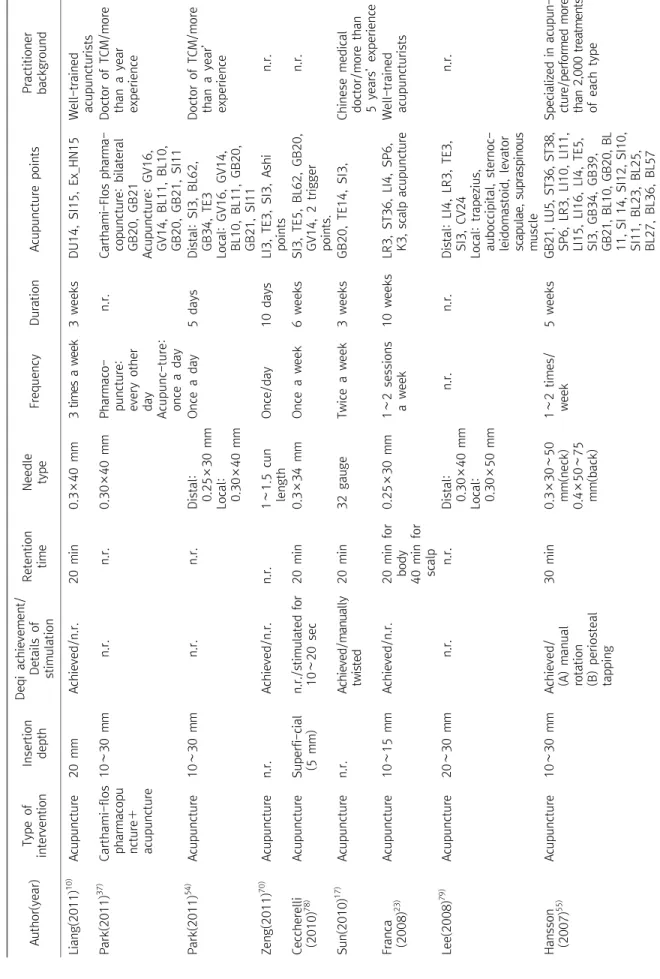
위해 연구설계(Study Design), 대상자 수(Number of subjects), 선정기준(Inclusion criteria), 중재군 및 대조군(Intervention group and control group), 결과(Results)를 살펴보았다. 두 번째로 사용한 침구치료 방법론 분석을 위해 침구치료 보고 표준인 STRICTA (Standards for Reporting Interventions in Controlled Trials of Acupuncture)의 항목 중 중재유형(Type of intervention), 자침 깊이(Insertion depth), 득기여부(Deqi achievement), 자극형태 (Detail of stimulation), 유침시간(Retention time), 침의 형태 (Needle type), 치료횟수(Number of treatment sessions), 치료 시간(Duration of treatment sessions), 사용한 혈위(Acupuncture point), 시술자의 배경(Practitioner Background) 항목을 선택하여 추출하였다. 테이블에는 군간 비교결과를 작성하였고, 군 간 비교 결과가 없는 경우는 군내 변화를 기술하였다. 본 연구는 목 통증에 대한 침구요법의 효과가 아닌, 구체적인 치료방법 탐색이 목적이므 로 메타분석 및 risk of bias 분석을 수행하지 않았다.
결 과
1. 검색결과 및 자료선정
국내외 학술문헌데이터베이스 검색을 통해 총 2,452편의 논문 을 검색하였고, 중복제거 후 2,046편이 추출되었다. 이를 대상으로 일차적으로 제목과 초록의 내용을 바탕으로 선정 기준에 합당한 119편의 논문을 선별하고, 이후 논문의 원문을 모두 확보하고 이차 적으로 전문을 검토하여 최종적으로 64편의 논문이 분석에 포함되 었다(Fig. 1).
2. 비특이적 만성 목 통증에 대한 침구치료 연구디자인 1) 연구 설계 및 연구대상자의 특성: 총 64편의 연구 중 무작위 배정 대조군 임상시험이 49편(77%), 대조군 임상연구가 15편(23%) 이었다. 대상자의 수는 10명부터 3,451명까지 매우 다양하였으며, 100명 이상의 대규모 연구는 10편(16%), 100명 미만의 연구는 54 편(84%)이었다. 30명 미안의 연구대상자를 포함한 연구도 19편으 로 30%에 달하였다. 비특이적 만성 목 통증의 선정기준으로는 주로 18세 이상이면서 만성적인 목과 어깨부위의 통증과 뻣뻣함(sti- ffness)를 호소하는 경우를 대상으로 하였으며, 지속기간 기준을 3개 월 이상으로 선정한 연구가 10편(15.6%)으로 가장 많았다(Table 1).
2) 중재군 및 대조군: 전체 64편의 논문 중 일반 침(Manual Acupuncture) 연구는 39편(61%)으로 절반 이상이었고 레이저침 (laser Acupuncture) 연구가 9편(14%), 약침(pharmacopuncture)
연구 6편(9%), 전침(electroacupuncture)과 이침(ear Acupuncture) 연구가 각각 3편(5%), 뜸(moxibustion) 3편(5%), 경혈지압(acu- pressure) 연구가 1편(2%)이었다. 일반 침을 중재로 채택한 39편의 연구 중 침 단독으로 치료한 연구는 35편(90%)이었고, 나머지 연구 들은 침과 함께 전침이나 뜸, 부항 등을 병용하였다.
침 연구 39건 중 30건은 침치료군과 대조군을 비교하여 침의 효과 여부를 검증하였고, 9건은 혈위 및 자극방법을 달리한 다양한 침치료법의 효과를 비교하였다. 침의 효과 여부를 검증하는 30건의 연구 중 대조군 중재로 가짜 침 8건(26%)및 일상치료 8건(26%)이 가장 많았고, 가짜 레이저와 TENS(transcutaneous electrical nerve stimulation)가 5건(16%), 중재가 없는 대조군이 4건(13%), 약물치 료 3건(10%), 침요법만 제외하고 치료군과 대조군에 동일한 요법을 사용한 경우 2건(6%), 최면 1건(3%) 순이었다.
다양한 침치료법의 효과를 비교하는 9건의 연구에서는 근위혈 과 원위혈 비교 3건(33%), 특정 이론에 따른 치료법과 표준치료법 비교 3건(33%), trigger point와 non-trigger point 비교 1건 (11%), 혈자리 수 비교 1건(11%), 유침시간 비교 1건(11%)이 포함 되었다.
비특이적 목 통증에 대한 뜸 연구 3건에서 사용된 대조군 중재는 시험군과 대조군에 침치료 적용 후 시험군에서만 뜸치료를 추가한
Table 1. Study Design of Included Studies Author(year)Study designNumber of subjects Total(int/cont)Inclusion criteriaIntervention groupControl groupResults Acupuncture studies(assessing the effect of acupuncture)(n=30) Segura-orti (2016)15)RCT34(12/10/12)Active symptomatic myofascial trigger points(A) Acupuncture (trigger point)(B) Strain-counterstrain1) 1) Pain: NS among 3 groups (C) Sham strain-counterstrain2) Disability score: NS among 3 groups Macpherson (2015)27)RCT517(173/172/172)Aged over 18, chronic neck pain lasting over 3 months, score over 28% of NPQ
(A) Acupuncture(B) Alexander technique2)+ usual care(A) vs (C) 1) NPQ: p<0.01 (C) Usual care 2) QoL: partiallyp<0.05 (B) vs (C) 1) NPQ: p=0.01 2) QoL: NSin physical, p<0.05 in mental Cho(2014)26) RCT45(15/15/15)Aged 25∼55 years with ch- ronic neck pain(A) Acupuncture+ medication (NSAIDS)
(B) Acupuncture1) Pain: NS among 3 groups (C) Medication(NSAID) Llamas-ramos (2014)28)RCT94(47/47)Chronic idiopathic mechanical neck painAcupunctureManual therapy(compression, stretching, massage)1) Pain: NS 2) NPQ: NS 3) Pressure pain threshold:p<0.01 4) Cervical range of motion: NS Mejuto-Vazquez (2014)22)RCT17(9/8)Acute idiopathic mechanical unilateral neck painAcupunctureno treatment1) Pain: p<0.01 2) Pressure pain threshold:p<0.01 Mu(2014)69) RCT58(30/28)2005 “semi-healthy clinic practice guideline”Acupuncture+ cuppingMedication(diclofenac sodium dual release enteric-coated capsules) 1) Clinical efficacy:p<0.05 2) Neck extension function: p<0.05 Wilke(2014)16) RCT19(Cross-over)Aged 18∼65 with active myofascial trigger point in the neck and shoulder
(A) Acupuncture(C) Sham laser acupuncture1) Pain: NS between(A) and(C); p<0.05 between(B) and(C)(B) Acupuncture+ stretching2) ROM: NS among 3 groups Liang(2011)10) RCT178(88/90)Aged 18∼60 with neck pain or stiffness in neck and shoulder for longer than 6 months
AcupunctureSham acupuncture1) Pain: p<0.05 3) QoL: partially p<0.05 Zeng(2011)70) RCT60(30/30)Pain in the neck and shoulder with tender pointsAcupunctureMedication(diclofenac diethylamine emulgel)1) Pain: NS Sun(2010)17) RCT34(17/17)Chronic neck myofascial pain syndromeAcupunctureSham acupuncture1) Pain: NS 2) ROM: NS 3) QoL: partially p<0.05
Table 1. Continued 1 Author(year)Study designNumber of subjects Total(int/cont)Inclusion criteriaIntervention groupControl groupResults Franca (2008)23)RCT46(16/15/15)Aged20∼60years withtension neck syndrome(A) Acupuncture+ physiotherapy(B) Acupuncture (A) vs (B) (C) Physiotherapy NS in all outcomes (A) vs (C) 1) Pain: p<0.05 2) Muscle tension: p<0.05 3) Neck disability: p<0.05 4) C-CFT:p<0.001 (B) vs (C) 1) Pain: NS 2) Muscle tension: NS 3) Neck disability: p<0.05 4) C-CFT:p<0.05 Hansson (2007)55)CCT144(59/55/30)Aged 18∼70 with pain in the neck or low back for more than 3 months(A) Intramuscular acupuncture (C) Information control group(A) vs (C) 1) Anxiety :NS (B) Periosteal acupuncture 2) Depression: NS 3) Sleep: NS 4) Mood at awakening: NS (B) vs (C) 1) Anxiety: NS 2) Depression: NS 3) Sleep: NS 4) Mood at awakening: NS Itoh(2007)11) RCT31(8/8/8/7)Aged 45 or over with a history of neck pain for longer than 6 months(A) Acupuncture (acupoints)(C) Acupuncture (non-trigger point)1) Pain:p<0.01 between (B) vs(A), (C), (D), NS among (A), (C), (D) (B) Acupuncture (trigger points)(D) Sham acupuncture 2) Functional impairment:p<0.01 between (B) vs (A), (C), (D), NS among(A), (C), (D) Salter (2006)29)RCT24(10/14)Over 18 years of age who had consulted the practice with neck pain Acupuncture+ usual careUsual care1) NPQ: NS Vas(2006)12) RCT123(61/62)Aged 17 years and over with uncomplicated neck pain over 3 months
Acupunctureplacebo TENS1) Pain: p<0.001 2) NPQ:p<0.001 3) Mobility: partiallyp<0.05 4) QoL: partially p<0.05 5) Rescue medication: p<0.001 Witt(2006)24) RCT3,451(1,753/1,698)Aged 18 or over with chronic neck pain for longer than 6 monthsAcupunctureNo intervention1) NPAD: p<0.001 2) QoL:p<0.001
Table 1. Continued 2 Author(year)Study designNumber of subjects Total(int/cont)Inclusion criteriaIntervention groupControl groupResults He(2005)21) RCT24(14/10)Aged 20∼50 female workers with neck and shoulder pain Acupuncture(body acupuncture+EA +ear acupuncture)
Sham acupuncture1) Pain-related activity impairment:p<0.04 2) Quality of sleep: p<0.05 3) Anxiety: p<0.05 4) Depression: p<0.05 5) Satisfaction with life:p<0.05 He(2004)13) RCT24(14/10)Aged 20∼50 female workers with neck and shoulder pain
Acupuncture(body acupuncture+EA +ear acupuncture) Sham acupuncture1) Pain: p<0.04 2) Headache: p=0.02 3) Pain threshold: p=0.002 Lee(2004)25) CCT40(19/21)Neck pain and/nor Radiating pain and symptoms.
AcupunctureNo intervention1) Pain: p<0.001 Seo(2004)71) CCT25(18/7)Neck painAcupunctureAcupressureWithin group 1) Pain threshold: NS 2) Pain(VAS): NS White (2004)14)RCT124(63/61)Aged 18∼80 with chronic mechanical neck pain longer than 2 months AcupunctureSham transcutane- ous electrical sti- mulation
1) Pain: p=0.01 Irnich (2002)72)RCT34(Cross-over)Chronic neck pain for longer than 2 months and limited mobility of the cervical spine
(A) Acupuncture (distal)(C) Sham laser acupunctureWithin group 1) Pain: p<0.001 in group A, p=0.7 in group B, NS in group C(B) Acupuncture (trigger points) 2) ROM: p<0.05 in group A and B, NS in group C Between group 1) Assessment of change : p<0.01 between (A) and (B) : p<0.01(A) and (C) : NS between (B) and (C) Nabeta (2002)18)RCT34(17/17)Chronic dull pain and stiffness of the neck and shoulder
Acupuncture Sham acupuncture1) Pain: NS Zhu (2002)19)RCT29(Cross-over)Aged 31∼70 with neck complaints of pain, stiffness or tenderness for longer than 6 months AcupunctureSham acupuncture 1) Pain: NS 2) NDI: NS Irnich (2001)20)RCT177(56/60/61)Painful restriction of cervical spine mobility for longer than 1 month
(A) Acupuncture(B) Massage (C) Sham laser acupuncture
(A) vs (B) 1) Pain: p=0.0052 2) ROM: p<0.05 3) Pressure pain threshold: NS (A) vs (C) 1) Pain: NS 2) ROM: NS 3) Pressure pain threshold: NS