https://doi.org/10.4174/astr.2017.92.4.200 Annals of Surgical Treatment and Research
Matched case-control analysis comparing oncologic outcomes between preoperative and postoperative chemoradiotherapy for rectal cancer
Byoung Chul Lee, In Ja Park, Chan Wook Kim, Seok-Byung Lim, Chang Sik Yu, Jin Cheon Kim
Division of Colon and Rectal Surgery, Department of Surgery, Asan Medical Center, University of Ulsan College of Medicine, Seoul, Korea
INTRODUCTION
Studies show that 20%–50% of patients who undergo curative resec tion for colorectal cancer with adjuvant therapy experience recur rence during followup [13]. Pre or postoperative chemo
radio therapy (CRT) is important in preventing recurrence in locally advanced rectal cancer (LARC). Improved surgical tech
ni ques, such as total mesorectal excision (TME), have also low
ered the local recurrence rate; TME with CRT has reduced lo cal
recurrence rates of LARC to 5%–10% [4].
For patients with LARC, preoperative CRT reportedly im
proves local control and causes less treatmentrelated toxicity than postoperative CRT, as well as improves sphincter pre ser
va tion [4]. These findings led to a change from postoperative to preoperative CRT, with preoperative CRT followed by radi
cal resection, including TME, and adjuvant chemotherapy becoming the standard treatment for patients with clinical stage II/III rectal cancer. Although the data do not show a clear Purpose: To investigate patterns of recurrence and oncologic outcomes after recurrence between preoperative and post- operative chemoradiotherapy (CRT).
Methods: Records of patients with stage II or III locally advanced rectal cancer seen between January 2000 and December 2010 were analyzed. The outcomes for patients undergoing preoperative CRT followed by radical resection (n = 466) were com pared with outcomes of patients matched for sex, age, and stage who had surgery and then postoperative CRT (n = 466). Recurrence rates and sites, treatment of recurrence, and oncologic outcomes after recurrence were investigated.
The rate of sphincter preservation and permanent stoma formation were also evaluated.
Results: Recurrence occurred in 124 and 140 patients in the pre- and postoperative CRT groups, respectively. The local and systemic recurrence rates were 3.6% and 20.8%, respectively, in the preoperative CRT group and 3.0% and 25.3%, respec tively, in the postoperative CRT group (P = 0.245). Time to recurrence was longer in the postoperative CRT group (19 months vs. 24.2 months, P = 0.029). The overall rates of sphincter preservation (sphincter preservation operation and post- operative permanent stoma formation) did not significantly different between the two groups (P = 0.381). The 5-year overall survival rate after recurrence did not differ between the two groups (25.6% vs. 18.6%, P = 0.051).
Conclusion: Preoperative and postoperative CRT are both safe and suitable treatment methods for rectal cancer, so the choice can be tailored to the patient’s situation.
[Ann Surg Treat Res 2017;92(4):200-207]
Key Words: Chemoradiotherapy, Colorectal surgery, Rectal neoplasms, Recurrence, Treatment outcome
Reviewed January February March April May June July August September October November December
Received October 27, 2016, Revised November 18, 2016, Accepted November 26, 2016
Corresponding Author: Jin Cheon Kim
Division of Colon and Rectal Surgery, Department of Colon and Rectal Surgery, Asan Medical Center, University of Ulsan College of Medicine, 88, Olympic-ro 43-gil, Songpa-gu, Seoul 05505, Korea
Tel: +82-2-3010-3489, Fax: +82-2-3010-6701 E-mail: [email protected]
Copyright ⓒ 2017, the Korean Surgical Society
cc Annals of Surgical Treatment and Research is an Open Access Journal. All articles are distributed under the terms of the Creative Commons Attribution Non- Commercial License (http://creativecommons.org/licenses/by-nc/4.0/) which permits unrestricted non-commercial use, distribution, and reproduction in any medium, provided the original work is properly cited.
oncologic benefit, preoperative CRT tends to be preferred over postoperative CRT. However, the latter is more often used when clinical staging is underestimated or bowel obstruction requires upfront surgery.
Some studies have investigated recurrence patterns after LARC [57], but few compared treatment and oncologic out
comes after recurrence in patients initially treated with pre
or postoperative CRT. This study is a retrospective analysis of patients with LARC who underwent pre or postoperative CRT to investigate patterns of recurrence and the treatment and on
cologic outcomes after recurrence in terms of overall survival (OS) and recurrencefree survival (RFS).
METHODS
Patient identification
Between January 2000 and December 2010, 2007 consecutive patients with primary rectal adenocarcinoma underwent pre
or postoperative CRT at Asan Medical Center, Seoul, Korea.
All patients had low (defined as within 5 cm of the anal verge [AV]) to mid (defined as between 5 cm and 10 cm of the AV) rectal tumors, locally advanced disease (T3/4 or nodepositive by clinical staging in the preoperative CRT group and by pathology in the postoperative CRT group), and no evidence of distant metastasis. We identified 1,157 patients who underwent preoperative CRT and 850 who underwent postoperative CRT.
We selected 466 patients from each group using casematching of sex, age, and clinical (preoperative CRT group) or pathologic stage (postoperative CRT group). This study was approved by the Institutional Review Board of Asan Medical Center (IRB No.
20160988).
Clinical/pathologic staging and CRT
Clinical staging was done preoperatively by MRI using a high
spatialresolution phasedarray magnetic resonance technique and by transrectal ultrasound (TUS) using a 7–10 MHz probe.
MRI diagnosis of a T3 lesion was based on the presence of tumor signal intensity extending through the muscle layers into the perirectal fat with a broadbased bulging configuration and in continuity with the intramural portion of the tumor. Positive lymph node (LN) status was ascertained by signal intensity, border characteristics, irregular contour, and/or heterogeneous texture. Morphology was not considered a predictor of LN positivity. Circular hypoechoic structures ≥3 mm in diameter were classified as malignant LNs. Nodes <3 mm in diameter and those with central hyperechogenicity were considered benign. Pathologists specializing in gastrointestinal cancers staged resected specimens histopathologically according to the guidelines of the College of American Pathology and the 7th edition of the American Joint Committee on Cancer.
The radiotherapy regimen consisted of a 45Gy dose of pelvic
external beam radiation delivered in 25 fractions over 5 weeks, followed by a 5.4Gy boost to the tumor in 5 fractions delivered as second daily fractions during the last week of treatment, for a cumulative dose of 50.4 Gy. Concurrent chemotherapy consisted of intravenous 5fluorouracil or capecitabine monotherapy.
Within 6–8 weeks of completing CRT, the preoperative CRT group underwent radical resection including TME. For the postoperative CRT group, adjuvant chemotherapy started within 4 weeks of curative resection, with most patients receiving intravenous 5fluorouracil or capecitabine monotherapy. Radio
therapy started at the third cycle of chemotherapy for five cycles, and the total radiation dose was 50.4–54 Gy. Surgery was performed by experts with more than 5 years’ experience and they followed the rule of TME surgery.
Follow-up and evaluation
Patients underwent standardized postoperative followup consisting of physical examination, including digital rectal examination, complete blood count, liver function tests, and serum CEA concentration. Computed tomography of the abdo men and pelvis was performed every 6 months and of the chest, every year. Colonoscopy was performed within 1 year postoperatively and then every 2 years. Recurrence was diagnosed upon radiological findings showing a newly de
veloped lesion over time. Local recurrence was defined as re
cur rence in the pelvic area, and distant metastasis was defined as any recurrence outside the pelvic cavity. The primary end
points were recurrence, RFS, and OS after recurrence. OS after re currence was defined as the time between recurrence after sur gery and death or last followup. RFS after recurrence was defined as the time between recurrence after surgery and rerecurrence.
Statistical analysis
Categorical variables were summarized as percentages, and differences were compared using a chisquare test, Fisher exact test, and Student ttest. The KaplanMeier method was used to calculate OS, RFS, 5year recurrence rates, and OS after re cur
rence and was followed by log rank test comparisons. Interac
tion between factors and treatment effects were summarized as hazard ratios and 95% confidence intervals using Cox pro
portional hazards regression analysis. A Pvalue of <0.05 was considered statistically significant. All statistical analyses were performed using IBM SPSS Statistics ver. 21.0 (IBM Co., Armonk, NY, USA).
RESULTS
Patient characteristics
There were no significant differences between pre and post
operative CRT groups in sex, age, T and N category, tumor site,
or circumferential resection margin status (Table 1). Perineural and lymphovascular invasion rates were significantly higher in the post than in the preoperative CRT group. Of the total 932 patients, 708 (78.0%) underwent sphincterpreserving resection, with no significant difference between the 2 groups. However, the sphincterpreservation rate among patients with low rectal cancer (AV ≤ 5 cm) was significantly higher in the pre than in the postoperative CRT group (P = 0.002). Patients who had permanent stoma formation after surgery was 24 (5.2%) and 12 (2.6%), respectively, with a significant difference between the 2 groups (P = 0.041). Permanent stoma formation was resulted from radiotherapy induced complications which were anastomosis leakage (14), stricture (4), proctitis (3), fistula (3) in the preoperative CRT group and stricture (7), anastomosis
leakage (3), fistula (1), proctitis (1) in the postoperative CRT group. The overall rates of sphincter preservation and per ma
nent stoma did not significantly different between the 2 groups (P = 0.381). Since postoperative CRT was mainly used in the early 2000s and preoperative CRT mainly in the late 2000s, the followup period of the postoperative CRT group was longer than that of the preoperative CRT group.
Pattern and treatment of recurrence
There were 264 recurrences, 124 (26.6%) in the preoperative and 140 (30.0%) in the postoperative CRT group. The overall systemic, local, and systemic and local recurrence rates were 20.8%, 3.6%, and 2.1%, respectively, in the preoperative and 25.3%, 3.0%, and 1.7%, respectively, in the postoperative CRT
Table 1. Characteristics of patients with rectal cancer
Characteristic Preoperative CRT (n = 466) Postoperative CRT (n = 466) P-value
Sex >0.999
Male 312 (67.0) 312 (67.0)
Female 154 (33.0) 154 (33.0)
Age (yr) 56.9 ± 9.2 56.9 ± 9.2 0.932
T category 0.074
T1/2 26 (5.6) 40 (8.6)
T3/4 440 (94.4) 426 (91.4)
N category 0.249
N0 362 (77.7) 347 (74.5)
N1/2 104 (22.3) 119 (25.5)
Tumor site (AV ≤ 5) 241 (51.7) 222 (47.6) 0.213
Lymphovascular invasion 55 (11.8) 148 (31.8) <0.001
Perineural invasion 40 (8.6) 59 (12.7) 0.043
Circumferential resection margin involved 6 (1.3) 10 (2.1) 0.313
Sphincter preservation 366 (78.5) 342 (73.4) 0.066
In low rectum (AV ≤ 5) 146/241 (60.6) 103/222 (46.4) 0.002
Permanent stoma formation 24 (5.2) 12 (2.6) 0.041
Overall sphincter preservation 342 (73.4) 330 (70.8) 0.381
Follow-up period (mo) 68.9 ± 35.6 77.8 ± 45.4 0.001
Values are presented as number (%) or mean ± standard deviation.
CRT, chemoradiotherapy; AV, anal verge.
Table 2. Recurrence of rectal cancer after curative treatment
Variable Preoperative CRT (n = 466) Postoperative CRT (n = 466) P-value
Type of recurrence 124 (26.6) 140 (30.0) 0.245
Systemic recurrence 97 (20.8) 118 (25.3) 0.102
Local recurrence 17 (3.6) 14 (3.0) 0.584
Systemic and local recurrence 10 (2.1) 8 (1.7) 0.634
Time to recurrence (mo) 19.0 ± 15.6 24.2 ± 21.3 0.029
Systemic recurrence 19.1 ± 16.3 22.4 ± 18.8 0.173
Local recurrence 20.7 ± 14.8 34.1 ± 26.1 0.085
Systemic and local recurrence 15.5 ± 9.4 32.5 ± 39.4 0.203
Values are presented as number (%) or mean ± standard deviation.
CRT, chemoradiotherapy.
group, all nonsignificant differences between the 2 groups.
Time to recurrence was longer in the postoperative than in the preoperative CRT group (P = 0.029), particularly for local recurrence (Table 2).
The major systemic recurrence site was the lung, followed by the liver and distant LNs. The major local recurrence site was the pelvic cavity, followed by pelvic LNs and the anastomosis site. For treatment of systemic recurrence, chemotherapy and/or radiotherapy (46.4% vs. 57.6% in preoperative vs. postoperative CRT group) was performed, followed by curative treatment including surgery, radiofrequency ablation (RFA), or stereotactic body radiotherapy (SBRT), with or without combined chemo
ther apy (37.1% vs. 27.1%). The major treatment for local re cur
rence was chemotherapy and/or radiotherapy (76.5% vs. 64.3%), followed by surgery combined with chemotherapy (23.5% vs.
21.4%) (Fig. 1).
In the preoperative CRT group, systemic recurrence occurred in 97 patients, including the lung in 49, the liver in 26, and multi ple sites in 22. In the postoperative CRT group, systemic re cur rence occurred in 118, including the lung in 55, the liver in 40, and multiple sites in 23. Patients with recurrences in the lung and liver were more likely to undergo curative treatment for the recurrence than those with systemic recurrences in other sites. In the preoperative CRT group, curative treatment was given to 19 patients (38.8%) with lung recurrence and 16 (61.5%) with liver recurrence. In the postoperative CRT group, cu ra tive treatment was administered to 14 patients (25.5%) with lung recurrence and 18 patients (45%) with liver recurrence (Fig.
1).
Preop CRT (n = 124) Postop CRT (n = 140)
Distant LN
(n = 12) PS
(n = 4) Bone
(n = 5) Others (n = 1) Op : 1
CTx : 9 BSC : 2
CTx : 2
BSC : 2 CTx : 2
BSC : 3 CTx : 1 (n = 49)Lung Liver
(n = 26) Op/SBRT : 19
CTx : 26 BSC : 4
Op/RFA : 16 CTx : 5 BSC : 5
Systemic (n = 97) Local (n = 17) Both (n = 10) Op : 4
CTx : 13 BSC : 0
Op : 1 CTx : 7 BSC : 2
Distant LN
(n = 12) PS
(n = 6) Bone
(n = 2) Others (n = 3) CTx : 10
BSC : 2 CTx : 3
BSC : 3 CTx : 1
BSC : 1 CTx : 2 BSC : 1 (n = 55)Lung Liver
(n = 40) Op/SBRT : 14
CTx : 35 BSC : 6
Op/ : 18 CTx : 17 BSC : 5
RFA
Systemic (n = 118) Local (n = 14) Both (n = 8) Op : 3
CTx : 9 BSC : 2
Op : 2 CTx : 4 BSC : 2
Fig. 1. Pattern and treatment of recurrences of rectal cancer. CRT, chemoradiotherapy; Op, operation; SBRT, stereotactic body radiotherapy; RFA, radiofrequency ablation; CTx, chemotherapy; BSC, best supportive care; LN, lymph node; PS, peritoneal seeding.
0 120
CumulativeOS(%)
Time after surgery (mo) 0
Pre CRT Post CRT 100
80 60 40 20
A B
96 72
48 24
P = 0.053
0 60
OSrateafterrecurrence(%)
Time after recurrence (mo) 0
Pre CRT Post CRT 100
80 60 40 20
48 36
24 12
P = 0.051
Fig. 2. (A) Overall survival (OS) in pre- and postoperative chemoradiotherapy (CRT) groups. (B) Overall survival after recurrence in the pre- and postoperative CRT groups.
Oncologic outcomes after recurrence
The 10year OS did not differ statistically between pre and postoperative CRT groups (71.8% vs. 65.3%, P = 0.053) nor did the 5year OS after recurrence (25.6% vs. 18.6%, P = 0.051). (Fig.
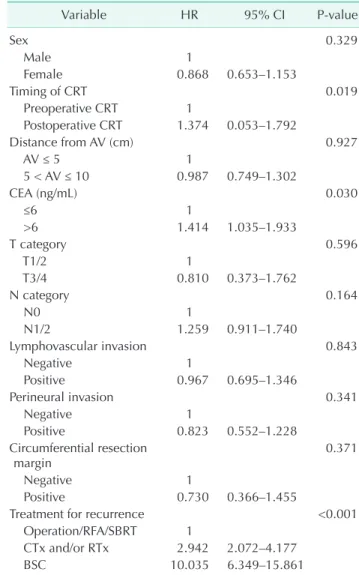
2). Multivariate analysis including sex, site, stage, timing of CRT, and pathologic features showed that CEA ≤ 6, and curative treatment of recurrence were associated with a better OS (Table 3). Similarly, preoperative CRT, CEA ≤ 6, and curative treatment of recurrence were associated with a better RFS (Table 4).
In the preoperative (35 patients) and postoperative (32 pa
tients) CRT groups of patients with liver or lung metastases, the 5year OS after recurrence were 29.4% vs. 22.3% (P = 0.159) and the 5year OS after recurrence were 58.0% vs. 44.0% (P = 0.290) in patients who received curative treatment for the recurrence.
Of 35 and 32 patients, 18 patients (51.4%) and 13 patients (40.6%) did not have another recurrence after curative treatment, re
spec tively (P = 0.208).
DISCUSSION
In the National Surgical Adjuvant Breast and Bowel Project R03 trial, preoperative CRT resulted in a significantly higher 5year RFS and a better 5year OS than postoperative CRT [8].
A representative study by the German Rectal Cancer Group showed that preoperative CRT provided better local control, toxicity profile, and sphincter preservation than postoperative CRT [4]. Since those reports, preoperative CRT followed by TME surgery has been extensively used and provides better local
Table 3. Multivariate analysis of factors associated with 5-year overall survival after treatment for a first recurrence of rectal cancer
Variable HR 95% CI P-value
Sex 0.498
Male 1
Female 0.903 0.673–1.212
Timing of CRT 0.397
Preoperative CRT 1
Postoperative CRT 1.138 0.844–1.534
Distance from AV (cm) 0.283
AV ≤ 5 1
5 < AV ≤ 10 0.853 0.638–1.140
CEA (ng/mL) 0.034
≤6 1
>6 1.402 1.026–1.915
T category 0.763
T1/2 1
T3/4 1.126 0.519–2.445
N category 0.245
N0 1
N1/2 1.215 0.875–1.686
Lymphovascular invasion 0.322
Negative 1
Positive 1.185 0.847–1.656
Perineural invasion 0.145
Negative 1
Positive 0.738 0.491–1.110
Circumferential resection
margin 0.838
Negative 1
Positive 0.931 0.468–1.853
Treatment for recurrence <0.001
Operation/RFA/SBRT 1
CTx and/or RTx 3.022 2.097–4.355
BSC 5.693 3.613–8.970
HR, hazard ratio; CI, confidence interval; CRT, chemoradio- therapy; AV, anal verge; SBRT, stereotactic body radiotherapy;
RFA, radiofrequency ablation; CTx, chemotherapy; RTx, radio- therapy; BSC, best supportive care.
Table 4. Multivariate analysis of factors associated with 5-year recurrence-free survival after treatment for a first re- currence of rectal cancer
Variable HR 95% CI P-value
Sex 0.329
Male 1
Female 0.868 0.653–1.153
Timing of CRT 0.019
Preoperative CRT 1
Postoperative CRT 1.374 0.053–1.792
Distance from AV (cm) 0.927
AV ≤ 5 1
5 < AV ≤ 10 0.987 0.749–1.302
CEA (ng/mL) 0.030
≤6 1
>6 1.414 1.035–1.933
T category 0.596
T1/2 1
T3/4 0.810 0.373–1.762
N category 0.164
N0 1
N1/2 1.259 0.911–1.740
Lymphovascular invasion 0.843
Negative 1
Positive 0.967 0.695–1.346
Perineural invasion 0.341
Negative 1
Positive 0.823 0.552–1.228
Circumferential resection
margin 0.371
Negative 1
Positive 0.730 0.366–1.455
Treatment for recurrence <0.001
Operation/RFA/SBRT 1
CTx and/or RTx 2.942 2.072–4.177
BSC 10.035 6.349–15.861
HR, hazard ratio; CI, confidence interval; CRT, chemoradio ther- apy; AV, anal verge; CEA, carcinoembryonic antigen; SBRT, stereo tactic body radiotherapy; RFA, radiofrequency ablation;
CTx, chemotherapy; RTx, radiotherapy; BSC, best supportive care.
control but no significant survival benefit [4,8,9]. Contrary to other reports, neither 5year OS nor 5year RFS in our study differed between the pre and postoperative CRT groups. The 5year OS was 82.1% vs. 79% and the 5year RFS 73% vs. 70.7%
in the pre and postoperative CRT groups, respectively, which did not differ significantly. Our study is important in that we investigated time to recurrence, recurrence pattern, and on
cologic survival after recurrence.
We found no significant difference in systemic and local re
cur rence between pre and postoperative CRT. Improvement in surgical techniques, such as TME, and radiotherapy have re
duced local recurrence rates in LARC. Several studies suggested that preoperative CRT had a major advantage over postoperative CRT in providing local control [4,10], but that was not found in the present study. In both groups, the local recurrence rate was less than 5%. This may be explained by the fact that TME was per formed well by experienced, skilled surgeons. Based on the circumferential resection margin, the success rate of TME is expected to be 98.7% and 97.9% in the pre and postoperative CRT groups, respectively. Because surgery results in increased fibrosis and decreased vascularity, CRT is assumed to provide greater benefit against local recurrence if given preoperatively.
However, in the present study, local recurrence did not differ between the 2 groups.
We found that time to both systemic and local recurrence tended to be longer in the postoperative than in the pre
opera tive CRT group, and time to overall recurrence of the post operative CRT group was also significantly longer. This might be due to the timing of chemotherapy. Sadahiro et al.
[11] indicated that chemotherapy significantly prolonged the time to recurrence in patients with colon or rectal cancer. Our result might also have been affected by the longer followup period (mean, 90 months) of the postoperative CRT group; six patients had a late recurrence: 5–10 years after surgery. In the preoperative CRT group, four patients had a recurrence that late, with a mean followup of 73 months. In terms of organspecific recurrence, the time to lung metastasis (23.04 months) was significantly longer than time to liver metastasis (15.39 months, P = 0.003). This is consistent with the hypothesis by Weiss et al. [12] that the hepatic capillary network may represent an effective filter into the systemic circulation.
The liver is the most common recurrence site in colon cancer [9,13,14], while the lung is the most common site in rectal cancer [7,15]. Yeo et al. [7] showed that recurrence site differed depending on the tumor site within the rectum, with lung metastasis more frequent in patients with low to midrectal cancer than upper rectal cancer. The present study found that mid to lowrectal cancers most frequently metastasized to the lung, followed by liver and distant LNs, regardless of the timing of CRT. The difference in these recurrence patterns is due to blood flow and lymphatic drainage [12,16]. Colon cancer cells
travel via the portal blood flow. Lymphatic vessels in the lower half of the rectum, however, travel via the midrectal vessels to the internal iliac nodes, so rectal cancer cells can travel via both systemic and portal blood flow. Weiss et al. [12] explained that the hepatic capillary network acts as an effective filter, trapping tumor emboli in the portal system and preventing their entry into the systemic circulation. These reasons explain why LARC metastasizes most frequently to the lung.
Neither the rate and pattern of recurrence nor the oncologic survival after recurrence did differ statistically between pre and postoperative CRT groups. The 5year OS rate after recurrence did not differ between the 2 groups, however, it showed mar
ginal benefit for oncologic survival in the preoperative CRT group (P = 0.051). This difference may be due to poorer com
pliance with treatment protocol in the postoperative CRT group than the preoperative CRT group, in accordance with the result of German study [4]. It may also be due to overstaging in the preoperative CRT group. The accuracy of current imaging modalities, such as TUS and MRI, for clinical staging of rectal can cer is only 30%–40% when combined with cT and cN cate
gories [1719]. Multivariate analysis showed that normal CEA level and presence of curative treatment were associated with 5year OS and RFS. Timing of CRT was also associated with 5year RFS, which, may be due to higher proportion of curative treatment in the preoperative CRT group. Curative resection or RFA and SBRT are the most important predictive factors for survival in patients with systemic recurrence of rectal cancer.
Curative treatment is often performed for patients with liver or lung metastases and in our study, the 5year OS after recurrence were 29.4% vs. 22.3% (P = 0.159) in the pre and postoperative CRT groups, respectively. However, it increased to 58.0% vs.
44.0% (P = 0.290) in patients who received curative treatment for the recurrence.
The choice of pre or postoperative CRT is generally deter
mined by the clinical stage based on imaging. However, due to the lack of accuracy of current imaging as noted above, this method for determining when CRT is administered may not be proper. In one study, more patients had a poor response (n = 357) to preoperative CRT and had worse oncologic out
comes than those who had a good response (n = 224) [20].
In another study, the stage after preoperative CRT for rectal cancer was closely correlated with recurrence free survival [21].
The controversy between pre and postoperative CRT lies in the overstaging of patients given preoperative CRT but who have a poor response. A supposed benefit of preoperative CRT is an increased chance of sphincter preservation [4,22,23].
In our study, there was a significant advantage of sphincter preservation in low rectal cancer in the preoperative CRT group (P = 0.002). However, despite this benefit, radiotherapy induced complications which resulted in permanent stoma were more frequent in the preoperative CRT group (P = 0.041).
The overall rates of sphincter preservation and permanent stoma between the 2 groups were compared and there was no significant difference (P = 0.381). The complications were anastomosis leakage (14), stricture (4), proctitis (3), fistula (3) in the preoperative CRT group and stricture (7), anastomosis leakage (3), fistula (1), proctitis (1) in the postoperative CRT group. Therefore, overuse of preoperative CRT must be avoided.
This study was retrospective and thus has limitations. First, some cases in the preoperative CRT group might have been overstaged because of the inaccuracy of imaging modalities.
Second, the followup period of the postoperative CRT group was slightly longer than that of the preoperative CRT group, since routine treatment for clinical stage T3 or nodepositive mid to lowrectal cancer was changed from postoperative to preoperative CRT between 2000 and 2010. However, the follow
up period after recurrence was similar between the 2 groups.
Third, we evaluated the first site of recurrence, which might underestimate the true incidence of recurrence and affect the recurrence analysis, including oncologic outcomes.
In conclusion, preoperative CRT increased sphincter preser
va tion in low rectal cancer patients, however, the rate of over all sphincter preservation did not differ between pre
and postoperative CRT groups. This is because there were
more radiation induced complications which resulted in per manent stoma in preoperative CRT group. There was no signi fi cant difference in systemic and local recurrence rates, in recurrence patterns, and in 5year OS after recurrence bet
ween preoperative and postoperative CRT. Preoperative and postoperative CRT are both safe and suitable treatment me
thods, so the choice can be tailored to the patient’s situation.
CONFLICTS OF INTEREST
No potential conflict of interest relevant to this article was reported.
ACKNOWLEDGEMENTS
This work was supported by grants to Jin Cheon Kim from the Korea Research Foundation (2013R1A2A2A03070986), Ministry of Science, ICT (Information and Communications Technologies) and Future Planning, the Korea Health 21 R&D Project (HI06C0868 and HI13C1750), and the Center for Development and Commercialization of AntiCancer Therapeutics (HI10C2014), Ministry of Health and Welfare, Republic of Korea.
1. Heald RJ, Ryall RD. Recurrence and sur
vi val after total mesorectal excision for rec tal cancer. Lancet 1986;1:147982.
2. Obrand DI, Gordon PH. Incidence and pat terns of recurrence following curative re sec tion for colorectal carcinoma. Dis Colon Rectum 1997;40:1524.
3. Tjandra JJ, Chan MK. Followup after cura
tive resection of colorectal cancer: a meta
an alysis. Dis Colon Rectum 2007;50:1783
99.
4. Sauer R, Becker H, Hohenberger W, Rodel C, Wittekind C, Fietkau R, et al. Pre op er a
tive versus postoperative chemo radio ther
apy for rectal cancer. N Engl J Med 2004;
351:173140.
5. Kobayashi H, Mochizuki H, Sugihara K, Morita T, Kotake K, Teramoto T, et al.
Char ac teristics of recurrence and sur veil
lance tools after curative resection for colo rec tal cancer: a multicenter study.
Surgery 2007;141:6775.
6. Merkel S, Mansmann U, Hohenberger W, Hermanek P. Time to locoregional recu
rrence after curative resection of rectal car cinoma is prolonged after neoadjuvant treat ment: a systematic review and meta
analysis. Colorectal Dis 2011;13:12331.
7. Yeo SG, Kim MJ, Kim DY, Chang HJ, Kim MJ, Baek JY, et al. Patterns of failure in pa
tients with locally advanced rectal can cer re ceiving preoperative or postop era tive chemoradiotherapy. Radiat Oncol 2013;8:
114.
8. Roh MS, Colangelo LH, O’Connell MJ, Yothers G, Deutsch M, Allegra CJ, et al.
Pre operative multimodality therapy im
proves diseasefree survival in patients with carcinoma of the rectum: NSABP R03. J Clin Oncol 2009;27:512430.
9. Park JH, Yoon SM, Yu CS, Kim JH, Kim TW, Kim JC. Randomized phase 3 trial com paring preoperative and postoperative chemo radiotherapy with capecitabine
for locally advanced rectal cancer. Cancer 2011;117:370312.
10. Guillem JG, Chessin DB, Cohen AM, Shia J, Mazumdar M, Enker W, et al. Longterm on cologic outcome following preoperative com bined modality therapy and total me sorectal excision of locally advanced rec tal cancer. Ann Surg 2005;241:82936.
11. Sadahiro S, Suzuki T, Ishikawa K, Naka
mura T, Tanaka Y, Masuda T, et al. Re
currence patterns after curative re sec tion of colorectal cancer in patients fol lowed for a minimum of ten years. Hepato
gastroenterology 2003;50:13626.
12. Weiss L, Grundmann E, Torhorst J, Hartveit F, Moberg I, Eder M, et al. Hae
ma to genous metastatic patterns in colo
nic carcinoma: an analysis of 1541 necro
psies. J Pathol 1986;150:195203.
13. Cho YB, Chun HK, Yun HR, Lee WS, Yun SH, Lee WY. Clinical and pathologic eval
u a tion of patients with recurrence of colo
REFERENCES
rec tal cancer five or more years after cu
ra tive resection. Dis Colon Rectum 2007;
50:120410.
14. Seo SI, Lim SB, Yoon YS, Kim CW, Yu CS, Kim TW, et al. Comparison of recurrence pat terns between ≤5 years and >5 years after curative operations in colorectal can
cer patients. J Surg Oncol 2013;108:913.
15. Ding P, Liska D, Tang P, Shia J, Saltz L, Goodman K, et al. Pulmonary re cur rence predominates after combined mo dality ther apy for rectal cancer: an ori gi nal retro spective study. Ann Surg 2012;256:
1116.
16. Hwang MR, Park JW, Kim DY, Chang HJ, Hong YS, Kim SY, et al. Prognostic im
pact of peritonealisation in rectal can cer treated with preoperative che mo radio
ther apy: extraperitoneal versus intra
peri toneal rectal cancer. Radiother Oncol 2010;94:3538.
17. Bipat S, Glas AS, Slors FJ, Zwinderman
AH, Bossuyt PM, Stoker J. Rectal cancer:
local staging and assessment of lymph node involvement with endoluminal US, CT, and MR imaginga metaanalysis.
Radiology 2004;232:77383.
18. Bosset JF, Calais G, Mineur L, Maingon P, RadosevicJelic L, Daban A, et al. Enhanced tumo rocidal effect of chemotherapy with pre operative radiotherapy for rectal can
cer: preliminary resultsEORTC 22921. J Clin Oncol 2005;23:56207.
19. Filippone A, Ambrosini R, Fuschi M, Marinelli T, Genovesi D, Bonomo L. Pre
op er ative T and N staging of colorectal can cer: accuracy of contrastenhanced multidetector row CT colonographyini
tial experience. Radiology 2004;231:8390.
20. Lim SB, Yu CS, Hong YS, Kim TW, Park JH, Kim JH, et al. Failure patterns cor relate with the tumor response after pre op era
tive chemoradiotherapy for locally ad
vanced rectal cancer. J Surg Oncol 2012;
106:66773.
21. Yoon WH, Kim HJ, Kim CH, Joo JK, Kim YJ, Kim HR. Oncologic impact of path
ologic response on clinical outcome after preoperative chemoradiotherapy in lo
cally advanced rectal cancer. Ann Surg Treat Res 2015;88:1520.
22. Crane CH, Skibber JM, Birnbaum EH, Feig BW, Singh AK, Delclos ME, et al. The addition of continuous infusion 5FU to pre operative radiation therapy increases tu mor response, leading to increased sphin cter preservation in locally advanced rec tal cancer. Int J Radiat Oncol Biol Phys 2003;57:849.
23. Weiser MR, Quah HM, Shia J, Guillem JG, Paty PB, Temple LK, et al. Sphinc
ter preservation in low rectal can cer is facilitated by preoperative chemo ra dia
tion and intersphincteric dissection. Ann Surg 2009;249:23642.