Outcomes of Combined Mitral Valve Repair and Aortic Valve Replacement
Background: The long-term results of combined mitral valve repair and aortic valve replacement (AVR) have not been well evaluated. This study was performed to investigate the early and long-term results of mitral valve repair with AVR.
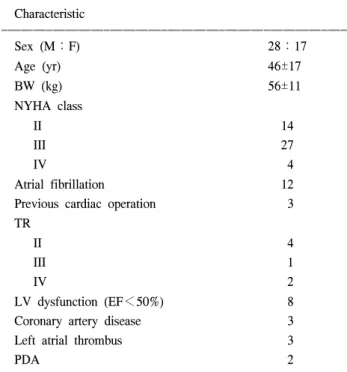
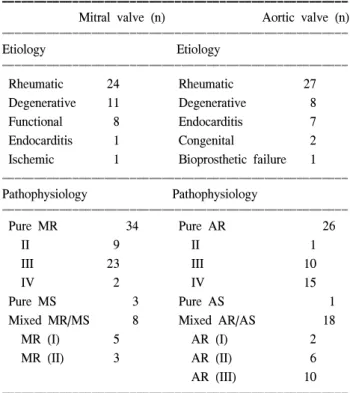
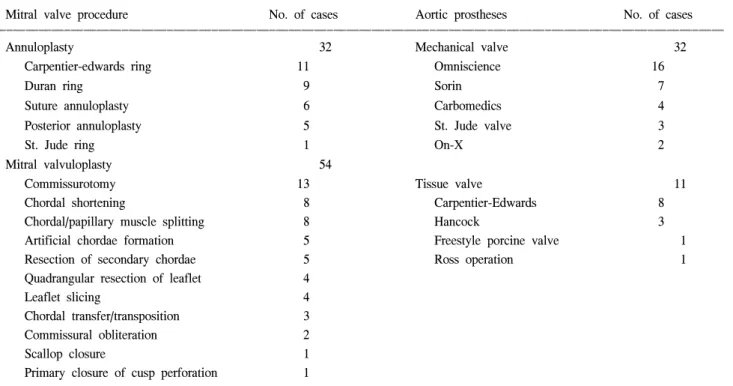
Material and Method: We retrospectively reviewed 45 patients who underwent mitral valve repair and AVR between September 1990 and April 2002. The average age was 47 years; 28 were men and 17 women. Twelve patients had atrial fibrillation and three had a previous cardiac operation. The mitral valve disease consisted of pure insufficiency (MR) in 34 patients, mitral stenosis (MS) in 3, and mixed lesion in 8. Mitral valve disease was due to rheumatic origin in 24 patients, degenerative in 11, annular dilatation in 8, and ischemia or endocarditis in 2. The functional anatomy of mitral valve was annular dilatation in 31 patients, chordal elongation in 19, leaflet thickening in 19, commissural fusion in 13, chordal fusion in 10, chordal rupture in 6, and so on. Aortic prostheses used included mechanical valve in 32 patients, tissue valve in 12, and pulmonary autograft in one. The techniques of mitral valve repair included annuloplasty in 32 patients and various valvuloplasty of 54 techniques in 29 patients. Total cardiopulmonary bypass and aortic cross clamp time were 204±62 minute and 153±57 minutes, respectively. Result:
Early death was in one patient due to low output syndrome (2.2%). After follow up of 57±37 months, late death was in one patient and the actuarial survival at 10 years was 96±4%. Recurrent MR developed grade II or III in 11 patients and moderate MS in 3.
Three patients required reoperation for valve-related complications. The actuarial freedom from recurrent MR, MS, and reoperation were 64±11%, 86±8%, and 89±7% respectively.
Conclusion:Combined mitral valve repair with
대동맥판막 치환술과 동반시행한 승모판막 성형술 결과
AVR offers good early and long-term survival, and adequate techniques and selection of indication of mitral valve repair, especially in rheumatic disease, are prerequisites for better long-term results.
(Korean J Thorac Cardiovasc Surg 2003;36:463-471) Key words
: 1. Mitral valve, repair2. Aortic valve, replacement
Table 1. Patient characteristics
Table 3. Pathologic anatomy of mitral and aortic valve Table 2. Etiology and pathophysiology of valvular disease
Table 4. Operative procedures
Fig. 1. Freedom from recurrent mitral stenosis. Fig. 3. Freedom from valve-related reoperation for mitral or aortic valve disease.
Fig. 2. Freedom from recurrent mitral regurgitation.
=국문 초록=
배경:
대상 및 방법:
결과:
결론:
중심 단어