• 검색 결과가 없습니다.

Outcomes of Mitral Valve Repair: Quadrangular Resection versus Chordal Replacement

N/A
N/A
Protected

Academic year: 2021

Share "Outcomes of Mitral Valve Repair: Quadrangular Resection versus Chordal Replacement"

Copied!
6
0
0

로드 중.... (전체 텍스트 보기)

전체 글

(1)

http://dx.doi.org/10.5090/kjtcs.2013.46.2.124 ISSN: 2233-601X (Print) ISSN: 2093-6516 (Online)

Department of Thoracic and Cardiovascular Surgery, Dong-A University Medical Center, Dong-A University College of Medicine

†This article was presented at the 43th autumn scientific meeting of The Korean Society for Thoracic and Cardiovascular Surgery.

Received: July 11, 2012, Revised: October 12, 2012, Accepted: October 17, 2012

Corresponding author: Jong Soo Woo, Department of Thoracic and Cardiovascular Surgery, Dong-A University Medical Center, Dong-A University College of Medicine, 1 Dongdaesin-dong 3(sam)-ga, Seo-gu, Busan 602-715, Korea

(Tel) 82-51-240-5195 (Fax) 82-51-231-5195 (E-mail) [email protected]

C

The Korean Society for Thoracic and Cardiovascular Surgery. 2013. All right reserved.

CC
This is an open access article distributed under the terms of the Creative Commons Attribution Non-Commercial License (http://creative- commons.org/licenses/by-nc/3.0) which permits unrestricted non-commercial use, distribution, and reproduction in any medium, provided the original work is properly cited.

Outcomes of Mitral Valve Repair: Quadrangular Resection versus Chordal Replacement

Kwon-Jae Park, M.D., Jong Soo Woo, M.D., Jung Hoon Yi, M.D., Jong Yoon Park, M.D.

Background: Mitral valve repair for posterior mitral leaflet (PML) prolapse has been considered to be a standard treatment because of its high success rate and high level of patient satisfaction. The aim of this study was to evaluate the clinical results of two different techniques of PML prolapse, quadrangular resection (QR) and chordal replacement (CR). Materials and Methods: The subjects consisted of 56 patients who had undergone mitral valve repair for PML prolapse between November 1997 and December 2010. The patients were divided into two groups according to surgical technique. Among them, 31 patients underwent QR (group QR) and 25 patients had CR (group CR). We reviewed the medical records of the patients retrospectively to compare the clinical outcomes of both groups. Results: After mitral valve repair, the degree of mitral regurgitation (MR) in both groups decreased to the to a mild degree or less and the amount of remnant MR was slightly higher in the CR group but it was not statistically different. Three patients received mitral valve-related reoperation (2 in the QR group and 1 in the CR group). Freedom from mitral valve-related reoperation at 7 years was 93% for the QR group and 96% for the CR group and was not significantly different between the two groups. Conclusion: Both QR and CR showed excellent long-term results and were considered equally effective methods for PML prolapse.

Key words: 1. Mitral valve

2. Mitral valve prolapse 3. Chordae tendineae

INTRODUCTION

Mitral valve repair is the treatment of choice for patients with severe mitral regurgitation (MR) of posterior mitral leaflet (PML) prolapse. Although a variety of techniques are available, quadrangular resection (QR) or chordal replace- ment (CR) is the most frequently performed technique for the repair of PML prolapse. QR has been the standard tech- nique with documented excellent long term results [1].

However, several problems, such as left ventricular outflow

tract obstruction, kicking in the circumflex artery and leaflet restriction have been reported in this technique [2,3]. To overcome these problems and restore a larger coaptation sur- face for the mitral valve, a method for CR preserving PML tissue with extended polytetrafluoroethylene (ePTFE) has been developed to facilitate mitral valve repair and numerous studies have reported excellent long term results [4-6].

However, little is known of the results of CR in comparison

to leaflet resection. The aim of the present study is to eval-

uate the clinical results of mitral valve repair, comparing CR

(2)

Table 1. Preoperative patient characteristics and echocardiographic findings

Characteristic Group QR Group CR p-value Number

Age (yr) Sex (male:female) Follow-up period (mo) NYHA class

Ejection fraction (%) MR grade

LA dimension (mm) LVEDD (mm)

31 56.2±14.7 17 (55):14 (45)

71.7±46.1 3.0±0.7 61.6±8.4 2.9±0.3 54.3±9.7 60.3±7.9

25 56.3±13.1 15 (60):10 (40)

63.5±32.9 2.7±0.9 65.4±5.8 2.8±0.3 49.2±10.0 56.5±8.6

0.973 0.698 0.460 0.158 0.070 0.716 0.080 0.109 Values are presented as mean±standard deviation or number (%). Ordinal values are expressed as follows: none, 0; mild, 1;

moderate, 2; severe, 3.

QR, quadrangular resection; CR, chordal replacement; NYHA, New York Heart Association; MR, mitral regurgitation; LA, left atrium; LVEDD, left ventricular end diastolic dimension.

Table 2. Surgical data

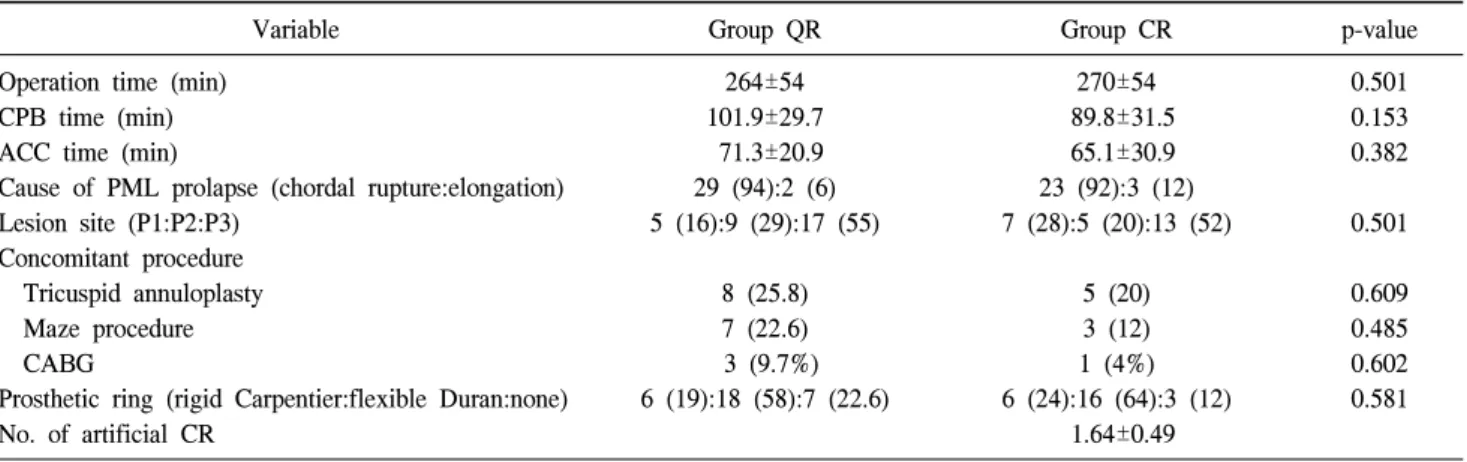
Variable Group QR Group CR p-value

Operation time (min) CPB time (min) ACC time (min)

Cause of PML prolapse (chordal rupture:elongation) Lesion site (P1:P2:P3)

Concomitant procedure Tricuspid annuloplasty Maze procedure CABG

Prosthetic ring (rigid Carpentier:flexible Duran:none) No. of artificial CR

264±54 101.9±29.7 71.3±20.9 29 (94):2 (6) 5 (16):9 (29):17 (55)

8 (25.8) 7 (22.6) 3 (9.7%) 6 (19):18 (58):7 (22.6)

270±54 89.8±31.5 65.1±30.9 23 (92):3 (12) 7 (28):5 (20):13 (52)

5 (20) 3 (12) 1 (4%) 6 (24):16 (64):3 (12)

1.64±0.49

0.501 0.153 0.382

0.501

0.609 0.485 0.602 0.581

Values are presented as mean±standard deviation or number (%).

QR, quadrangular resection; CR, chordal replacement; CPB, cardiopulmonary bypass; ACC, aortic cross clamp; PML, posterior mi- tral leaflet; CABG, coronary artery bypass grafting.

and QR.

MATERIALS AND METHODS 1) Patients

From November 1997 to December 2010, 56 patients with PML prolapse who underwent mitral valve repair were in- cluded in the present study. Based on the surgical technique, the patients were classified into one of two groups: group QR (n=31) or group CR (n=25). Details on preoperative pa-

tient characteristics and echocardiographic findings are sum- marized in Table 1. The longest follow-up interval was 161 months in group QR and 124 in group CR, and the median follow-up period was 58 months in group QR and 69 in group CR.

2) Surgical procedures

The operative approach was a standard median sternotomy and cardiopulmonary bypass was initiated with an ascending aortic and two vena caval cannulations in all patients. Cold blood cardioplegia was used for heart arrest and protection.

The mitral valve was exposed through an interatrial groove

and tested with a valve hook and saline test. Prosthetic ring

annuloplasty (Carpentier-Edwards ring, Edwards Lifesciences,

Irvine, CA, USA; Duran annuloplasty ring, Medtronic, Min-

neapolis, MN, USA) was performed with 10 to 14 interrupted

2-0 Ticron sutures. The size of the ring was chosen according

to the intertrigonal or intercommissural distance. In group

QR, a prolapsed segment of the PML was resected and the

leaflet continuity was restored with several simple interrupted

sutures and ring annuloplasty was performed. In group CR, a

4-0 or 5-0 double armed ePTFE suture was passed through

the tip of a papillary muscle. The two arms of the suture

were passed through the free margin of the prolapsed seg-

ment of PML at 2 to 3 mm distance. The suture was tied,

adjusting the appropriate chorda length, and ring annuloplasty

was performed.

(3)

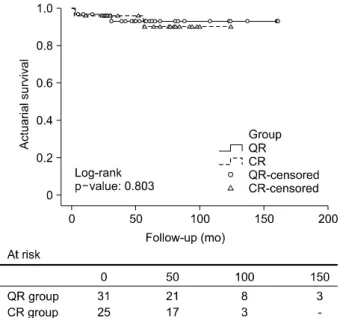
Fig. 1. Kaplan-Meier estimate of actuarial survival for 51 patients who underwent quadrangular resection (QR) or chordal replace- ment (CR).

Table 3. Postoperative echocardiographic data

Variable Group QR Group CR p-value

Ejection fraction (%) LA dimension (mm) LVED dimension (mm) Mean rMR

Significant rMR (more than moderate grade) MOA (cm²)

PISA (cm)

Regurgitant volume (mL)

57.7±11.2 44.6±8.0 48.7±9.5 0.66±0.73

2 (6.5)

2.35±0.59 0.10±0.18 4.2±8.4

59.7±9.2 42.7±10.4 50.8±4.1 0.82±0.64

3 (12)

2.15±0.65 0.23±0.28 12.4±15.3

0.510 0.510 0.322 0.400 0.647

0.369 0.136 0.083 Values are presented as mean±standard deviation or number (%). Ordinal values are expressed as follows: none, 0; mild, 1;

moderate, 2; severe, 3.

QR, quadrangular resection; CR, chordal replacement; LA, left atrium; LVED, left ventricular end diastolic; rMR, remnant mi- tral regurgitation; MOA, mitral orifice area; PISA, proximal isovelocity surface area.

3) Statistical analysis

All analyses were performed with IBM SPSS ver. 19.0 (IBM Co., Armonk, NY, USA). Continuous variables are ex- pressed as the mean±standard deviation and categorical varia- bles as percentages. Categorical data were compared by the χ

2

test and continuous data by the Student’s unpaired t-test and paired t-test. The Kaplan-Meier test was used to estimate the actuarial freedom from reoperation and survival rate. The log-rank method was used to determine statistical differences between groups.

RESULTS

The mean operation time was 265.3±54 minutes, the mean cardiopulmonary bypass time was 96.4±30.8 minutes, and the mean aortic cross clamp time was 68.5±25.8 minutes. The chordal rupture was the most common cause of PML pro- lapse and the P3 segment was the most frequently involved.

The prosthetic ring was not inserted in 10 patients (Table 2).

One patient in group CR died in the early postoperative peri- od, and the cause of death was sepsis. Three patients (2 in group QR, 1 in group CR) died in the late postoperative peri-

od and the reasons for the late deaths were traumatic intra- cerebral hemorrhage, renal failure in group QR, and acute myocardial infarction in group CR. The actuarial survival rate at 1, 5, and 7 years was 97%, 93%, and 93% in group QR and 96%, 90%, and 90% in group CR with no significant difference in the two groups’ survival rates (log-rank p=

0.803) (Fig. 1).

The echocardiographic data were obtained at least 6 months after surgery at last follow-up in all patients except one reoperative case in group CR (mean interval, 35.1±36.3 months). When the ordinal grade of MR was transformed into a numerical value (none, 0; mild, 1; moderate, 2; severe, 3), the mean grade of remnant mitral regurgitation (rMR) was decreased to less than mild in the patients overall (0.73±

0.69). The mean grade of rMR was 0.66±0.73 in the QR group and 0.82±0.64 in the CR group, with no significant difference between the two groups. In this series, there was no benefit for the CR group compared with the QR group with respect to mitral orifice area (MOA). Overall, the mean MOA was 2.25±0.62 cm

2

and the two groups did not differ significantly (Table 3). When comparing data within each group, it was recognized that the echocardiographic outcomes were improved after the surgery (Table 4).

Among the five patients with significant rMR, two patients

in group QR and one in group CR required mitral valve-re-

(4)

Table 4. Echocardiographic data before and after the surgery

Variable Group QR Group CR

Preoperative Postoperative p-value Preoperative Postoperative p-value MR grade

EF (%)

LA dimension (mm) LVED dimension (mm) NYHA class

2.87±0.32 61.6±8.4 54.3±9.7 60.3±7.9 2.98±0.66

0.66±0.73 57.7±11.2 44.6±8.0 48.7±9.5 1.52±0.74

0.000 0.267 0.002 0.000 0.000

2.84±0.31 65.4±5.8 49.2±10.0

56.5±8.6 2.73±0.94

0.82±0.64 59.7±9.2 42.7±10.4

50.8±4.1 1.69±0.76

0.000 0.048 0.004 0.001 0.000 Values are presented as mean±standard deviation. Ordinal values are expressed as follows: none, 0; mild, 1; moderate, 2; severe, 3.

MR, mitral regurgitation; EF, ejection fraction; LA, left atrium; LVED, left ventricular end diastolic; NYHA, New York Heart Association; QR, quadrangular resection; CR, chordal replacement.

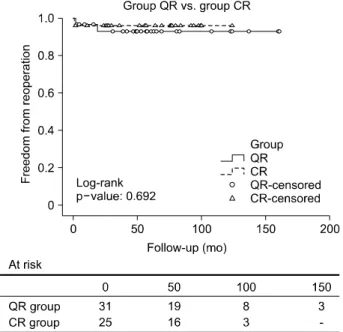
Fig. 3. Kaplan-Meier curve of actuarial freedom from reoperation between group quadrangular resection (QR) and group chordal re- placement (CR).

Fig. 2. Kaplan-Meier curve of actuarial freedom from reoperation.

lated reoperation and the reasons for reoperation were de- hiscence between reapproximated valve remnants and chordal rupture in another PML segment in group QR, and the ag- gravation of rMR in group CR. Two patients who did not re- ceive reoperation have been observed in the outpatient depart- ment because symptoms and pulmonary pressure were within tolerable range. Overall, freedom from mitral valve-related re- operation at 1, 5, and 7 years was 95%, 94%, and 94% (Fig.

2). By group, the freedom from mitral valve-related reopera- tion at 1, 5, and 7 years was 96%, 93%, and 93% in group QR and 96%, 96%, and 96% in group CR, and there was no statistical difference between the two groups (log-rank p=0.692) (Fig. 3).

DISCUSSION

Significant MR should be treated to preserve left ven-

tricular function and improve long term survival [7,8]. With

regard to correcting MR, mitral valve repair is preferred to

replacement because it has no possibilities of anticoagulant or

prosthesis-related complications and is favorable to cardiac

function [9-11]. PML prolapse causes significant MR more

frequently than anterior mitral leaflet prolapse or prolapse of

both leaflets. Several techniques have been proposed to repair

PML prolapse. QR and CR are the most popular techniques

(5)

and have shown excellent long-term results [12-16].

In this series, we compared the clinical outcomes of both techniques for repairing PML prolapse. Both outcomes were relatively favorable, and there were no significant differences between the groups regarding clinical data such as mortality rate, operation time, reexploration rate for bleeding, post- operative cerebral events, and symptomatic status.

It is known that the incidence of reoperation is equally low with CR and QR [17,18]. When comparing both methods for mitral valve-related reoperation, it was reported that CR is slightly better than QR in other series [19]. However, we found that they were not statistically different and showed high freedom from mitral valve-related reoperation. It is thought that if PML prolapse is successfully repaired, the long-term durablility of mitral valve structure can be equally achieved by both techniques.

It is important how often MR recurs after mitral valve repair. In other series, only a small portion of patients (3.8%) who underwent CR showed moderate MR at follow-up [20].

In the present series, 2 of 31 patients (6.5%) who underwent QR showed moderate to severe MR and 3 of 26 patients (12%) who had CR showed moderate to severe MR. Our re- sults showed a slightly higher recurrence rate of moderate to severe MR than other studies. Postoperative echocardiography revealed that group CR had a higher volume of remnant re- gurgitation than group QR even though it was not sig- nificantly different. Thus it should be noted that CR is usu- ally successful for repairing PML prolapse but is technically more demanding and has a possibility of leaving more rem- nant MR than QR in spite of intraoperative echocardiographic examination. For this reason, we have initially performed CR for PML prolapse to preserve the leaflet tissue. However, in case it was not successful, it was abandoned and QR was employed.

CR is superior for preserving native leaflet tissue, leaflet motion, and mitral valve orifice area and avoiding the possi- bility of left outflow tract obstruction compared to QR [21].

However, QR can be easily performed and has more ex- tensive evidence of excellent results in repairing PML pro- lapse than CR. Therefore, it is thought that both techniques have their own benefits relative to each other.

To achieve a larger MOA is one of the major goals of mi-

tral valve repair [22]. It was reported that CR would produce a longer coaptation line than QR, but it failed to demonstrate a greater MOA [20]. We found that CR did not show a larg- er MOA (2.35 cm

2

vs. 2.15 cm

2

, p=0.369) and it is presumed that the amount of resected leaflet tissue was not excessive by QR because most of the prolapsed segments were not P2.

This study is a retrospective analysis with all of its weak points and had a relatively small number of patients.

Follow-up echocardiography for each patient was performed at different intervals and might have been more likely to be performed in symptomatic patients than asymptomatic patients.

CONCLUSION

Clinical results of both QR and CR were excellent and equally effective for repair of PML prolapse, and the majority of patients experienced symptomatic improvement. Therefore, the choice between QR and CR should be individualized cor- responding to the technical feasibility and valvular structure.

CONFLICT OF INTEREST

No potential conflict of interest relevant to this article was reported.

REFERENCES

1. Deloche A, Jebara VA, Relland JY, et al. Valve repair with Carpentier techniques: the second decade. J Thorac Cardio- vasc Surg 1990;99:990-1001.

2. Jebara VA, Mihaileanu S, Acar C, et al. Left ventricular out- flow tract obstruction after mitral valve repair: results of the sliding leaflet technique. Circulation 1993;88(5 Pt 2): II30-4.

3. Da Col U, Di Bella I, Bardelli G, Koukoulis G, Ramoni E, Ragni T. Triangular resection and folding of posterior leaflet for mitral valve repair. J Card Surg 2006;21:274-6.

4. David TE, Omran A, Armstrong S, Sun Z, Ivanov J. Long- term results of mitral valve repair for myxomatous disease with and without chordal replacement with expanded poly- tetrafluoroethylene sutures. J Thorac Cardiovasc Surg 1998;

115:1279-85.

5. Salvador L, Mirone S, Bianchini R, et al. A 20-year experi-

ence with mitral valve repair with artificial chordae in 608

patients. J Thorac Cardiovasc Surg 2008;135:1280-7.

(6)

6. Perier P, Hohenberger W, Lakew F, et al. Toward a new paradigm for the reconstruction of posterior leaflet prolapse:

midterm results of the “respect rather than resect” approa- ch. Ann Thorac Surg 2008;86:718-25.

7. Ling LH, Enriquez-Sarano M, Seward JB, et al. Clinical out- come of mitral regurgitation due to flail leaflet. N Engl J Med 1996;335:1417-23.

8. Wisenbaugh T, Skudicky D, Sareli P. Prediction of outcome after valve replacement for rheumatic mitral regurgitation in the era of chordal preservation. Circulation 1994;89:191-7.

9. Gillinov AM, Blackstone EH, Nowicki ER, et al. Valve re- pair versus valve replacement for degenerative mitral valve disease. J Thorac Cardiovasc Surg 2008;135:885-93, 893.e1- 2.

10. Shuhaiber J, Anderson RJ. Meta-analysis of clinical out- comes following surgical mitral valve repair or replacement.

Eur J Cardiothorac Surg 2007;31:267-75.

11. Baek MJ, Na CY, Oh SS, et al. Mitral valve reconstruction in patients with moderate to severe left ventricular dysfunc- tion. Korean J Thorac Cardiovasc Surg 2003;36:812-9.

12. Johnston DR, Gillinov AM, Blackstone EH, et al. Surgical repair of posterior mitral valve prolapse: implications for guidelines and percutaneous repair. Ann Thorac Surg 2010;

89:1385-94.

13. Perier P, Stumpf J, Gotz C, et al. Valve repair for mitral re- gurgitation caused by isolated prolapse of the posterior leaflet. Ann Thorac Surg 1997;64:445-50.

14. Aoyagi S, Tanaka K, Kawara T, Oryoji A, Kosuga K, Oishi K. Long-term results of mitral valve repair for non-rheu-

matic mitral regurgitation. Cardiovasc Surg 1995;3:387-92.

15. Seeburger J, Kuntze T, Mohr FW. Gore-tex chordoplasty in degenerative mitral valve repair. Semin Thorac Cardiovasc Surg 2007;19:111-5.

16. Lee JW, Lim HJ, Jung SH, et al. Midterm results of mitral valve repair by the new chordae formation technique.

Korean J Thorac Cardiovasc Surg 2001;34:329-37.

17. Chiappini B, Sanchez A, Noirhomme P, et al. Replacement of chordae tendineae with polytetrafluoroethylene (PTFE) su- tures in mitral valve repair: early and long-term results. J Heart Valve Dis 2006;15:657-63.

18. Nardi P, Pellegrino A, Scafuri A, et al. Survival and dura- bility of mitral valve repair surgery for degenerative mitral valve disease. J Card Surg 2011;26:360-6.

19. Seeburger J, Falk V, Borger MA, et al. Chordae replace- ment versus resection for repair of isolated posterior mitral leaflet prolapse: a egalite. Ann Thorac Surg 2009;87:1715- 20.

20. Rankin JS, Orozco RE, Rodgers TL, Alfery DD, Glower DD. “Adjustable” artificial chordal replacement for repair of mitral valve prolapse. Ann Thorac Surg 2006;81:1526-8.

21. Filsoufi F, Carpentier A. Principles of reconstructive surgery in degenerative mitral valve disease. Semin Thorac Cardio- vasc Surg 2007;19:103-10.

22. Falk V, Seeburger J, Czesla M, et al. How does the use of

polytetrafluoroethylene neochordae for posterior mitral valve

prolapse (loop technique) compare with leaflet resection?: a

prospective randomized trial. J Thorac Cardiovasc Surg

2008;136:1205.

수치

Table 2. Surgical data
Fig. 1. Kaplan-Meier estimate of actuarial survival for 51 patients  who underwent quadrangular resection (QR) or chordal  replace-ment (CR).
Fig. 3. Kaplan-Meier curve of actuarial freedom from reoperation  between group quadrangular resection (QR) and group chordal  re-placement (CR).

참조

관련 문서

(바) “액체 밀봉드럼 (Liquid seal drum)”이라 함은 플레어스택의 화염이 플레어시 스템으로 거꾸로 전파되는 것을 방지하거나 또는 플레어헤더에

• 글로벌 거버넌스란 국제사회에서 과거 주권국가들이 유읷핚 행위자로서 그들의 관계로 형성되었던 국제관계가 다양핚 다른 행위자들이 등장하고 새로욲 행위자들이 국가들과

CFS = Container freight station where containers are stuffed and unstuffed MT Depot = area for storing empty containers. M&R = maintenance and repair of containers

By plotting a series of the free energy-composition curves at different temperatures we established the manner in which the phase compositions changes with temperature. In

Sandberg D, Lavyne M (1999) Symptomatic spinal epidural lipomatosis after local epidural corticosteroid injections:

Thermal balloon ablation versus endometrial resection for the treatment of abnormal uterine bleeding. Thermal balloon ablation in myoma-induced menorrhagia

Chang Goo Kang, Ah Hyun Park, Jang Ho Ha, Young Soo Kim, Joon-Ho Oh, Jeong Min Park, Soo Mee Kim, Seung-Jae Lee, Seung Hee Lee, and Han Soo Kim(KAERI). Fabrication

P04G02 Design and Fabrication of Irradiation Testing Capsule for Research Reactor Materials Seong Woo Yang, Bong Goo Kim, Seung Jae Park, Man Soon Cho, Kee Nam Choo, Jong Myeong