• 검색 결과가 없습니다.

Postoperative Outcomes of Mitral Valve Repair for Mitral Restenosis after Percutaneous Balloon Mitral Valvotomy

N/A
N/A
Protected

Academic year: 2021

Share "Postoperative Outcomes of Mitral Valve Repair for Mitral Restenosis after Percutaneous Balloon Mitral Valvotomy"

Copied!
7
0
0

로드 중.... (전체 텍스트 보기)

전체 글

(1)

ISSN: 2233-601X (Print) ISSN: 2093-6516 (Online)

Department of Thoracic and Cardiovascular Surgery, Konkuk University Medical Center, Konkuk University School of Medicine Received: September 16, 2014, Revised: October 28, 2014, Accepted: November 7, 2014, Published online: October 5, 2015 Corresponding author: Je Kyoun Shin, Konkuk University Medical Center, 120-1 Neungdong-ro, Gwangjin-gu, Seoul 05030, Korea

(Tel) 82-2-2030-7595 (Fax) 82-2-2030-5009 (E-mail) [email protected]

C

The Korean Society for Thoracic and Cardiovascular Surgery. 2015. All right reserved.

CC

This is an open access article distributed under the terms of the Creative Commons Attribution Non-Commercial License (http://creative- commons.org/licenses/by-nc/4.0) which permits unrestricted non-commercial use, distribution, and reproduction in any medium, provided the original work is properly cited.

Postoperative Outcomes of Mitral Valve Repair for Mitral Restenosis after Percutaneous Balloon Mitral Valvotomy

Seong Lee, M.D., Hyun Keun Chee, M.D., Jun Seok Kim, M.D., Myong Gun Song, M.D., Jae Bum Park, M.D., Je Kyoun Shin, M.D.

Background: There have been a number of studies on mitral valve replacement and repeated percutaneous mitral balloon valvotomy for mitral valve restenosis after percutaneous mitral balloon valvotomy. However, studies on mitral valve repair for these patients are rare. In this study, we analyzed postoperative outcomes of mitral valve repair for mitral valve restenosis after percutaneous mitral balloon valvotomy. Methods: In this study, we assessed 15 pa- tients (mean age, 47.7±9.7 years; 11 female and 4 male) who underwent mitral valve repair between August 2008 and March 2013 for symptomatic mitral valve restenosis after percutaneous mitral balloon valvotomy. The mean in- terval between the initial percutaneous mitral balloon valvotomy and the mitral valve repair was 13.5±7 years. The mean preoperative Wilkins score was 9.4±2.6. Results: The mean mitral valve area obtained using planimetry in- creased from 1.16±0.16 cm

2

to 1.62±0.34 cm

2

(p=0.0001). The mean pressure half time obtained using Doppler ul- trasound decreased from 202.4±58.6 ms to 152±50.2 ms (p=0.0001). The mean pressure gradient obtained using Doppler ultrasound decreased from 9.4±4.0 mmHg to 5.8±1.5 mmHg (p=0.0021). There were no early or late deaths. Thromboembolic events or infective endocarditis did not occur. Reoperations such as mitral valve repair or mitral valve replacement were not performed during the follow-up period (39±16 months). The 5-year event-free survival was 56.16% (95% confidence interval, 47.467–64.866). Conclusion: On the basis of these results, we could not conclude that mitral valve repair could be an alternative for patients with mitral valve restenosis after percutaneous balloon mitral valvotomy. However, some patients presented with results similar to those of mitral valve replacement. Further studies including more patients with long-term follow-up are necessary to determine the possibility of this application of mitral valve repair.

Key words: 1. Restenosis 2. Mitral valve, repair

3. Percutaneous mitral balloon valvotomy 4. Complication

INTRODUCTION

Percutaneous mitral balloon valvotomy (PMV) has been used widely for mitral stenosis since it was introduced in 1984 by Inoue et al. [1]. Further, symptomatic mitral valve restenosis after PMV occurs at the rate of 7% to 23% [2,3].

Treatment modalities in these cases include mitral valve re-

placement and repeated PMV. With respect to repeated PMV,

recent studies have presented good intermediate and long-term

outcomes [4,5]. Nevertheless, mitral valve replacement is usu-

ally preferred [6,7]. A number of studies have demonstrated

the possibility of mitral valve repair for rheumatic mitral

http://dx.doi.org/10.5090/kjtcs.2015.48.5.328

(2)

Table 1. Preoperative baseline characteristics of patients

Variable Value

Age (yr) 47±10 (31–64)

Sex (male/female) 4/11

Interval time (yr) between PMV and mitral valvuloplasty

13±7 (3–25)

Functional class (New York Heart Association)

I 0

II 6 (40)

III 8 (53.3)

IV 1 (6.7)

Rhythm

Atrial fibrillation 9 (60)

Previous thromboembolism 2 (13.3)

Left atrial thrombosis 2 (13.3)

Second PMV 4 (26.7)

Echocardiographic score (Wilkins score) 9.4±2.6 Left atrial dimension (mm) 56.9±12.3 Mitral regurgitation

Grade 1 3 (20)

Grade 2 2 (13.3)

Grade 3 0

Grade 4 0

Tricuspid regurgitation

Grade 1 5 (33.3)

Grade 2 3 (20)

Grade 3 0

Grade 4 0

Values are presented as mean±standard deviation (range), num- ber (%), or mean±standard deviation.

PMV, percutaneous balloon mitral valvotomy.

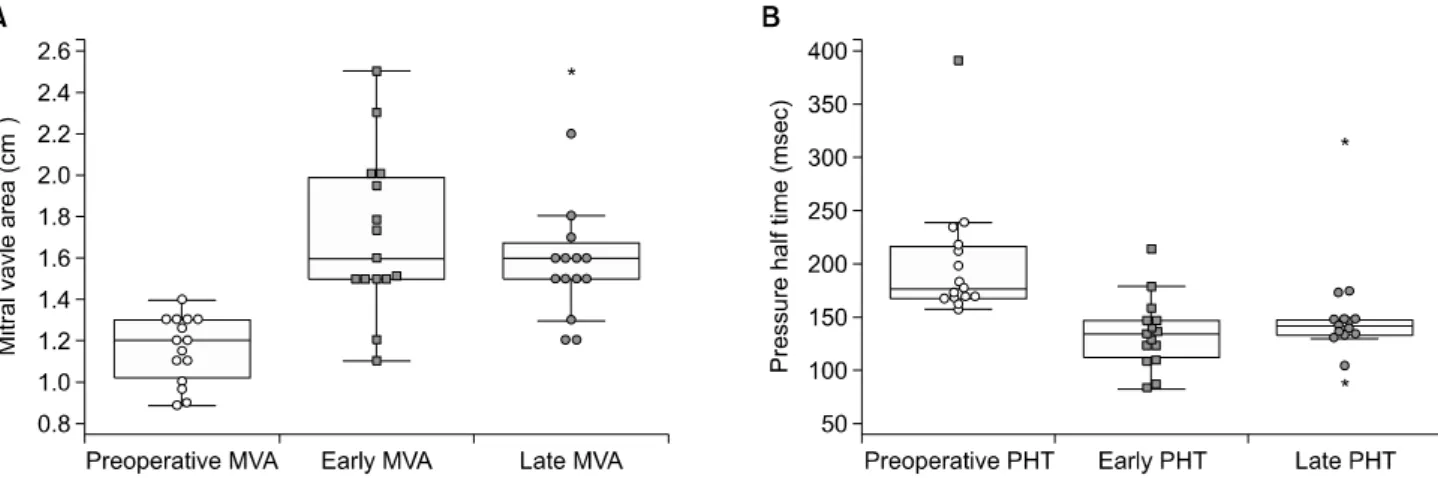
Fig. 1. (A) Comparison of preoperative and postoperative mitral valve area. (B) Comparison of preoperative and postoperative pressure half time. MVA, mitral valve area; PHT, pressure half time.

valve diseases, which were mostly mixed with stenosis and regurgitation [8-14]. However, mitral valve repair for rheu- matic mitral valve stenosis is still uncommon. Accordingly, few reports on mitral valve repair for mitral valve restenosis after PMV have been published. In this study, we assessed postoperative outcomes of mitral valve repair for symptomatic mitral valve restenosis after PMV.

METHODS

Between August 2008 and March 2013, 22 patients under- went mitral valve surgery for mitral valve disease at our cen- ter after they had undergone PMV for rheumatic mitral valve stenosis at different hospitals. Patients were excluded if they had significant (>grade 2) mitral regurgitation because this factor could affect the analyses by confounding variables and we were concerned about mitral valve restenosis after PMV.

Three patients did not undergo follow-up echocardiography.

In the end, 15 patients formed the subject population of this study. Preoperative baseline characteristics are given in Table 1.

Mitral valve replacement was recommended to eight patients (53.3%) at different centers before visits to our center. The mean preoperative left ventricular ejection fraction was 59.5%

±7.9%. The mean mitral valve area was 1.15±0.16 cm

2

(Fig.

1A), and the mean pressure half time was 202.4±58.6 ms (Fig. 1B).

Right anterolateral thoracotomy was performed in 13 pa-

tients as a standard approach of surgery for mitral valve dis-

(3)

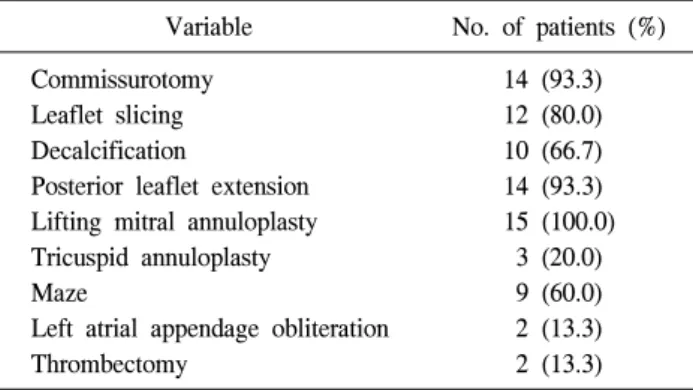
Table 2. Surgical technique for mitral valve repair and concomitant procedures

Variable No. of patients (%)

Commissurotomy 14 (93.3)

Leaflet slicing 12 (80.0)

Decalcification 10 (66.7)

Posterior leaflet extension 14 (93.3) Lifting mitral annuloplasty 15 (100.0)

Tricuspid annuloplasty 3 (20.0)

Maze 9 (60.0)

Left atrial appendage obliteration 2 (13.3)

Thrombectomy 2 (13.3)

Fig. 2. Comparison of preoperative and postoperative New York Heart Association (NYHA) functional class.

ease or tricuspid valve disease at our center. Median sternot- omy was performed in two patients who had very moderate forced expiratory volume to achieve one-lung ventilation.

Each valve was assessed in direct vision and via intraope- rative transesophageal echocardiography. All operations were performed by the same surgeon. Surgical techniques utilized for mitral valve repair and concomitant procedures are listed in Table 2. Posterior leaflet extension was performed with bovine pericardium (Supple Peri-Guard Repair Patch, 6×8 cm Synovis; Jisang International Inc., Seoul, Korea). Lifting mi- tral annuloplasty was performed with a mitral strip (Mitracon, Mitral Annuloplasty Ring, Mitracon Strip; Sciencity Co. Ltd., Seoul, Korea). Tricuspid annuloplasty was performed with a Carpentier- Edward ring.

Demographic clinical variables were collected retrospec- tively with a review of medical records. The optimal echo- cardiographic outcome was defined as a mitral valve area of more than 1.5 cm

2

and a pressure half time of less than 150 ms. Event-free survival means that in addition to these hemo- dynamic parameters, the New York Heart Association func- tional class (NYHA Fc) was less than III without reoperation events such as mitral valve repair and mitral valve replace- ment [4,5].

Statistical analyses were performed with PASW SPSS ver.

18.0 (SPSS Inc., Chicago, IL, USA). Categorical variables are expressed as percentages or numbers, and continuous varia- bles are expressed as means with standard deviations. After testing for the normality of distribution, continuous variables were compared using the paired samples t-test or the Wilcoxon signed-rank test. The cumulative event-free survival curve

was determined according to the Kaplan–Meier method. All p-values of less than 0.05 were considered statistically significant.

RESULTS

All patients underwent follow-up for a mean duration of 39±16 months. There were no early or late deaths. One pa- tient suffered from postoperative bleeding due to intercostal artery injury. There were no morbidities such as thromboem- bolic events, infective endocarditis, reoperations, or complica- tions with respect to the use of warfarin during the follow-up period. Atrial fibrillation persisted in two of the nine patients who underwent the maze procedure. Thirteen patients pre- sented with a sinus rhythm. The functional capacity of 12 pa- tients (80%) improved from NYHA Fc II to NYHA Fc I.

Three patients (20%) improved from NYHA Fc III or IV to NYHA Fc II (Fig. 2). Postoperatively, 13 patients were treat- ed with warfarin for 2 months. Two patients with persistent atrial fibrillation were treated with aspirin alone after cessa- tion of warfarin treatment. Two patients who had atrial thro- mbosis preoperatively were treated with warfarin for 6 months.

When echocardiography revealed no atrial thrombosis 6 months later, these two patients were treated with aspirin alone. The range of the target international normalized ratio was 2.0 to 3.0.

1) Early postoperative echocardiographic results

In a comparison of early postoperative echocardiographic

results with preoperative echocardiographic results, we found

(4)

Table 3. Comparison of preoperative with early echocardiographic results after MVP

Variable Before MVP Early after MVP p-value

Left ventricular ejection fraction (%) 59.5±7.9 62.7±6.7 0.2529

a)

Valve area (cm

2

) (planimetry) 1.16±0.16 1.71±0.4 0.0001

a)

Pressure half time (msec) (Doppler) 202.4±58.6 135.7±33.3 0.0001

b)

Mean pressure gradient (mmHg) (Doppler) 9.4±4.0 5.4±1.9 0.001

a)

Values are presented as mean±standard deviation.

MVP, mitral valve repair.

a)
By paired samples t-test.

b)

By Wilcoxon signed-rank test.

Table 4. Comparison of preoperative with late echocardiographic results after MVP

Variable Before MVP Late after MVP p-value

Left ventricular ejection fraction (%) 59.5±7.9 64.5±4.9 0.0276

a)

Valve area (cm²) (planimetry) 1.16±0.16 1.62±0.34 0.0001

b)

Pressure half time (msec) (Doppler) 202.4±58.6 152±50.2 0.0001

b)

Mean pressure gradient (mmHg) (Doppler) 9.4±4.0 5.8±1.5 0.0021

a)

Values are presented as mean±standard deviation.

MVP, mitral valve repair.

a)
By paired samples t-test.

b)

By Wilcoxon signed-rank test.

Fig. 3. Kaplan-Meier curves for 5-year event-free survival rate ful- filling with mitral valve area≥1.5 cm

2

and New York Heart Asso- ciation functional class I or II without reoperation (mitral valvulo- plasty or mitral valve replacement; 95% confidence interval, 47.467 to 64.866).

that the mean left ventricular ejection fraction increased from 59.5%±7.9% to 62.7%±6.7% (p=0.2529), the mean mitral valve area increased from 1.16±0.16 cm

2

to 1.71±0.4 cm

2

(p<0.0001), the mean pressure half time decreased from 202.4±58.6 ms to 135.7±33.3 ms (p=0.0001), and the mean diastolic transmitral pressure gradient decreased from 9.4±4.0 mmHg to 5.4±1.9 mmHg (p=0.001) (Table 3, Fig. 1). The mitral valve area in 13 patients was larger than 1.5 cm

2

. In the remaining two pa- tients, the mitral valve area was smaller than 1.5 cm

2

. The mitral valve area increased slightly from 0.9 cm

2

to 1.1 cm

2

and 1.2 cm

2

in these two patients, respectively. Thirteen pa- tients had no or trivial mitral regurgitation and the other two patients had mild mitral regurgitation (grade 1). Meanwhile, 13 patients presented no or trivial tricuspid regurgitation, and two patients had mild tricuspid regurgitation (grade 1).

2) Late postoperative echocardiographic results

In a comparison of the late postoperative echocardiographic results with the preoperative echocardiographic results, we found that the mean left ventricular ejection fraction increased from 59.5%±7.9% to 64.55%±4.9% (p=0.0276), the mean mi- tral valve area increased from 1.16±0.16 cm

2

to 1.62±0.34 cm

2

(p=0.0001), the mean pressure half time decreased from

202.4±58.6 ms to 152±50.2 ms (p=0.001), and the mean dia-

stolic transmitral pressure gradient decreased from 9.4±4.0

mmHg to 5.8±1.5 mmHg (p=0.0021) (Table 4, Fig. 1). In 12

patients (80%), the mitral valve area was larger than 1.5 cm

2

.

(5)

In the remaining three patients (20%), the mitral valve area was smaller than 1.5 cm

2

. In two of these three patients, the mitral valve area increased slightly from 0.9 cm

2

to 1.2 cm

2

. The remaining patient showed no changes in the mitral valve area (1.3 cm

2

). The degree of mitral regurgitation was less than grade 1 in all patients. Tricuspid regurgitation was less than grade 1 in 14 patients. One patient presented with grade 2 tricuspid regurgitation; she had not undergone tricuspid annuloplasty. The 5-year event-free survival rate was 56.16%

(95% confidence interval, 47.467 to 64.866) (Fig. 3).

DISCUSSION

Since PMV is commonly used worldwide for mitral valve stenosis, mitral valve restenosis is a frequent cause of late de- terioration after PMV. Because of the severity of the valve disease in most of these patients, mitral valve replacement is usually performed. However, recent studies on repeated PMV for these patients reported good intermediate and long-term outcomes. Bouleti et al. [4,5] noted that repeated PMV en- abled one out of three patients to remain free from any other surgery at 20 years and one out of five patients to exhibit good functional results at 20 years. Nevertheless, PMV is contraindicated in patients with left atrial thrombus or con- comitant heart disease. Mitral valve replacement is preferred for these patients with symptomatic mitral restenosis after PMV, particularly in cases with unfavorable anatomy [6,7].

Song et al. [6] reported a better long-term outcome of mitral valve replacement; they considered patients who had an echo- cardiographic score of more than 8 with atrial fibrillation and suggested mitral valve replacement as the initial treatment for mitral valve stenosis. In a comparison of the long-term event- free survival rate between repeated PMV and mitral valve re- placement for mitral restenosis after PMV, Kim et al. [7]

demonstrated that the 3-year event-free survival rate was 96.6% for mitral valve replacement and 90% for repeated PMV.

The 9-year event-free survival rate was 90.4% for mitral valve replacement and 36% for repeated PMV.

However, mitral valve replacement leads to life-long anti- coagulation therapy, increased hemolysis, and a long-term risk of prosthesis-related complications. The incidence rates of thromboembolic complications after bileaflet mechanical mitral

valve replacement despite oral anticoagulation therapy can be between 2.2% and 4.1% per year. Furthermore, in patients who have undergone mitral valve replacement, a relatively high target international normalized ratio (2.0–3.0) is recom- mended; this can result in a 2.5% annual risk of important bleeding events [10,15]. Although Kim et al. [14] demon- strated that a lower incidence rate of thromboembolic compli- cations could be achieved by following a strict anticoagu- lation protocol, there are the inconveniences of oral anti- coagulation therapy that include variability in dosing, the need for blood sampling, activity restrictions, and minor hem- orrhagic complications [10].

Mitral valve repair allows for the avoidance of long-term

anticoagulation therapy and preservation of left ventricular

function, while yielding decreased thromboembolic complica-

tions, low perioperative mortality rates, a low risk of native

valve endocarditis, and long-term freedom from reoperation

[16]. In the case of degenerative mitral valve regurgitation,

mitral valve repair is known to be better than mitral valve re-

placement [17-19]. However, in the case of rheumatic mitral

valve disease, mitral valve repair is more technically chal-

lenging and has the disadvantage of more frequent reopera-

tions than the repair for degenerative diseases [8,9,20]. Never-

theless, recent studies have suggested that mitral valve repair

could be considered optimal treatment in selected patients

[10-14]. These studies included patients who had predominant

regurgitation and mixed stenosis with regurgitation and who

underwent mitral valve repair as initial surgery without pre-

vious intervention. Our study excluded predominant mitral re-

gurgitation in order to focus on mitral valve repair for mitral

restenosis after PMV. Then, 13 of 15 patients had predom-

inant mitral valve stenosis and the remaining two had mixed

stenosis with regurgitation. In all the patients, the mean mitral

valve area was 1.16±0.16 cm

2

, the mean preoperative Wilkins

score was 9.4±2.6, and the mean mitral valve regurgitation

grade was 0.53±0.9. From a technical perspective, the cur-

rently known techniques were used. Early outcomes were

similar to those of repeated PMV [4,5] and mitral valve re-

pair for rheumatic mitral disease [10-14]. In a comparison

with mitral valve replacement, however, we found that a

smaller mitral valve area was achieved, higher pressure half

time was presented, and the durability of the repaired valve

(6)

was less than in the case of mitral valve replacement [6,7].

The early favorable outcomes worsened, and it was thought that rheumatic inflammatory processes would be affected.

Some patients may have to undergo a reoperation soon.

However, some patients presented with results similar to those of mitral valve replacement (Fig. 1A, B).

Because this study is limited in terms of the number of pa- tients and the follow-up period, and does not consider a con- trol group, further studies including more patients with a long-term follow-up and a comparison with a control group are necessary to determine the possibility of mitral valve re- pair in such cases.

In conclusion, on the basis of the study results, we cannot suggest mitral valve repair as an alternative for most patients with mitral valve restenosis after percutaneous mitral balloon valvotomy. However, in some patients with mitral restenosis after PMV, the mitral valve may be repairable. Therefore, a thorough and systematic assessment of the valve should be performed.

CONFLICT OF INTEREST

No potential conflict of interest relevant to this article was reported.

ACKNOWLEDGMENTS

This study was supported by a Grant of the Samsung Vein Clinic Network (Daejeon, Anyang, Cheongju, Cheonan; Fund No. KTCS04-031).

REFERENCES

1. Inoue K, Owaki T, Nakamura T, Kitamura F, Miyamoto N.

Clinical application of transvenous mitral commissurotomy by a new balloon catheter. J Thorac Cardiovasc Surg 1984;

87:394-402.

2. Iung B, Cormier B, Ducimetiere P, et al. Functional results 5 years after successful percutaneous mitral commissurotomy in a series of 528 patients and analysis of predictive factors.

J Am Coll Cardiol 1996;27:407-14.

3. Desideri A, Vanderperren O, Serra A, et al. Long-term (9 to 33 months) echocardiographic follow-up after successful per- cutaneous mitral commissurotomy. Am J Cardiol 1992;69:

1602-6.

4. Bouleti C, Iung B, Himbert D, et al. Reinterventions after percutaneous mitral commissurotomy during long-term fol- low-up, up to 20 years: the role of repeat percutaneous mi- tral commissurotomy. Eur Heart J 2013;34:1923-30.

5. Bouleti C, Iung B, Himbert D, et al. Long-term efficacy of percutaneous mitral commissurotomy for restenosis after pre- vious mitral commissurotomy. Heart 2013;99:1336-41.

6. Song JK, Kim MJ, Yun SC, et al. Long-term outcomes of percutaneous mitral balloon valvuloplasty versus open car- diac surgery. J Thorac Cardiovasc Surg 2010;139:103-10.

7. Kim JB, Ha JW, Kim JS, et al. Comparison of long-term outcome after mitral valve replacement or repeated balloon mitral valvotomy in patients with restenosis after previous balloon valvotomy. Am J Cardiol 2007;99:1571-4.

8. Yau TM, El-Ghoneimi YA, Armstrong S, Ivanov J, David TE. Mitral valve repair and replacement for rheumatic disease. J Thorac Cardiovasc Surg 2000;119:53-60.

9. Choudhary SK, Talwar S, Dubey B, Chopra A, Saxena A, Kumar AS. Mitral valve repair in a predominantly rheu- matic population: long-term results. Tex Heart Inst J 2001;

28:8-15.

10. El Oumeiri B, Boodhwani M, Glineur D, et al. Extending the scope of mitral valve repair in rheumatic disease. Ann Thorac Surg 2009;87:1735-40.

11. Omeroglu SN, Kirali K, Mansuroglu D, et al. Is posterior leaflet extension and associated commissurotomy effective in rheumatic mitral valve disease?: long-term outcome. Tex Heart Inst J 2004;31:240-5.

12. Bakir I, Onan B, Onan IS, Gul M, Uslu N. Is rheumatic mi- tral valve repair still a feasible alternative?: indications, technique, and results. Tex Heart Inst J 2013;40:163-9.

13. Chan PG, Hayanga AJ, Badhwar V. Repair of rheumatic mi- tral stenosis with bicommissural release, anterior leaflet augmentation and oversized annuloplasty. Multimed Man Cardiothorac Surg 2014;2014:mmt020.

14. Kim JB, Kim HJ, Moon DH, et al. Long-term outcomes af- ter surgery for rheumatic mitral valve disease: valve repair versus mechanical valve replacement. Eur J Cardiothorac Surg 2010;37:1039-46.

15. Salem DN, Stein PD, Al-Ahmad A, et al. Antithrombotic therapy in valvular heart disease: native and prosthetic: the Seventh ACCP Conference on Antithrombotic and Thrombo- lytic Therapy. Chest 2004;126(3 Suppl):457S-482S.

16. DiBardino DJ, ElBardissi AW, McClure RS, Razo-Vasquez OA, Kelly NE, Cohn LH. Four decades of experience with mitral valve repair: analysis of differential indications, tech- nical evolution, and long-term outcome. J Thorac Cardiovasc Surg 2010;139:76-83.

17. Suri RM, Schaff HV, Dearani JA, et al. Survival advantage

and improved durability of mitral repair for leaflet prolapse

subsets in the current era. Ann Thorac Surg 2006;82:819-26.

(7)

18. Enriquez-Sarano M, Schaff HV, Orszulak TA, Tajik AJ, Bailey KR, Frye RL. Valve repair improves the outcome of surgery for mitral regurgitation: a multivariate analysis.

Circulation 1995;91:1022-8.

19. Gillinov AM, Cosgrove DM, Blackstone EH, et al. Durability

of mitral valve repair for degenerative disease. J Thorac Cardiovasc Surg 1998;116:734-43.

20. Duran CM, Gometza B, Saad E. Valve repair in rheumatic

mitral disease: an unsolved problem. J Card Surg 1994;9(2

Suppl):282-5.

수치

Fig. 1. (A) Comparison of preoperative and postoperative mitral valve area. (B) Comparison of preoperative and postoperative pressure half  time
Fig. 2. Comparison of preoperative and postoperative New York  Heart Association (NYHA) functional class.
Table 3. Comparison of preoperative with early echocardiographic results after MVP

참조

관련 문서

Endoscopic spine surgery has become a practical, minimally invasive technique for decompression in patients with spinal disc herniation or stenosis.. However,

Autho: Effectiveness of surgery for lumbar stenosis and degenerative spondylolisthesis in the octogenarian population: analysis of the Spine Patient Outcomes Research

contralateral extremity except 3 patients who had comminuted fracture at the last follow-up. These three cases showed an angular deformity of less than 5 degrees and

In this study we will survey the changes in DNA repair factors during aging in rat, including mismatch repair (MMR), base excision repair (BER), and double-strand break

(A) Before repair of RCT shows fatty degeneration of supraspinatus (stage 2) and infraspinatus (stage 3) muscle and atrophy (Grade 2) (B) After 18months later

For Kummell’s disease with persistent pain and without neurological symptoms, percutaneous vertebroplasty (VP) or balloon kyphoplasty (KP) has been known to

With these results, we can suggest the hypothesis that increased cardiac output in the patients who administered ketamine increased muscle blood flow, and this is the

Third, we divided students whose experiences in learning the terms were identical into those who had chosen chemistry as their major and those who had
