• 검색 결과가 없습니다.

한글화된 균형 평가도구들의 신뢰도와 타당도 분석 장호영

N/A
N/A
Protected

Academic year: 2021

Share "한글화된 균형 평가도구들의 신뢰도와 타당도 분석 장호영"

Copied!
8
0
0

로드 중.... (전체 텍스트 보기)

전체 글

(1)

Research Article Open Access

한글화된 균형 평가도구들의 신뢰도와 타당도 분석

장호영⋅이정훈 1 ⋅이석민 2†

삼육대학교 물리치료학과 일반대학원, 1 연세대학교 작업치료학과,

2 삼육대학교 물리치료학과

The Analysis on the Reliability and Validity of Korean-Version Balance Assessment Tools

Ho-Young Jang, PT⋅Jeong-Hoon Lee, OT 1 ⋅Suk-Min Lee 2†

Dept. of Physical Therapy, The Graduate School, Sahmyook University

1 Dept. of Occupational Therapy, The Graduate School, Yonsei University

2 Dept. of Physical Therapy, College of Health and Welfare, Sahmyook University

Received: November 1, 2017 / Revised: November 1, 2017 / Accepted: November 3, 2017

ⓒ 2017 J Korean Soc Phys Med

| Abstract |

1)

PURPOSE: The purpose of this study was to systematically analyze the reliability and validity of the Korean-version of the balance assessment tools.

METHODS: Two reviewers of this study independently evaluated the titles of articles and abstracts of studies published until December 2016 through electronic databases (RISS, NDSL, KISS, DBpia) using the keywords “Balance or posture or postural control or postural stability”, “Test or assessment or measurement or outcome measure or assessment tool or measurement tool”, “Korean version”,

“Reliability” and “Validity”. Regarding the questions considered suitable for the purpose of this study, consensus was reached after reading the full text. Selecting journals

†Corresponding Author : [email protected]

This is an Open Access article distributed under the terms of the Creative Commons Attribution Non-Commercial License (http://creativecommons.org/licenses/by-nc/3.0) which permits unrestricted non-commercial use, distribution, and reproduction in any medium, provided the original work is properly cited.

suitable for the purpose of the study, they were analyzed as data.

RESULTS: The reviewers selected nine papers suitable for the purpose of this study, and Korean-version of the balance assessment tools, included the Berg Balance Scale (BBS), Activities-specific Balance Confidence (ABC) scale, Postural Assessment Scale for Stroke (PASS), Motor Assessment Scale (MAS), Trunk Impairment Scale (TIS), Falls Efficacy Scale (FES), Tinetti-Balance scale, Fullerton Advanced Balance (FAB) scale, and Function In Sitting Test (FIST). Our study showed that the reliability and validity of the Korean-version of the balance assessment tools were high.

CONCLUSION: The Korean-version of the balance assessment tools with high reliability and validity would enable physical therapists to make a more accurate evaluation of balance.

Key Words: Assessment, Balance, Reliability, Tool, Validity

(2)

Ⅰ. 서 론

균형은 지지면 내에서 체중심을 유지하는 능력 (Shumway-Cook 과 Woollacott, 2007) 혹은 넘어지지 않 고 특정 상태를 유지(maintaining), 성취(achieving), 회복 (restoring)하는 인체의 능력으로 운동계, 감각계 그리고 물리적 특성(physical properties)에 영향 받는다고 하였 다(Pollock 등, 2000). 이런 균형은 일상 생활을 수행하고 사회 참여에 있어서 가장 기본적으로 요구되는 신체 활동 능력이다(Mayo 등, 2002).

뇌졸중, 외상성 뇌손상, 척수손상, 뇌성마비, 파킨슨 병 등 다양한 신경계 손상 환자 뿐만 아니라 관절염, 소아마비 같은 근골격계 손상과 당뇨와 같은 내과적 질환 그리고 노인에게서 균형 장애를 보인다(Tyson 등, 2006; Basford 등, 2003; Sturnieks 등, 2004; Sturnieks 등, 2008).

물리치료는 이런 균형 장애를 개선하여 신체 능력을 증진시키기 위한 방법으로 neurophysiological approaches (Bobath), moving platform, biofeedback, repetitive task- specific training, virtual reality training 과 pressure sense perception training 그리고 진동을 이용한 몸통 근력 운 동 등의 중재를 사용한다(Langhorne 등, 2009; Lee, 2013;

Kim 등, 2015; Cho 등, 2017).

효과적인 치료를 위해서는 환자에 대한 정확한 균형 평가가 우선되어야 한다. 평가는 균형 문제의 원인을 밝혀내고, 치료 계획을 수립하며, 결과 측정에 사용된다.

또한 환자와 보호자 교육에 필요한 정보를 제공하고 이를 통해 신뢰를 얻게 한다. 뿐만 아니라 재활 전문가들 사이에 정보 공유를 위한 자료가 되며, 근거 중심 물리치 료에 중요한 부분이다(Horak, 1997; APTA, 2001).

Tyson 과 Connell (2009)은 신경계 손상 환자의 신뢰 도와 타당도 있는 균형 평가도구들로 sitting balance section of the Motor Assessment Scale (MAS), Berg Balance Scale (BBS), Brunel Balance Assessment (BBA), Standing Balance Scale, Trunk Impairment Scale (TIS), Sandin and Smith, balance section of the Fugl-Meyer motor assessment (FM-B) 등의 다양한 평가 방법을 추천하고

있다(Tyson과 Connell, 2009).

그러나 이런 평가도구들은 대부분 다른 나라에서 만들어진 평가도구들로 언어적, 문화적 차이로 인해 그리고 물리치료사의 균형 평가에 대한 인식과 실태 조사에서 낮은 인식과 실태를 보이고 있어(Jang 등, 2017) 국내 물리치료사들이 균형 평가를 위해 임상에 적용하는데 어려움이 있다. 한글화된 Berg Balance Scale, Trunk Impairment Scale, Motor Assessment Scale의 제시는 이런 문제를 해결하고 효과적으로 균형 평가를 수행하게 한다(Jung 등, 2006; Seo 등, 2008; Cha 등, 2013). 현재 많은 한글화된 균형 평가도구들이 신뢰도 와 타당도를 검증하여 제시되고 있으나 이에 대한 체계 적인 분석이 이루어지지 않았다. 이에 본 연구의 목적 은 한글화된 균형 평가도구들의 신뢰도와 타당도를 체 계적으로 분석하고 제시하여 임상에서 물리치료사들 이 정확한 평가를 위해 활용하고자 한다. 아울러 균형 평가도구의 임상 가이드라인을 위한 기초 자료로도 활 용될 수 있을 것이다.

Ⅱ. 연구 방법

1. 연구 절차

문헌 검색을 통한 체계적 고찰로 electronic databases 는 RISS, NDSL과 KISS 그리고 DBpia를 이용해 2016년 12월 까지 출간된 문헌을 검색하였으며, 검색 key word

“Balance or posture or postural control or postural stability”, “Test or assessment or measurement or outcome measure or assessment tool or measurement tool”, “Korean version”, “Reliability” 그리고 “Validity”를 영어로 2명의 리뷰어(Jang HY과 Lee JH)가 독립적으로 검색하였다.

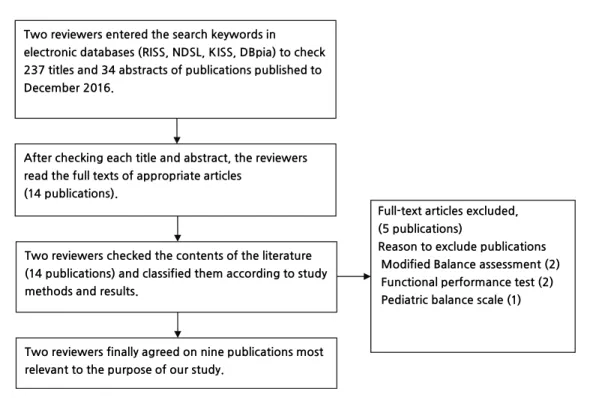
2명의 리뷰어는 각각 문헌의 제목과 초록을 검토한 후

확인된 자료 중 연구에 적당하다고 판단 된 문헌은 전체

문헌(Full text)을 읽었다. 리뷰어들은 선정된 자료를 연

구 방법과 결과로 분류하였고 서로 합의 하에 결정하였

다(Fig. 1).

(3)

Two reviewers entered the search keywords in electronic databases (RISS, NDSL, KISS, DBpia) to check 237 titles and 34 abstracts of publications published to December 2016.

After checking each title and abstract, the reviewers read the full texts of appropriate articles

(14 publications).

Two reviewers checked the contents of the literature (14 publications) and classified them according to study methods and results.

Full-text articles excluded, (5 publications)

Reason to exclude publications Modified Balance assessment (2) Functional performance test (2) Pediatric balance scale (1)

Two reviewers finally agreed on nine publications most relevant to the purpose of our study.

Fig. 1. Process of the study

Ⅲ. 연구 결과

리뷰어들은 본 연구에 목적에 맞는 9개 문헌에 자료 를 채택했으며, 한글화 된 균형 평가도구들로는 Berg 균형 척도(Berg Balance Scale, BBS), 활동 특이성 균형 자신감 척도(Activities-specific Balance Confidence, ABC scale), 뇌졸중의 자세 평가 척도(Postural Assessment Scale for Stroke, PASS), Motor Assessment Scale (MAS), Trunk Impairment Scale (TIS), 낙상 효능 척도(Falls Efficacy Scale, FES), 티네티 균형 척도(Tinetti-Balance Scale), 플러턴 어드밴스드 균형 척도(Fullerton Advanced Balance Scale, FAB scale), 기능적 앉기 검사(Function In Sitting Test, FIST) 가 있었으며, 각각의 신뢰도와 타당 도를 알아보았다.

1. Berg 균형 척도(Berg Balance Scale, BBS) 한글화된 Berg 균형 척도의 신뢰도는 일차 검사로 18례의 환자에게서 시행된 Berg 균형 척도가 기록된 비디오 영상을 보고 9명의 측정자는 각기 독립적으로

평가하고 점수화하였으며, 이차 검사는 10일 후 일차 검사와 같은 방식으로 시행되었다. 측정자간 신뢰도는 일차 검사에서 .97을 보였고, 이차 검사에서도 .97로서 측정자간의 높은 일치도를 보였다. 측정자 내 신뢰도는 재활의학과 의사군은 .95를 보였고, 물리치료사군은 .97 이였다(Jung 등, 2006).

2. 활동 특이성 균형자신감 척도(Activities-specific Balance Confidence, ABC scale)

한글화된 활동 특이성 균형자신감 척도는 90명의

노인을 대상으로 분석하였고, 4주 후 같은 도구에 대한

재 측정에 응한 26명을 대상으로 검사-재검사 신뢰도

를 구하였다. 그 결과는 .82로 틍계적으로 의미가 있는

상관관계를 보여 재검사에 의해서도 유사한 결과를

보임을 알 수 있다. 타당도 조사에서 한글화된 활동

특이성 균형자신감 척도와 낙상 효능 척도는 통계적으

로 유의한 차이를 보여 내용 타당도가 입증되었다

(Jang 등, 2003).

(4)

3. 뇌졸중의 자세 평가 척도(Postural Assessment Scale for Stroke, PASS)

43 명의 뇌졸중 환자를 대상으로 한글화된 뇌졸중 의 자세 평가 척도의 신뢰도와 타당도를 분석하였다.

측정자간 신뢰도는 .97로 높은 신뢰도를 보였다. PASS 는 BBS, TCT, FM-B (r=.65-.96, p<.01)와 유의한 양의 상관관계를 보여 자세조절의 기능적인 향상이 있을수 록 균형 능력은 증가하는 것을 알 수 있었다(An과 Lee, 2009).

4. Motor Assessment Scale (MAS)

한글화된 MAS는 측정자간 신뢰도를 알아보기 위해 무작위로 20명의 비디오 파일을 빔 프로젝트를 사용하 여, 23명의 물리치료사가 각자 독립적으로 평가하였다.

측정자 내 신뢰도를 평가하기 위해 무작위로 9명의 환 자를 3주 간격으로 7명의 물리치료사가 2번의 평가를 시행 하였다. 측정자간 신뢰도는 .99이상으로 매우 높 은 신뢰도를 나타내었다. 측정자 내 신뢰도는 1번 항목 (ICC=.75)과 3번 항목(ICC=.79)에서 보통의 신뢰도를 보였고, 다른 항목에서는 모두 높은 신뢰도를 나타내었 다(ICC=.87~.99)(Cha 등, 2013).

5. Trunk Impairment Scale (TIS)

한글화된 TIS는 25명의 뇌졸중 환자를 대상으로 두 명의 측정자에 의해 측정자간 신뢰도와 측정자 내 신뢰 도가 평가되었다. 그 결과 측정자간 신뢰도 ICC=.95, 검사-재검사 일치도 ICC=.97으로 높은 신뢰도를 보였 다(Seo 등, 2008).

6. 낙상 효능 척도(Falls Efficacy Scale, FES) 한글화된 낙상 효능 척도의 검사-재검사 신뢰도 결 과는 .97였다. 한글화된 낙상 효능 척도의 총점과 다른 평가도구와의 상관관계를 분석한 결과 GDS (r=.41), BBS (r=.45), TUG (r=.54) 및 MBI (r=-.47)와 중간 정도의 상관관계가 있는 것으로 나타나 만족할만한 신뢰도와 타당도가 입증되었다(An 등, 2012).

7. 티네티 균형 척도(Tinetti-Balance Scale) 한글화된 티네티 균형 척도의 측정자간 신뢰도는

.91으로 높은 신뢰도를 보였다. 한글화된 티네티 균형 척도의 총점과 다른 평가 도구와의 상관 관계를 분석한 결과 10m 보행 속도 검사(r=-.74), 마비측 OLST (r=-.72), 비마비측 OLST (r=-.76), STS (r=-.73)와는 음의 상관관 계가 있었고, FM-상지 운동 기능(r=.64), 하지 운동 기능 (r=.76)과는 양의 상관관계가 있어 만족할만한 동시 타 당도가 있음을 확인할 수 있었다(Lee 등, 2013).

8. 플러턴 어드밴스드 균형 척도(Fullerton Advanced Balance Scale, FAB scale) 한글화된 플러턴 어드밴스드 균형 척도의 검사-재검 사 신뢰도는 .99로 높은 신뢰도를 보였고, Berg 균형 척도와의 동시 타당도는 r=.89로 높은 상관관계를 보였 다(Kim, 2016).

9. 기능적 앉기 검사(Function In Sitting Test, FIST) 한글화된 기능적 앉기 검사의 측정자간 신뢰도는 .99 로 매우 높았고, 동시 타당도 역시 TCT (r=.85), PASS (r=.82), MBI (r=.81)로 매우 높은 양의 상관관계가 있는 것으로 확인되었다(An과 Lee, 2016).

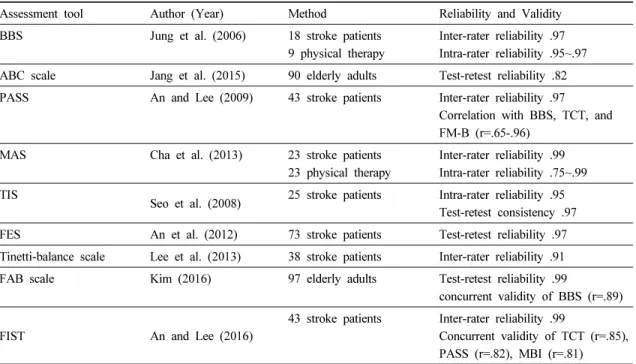
본 연구를 통해 한글화된 균형 평가도구들의 신뢰도 와 타당도는 높은 것으로 조사되었다(Table 1). 측정자 간 신뢰도는 Berg 균형 척도(.97), 뇌졸중의 자세 평가 척도(.97), MAS (.99), 티네티 균형 척도(.91), 기능적 앉기 검사(.99)가 높았으며, 측정자 내 신뢰도는 Berg 균형 척도(.95~.97), TIS (.95) 높았다. 동시 타당도 조사 에서는 플러턴 어드밴스드 균형 척도(r=.89) 그리고 기 능적 앉기 검사(r=.81~.85)가 높았다.

Ⅳ. 고 찰

많은 평가도구들이 대부분 다른 나라에서 만들어진

평가도구들로 언어적, 문화적 차이로 인해 그리고 물

리치료사의 균형 평가에 대한 인식과 실태 조사에서

낮은 인식과 실태를 보이고 있어(Jang 등, 2017) 국내

물리치료사들이 균형 평가를 위해 평가도구를 임상에

적용하는데 어려움이 있다. 현재 많은 한글화된 균형

(5)

Assessment tool Author (Year) Method Reliability and Validity

BBS Jung et al. (2006) 18 stroke patients

9 physical therapy

Inter-rater reliability .97 Intra-rater reliability .95~.97 ABC scale Jang et al. (2015) 90 elderly adults Test-retest reliability .82 PASS An and Lee (2009) 43 stroke patients Inter-rater reliability .97

Correlation with BBS, TCT, and FM-B (r=.65-.96)

MAS Cha et al. (2013) 23 stroke patients

23 physical therapy

Inter-rater reliability .99 Intra-rater reliability .75~.99 TIS Seo et al. (2008) 25 stroke patients Intra-rater reliability .95

Test-retest consistency .97 FES An et al. (2012) 73 stroke patients Test-retest reliability .97 Tinetti-balance scale Lee et al. (2013) 38 stroke patients Inter-rater reliability .91

FAB scale Kim (2016) 97 elderly adults Test-retest reliability .99

concurrent validity of BBS (r=.89)

FIST An and Lee (2016)

43 stroke patients Inter-rater reliability .99

Concurrent validity of TCT (r=.85), PASS (r=.82), MBI (r=.81)

BBS: Berg Balance Scale, ABC scale: Activities-specific Balance Confidence scale PASS: Postural Assessment Scale for Stroke, MAS: Motor Assessment Scale TIS: Trunk Impairment Scale, FES: Falls Efficacy Scale

FAB scale: Fullerton Advanced Balance Scale, FIST: Function In Sitting Test

Table 1. The Reliability and Validity of Korean-Version Balance assessment Tools

평가도구들이 신뢰도와 타당도를 검증하여 제시되고 있으나 이에 대한 체계적인 분석이 이루어지지 않았 다. 이에 본 연구의 목적은 한글화된 균형 평가도구들 의 신뢰도와 타당도를 체계적으로 분석하고 제시하여 임상에서 물리치료사들이 정확한 평가를 위해 활용하 고자 한다.

한글화된 균형 평가도구들의 제작은 먼저 타국가의 평가도구를 한국어로 번역하고, 그것을 다시 역번역하 여 이후 원문과 역번역 본간의 언어의 구조적 유상성과 의미 전달의 유사성을 평가하여 최종 감수를 거쳐 번역 을 완성하는 과정을 거친다.

Berg 균형 척도는 14개 항목으로 구성된 서열척도 로 노인의 균형 능력을 평가하기 위해 개발되었으며, 뇌졸중 환자의 균형 능력 평가에도 신뢰도와 타당도 가 인정되고 있다(Jung 등, 2006). 활동 특이성 균형자 신감 척도는 낙상 효능 척도와 같이 Bandura의 이론을 바탕으로 만들어졌으나, 낙상 효능 척도와 대조적으

로 집안에서의 활동 뿐만 아니라, 집 밖의 외부 활동에

대해서도 광범위하게 측정되어 노인들 중 기능수준이

중간 이상으로 높은 대상자들의 평가에 특히 유용하

다고 주장되었다(Jang 등, 2003). 뇌졸중의 자세 평가

척도는 Fugl- Meyer균형 척도 항목을 수정 보안하여

뇌졸중 환자의 균형 측정 뿐만 아니라 뇌졸중 환자의

자세 조절 수행 능력을 평가하기 위해 만들었다(An과

Lee, 2009). MAS 는 뇌졸중 환자의 기능적 과제 수행

능력을 평가하기 위한 평가지이다. MAS는 뇌졸중 환

자의 잔여 운동기능을 평가하여 시너지 패턴보다 오

히려 기능적 과제의 수행 능력을 평가하기 때문에 널

리 유용하게 사용되고 있으며 현재까지 높은 신뢰도

와 타당도를 보이고 있다(Cha 등, 2013). TIS는 3가지

항목으로 최소 0점에서 23점으로 정적 앉은 자세 균형

항목(7점), 동적 앉은 자세 균형 항목(10점), 협응 평가

항목(6점)으로 구성되어 있다. 해외에서 TIS는 뇌졸

중, 다발성 경화증, 파킨슨씨 병과 같은 다양한 신경학

(6)

적인 질환을 가지고 있는 환자들의 평가에서 높은 신 뢰도와 타당도를 보고하였다(Seo 등, 2008). Tinetti와 Richman (1990) 는 낙상 없이 다양한 일상생활 동작을 수행하는 동안의 만족도를 평가하는 도구인 낙상 효 능 척도를 개발하였다. 총 10개 문항으로 다차원적으 로 구성되어 있어 사정도구로써의 이용 가치가 높다.

한글화된 낙상 효능 척도의 검사-재검사 신뢰도 평가 를 위해 치료사와 환자의 1:1 대면 하에 초기 평가를 실시한 후 72시간 내에 재평가를 실시하였다. 그리고 객관적인 다른 평가 도구들과 비교하여 도구의 타당 도를 알아보기 위해 한국판 노인 우울증 척도(Geriatric Depression Scale-Korean version, GDS), Berg 균형 척도, 일어나 걸어가기 검사(Timed Up & Go test), 수정된 바델 지수(Modified Barthel Index, MBI)가 시행되었다.

검사-재검사 신뢰도 결과는 .97였다(An 등, 2012). 노 인의 낙상위험도를 결정하고 균형 및 운동성의 정도 를 평가할 수 있는 도구로 티네티 균형/보행 척도가 개발되었다. 2~3점 척도로 구성되어 있으며, 균형검사 는 16점, 보행 검사는 12점으로 총 28점이 만점이다.

뇌졸중 환자 38명을 대상으로 2명의 물리치료사가 측 정자간 신뢰도를 측정했으며, 티네티 균형 척도의 타 당도를 조사하기 위해 2~3일에 걸쳐 10m 보행 속도 검사, 마비측⋅비마비측 외발서기 검사, 앉고 일어서 기 검사, Fugl Myer (Upper/Lower Extremity) 순으로 검사를 시행하였다(Lee 등, 2013). 플러턴 어드밴스드 균형 척도은 Berg 균형 척도를 이용한 연구에서 드러 난 높은 균형 능력을 가진 노인 그룹에서의 천정 효과 (ceiling effect) 뿐만 아니라 전정계와 시각계 등과 같은 균형에 영향을 미치는 다양한 감각 체계에 대한 평가 항목이 포함되지 않은 문제점을 보완하기 위해 개발 된 수행 능력 기반 균형 평가도구이다. 10개 항목으로 구성되어 있으며, 각 항목은 0~4점 서열척도로 구성되 어 있다. 한글화된 플러턴 어드밴스드 균형 척도은 노인 97명을 대상으로 검사-재검사 신뢰도를 위해 대 상자 97명 중 무작위로 64명을 선정하여 3일 후에 재평 가를 실시하였다. 동시 타당도를 알아보기 위해 한글 화된 Berg균형 척도와 비교하였다(Kim, 2016). 기능적 앉기 검사는 뇌졸중 환자들의 자세 조절과 균형과의

관련성을 고려하여 국제 기능⋅장애⋅건강 분류 (International Classification of Function, Disability and Health, ICF) 에 기반한 14개의 기능적이고 양적인 앉기 균형을 평가할 수 있도록 고안되었다. 기능적 앉기 검사는 침상에서 앉기 균형 능력에 현저히 제한이 있 는 뇌졸중 환자들에게도 평가를 할 수 있다. 한글화된 기능적 앉기 검사는 43명의 만성 뇌졸중 환자를 대상 으로 2명의 물리치료사가 측정자간 신뢰도를 평가했 고, 동시 타당도를 알아보기 위하여 Trunk Control Test (TCT), PASS와 MBI를 이용했다(An과 Lee, 2016).

측정자간 신뢰도는 Berg 균형 척도(.97), 뇌졸중의 자세 평가 척도(.97), MAS (.99), 티네티 균형 척도(.91), 기능적 앉기 검사(.99)가 높았으며, 측정자 내 신뢰도는 Berg 균형 척도(.95~.97), TIS (.95) 높았다. 동시 타당도 조사에서는 플러턴 어드밴스드 균형 척도(r=.89) 그리 고 기능적 앉기 검사(r=.81~.85)가 높았다. 본 연구를 통해 한글화된 균형 평가도구들의 신뢰도와 타당도는 높은 것으로 나타났다.

본 연구의 제한점은 체계적인 문헌 고찰을 통해 자료 를 수집하였으나 electronic databases로 RISS, NDSL과 KISS 그리고 DBpia만을 사용했으며, 2016년 12월 이후 출간된 문헌과 등재 되지 않은 문헌이나 회색 문헌은 검색하지 못하였다. 아울러 기능적 동작 수행을 통한 평가 방법인 Sit to stand test (Cho 등, 2013), Step test (Lee 등, 2017)와 같은 기능적 동작 수행을 통한 평가 방법과 수정된 PASS (Lee 등, 2014), 수정된 TIS (An과 Park, 2015) 같은 수정된 평가도구 그리고 아동 균형 평가도구(PBS)(Ko 등, 2008)는 배제하였다.

Ⅴ. 결 론

본 연구는 체계적인 문헌 고찰을 통해 한글화된 균형

평가도구들을 확인하고, 그 신뢰도와 타당도를 분석하였

다. 그 결과 한글화된 평가도구들은 높은 신뢰도와 타당

도를 갖고 있었다. 높은 신뢰도와 타당도를 갖는 한글화

된 균형 평가도구들은 임상에서 치료사들이 균형 능력을

평가하는데 유용하게 사용될 수 있을 것이다.

(7)

References

An SH, Lee BK. The reliability and validity of the Korean version of function in sitting test in patients with stroke who are limited walking ability. Journal of Special Education & Rehabilitation Science. 2016;55:

471-86.

An SH, Lee JH. Reliability and validity of the postural assessment scale for stroke in chronic stroke patients. J Korean Soc of Phys Ther. 2009;21:9-18.

An SH, Park DS. The reliability of the modified trunk impairment scale (Korean version) in stroke patients. Journal of Special Education & Rehabilitation Science. 2015;

54:277-90.

An SH, Sin HH, Cho HY, et al. The reliability and validity of the falls efficacy scale (Korean version) in stroke patients. Journal of Special Education & Rehabilitation Science. 2012;51:363-81.

APTA. Guide to physical therapy practice (2 nd ed). USA. Phys Ther. 2001.

Basford JR, Chou LS, Kaufman KR, et al. An assessment of gait and balance deficits after traumatic brain injury.

Arch Phys Med Rehabil. 2003;84:343-9.

Cha YR, Jung KS, Chung YJ. Reliability of the Korean version of motor assessment scale in patients with stroke.

Journal of Special Education & Rehabilitation Science.

2013;52:279-93.

Cho HY, An SH, Lee YB, et al. The reliability and validity of the sit to stand test in chronic stroke patients.

Journal of Special Education & Rehabilitation Science.

2013;52:361-79.

Cho WS, Park CB, Lim JH. The Effect of trunk strengthening exercise using oscillation on trunk muscle thickness and balance. J Korean Soc Phys Med. 2017;12(2):

91-101.

Horak FB. Clinical assessment of balance disorders. Gait Posture. 1997;6:76-84.

Jang HO, Kim YL, Lee SM. Perception and use of balance

measures for stroke patients among physical therapists in South Korea. J Phys Ther Sci. 2017;29:255-60.

Jang SN, Cho SI, Ou SW, et al. The validity and reliability of Korean fall efficacy scale (FES) and activities- specific balance confidence scale (ABC). J Korean Geriatr Soc. 2003;7(4):255-68.

Jung HY, Park JH, Sim JJ. Reliability test of Korean version of Berg balance scale. J Korean Acad Rehab Med.

2006;30:611-8.

Kim BS, Bang DH, Shin WS. Effects of pressure sense perception training on unstable surface on somatosensory, balance and gait function in patients with stroke.

J Korean Soc Phys Med. 2015;10(3):237-45.

Kim GM. Reliability and validity study on the Korean version of the Fullerton advanced balance Scale. Phys Ther Korea. 2016;23:31-7.

Ko MS, Lee NH, Lee JA, et al. Inter-examiner reliability of the Korean version of the pediatric balance scale.

Phys Ther Korea. 2008;15:86-91.

Langhorne P, Coupar F, Pollock A. Motor recovery after stroke:

a systematic review. Lancet Neurol. 2009;8:741-54.

Lee BK, Choi HS, An SH. The Relative ⋅absolute reliability and validity of step test in patients with chronic stroke.

KSIM. 2017;5:43-53.

Lee CH, An SH, Lee YB, et al. The reliability and concurrent validity of the Tinetti-balance scale (Korean version) in stroke patients. Journal of Special Education &

Rehabilitation Science. 2013;52:435-52.

Lee HM. Effects of virtual reality based video game and rehabilitation exercise on the balance and activities of daily living of chronic stroke patients. J Korean Soc Phys Med. 2013;8:201-7.

Lee YB, An SH, Lee GC. The Reliability and validity of the modified postural assessment scale for stroke (Korean version) in stroke patients. Journal of Special Education & Rehabilitation Science. 2014;53:333-51.

Mayo NE, Wood-Dauphinee S, Cote R, et al. Activity,

participation, and quality of life 6 months poststroke.

(8)

Arch Phys Med Rehabil. 2002;83:1035-42.

Pollock AS, Durward BR, Rowe PJ. What is balance? Clin Rehabil. 2000;14:402-6.

Seo HD, Kim NJ, Chung YJ. Reliability of the Korean version of the trunk impairment scale in patients with stroke.

Phys Ther Korea. 2008;15:87-94.

Shumway-Cook A, Woollacott MH. Motor Control: Translating Research into Clinical Practice (3 rd ed). USA.

Lippincott Williams & Wilkins. 2007.

Sturnieks DL, George R, Lord SR. Balance disorders in the elderly. Clin Neurophysiology. 2008;38:467-78.

Sturnieks DL, Tiedemann A, Chapman K, et al. Physiological

risk factors for falls in older people with lower limb arthritis. J Rheumatol. 2004;31:2272-9.

Tinnetti ME, Richamn D, Powell L. Falls efficacy as a measure of fear of falling. Journal of Gerontology. 1990;45:

239-43.

Tyson SF, Connell LA. How to measure balance in clinical practice. A systematic review of the psychometrics and clinical utility of measures of balance activity for neurological conditions. Clin Rehabil. 2009;23:

824-40.

Tyson SF, Hanley M, Chillala J, et al. Balance disability after

stroke. Phys Ther. 2006;86:30-8.

수치

Fig. 1. Process of the study
Table 1. The Reliability and Validity of Korean-Version Balance assessment Tools

참조

관련 문서

The purpose of this study was to investigate how the Da Vinci body board exercise program affects the body balance and physical stress of women with body imbalance.. For

The purpose of this study is to research prevalence of nonnutritive sucking for Korean preschool children, evaluate the relation of contributing factors

The purpose of this study is to develop a multidimensional Flourish Scale for Early Childhood Teachers based on the opinions of the panel of early childhood education experts

The proposal of the cell theory as the birth of contemporary cell biology Microscopic studies of plant tissues by Schleiden and of animal tissues by Microscopic studies of

웹 표준을 지원하는 플랫폼에서 큰 수정없이 실행 가능함 패키징을 통해 다양한 기기를 위한 앱을 작성할 수 있음 네이티브 앱과

_____ culture appears to be attractive (도시의) to the

1 John Owen, Justification by Faith Alone, in The Works of John Owen, ed. John Bolt, trans. Scott Clark, &#34;Do This and Live: Christ's Active Obedience as the

This study selected Korea University for South Korean university and the University of Pennsylvania and the University of Chicago, US for foreign