Although the outcomes of single-bundle anterior cruciate ligament (ACL) reconstruction have been reported to be excellent, there remains no consensus on the optimal graft choice for ACL reconstruction.1) Previous articles reported
that bone–patellar tendon–bone (BPTB) autograft which might alter the patellofemoral biomechanics had a number of disadvantages, such as anterior knee pain, quadriceps weakness, and patellofemoral osteoarthritis (PFOA).2) Recent comparative studies proved that there were no significant differences between the BPTB autograft and hamstring tendon (HT) autograft for any of the variables measured; however, anterior knee pain, kneeling pain, and higher rates of PFOA were noted with BPTB graft use.1)
Yet, PFOA has been also problematic after ACL reconstruction with HT autograft.3) Not only are the rates
Prevalence and Predictors of Patellofemoral Osteoarthritis after Anterior Cruciate Ligament Reconstruction with Hamstring Tendon Autograft
Dhong Won Lee, MD, Cheol Hynn Yeom, MD, Du Han Kim, MD, Tae Min Kim, MD, Jin Goo Kim, MD
Department of Orthopaedic Surgery, Konkuk University Medical Center, Seoul, Korea
Background: The present study aimed to evaluate the prevalence of patellofemoral osteoarthritis (PFOA) and identify the factors that affect PFOA development after single-bundle anterior cruciate ligament (ACL) reconstruction with hamstring autograft. We hypothesized that detecting these factors could be helpful in establishment of a rehabilitation strategy to focus on the modifiable factors.
Methods: Of the 324 patients who underwent primary ACL reconstruction between January 2010 and June 2013, 92 patients who were available for follow-up for a minimum of 36 months after the surgery and underwent second-look arthroscopy were enrolled.
Subjective assessments and clinical outcome evaluation were conducted. Arthroscopic cartilage evaluation was done using the Outerbridge classification. Univariable and multivariable logistic regression analyses were used.
Results: Ninety-two patients were evaluated at an average of 38.9 ± 5.4 months of follow-up. PFOA above grade 2 was observed in 19 patients (20.7%) at the second-look arthroscopy. Of them, three patients with pre-existing PFOA (3.3%) showed progression of the Outerbridge grade, and 16 (17.4%) had newly developed PFOA. According to the multivariable logistic regression analysis, isokinetic extensor deficit at 60°/sec at the last follow-up (odds ratio [OR], 2.193; 95% confidence interval [CI], 1.081 to 12.439; p = 0.031), age at primary surgery (OR, 1.118; 95% CI, 1.019 to 1.227; p = 0.018), and concurrent meniscectomy at primary surgery (OR, 0.091; 95% CI, 1.012 to 1.177; p = 0.023) were the significant predictors of PFOA development.
Conclusions: Significant predictors of PFOA after ACL reconstruction with hamstring autograft were decreased quadriceps strength at last follow-up, increased age, and concurrent meniscectomy at primary surgery. Quadriceps weakness as a modifiable factor should be considered in the establishment of a rehabilitation strategy to prevent PFOA after ACL reconstruction, especially in older age.
Keywords: Anterior cruciate ligament reconstruction, Patellofemoral osteoarthritis, Meniscectomy, Knee extension, Risk factors
Copyright © 2018 by The Korean Orthopaedic Association
This is an Open Access article distributed under the terms of the Creative Commons Attribution Non-Commercial License (http://creativecommons.org/licenses/by-nc/4.0) which permits unrestricted non-commercial use, distribution, and reproduction in any medium, provided the original work is properly cited.
Clinics in Orthopedic Surgery • pISSN 2005-291X eISSN 2005-4408 Received January 7, 2018; Accepted March 15, 2018
Correspondence to: Jin Goo Kim, MD
Department of Orthopaedic Surgery, Konkuk University Medical Center, 120-1 Neungdong-ro, Gwangjin-gu, Seoul 05030, Korea
Tel: +82-2-2030-7606, Fax: +82-2-2030-7369 E-mail: [email protected]
of PFOA in HT autograft not low compared with BPTB autograft, but also PFOA is not a trivial outcome of ACL reconstruction. Culvenor et al.4) concluded that the com- partmental distribution pattern of osteoarthritis after ACL reconstruction with HT autograft was identical to that of ACL reconstruction with BPTB autograft, hence they suggested that the HT autograft did not prevent PFOA after ACL reconstruction. PFOA is significantly associated with the anterior knee, which is a common problem after ACL reconstruction, and these symptoms could impact substantially activities of daily living and delay return to sports activities.4,5) Therefore, clinicians should emphasize recognition of PFOA development, irrespective of graft type.
Various factors have been proposed as contributors to PFOA development after ACL reconstruction, including concomitant damage to articular cartilage, meniscal resec- tion, quadriceps muscle weakness, follow-up duration, age, sex, body mass index, and limitation of knee range of motion (ROM).4,5) Among them, altered knee kinematics, quadriceps weakness, and limited ROM influencing patel- lofemoral biomechanics have been known as risk factors resulting from inadequate postoperative rehabilitation.4,6) However, the clinically important factors in the develop- ment of PFOA are still not fully known. Moreover, the prevalence and clinical effects of PFOA after ACL recon- struction with HT autograft have been rarely reported.
Therefore, there is a need to investigate the prevalence of PFOA and contributors to PFOA after ACL reconstruction with HT autograft, and it could help determine proper re- habilitation strategies and lead to improved physical func- tions.
The present study aimed to evaluate the prevalence of PFOA and identify the factors that affect PFOA de- velopment after single-bundle ACL reconstruction with hamstring autograft. We hypothesized that quadriceps weakness and age would be significant predictors of the development of PFOA, and detecting these factors could be helpful in establishment of a rehabilitation strategy to focus on the modifiable factors such as quadriceps weak- ness.
METHODS
We reviewed a cohort of 324 consecutive patients who underwent primary ACL reconstruction performed by an experienced single surgeon (JGK) between January 2010 and June 2013. To be included in this study, subjects had to meet the following criteria: the patients (1) who under- went single-bundle ACL reconstruction using hamstring
autograft; (2) who were available for follow-up for a mini- mum of 36 months after the surgery; (3) who underwent second-look arthroscopy at 24 months after the surgery;
(4) who did not have any pre-existing clinical complaints of anterior knee pain; and (5) who had compliance with undergoing all required tests and questionnaires. Exclu- sion criteria were multiple ligament injuries, concomitant fractures, contralateral injuries, revision surgeries includ- ing meniscal procedure, and infection. The patients with a history of cartilage procedure such as microfracture or mosaicplasty were also excluded. Of the 324 patients who were originally identified, 92 who met the above criteria were enrolled. The current study was approved by the Institutional Review Board of Inje University Seoul Paik Hospital (IRB No. IIT-2015-011), and all included patients provided written informed consent.
Surgical Technique
Arthroscopic anatomic ACL reconstruction with a modi- fied transtibial technique using hamstring autograft was conducted at least 3–4 weeks after injury by an experi- enced single surgeon (JGK) when knee ROM was fully ob- tained.7) After making tunnels and graft passage, femoral fixation was achieved using the XO Button (ConMed, Lar- go, FL, USA) and the Bio-Cross Pin (RIGIDFIX; Depuy, Raynham, MA, USA). Tibial fixation was performed with a bioabsorbable interference screw (Matryx, ConMed), and additional cortical screw and washer were used for tibial fixation. For accelerated rehabilitation, this dual fixa- tion was performed.
Postoperative Rehabilitation
Patients were permitted to bear weight with an ACL sup- port brace (DonJoy Legend; DJO Global, Vista, CA, USA) and to start isometric quadriceps exercise and ROM exercise as tolerated immediately after ACL reconstruc- tion based on our accelerated rehabilitation program.8) The brace was locked in extension for ambulation and unlocked for ROM exercise. When the meniscus was repaired, partial weight bearing with crutches was per- formed for 6 weeks. Closed kinetic chain exercises were started at 3 weeks and open kinetic exercises and pertur- bation training program were started 6 weeks postopera- tively. But, hamstring curl exercise was permitted from 3 months after ACL reconstruction. Quadriceps open kinetic exercises using a leg extension machine was started at 6 weeks after ACL reconstruction within 90°–45° and full extension was permitted at 3 months after the surgery.
After the course of home-based rehabilitation, running and competitive sports were targeted at 3 and 9 months
after ACL reconstruction, respectively.
Clinical Assessments
Clinical and functional performance tests (FPTs) were performed before the surgery and at 3, 6, 9, and 12 months or more after the surgery and were usually completed at 36 months of follow-up. Subjective knee function as- sessments included Lysholm score, International Knee Documentation Committee subjective knee score, and Tegner activity scale. Objective assessments included KT- 2000 arthrometer (MEDmetric, San Diego, CA, USA) test, ROM measurement, manual pivot shift test, FPTs, and isokinetic muscle strength test using a Biodex System III dynamometer (Biodex, Shirley, NY, USA). Standard iso- kinetic muscle strength was assessed in a sitting position at angular velocities of 60°/sec and 180°/sec. The peak torque (the maximum value during four repetitions) of flexor and extensor muscles was assessed, and the value of the in- volved side was compared with that of the uninvolved side.
The hamstring to quadriceps ratio of the involved side was calculated at 60º/sec and 180°/sec.
On FPTs, the patients were asked to perform three practice trials for each type of the tests after warming-up.
For the single leg hop for distance test reported by Noyes et al.9) as a unilateral test, each leg was tested individually and the highest values were recorded. Limb symmetry in- dex (LSI, %) was calculated by dividing involved limb data by uninvolved limb data and then multiplying by 100.9) The cocontraction test, Shuttle-run test, and Carioca test were performed according to previous protocols,10) and the shortest time was recorded.
Arthroscopic Assessments
Arthroscopic cartilage evaluation allows for more detailed description of the depth and extent of arthritic lesions and detection of subtle changes such as cartilage softening, fibrillation, and tangential flaking.11) Cartilage lesion grad- ing was performed by a single senior surgeon (JGK) using the modified Outerbridge classification12) at both the be- ginning and end of the surgery, and the grading was based on the most severe cartilage damage. Grade 2 and above cartilage lesion was defined by the Outerbridge classifica- tion as any damage at each compartment (patellofemoral, medial tibiofemoral, and lateral tibiofemoral).4) Concomi- tant meniscal injury was also evaluated and defined as a meniscal tear requiring surgery such as meniscectomy and repair.13) In the present study, meniscectomy was defined as meniscal resection of > 33% of the whole meniscus.
Second-look arthroscopy with hardware removal was performed usually at 24 months after the primary
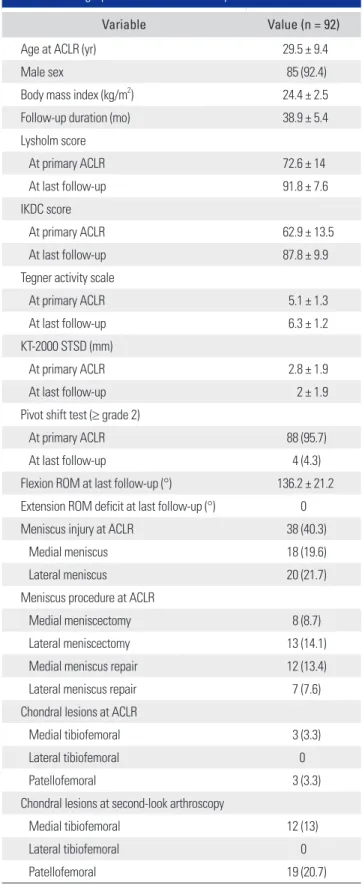
Table 1. Demographics and Pre- and Postoperative Data
Variable Value (n = 92)
Age at ACLR (yr) 29.5 ± 9.4
Male sex 85 (92.4)
Body mass index (kg/m2) 24.4 ± 2.5
Follow-up duration (mo) 38.9 ± 5.4
Lysholm score
At primary ACLR 72.6 ± 14
At last follow-up 91.8 ± 7.6
IKDC score
At primary ACLR 62.9 ± 13.5
At last follow-up 87.8 ± 9.9
Tegner activity scale
At primary ACLR 5.1 ± 1.3
At last follow-up 6.3 ± 1.2
KT-2000 STSD (mm)
At primary ACLR 2.8 ± 1.9
At last follow-up 2 ± 1.9
Pivot shift test (≥ grade 2)
At primary ACLR 88 (95.7)
At last follow-up 4 (4.3)
Flexion ROM at last follow-up (°) 136.2 ± 21.2 Extension ROM deficit at last follow-up (°) 0
Meniscus injury at ACLR 38 (40.3)
Medial meniscus 18 (19.6)
Lateral meniscus 20 (21.7)
Meniscus procedure at ACLR
Medial meniscectomy 8 (8.7)
Lateral meniscectomy 13 (14.1)
Medial meniscus repair 12 (13.4)
Lateral meniscus repair 7 (7.6)
Chondral lesions at ACLR
Medial tibiofemoral 3 (3.3)
Lateral tibiofemoral 0
Patellofemoral 3 (3.3)
Chondral lesions at second-look arthroscopy
Medial tibiofemoral 12 (13)
Lateral tibiofemoral 0
Patellofemoral 19 (20.7)
Values are presented as mean ± standard deviation or number (%).
ACLR: anterior cruciate ligament reconstruction, IKDC: International Knee Documentation Committee, STSD: side-to-side difference, ROM: range of motion.
ACL reconstruction, especially in patients who had persis- tent pain, wanted to remove the irritable materials, or vol- untarily wanted to confirm the status of the reconstructed ACL. Most patients wanted to a second-look arthroscopy with hardware removal.
Statistical Analysis
Statistical analysis was done using IBM SPSS ver. 20.0 (IBM Corp., Armonk, NY, USA). Pearson chi-square test, Stu- dent t-test, or the Mann-Whitney U-test were performed to compare results between the PFOA and the no PFOA groups, depending on the parametric or nonparametric data distribution. A univariable logistic regression analy- sis was implemented to determine significant factors for developing PFOA. Then, a multivariable stepwise logistic regression was performed using the significant factors identified in the univariable logistic regression. The results of regression analysis were presented as odds ratio (OR) with 95% confidence interval (CI), and a p-value < 0.05 was considered significant.
RESULTS
Ninety-two patients, including 85 males and 7 females, were evaluated, and the mean follow-up was 38.9 ± 5.4 months. The patient’s baseline characteristics are pre- sented in Table 1. Their mean age at ACL reconstruction was 29.5 ± 9 years. Concomitant meniscal injuries at the time of ACL reconstruction were detected in 38 patients (40.3%), including 18 medial meniscus (19.6%) and 20 lateral meniscus injuries (21.7%). Eight subjects (8.7%) had a medial meniscectomy, and 13 (14.1%) had a lateral meniscectomy; thus, total 21 patients (22.8%) underwent a concurrent meniscectomy during ACL reconstruction.
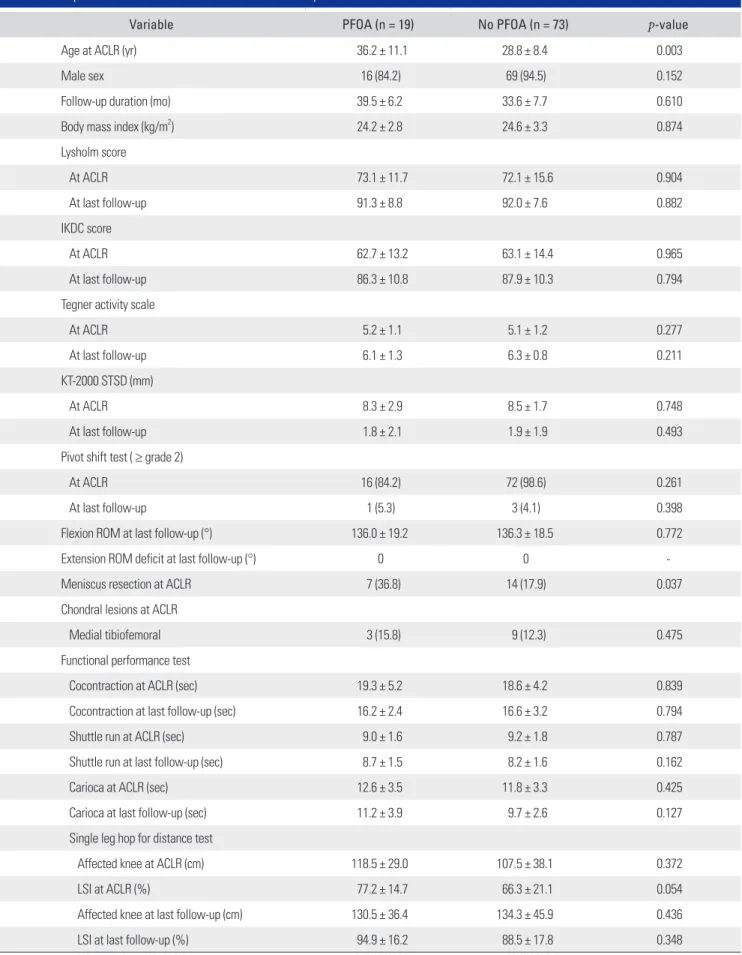
PFOA above grade 2 according to the Outerbridge classifi- cation was observed in 19 patients (20.7%) at the second- look arthroscopy. Of them, three patients (3.3%) with pre- existing PFOA showed progression of the cartilage lesion, and 16 (17.4%) had newly developed PFOA. The patient characteristics for those with PFOA are described in Table 2. All patients did not have any pre-existing clinical complaints of anterior knee pain, and 19 (100%) patients with PFOA development presented with anterior knee pain, while six patients (8.2%) without PFOA develop- ment showed anterior knee pain. Three factors were sig- nificantly different (p < 0.05) between the PFOA and no PFOA groups: age at ACL reconstruction, meniscectomy at primary surgery, and isokinetic extensor deficit at the second-look arthroscopy. In the univariate logistic regres- sion analysis (Table 3), PFOA was significantly associated
with age at ACL reconstruction (OR, 1.083; 95% CI, 1.027 to 1.142), follow-up duration (OR, 1.108; 95% CI, 1.014 to 1.211), concurrent meniscectomy at ACL reconstruc- tion (OR, 3.675; 95% CI, 1.168 to 11.564), and isokinetic extensor strength deficit at the last follow-up (60°/sec: OR, 1.06; 95% CI, 1.018 to 1.104; 180°/sec: OR, 1.045; 95% CI, 1.002 to 1.090). The results of the multivariate analysis are shown in Table 4. The isokinetic extensor deficit at 60°/sec at the last follow-up (p = 0.031; OR, 2.193; 95% CI, 1.081 to 12.439), age at primary ACL reconstruction (p = 0.018;
OR, 1.118; 95% CI, 1.019 to 1.227), and concurrent men- iscectomy at primary surgery (p = 0.023; OR, 0.091; 95%
CI, 1.012 to 1.177) were the significant predictors of PFOA development.
DISCUSSION
The principal finding of the current study was that the sig- nificant predictors of PFOA after ACL reconstruction with hamstring autograft were (1) quadriceps muscle weakness at last follow-up, (2) increased age at primary surgery, and (3) concurrent meniscectomy at primary surgery. Among them, quadriceps strengthening was a modifiable factor.
In addition, the prevalence of PFOA development after ACL reconstruction was 20.7% (3.3% pre-existing PFOA and 17.4% newly developed PFOA) at a mean follow-up of 38.9 months.
The development of chondral lesion after ACL re- construction is the results of biochemical and biomechani- cal changes, and chondral lesions are mainly observed in the patellofemoral joint.4) The median prevalence of PFOA at 10 to 15 years after ACL reconstruction is almost 50%.14) If we evaluate the association between PFOA and predic- tors including muscle strength after ACL reconstruction at short-term follow-up using second-look arthroscopy, additional rehabilitation programs to correct modifiable factors for risk of PFOA could be performed to prevent structural cartilage changes in the longer term.
Culvenor et al.14) conducted a literature review about the prevalence of PFOA after ACL reconstruction and risk factors of PFOA and concluded as follows: (1) there was a high prevalence of PFOA after ACL reconstruction as frequently as tibiofemoral osteoarthritis, irrespective of graft type; (2) several mechanisms existed for PFOA after ACL reconstruction; (3) it would be important to address factors contributing to PFOA development during reha- bilitation. The proposed predictors of PFOA development which they evaluated were concomitant damage to the cartilage and meniscus, altered knee biomechanics, de- creased quadriceps strength, and inflammation. Culvenor
Table 2. Comparison of Patient Characteristics between Groups with and without PFOA
Variable PFOA (n = 19) No PFOA (n = 73) p-value
Age at ACLR (yr) 36.2 ± 11.1 28.8 ± 8.4 0.003
Male sex 16 (84.2) 69 (94.5) 0.152
Follow-up duration (mo) 39.5 ± 6.2 33.6 ± 7.7 0.610
Body mass index (kg/m2) 24.2 ± 2.8 24.6 ± 3.3 0.874
Lysholm score
At ACLR 73.1 ± 11.7 72.1 ± 15.6 0.904
At last follow-up 91.3 ± 8.8 92.0 ± 7.6 0.882
IKDC score
At ACLR 62.7 ± 13.2 63.1 ± 14.4 0.965
At last follow-up 86.3 ± 10.8 87.9 ± 10.3 0.794
Tegner activity scale
At ACLR 5.2 ± 1.1 5.1 ± 1.2 0.277
At last follow-up 6.1 ± 1.3 6.3 ± 0.8 0.211
KT-2000 STSD (mm)
At ACLR 8.3 ± 2.9 8.5 ± 1.7 0.748
At last follow-up 1.8 ± 2.1 1.9 ± 1.9 0.493
Pivot shift test ( ≥ grade 2)
At ACLR 16 (84.2) 72 (98.6) 0.261
At last follow-up 1 (5.3) 3 (4.1) 0.398
Flexion ROM at last follow-up (°) 136.0 ± 19.2 136.3 ± 18.5 0.772
Extension ROM deficit at last follow-up (°) 0 0 -
Meniscus resection at ACLR 7 (36.8) 14 (17.9) 0.037
Chondral lesions at ACLR
Medial tibiofemoral 3 (15.8) 9 (12.3) 0.475
Functional performance test
Cocontraction at ACLR (sec) 19.3 ± 5.2 18.6 ± 4.2 0.839
Cocontraction at last follow-up (sec) 16.2 ± 2.4 16.6 ± 3.2 0.794
Shuttle run at ACLR (sec) 9.0 ± 1.6 9.2 ± 1.8 0.787
Shuttle run at last follow-up (sec) 8.7 ± 1.5 8.2 ± 1.6 0.162
Carioca at ACLR (sec) 12.6 ± 3.5 11.8 ± 3.3 0.425
Carioca at last follow-up (sec) 11.2 ± 3.9 9.7 ± 2.6 0.127
Single leg hop for distance test
Affected knee at ACLR (cm) 118.5 ± 29.0 107.5 ± 38.1 0.372
LSI at ACLR (%) 77.2 ± 14.7 66.3 ± 21.1 0.054
Affected knee at last follow-up (cm) 130.5 ± 36.4 134.3 ± 45.9 0.436
LSI at last follow-up (%) 94.9 ± 16.2 88.5 ± 17.8 0.348
et al.5) reported that 30% had patellofemoral joint problem after ACL reconstruction with hamstring autograft at 12 months of follow-up and older age at ACL reconstruction was the only predictor of postoperative patellofemoral pain, and they emphasized postoperative rehabilitation in patients with ≥ 27 years of age. In our study, the PFOA above grade 2 according to the Outerbridge classification was found in 20.7% at a mean follow-up of 38.9 months, and of them, 3.3% had pre-existing PFOA which showed progression of cartilage lesion, and 17.4% had newly devel- oped PFOA. The contributors to a greater chance of PFOA development after ACL reconstruction with hamstring autograft in our study were decreased quadriceps strength at last follow-up, increased age and concurrent meniscec- tomy at primary surgery, which is congruent with previous studies.5,14)
Quadriceps weakness is a common finding in pa-
tients who underwent ACL reconstruction, in whom quadriceps strength deficits have been reported at rates of 2%–20%.15) Urbach et al.16) reported that unilateral ACL rupture could lead to inhibition of the quadriceps muscle in both the involved and uninvolved limbs, showing vol- untary-activation deficit and true muscle weakness. De- creased quadriceps strength is related to peripheral chang- es in the muscle–tendon units of the quadriceps muscle.17) These peripheral changes include chronic atrophy, changes in compliance of the series of elastic components in the muscle–tendon units, and alterations in the architectural structure and composition (fiber type) of the quadriceps muscle.18) A recent systematic review proved that the patients who underwent ACL reconstruction showed decreased knee extensor moments and flexion angles in performing tasks such as walking, running, and single-leg landing.19) Culvenor et al.20) reported that the participants Table 2. Continued
Variable PFOA (n = 19) No PFOA (n = 73) p-value
Isokinetic muscle strength test Extensor deficit in 60°/sec
At ACLR 34.3 ± 23.3 33.6 ± 20.0 0.886
At last follow-up 21.5 ± 16.7 12.9 ± 15.8 0.002
Extensor deficit in 180°/sec
At ACLR 27.7 ± 22.1 26.3 ± 18.3 0.785
At last follow-up 14.1 ± 10.9 8.9 ± 14.2 0.033
Flexor deficit in 60°/sec
At ACLR 18.5 ± 23.3 24.2 ± 22.5 0.322
At last follow-up 5.3 ± 21.0 7.4 ± 15.1 0.516
Flexor deficit in 180°/sec
At ACLR 13.6 ± 17.8 18.1 ± 18.4 0.352
At last follow-up 6.4 ± 12.8 5.5 ± 15.0 0.889
H/Q ratio in 60°/sec (%)
At ACLR 62.9 ± 21.1 58.4 ± 17.7 0.346
At last follow-up 63.1 ± 19.6 54.5 ± 11.3 0.156
H/Q ratio in 180°/sec (%)
At ACLR 70.5 ± 29.9 62.4 ± 17.7 0.127
At last follow-up 60.7 ± 14.2 56.9 ± 12.3 0.357
Values are presented as mean ± standard deviation or number (%).
PFOA: patellofemoral osteoarthritis, ACLR: anterior cruciate ligament reconstruction, IKDC: International Knee Documentation Committee, STSD: side-to-side difference, ROM: range of motion, LSI: limb symmetry index, H: hamstring, Q: quadriceps.
with early PFOA after ACL reconstruction with hamstring autograft at 12–24 months of follow-up exhibited smaller peak knee flexion angles and extensor moments, and greater knee internal rotation excursion during hop task, compared to those without PFOA using three-dimen- sional motion analysis. They suggested that lower peak knee flexion angles and extensor moments might reflect quadriceps weakness; hence, rehabilitation strategies fo- cusing neuromuscular deficits associated these abnormal post-ACL reconstruction biomechanics could increase the longevity of patellofemoral cartilage. Altered kinematics and kinetics, such as decreased knee flexion angles and moments, and increased knee internal rotation excursion during high-demand tasks resulted from quadriceps weak- ness, can increase the risk of early PFOA progression by limiting the contact area over which large patellofemoral loads can be distributed and create more localized areas of contact stress.20) Amin et al.21) performed a prospective study with 265 subjects to analyze the 30-month natural history of knee osteoarthritis. They concluded that greater quadriceps strength was protective against cartilage lesion at the lateral patellofemoral joint and there was no associa- tion between quadriceps strength and cartilage lesion at the tibiofemoral joint. Wang et al.22) reported that greater than 80% recovery of quadriceps strength after ACL re- construction using hamstring autograft in 42 patients was associated with less severe patellofemoral joint cartilage damaged at an average of 24.1 months. Our results sup- port previous reports of a significant association between quadriceps strength weakness and PFOA development after ACL reconstruction (p = 0.031; OR, 2.193; 95% CI, 1.081 to 12.439) at the last follow-up. Hence, our sug- gestion is that isokinetic knee extensor strength demon- strating a LSI lower than 20% is an appropriate result of adequate postoperative muscle rehabilitation. Brasileiro et al.23) demonstrated that eccentric training twice a week proved to be a potent resource for the quadriceps recovery, both morphologically and functionally. Quadriceps open kinetic exercises using a leg extension machine was started at 6 weeks after ACL reconstruction within 90°–45° and full extension was permitted at 3 months after the surgery.
Although our patients performed rehabilitation program at home by themselves, they visited our clinic at 3, 6, 9, 12 months to evaluate their isokinetic muscle strength and functional performance.
Increased age at primary surgery was a significant contributor to PFOA development, with the PFOA group being older than the no PFOA group (p = 0.003), and mid- dle-aged patients (≥ 40 years) had increased risk of PFOA development compared with younger patients (< 40 years) Table 3. Univariable Regression Analysis for Predictors of
Patellofemoral Osteoarthritis
Predictor OR (95% CI) p-value
Age at ACLR (yr) 1.083 (1.027–1.142) 0.003
Female sex 3.234 (0.658–15.903) 0.152
Follow-up duration (mo) 1.108 (1.014–1.211) 0.023 Body mass index (kg/m2) 0.958 (0.776–1.182) 0.690 Lysholm score
At ACLR 1.002 (0.966–1.039) 0.903
At last follow-up 0.983 (0.921–1.050) 0.617 IKDC score
At ACLR 0.998 (0.962–1.037) 0.937
At last follow-up 0.991 (0.942–1.042) 0.720 Tegner activity scale
At ACLR 0.87 (0.616–1.229) 0.430
At last follow-up 0.862 (0.587–1.265) 0.447 KT-2000 STSD (mm)
At ACLR 1.064 (0.818–1.385) 0.643
At last follow-up 1.057 (0.811–1.377) 0.682 Pivot shift test ( ≥ grade 2)
At ACLR 1.332 (0.974–1.872) 0.319
At last follow-up 1.145 (0.889–1.538) 0.527 Flexion ROM at last follow-up (°) 1.182 (0.832–1.497) 0.694 Meniscectomy at ACLR 3.675 (1.168–11.564) 0.041 Chondral lesions at ACLR
Medial tibiofemoral 4.375 (0.807–23.709) 0.132 Functional performance test
at last follow-up
Cocontraction (sec) 0.96 (0.755–1.219) 0.735 Shuttle run (sec) 1.244 (0.836–1.852) 0.282
Carioca (sec) 1.175 (0.954–1.446) 0.129
Single leg hop for distance test
Affected knee (cm) 0.998 (0.986–1.011) 0.759 Limb symmetric index (%) 1.028 (0.983–1.075) 0.222 Isokinetic muscle strength test
at last follow-up
Extensor deficit in 60°/sec 1.06 (1.018–1.104) 0.005 Extensor deficit in 180°/sec 1.045 (1.002–1.090) 0.038 Flexor deficit in 60°/sec 0.994 (0.964–1.024) 0.682 Flexor deficit in 180°/sec 1.005 (0.97–1.041) 0.796 H/Q ratio in 60°/sec (%) 1.043 (1.006–1.081) 0.021 H/Q ratio in 180°/sec (%) 1.024 (0.985–1.064) 0.237 OR: odds ratio, CI: confidence interval, ACLR: anterior cruciate ligament reconstruction, IKDC: International Knee Documentation Committee, STSD:
side-to-side difference, ROM: range of motion, H: hamstring, Q: quadriceps.
(OR, 12.407; 95% CI, 3.633 to 42.374; p < 0.001) in our study. Even though ACL reconstruction usually has result- ed in good outcomes for middle-aged patients, sometimes the outcomes from ACL reconstruction have not been different subjectively or objectively between patients ≥ 40 years and those < 40 years.24) Despite the overall favorable outcomes, radiographic osteoarthritis including PFOA could worsen in middle-aged patients.25) Culvenor et al.5) evaluated the patellofemoral pain following HT ACL re- construction in 110 patients, and they showed that the patients ≥ 27 years of age at ACL reconstruction were 2.6 times more likely to have patellofemoral pain compared to
< 27 years at 12 months after the surgery. They speculated that the higher rates of patellofemoral pain might be a re- sult of ongoing patellofemoral cartilage thinning known to develop in older people during the first 2 years after the ACL reconstruction based on previous research.26) Musculoskeletal aging affects joint function and tissue components due to sarcopenia, loss of proprioception and balance, increased joint laxity, increased catabolic activity of articular cartilage, and tendency to become brittle of cartilage structures.27) Altered patellofemoral biomechan- ics, decreased quadriceps strength, and increased focal loading could result in the imbalance in the underlying age-related tissue homeostasis exceeding the biological- mechanical threshold of cartilage, which could cause the patellofemoral cartilage to become thinner and less elastic and stimulate the highly innervated subchondral bone, ultimately leading to patellofemoral pain and progressive cartilage loss (PFOA).28)
Concurrent meniscectomy at primary surgery was a significant predictor of PFOA development (OR, 0.091;
95% CI, 1.012 to 1.177; p = 0.023). In the present study, concomitant meniscal injuries at the time of ACL recon- struction were found in 40.3%, including 19.6% of medial meniscus and 21.7% of lateral meniscus injuries. Among them, 8.7% got a medial meniscectomy, and 14.1% got a lateral meniscectomy; thus, total 22.8% underwent a con- current meniscectomy during primary surgery. The rela- tionship between meniscectomy and the development of
PFOA has been reported in several studies. Englund and Lohmander29) showed that the ORs for PFOA after medial and lateral meniscectomy without ACL injury after 20 years were 2.6 (95% CI, 1.1 to 6.6) and 5.3 (95% CI, 1.9 to 15.0), respectively. Keays et al.30) reported meniscectomy (r = 0.45), chondral damage (r = 0.75), and age at surgery (r = 0.65) as predictors of PFOA after ACL reconstruction or close predictors at a 6-year follow-up. These findings might have resulted from the decreased contact area and increased contact stress focused within the tibiofemoral joint which would affect gait and patellofemoral joint bio- mechanics at the PF joint.31) Wang et al.32) reported that partial medial meniscectomy (< 33% of medial meniscus resection) had more prevalent PFOA (OR, 13.76; 95% CI, 1.52 to 124.80) and time from partial medial meniscec- tomy was positively associated with PFOA (OR, 1.04; 95%
CI, 1.01 to 1.07) than medial tibiofemoral osteoarthritis.
They speculated that when coupled with quadriceps weak- ness seen in medial meniscectomy, a varus alignment might increase the stress on the medial patellofemoral joint, consequentially increasing the risk of PFOA devel- opment. Further research is needed to identify the biome- chanical effects of medial and lateral meniscectomy on the patellofemoral joint mechanics and PFOA.
Clinically, our results are emphasizing the impor- tance of quadriceps strengthening after ACL reconstruc- tion, especially in the older patients and meniscectomy to minimize patellofemoral joint force and stress during rehabilitation and to decrease the risk of development of PFOA. Quadriceps strengthening is an achievable target during rehabilitation and totally depends on the efforts of the clinician and patient. Again, the prevalence of PFOA after ACL reconstruction with hamstring autograft is rela- tively high, so the greater focus on early detection of high risk factors for PFOA progression and strategies such as optimizing quadriceps exercise and neuromuscular con- trol are warranted.
The present study has some limitations. First, there would be a selection bias as we only included the patients who were participating in our rehabilitation protocol Table 4. Predictors Associated with Patellofemoral Osteoarthritis in Stepwise Multivariable Logistic Regression Analysis
Significant predictor OR (95% CI) Standard error p-value
Isokinetic extensor deficit at 60°/sec at last follow-up 2.193 (1.081–12.439) 0.786 0.031
Age at ACLR 1.118 (1.019–1.227) 0.047 0.018
Meniscectomy at ACLR 1.091 (1.012–1.177) 0.038 0.023
OR: odds ratio, CI: confidence interval, ACLR: anterior cruciate ligament reconstruction.
and clinical tests which involved high-level activities for isokinetic muscle strength tests and FPTs. Second, the study had a relatively short-term follow-up. The follow- up duration might be a critical risk factor for the develop- ment of PFOA, so the prevalence could have been lower than the incidence observed in a long-term follow-up.
Third, this retrospective study lacks comparison with a cohort of patients without ACL reconstruction in terms of PFOA grades. Finally, the location and area of PFOA were not described in detail. However, we could determine the cartilage lesions’ depth and extent and detected early stage subtle arthritic changes, such as cartilage softening, fibrillation, and tangential flaking through second-look arthroscopy. As there has been no consensus yet on how to combine and quantify the cartilage lesions of the patella
and trochlear groove, further research based on compre- hensive evaluation is needed.
In conclusion, significant predictors of PFOA after ACL reconstruction with hamstring autograft were de- creased quadriceps strength at last follow-up, increased age, and concurrent meniscectomy at primary surgery.
Quadriceps weakness as a modifiable factor should be considered in the establishment of a rehabilitation strategy to prevent PFOA after ACL reconstruction, especially in older age.
CONFLICT OF INTEREST
No potential conflict of interest relevant to this article was reported.
REFERENCES
1. Xie X, Liu X, Chen Z, Yu Y, Peng S, Li Q. A meta-analysis of bone-patellar tendon-bone autograft versus four-strand hamstring tendon autograft for anterior cruciate ligament reconstruction. Knee. 2015;22(2):100-10.
2. Barenius B, Nordlander M, Ponzer S, Tidermark J, Eriks- son K. Quality of life and clinical outcome after anterior cruciate ligament reconstruction using patellar tendon graft or quadrupled semitendinosus graft: an 8-year follow- up of a randomized controlled trial. Am J Sports Med.
2010;38(8):1533-41.
3. Culvenor AG, Collins NJ, Guermazi A, et al. Early patello- femoral osteoarthritis features one year after anterior cruci- ate ligament reconstruction: symptoms and quality of life at three years. Arthritis Care Res (Hoboken). 2016;68(6):784- 92.
4. Culvenor AG, Lai CC, Gabbe BJ, et al. Patellofemoral osteo- arthritis is prevalent and associated with worse symptoms and function after hamstring tendon autograft ACL recon- struction. Br J Sports Med. 2014;48(6):435-9.
5. Culvenor AG, Collins NJ, Vicenzino B, et al. Predictors and effects of patellofemoral pain following hamstring-tendon ACL reconstruction. J Sci Med Sport. 2016;19(7):518-23.
6. Culvenor AG, Schache AG, Vicenzino B, et al. Are knee bio- mechanics different in those with and without patellofemo- ral osteoarthritis after anterior cruciate ligament reconstruc- tion? Arthritis Care Res (Hoboken). 2014;66(10):1566-70.
7. Lee DW, Kim JG. Anatomic single-bundle anterior cruciate ligament reconstruction using the modified transtibial tech- nique. Arthrosc Tech. 2017;6(1):e227-32.
8. Kruse LM, Gray B, Wright RW. Rehabilitation after anterior
cruciate ligament reconstruction: a systematic review. J Bone Joint Surg Am. 2012;94(19):1737-48.
9. Noyes FR, Barber SD, Mangine RE. Abnormal lower limb symmetry determined by function hop tests after anterior cruciate ligament rupture. Am J Sports Med. 1991;19(5):513- 8.
10. Lephart SM, Perrin DH, Fu FH, Gieck JH, McCue FC, Irrgang JJ. Relationship between selected physical char- acteristics and functional capacity in the anterior cruciate ligament-insufficient athlete. J Orthop Sports Phys Ther.
1992;16(4):174-81.
11. Brismar BH, Wredmark T, Movin T, Leandersson J, Svens- son O. Observer reliability in the arthroscopic classifica- tion of osteoarthritis of the knee. J Bone Joint Surg Br.
2002;84(1):42-7.
12. Outerbridge RE. The etiology of chondromalacia patellae. J Bone Joint Surg Br. 1961;43(4):752-7.
13. Goodwillie AD, Myers K, Sgaglione NA. Current strate- gies and approaches to meniscal repair. J Knee Surg.
2014;27(6):423-34.
14. Culvenor AG, Cook JL, Collins NJ, Crossley KM. Is patel- lofemoral joint osteoarthritis an under-recognised outcome of anterior cruciate ligament reconstruction? A narrative literature review. Br J Sports Med. 2013;47(2):66-70.
15. Palmieri-Smith RM, Thomas AC, Wojtys EM. Maximizing quadriceps strength after ACL reconstruction. Clin Sports Med. 2008;27(3):405-24.
16. Urbach D, Nebelung W, Weiler HT, Awiszus F. Bilateral defi- cit of voluntary quadriceps muscle activation after unilateral ACL tear. Med Sci Sports Exerc. 1999;31(12):1691-6.
17. Williams GN, Buchanan TS, Barrance PJ, Axe MJ, Snyder- Mackler L. Quadriceps weakness, atrophy, and activation failure in predicted noncopers after anterior cruciate liga- ment injury. Am J Sports Med. 2005;33(3):402-7.
18. Krishnan C, Williams GN. Factors explaining chronic knee extensor strength deficits after ACL reconstruction. J Or- thop Res. 2011;29(5):633-40.
19. Kaur M, Ribeiro DC, Theis JC, Webster KE, Sole G. Move- ment patterns of the knee during gait following ACL re- construction: a systematic review and meta-analysis. Sports Med. 2016;46(12):1869-95.
20. Culvenor AG, Perraton L, Guermazi A, et al. Knee kinemat- ics and kinetics are associated with early patellofemoral os- teoarthritis following anterior cruciate ligament reconstruc- tion. Osteoarthritis Cartilage. 2016;24(9):1548-53.
21. Amin S, Baker K, Niu J, et al. Quadriceps strength and the risk of cartilage loss and symptom progression in knee os- teoarthritis. Arthritis Rheum. 2009;60(1):189-98.
22. Wang HJ, Ao YF, Jiang D, et al. Relationship between quad- riceps strength and patellofemoral joint chondral lesions after anterior cruciate ligament reconstruction. Am J Sports Med. 2015;43(9):2286-92.
23. Brasileiro JS, Pinto OM, Avila MA, Salvini TF. Functional and morphological changes in the quadriceps muscle in- duced by eccentric training after ACL reconstruction. Rev Bras Fisioter. 2011;15(4):284-90.
24. Barber FA, Aziz-Jacobo J, Oro FB. Anterior cruciate ligament reconstruction using patellar tendon allograft:
an age-dependent outcome evaluation. Arthroscopy.
2010;26(4):488-93.
25. Chehab EL, Flik KR, Vidal AF, et al. Anterior cruciate liga- ment reconstruction using achilles tendon allograft: an assessment of outcome for patients age 30 years and older.
HSS J. 2011;7(1):44-51.
26. Frobell RB. Change in cartilage thickness, posttraumatic bone marrow lesions, and joint fluid volumes after acute ACL disruption: a two-year prospective MRI study of sixty- one subjects. J Bone Joint Surg Am. 2011;93(12):1096-103.
27. Venturelli M, Richardson RS, Reggiani C, Schena F. Age- related changes in skeletal muscle function: the sum of the parts could be greater than the whole. J Appl Physiol (1985).
2016;121(5):1234.
28. Weiss K, Whatman C. Biomechanics associated with patel- lofemoral pain and ACL injuries in sports. Sports Med.
2015;45(9):1325-37.
29. Englund M, Lohmander LS. Patellofemoral osteoarthritis coexistent with tibiofemoral osteoarthritis in a meniscec- tomy population. Ann Rheum Dis. 2005;64(12):1721-6.
30. Keays SL, Newcombe PA, Bullock-Saxton JE, Bullock MI, Keays AC. Factors involved in the development of osteoar- thritis after anterior cruciate ligament surgery. Am J Sports Med. 2010;38(3):455-63.
31. Dempsey AR, Wang Y, Thorlund JB, et al. The relationship between patellofemoral and tibiofemoral morphology and gait biomechanics following arthroscopic partial medial meniscectomy. Knee Surg Sports Traumatol Arthrosc.
2013;21(5):1097-103.
32. Wang Y, Dempsey AR, Lloyd DG, et al. Patellofemoral and tibiofemoral articular cartilage and subchondral bone health following arthroscopic partial medial meniscectomy. Knee Surg Sports Traumatol Arthrosc. 2012;20(5):970-8.