I. Introduction
According to a market report, artificial intelligence (AI) in healthcare is expected to grow rapidly in the next 5 years [1].
Healthcare-related AI publications have been increasing by an average of 17% every year since 1995 [2,3]. Future stud- ies are expected to use machine learning or deep learning models. However, few professionals, such as doctors, profes- sors, and researchers, have opportunities to learn program- ming languages and apply AI in their research. As a solution, graphic user interface (GUI) tools have been developed.
Keras UI [4], a laboratory virtual instrument engineering workbench, the Waikato environment for knowledge analy- sis, and the Konstanz Information Miner (KNIME) analytics
Codeless Deep Learning of COVID-19 Chest X-Ray Image Dataset with KNIME Analytics Platform
Jun Young An1,*, Hoseok Seo2,*, Young-Gon Kim1,3,*, Kyu Eun Lee1,4, Sungwan Kim1,3,5, Hyoun-Joong Kong2,3
1Institute of Medical & Biological Engineering, Medical Research Center, Seoul National University College of Medicine, Seoul, Korea
2Department of Biomedical Engineering, Chungnam National University College of Medicine, Daejeon, Korea
3Transdisciplinary Department of Medicine and Advanced Technology, Seoul National University Hospital, Seoul, Korea
4Department of Surgery, Seoul National University College of Medicine, Seoul, Korea
5Department of Biomedical Engineering, Seoul National University College of Medicine, Seoul, Korea
Objectives: This paper proposes a method for computer-assisted diagnosis of coronavirus disease 2019 (COVID-19) through chest X-ray imaging using a deep learning model without writing a single line of code using the Konstanz Information Miner (KNIME) analytics platform. Methods: We obtained 155 samples of posteroanterior chest X-ray images from COVID-19 open dataset repositories to develop a classification model using a simple convolutional neural network (CNN). All of the images contained diagnostic information for COVID-19 and other diseases. The model would classify whether a patient was infected with COVID-19 or not. Eighty percent of the images were used for model training, and the rest were used for test- ing. The graphic user interface-based programming in the KNIME enabled class label annotation, data preprocessing, CNN model training and testing, performance evaluation, and so on. Results: 1,000 epochs training were performed to test the simple CNN model. The lower and upper bounds of positive predictive value (precision), sensitivity (recall), specificity, and f-measure are 92.3% and 94.4%. Both bounds of the model’s accuracies were equal to 93.5% and 96.6% of the area under the receiver operating characteristic curve for the test set. Conclusions: In this study, a researcher who does not have basic knowl- edge of python programming successfully performed deep learning analysis of chest x-ray image dataset using the KNIME in- dependently. The KNIME will reduce the time spent and lower the threshold for deep learning research applied to healthcare.
Keywords: COVID-19, Mass Chest X-Ray, Diagnosis, Computer Assisted, Deep Learning, KNIME
Healthc Inform Res. 2021 January;27(1):82-91.
https://doi.org/10.4258/hir.2021.27.1.82 pISSN 2093-3681 • eISSN 2093-369X
Submitted: January 4, 2021 Accepted: January 25, 2021 Corresponding Author Hyoun-Joong Kong
Transdisciplinary Department of Medicine & Advanced Technol- ogy, Seoul National University Hospital, 101 Daehak-ro, Jongno- gu, Seoul 03080, Korea. Tel: +82-2-2072-4492, E-mail: gongcop@
melab.snu.ac.kr (https://orcid.org/0000-0001-5456-4862)
*These authors contributed equally to this work.
This is an Open Access article distributed under the terms of the Creative Com- mons Attribution Non-Commercial License (http://creativecommons.org/licenses/by- nc/4.0/) which permits unrestricted non-commercial use, distribution, and reproduc- tion in any medium, provided the original work is properly cited.
ⓒ 2021 The Korean Society of Medical Informatics
tions, especially in repeated tasks, such as looping structures.
This makes the application reliable and efficient. In addi- tion, it minimizes the complexity by requiring fewer nodes [5]. The entry barrier is not high for beginners in learning and handling tools. However, customizing the code in de- tail is not an option in graphical format. The advantages of the Waikato environment for knowledge analysis are that it provides a wealth of state-of-the-art machine learning algo- rithms, and it is open-source and fully implemented in Java, which allows it to be run on almost any platform. The main disadvantage is that all data are supposed to be in the main memory. Not many algorithms may run data increasingly or in batches. In addition, C/C++ implementation is relatively faster than Java implementation [6].
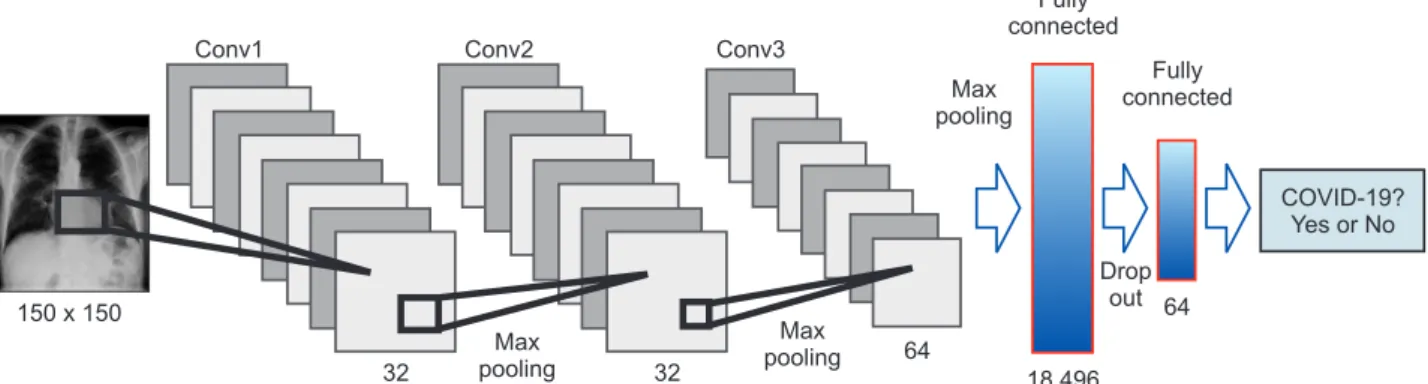
In this paper, we introduce the KNIME analytics platform, which addresses the shortcomings of these existing tools and is capable of performing state-of-the-art deep learn- ing algorithms [7], such as convolutional neural network (CNN) analysis. We performed a deep learning analysis to determine whether a patient was infected with coronavirus disease 2019 (COVID-19) using a simple CNN model [8].
Thus, we validated the performance of the model, which is meaningful during the COVID-19 pandemic. By applying the methods used in this study, professionals who are not familiar with coding will be able to begin research with ma- chine learning or deep learning analysis.
II. Methods
1. Installation and Settings
In this study, a PC with an Intel I7 8700 K 3.70 GHz proces- sor, 32 GB DDR4 RAM, NVidia GeForce GTX 1080 8 GB, Anaconda with Python, and TensorFlow was used. Once the installation of the KNIME analysis platform was complete, the latest Anaconda was downloaded from https://docs.
knime.com/latest/python_installation_guide/#anaconda_
setup. The procedures to install Anaconda and KNIME ex-
the intensive care unit. The dataset is collected from public sources, such as the Italian Society of Medical and Interven- tional Radiology, the Hannover Medical School, and other institutions [9,10]. Data consisting of two different formats were converted to Portable Network Graphics. To make sort- ing simple, we put “1_” in front of the file names of the posi- tive dataset and “0_” of the negative dataset.
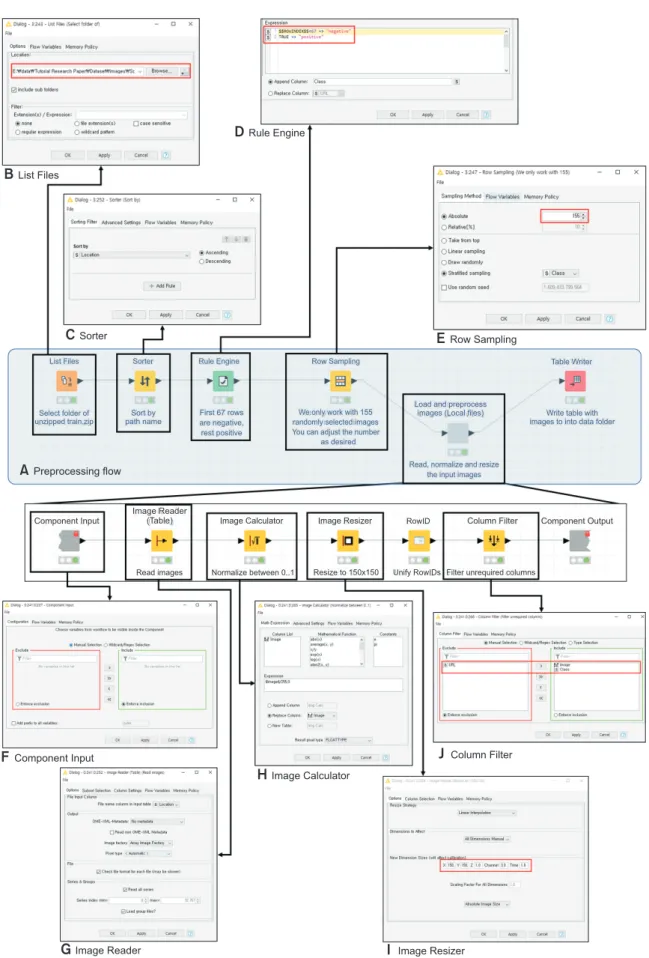
As shown in Figure 4, the “List Files” node imported the dataset. “Sorter” node sorted the data in ascending order, which put negative data first, followed by positives. The “Rule Engine” node classified the first 67 data as “negative” and the rest as “positive” and added the classification column on the datasheet. The “Row Sampling” node selected the data from all rows to utilize them. The “Load and Preprocess Images (local files)” node in KNIME handles the normalization and resizing of the images. Right-clicking the node and clicking
“Component→Open” activated the editor window, which al- lowed us to normalize and resize the images to 150 × 150.
The “Column Filter” node removed unnecessary variables.
In the final preprocessing stage, a table for a deep learning model was prepared by executing the “Table Writer” node.
Then, we trained a simple CNN model to conduct a comput- er-assisted diagnosis of COVID-19.
3. Training
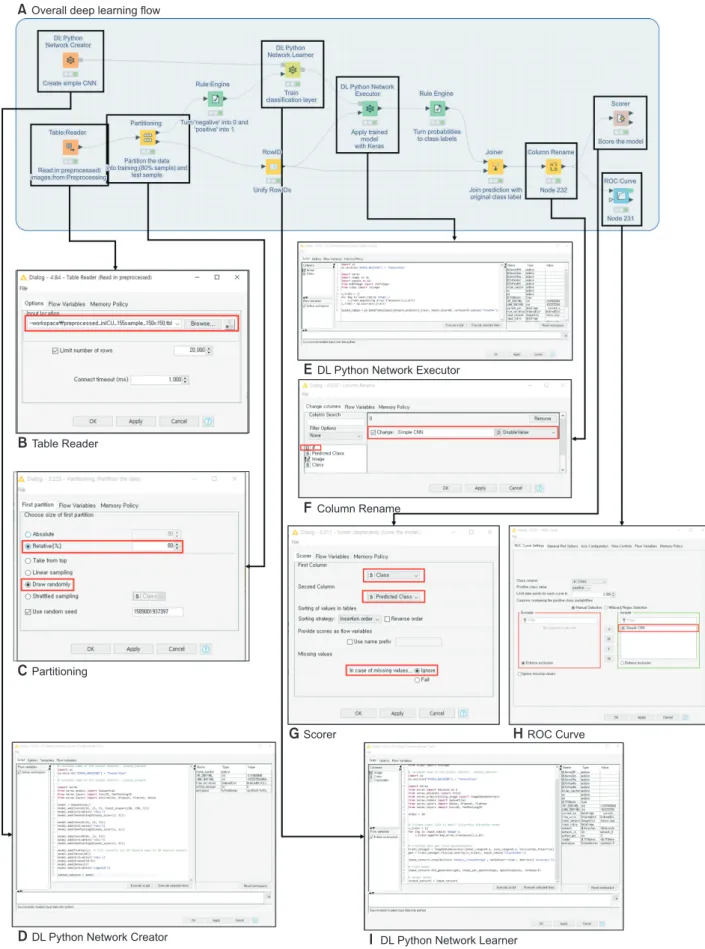
The process of training and testing the model is depicted in Figure 5. The table from preprocessing needed to be im- ported. The “DL Python Network Creator” node was coded to generate a simple CNN. The user may check and modify the code if necessary in configuration, which can be found by right-clicking the node. First, the “Table Reader” node imported the table stored in preprocessing. In the “Partition- ing” node, the dataset was divided into two sets randomly.
Eighty percent of the dataset was selected to train the model, and the rest was used to test it. The “Rule Engine” node was used to set the rule of turning “negative” into 0 and “positive”
into 1. The “DL Python Network Learner” node learned the
Figure 1. Installation procedures of Anaconda.
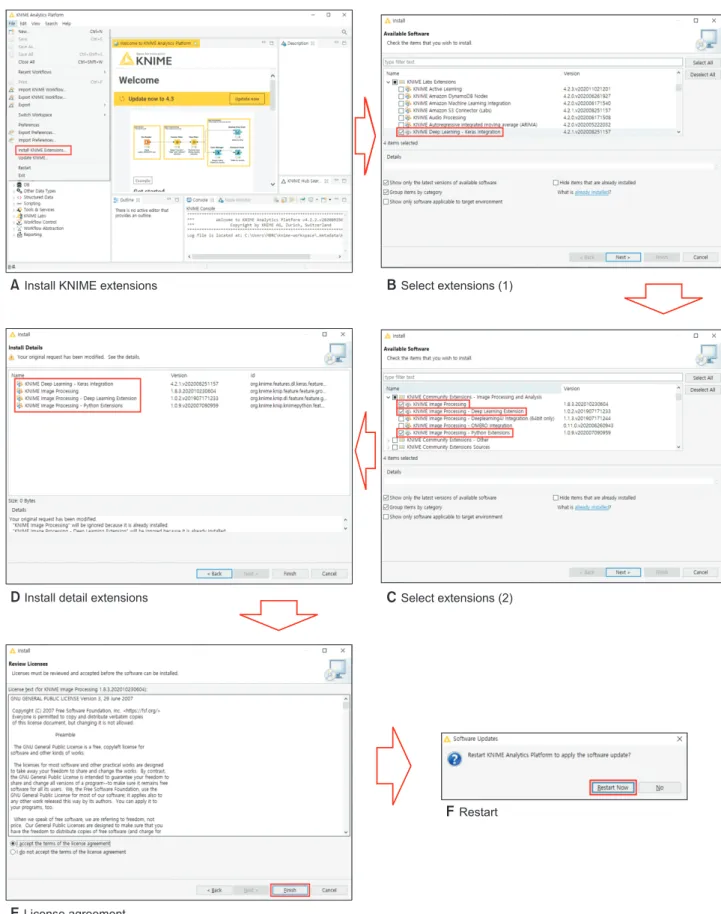
Figure 2. Installation procedures of extensions. (A) KNIME extensions should be installed to execute deep learning model. (B) Select
“KNIME Deep Learning – Keras Integration.” (C) Select “KNIME Image Processing,” “KNIME Image Processing – Deep Learning Extension,” and “KNIME Image Processing – Python Extensions.” (D) Click “Finish.” (E) Agree to “License agreements.” (F) Restart.
AInstall KNIME extensions BSelect extensions (1)
DInstall detail extensions CSelect extensions (2)
ELicense agreement
FRestart
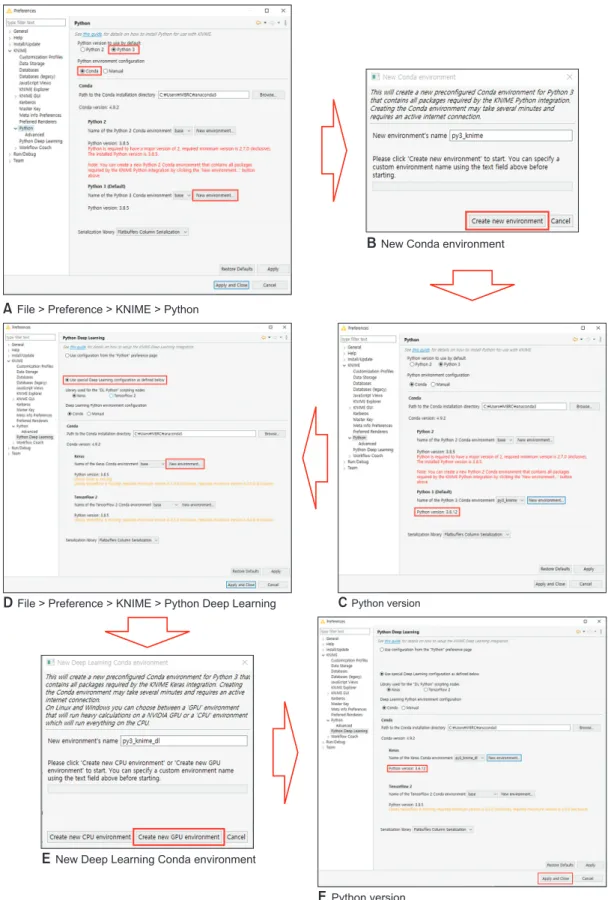
Figure 3. Conda and Deep Learning Conda environment setting. (A) Select “Python3.” (B) Create “New Conda environment.” (C) Create Python environment in which correct version is matched automatically. (D) Select “Use Special Deep Learning Configuration as Defined Below.” (E) Create “New Deep Learning Conda environment.” (F) Create deep learning environment in which cor- rect version is matched automatically.
AFile > Preference > KNIME > Python
BNew Conda environment
CPython version
DFile > Preference > KNIME > Python Deep Learning
ENew Deep Learning Conda environment
FPython version
Figure 4. Example of overall preprocessing flow. (A) All nodes for preprocessing. (B) Import filenames of a dataset. (C) Sort by file- names. (D) Classify files as “positive” or “negative.” (E) Perform stratified sampling and Open “Load and Preprocess Images”
node by right-clicking the node→component→open. (F) Import components. (G) Add image column before filename col- umn. (H) Normalize images. (I) Resize images by 150 × 150. (J) Filter out other columns except image and class columns.
CSorter ERow Sampling
APreprocessing flow
FComponent Input
HImage Calculator
J Column Filter
GImage Reader I Image Resizer
Component Input Component Input
Image Reader (Table) Image Reader
(Table)
Read images
Read images Normalize between 0..1Normalize between 0..1 Resize to 150x150Resize to 150x150 Unify RowIDsUnify RowIDs Filter unrequired columnsFilter unrequired columns RowID
RowID Column FilterColumn Filter Image Resizer
Image Resizer Image Calculator
Image Calculator Component OutputComponent Output
List Files List Files
Select folder of unzipped train.zip
Select folder of unzipped train.zip
Sorter Sorter
Sort by path name
Sort by path name
First 67 rows are negative, rest positive First 67 rows are negative, rest positive Rule Engine
Rule Engine Row SamplingRow Sampling
We only work with 155 We only work with 155 randomly selected images randomly selected images You can adjust the number You can adjust the number
as desired as desired
Load and preprocess images (Local files) Load and preprocess
images (Local files)
Read, normalize and resize the input images Read, normalize and resize
the input images
Table Writer Table Writer
Write table with images to into data folder
Write table with images to into data folder
Figure 5. Example of overall deep learning flow. (A) All nodes for deep learning flow. (B) Import table of preprocessed dataset. (C) Di- vide the dataset into two, one for training and the other for testing. (D) Create a convolutional neural network. (E) Apply the trained model. (F) Rename the column of ROC Curve. (G) Scores the model. (H) Show area under curve. (I) Train the model.
AOverall deep learning flow
BTable Reader
CPartitioning
DDL Python Network Creator
EDL Python Network Executor
FColumn RenameColumn Rename
GScorer HROC Curve
I DL Python Network Learner
DL Python Network Creator
DL Python Network Creator
Create simple CNN Create simple CNN
DL Python Network Learner
DL Python Network Learner
Train classification layer
Train classification layer
DL Python Network Executor DL Python Network
Executor
Apply trained model with Keras Apply trained
model with Keras
Rule Engine Rule Engine
Turn probabilities to class labels Turn probabilities
to class labels Rule Engine
Rule Engine
Turn 'negative' into 0 and 'positive' into 1 Turn 'negative' into 0 and
'positive' into 1
RowID RowID
Unify RowIDs Unify RowIDs Partitioning
Partitioning
Partition the data into training (80% sample) and
test sample Partition the data into training (80% sample) and
test sample Table Reader
Table Reader
Read in preprocessed images from Preprocessing
Read in preprocessed images from Preprocessing
Joiner Joiner
Join prediction with original class label Join prediction with original class label
Column Rename Column Rename
Node 232 Node 232
Scorer Scorer
Score the model Score the model
ROC Curve ROC Curve
Node 231 Node 231
model, presented in Figure 6, using the training dataset from the “Partitioning” node. The code was checked and modified by right-clicking on the node and clicking on Setting. The
“DL Python Network Executor” node validated the model that was learned using the test dataset. The result presents the probability values. After the Executor node, the “Rule Engine” node turned probabilities above 0.5 into “positive,”
and the rest into “negative.” The “Joiner” node combined
two different files and compared them. One was the class of the test dataset, and the other was the predicted value. The Scorer node scored the performance of the model.
4. Performance Evaluation
We obtained true positives, false positives, true negatives, false negatives, sensitivity (=recall), specificity, positive pre- dictive value (=precision), accuracy, and area under curve.
0.0 1.0 0.9 0.8 0.7 0.6 0.5 0.4 0.3 0.2 0.1
1.0
Truepositiverate
False positive rate 0.0
0.1 0.2 0.3 0.4 0.5 0.6 0.7 0.8 0.9
Simple CNN (0.966)
Simple CNN Random
AAccuracy statistics
BConfusion matrix CROC Curve
Figure 7. Performance of a simple convolutional neural network (CNN) model in detecting COVID-19: “Scorer” node shows (A) ac- curacy statistics (true positive, false positive, true negative, false negative, sensitivity, specificity, F-measure, accuracy and Cohen’s kappa; (B) confusion matrix (accuracy, Cohen’s kappa). (C) “ROC Curve” node shows area under the curve.
III. Results
The extracted images were normalized and resized for equal- ization. After preprocessing of the dataset and training of a simple CNN model, 1,000 epochs were performed to test the model because the model’s accuracy increases until 1,000 epochs [11-13]. The lower and upper bounds of positive pre- dictive value (precision), sensitivity (recall), specificity, and F-measure are 92.3% and 94.4%. Both bounds of the accura- cies of the model were equal to 93.5%. The area under curve of the receiver operating characteristic curve was 96.6%, as shown in Figure 7.
IV. Discussion
As the AI market in healthcare grows, research in the health- care area has increased [1]. However, beginners have dif- ficulty conducting research using machine learning or deep learning. This paper describes the overall deep learning pro- cess of applying a simple CNN model via the KNIME analyt- ics platform. KNIME does not require users to code because they can follow the procedures with clicks, drags, and drops, thanks to the GUI. In this study, we trained a simple CNN model with data obtained from 155 intensive care unit pa- tients; this work was expected to have implications for the COVID-19 pandemic. Our analysis showed that the model achieved 93.6% accuracy.
Prior studies also trained CNN models with X-ray images and obtained similar results. Gao [14] stated that, as part of the evidence used to distinguish COVID-19 from other diseases, X-ray images play an essential role. The researcher also mentioned that if hospitals have support in using X- ray equipment and diagnosing COVID-19, it would lead to cost savings. Ismael and Sengur [15] used pre-trained deep CNN models (ResNet18, ResNet50, ResNet101, VGG16, and VGG19) to obtain deep features with accuracies above 85%
and below 93%. Maghdid et al. [16] used a simple CNN and modified the pre-trained AlexNet model, with accuracies of 94% and 98%, respectively. The researcher mentioned that a simple CNN model could be used to diagnose COVID-19 and stimulate research. Our study also used a simple CNN model to detect COVID-19 with a 93% accuracy without writing a single line of code through the KNIME analytics platform. This will contribute to lowering the threshold for research in AI.
The KNIME automatically discovered the versions of py- thon, CUDA, and Keras. It is fast and easy to build a work- flow by dragging the nodes installed in extensions. Since the
example codes for the models are not built-in, some parts are necessary to search for and use the published nodes directly from the KNIME Hub website. A total of 155 data used in the analysis are difficult in view of generalization because the volume of the dataset is small. Furthermore, the data col- lection period is also not long, requiring larger amounts of data and broader periods of data in the future [17].
Codeless deep learning using the KNIME will reduce the time spent and lower the threshold for deep learning re- search applied to healthcare because the KNIME provides a user-friendly GUI and compatibility.
Conflicts of Interest
Hyoun-Joong Kong is an editorial member of Healthcare In- formatics Research; however, he did not involve in the peer reviewer selection, evaluation, and decision process of this article. Otherwise, no potential conflict of interest relevant to this article was reported.
Acknowledgments
This work was supported by research fund of Chungnam National University.
ORCID
Jun Young An (http://orcid.org/0000-0003-0686-1955) Hoseok Seo (http://orcid.org/0000-0001-7740-0887) Young-Gon Kim (http://orcid.org/0000-0003-2148-1299) Kyu Eun Lee (http://orcid.org/0000-0002-2354-3599) Sungwan Kim (http://orcid.org/0000-0002-9318-849X) Hyoun-Joong Kong (http://orcid.org/0000-0001-5456-4862)
References
1. Grand View Research. Artificial intelligence in healthcare market size, share & trends analysis report by component (hardware, software, services), by application, by region, competitive insights, and segment forecasts, 2019-2025 [In- ternet]. San Francisco (CA): Grand View Research; 2019 [cited at 2021 Jan 27]. Available from: https://www.grand- viewresearch.com/industry-analysis/artificial-intelligence- ai-healthcare-market?utm_source=prnewswire&utm_
medium=referral&utm_campaign=hc_16-dec-19&utm_
term=ai-healthcare-market&utm_content=rd/toc.
2. Guo Y, Hao Z, Zhao S, Gong J, Yang F. Artificial intelli- gence in health care: bibliometric analysis. J Med Inter-
6. Frank E, Hall M, Holmes G, Kirkby R, Pfahringer B, Witten IH, et al. Weka: a machine learning workbench for data mining. In: Maimon O, Rokach L, editors. Data mining and knowledge discovery handbook. Boston (MA): Springer; 2009. p. 1269-77.
7. KNIME Analytics Platform [Internet]. Zurich, Switzer- land: KNIME AG; c2020 [cited at 2021 Jan 27]. Avail- able from: https://www.knime.com/knime-analytics- platform.
8. Lin Q, Zhao S, Gao D, Lou Y, Yang S, Musa SS, et al.
A conceptual model for the coronavirus disease 2019 (COVID-19) outbreak in Wuhan, China with individual reaction and governmental action. Int J Infect Dis 2020;
93:211-6.
9. RSNA pneumonia detection challenge [Internet]. San Francisco (CA): Kaggle.com; 2018 [cited at 2021 Jan 27]. Available from: https://www.kaggle.com/c/rsna- pneumonia-detection-challenge.
10. Cohen JP, Morrison P, Dao L, Roth K, Duong TQ, Ghas- semi M. Covid-19 image data collection: prospective predictions are the future [Internet]. Ithaca (NY): arXiv.
org; 2020 [cited at 2020 Jan 28]. Available from: https://
arxiv.org/abs/2006.11988.
11. Shaheen F, Verma B, Asafuddoula M. Impact of auto-
13. Swapna G, Soman Kp, Vinayakumar R. Automated detection of diabetes using CNN and CNN-LSTM network and heart rate signals. Procedia computer sci- ence 2018;132:1253-62.
14. Gao T. Chest X-ray image analysis and classification for COVID-19 pneumonia detection using deep CNN. me- dRxiv 2020 [Epub]. https://doi.org/10.1101/2020.08.20.
20178913.
15. Ismael AM, Sengur A. Deep learning approaches for COVID-19 detection based on chest X-ray images. Ex- pert Syst Appl 2021;164:114054.
16. Maghdid HS, Asaad AT, Ghafoor KZ, Sadiq AS, Khan MK. Diagnosing COVID-19 pneumonia from X-ray and CT images using deep learning and transfer learn- ing algorithms [Internet]. Ithaca (NY): arXiv.org; 2020 [cited at 2020 Jan 28]. Available from: https://arxiv.org/
abs/2004.00038.
17. Phillips NA, Rajpurkar P, Sabini M, Krishnan R, Zhou S, Pareek A, et al. Chexphoto: 10,000+ smartphone photos and synthetic photographic transformations of chest x- rays for benchmarking deep learning robustness [Inter- net]. Ithaca (NY): arXiv.org; 2020 [cited at 2020 Jan 28].
Available from: https://arxiv.org/abs/2007.06199.