• 검색 결과가 없습니다.

Bronchioloalveolar Carcinoma in a Juvenile Rhadomyosarcoma Patient

N/A
N/A
Protected

Academic year: 2021

Share "Bronchioloalveolar Carcinoma in a Juvenile Rhadomyosarcoma Patient"

Copied!
4
0
0

로드 중.... (전체 텍스트 보기)

전체 글

(1)

Korean J Thorac Cardiovasc Surg 2014;47:51-54 □ Case Report □ http://dx.doi.org/10.5090/kjtcs.2014.47.1.51 ISSN: 2233-601X (Print) ISSN: 2093-6516 (Online)

− 51 −

1

Department of Thoracic and Cardiovascular Surgery, Seoul St. Mary’s Hospital, The Catholic University of Korea College of Medicine,

2

Department of Thoracic and Cardiovascular Surgery, Bucheon St. Mary’s Hospital, The Catholic University of Korea College of Medicine,

3

Department of Pathology, Seoul St. Mary’s Hospital, The Catholic University of Korea College of Medicine Received: July 30, 2013, Revised: September 26, 2013, Accepted: October 1, 2013

Corresponding author: Jae Kil Park, Department of Thoracic and Cardiovascular Surgery, Seoul St. Mary’s Hospital, The Catholic University of Korea College of Medicine, 222 Banpo-daero, Seocho-gu, Seoul 137-701, Korea

(Tel) 82-2-2258-2858 (Fax) 82-2-594-8644 (E-mail) [email protected]

C

The Korean Society for Thoracic and Cardiovascular Surgery. 2014. All right reserved.

CC
This is an open access article distributed under the terms of the Creative Commons Attribution Non-Commercial License (http://creative- commons.org/licenses/by-nc/3.0) which permits unrestricted non-commercial use, distribution, and reproduction in any medium, provided the original work is properly cited.

Bronchioloalveolar Carcinoma in a Juvenile Rhadomyosarcoma Patient

Soo Hwan Choi, M.D.

1

, Hyun Woo Jeon, M.D.

2

, Woo Jin Oh, M.D.

3

, Jae Kil Park, Ph.D.

1

Primary tumors of the lung are uncommon in pediatric patients, particularly bronchioloalveolar carcinoma (BAC). An 11-year-old female suffering from back pain for 1 month was referred to Seoul St. Mary's Hospital for treatment of a pathologic fracture of the lumbar spine. Comprehensive evaluation disclosed numerous pulmonary metastases of rhabdomyosarcoma (stage IV). During chemotherapy, most of the lung lesions regressed, with the exception of two nodules. Wedge resections, intended for diagnosis and cure, yielded a histologic diagnosis of BAC.

Key words: 1. Lung neoplasms

2. Adenocarcinoma, bronchiolo-alveolar 3. Pediatric

4. Rhabdomyosarcoma

CASE REPORT

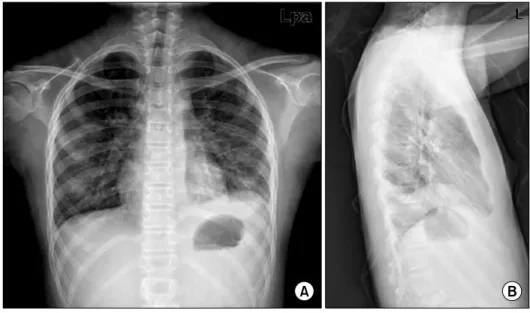
An 11-year-old female was referred to our care for the treatment of a pathologic fracture of the lumbar spine. One month prior, she had fallen during exercise, causing persistent back pain. When symptoms failed to abate, computed tomog- raphy (CT) of the spine was performed, revealing a fracture at the L-2 level that was most likely pathologic. Given the circumstances, she was admitted to Seoul St. Mary's Hospital as a pediatric hematology patient. A chest X-ray (Fig. 1) re- vealed a left lower lobe infiltrate with pleural effusion, and the chest CT revealed bilateral pleural effusions with multi- ple, diffuse nodules of both lungs. Positron emission tomog- raphy (PET)-CT further disclosed whole-body tumor involve- ment. Biopsies of the bone marrow and the sole of the right foot confirmed stage IV rhabdomyosarcoma. After 5 months

of chemotherapy, a complete metabolic response was evident by PET-CT; and after 11 months of treatment, the lung le- sions and pleural effusions had essentially resolved. However, two nodules persisted in the left lung—one in the upper lobe and the other in the superior segment of the lower lobe (Fig.

2B). For diagnostic and curative purposes, wedge resection of these two nodules was performed via mini-thoracotomy. The patient’s recovery was uneventful, and she was discharged on postoperative day 6.

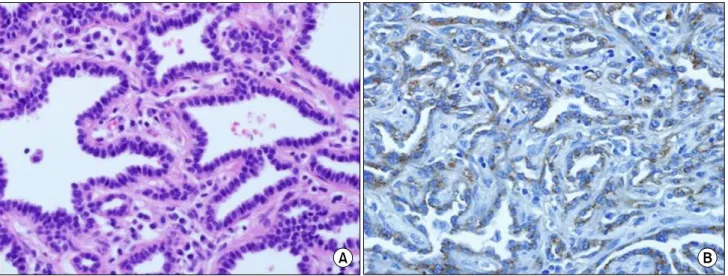
Grossly, the resected nodules were firm and ovoid, measur- ing 3 mm in diameter. In histologic sections, tumor pro- liferation was lepidic, marked by cuboidal to columnar cells with scanty cytoplasm following alveolar contours. Thus, bronchioloalveolar carcinoma (BAC), non-mucinous type (Fig.

3) was diagnosed. The patient was tumor-free after 6 months,

but a new mass developed on her left wrist 10 months

(2)

Soo Hwan Choi, et al

− 52 −

Fig. 1. Initial chest X-ray. (A) Pos- terioranterior (PA) view: pleural effu- sion and lower lobe infiltrate on left.

(B) Left lateral view: left pleural effu- sion with thickened fissure, indicative of pleural lesion.

Fig. 2. Serial chest computed tomography. (A) Initial scan: bilateral pleural effusions and multiple small nodules throughout lungs. (B) After chemotherapy (11 months): nodules and pleural effusion absent, with persistent nodule <5 mm (arrow) of left lower lobe. (C) After surgery (13 months): multiple nodules throughout lungs and postoperative change of left lung.

postoperatively. Whole-body recurrence of rhabdomyosarcoma was subsequently verified by PET-CT.

DISCUSSION

Primary lung tumors are rare in the pediatric age group.

Solitary pulmonary nodules are largely due to inflammation, but the neoplasms that do occur are generally malignant, with the incidence of metastatic disease outnumbering that of pri- mary lung cancer [1]. Most primary cancers of the lung are bronchogenic in origin, typically arising during the sixth or the seventh decade of life. In the second decade, the reported incidence is only 0.9%, and prior to the age of 40 years, this

figure changes little (1.2%) [1]. BAC is a variant of adenocarcinoma. Although its etiology and risk factors are not fully appreciated, smoking and environmental exposures are unlikely contributors [2]. Instead, an association between congenital pulmonary airway malformation (CPAM), type I and BAC has been reported [3], and BAC has been encoun- tered as a second malignancy among survivors of other pe- diatric malignancies, including Ewing’s sarcoma, Hodgkin’s lymphoma, hepatoblastoma, and testicular teratocarcinoma [4].

In this instance, there were no signs of CPAM in the pre-

operative chest X-ray or chest CT, and the lung lesions were

not cystic. Shiraishi et al. [5] similarly reported three young

patients (14, 17, and 23 years of age) with osteosarcoma and

(3)

Primary Lung Cancer in Juvenile Patient

− 53 −

Fig. 3. (A) Cuboidal to columnar cells nondestructively follow alveolar contours (H&E, ×400). (B) Immunohistochemistry (EGFR), histopathol- ogy of bronchioloalveolar carcinoma; positive EGFR immunostaining (×400). EGFR, epidermal growth factor receptor.

concurrent malignancy (adenocarcinoma) or premalignancy (atypical adenomatous hyperplasia) of the lung. All lung path- ology was proven before the chemotherapy for osteosarcoma, but the significance of this association remains to be seen.

Our patient presented with bilateral pleural effusions and bog- gy lungs, precluding the identification of BAC. Without a de- finitive timeline, BAC could not legitimately be linked to chemotherapy. Kowalczyk et al. [6] reported that the proba- bility of the second malignancy was greater in pediatric acute lymphoblastic leukemia patients than in the normal group.

We believe that soft tissue malignancy could affect the devel- opment of the second malignancy. Further studies including genetic predisposition need to be followed.

Pediatric patients with BAC are usually asymptomatic, which hampers discovery and diagnosis. Therefore, our pa- tient was under CT surveillance for disseminated sarcoma.

Hence, the detection of concurrent BAC was possible.

Ultimately, it is important to recognize that solitary lung nod- ules in young patients with sarcomas can be primary malig- nancies, particularly BAC.

As in adults, the prognosis for BAC in juveniles is better than that for other lung malignancies, provided that the surgi- cal resection is adequate [2]. Unfortunately, rhabdomyosarco- ma recurred in this patient 10 months after surgery. Multiple lung lesions reappeared at this time, consistent with metastases. At present, the patient is still living and will con-

tinue to be follwed.

CONFLICT OF INTEREST

No potential conflict of interest relevant to this article was reported.

ACKNOWLEDGMENTS

This manuscript has been edited by native English-speaking experts of BioMed Proofreading.

REFERENCES

1. Weldon CB, Shamberger RC. Pediatric pulmonary tumors:

primary and metastatic. Semin Pediatr Surg 2008;17:17-29.

2. Ohye RG, Cohen DM, Caldwell S, Qualman SJ. Pediatric bronchioloalveolar carcinoma: a favorable pediatric malig- nancy? J Pediatr Surg 1998;33:730-2.

3. Ramos SG, Barbosa GH, Tavora FR, et al. Bronchioloalveo- lar carcinoma arising in a congenital pulmonary airway malformation in a child: case report with an update of this association. J Pediatr Surg 2007;42:E1-4.

4. Lebensburger J, Katzenstein H, Jenkins JJ, Rodriguez- Galindo C. Bronchioloalveolar carcinoma as a second ma- lignancy in osteosarcoma survivors. Pediatr Blood Cancer 2009;53:499-501.

5. Shiraishi K, Mori T, Ohba Y, Iwatani K, Yoshimoto K,

Iyama K. Three young osteosarcoma patients with small ad-

(4)

Soo Hwan Choi, et al

− 54 − enocarcinoma or atypical adenomatous hyperplasia of the lung. Ann Thorac Cardiovasc Surg 2010;16:358-61.

6. Kowalczyk J, Nurzynska-Flak J, Armata J, et al. Incidence

and clinical characteristics of second malignant neoplasms

in children: a multicenter study of a polish pediatric leuke-

mia/lymphoma group. Med Sci Monit 2004;10:CR117-22.

수치

Fig. 2. Serial chest computed tomography. (A) Initial scan: bilateral pleural effusions and multiple small nodules throughout lungs
Fig. 3. (A) Cuboidal to columnar cells nondestructively follow alveolar contours (H&E, ×400)

참조

관련 문서

Autho: Effectiveness of surgery for lumbar stenosis and degenerative spondylolisthesis in the octogenarian population: analysis of the Spine Patient Outcomes Research

§ Due to the late start of construction and frequent design changes during construction, the completion of the project has been one year delayed. of the project has been

As a result of performing a compound exercise of spinning and Zumba for 8 weeks, the change in α-amylase showed a significant difference in the exercise group (p<.01), and

Purpose: Calcaneal fracture is a rare fracture, which accounts for about 2% of all fractures, but is one of the most common fractures in the ankle bone.. There is

Lumbar discogenic radiculopathy (LDR) is one of the most common spinal disorders which can lead to high medical expenses for the patient, occupational impairment,

Therefore, as a recovery method during exercise, it is more effective for recovery of exercise fatigue and prevention of body acidification due to high

82 year-old female patient with traffic accident, (A,B,C) Initial x-rays show open fracture of left distal femur(AO 33-C3, Gustilo-Anderson II) with patella

After her husband died for his country, she had a crisis in her writing, but she overcame her anxiety of being alone in a period of turbulence