• 검색 결과가 없습니다.

Long Term Outcomes of Aortic Root Replacement: 18 Years’ Experience

N/A
N/A
Protected

Academic year: 2021

Share "Long Term Outcomes of Aortic Root Replacement: 18 Years’ Experience"

Copied!
7
0
0

로드 중.... (전체 텍스트 보기)

전체 글

(1)

http://dx.doi.org/10.5090/kjtcs.2013.46.2.104 ISSN: 2233-601X (Print) ISSN: 2093-6516 (Online)

Department of Thoracic and Cardiovascular Surgery, Asan Medical Center, University of Ulsan College of Medicine Received: August 7, 2012, Revised: October 17, 2012, Accepted: October 18, 2012

Corresponding author: Sung-Ho Jung, Department of Thoracic and Cardiovascular Surgery, Asan Medical Center, University of Ulsan College of Medicine, 88 Olympic-ro 43-gil, Songpa-gu, Seoul 138-736, Korea

(Tel) 82-2-3010-3584 (Fax) 82-2-3010-6966 (E-mail) [email protected]

C

The Korean Society for Thoracic and Cardiovascular Surgery. 2013. All right reserved.

CC

This is an open access article distributed under the terms of the Creative Commons Attribution Non-Commercial License (http://creative- commons.org/licenses/by-nc/3.0) which permits unrestricted non-commercial use, distribution, and reproduction in any medium, provided the original work is properly cited.

Long Term Outcomes of Aortic Root Replacement:

18 Years’ Experience

Ji Hyun Bang, M.D., Yu-Mi Im, M.S., Joon Bum Kim, M.D., Suk Jung Choo, M.D., Cheol Hyun Chung, M.D., Jae Won Lee, M.D., Sung-Ho Jung, M.D.

Background: We reviewed the long-term outcomes of aortic root replacement at Asan Medical Center and inves- tigated the predictors affecting mortality. Materials and Methods: A retrospective analysis was performed on 225 consecutive adult patients undergoing aortic root replacement with mechanical conduits (n=169), porcine aortic root prosthesis (n=23), or aortic homografts (n=33) from January 1992 to September 2009. The median follow-up dura- tion was 6.1 years (range, 0 to 18.0 years). Results: The porcine root group was older than the other groups (freestyle 55.9±14.3 years vs. mechanical 46.3±14.6 years, homograft 48.1±14.7 years; p=0.02). The mechanical group had the highest incidence of the Marfan syndrome (mechanical 22%, freestyle 4%, homograft 3%; p=0.01).

Surgery performed for infective endocarditis was more frequent in the homograft group (mechanical 10%, freestyle 10%, homograft 40%; p<0.001). The overall 30-day mortality was 5.3% (12/225). Actuarial survival rates in the mechanical, porcine root, and homograft groups were 79.4%, 81.5%, and 83.5% at 5 years and 67%, 61.9%, and 61.1% at 10 years, respectively (p=0.73). By multivariate analysis, preoperative diabetes mellitus, older age, and longer cardiopulmonary bypass time were independent predictors of mortality. Incidence of postoperative complica- tions, including infective endocarditis and thromboembolism were comparable in all of the groups. Conclusion:

Aortic root replacement can be safely performed with different types of prostheses as the outcome was not af- fected by the choice of prosthesis. Further studies are required to assess the long-term durability of biological prostheses.

Key words: 1. Aorta, surgery 2. Heart valve prosthesis 3. Follow-up studies 4. Aortic valve, surgery

INTRODUCTION

In 1968, Bentall and DeBono described a technique for complete replacement of the aortic valve and ascending aorta with a composite graft: reimplanting the coronary ostia into the graft with the inclusion technique. The outcome was im- proved by later technical modifications that paid attention to

avoiding tension, torsion, or kinking of the coronary re-

implantation sites. There remains a concern about the

long-term risk of thromboembolism, anticoagulation-related

hemorrhage, endocarditis, and reoperation [1-3]. Biological

prostheses such as homograft, pulmonary autograft, and stent-

less bioprostheses (porcine root or stentless pericardial valve)

have been gaining more attention because they can minimize

(2)

Table 1. Patient demographics (n=225) Variable Mechanical

(n=169)

Freestyle (n=23)

Homograft (n=33) p-value Age (yr)

Sex (male) Diabetes mellitus Hypertension Renal failure COPD

NYHA class III or IV Marfan syndrome Emergency operation Prior cardiac surgery Annuloaortic ectasia Infective endocarditis Aortic dissection

46±14 116 (69) 10 (6) 50 (30) 2 (1) 26 (15) 39 (23) 38 (22) 35 (20) 18 (11) 139 (80) 15 (10) 42 (25)

55±14 11 (48) 1 (4) 6 (26) 1 (4) 1 (4) 4 (17) 1 (4) 1 (4) 3 (13) 17 (70) 3 (10) 3 (10)

48±14 25 (75) 2 (6) 5 (15) 4 (12) 1 (3) 9 (27) 1 (3) 2 (6) 2 (6) 28 (80) 14 (40) 3 (10)

0.02 0.07

>0.99 0.22 0.01 0.06 0.69 0.01 0.40 0.61 0.53

<0.001 0.02 Values are presented as mean±standard deviation or number (%).

COPD, chronic obstructive pulmonary disease; NYHA, New York Heart Association.

the risk of thromboembolism and anticoagulation-related problems. However, few studies have directly compared the outcomes of using different prostheses in a single center. In this report we assessed the outcomes of patients who received aortic root replacement with three different types of prostheses.

MATERIALS AND METHODS 1) Study population

From January 1992 to September 2009, a total of 225 pa- tients underwent aortic root replacement at Asan Medical Center. The follow-up ended on October 17, 2011, and cur- rent follow-up data were available for 196 of the 225 patients (87%). The median length of follow-up was 6.1 years (mechanical group, 0 to 17.8 years; freestyle group, 0 to 17.9 years; homograft group, 0 to 16.7 years). Annuloaortic ectasia (dilatation of the sinuses of Valsalva with associated moder- ate or severe aortic valve incompetence, cephalad displace- ment of the coronary ostia, and varying degrees of dilatation of the more distal descending aorta) was the most common indication for surgery (185 patients, 82.5%). Forty-nine pa- tients had acute or chronic ascending aortic dissection.

Eighteen of 49 patients with aortic dissection undergoing pri- mary operations also had annuloaortic ectasia. The aortic root was replaced with a mechanical valved conduit (St. Jude Regent; St. Jude Medical, St. Paul, MN, USA) in 169 pa- tients, porcine aortic root (Freestyle; Medtronic, Minneapolis, MN, USA) in 23 patients, or homograft in 33 patients. The choice of valve type depended on the preference of the surgeons. This series includes patients who underwent aortic root replacement under either elective or emergency surgical conditions.

2) Statistical analysis

Data are expressed as mean±standard deviation or median (range) for continuous variables and as number (%) for cate- gorical variables. The cumulative survival as a function of time after the date of surgery was generated by using the Kaplan-Meier method. The equivalence of long-term mortality among the mechanical valve group, freestyle group, and ho- mograft group survival curves was evaluated by the log-rank

test. The Cox proportional hazards model was used to exam- ine both univariate and multivariate relationships between baseline characteristics and mortality by using stepwise for- ward or backward selection of candidate variables at the p-value of 0.05.

RESULTS 1) Patient demographics

Preoperative patient characteristics are summarized in Table 1. The mechanical group had a higher degree of the Marfan syndrome (mechanical 22%, freestyle 4%, homograft 3%;

p=0.01). Surgical indications for aortic root replacement dif- fered among the three groups, with homograft aortic root re- placement having been performed more frequently for in- fective endocarditis, while aortic dissection patients more fre- quently received mechanical valved conduits. However, aortic root replacement was performed for annuloaortic ectasia in similar proportions of the mechanical group, the porcine root group, and the homograft group patients (Table 1).

2) Surgical results

No differences were observed in the three groups with re-

(3)

Fig. 1. Survival of patients undergoing aortic root replacement ac- cording to the valve type.

Table 2. Operative data and concomitant procedure (n=225) Variable Mechanical

(n=169)

Freestyle (n=23)

Homograft (n=33) p-value CPB time (min)

ACC time (min) TCA time (min) Concomitant procedure

CABG MVP MVR TVP

Total arch replacement Hemiarch replacement

236±113 148±59 6±14

21 (10) 8 (5) 7 (4) 6 (4) 5 (3) 23 (14)

225±117 156±79 3±9

2 (9) 2 (9) 0 (0) 1 (4) 1 (4) 1 (4)

200±80 152±63 2±6

2 (6) 6 (19) 3 (9) 1 (3) 0 (0) 2 (6)

0.20 0.67 0.06

0.71 0.02 0.69

>0.99 0.47 0.15 Values are presented as mean±standard deviation or number (%).

CPB, cardiopulmonary bypass; ACC, aortic cross clamp; TCA, total circulatory arrest; CABG, coronary artery bypass graft;

MVP, mitral valvuloplasty; MVR, mitral valve replacement;

TVP, tricuspid valvuloplasty.

Fig. 2. Morbidity-free survival of patients undergoing aortic root replacement according to the valve type.

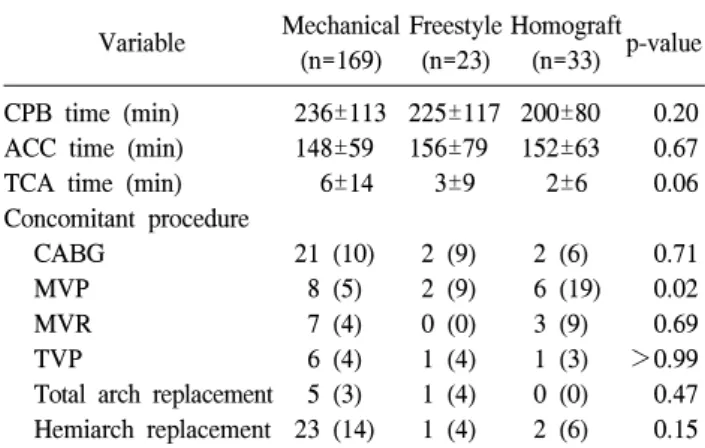
gard to the aortic cross clamp or cardiopulmonary bypass times. Concurrent procedures, such as coronary artery bypass grafting, mitral valve replacement, total arch replacement, hemiarch replacement, and tricuspid valve repair were carried out in 34% (76/225) of aortic root replacement cases. A

bleeding reoperation was required in 23 patients and the in- cidences did not differ significantly among the three groups (p=0.52). Of the 225 patients undergoing aortic root replace- ments, the overall 30-day mortality was 5.3% (12/225) (Fig.

1). Of these patients, 11 patients expired of postoperative car- diogenic shock or hemodynamic instability. The one remain- ing patient expired due to septic shock. There was no statisti- cally significant difference in 30-day mortality between the types of valves (p=0.86) (Table 2).

3) Long term survival

Actuarial survival rates in the mechanical, porcine root, and

homograft groups were 79.4%, 81.5%, and 83.5% at 5 years

and 67%, 61.9%, and 61.1% at 10 years, respectively

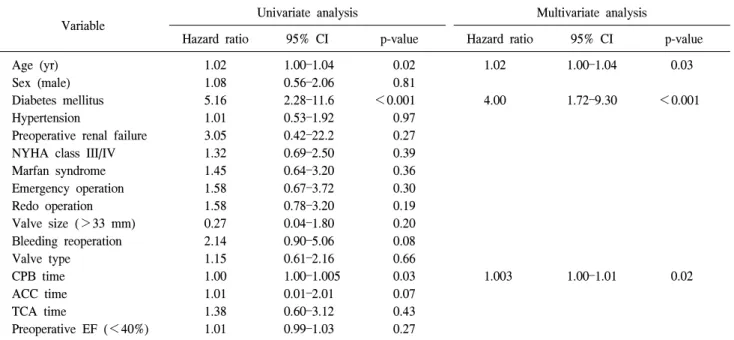
(p=0.73) (Fig. 2). A total of 54 deaths occurred during the 16

years of follow-up. In the univariate analysis, significant pre-

dictors of long-term mortality included diabetes mellitus

(DM), reoperation for postoperative bleeding, and longer aort-

ic cross clamp and cardiopulmonary bypass times. Sex, aging,

preoperative renal failure, emergency performance of aortic

root replacement, Marfan syndrome, and redo operation were

not statistically significant predictors of mortality. By uni-

variate Cox model analysis, insertion of a mechanical valve

(4)

Table 3. Analysis of risk factors of mortality

Variable Univariate analysis Multivariate analysis

Hazard ratio 95% CI p-value Hazard ratio 95% CI p-value

Age (yr) Sex (male) Diabetes mellitus Hypertension

Preoperative renal failure NYHA class III/IV Marfan syndrome Emergency operation Redo operation Valve size (>33 mm) Bleeding reoperation Valve type

CPB time ACC time TCA time

Preoperative EF (<40%)

1.02 1.08 5.16 1.01 3.05 1.32 1.45 1.58 1.58 0.27 2.14 1.15 1.00 1.01 1.38 1.01

1.00–1.04 0.56–2.06 2.28–11.6 0.53–1.92 0.42–22.2 0.69–2.50 0.64–3.20 0.67–3.72 0.78–3.20 0.04–1.80 0.90–5.06 0.61–2.16 1.00–1.005 0.01–2.01 0.60–3.12 0.99–1.03

0.02 0.81

<0.001 0.97 0.27 0.39 0.36 0.30 0.19 0.20 0.08 0.66 0.03 0.07 0.43 0.27

1.02

4.00

1.003

1.00–1.04

1.72–9.30

1.00–1.01

0.03

<0.001

0.02

CI, confidence interval; NYHA, New York Heart Association; CPB, cardiopulmonary bypass; ACC, aortic cross clamp; TCA, total circulatory arrest; EF, ejection fraction.

Table 4. Valve-related complications (n=225) Variable Mechanical

(n=169)

Freestyle (n=23)

Homograft (n=33) p-value Reoperation

Infective endocarditis Hemorrhage Thromboembolism

15 (9) 6 (4) 25 (15) 8 (5)

4 (17) 1 (4) 3 (13) 2 (9)

7 (21.2) 2 (6) 0 (0) 4 (12)

0.01 0.71 0.01 0.16 Values are presented as number (%). Hemorrhage includes postoperative intracerebral hemorrhage. Thromboembolism in- cludes postoperative cerebral infarction.

conduit did not confer a survival benefit relative to freestyle or homograft aortic root replacement at intermediate fol- low-up. By multivariate analysis, preoperative DM, older age, and longer cardiopulmonary bypass time were independent predictors of mortality (Table 3).

4) Valve-related complications

Reoperation was required in 26 patients (for valve-root dehiscence, structural valve degeneration, periaortic abscess, and infective endocarditis, respectively). The overall free- dom from reoperation rate at 1, 5, and 10 years was 97.5%,

91.6%, and 85.3%, respectively. There were meaningful dif- ferences in the reoperation rates of the biologic and me- chanical groups (p=0.01). Nine patients (4.0%, or 0.02% per patient year) had endocarditis and fourteen patients (6.2%, or 0.3% per patient-year) experienced episodes of clinically significant thromboembolism (including cerebral infarction).

No differences were observed between groups with regard to the frequency of infective endocarditis (p=0.71) or thro- mboembolism (p=0.16). Postoperative hemorrhage (including intracerebral hemorrhage) events occurred in 28 patients (12.4%, 0.6% per patient-year), and their incidence was higher in the mechanical group than in the other groups (Table 4).

DISCUSSION

Aortic root replacement has been the favored surgical pro-

cedure for patients with annuloaortic ectasia and other dis-

orders of the ascending aorta that are associated with aortic

regurgitation. This technique reduced the risk of recurrent

proximal aortic aneurysm [1] and surgical outcomes improved

dramatically. The thirty-day mortality for aortic root replace-

(5)

ment has fallen below 5% in this report and others [2,3].

These results are gratifying in light of the high mortality at- tending untreated ascending aortic aneurysm, dissection, and root infection. The hospital deaths that occurred in our study were similar to others reported in the literature [3]. In other comparable aortic root series, the hospital mortality has ranged between 1.7% and 18%, averaging 7% to 8% in re- cent studies [2-5]. Although the mortality rate for root re- placement is low, risk factors for death have been identified.

In this series, preoperative DM, an older age, and longer car- diopulmonary bypass time were predictors of death. Surprisin- gly, the era of operation, previous aortic root operation, and use of hypothermic circulatory arrest were not significant pre- dictors of mortality.

Several clinical studies have confirmed the risk factors for mortality. In 2002, Kouchoukos et al. [6] reported that an older age, preoperative New York Heart Association (NYHA) class III and IV, non-Marfan status, urgent surgery, longer cardiopulmonary bypass time, and male gender were pre- dictors of mortality. Baumgartner et al. [7] reported that a higher mortality rate in patients with aortic root replacement is closely related to NYHA classification III or IV, male gen- der, and urgent surgery. There was no in-hospital mortality among 13 patients with Marfan’s syndrome in our series. The ten-year survival in this series was similar to other series [3,8]; only 60% of the patients who undergo aortic root re- placement are expected to live longer than 10 years.

Up to now, the optimal choice of valved conduit for aortic valve replacement remains controversial because of a lack of prospective randomized studies. The mechanical valves offer stable hemodynamic function and longer durability, but they are thrombogenic, and patients who receive them require long-term anticoagulation, with its associated increase in the risk of hemorrhage. Bioprosthetic valves have fewer throm- boembolic events and usually do not require anticoagulant agents; however, structural deterioration of the valves reduces their durability. This study represents a large series of aortic root replacements performed with aortic mechanical valve conduits or freestyle conduits or homografts. The first study of this kind, by Byrne et al. [9], included 231 elective aortic root replacements (mechanical, n=85; biologic, n=136), and concluded that there were no meaningful differences in early

or mid-term valve-related outcomes between biologic and me- chanical groups. Like prior series [9], our 6-year post- operative follow-up revealed that the majority of patients were generally doing well in all three groups, and we could not find any meaningful differences regarding overall mortal- ity or freedom from valve-related complications in the three groups.

The relatively high rates of bleeding in the mechanical groups were due largely to our policy of anticoagulant ther- apy according to the type of valve. The mechanical groups received coumadine for the rest of their lifetime and the ho- mograft groups received anticoagulant therapy for only three months postoperatively. The freestyle groups had three bleed- ing events in our study because they needed anticoagulation therapy. One patient had postoperative atrial fibrillation and two patients were reoperated with a mechanical valve pros- thesis because one patient had postoperative infective endo- carditis and another patient suffered from severe mitral regurgitation. This study confirms the presence of a direct re- lationship between the intensity of anticoagulation and the risk of bleeding. The recommended prothrombin-time ratio in our protocol (1.8 to 2.2 times the control value) was similar to that of the Edinburgh Heart Valve Trial [10]. Increasing the prothrombin-time ratio from 1.5 to 2.5 doubles the risk of bleeding. Of the 26 major bleeding episodes in our patients, 25 occurred when the prothrombin-time international normal- ized ratio was over 3.0; the remaining one patient, in which the ratio was between 2.0 and 2.5 had recognizable precipitat- ing factors.

Overall, the low rate of valve-related events in this study, such as thromboembolism and endocarditis compared favor- ably with the results obtained from other larger series of aort- ic root replacements [11]. Prasongsukarn et al. [12] recently compared mechanical and bioprosthetic valves in patients 61 to 70 years in terms of combined major valve-related compli- cations and revealed no difference between biologic and me- chanical valves in terms of valve-related reoperation and mortality.

Tyers et al. [13] have noted that patients with biopros-

theses were more likely to require valve-related reoperation

than were those with mechanical prostheses. However, mor-

tality from reoperation secondary to bioprosthetic aortic struc-

(6)

tural failure can be decreased by reoperation in patients with a low, rather than medium to high, NYHA functional class [14]. Jamieson et al. [15] compared composites of valve-re- lated complications in biologic and mechanical heart valves in terms of mitral valve replacement. In that report, mechanical prostheses had a greater than 94% actual freedom from valve-related reoperation in all age groups at 12 to 15 years.

Like prior series, our study found that patients in the homo- graft and the freestyle groups may have had a higher risk of reoperation than those in the mechanical group, but all groups may have similar rates of causes leading to reoperation (valve failure, infective endocarditis, ascending aorta dilatation, and ascending aorta pseudoaneurysm).

The most important limitation of this study is that it is not a prospective, randomized, controlled study but a single-in- stitution retrospective review susceptible to inherent selection biases. The patients in the mechanical group, freestyle group, and homograft group were also very heterogeneous and dis- similar with regard to preoperative characteristics and oper- ative indications. The size of the series is also relatively small, and the extent of follow-up is limited beyond 10 years.

This latter point is quite important, particularly because it is in the 10- to 15-year time interval when most of the reported cases of structural valve degeneration occur in aortic allog- rafts [16-18]. Therefore, a specific comparison of long-term durability in the mechanical valve conduit, freestyle, homo- graft conduit aortic root replacement groups would require a longer period of follow-up than provided in this study.

CONCLUSION

Our data suggest that aortic root replacement with a me- chanical valve conduit is safe and achieves favorable out- comes similar to those of patients receiving homograft or freestyle valve conduits. When choosing the type of valve in aortic root replacement, it is worth considering a number of patient-specific factors, including age, comorbidities, and the risk of hemorrhage and thromboembolism.

CONFLICT OF INTEREST

No potential conflict of interest relevant to this article was

reported.

REFERENCES

1. McCready RA, Pluth JR. Surgical treatment of ascending aortic aneurysms associated with aortic valve insufficiency.

Ann Thorac Surg 1979;28:307-16.

2. Crawford ES, Svensson LG, Coselli JS, Safi HJ, Hess KR.

Surgical treatment of aneurysm and/or dissection of the as- cending aorta, transverse aortic arch, and ascending aorta and transverse aortic arch: factors influencing survival in 717 patients. J Thorac Cardiovasc Surg 1989;98(5 Pt 1):659- 73.

3. Lewis CT, Cooley DA, Murphy MC, Talledo O, Vega D.

Surgical repair of aortic root aneurysms in 280 patients.

Ann Thorac Surg 1992;53:38-45.

4. Cohn LH, Rizzo RJ, Adams DH, et al. Reduced mortality and morbidity for ascending aortic aneurysm resection re- gardless of cause. Ann Thorac Surg 1996;62:463-8.

5. Westaby S, Katsumata T, Vaccari G. Aortic root replace- ment with coronary button re-implantation: low risk and predictable outcome. Eur J Cardiothorac Surg 2000;17:259- 65.

6. Kouchoukos NT, Wareing TH, Murphy SF, Perrillo JB.

Sixteen-year experience with aortic root replacement: results of 172 operations. Ann Surg 1991;214:308-18.

7. Baumgartner WA, Cameron DE, Redmond JM, Greene PS, Gott VL. Operative management of Marfan syndrome: the Johns Hopkins experience. Ann Thorac Surg 1999;67:1859- 60.

8. Kaya A, Schepens MA, Morshuis WJ, Heijmen RH, Brutel de la Riviere A, Dossche KM. Valve-related events after aortic root replacement with cryopreserved aortic homo- grafts. Ann Thorac Surg 2005;79:1491-5.

9. Byrne JG, Gudbjartsson T, Karavas AN, et al. Biological vs.

mechanical aortic root replacement. Eur J Cardiothorac Surg 2003;23:305-10.

10. Bloomfield P, Wheatley DJ, Prescott RJ, Miller HC.

Twelve-year comparison of a Bjork-Shiley mechanical heart valve with porcine bioprostheses. N Engl J Med 1991;324:

573-9.

11. Sioris T, David TE, Ivanov J, Armstrong S, Feindel CM.

Clinical outcomes after separate and composite replacement of the aortic valve and ascending aorta. J Thorac Cardio- vasc Surg 2004;128:260-5.

12. Prasongsukarn K, Jamieson WR, Lichtenstein SV. Perfor- mance of bioprostheses and mechanical prostheses in age group 61-70 years. J Heart Valve Dis 2005;14:501-8, 510-1.

13. Tyers GF, Jamieson WR, Munro AI, et al. Reoperation in

biological and mechanical valve populations: fate of the re-

operative patient. Ann Thorac Surg 1995;60(2 Suppl):

(7)

S464-8.

14. Jamieson WR, Burr LH, Miyagishima RT, et al. Re-oper- ation for bioprosthetic aortic structural failure: risk assess- ment. Eur J Cardiothorac Surg 2003;24:873-8.

15. Jamieson WR, von Lipinski O, Miyagishima RT, et al.

Performance of bioprostheses and mechanical prostheses as- sessed by composites of valve-related complications to 15 years after mitral valve replacement. J Thorac Cardiovasc Surg 2005;129:1301-8.

16. Gott VL, Cameron DE, Alejo DE, et al. Aortic root replace- ment in 271 Marfan patients: a 24-year experience. Ann Thorac Surg 2002;73:438-43.

17. Kirklin JK, Smith D, Novick W, et al. Long-term function of cryopreserved aortic homografts: a ten-year study. J Thorac Cardiovasc Surg 1993;106:154-65.

18. Takkenberg JJ, Eijkemans MJ, van Herwerden LA, et al.

Prognosis after aortic root replacement with cryopreserved

allografts in adults. Ann Thorac Surg 2003;75:1482-9.

수치

Table 1. Patient demographics  (n=225) Variable Mechanical  (n=169) Freestyle (n=23) Homograft (n=33) p-value Age  (yr) Sex  (male) Diabetes  mellitus Hypertension Renal  failure COPD
Fig. 2. Morbidity-free survival of patients undergoing aortic root  replacement according to the valve type.
Table 3.  Analysis of risk factors of mortality

참조

관련 문서

When fiber posts were cemented into the root canal using total-etch adhesives, the bond strength and adaptation between post and root canal dentin were affected

Efficacy of syringe irrigation, RinsEndo and passive ultrasonic irrigation in removing debris from irregularities in root canals with different apical

The expression of reporter genes driven by the ZAT1 promoter was observed in the tissues undergoing maturation such as border cell of root cap, endodermis,

Long-term outcomes of short dental implants supporting single crowns in posterior region: a clinical retrospective study of 5-10 years.. Osteotome sinus

A comparison of the cleaning efficacy of short-term sonic and ultrasonic passive irrigation after hand instrumentation in molar root canals.. Ultrasonic

Weine 14 categorized the root canal systems in single root into four basic types: Type Ⅰ-single canal from the pulp chamber to the apex; Type Ⅱ -two separate canals

Contents of total lipid in the epididymal adipose of rats fed high fat-high cholesterol diet containing Stachys sieboldii Miq root powder for 6 weeks ···78 Fig.. Contents of

• Decision trees classify instances by sorting them down the tree from the root to some leaf node..