• 검색 결과가 없습니다.

Comparison of Spatio-temporal Gait Parameters between Paretic and Non-paretic Limb while Stepping over the Different Obstacle’s Heights in Subjects with Stroke

N/A
N/A
Protected

Academic year: 2021

Share "Comparison of Spatio-temporal Gait Parameters between Paretic and Non-paretic Limb while Stepping over the Different Obstacle’s Heights in Subjects with Stroke"

Copied!
6
0
0

로드 중.... (전체 텍스트 보기)

전체 글

(1)

Research Article Open Access

편마비 환자의 장애물 높이에 따른 마비측과 비마비측 하지의 시공간적 보행변수 비교

한진태

경성대학교 물리치료학과

Comparison of Spatio-temporal Gait Parameters between Paretic and Non-paretic Limb while Stepping over the Different Obstacle’s Heights in Subjects with Stroke

Jin-Tae Han, PT, PhD

Department of Physical Therapy, Kyungsung University

Received: December 23, 2013 / Revised: January 16, 2014 / Accepted: January 28, 2014

ⓒ 2014 J Korean Soc Phys Med

| Abstract |

PURPOSE: The aim of this study is to compare the spatio-temporal gait parameters between paretic and non-paretic limb while stepping over the different obstacle’s heights in subjects with stroke.

METHODS: Nine subjects with stroke were participated in this study. Subjects were asked to step over obstacles with a different height. 8 camera motion analysis system(Motion Analysis Corporation, Santa Rosa, USA) was used to measure spatio-temporal parameters. The two way repeated measurement ANOVA was used to compare spati-temporal gait parameters between paretic and non-paretic limbs while stepping over a different obstacle’s height(0cm, 10cm, 20cm).

RESULTS: Step width, velocity, single supoort time, and double support time were not different among obstacle’s height(p>0.05) but stride length, step length, and cadence were significantly different(p>0.05). In stride length, cadence, and double support time, the interactions between

†Corresponding Author : [email protected]

obstacle’s heights and limbs were not different(p>0.05) but it was significantly different in velocity, step length, and single support time(p<0.05). Velocity, stride length, cadence, and double support times were not different between paretic limb and non-paretic limb(p>0.05) but step length and single support times were significantly different between paretic limb and non-paretic limb(p<0.05).

CONCLUSION: These results show that there are differences with spatio-temporal gait parameters among obstacle’s heights and between paretic and non-paretic limb during obstacle crossing in subjects with stroke.

Key Words: Obstacles, Spatio-temporal parameter, Gait, Stroke

Ⅰ. 서 론

장애물 안전하게 넘어가는 것은 많은 뇌졸중 환자들

에게 어려운 과제이다(Den Otter 등, 2005; Said 등,

1999). 뇌졸중 이후 보행 훈련을 받는 환자의 50%가

(2)

작은 장애물을 피하기 위해 시도하는 중 장애물에 부딪 치거나 균형을 잃는 사고가 발행한다고 한다(Said 등, 1999). 또한 선행연구들은 정상인들과 비교하여 뇌졸 중 환자들은 장애물을 넘어갈 때 보행속도가 느려지고 장애물 먼저 넘어가는 발(lead limb)의 위치와 같은 보행 양상이 다르다고 보고하였다(Said 등, 2008; Said 등, 2005).

일반적으로 정상인들은 대칭적인 보행양상을 보인 다고 가정하지만(Said 등, 2009) 뇌졸중과 같은 질환에 서 비대칭적인 보행양상이 나타나며 특히, 마비측이 비마비측보다 두드러진다(Olney와 Richard, 1996). 예를 들어, 건강한 성인의 평균 보행속도는 1.4㎧이지만 편 마비환자의 보행속도는 0.18∼1.03㎧로 느려지고 (Olney 등, 1994), 보행의 시공간적 변수 중 대칭성을 알 수 있는 걸음길이 대칭 비은 약 1.13, 그리고 한발 지지기 대칭 비에서 0.53∼0.66으로 비대칭적 보행양상 을 보인다(Dettmann 등, 1987; Hill 등, 1994). 또한 장애 물을 넘어가는 과제를 수행하는 동안 먼저 넘어가는 발과 뒤따라 넘어가는 발 (trail limb)의 운동 양상은 유의 한 차이가 있다(Palta 등, 1996).

보행의 대칭성은 보행의 중요한 특징이며 특히, 뇌 졸중 환자에 있어 보고가 증가하는 추세이다. 두 하지 사이의 유사성 측정인 대칭성은 임상치료사들에게 치 료방향을 제시하는 역할을 할 수 있고 비정상적인 보행 조절에 대한 방법을 제공할 수 있다(Patterson 등, 2008).

또한 보행의 대칭성은 비마비측 하지의 비효율성 , 균형 조절 문제, 그리고 근골격계 손상 위험과 마비측 하지 의 골밀도 감소 등과 같은 부정적 진행과 관련이 있기 때문에 임상적으로 중요하다 (Patterson 등, 2008; Jorgensen 등, 2000).

하지만 현재 뇌졸중 환자들의 보행에 대한 연구들은 대부분 치료적 중재에 따른 보행기능평가 혹은 균형능 력에 관한 연구들이 수행되었고 장애물 보행 시 장애물 높이에 따른 보행변수들의 변화 혹은 마비측과 비마비 측의 대칭성을 비교한 연구는 부족한 실정이다 . 따라서 본 연구는 뇌졸중 환자의 장애물 보행 시 장애물 높이에 따른 시공간적 보행 변수를 비교하고 또한 마비측과 비마비측 하지 사이에 시공간적 보행변수 차이를 비교

하고자 하였다.

Ⅱ. 연구 방법

1. 연구 대상

9명의 뇌졸중 환자(남자 7명, 여자 2명)가 연구에 참여하였으며 대상자는 뇌졸중과 관련된 근골격계 질 환 이외의 이상 증상은 없었다 . 보조도구 없이 5분 이상 보행이 가능하고 기능적 보행 지수 (FAC)가 3등급 이상 인 편마비 뇌졸중 환자들 (마비측: 오른쪽 5명, 왼쪽 4명) 을 지역 재활병원에서 모집하였다 . 실험 전 실험내용에 대해 대상자들에게 충분히 설명하였으며 자발적인 동 의를 얻었다.

2. 연구 도구 및 측정방법

1) 연구 절차

대상자들에게 높이가 다른 장애물(0cm, 10cm, 20cm) 을 편안한 걸음으로 넘어가도록 요구하였고, 장애물 높이는 무작위로 적용하였고 , 실험 전 충분히 연습하도 록 하였다. 대상자들은 장애물을 넘어갈 때 비마비측 발을 장애물을 넘기 전에 디디게 하고 마비측 발로 장애 물을 먼저 넘어가도록 지시하였으며 이어서 비마비측 발을 따라 넘어가도록 하였다. 실험을 하기 전에, 대상 자들의 기본적인 신체자료를 수집하였으며 장애물 높 이에 따른 시-거리 보행변수들을 대상자들이 장애물을 넘어가는 동안 수집하였다. 모든 자료는 3번 반복하여 수집하였고 평균값을 사용하였다. 보행거리는 5m였으 며 평상 시 걸음을 재현하도록 5 걸음 이상 걷도록 지시 하였고 처음과 마지막 걸음은 제외하고 자료를 분석하 였다 . 자료 분석은 걸음 중 장애물을 넘어갈 때 사용된 마비측과 비마측발의 각 큰걸음 하나만(one stride)을 사용하여 분석하였다.

2) 측정 도구

8대의 적외선 카메라를 사용한 삼차원 동작분석기

(Motion Analysis Corporation, Santa Rosa, USA)를 사용

(3)

하여 높이가 다른 장애물을 대상자들이 넘는 동안 1000

㎐ 단위로 측정하였다(그림 1). 반사마커를 전체 몸에 부착하였으며 자료처리는 Orthorak 소프트 프로그램 (Motion Analysis Corporation, Santa Rosa, USA)을 이용 하였다.

3. 통계 처리

뇌졸중 환자의 장애물 높이에 따른 시공간 보행변수 와 마비측과 비마비측 하지 사이의 시공간 보행변수 차이를 알아보기 위해 이요인 반복측정 분산분석을 사

용하였다. 모든 통계분석은 SPSS 버전 21을 사용하였 고 유의수준(α)은 0.05로 하였다.

Ⅲ. 연구 결과

1. 연구 대상자의 일반적 특성

표 1은 대상자의 개인적은 특성을 정리하였으며 다 음과 같다.

Subject Sex Age(y) Time since stroke(m) Paretic side Stroke type FAC

1 M 47 8 Right Ischemic Grade 4

2 M 37 28 Left Hemorrhagic Grade 4

3 M 38 30 Right Hemorrhagic Grade 4

4 M 21 18 Left Hemorrhagic Grade 4

5 M 48 31 Left Hemorrhagic Grade 4

6 M 67 22 Left Ischemic Grade 4

7 M 65 31 Left Hemorrhagic Grade 3

8 F 49 26 Right Hemorrhagic Grade 3

9 F 46 30 Right Ischemic Grade 4

FAC : functional ambulation category scale Table 1. Subject characteristics

2. 장애물 높이에 따른 환측-비환측 하지의 시-거리 보행변수 비교

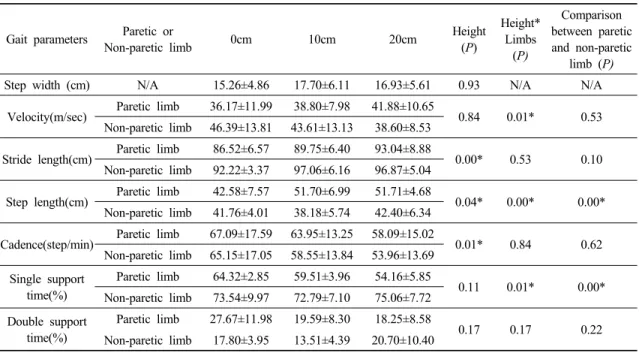
발너비, 보행속도, 한발지지 시간, 그리고 두발지지 시간은 장애물 높이에 따라 차이가 없었지만(p>0.05) 큰걸음길이 , 걸음길이, 그리고 분당걸음수는 통계적으 로 유의한 차이가 있었다(p>0.05). 큰걸음길이와 분당 걸음수 그리고 두발지지 시간은 장애물 높이와 다리 사이에 교호작용이 없어지만 (p>0.05) 보행속도, 걸이길 이, 그리고 한발지지 시간은 교호작용이 있었다 (p<0.05). 즉, 장애물이 높아질수록 마비측 하지의 보행

속도는 증가하고 비마비측 보행속도는 감소하였고, 장 애물 높이가 높아질수록 마비측 하지의 걸음길이는 증 가하고 바마비측 하지의 걸음걸이는 차이가 없었다.

또한 장애물 높이가 높아질수록 마비측 하지의 한발지

지 시간은 감소하였고 비마비측 하지의 한발지지 시간

은 차이가 없었다. 그리고 보행속도, 큰걸음길이, 분당

걸음수 , 두발지지 시간은 마비측과 비마비측 하지 사이

에 차이가 없었지만(p>0.05) 걸음길이와 한발지지 시간

은 마비측과 비마비측 하지 사이에 통계적으로 유의한

차이가 있었다(p<0.05).

(4)

Gait parameters Paretic or

Non-paretic limb 0cm 10cm 20cm Height

(P)

Height*

Limbs (P)

Comparison between paretic and non-paretic

limb (P)

Step width (cm) N/A 15.26±4.86 17.70±6.11 16.93±5.61 0.93 N/A N/A

Velocity(m/sec) Paretic limb 36.17±11.99 38.80±7.98 41.88±10.65

0.84 0.01* 0.53

Non-paretic limb 46.39±13.81 43.61±13.13 38.60±8.53

Stride length(cm) Paretic limb 86.52±6.57 89.75±6.40 93.04±8.88

0.00* 0.53 0.10

Non-paretic limb 92.22±3.37 97.06±6.16 96.87±5.04

Step length(cm) Paretic limb 42.58±7.57 51.70±6.99 51.71±4.68

0.04* 0.00* 0.00*

Non-paretic limb 41.76±4.01 38.18±5.74 42.40±6.34

Cadence(step/min) Paretic limb 67.09±17.59 63.95±13.25 58.09±15.02

0.01* 0.84 0.62

Non-paretic limb 65.15±17.05 58.55±13.84 53.96±13.69 Single support

time(%)

Paretic limb 64.32±2.85 59.51±3.96 54.16±5.85

0.11 0.01* 0.00*

Non-paretic limb 73.54±9.97 72.79±7.10 75.06±7.72 Double support

time(%)

Paretic limb 27.67±11.98 19.59±8.30 18.25±8.58

0.17 0.17 0.22

Non-paretic limb 17.80±3.95 13.51±4.39 20.70±10.40

* p<.05

N/A : no application

Table 2. Comparison of spatio-temporal gait parameters between paretic and non-paretic limb and among the different obstacle’s heights
Ⅳ. 고 찰

노인의 중요한 건강 문제 중에 하나인 뇌졸중은 만성 적 기능장애 원인 중 가장 일반적인 원인이다 (Corriveau 등 , 2004). 특히 만성 뇌졸중 환자는 지속적인 보행 훈련 에도 보행 속도 감소와 비대칭적 보행 양상이 나타난다 (Hsu 등, 2003). 임상 진단과 관리의 발전으로, 뇌졸중 증상의 심각성이 감소하는 추세이며 반면 약한 손상이 나 중간 정도의 손상이 있는 뇌졸중 환자는 증가하고 있다(Jorgensen 등, 1995). 따라서 약간의 손상이 있는 뇌졸중 환자를 대상으로 회복훈련 강화와 기능 및 삶의 질을 개선하는 보다 효과적이고 세심하게 평가가 필요 하다(Lu 등, 2010). 뇌졸중 이후 높은 수행능력을 보이 는 뇌졸중 환자가 장애물 넘기와 같은 일상생활에서 복잡한 과제를 수행할 때만 나타나는 문제가 있는지 그리고 이런 활동을 수행할 때 특별한 전략을 적용하는 지 알려진 것이 없다(Lu 등, 2010).

정상적인 장애물 넘기는 먼저 넘어가는 발과 뒤따라 가는 발의 조절에 대한 역학적 요구가 다른 위치에 있 는 , 입각기(stance phase)와 유각기(swing phase) 하지의 높은 관절의 협력 움직임을 통해 몸의 균형을 유지하는 동안 섬세한 유각기 발 조절이 요구된다(Chen과 Lu, 2006). 하지만 뇌졸중 환자는 근약화 그리고 운동 조절 장애로 인한 비대칭적인 하지 기능이 마비측 하지가 장애물을 먼저 넘어가거나 뒤에 넘어 가느냐에 따라 보행 수행이 달라진다(De Quervain 등, 1996).

Lu 등(2010)은 장애물 높이에 따른 보행속도는 차이

가 없고 마비측과 비마비측 하지의 차이도 없다고 보고

하였다. 본 연구에서는 애물 높이에 따른 보행속도는

유의한 차이가 없었지만 장애물 높이가 높아질수록 마

비측 하지의 보행속도는 증가하고 비마비측 보행속도

는 감소하였다. 이는 장애물의 높이가 뇌졸중 환자의

장애물 보행 시 비마비측 하지에 무게 중심을 두고 마비

측 하지를 빠르게 이동하여 안정성을 유지하고 자 하기

(5)

위함이라고 생각된다. 또 Patterson 등(2008)은 뇌졸중 환자의 마비측과 비마비측 하지의 걸음길이 비와 한발 지지 시간 비 등이 유이한 차이가 있었다고 보고하였 다 . 이는 본 연구에서도 비마비측 하지에 비해 마비측 하지의 걸음길이가 길었고 장애물이 높아질수록 증가 하였으며 한발지지 시간은 비마비측 하지에 비해 마비 측 하지가 짧았고 장애물 높이가 증가할수록 더욱 짧아 졌다. 이런 시공간적인 보행 변수의 변화는 장애물을 마비측 하지로 먼저 넘어가는 경우 비마비측 하지에서 안정성을 제공해주기 위한 전략으로 생각된다.

두 다리를 교대로 하여 장애물을 넘어가는 훈련이 대칭성 보행 전략을 발전시키는 데 도움이 된다(Lu 등, 2010)는 보고와 본 연구의 결과를 근거로, 뇌졸중 환자 의 낙상예방을 위해 실시되는 보행훈련에 일상생활에 서 자주 만나게 되는 장애물보행이 뇌졸중 환자의 보행 훈련 내용에 포함되어야 한다는 의미를 전달하고 있다.

Ⅴ. 결 론

본 연구는 뇌졸중 환자의 장애물 보행 시 장애물 높이에 따른 시공간적 보행변수의 변화와 마비측 하지 와 비마비측 하지 사이의 대칭성을 알아보고자 하였다.

뇌졸중 환자의 장애물 보행 시 장애물 높이에 따라 큰걸 음길이, 걸음길이, 그리고 분당 걸음수은 유의한 차이 가 있었고 걸음길이와 한발지지 시간이 마비측 하지와 비마비측 하지에서 유의한 차이가 있었다. 이는 뇌졸중 환자가 장애물 보행에서도 높이에 따라 마비측과 비마 측 하지의 대칭성에 크게 차이가 있다는 것을 알 수 있으며 , 따라서 뇌졸중 환자의 보행 훈련 시 일상생활 에서 만나게 되는 다양한 장애물에 대한 보행훈련이 제공되어야 함을 제안한다.

Acknowledgment

이 논문은 2013학년도 경성대학교 학술연구비지원 에 의하여 연구되었음.

References

Corriveau H, Hebert R, Raiche M, et al. Evaluation of postural stability in the elderly with stroke. Arch Phys Med Rehabil. 2004;85(7):1095-101.

Chen HL, Lu TW. Comparisons of the joint moments between leading and trailing limb in young adults when stepping over obstacles. Gait Posture. 2006;23(1)69-77.

Den Otter AR, Geurts AC, de Haart M, et al. Step characteristics during obstacle avoidance in hemiplegic stroke. Exp Brain Res. 2005;161(2):180-92.

De Quervain IA, Simon SR, Leurgans S, et al. Gait pattern in the early recovery period after stroke. J Bone Joint Surg Am. 1996;78(10):1506-14.

Dettmann MA, Liner MT, Sepic SB. Relationships among gait performance, postural stability, and functional assessments of the hemiplegic patient. Am J Phys Med. 1987;66(2):77-90.

Hill KD, Goldie PA, Baker PA, et al. Retest reliability of the temporal and distance characteristics of hemiplegic gait using a footswich system. Arch Phys Med Rehabil.

1994;75(5):577-83.

Hsu AL, Tang PF, Jan MH. Analysis of impairments influencing gait velocity and asymmetry of hemiplegic patients after mild to moderate stroke. Arch Phys Med Rehabil.

2003;84(8):1185-93.

Jorgensen L, Cratree NJ, Reeve J, et al. Ambulatory level and asymmetrical weight bearing after stroke affects bone loss in the upper and lower part of the femoral neck differently: bone adaptation after decreased mechanical loading. Bone. 2000;27(5):701-7.

Jorgensen HS, Nakayama H, Raaschou HO, et al. Outcome and time course of recovery in stroke. PartⅠ, Outcome.

The Copenhagen strok study. Arch Phys Med Rehabil.

1995;76(5):399-405.

Lu TW, Yen HC, Chen HL, et al. Symmetrical kinematic

changes in highly functioning older patients

post-stroke during obstacle-crossing. Gait Posture.

(6)

2010;31(4):511-6.

Olney SJ, Griffin MP, McBride ID. Temporal, kinematic, and kinetic variables related to gait speed in subjects with hemiplegia: A regression approach. Phys Ther.

1994;74(9):872-85.

Olney SJ, Rechard C. Hemiparetic gait following stroke. PartⅠ:

characteristics. Gait Posture. 1996;4(2):136-48.

Palta AE, Rietdyk S, Martin C, et al. Locomotor patterns of the leading and the trailing limbs as solid and fragile obstacles are stepped over: some insights into the role of vision during locomotion. J Mot Behav.

1996;28(1):35-47.

Patteerson KK, Parafianowicz I, Danells CJ, et al. Gait asymmetry in community-ambulating stroke survivors.

Arch Phys Med Rehabil. 2008;89(2):304-10.

Said CM, Goldie PA, Palta AE, et al. Obstacle crossing in subjects with stroke. Arch Phys Med Rehabil.

1999;80(9):1054-9.

Said CM, Goldie PA, Culham E, et al. Control of lead and trail limb clearance during obstacle crossing following stroke. Phys Ther. 2005;85(5):413-27.

Said CM, Goldie PA, Patla AE, et al. Balance during obstacle crossing following stroke. Gait Posture. 2008;27 (1):23-30.

Said CM, Galea M, Lythgo N. Obstacle crossing performance does not differ between the first and subsequent attempts in people with stroke. Gait Posture. 2009;

30(4):455-8.

수치

Table 2. Comparison of spatio-temporal gait parameters between paretic and non-paretic limb and among the different obstacle’s heights  Ⅳ

참조

관련 문서

&#34;Guidelines for the early management of adults with ischemic stroke: a guideline from the American Heart Association/American Stroke Association Stroke

Comparison of the prevalence of Malnutrition and Overweight, Obesity between South Korean families and North Korean refugees families 15 Table 5.. Comparison of the

The present work considers the effect of different system parameters (orifice diame- ter, orifice number and spacing between orifices) on bubble for- mation, bubble

Studies on the stabilization mechanism of metal(loid)s in contaminated soil with different calcareous wastes Waste..

The benefits and harms of intravenous thrombolysis with recombinant tissue plasminogen activator within 6 h of acute ischaemic stroke (the third

34 Comparison of temperature histories for FSW welded joints with travel speed in different rotation speeds · · · ·58 Fig.. 35 Comparison of temperature values for

Figure 6.23 Comparison of the average absorption coefficient between the honeycomb panel and HMPP for a 25-mm core thickness.. 174 Figure 6.24 Comparison of STL between

&lt;Table 5&gt; Difference of limb load asymmetry, postural sway and lumbar flexibility between control group and experimental group(In case