Effect of Pyrroloquinoline Quinone on Osteoclast Generation and Activity
Seon-Yle Ko, D.D.S.,Ph.D., Dong-Ho Han, D.D.S.,Ph.D., Jung-Keun Kim, D.D.S.,Ph.D.
Department of Oral Biochemistry, School of dentistry, Dankook University
We examined the effect of PQQ, as a scavenger of superoxide, on osteoclast-like cell formation and on mature osteoclast function. To determine whether PQQ scavenges the superoxide, nitroblue tetrazolium (NBT) staining, which is a method to detect superoxide, was performed on HD-11 cells which are a chick myelomonocytic cell line having tartrate-resistant acid phosphatase (TRAP) activity in response to 1,25-dihydroxyvitamin D3
[1,25-(OH)2D3]. Histochemical study of TRAP was also performed on HD-11 cells. PQQ inhibited the TRAP-positive multinucleated cell formation of chicken bone marrow cells was also examined. The addition of 20 μM PQQ inhibited the formation of TRAP-positive multinucleated cell. When chicken osteoclasts were cultured on dentin slices, treatment of 20 μM PQQ resulted in a significant decrease in dentin resorption by osteoclasts in terms of total resorption area and number of resorption pits. The present data suggest that PQQ, possibly as a scavenger of superoxide ion, inhibits the osteoclastic differentiation and bone resorption.
Key words : Osteoclast, Superoxide, Pyrroloquinoline quinone, TRAP
1)
Ⅰ. INTRODUCTION
Pyrroloquinoline quinone (PQQ), which is the prosthetic group or coenzyme of quinoprotein enzyme
1,2), has been reported to be a growth factor or vitamin in mice
3). PQQ is distributed in animals as well as in microorganisms and it serves as a growth stimulatant of a number of bacteria and animal cells
4-6). PQQ, as a free radical scavenger, has been shown preventive effects on the carrageenin-induced rat paw edema
7)and on the
Corresponding author: Prof. Seon-Yle Ko
Department of Oral Biochemistry, School of Dentistry, Dankook University, San 29, Anseo-dong, Cheonan, Choongnam, Korea 330-716
e-mail : [email protected] received: 2005-05-30 accepted: 2005-07-26
hydrocortisone-induced cataract
8)which are probably associated with reactive oxygen species.
It is generally accepted that osteoclasts, which
are the principal cells responsible for physiological
and pathological bone resorption, are regulated by a
variety of osteotropic hormones and cytokines in its
formation and function. However, it is becoming
increasingly evident that the reactive oxygen
species (ROS) produced by osteoclasts may also
play a crucial role in bone resorption. It has been
postulated that the respiratory activity of
osteoclasts is related to bone resorptive activity by
Fallon et al.
9). In addition, Beard et al.
10)reported
that malignant infantile osteopetrosis, which is
caused by a lack of normal osteoclastic function, is
associated with defective superoxide production in
neutrophils. Thereafter, Key et al.
11)have identified
the superoxide anion between the external
osteoclastic membrane and the bone, and Garrett et
al.
12)and Ries et al.
13)have suggested that oxygen-derived free radicals, especially the superoxide anion, are associated with osteoclastic bone resorption. Recently, Bai et al.
14)reported that ROS such as superoxide anion is involved in bone loss-related diseases by stimulating osteoclast differentiation and bone resorption and that receptor activator of NF-kappaB ligand (RANKL) is a critical osteoclastogenic factor expressed on osteoblastic cells.
The present study was undertaken to investigate whether PQQ, as a scavenger of superoxide, affects on osteoclast-like cell formation and bone resorption. We demonstrate that PQQ decreases the NBT reduction and the TRAP activity of the chick myelomonocytic cell line HD-11. Likewise, we show that PQQ inhibits the formation of TRAP-positive multinucleated osteoclast-like cells from chicken bone marrow precursors.
Furthermore, PQQ is observed to inhibit dentin resorption in in ovo and in vitro studies. These results suggest that PQQ, possibly as a scavenger of superoxide, inhibits the formation of osteoclasts and osteoclastic bone resorption.
Ⅱ. MATERIALS AND METHODS 1. Isolation and culture of cells
1) HD-11 cells
HD-11 cells were kindly provided by Dr. J.S.
Adams (UCLA School of Medicine, Los Angeles, California). Cells were maintained in 75 cm
2tissue culture flasks in Dulbecco's modification of Eagle's medium supplemented with 10% fetal calf serum and antibiotics (DMEM/FCS, Gibco, Grand Island, NY) at 37℃ in a humidified atmosphere of 5% CO
2and 95% air.
2) Chicken osteoclasts and bone marrow cells The method used for the isolation of chicken osteoclasts and bone marrow cells was a modification of the methods described by Takahashi et al.
15). Chicken osteoclasts were
isolated from the bone marrow of the chick tibias between day 16 and day 19 of embryonic development. Fertile white leghorn chicken eggs were incubated at 37℃, 65% relative humidity in an egg incubator. Embryonic chick tibias were sectioned longitudinally and the bone marrow was mechanically curetted into cold serum-free HEPES-buffered Medium 199. The resulting cells in suspension were collected by centrifugation and resuspended in HEPES-buffered Medium 199 with 10% fetal calf serum and antibiotics (M199/FCS, Gibco, Grand Island, NY). For the assay of dentin resorption, the cells were plated on pilot whale dentin slices and allowed to attach for 30 min. The remaining unattached cells were collected and replated in 60 mm culture dishes and then allowed to attach for 6 hours to exclude the mature cells.
Finally, the unattached cells from the 6 hours attachment period were collected and cultured in M-199/FCS for the assay of osteoclast-like cell formation.
2. Assay of NBT reduction by superoxide in HD-11 cell culture
HD-11 cells were plated at a density of 4-5 ×
10
4/cm
2in 96-well tissue culture plates and
cultured in DMEM/FCS. Medium was changed
with 100 nM 1,25-(OH)
2D
3(Biomol, Plymouth
Meeting, Pennsylvania) or vehicle (0.087% (v/v)
final ethanol concentration) when the cells reached
confleuncy. After 24 hours of culture, the cells were
pretreated with PQQ (0-20 μM) in fresh
DMEM/FCS for 45 min. And then the cells were
washed with warm PBS and incubated for 2 hours
in Hank's balanced salt solution (HBSS) containing
1 mg/ml nitroblue tetrazolium (NBT). Stained cells
were fixed with 2.5% formalin for 2 min and rinsed
with PBS. Each well of the 96-well tissue culture
plate was read at 595 nm by spectrophotometry
(UVmax kinetic microplate reader, Molecular
Devices, Menlo Park, California).
3. Quantitative histochemical TRAP assays of HD-11 cells
HD-11 cells were cultured in DMEM/FCS on 13 mm in diameter tissue culture coverslips (Lux, Nunc, Inc. Illinois) placed in 6-well tissue culture plates. When the cells reached 50-70% spread, the media was changed with 10 nM 1,25-(OH)
2D
3or vehicle in the presence of absence of PQQ (20 μM) and incubated for 24 hours. After 24 hours of incubation, the HD-11 cells were washed with warm PBS, air-dried at 4℃, and fixed with 3.7%
formalin fumes for 5 min. For the determination of TRAP positive cells, cultures were stained using a commercial kit (Sigma) according to the directions using naphthol AS-BI phosphate (0.125 mg/ml) as a substrate. After TRAP staining, the cells were counterstained with 0.02% aqueous Fast Green FCF for 2 min. TRAP-positive HD-11 cells were counted from five randomly selected fields and expressed as a percentage of the total cells counted in each field using light microscopy (Nikon, HFX).
4. Osteoclast-like cell formation of bone marrow cells
Bone marrow cells, isolated from chick embryonic tibial bone marrow as described above, were plated in 8-well chamber slides (Nunc Inc., Naperville, Illinois) and cultured in 0.4 ml of M-199/FCS for 24 hours. After the nonadhered cells were removed by rinsing the well with M-199/FCS three times, the remaining cells were treated with 10 nM 1,25-(OH)
2D
3containing the appropriate PQQ concentration (0-20 μM) and cultured for 7 days. Media was changed every other day by replacing 0.2 ml old media with fresh media containing the corresponding concentration of 1,25-(OH)
2D
3and PQQ. After 7 days of culture, the cells were stained for TRAP using the same method as described above. Total TRAP-positive multinucleated cells (containing three or more nuclei) which were formed from bone marrow cells were counted from the entire culture surface of the
well. To exclude the possibility that PQQ could affect TRAP activity itself rather than TRAP expression, the culture was pretreated with 20 μM PQQ for 1 hour just before TRAP staining.
5. Dentin resorption assays
Pilot whale (Globicephala melaena) teeth were kindly provided by Dr. G. Early (Director of the New England Aquarium Marine Mammal Stranding Program) with U.S. Government permission. Teeth were cut into uniform dentin slices (4×4 mm), and the dentin slices were washed with 70% ethanol and sterilized by ultraviolet irradiation. Chick osteoclasts, isolated from embryonic tibiae, were seeded on the dentin slices, allowed to attach for 30 min, and cultured in the presence or absence (control) of 20 μM PQQ for 18 hours. After culture, cells were removed from the dentin slices by treatment with 1 M ammonium hydroxide for 30 min and sonication for 3 min. Dentin slices were rinsed with absolute ethanol, air dried, and gold sputter coated for inspection by scanning electron microscopy (SEM, JEOL, T-200). The dentin resorption area was traced out from the SEM monitor and the area of each resorption pit was measured using a computer program named Image 1.40 (produced by Wayne Rasbadn, NIH).
6. Statistical analysis
The mean ± SE was calculated for all data. The statistical significance of the difference was determined by a paired Student's t test.
Ⅲ. RESULTS
1. Assay of NBT reduction in HD-11 cell culture
NBT reduction was measured in HD-11 cells
which had been cultured in the presence or absence
of 100 nM 1,25-(OH)
2D
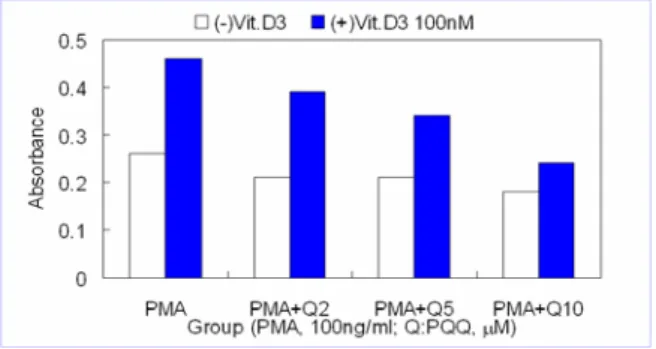
3for 24 hours. Fig. 1 shows
that 1,25-(OH)
2D
3stimulated the superoxide
Fig. 1. Effects of PQQ on PMA-induced NBT reduction in HD-11 cell culture.
production of HD-11 cells in response to PMA (1.77 times to the control) and that PQQ inhibited the 1,25-(OH)
2D
3-induced NBT reduction in a dose-dependent manner. The maximal effect of PQQ (20 μM) on NBT reduction was 42% inhibition in the nontreated group and 52% inhibition in the 1,25-(OH)
2D
3-treated group.
2. Quantitative histochemical TRAP assays of HD-11 cells
TRAP activity of HD-11 cells was measured in the presence of 10 nM 1,25-(OH)
2D
3and 20 μM PQQ using a histochemical assay. Fig. 2 shows the effects of PQQ on histochemical TRAP staining.
The percentage of TRAP positive cells was reduced prominently by the addition of PQQ in the 1,25-(OH)
2D
3-treated group (34.1%, control ; 13.7%, 29 μM PQQ).
Fig. 2. Effects of PQQ on vit. D3-induced TRAP (+) cell formation in HD-11 cell culture.
Fig. 3. Effects of PQQ on TRAP(+) MNCs formation in chicken bone marrow cell culture.
3. Osteoclast-like cell formation of bone marrow cells
Chicken bone marrow cells, which were isolated from tibiae as described above, were cultured with PQQ (0-20 μM) in the presence of 10 nM 1,25-(OH)
2D
3. Fig. 3 shows the effect of PQQ on TRAP-positive MNC formation dose-dependently.
There was no discernable effect of PQQ on TRAP staining when the bone marrow cells were pretreated with 20 μM PQQ for 1 hour at the end of the culture.
4. Dentin resorption assays
As shown in Fig. 4, treatment of 20 μM PQQ resulted in a significant decrease in dentin resorption by mature chicken osteoclasts compared to the control in terms of the total resorption area (23678
Fig. 4. Effect of PQQ on dentin resorption in chicken osteoclast culture.
± 4937 ㎛
2, control ; 8148 ± 1373 ㎛
2, 20 μM PQQ) and the number of resorption pits per 16 mm
2dentin slice (103.50 ± 29.32, control ; 38.33 ± 5.18 ㎛
2, 20 μM PQQ). However, the mean area of each resorption pit was not changed by the addition 20 μM PQQ (229
± 20, control ; 213 ± 24 ㎛
2, 20 μM PQQ).
Cells were cultured with and without vit. D3 (100 nM) in 96-well plate for 24 hrs and stained with 1 mg/ml NBT in HBSS for 2 hrs. Stained cells were read directly after fixation with formalin at the 595 nm. Qx :xmM PQQ Data are Mean of 4wells.
Cells were incubated with (+/-) 10 nM vit. D3 and (+/-) 20 mM PQQ for 24 hrs. TRAP (+) cells were counted at randomly selected five sites.
Chicken bone marrow cells were cultured with PQQ in the presence of 10 nM Vit. D3 for 7 days.
TRAP (+) multinucleated cells were counted from the entire surface of 8-well chamber slides. Data are Mean + S.E.
Data are from dentin slice (4X4 mm2) on which chicken osteoclasts were cultured for 18 hours.
Data are Mean + S.E.M. * : P < 0.05, compared to control.
Ⅳ. DISCUSSION
PQQ, which is a cofactor of several bacterial dehydrogenase
16), has been identified in mammalian tissues and fluids in nanomolar concentrations
17). It has been shown that when PQQ is deprived from a diet, growth impairment is observed in mice.
As one model for the study of superoxide production and TRAP activity, we used the v-myc transformed chick myelomonocytic cell line HD-11, which was developed by the infection of chick bone marrow cells with the MC29 leukemia virus
18). Steinbeck et al.
19)have shown that HD-11 cells have the potential to differentiate into osteoclast-like cells possessing, and the ability to degrade particles when induced by 1,25-(OH)
2D
3. Thus the HD-11 cell line may mimic some of the phenotypic transformations occurring in the monocyte/macrophage lineage leading to the fully differentiated osteoclast.
HD-11 cells, activated by 100 ng/ml PMA, reduce yellow NBT dye to an insoluble purple formazan by means of the superoxide generated during the respiratory burst. NBT reduction of HD-11 cells is increased by the addition of 100 nM 1,25-(OH)
2D
3which is a known activator of NADPH oxidase
20). Our previous work had shown that cyanide resistant oxygen consumption of HD-11 cells in response to PMA was increased by the pretreatment of 100 nM 1,25-(OH)
2D
3for 24 hours (non-treated, 2.08 nmole O
2/106 cells/10 min vs. a treated value of 6.08). These results are also consistent with a previous finding that peritoneal macrophages exposed to 1,25-(OH)
2D
3demonstrate a two-fold increased in superoxide generation
21)and that 1,25-(OH)
2D
3modulates superoxide generation by inducing the p47 cytosolic phosphoprotein which determine the activity of HADPH-oxidase.
Generally, PQQ has been known to have dual functions in both generating and scavenging superoxide by catalyzing the interconversion of dioxygen and superoxide. In this study PQQ shows the inhibitory effect of the 1,25-(OH)
2D
3-induced NBT reduction in a dose-dependent manner. Thus, the prominent inhibitory effect of PQQ on 1,25-(OH)
2D
3-induced NBT reduction seems to be associated with the superoxide production by this enzyme.
PQQ shows an inhibitory effect on TRAP expression in histochemical study of HD-11 cells (Fig. 2). PQQ also shows an inhibitory effect of TRAP-positive osteoclast-like multinucleated cell formation in chick embryonic bone marrow cells in vitro (Fig. 3). There is no discernable effect of PQQ on TRAP staining when the bone marrow cells were pretreated with 20 μM PQQ for 1 hour at the end of the culture. Therefore, the inhibitory action of PQQ on the TRAP-positive staining seems to be caused not by the inhibition of TRAP activity but by the inhibition of TRAP expression. These observations shows one possibility that PQQ may modulate TRAP expression and osteoclast-like multinucleated cell formation.
As a possible mechanism, one recent study
reports that superoxide is involved as a second messenger in the induction of colony stimulating factor (CSF)
22). CSF is in turn a promoter of hematopoietic cell proliferation and differentiation, and is also an essential factor in osteoclast formation
23,24). Likewise, it has also been shown that hydrogen peroxide, which is converted from superoxide, can be involved in the regulation of osteoclast formation
25).
In our assay of dentin resorption by mature osteoclasts in in vitro, total resorption area as well as number of resorption pits was reduced by 20 μM PQQ without change of individual mean pit size. In these regards, PQQ seems to show inhibitory effects on dentin resorption by mature chicken osteoclasts. Although it is unclear which mechanisms are involved in the inhibitory action of PQQ on osteoclastic dentin resorption, it can be possibly explained in several ways. First, as it has been reported by Bax et al.
26)nanomolar concentrations of hydrogen peroxide, which is dismutated from superoxide, stimulates the motility of osteoclasts. This is one of crucial factors in bone resorption activity. Second, numerous investigators have been demonstrated that reactive oxygen species degrade collagen directly
27-29). Recently, Gallop et al.
30)have postulated that PQQ (or PQQ-ascorbate) is important in the generation of the nitric oxide which exerts a powerful inhibitory effect on the bone resorbing activity of the osteoclasts
31). PQQ is also able to catalyze the oxidation of cysteinyl residues to generate disulfide bond
32)which probably results in conformational change of proteolytic enzyme.
Superoxide, the primary compound formed in the respiratory burst, can be converted to another form of potent oxidant. Part of the superoxide dismutes to form hydrogen peroxide by the action of SOD, and subsequently a hydroxyl radical is generated from a reaction between superoxide and hydrogen peroxide
33). Therefore, it is unclear which reactive oxygen species are involved specifically in these studies. Nevertheless, it is perhaps possible to inhibit these various action of reactive oxygen
species indirectly by blocking the superoxide in the first place.
In conclusion, although the precise action of PQQ remains to be elucidated in detail, the inhibitory action of PQQ in osteoclast-like cell formation and bone resorption in our study seems to be associated, at least in part, with the superoxide scavenging action.
REFERENCES
1. Duine JA, Frank J Jr, Jongejan JA. Enzymology of quinoproteins. Adv Enzymol 1987;59:169-212.
2. Matsushita K, Toyama H, Yamada M, Adachi O.
Quinoproteins: structure, function, and biotechnolo- gical applications. Appl Microbiol Biotechnol 2002;58:
13-22.
3. Stites TE, Mitchell AE, Rucker RB. Physiological importance of quinoenzymes and the O-quinone family of cofactors. J Nutr 2000;130:719-727.
4. Ameyama M, Shinagawa E, Matsushita K, Adachi O.
Growth stimulating activity of for microorganisms in naturally occuring substances and partial characterization of the substance for the activity as pyrroloquinoline quinone. Agric Biol Chem 1985;49:
699-709.
5. Naito Y, Kumazawa T, Kino I, Suzuki O. Effects of pyroloquinoline quinone (PQQ) and PQQ-oxazole on DNA synthesis of cultured human fibroblasts. Life Sci 1993;52:1909-1915.
6. Atchuta Ramaiah KV, Chen JJ, Gallop PM, London IM. The effects of pyrroloquinoline quinone on heme-regulated eIF-2alpha kinase and eIF-2B activities in eukaryotic protein synthesis. Blood Cells Mol Dis 1997;23:177-187.
7. Hamagishi Y, Murata S, Kamei H, Oki T, Adachi O, Ameyama M. New biological properties of pyrroloquinoline quinone and its related compounds : Inhibition of chemiluminescence, lipid peroxidation and rat paw edema. J Pharmacol Exp Therap 1990;255:980-985.
8. Nishigori H, Yasunaga M, Mizumura M, Lee JW, Iwatsuru M. Preventive effects of pyrroloquinoline quinone on formation of cataract and decline of lenticular hepatic glutathione of devoleping chick embryo after glucocorticoid treatment. Life Sci 1989;45:593-598.
9. Fallon M, Silverton S, Smith P et al. The oxidative
metabolism of isolated osteoclasts is regulated by calcitropic agents. J Bone Miner Res [suppl 1] 1986;
1 (abstract).
10. Beard CJ, Key L, Newburger PE et al. Neutrophil defect associated with malignant infantile osteopetrosis. J Lab Clin Med 1986;108:498-505.
11. Key Jr. LL, Ries WL, Taylor RG, Hays BD, Pitzer BL.
Oxygen derived free radicals in osteoclasts; The specificity and location of the nitroblue tetrazolium reaction. Bone 1990;11:115-119.
12. Garrett IR, Boyce BF, Oreffo ROC, Bonewald L, Poser J, Mundy GR. Oxygen-derived free radicals stimulate osteoclastic bone resorption in rodent bone in vitro and in vivo. J Clin Invest 1990;85:632-639.
13. Ries WL, Key J LL, Rodriguiz RM. Nitroblue tetrazolium reduction and bone resorption by osteoclasts in vitro inhibited by a manganese-based superoxide dismutase mimic. J Bone Miner Res 1992;7:931-939.
14. Bai XC, Lu D, Liu AL et al. Reactive Oxygen Species Stimulates Receptor Activator of NF-{kappa}B Ligand Expression in Osteoblast. J Biol Chem 2005;280:17497-17506.
15. Takahashi N, Yamana H, Yoshiki S et al. Osteoclast- like cell formation and its regulation by osteotropic hormones in mouse bone marrow cultures.
Endocrinology 1988;122:1373-1382.
16. Salisbury SA, Forrest HS, Cruse WBT, Kennard OA.
A novel coenzyme from bacterial primary alcohol dehydrogenases. Nature 1979;280:843-844.
17. Fluckiger R, Paz A, Mah J, Bishop A, Gallop PM.
Characterization of the glycine-dependent redox- cycling activity in animal fluids and tissues using specific inhibitors and activators: Evidence for presence of PQQ. Biochem Biophys Res Commun 1993;196:61-68.
18. Beug H, von Kirchbach A, Doderlein G, Conscience JF, Graf T. Chicken hematopoietic cells transformed by seven strains of defective avian leukemia viruses display three distinct phenotypes of differentiation.
Cell 1979;18:375.
19. Steinbeck MJ, Kim JK, Trudeau MJ, Hauschka PV, Karnovsky MJ. Involvement of hydrogen peroxide in the differentiation of clonal HD-11EM cells into osteoclast-like cells. J. Cell Physiol 1998;176:574-587.
20. Levy R. Malech HL. Effect of 1,25-dihydroxyvitamin D3, lipopolysaccharide, or lipoteichoic acid on the expression of NADPH oxidase components in cultured human monocytes. J Immunol 1991;147:
3066-3071.
21. Levy R, Klein J, Rubinek T, Alkan M, Shany S, Chaimovitz C. Diversity in peritoneal macrophage response of CAPD patients to 1,25-dihydroxyvitamin D3. Kidney Int 1990;37:1310-1315.
22. Satriano JA, Shuldiner M, Hora K, Xing Y, Shan Z, Schlondorff D. Oxygen radicals as second messengers for expression of the monocyte chemoa- ttractant protein, JE/MCP-1, and the monocyte colony-stimulating factor, CSF-1, in response to tumor necrosis factor-α and immunoglobin G.
Evidence for involvement of reduced nicotineamide adenine dinucleotide phosphate (NADPH)-dependent oxidase. J Clin Invest 1993;92:1564-1571.
23. Takahashi N, Udagawa N, Akastu T, Tanaka H, Shionome M, Suda T. Role of colony-stimulating factors in osteoclast development. J Bone Miner Res 1991;6:977-985.
24. Yao GQ, Wu JJ, Sun BH, Troiano N, Mitnick MA, Insogna K. The cell surface form of colony- stimulating factor-1 is biologically active in bone in vivo. Endocrinology 2003;144:3677-3682.
25. Suda N, Morita I, Kuroda T, Murota S. Participation of oxidative stress in the process of osteoclast differentiation. Biochim Biophys Acta 1993;1157:
318-323.
26. Bax BE, Alam ASMT, Banerji B et al. Simulation of osteoclastic bone resorption by hydrogen peroxide.
Biochem Biophys Res Commun 1992;183:1153-1158.
27. Monbiosse JC, Gardes-Albert M, Randoux A, Borel JP, Ferradini C. Callagen degradation by superoxide anion in pulse and gamma radiolysis. Biochem Biophys Acta 1988;965:29-35.
28. Uchida K, Kato Y, Kawakishi S. A novel mechanism for oxidative cleavage of prolyl peptides induced by the hydroxyl radical. Biochem Biophys Res Commun 1990;169:262-271.
29. Lean JM, Jagger CJ, Kirstein B, Fuller K, Chambers TJ. Hydrogen peroxide is essential for estrogen- deficiency bone loss and osteoclast formation.
Endocrinology 2005;146:728-735.
30. Gallop PA, Paz MA, Fluckiger R, Henson E. Is the antioxidant, anti-inflammatory putative new vitamin, PQQ, involved with nitric oxide in bone metabolism?
Connective Tissue Res 1993;29:153-161.
31. Kasten TP, Collin-Osdoby P, Patel N et al.
Potentiation of chicken osteoclast bone resorption activity by inhibition of nitric oxide synthase. J Bone Miner Res 1993;8[suppl. 1]:188(abstract).
32. Park J. Churchich JE. Pyroloquinoline quinone (coenzyme PQQ) and the oxidation of SH residues if proteins. Biofactors 1992;3:257-260.
국문요약
Pyrroloquinoline quinone이 파골세포의 생성 및 활성에 미치는 영향
단국대학교 치과대학 생화학교실 고선일․한동호․김정근
본 연구는 superoxide의 제거물질로 알려진 pyrroloquinoline quinone (PQQ)이 파골세포의 분화 및 성숙한 파 골세포의 활성에 미치는 영향을 알아보고자 시행하였다. Superoxide를 인지하는 방법인 nitroblue tetrazolium (NBT) 염색방법을 이용하여 PQQ가 HD-11 세포가 생성한 superoxide를 제거하는지 확인하였다. 본 연구에서 이용된 HD-11세포는 닭 myelomonocytic 세포주로써 1,25-dihydroxyvitamin D
3[1,25(OH)
2D
3]로 처리시 tartrate-저항성 산성인산분해효소 (tartrate-resistant acid phosphatase, TRAP)의 활성을 나타내는 등 파골세포 의 특성을 지니는 세포로 알려져 있다. HD-11세포에서 TRAP 활성을 확인하기 위하여 조직화학적 염색을 시행 하였다. PQQ는 NBT의 환원을 감소시켰으며 1,25(OH)
2D
3에 의해 유도된 TRAP 활성을 억제하였다. 또한 PQQ 가 닭 골수세포에서 TRAP 양성 다핵세포의 형성에 미치는 영향도 관찰한 결과 20 μM의 PQQ는 TRAP 양성 다핵세포의 형성을 현저히 억제하였다. 닭 파골세포를 상아질 절편에서 배양하면서 20 μM의 PQQ를 처치한 경 우 파골세포에 의한 상아질 흡수가 현저히 억제되었다. 따라서 본 연구결과 PQQ가 superoxide의 제거물질로 작용하여 파골세포의 분화 및 활성도에 영향을 미칠 것으로 사료되며, 이는 생리적 혹은 병적 골흡수에 억제적인 작용을 할 물질로의 가능성을 시사한다.
주제어 : 파골세포, Superoxide, Pyrroloquinoline quinone, TRAP
33. Starke PE. Farber JL. Ferric iron and superoxide ions are required for the killing of cultured hepatocytes by hydrogen peroxide. Evidence for the participation of hydroxyl radicals formed by an iron-catalyzed Haber-Weiss reaction. J Biol Chem 1985;260:
10099-10104.