1. Introduction
The self-assembly of monodisperse silica spheres has intrigued the scientific communities due to its variety of application fields including photonics
1,2), catalysis
3), optical modulator
4), optical switching
5), well-defined patterning
6)and optical data storage with surface modified fluorescing dyes
5). A periodic spatial modulation in the refractive index produces coherent light scattering, which is called photonic crystal. Especially, for the three-dimensional photonic crystals with sufficiently high value of different refractive indices between the materials, specific wavelength range of the light is forbidden from propagating in all directions. Various methods fabricating periodic structures including nanoimprinting
7), photolithography
8), sequential de- position of alternating layers
9), holographic patterning
10)and self-assembly poly or silica particles
11)have been developed for fabrication of three-dimensional photonic crystals.
Self-assembly of submicrometer silica spheres is a typical approach for fabricating periodic photonic structures. These structures can be fabricated using gravity
12), particle assembly on patterned surfaces
13), capillary forces
14)and electric or magnetic fields
15). With these periodic photonic structures, adding the additional functionality on the surface of silica spheres will be the most interesting research field in material
science due to their unique combined and tailored properties in many application fields. Silica submicrospheres are a particularly good candidate to give functionality on the surface due to the ability to perform the condensation reaction of silanol (Si-OH) at room temperature.
Core-shell structures with fluorescence dye and optically inert soft shell have been used as a recording media for optical data storage
16). In this nanostructured material, the density of the effective optical storage has been increased by more than a factor of two with respect to homogeneous storage media. The next-generation optical data recording material has been developed from multilayers of microspheres contained with UV, visible and near-infrared fluorescence dyes for protecting secure documents
17). Therefore, development of submicrometer silica spheres with fluorescent dyes is promising fields in many optical device applications. In this paper, we report two step synthetic routes to attach the disperse red-13 (DR-13) on the surface of the silica spheres. This report also includes concentration dependent absorption spectra of DR-13, large absorption band shift of the DR-13 and field emission scanning electron micro- scope (FESEM) images.
2. Experimental
Tetraethyl orthosilicate (TEOS, 98%), methanol (HPLC grade), ammonium hydroxide (28%), 3-isocyanatopropyltriethoxysilane (ICPTES, 95%), DR-13 (95%) were purchased from Sigma
Current Photovoltaic Research 5(2) 43-46 (2017) pISSN 2288-3274
DOI:https://doi.org/10.21218/CPR.2017.5.2.043 eISSN 2508-125X
Optical Characterization of Azo-dye Attached on Photonic Crystal:
The Cause of Large Absorption Band Shift
Byoung-Ju Kim ․ Ki-Chul Kwon ․ A-Reum Yu ․ Kwang-Sun Kang*
Department of New & Renewable Energy, Kyungil University, 50 Gamasilgil, Hayangup, Kyeongsan, Kyeongbuk, 38428, South Korea
ABSTRACT: Large absorption band shift has been observed for the azo-dye (disperse red-13, DR-13) attached on the surface of silica spheres. Urethane linkage has been utilized to form covalent bond between azo-dye (-OH) and 3-isocyanatopropyltriethoxysilane (ICPTES, -N=C=O). The synthesized ICPTES-DR-13 (ICPDR) molecules were attached to the silica spheres by the hydrolysis and condensation reaction. Although the absorption peak of DR-13 in methanol is at 510 nm, the absorption peak of the ICPDR-silica spheres shifts to 788 nm. The large absorption peak shift is due to the formation of intramolecular charge-transfer band with large aggregated ICPDR.
Key words: Azo-dye, Photonic crystal, Absorption band shift, Intramolecular charge transfer
*Corresponding author: [email protected]
Received March 10, 2017; Revised March 20, 2017;
Accepted March 26, 2017
ⓒ 2017 by Korea Photovoltaic Society
This is an Open Access article distributed under the terms of the Creative Commons Attribution Non-Commercial License (http://creativecommons.org/licenses/by-nc/3.0)
which permits unrestricted non-commercial use, distribution, and reproduction in any medium, provided the original work is properly cited.
43
B.J. Kim et al. / Current Photovoltaic Research 5(2) 43-46 (2017) 44
Aldrich Co LTD. The monodisperse silica nanospheres were synthesized using Stöber synthetic method. The mixture of the methanol (100 ml) and 3.5 g of TEOS was charged into a 250 ml round bottom flask. The ammonium hydroxide (100 ml) was quickly added to the round bottom flask and vigorously stirred for 6 h. The resulting reactant was centrifuged at 3000 rmp for 30 min. The separated spheres were washed with methanol several times. The spheres were dried in a dry oven overnight.
The DR-13 (50 mg) was dissolved in the pyridine, and dry nitrogen was purged into the reaction flask for 2 h. The ICPTES (150 mg) was added to the reaction flask and stirred. The reaction temperature maintained approximately 50°C for 3 h.
The spheres were dispersed in the acetone and added to the DR-13 and ICPTES solution. The solution was stirred for 6 h at room temperature. The resulting compound, ICPTES/DR-13/
silica-spheres (ICPDRSS), was centrifuged at 3000 rpm for 30min. The spheres were repeatedly washed with methanol until the methanol color was clear. For dye concentration dependent UV-visible spectra, approximately 5 mg of DR-13 was dispersed in 10 mL of acetone. Approximately 0.8 ml of acetone was added to the quartz cuvette. UV-visible spectrum
was recorded with the addition of each 20 mg of DR-13 solution to the cuvette. The sphere film was fabricated on the glass substrate, and the UV-visible absorption spectrum was obtained with the dried sphere film.
3. Results and Discussion
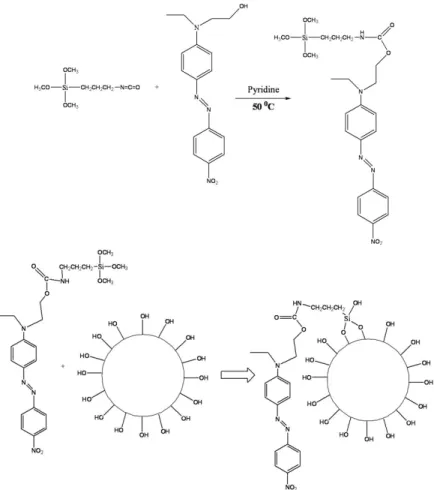
A urethane bond formation between DR-13 and ICPTES can be achieved by reacting between an –OH group of the DR-13 and an –N=C=O group of the ICPTES in tetrahydrofurane with a dibutyltin dilaurate as a catalyst
18-20). The same result can be obtained by using pyridine as a solvent and a catalyst
21)and employed in this synthetic process. Fig. 1(a) illustrates the synthetic route of ICPTES and DR-13. The temperature maintained approximately 50°C during the synthesis. According to the Fourier transform infrared (FTIR) spectrum, the charac- teristic C=O stretching vibration peak at 1700 cm
-1was observed, which indicated the urethane bond formation. The silica spheres dispersed in acetone were added to the reaction solution comprised of ICPTES, DR-13 and pyridine. Since pyridine can
Fig. 1. Schematic representation of (a) urethane bond formation between ICPTES and DR-13 and (b) covalent bond formation between ICPDR and silica spheres
B.J. Kim et al. / Current Photovoltaic Research 5(2) 43-46 (2017) 45
act as a base catalyst for the ethoxysilane, the hydrolysis and condensation reactions between ICPTES-DR-13 (ICPDR) and silica spheres can occur. The schematic diagram of the second step reaction is shown in Fig. 1(b). The final product becomes covalently bonded between ICPDR and silica sphere (ICPDRSS).
Fig. 2 shows the UV-visible absorption spectra with various concentrations of DR-13 in acetone. Each spectrum was obtained after adding 20 mg of the dye solution to the 0.8 ml of acetone.
The absorption intensities centered at 510 nm linearly increase with the increase of the amount of the added dye solution. The inset Fig. 2 shows the integrated total absorption vs. the amount of the added dye solution. Although absorption intensity reached near saturation, additional absorption band was not observed. Faccetti et al.
22)investigated the coupling layer effect of the azo dyes covalently bonded to the substrate surface via siloxane linkages. A characteristic change in the optical spectrum was observed after attachment of the chromophore. They also observed characteristic intrachromophore charge-transfer band resulting red-shifted spectra with respect to the corresponding dyes in solution. The ICPDRSS film was fabricated in the glass substrate. Fig. 3 shows the UV-visible absorption spectrum of the ICPDRSS film. Surprisingly, new absorption bands are observed with the absorption maximum at 788 and 475 nm.
Especially, the absorption band at 788 nm is far away from the absorption band in acetone (510 nm). The difference of the absorption band energy is approximately 0.83 eV, which is big energy band difference.
Fig. 4(a) and 4(b) show the FESEM images for the ICPDRSS with magnitude of 10,000 and 60,000, respectively. Large number of aggregated nanoparticles are attached on the surface of the silica spheres. The particles comprised of ICPDR have irregular shape. The large absorption band shift toward the red
may be due to the aggregation of the dye molecules.
4. Conclusions
In summary, DR-13 has been attached to the monodisperse
Fig. 2. DR-13 concentration dependent UV-visible spectra inacetone Fig. 3. UV-visible and near IR absorption spectrum of the
ICPDRSS film
Fig. 4. FESEM images of ICPDRSS with (a) 10000 magnitude and (b) 60000 magnitude
B.J. Kim et al. / Current Photovoltaic Research 5(2) 43-46 (2017) 46
silica spheres with two step reactions. Urethane linkage was formed by the reaction with DR-13 (-OH) and ICPTES (-N=C=O) in pyridine at 50°C. The ICPDR molecules were attached on the surface of the silica spheres by hydrolysis and condensation reaction. The absorption intensity of the DR-13 in acetone linearly increased with the increase of the DR-13 concentration without additional absorption peak. The large absorption band shift toward red was observed. This large absorption band shift may be due to the formation of intrachromophore charge-transfer band by the large aggregation of dyes.
Acknowledgements
This work has been supported by Kyungil University in Korea.
References
1. S. Murai, S. Yao, T. Nakamura, T. Kawamoto, K. Fujita, K.
Yano, and K. Tanaka, Appl. Phys. Lett. 101, 151121, 2012.
2. Y. Sivan, Appl. Phys. Lett. 101, 021111, 2012.
3. R. C. Schroden, C. F. Blanford, B. J. S. Melde, and A. Stein, Chem. Mater. 13, 1074, 2001.
4. Q. Zhang, and L. A. Archer, Macromolecules 37, 1928, 2004.
5. Y. Li, Y. Deng, Y. He, X. Tong, and X. Wang, Langmuir 21, 6567, 2005.
6. S. Choi, S. Stassi, A. P. Pisano, and T. I. Zohdi, Langmuir 26,
11690, 2010.
7. S. H. Ko, I. Park, H. Pan, C. P. Grigoropoulos, A. P. Pisano, C.
K. Luscombe, and J. M. J. Frechet, Nano Lett. 7, 1869, 2007.
8. Y. Chen, Y. Zhang, L. Shi, J. Li, Y. Xin, T. Yang, and Z. Guo, Appl. Phys. Lett. 101, 033701, 2012.
9. C. J. Barrelet, J. Bao, M. Loncar, H. G. Park, F. Capasso, and C. M. Lieber, Nano Lett. 6, 11, 2006.
10. L. M. Goldenberg, O. V. Sakhno, T. V. Smirnova, P. Helliwell, V. Chechik, and J. Stumpe, Chem. Mater. 20, 4619, 2008.
11. H. Yusuf, W. G. Kim, D. H. Lee, M. Aloshyna, A. G. Brolo, and M. G. Moffitt, Langmuir 23, 5251, 2007.
12. H. Shpaisman, B. J. Krishnatreya, and D. G. Grier, Appl. Phys.
Lett. 101, 091102, 2012.
13. Z. Cai, J. Teng, D. Xia, and X. S. Zhao, J. Phys. Chem. C 115, 9970, 2011.
14. H. Duan, and K. K. Berggren, Nano Lett. 10, 3710 (2010).
15. H. Niu, Q. Chen, M. Ning, Y. Jia, and X. Wang, J. Phys.
Chem. B 108, 3996, 2004.
16. C. Paquet, and E.Kumacheva, Materialstoday 11, 48 (2008).
17. H. H. Pham, I. Gourevich, E. N. Jonkman, and E. Kumacheva, J. Mater. Chem. 17, 523, 2007.
18. J. Yu, J. Qiu, Y. Cui, J. Yu, L. Liu, L. Xu, and G. Qian, Mater Lett. 63, 2594, 2009.
19. D. H. Choi, J. H. Park, J. H. Lee, and S. D. Lee, Thin Solid Films 360, 213, 2000.
20. Y. Cui, M. Wang, L. Chen, and G. Qian, Dyes and Pigments 62, 43, 2004.
21. C. Pavier, and A. Candini, Eur. Polym. J. 36, 1653, 2000.
22. A. Facchetti, A. Abbotto, L. Beverina, M. E. Boom, P. Dutta, G. Evmenenko, T. J. Marks, G. A. Pagani, Chem. Mater. 14, 4996, 2002.