Veterinary Science
http://dx.doi.org/10.4142/jvs.2012.13.4.385
Received: 2 Dec. 2011, Revised: 27 Jan. 2012, Accepted: 19 Apr. 2012
Original Article
*Corresponding author: Tel: +82-31-400-5513; Fax: +82-31-406-6316; E-mail: [email protected]
†The first two authors contributed equally to this work.
ⓒ 2012 The Korean Society of Veterinary Science.
This is an Open Access article distributed under the terms of the Creative Commons Attribution Non-Commercial License (http://creativecommons.org/licenses/by-nc/3.0) which permits unrestricted non-commercial use, distribution, and reproduction in any medium, provided the original work is properly cited.
Genetic populations of Bacillus anthracis isolates from Korea
Kyoung Hwa Jung
1,†, Sang Hoon Kim
2,†, Se Kye Kim
2, Soo Young Cho
2, Jin Choul Chai
2, Young Seek Lee
2, Ji Cheon Kim
2, Seoung Joo Kim
2, Hee-Bok Oh
3, Young Gyu Chai
2,*
1
Institute of Natural Science and Technology, and
2Division of Molecular and Life Sciences, Hanyang University, Ansan 426-791, Korea
3
Department of Bacteriology, National Institute of Health, Cheongwon 363-951, Korea
Bacillus (B.) anthracis is the pathogen that causes fatal
anthrax. Strain-specific detection of this bacterium using molecular approaches has enhanced our knowledge of microbial population genetics. In the present study, we employed molecular approaches including multiple-locus variable-number tandem repeat analysis (MLVA) and canonical single-nucleotide polymorphism (canSNP) analysis to perform molecular typing of B. anthracis strains isolated in Korea. According to the MLVA, 17 B. anthracis isolates were classified into A3a, A3b, and B1 clusters. The canSNP analyses subdivided the B. anthracis isolates into two of the three previously recognized major lineages (A and B). B. anthracis isolates from Korea were found to belong to four canSNP sub-groups (B.Br.001/2, A.Br.005/006, A.Br.001/002, and A.Br.Ames). The A.Br.001/002 and A.Br.Ames sub-lineages are closely related genotypes frequently found in central Asia and most isolates were. On the other hand, B. anthracis CH isolates were analyzed that belonged to the B.Br.001/002 sub-group which found in southern Africa, Europe and California (USA). B.Br.001/002 genotype is new lineage of B.
anthracis in Korea that was not found before. This discovery
will be helpful for the creation of marker systems and might be the result of human activity through the development of agriculture and increased international trade in Korea.
Keywords: Bacillus anthracis, canonical single-nucleotide polymorphism (canSNP), genotyping, multiple-locus variable- number tandem repeat analysis (MLVA)
Introduction
Within the Bacillus genus, the most pathogenic species is
Bacillus (B.) anthracis, the causative agent of anthrax and a Gram-positive spore-forming soil bacterium [9,28].
Anthrax is a disease that occurs worldwide. This zoonosis and infectious disease affects a wide range of species, including humans and herbivorous mammals [3,32]. The incidence of anthrax has been reduced by continuous research and disease control, but still occurs in undeveloped and developing countries.
In 1905, the first anthrax case occurred in animal was recorded in Korea. During the next 5 years after the first official report in 1907, the number of anthrax cases occurred in animal increased to 2,562, causing serious damage to related industries that handle animal by-products like meat and animal skins. More than 1,000 cases were subsequently reported annually, and until 1924 the rate of occurrence was approximately 500 cases per year [22]. The reduction of anthrax cases is due to development of live vaccines using non-virulent B.
anthracis Sterne and other methods of disease control.
However, there were two cases reported in 1994 (Kyungju and Hongseong, respectively), one in 1995 (Hongseong), another two cases in 2000 (Changnyung), and one in 2008 (Yeongcheon). The disease occurs annually in a seasonal manner, but the distribution of cases is most prominent in May and August. Since the annual average rainfall is high in April and July to August, it can be inferred that contaminated soil is more exposed during the rainy season and pollutes pastures, thus transmitting the pathogen to cattle [23].
B. anthracis strains are genetically monomorphic with
low levels of sequence diversity [18,26]. Discriminatory
markers have long been used to identify and subdivide
groups of these microbial pathogens. Tracking the
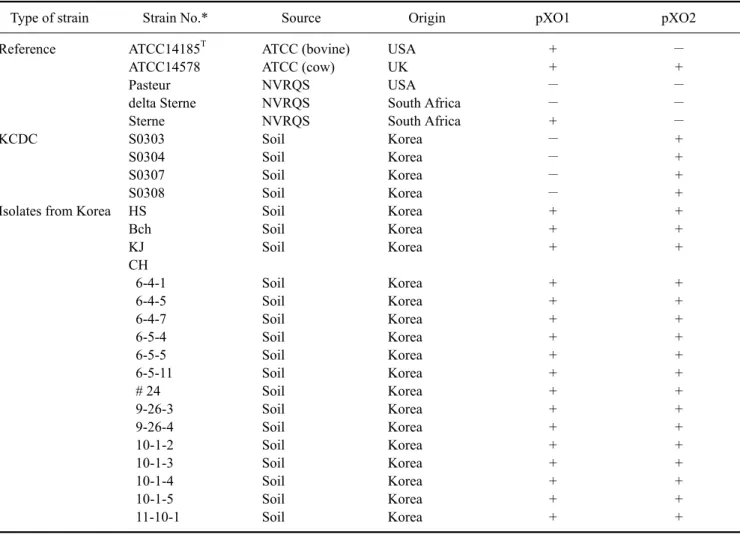
Table 1. Bacillus (B.) anthracis strains used for the present study and their plasmid content
Type of strain Strain No.* Source Origin pXO1 pXO2
Reference
KCDC
Isolates from Korea
ATCC14185
TATCC14578 Pasteur delta Sterne Sterne S0303 S0304 S0307 S0308 HS Bch KJ CH 6-4-1 6-4-5 6-4-7 6-5-4 6-5-5 6-5-11 # 24 9-26-3 9-26-4 10-1-2 10-1-3 10-1-4 10-1-5 11-10-1
ATCC (bovine) ATCC (cow) NVRQS NVRQS NVRQS Soil Soil Soil Soil Soil Soil Soil Soil Soil Soil Soil Soil Soil Soil Soil Soil Soil Soil Soil Soil Soil
USA UK USA South Africa South Africa Korea Korea Korea Korea Korea Korea Korea Korea Korea Korea Korea Korea Korea Korea Korea Korea Korea Korea Korea Korea Korea
+ +
−
− +
−
−
−
− + + + + + + + + + + + + + + + + +
− +
−
−
− + + + + + + + + + + + + + + + + + + + + +
*The type strain is indicated with a superscript T. The presence or absence of pXO1 and pXO2 plasmids is indicated with a “+” or “−” sign, respectively. ATCC: American Type Culture Collection (USA), NVRQS: National Veterinary Research and Quarantine Service (Korea), KCDC: Korean Centers for Disease Control and Prevention.
epidemic and pandemic spread of particular strains may be possible using such markers, yielding a long-term overview of epidemiological patterns [1]. There are regions in the B. anthracis genome that vary greatly from strain to strain. Numerous studies have shown that genetic markers such as single-nucleotide polymorphisms (SNPs), variable number tandem repeats (VNTRs), and single-nucleotide repeats (SNRs) can be used to discriminate between strains in B. anthracis [2,5,7,12,15].
Canonical SNPs (canSNPs), originally described by Keim et al. [12], are a number of SNPs located at key phylogenetic junctions and are sufficient to create phylogenetic trees. It is evident that canSNPs can identify relationships among global B. anthracis isolates. Previously, a set of canSNPs was able to distinguish three major lineages of B. anthracis isolates [36] and 12 clonal sub-lineages.
In the present study, we examined a genetic population of B. anthracis isolates from Korea and compared it to a global
genetic population using an eight-loci multiple-locus variable-number tandem repeat analysis (MLVA) and 13-canSNP analysis.
Materials and Methods
The B. anthracis strains used in this study included four obtained from the Korean Centers for Disease Control and Prevention (KCDC), five reference strains, and 17 isolates from soil of four different regions in Korea (Table 1).
ATCC14185 and ATCC14578 stain obtained from American Type Culture Collection (ATCC), (USA), and Pasteur, delta Sterne, and Sterne strain obtained from National Veterinary Research and Quarantine Service (NVRQS), (Korea). The B. anthracis strains were cultured in brain heart infusion media (Becton Dickinson, USA) and grown at 37
oC with shaking at 200 rpm for 3 days.
Total genomic DNA was extracted was modified by
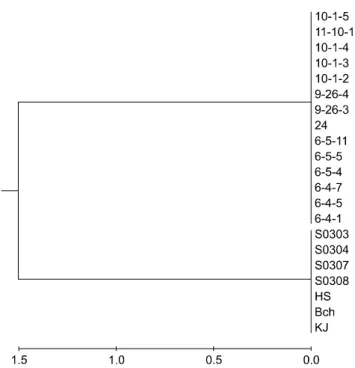
Fig. 1. Genetic relationships among B. anthracis strains isolated in Korea identified by multiple-locus variable-number tandem repeat analysis (MLVA). Eight variable number tandem repeat (VNTR) marker loci were used to calculate simple matching coefficients.
Hunter’s method [8]. To isolate total bacterial DNA, bacteria cells were harvested by centrifugation at 15,000 rpm for 10 min at 4
oC and resuspended in 1 mL TE buffer (pH 7.4) containing lysozyme (0.1 mg/mL), SDS and proteinase K at 55
oC for 3 h. After the completion of this incubation, DNA was extracted with phenol-chloroform, precipitated with isopropanol and dissolved in TE buffer with RNase (20 µg/mL).
In order to determine whether B. anthracis isolates were full virulent (pXO1
+and/or pXO2
+), we performed a polymerase chain reaction (PCR) assay with a primer set specific for B. anthracis [4]. Each PCR mixture (20 μL) contained 10 ng of genomic DNA, 10 pmole of each B.
anthracis specific primer, and 2× EF-Taq Premix II (10 μL, SolGent, Korea). The following thermal cycling (Bio-Rad, USA) conditions were used: an initial denaturation step (94
oC for 5 min) followed by 30 cycles of denaturation at 94
oC for 1 min, annealing at 40
oC for 1 min, and primer extension at 72
oC for 1 min. The PCR reaction concluded with a final incubation at 72
oC for 5 min. The PCR products were electrophoretically separated on 1% agarose gel and stained with ethidium bromide.
MLVA was performed for the eight different VNTR loci described by Keim et al. [14]. After amplification, the PCR products were diluted 1 : 10 (volume : volume) in TE buffer and 1 μL of the dilution was added to a mixture containing 8 μL of Hi-DiTM formamide (Applied Biosystems, USA) and ROX-labeled MapMaker 1000 size standard [BioVentures, USA; 20 : 1 (volume : volume)]. The DNA was denatured at 95
oC for 5 min and then immediately placed on ice. Fragments were detected using an ABI 3100 Prism Genetic Analyzer (Applied Biosystems, USA) with a 36-cm capillary at a running voltage of 15 kV at 60
oC. To determine the size of the detected fragments, peak height and peak area was measured using GeneScan Analysis software (ver. 3.7; Applied Biosystems, USA). For genotype determination, an MLVA bank developed by the University of Orsay (University Paris XI, France) was used.
For canSNP analysis, we used the primers described by Van Ert et al. [37] and purchased from Genotech (Korea) in which each primer was added a T7 primer sequence as a 5´
tail on the primers for sequencing purposes. After amplification, the PCR products were cloned using a T-A cloning vector (RBC Bioscience, Taiwan). Each PCR mixtures contained 2× EF-Taq Premix II (Solgent, Korea), forward and reverse primers (0.5 pmol each), and genomic DNA (400 ng/µL). The thermal cycling conditions were incubation at 95
oC for 5 min that was followed by 30 cycles of 95
oC for 1 min, 60
oC for 1 min, and 72
oC for 1 min. The plasmids were then purified with Hi-Yield Plasmid Mini Kit (RBC Bioscience, Taiwan) and sequenced using the T7 primer. Sequencing analysis was performed five times.
MLVA and canSNP analysis data obtained for B. anthracis isolates from Korea were used to calculate simple
matching coefficients using MEGA (ver. 4.0.2).
Results
To investigate the genetic diversity of B. anthracis strains isolated in Korea, we used MLVA and canSNP analysis to characterize 21 strains, including four that were obtained from the KCDC (Table 1). Many researchers reported the Pasteur strain to be pXO1
−and pXO2
+, but the one used in our study was pXO1
−and pXO2
−since pXO2 was cured during the culturing process. B. anthracis strains obtained from the KCDC were pXO1
−and pXO2
+while the isolates obtained in Korea (HS, Bch, KJ, and CH) contained both pathogenic plasmids (pXO1
+and pXO2
+; Table 1).
Genotype analysis was performed using eight-locus
MLVA data acquired from an MLVA bank. B. anthracis
strains obtained from the KCDC were placed into the A3b
cluster while the CH isolates were in a B1 cluster (Fig. 1
and Table 2). On the other hand, HS, Bch, and KJ strain
were classified as A3a cluster and were not a part of the
A3b or B1 clusters. B. anthracis strains obtained from the
KCDC (S0303, S0304, S0307, and S0308) had the same
MLVA type with #07 strain of Ryu’s study. Interestingly,
all of the local isolates (CH) were pathogenic and
contained identical sequences at eight hypervariable
MLVA loci. Sequence repeats in eight of the VNTR loci
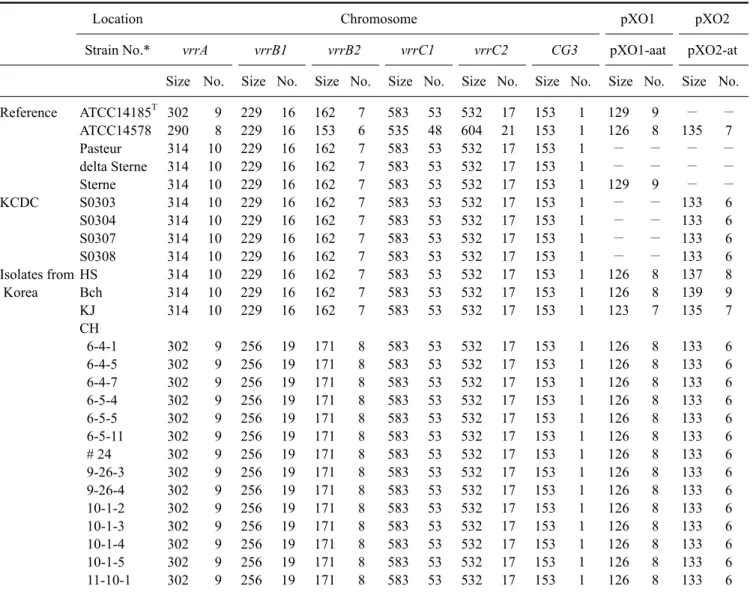
Table 2. Observed fragment sizes and the number of repeats at eight MLVA loci in the B. anthracis strains isolated in Korea
Location Chromosome pXO1 pXO2
Strain No.* vrrA vrrB1 vrrB2 vrrC1 vrrC2 CG3 pXO1-aat pXO2-at
Size No. Size No. Size No. Size No. Size No. Size No. Size No. Size No.
Reference
KCDC
Isolates from Korea
ATCC14185
TATCC14578 Pasteur delta Sterne Sterne S0303 S0304 S0307 S0308 HS Bch KJ CH 6-4-1 6-4-5 6-4-7 6-5-4 6-5-5 6-5-11 # 24 9-26-3 9-26-4 10-1-2 10-1-3 10-1-4 10-1-5 11-10-1
302 290 314 314 314 314 314 314 314 314 314 314 302 302 302 302 302 302 302 302 302 302 302 302 302 302
9 8 10 10 10 10 10 10 10 10 10 10 9 9 9 9 9 9 9 9 9 9 9 9 9 9
229 229 229 229 229 229 229 229 229 229 229 229 256 256 256 256 256 256 256 256 256 256 256 256 256 256
16 16 16 16 16 16 16 16 16 16 16 16 19 19 19 19 19 19 19 19 19 19 19 19 19 19
162 153 162 162 162 162 162 162 162 162 162 162 171 171 171 171 171 171 171 171 171 171 171 171 171 171
7 6 7 7 7 7 7 7 7 7 7 7 8 8 8 8 8 8 8 8 8 8 8 8 8 8
583 535 583 583 583 583 583 583 583 583 583 583 583 583 583 583 583 583 583 583 583 583 583 583 583 583
53 48 53 53 53 53 53 53 53 53 53 53 53 53 53 53 53 53 53 53 53 53 53 53 53 53
532 604 532 532 532 532 532 532 532 532 532 532 532 532 532 532 532 532 532 532 532 532 532 532 532 532
17 21 17 17 17 17 17 17 17 17 17 17 17 17 17 17 17 17 17 17 17 17 17 17 17 17
153 153 153 153 153 153 153 153 153 153 153 153 153 153 153 153 153 153 153 153 153 153 153 153 153 153
1 1 1 1 1 1 1 1 1 1 1 1 1 1 1 1 1 1 1 1 1 1 1 1 1 1
129 126
−
− 129
−
−
−
− 126 126 123 126 126 126 126 126 126 126 126 126 126 126 126 126 126
9 8
−
− 9
−
−
−
− 8 8 7 8 8 8 8 8 8 8 8 8 8 8 8 8 8
− 135
−
−
− 133 133 133 133 137 139 135 133 133 133 133 133 133 133 133 133 133 133 133 133 133
− 7
−
−
− 6 6 6 6 8 9 7 6 6 6 6 6 6 6 6 6 6 6 6 6 6
*The type strain is indicated with a superscript T. Size is the observed fragment size (bp). “No.” is the number of repeats. The absence of pXO1 and pXO2 plasmids is indicated with a “−” sign.
(vrrA, vrrB1, vrrB2, vrrC1, vrrC2, CG3, pXO1, and pXO2) were identical to those of the other Korean B.
anthracis strains from Changnyung (#02 strain of Ryu’
study). In our analysis, sequences of the B. anthracis strains obtained from the KCDC (pXO1
−, pXO2
+) were identical in the VNTR loci (vrrA, vrrB1, vrrB2, vrrC1, vrrC2, and CG3) and varied at one VNTR locus (pXO2) with respect to the Sterne strain. Furthermore, the genotypes of the B. anthracis strains obtained from the KCDC and the Sterne strain differed and were varied at three VNTR loci (vrrA, vrrB1, and vrrB2) with respect to the ATCC14185 and ATCC14578 strains (Table 2). The HS strain had the same MLVA type as #50 strain of Keim’s study except vrrC1. The MLVA type of the Bch strain was
identical to #58 strain of Keim’s study except pXO2.
Additionally, the MLVA type of the KJ strain was same as
#32 strain of Keim’s study except vrrC1.
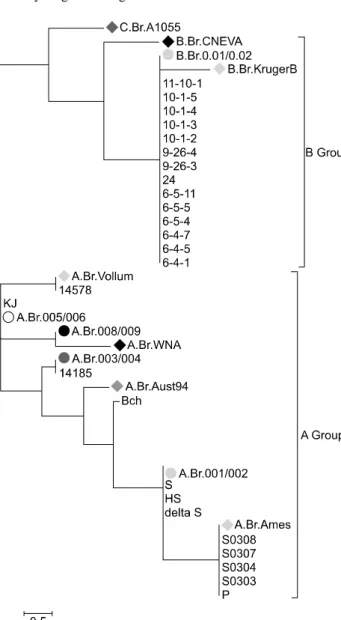
canSNPs were used to calculate simple matching
coefficients and subdivided the B. anthracis isolates
according to major sub-lineages (A and B). These were
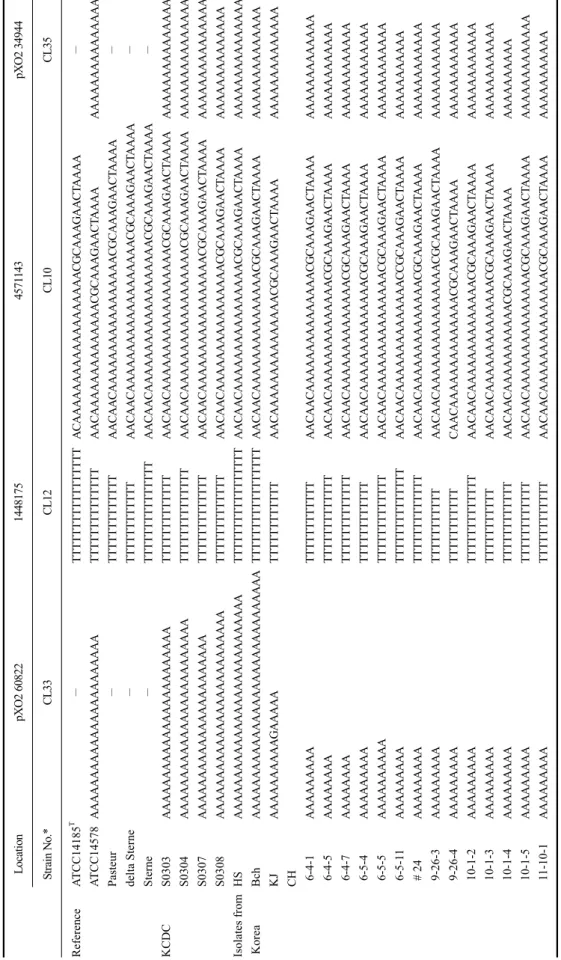
further divided into six of 12 different sub-lineages (Table
3 and Fig. 2, diamond) or sub-groups (circle). In order to
make comparisons with global genetic populations, data
obtained for B. anthracis Korean isolates from our study
along with the results of an eight-loci MLVA and
13-canSNP analysis for 1,033 reported B. anthracis
isolates from 42 countries were used to calculate simple
matching coefficients (Figs. 2 and 3).
Table 3. Observed sequences of 13 canonical single-nucleotide polymorphism (canSNP) loci of B. anthracis strains isolated in Korea LocationpXO2 6082214481754571143pXO2 34944 Strain No.*CL33CL12CL10CL35 Reference KCDC Isolates from Korea
ATCC14185T ATCC14578 Pasteur delta Sterne Sterne S0303 S0304 S0307 S0308 HS Bch KJ CH 6-4-1 6-4-5 6-4-7 6-5-4 6-5-5 6-5-11 # 24 9-26-3 9-26-4 10-1-2 10-1-3 10-1-4 10-1-5 11-10-1
− AAAAAAAAAAAAAAAAAAAAAAA − − − AAAAAAAAAAAAAAAAAAAAAAAA AAAAAAAAAAAAAAAAAAAAAAAAA AAAAAAAAAAAAAAAAAAAAAAA AAAAAAAAAAAAAAAAAAAAAAAAAA AAAAAAAAAAAAAAAAAAAAAAAAAAAA AAAAAAAAAAAAAAAAAAAAAAAAAAAAAAA AAAAAAAAAAGAAAAA AAAAAAAAA AAAAAAAA AAAAAAAA AAAAAAAAA AAAAAAAAAA AAAAAAAAA AAAAAAAAA AAAAAAAAA AAAAAAAAA AAAAAAAAA AAAAAAAAA AAAAAAAAA AAAAAAAAA AAAAAAAAA TTTTTTTTTTTTTTTTT TTTTTTTTTTTTTT TTTTTTTTTTTTT TTTTTTTTTTTT TTTTTTTTTTTTTTT TTTTTTTTTTTTT TTTTTTTTTTTTTT TTTTTTTTTTTTT TTTTTTTTTTTTT TTTTTTTTTTTTTTTTT TTTTTTTTTTTTTTTTT TTTTTTTTTTTT TTTTTTTTTTTT TTTTTTTTTTTTT TTTTTTTTTTTTT TTTTTTTTTTTT TTTTTTTTTTTTT TTTTTTTTTTTTTT TTTTTTTTTTTTT TTTTTTTTTTT TTTTTTTTTTT TTTTTTTTTTTTT TTTTTTTTTTT TTTTTTTTTTTT TTTTTTTTTTTT TTTTTTTTTTTT ACAAAAAAAAAAAAAAAAAAACGCAAAGAACTAAAA AACAAAAAAAAAAAAAACGCAAAGAACTAAAA AACAACAAAAAAAAAAAAAAAAACGCAAAGAACTAAAA AACAACAAAAAAAAAAAAAAAAAAACGCAAAGAACTAAAA AACAACAAAAAAAAAAAAAAAAAAACGCAAAGAACTAAAA AACAACAAAAAAAAAAAAAAAAAACGCAAAGAACTAAAA AACAACAAAAAAAAAAAAAAAAAACGCAAAGAACTAAAA AACAACAAAAAAAAAAAAAAAAACGCAAAGAACTAAAA AACAACAAAAAAAAAAAAAAAACGCAAAGAACTAAAA AACAACAAAAAAAAAAAAAAAACGCAAAGAACTAAAA AACAACAAAAAAAAAAAAAAACGCAAAGAACTAAAA AACAAAAAAAAAAAAAAACGCAAAGAACTAAAA AACAACAAAAAAAAAAAAAAACGCAAAGAACTAAAA AACAACAAAAAAAAAAAAAACGCAAAGAACTAAAA AACAACAAAAAAAAAAAAAACGCAAAGAACTAAAA AACAACAAAAAAAAAAAAAACGCAAAGAACTAAAA AACAACAAAAAAAAAAAAAAACGCAAAGAACTAAAA AACAACAAAAAAAAAAAAAACCGCAAAGAACTAAAA AACAACAAAAAAAAAAAAAACGCAAAGAACTAAAA AACAACAAAAAAAAAAAAAAAACGCAAAGAACTAAAA CAACAAAAAAAAAAAAAACGCAAAGAACTAAAA AACAACAAAAAAAAAAAAAACGCAAAGAACTAAAA AACAACAAAAAAAAAAAAAACGCAAAGAACTAAAA AACAACAAAAAAAAAAACGCAAAGAACTAAAA AACAACAAAAAAAAAAAAAAACGCAAAGAACTAAAA AACAACAAAAAAAAAAAAAAACGCAAAGAACTAAAA
− AAAAAAAAAAAAAAAA − − − AAAAAAAAAAAAAAAA AAAAAAAAAAAAAAAAA AAAAAAAAAAAAAAAA AAAAAAAAAAAAAA AAAAAAAAAAAAAAA AAAAAAAAAAAAAA AAAAAAAAAAAAAA AAAAAAAAAAAAA AAAAAAAAAAAA AAAAAAAAAAAA AAAAAAAAAAAA AAAAAAAAAAAA AAAAAAAAAAA AAAAAAAAAAAA AAAAAAAAAAAA AAAAAAAAAAAA AAAAAAAAAAAA AAAAAAAAAAAA AAAAAAAAAA AAAAAAAAAAAAA AAAAAAAAAAA
* The type strain is indicated with a superscript T. The absence of pXO2 plasmids is indicated with a “−” sign.