
Purpose: To describe the long-term results of deep sclerectomy with collagen implant (DSCI) with or without adjuvant mitomycin C in Korean patients with primary or secondary open-angle glaucoma (OAG)
5
0
0
전체 글
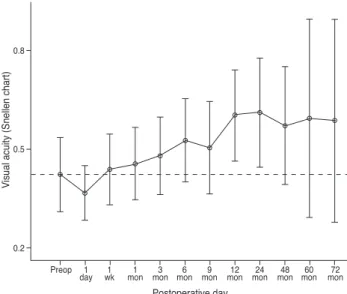
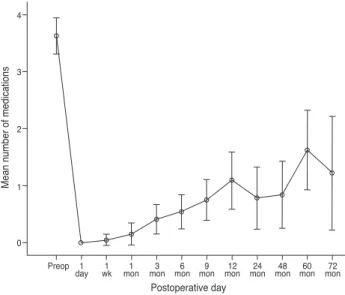
(2) S Rho, et al. Deep Sclerectomy with Small Collagen Implant. mg/mL mitomycin C were applied to the exposed sclera for three minutes and washed out with 10 mL saline irrigation. In certain cases of thin conjunctiva (n = 4) or history of hypotony in the opposite eye (n = 2), mitomycin C was not applied. A hexahedron piece of deep sclera was then removed, leaving a thin scleral layer. Schlemm’s canal was de-roofed at the level of the scleral spur. The dissection was continued until the trabeculo-Descemet’s membrane (TDM) was exposed. The inner wall of Schlemm’s canal and the juxtacanalicular meshwork was peeled off. A synthetic absorbable collagen implant (Ultraplug; Surgical Specialties, Reading, PA, USA) of a cylindrical shape measuring 0.4 mm in diameter and 2.0 mm in length was placed in the center of the deep sclerectomy and sutured with 10-0 nylon. The superficial scleral flap was repositioned over the implant and sutured with 10-0 nylon. Surgery was considered a complete success when IOP was less than 21 mmHg without anti-glaucoma medication or laser goniopuncture, and a qualified success when medication or laser goniopuncture was necessary. It was Table 1. Subject characteristics Characteristic Gender (M : F) Laterality (R : L) Age (yr) Diagnosis (n). Primary open-angle glaucoma Uveitic glaucoma Steroid-induced glaucoma Traumatic glaucoma Use of mitomycin-C Postoperative follow-up duration (mon). Value 29 : 20 22 : 27 43.1 ± 17.0 19 21 7 2 43 (87.8%) 53.0 ± 16.2. considered a failure when an eye required further drainage surgery or lost light perception. Goniopuncture with a neodymium:YAG laser was performed when IOP failed to remain below 21 mmHg due to TDM fibrosis. Kaplan-Meier survival curves were constructed using PASW ver. 18.0 (SPSS Inc., Chicago, IL, USA) for longterm success rate analysis.. Results Patient demographics are shown in Table 1. Of the 65 eyes initially selected for the initial review, 16 eyes were excluded from further analysis due to follow-up periods less than 12 months. The IOP and best-corrected visual acuity changes are shown in Figs. 1 and 2. The mean IOP was 30.5 ± 11.7 mmHg (49 patients) preoperatively and 8.4 ± 4.3 mmHg one day postoperatively. However, as length out from surgery increased, the mean IOP was slightly increased to 13.2 ± 3.7 mmHg (25 patients) at 48 months and to 13.4 ± 3.8 mmHg (16 patients) at 60 months postoperatively. Complete success was 59.2% at 12 months but decreased to 36.7% at 60 months. Qualified success registered at 89.9% at 12 months and 79.6% at 60 months (Fig. 3). When we change the definition of success to an IOP level of 18 mmHg, complete and qualified success rates were slightly decreased to 34.7% and 75.5% 60 months postoperatively, respectively. The mean number of anti-glaucoma medications decreased from 3.6 ± 1.1 (49 patients) to 0.8 ± 1.4 (25 patients) at 48 months, then increased to 1.6 ± 1.3 (16 patients) at 60 months postoperatively (Fig. 4). No shallow or f lat anterior chamber, endophthalmitis, or surgery-induced significant cataract was observed.. 35. Mean IOP (mmHg). 25 IOP = 21 mmHg. 20. Visual acuity (Snellen chart). 0.8. 30. 0.5. 15. 10. 5. 0.2 Preop. 1 day. 1 wk. 1 mon. 6 9 12 24 3 mon mon mon mon mon. 48 60 mon mon. 72 mon. Postoperative day. Fig. 1. Intraocular pressure (IOP) results during follow period (mean ± SD). Preop = preoperative.. Preop. 1 day. 1 wk. 1 mon. 3 6 mon mon. 9 mon. 12 mon. Postoperative day. 24 mon. 48 60 mon mon. 72 mon. Fig. 2. Visual acuity results during follow period (mean ± SD). Preop = preoperative. 35.
(3) Korean J Ophthalmol Vol.27, No.1, 2013. 1.0. 1.0 Qualified success rate 0.8. Rate of conversion. Cumulative survival. 0.8. 0.6. 0.2. 0.0. 0. 10. 20. 30. 40. 50. 60. Sequential number of operation. 70. 80. 90. Fig. 5. Rate of conversion to other glaucoma surgery over time.. 0.0 0. 20. 40. 60. Time (mon). 80. Fig. 3. Cumulative survival rates of qualif ied success and complete success. 4. Mean number of medications. 0.4. Complete success rate. 0.4. 0.2. 3. 2. 1. 0 Preop. 1 day. 1 wk. 1 mon. 3 mon. 6 9 mon mon. 12 mon. Postoperative day. 24 mon. 48 60 mon mon. 72 mon. Fig. 4. Number of antiglaucoma medications before and after deep sclerectomy. Preop = preoperative.. However, five eyes (10.2%) developed a progression of pre-existing cataract. Four eyes (8.2%) showed chronic hypotony lasting for more than two months. Goniopuncture was performed in 23 eyes (46.9%). Mean time between DSCI and goniopuncture was 4.7 ± 6.1 months. The rate of iris synechiae formation after laser goniopuncture was 5.4%. When the TDM was perforated, the procedure was converted to and completed as trabeculectomy. The conversion rate to trabeculectomy plateaued below 20% (Fig. 5).. 36. 0.6. Discussion Non-penetrating glaucoma surgery is technically more difficult to perform than conventional trabeculectomy, as it requires a longer learning curve [3-5]. Our experience shows a similar declining conversion rate as providers become more accustomed to the procedure. The efficacy of IOP reduction after DSCI when compared to conventional trabeculectomy has been an issue [6,7] (Table 2). Shaarawy et al. [5] reported a higher success rate of DSCI compared to DS only [8]. In terms of not only success rate but also the number of anti-glaucoma medication after surgery, their report showed relatively desirable results. Lachkar et al. also described similar long term outcome (six years) of DS retrospectively. Chiselita found a small but statistically significant lower IOP in the trabeculectomy group, but had fewer complications in the DSCI group. It is obvious that we cannot directly compare the outcome of respective studies. However, many reports show that DSCI is better than DS only by means of success rate [9,10]. DSCI has non-penetrating characteristic though, in that it cannot be completely free from the nature of filtering surgery. Xu et al. [11] demonstrated the physiology of DS with porcine eyes. The major factors affecting postoperative outflow increase include the subconjunctival pathway, the functional deep scleral lake and the opening of Schlemm’s canal. In the past few years, it was discovered by authorities that the major late complication of DSCI was the loss of its efficacy [12]. This study found that 46% of eyes eventually needed goniopuncture at a mean post-operative period of 4.7 ± 6.1 months. It has been speculated that an early (less than nine months after the initial procedure) necessity for goniopuncture was because of the lack of surgical dissection during the initial procedure and when the necessity.
(4) S Rho, et al. Deep Sclerectomy with Small Collagen Implant. Table 2. Comparisons of variable parameters at 60 months postoperative deep sclerectomy with collagen implant with different meta-analysis articles Author Implant name. Current study Shaarawy et al. [6] Lachkar et al. [7] Ultraplug Aqua-Flow Aqua-Flow (0.4 mm diameter, 2.0 mm length) (1.0 mm diameter, 2.5 mm length) (1.0 mm diameter, 2.5 mm length) Ethnicity East Asian 100% White 100% Not commented Complete success (%)* 36.7 61.9 66.46 Qualified success (%) 79.6 94.8 80.32 Mean FU (mon). 53.0 ± 16.2. 43.2 ± 14.3. 54.4 ± 17.07 Preop IOP (mmHg). 30.49 ± 11.69. 26.8 ± 7.7. 24.47 ± 5.92 Postop IOP (mmHg). 13.44 ± 3.79. 11.8 ± 3. 15.61 ± 3.48 Preop eyedrop (n). 3.63 ± 1.09. 2.3 ± 0.7. 2.01 ± 0.58 Postop eyedrop (n). 1.63 ± 1.31. 0.49 ± 0.72. 0.85 ± 0.92 Complications (%)† <10.2 <25 0.4-10.5 FU = follow up; Preop = preoperative; Postop = postoperative; IOP = intraocular pressure. * Complete success rate is defined as the proportion of subjects that showed IOP ≤21 mmHg without any IOP lowering medication, and qualified success rate is defined as IOP ≤21 mmHg with any IOP lowering medication at 60 months after surgery. † Complications include aggravation of preexisting cataract, hyphema, hypotony associated complication.. arose late in the course of follow-up, it was probably due to fibrosis of the TDM [5]. This differs from the findings of the present study. Most eyes requiring goniopuncture showed good filtration and low IOPs immediately after the initial DSCI procedure. We believe that this study group, as a single ethnic group, may show differences in patterns of postoperative fibrosis. This ethnic characteristic is also evident in the rate of iris synechiae formation after laser goniopuncture. The present study shows a significantly higher rate of synechiae formation at 5.4% that needed reduction by laser synechiolysis and peripheral iridectomy compared to a previous report [13]. The authors presume an ethnic predisposition to inflammation leading to excessive fibrosis after laser procedures involving uveal tissue in Koreans. Mermoud et al. [14] described the immediate success rate of goniopuncture as 83% with no iris synechiae. In fact, it is not always clear whether the iris synechiae was developed by the laser goniopuncture or by the surgery (DS) itself. For example, Moreno-Montanes et al. [15] reported that nine eyes (8.49%, total 106 eyes) showed iris synechiae after DS only. Shallower anterior chambers and more reaction to light may also affect postoperative results. According to the study by Oh et al. [16], no statistically significant difference was found between the angle width of African-Americans, Caucasians and Far East Asians, however, the iris attaches to the scleral wall more anteriorly in Asian populations. Wang et al. [17] noted that Chinese populations had a smaller angle recess area and trabecular-iris space area, but greater dark-to-light changes in angle opening distance and the trabecular-iris space area. The answer warrants future study, which may possibly involve anterior chamber depth measurements. Other possible reasons for the lower success rate include. higher preoperative IOP level and a much greater number of preoperative glaucoma medications (Table 2). It has already been known that the eye of the patient who has higher IOP at diagnosis shows a lower success rate of trabeculectomy [18,19]. Additionally, those using two or more topical medications were more at risk of failure [18]. These might be applicable to predict outcome of DSCI. Moreover, the different proportion of uveitic glaucoma, which has a relatively poor outcome, could influence the lower success rate [18]. In conclusion, these results show that DSCI in Korean glaucoma patients can have a relatively lower complete success rate and tolerable qualified success rate compared to the outcome of other previous studies. The structural difference in anterior segment (in relation to ethnicity), higher preoperative IOP level, and increased number of preoperative anti-glaucoma eyedrops are the possible factors leading to a lower success rate.. Conflict of Interest No potential conflict of interest relevant to this article was reported.. Acknowledgements This study was supported by a grant of the Korea Health Technology R&D Project, Ministry of Health and Welfare, Republic of Korea (A101727).. References 1. Watson PG, Jakeman C, Ozturk M, et al. The complications of trabeculectomy (a 20-year follow-up). Eye (Lond). 37.
(5) Korean J Ophthalmol Vol.27, No.1, 2013. 1990;4(Pt 3):425-38. 2. El Sayyad F, Helal M, El-Kholify H, et al. Nonpenetrating deep sclerectomy versus trabeculectomy in bilateral primary open-angle glaucoma. Ophthalmology 2000;107:16714. 3. Bauchiero L, Demarie A, Belli L, Brogliatti B. Deep sclerectomy and viscocanalostomy: critical revision of the results obtained during the learning curve. Acta Ophthalmol Scand Suppl 2002;236:64-6. 4. Mermoud A, Schnyder CC, Sickenberg M, et al. Comparison of deep sclerectomy with collagen implant and trabeculectomy in open-angle glaucoma. J Cataract Refract Surg 1999;25:323-31. 5. Shaarawy T, Mansouri K, Schnyder C, et al. Long-term results of deep sclerectomy with collagen implant. J Cataract Refract Surg 2004;30:1225-31. 6. Shaarawy T, Karlen M, Schnyder C, et al. Five-year results of deep sclerectomy with collagen implant. J Cataract Refract Surg 2001;27:1770-8. 7. Lachkar Y, Neverauskiene J, Jeanteur-Lunel MN, et al. Nonpenetrating deep sclerectomy: a 6-year retrospective study. Eur J Ophthalmol 2004;14:26-36. 8. Hamel M, Shaarawy T, Mermoud A. Deep sclerectomy with collagen implant in patients with glaucoma and high myopia. J Cataract Refract Surg 2001;27:1410-7. 9. Shaarawy T, Nguyen C, Schnyder C, Mermoud A. Comparative study between deep sclerectomy with and without collagen implant: long term follow up. Br J Ophthalmol 2004;88:95-8. 10. Shaarawy T, Mermoud A. Deep sclerectomy in one eye vs deep sclerectomy with collagen implant in the contralateral. 38. 11. 12. 13. 14. 15. 16. 17.. 18. 19.. eye of the same patient: long-term follow-up. Eye (Lond) 2005;19:298-302. Xu W, Yao K, Wu W, et al. Change in outflow pathway of porcine eyes in vitro by nonpenetrating filtering surgery. Can J Ophthalmol 2010;45:632-6. Sarodia U, Shaarawy T, Barton K. Nonpenetrating glaucoma surgery: a critical evaluation. Curr Opin Ophthalmol 2007;18:152-8. Kim CY, Hong YJ, Seong GJ, et al. Iris synechia after laser goniopuncture in a patient having deep sclerectomy with a collagen implant. J Cataract Refract Surg 2002;28:900-2. Mermoud A, Karlen ME, Schnyder CC, et al. Nd:Yag goniopuncture after deep sclerectomy with collagen implant. Ophthalmic Surg Lasers 1999;30:120-5. Moreno-Montanes J, Rebolleda G, Munoz-Negrete FJ. Prognostic value of gonioscopy after deep sclerectomy. Eur J Ophthalmol 2007;17:702-8. Oh YG, Minelli S, Spaeth GL, Steinman WC. The anterior chamber angle is different in different racial groups: a gonioscopic study. Eye (Lond) 1994;8(Pt 1):104-8. Wang D, Chiu C, He M, et al. Differences in baseline dark and the dark-to-light changes in anterior chamber angle parameters in whites and ethnic Chinese. Invest Ophthalmol Vis Sci 2011;52:9404-10. Landers J, Martin K, Sarkies N, et al. A twenty-year follow-up study of trabeculectomy: risk factors and outcomes. Ophthalmology 2012;119:694-702. Fontana H, Nouri-Mahdavi K, Caprioli J. Trabeculectomy with mitomycin C in pseudophakic patients with openangle glaucoma: outcomes and risk factors for failure. Am J Ophthalmol 2006;141:652-9..
(6)
수치
관련 문서
Be it FIFA with its quadrennial World Cup or biennial Confederations’ Cup , UEFA with the Euro or the UEFA Champions League, the National Associations with the participation
temperature (Figure 14), control of bead shape during welding (Figure 6) to enhance interbead tempering or softening and specifying weld metal composition limitations (Figure
–The AABB suggests adhering to a restrictive strategy in hospitalized patients with preexisting cardiovascular disease and considering transfusion for patients with symptoms or
All disputes, controversies, or differences which may arise between the parties out of or in relation to or in connection with this contract, or for the breach thereof,
SigmaNEST 펀칭 파워팩 제품 관리, 자동 다이나믹™ 배 열 및 펀칭 툴 관리를 갖춘 터렛 펀칭 프로그래밍을 위한 가장 완벽하고 최적화된
Results: 44 of 1048 patients with gastric cancer(4.1%) had synchronous and metachronous cancers. The average time interval between gastric cancer and secondary primary cancer
Results: In this research, in the group with fibromyalgia patients group, systemic lupus erythematosus patients group and without systemic autoimmune
Although van der Waals equation is still less accurate at high
