Perception-Behavior Differences on Good Teaching and Learning:
Korean EFL College Students*
1)Sun-Young Kim
(Mokpo National University)
Kim, Sun-Young. 2010. Perception-Behavior Differences on Good Teaching and Learning: Korean EFL College Students. Linguistic Research27(1), 165-188. This study examined the perceptions on good teaching and learning held by Korean EFL college students in the four pedagogical areas (i.e., teaching, learning, class dynamics, and educational system) and investigated to what extent survey responses reflected students’ perceptions and their behaviors by analyzing the perception-behavior differences. The self-reported survey was constructed in the way it distinguished students’ responses on the perceptions and their literacy behaviors. The results showed that Korean students, as opposed to commonly-held conceptions of Asian learners (Cortazzi & Jin, 1996, 2002; Hammond & Gao, 2002), possessed fairly well developed perceptions about English learning, suggesting that the perceptions on good teaching and learning shared common ground across different cultural groups. Specifically, good teaching and learning reported by Korean students were ‘learner-centered,’ ‘communicative approach,’ ‘interactive classroom dynamics,’ and ‘cooperative learning.’ However, Korean students described their literacy behaviors as ‘less interactive and social’ and ‘passive recipient of knowledge.’ The significant and positive differences between the perceptions and behaviors demonstrated that although Korean students held perceptions not different from their Western counterparts, their literacy behaviors were often constrained by the traditional classroom. This study argues that narrowing the perception-behavior gap should be taken as an essential part of teaching practices in the Korean EFL college contexts. (Mokpo National University) Key Words perceptions on teaching and learning, literacy behaviors, cultures
of learning, EFL classrooms
1. INTRODUCTION
Recent studies in the field of English education (Byram & Feng, 2006;
* I'd like to express my appreciation to anonymous reviewers for their valuable criticism and suggestions. All remaining errors are of my own.
Coleman, 1998; Cortazzi & Jin, 1996, 2002; Hammond & Gao, 2002; Littlewood, 2001) have shown a wide range of perceptional differences on teaching and learning in the cross-cultural contexts. It is widely agreed that students from different learning cultures do differ in terms of their values, beliefs, and perceptions on teaching and learning. In these studies highlighting cultural differences in Eastern and Western conceptions of learning, two cultures of learning are dichotomized in a particular way. For example, Asian learners were often described as ‘passive receivers of knowledge’ (Cortazzi & Jin, 2002;
Hammond & Gao, 2002), as ‘learners who prefer individual practices and memorization’ (Brown, 2009), and as ‘less interactive learners’ (Cortazzi & Jin, 2002). Such differences reported in the studies have helped to shape and reinforce commonly held perceptions of Asian learners over time.
Cultural differences in the perceptions on teaching and learning may exist or be partially true (Hirvela, 2001). However, an attempt to institutionalize the differences in perceptions (i.e., patterned perceptions specific to particular cultures) without exceptions or individual differences is likely to be misled. It may provide wrong implications for L2 classrooms by contributing to shaping some misconceptions or stereotypes regarding Asian learners. This point was addressed by some studies (Briggs, 1998; Kember, 2000; Littlewood, 2001) conducted in similar contexts. In their studies, no significant differences in students’perceptions on teaching and learning across cultures and countries have been found. They showed that even students from diverse communities of learning could share many common grounds toward good learning and teaching.
As Littlewood (2007) illustrated, the perceptions held by Asian students were often over-exaggerated because the majority of studies highlighting perceptional differences failed to distinguish between students' perceptions and their learning behaviors.
The research on students’ perceptions has paid less attention to perception-behavior gap for several reasons. First, it is not clear whether the results reported in the literature reflected on students’ views on teaching and learning or their actual literacy behaviors constrained by the given educational settings. The surveys from some studies (Cortazzi & Jin, 2002; Hammond & Gao, 2002), for instance, were administrated without the distinction between perception and behaviors. Second, from the cognitive and social perspective of L2 learning (Flower, 1994, 2000; Hirvela, 2001), researchers tend to treat both
perception and behavior as the same construct. Under this theoretical orientation that emphasizes the inseparable connection between perceptions and literacy practices, students would engage in literacy behaviors consistent with their perceptions on English learning. Specifically, students’ expectations about literacy, teaching and learning of literacy, and education played a great role in shaping their ways of practicing English in or out of classrooms. Such a theorizing way, however, is not likely to be applied to EFL learning contexts in that the majority of students who do not use English as their first language are exposed to the limited literacy experience in their home cultures. Finally, to better understand students’ approaches to English learning, we as teachers need to conduct students’ perception in relation to their literacy practices. Most of the research done in this area (Briggs, 1998; Brown, 2009; Cudykunst, 1994;
Hammond & Gao, 2002; Llurda, 2005) addressed the issue of perception and behavior in a separate context.
As noted by Littlewood (2001), the researcher challenges views on Asian learners (mostly Chinese and Korean learners) as ‘passive recipient of knowledge,’ as ‘simple knowledge transfer,’ or as ‘low cognitive process’
(memorization). These conceptions tend to be reinforced when what students view and what they behave in class are not clearly distinguished. Such lack of distinction seems to over-generalize the perceptional differences between native English speakers and EFL students, creating some misconceptions that we as teachers hardly accept in ordinary teaching settings.
Although many researchers (Byram & Feng, 2006; Coleman, 1998; Cortazzi &
Jin, 1996; Zhangxian, 2003) have addressed the importance of perceptional differences in the pedagogical context, a few studies examined the perception-behavior differences held by EFL Asian learners. In the spirit of Littlewood (2001), this study hypothesizes that Korean students, like native English speakers, share the common ground on the perspectives toward good teaching and learning, although their ways of engaging in classroom practices are often constrained by the traditional EFL classroom cultures.1)
The purposes of this study are two-folded: a) to examine the perceptions on
1) According to the reviewer's suggestion, the notion of the traditional classroom in the EFL setting (Skilton-Sylvester, 2001) is described as following learning contexts. Students often have the limited exposure to foreign language interaction in the teacher-directed classroom, and their performances are evaluated mainly based on assignments and tests. And a teacher takes a role as a deliverer of information while a student is viewed as a receiver of information in a large-sized classroom.
teaching and learning held by EFL Korean college students and b) to investigate the perception-behavior differences using the survey distinguishing how they view and what they do. Specifically, we as teachers want to know to what extent survey responses reflect students’ perceptions and literacy behaviors they engage in. To do so, this paper conducts the survey in the way it distinguishes students’
responses to the perceptions from their actual behaviors. The research questions proposed are as follows:
1. Based on a Likert-scale survey, to what extent do survey responses reflect students’ perceptions on "good teaching and learning" in the context of EFL classrooms?
2. What are the similarities and differences existing between the perceptions and behaviors in the four areas (i.e., teaching, learning, class dynamics, and educational system) of EFL pedagogy?
2. LITERATURE REVIEW
The questions about good teaching and learning have been an unending quest in the academy. Teaching and learning cannot be understood in a simple process due to some complexity operated by contextual factors such as different cultural conceptions, classroom dynamics, and so on. Many studies (Cortazzi &
Jin, 1996; Hammond & Gao, 2002; Harris, 2002; Littlewood, 2001, 2007; Tweed &
Lehman, 2002) on beliefs and conceptions about good teaching and learning have widely agreed that teachers and learners from different cultures do differ in their values, beliefs, and behaviors. To address such differences, these studies argue that teachers from different cultural groups should adapt, accommodate, and acculturate learners’ ways of learning. Specifically, in this area, Eastern vs.
Western conceptions of learning have often been examined through the comparative or contrastive studies.
The core argument of Western conception of learning is that learning occurs with interaction with the world, and thus quality learning happens when learners engage themselves in higher cognitive-level processes through interaction (Briggs, 1998; Marton & Booth, 1997; Steffe & Gale, 1995). On the other hand, Eastern conception of learning, or Confucian conception, values effortful and respectful learning of knowledge as well as behavioral reform
(Tweed & Lehman, 2002). In this context, knowledge is viewed as something to learn through individual practices and memorization that emphasize successive repetition.
A large volume of studies to conceptualize the influence of different cultures of learning on the perceptions and behaviors have been conducted (Cudykunst, 1994; Gallois & Callan, 1997; Klopf, 1995). These studies categorized a wide range of perceptions into several pedagogical areas: teaching approach, learning approach, and educational systems. The majority of comparative studies based on the survey method were intended to compare Eastern cultures of learning with the Western norms, tending to generalize such differences in norms in favor of Western conceptions of teaching and learning (Byram & Feng, 2006; Coleman, 1998; Cortazzi & Jin, 1996, 2002; Hammond & Gao, 2002).
Based on the binary contrasts, Schulz (1996) examined Foreign Language (FL) students’ views on FL learning and found that FL students from Eastern cultures of learning have strongly favorable attitude toward explicit grammar instruction and error correction over a communicative approach. Similarly, Brown (2009) in his quantitative study, involving 49 FL teachers and their students, examined what they expected about their effective teaching in order to identify their views on effective teacher behaviors. The results show that teachers and students had statistically significant differences in perceptions in some areas of FL pedagogy such as error correction, target language use, and group work. More specifically, FL students had more favorable attitudes than their teachers towards grammar instruction and error correction. To minimize such mismatch, teachers and students should be aware of their notions of effective L2 learning and try to communicate openly about them.
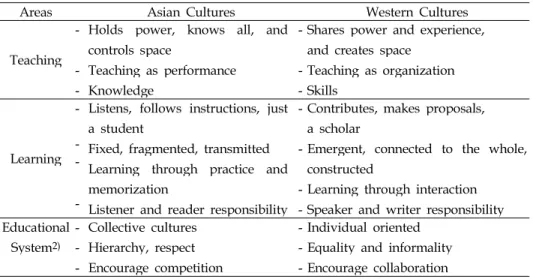
In Cortazzi and Jin's (1996) comparative study, they examined how Chinese college students perceived "a good student and a good teacher," and found that Chinese students’ perceptions about good teaching and learning differed widely, as compared to hidden curriculum (Skilton-Sylvester, 2001) underlying Western cultures of learning. Similarly, Cortazzi and Jin (2002) and Hammond and Gao (2002) provided the evidence supporting the patterned perceptions shared by Asian learners. In their studies, Asian students were described by the terms such as ‘just listening and following instruction,’ ‘fixed and fragmented,’
‘memorization and repetition,’ and ‘knowledge transfer,’ while Western students were considered ‘contributing and making proposals,’ ‘emergent and connected
Areas Asian Cultures Western Cultures
Teaching -
- -
Holds power, knows all, and controls space
Teaching as performance Knowledge
-
- -
Shares power and experience, and creates space
Teaching as organization Skills
Learning
- Listens, follows instructions, just a student
Fixed, fragmented, transmitted Learning through practice and memorization
Listener and reader responsibility -
-
- -
Contributes, makes proposals, a scholar
Emergent, connected to the whole, constructed
Learning through interaction Speaker and writer responsibility -
-
- Educational
System2) - - -
Collective cultures Hierarchy, respect Encourage competition
- - -
Individual oriented Equality and informality Encourage collaboration
to whole,’ ‘interactive learning,’ and ‘constructing knowledge.’ These results strongly suggest that Asian students engage mostly in the low level of cognitive process, as compared to their counterparts. Key findings from Cortazzi and Jin (2002) and Hammond and Gao (2002) are summarized in Table 1.
TABLE 1 Differences in Perceptions between Asian vs. Western Norms
Note: No significant differences in perceptions between the Asian and American cultures in 3 pedagogical areas above were found in some other studies (e.g., Broch, 1996; Cheng, 2001;
Feng, 2007; Littlewood, 2001).
Such a binary view that takes cultures in contact as two entities of homogeneity was challenged by recent studies (Brosh, 1996; Bustos-Orosa, 2008;
Cheng, 2001; Littlewood, 2001; Llurda, 2005) on the ground that those contrasts don't take into consideration of individual differences. To be specific, Llurda (2005) illustrated the contrasts as reductionists’ approaches to theorize culture.
The studies highlighting cultural differences in this field focused mainly on examining the possible factors affecting students’attitudes toward classroom English teaching rather than depending on cultural conceptions.
Littlewood (2001) in his cross-cultural study, using a 12-item questionnaire on
2) The view that the value of cooperation is rooted in the educational system of Western cultures is often refuted by many other researchers. In particular, Phuong-Mai, Terlouw, and Pilot (2005) argue that cooperation is one of the cultural assets deeply incorporated into a collectivist society, or Asian countries (see Datasman, Crandle, and Kearny (1997) for detailed information about the
‘social value of collectivism’ in Asian countries).
the perceptions and attitudes on learning, conducted a large-scale survey to 2656 students from eleven countries (8 Asians and 3 Europeans). The result showed that most students from different cultural backgrounds questioned the traditional authority-based transmission mode of learning. Such findings make us criticise what we have assumed about the learning attitudes Asian students have.
Bustos-Orosa (2008), using an open-ended questionnaire, conducted the research to identify the emergent thematic categories and core ideas related to the knowledge and processes attributed to good teaching. Qualitative analysis of the data showed that good teaching could be best described not as a single dimensional trait but as a profile. Thus, it clearly points out that we should be aware that good teaching takes on multi-dimensional constructs, not unitary personality type.
Another strand of studies (Broch, 1996; Cheng, 2001; Feng, 2007; Littlewood, 2001) demonstrated that Asian ESL/EFL students shared common grounds on the perceptions on teaching and learning although their literacy behaviors were often constrained by given learning situations. In line with this argument, Cheng (2001) points out that if Asian students are found in English class to be quieter than expected in certain circumstances, "the causes are situation-specific rather than culturally pre-set (p. 435)." He indicates that the used teaching methodologies or the poor target language proficiency may cause Asian students’
apparent passivity toward classroom English teaching rather than cultural differences. It is suggested that students’ behaviors of engaging in classroom practices may not be consistent with their perceptions on teaching and learning.
In the similar context, Brosh (1996) examined what important characteristics an effective teacher has by asking the teachers and the L2 students from various cultural groups to choose them from a list of 20 characteristics. Students and teachers chose the same items as the first and second, which shows that students and teachers had homogeneous perceptions on an effective teacher. This study addressed the importance of examining students’ perceptions on good teaching and learning in relation to their literacy behaviors. Specifically, he showed that students’ views on teaching and learning were closely related to their ways of engaging in classroom practices. Feng (2007), in his study involving American and Chinese college students, also showed that American students tended to be more articulate than Chinese students, but such behavioral differences were mainly caused by linguistic barrier. He indicates that unlike students’
perceptions, their behaviors are likely to be constrained by various factors such as linguistic barrier. These studies suggest that to better understand learning approach taken by ESL/EFL students, researchers should take a look at the perception-behavior differences.
The research highlighting perceptional differences between Asian and American students tends to over-generalize the results for several reasons. First, a volume of perceptional studies (Byram & Feng, 2006; Coleman, 1998; Cortazzi
& Jin, 1996, 2002; Hammond & Gao, 2002) have paid less attention to literacy behavior by viewing that students behave according to what they perceive. But treating perception and behavior as the same construct is a strong assumption especially in an EFL context. Second, if the distinction between perception and behavior is not clearly sorted out, students’ behaviors are likely to influence their responses to perceptional items, as Littlewood (2001) argues. For that reason, it is not clear to what extent their results reflected on students’ perspectives and on their literacy behaviors. Finally, the interrelationship between perception and behavior has not been studied in the literature although the perceptional and behavior differences have been examined in a separate context. To address those needs, this study examines the perception-behavior differences held by EFL Korean college students, using a survey distinguishing between their perceptions and behaviors.
3. METHODS
3.1 Participants
The participants for this study consisted of 249 Korean co-educational students from an urban university (7 sections of English classes from two different courses) who took English classes as the general educational requirements in 2008. The majority of subjects participating in this study were the first- and second-year students mostly aged between 21 and 25. The students from 15 different academic disciplines participated in the survey administrated at the beginning of the semester.
3.2 Survey
A survey used in this study was designed to obtain students’ responses by
distinguishing between their perceptions on teaching and learning and the behaviors they experienced during the learning practices (i.e., classroom participation and preparation, group discussion, individual practices in class or outside of class). A 16-item Likert-scale questionnaire was developed to access students’ perceptions on teaching and learning in the four specific areas drawn from the theory and literature: a) teaching approach, b) learning approach, c) classroom dynamics, d) and educational system. This instrument was a self-scoring survey (16 items) consisting of clusters of items that measured the same target areas3). The students responded to a 5-point Likert scale ranging from 1 ("strongly disagree") to 5 ("strongly agree"). The survey was grouped into the four areas containing four individual items each.
1. Teaching approach measures to what extent students perceive "good teaching." (i.e., "A good teacher should control the classroom rather than share power with students in class.")
2. Learning approach measures to what extent students perceive "good learning." (i.e., "I believe it is important for a student to listen and follow what a teacher orders in class rather than find his/her own ways of learning.")
3. Classroom dynamics measure to what extent students learn through the classroom interaction. (i.e., "I believe it is important to engage in more activities involving other students in discussions.")
4. Educational system measures students’ ways of recognizing institutional factors underlying teaching and learning for given community. (i.e., "I believe a good educational system would encourage cooperative learning rather than encourage competitions among students".)
This survey instrument was designed to measure students’ perceptions on
3) According to the reviewer's suggestion, each item in the survey is explained in detail. To construct the survey, the researcher regrouped all the items used in prior studies (i.e., Cortazzi & Jin, 1996;
Hammond & Gao, 2002; Harris, 2002; Littlewood, 2001, 2007) according to 4 pedagogical areas and then randomly chose 4 items for each category.
good teaching and learning approach and the actual behaviors they undertook in the given educational setting. Since this instrument was first developed for this study, it was not always feasible to provide indices of every aspect of validity and reliability. However, even in the cases where there was no resource and opportunity for elaborating validation exercises, I could at least examine the validity of the instrument based on the prediction made from the theory and the homogeneity of the items making up the various multi-item scales within the survey or internal consistency. To obtain reliable information, the researcher calculated both an alpha coefficient, called Cronbach alpha after Cronbach (1951), and a reliability coefficient using Kuder-Richardson approaches. The reliability coefficient for the Kuder-Richardson approach is calculated as follows: Reported coefficients greater than .70 usually indicate that the scores obtained from an instrument could be considered as a reliable measure (Fraenkel & Wallen, 2000).
3.3 Analytic Procedures
First, to answer the first research question (i.e. the perceptions on the four pedagogical areas of teaching and learning), students’ perception scores for each category were analyzed, with 1 ("strongly disagree") as the minimum and 5 ("strongly agree") as the maximum. Specifically, overall range of scores, and mean scores for a student, for each category, and for each item were analyzed using both the descriptive and inferential statistics.
Second, to answer the second research question (i.e., perception-behavior differences held by Korean students), the survey responses were analyzed using a correlational method. The correlation coefficients for each item were analyzed to identify the relationships between the perceptional and behavioral scores. A single sample t-test was used to examine the significance of such differences.
Specifically, a statistically positive and significant difference provided the evidence rejecting Eastern conceptions of teaching and learning discussed in the literature.
4. RESULTS AND DISCUSSIONS
In the tables that appear in this section, mean scores and standard deviations are given for each of the 16 items. The analysis of the survey is aimed to explore the students’perceptions on teaching and learning in the following four broad
Good Teaching Approach Good Learning Approach
Mean SD Range Mean SD Range
Item 1 2.43 0.47 1.49-3.37 Item 5 2.59 0.51 1.57-3.61 Item 2 2.31 0.41 1.49-3.13 Item 6 3.02 0.62 1.78-4.26 Item 3 2.25 0.41 1.43-3.07 Item 7 2.12 0.37 1.38-2.86 Item 4 2.16 0.38 1.40-2.92 Item 8 2.23 0.40 1.43-3.03
Cate. 1 2.35 0.42 1.47-3.13 Cate. 2 2.49 0.50 1.49-3.49 Note: "strongly disagree"=1; "disagree"=2; "undecided"=3; "agree"=4; "strongly agree"=5.
"Range" denotes mean plus/minus 2 standard deviations, which includes 86% of participants in the sample.
domain of teaching and learning:
1. Perceptions on good teaching approach 2. Perceptions on good learning approach 3. Perceptions on class dynamics
4. Perceptions on good educational system
4.1 Students’ Perceptions on the Four Pedagogical Areas
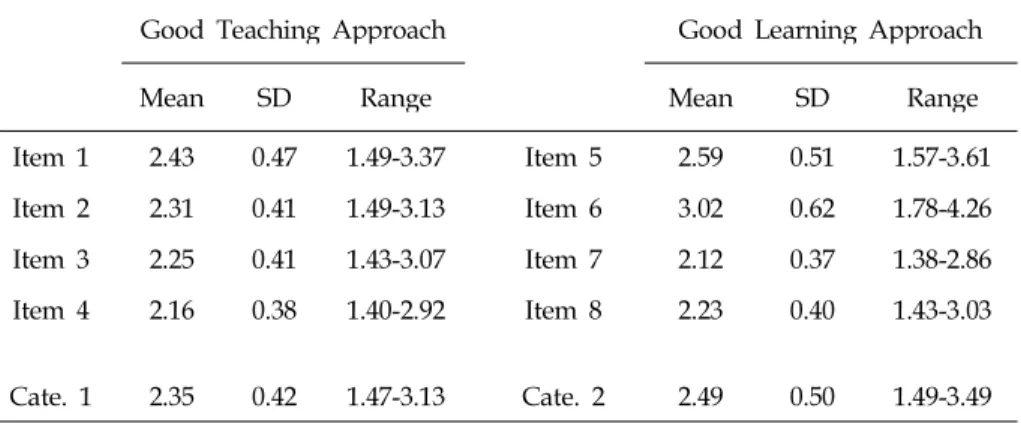
Perceptions on good teaching/learning approach: The analysis of students’ responses revealed that the majority of students, on average, viewed teacher-centered teaching approach to be less desirable, as opposed to the commonly held perceptions by Asian students. The mean value and overall range of scores for the teaching approach category were 2.35 and 1.47-3.13, respectively. It indicates that the majority of students responded to the four items included in Category 1 with "strongly disagree" and "disagree," revealing that they had the negative views on these items. The range of perception scores skewed to the left end of the continuum showed that many Korean students viewed a teacher-centered teaching approach as less desirable. The mean perception scores, standard deviations, and range of scores are presented in Table 2 below.
TABLE 2 Descriptive Statistics for Perceptions on a Good Teaching and Learning Approach
Item 1: A good teacher should control the classroom rather than share power with students in class.
Item 2: A good teacher should know all aspects of subjects rather than know how to teach.
Item 3: A good teaching approach is to pass on knowledge to students rather than provide an opportunity to develop knowledge for them.
Item 4: A good teacher should evaluate students’ performance rather than pay more attention to individual progress.
Item 5: I believe a good student would pay more attention to listening and following what a teacher orders in class rather than trying to find his/her own ways of learning.
Item 6: I believe a good student would prepare for the class rather than participate in classroom activities (i.e., classroom discussion)
Item 7: A good learning approach is to keep learning through individual practices and memorization rather than learning through classroom interactions with students.
Item 8: I believe a good student would view knowledge as something to be transmitted by the teacher rather than consider it as something to be discovered by him/herself.
In the response to power relationship (item 1), Korean students put more value on the teaching of sharing power than that of holding power, casting a negative view on the teacher-directed classroom climates. In Item 2, students valued a teacher with good teaching skills than one who had deeper knowledge (almighty teacher). The knowledge transfer relative to the knowledge development (Item 3) and paying attention to individual progresses relative to overall performance (Item 4) were viewed as good teaching approach by Korean students.
When it comes to the good learning approach perceived by Korean students, the students’ responses provided the evidence contradicting the conceptions of Asian learners reported in many prior studies (Cortazzi & Jin, 1996; Hammond &
Gao, 2002). The mean scores and the range of scores for the learning approach category were 2.49 and 1.49-3.49, respectively. Specifically, Item 6 (the response to the relative value of preparation and participation) had the highest mean value with 3.02, and the responses to Item 7 (students’ view on practices and memorization) showed the lowest mean score with 2.12. Students reported the desire to develop their own ways of learning instead of the teacher-directed
Class Dynamics Educational System
Mean SD Range Mean SD Range
Item 9 3.81 0.43 2.95-4.67 Item 13 3.83 0.47 2.89-4.77 Item 10 3.54 0.42 2.70-4.38 Item 14 3.61 0.52 2.57-4.65 Item 11 3.48 0.43 2.62-4.34 Item 15 2.93 0.51 1.91-3.95 Item 12 3.91 0.39 3.13-4.69 Item 16 3.36 0.44 2.48-4.24
Cate. 3 3.75 0.47 2.81-4.69 Cate. 4 3.63 0.51 2.63-4.63 Note: "strongly disagree"=1; "disagree"=2; "undecided"=3; "agree"=4; "strongly agree"=5.
"Range" denotes mean plus/minus 2 standard deviations, which includes 86% of participants in the sample.
learning practices (in Item 5) and recognized the relative value of class participation over preparation (in Item 6). More importantly, students’ preference for ‘interactive learning’ overwhelmed a commonly-cited conception of ‘learning through memorization by Asian learners.’ And ‘the independent way of learning’
relative to the teacher-directed learning (in Item 8) was viewed as a good learning approach.
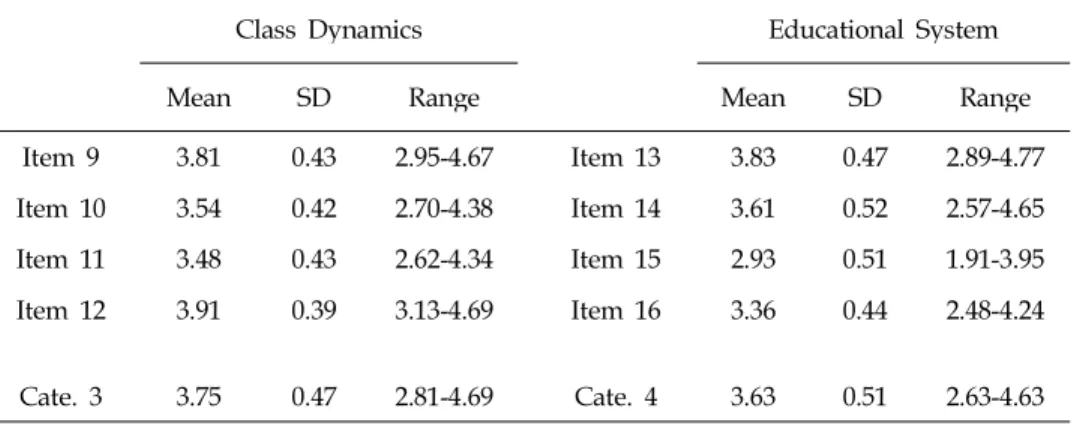
TABLE 3 Perceptions on a Good Educational System and Classroom Dynamics
Item 9: I believe it is important to engage more in activities involving other students in discussions.
Item 10: I’d like to help less able students in class during the classroom interaction.
Item 11: A good classroom practice is to provide an opportunity to learn from other students rather than learn from the teacher.
Item 12: I believe it is more desirable to have a chance to practice in groups rather than practice by myself.
Item 13: I believe a good educational system should encourage cooperative learning rather than encourage competitions among students.
Item 14: I believe a good educational system should promote learning from classroom activities rather than learning from individual practices.
Item 15: I believe a good educational system should encourage the evaluation based on individual progress (process) rather than one based on the
performance-oriented test (learning outcome).
Item 16: I believe a good educational system should help students acquire learning skills rather than learn knowledge from the teacher.
Perceptions on class dynamics and educational system: The analysis of the students’responses to Category 3 (the views on class dynamics) revealed the strong tendency toward classroom engagement and their roles in class as active participants. The mean value and the range for this category were 3.75 and 2.81-4.69, respectively, indicating the students’ perceptions skewed to the learner-centered continuum. It suggests that students valued ‘communicative classroom’ as a more desirable approach, when compared with the whole class, and instructional approach. In particular, Korean students tended to view
‘classroom participation’ (Item 9), ‘helping others and others’ assistances through the classroom interaction’ (Item 10 and Item 11), and ‘group practices’ (Item 12) relative to individual practices as more valuable classroom dynamics.
Perceptions on good educational system: The mean score for Category 4 was 3.63 with the students’ responses ranging from 2.63 to 4.63. With respect to the descriptions of good educational system, Korean students, on average, valued
‘cooperative learning environment’ relative to ‘competitive system’ (Item 13), ‘a process-oriented approach’ relative to ‘a product-oriented one’ (Item 14), and ‘the acquisition of learning skills’ relative to ‘knowledge acquisition itself’ (Item 16).
However, the students strongly believed that a good education system should encourage ‘performance measures’ (Item 15) relative to ‘process ones,’ as indicated by the mean score of 2.92 and the range of 1.91-3.95. In this respect, item 15 can be considered to be the only response that supports conceptions of Asian learners reported in prior studies.
In short, Korean college students possessed well developed perceptions on teaching and learning in the four pedagogical areas that were not different from L1 or L2 students, suggesting that the perceptions on good teaching and learning could share common ground across different cultures. Korean students valued the learner-centered learning and teaching approach as desirable, providing evidence not consistent with the findings from many prior studies. With respect to the classroom practices, the students revealed their preferences for ‘communicative and interactive approach,’ and they also viewed that a good educational system should
encourage cooperation over competition among students.
4.2 Perception-Behavior Differences
The students were asked to describe their literacy behaviors or their own learning experiences using the same 16 survey items in the four pedagogical areas. An analysis of the students’ literacy behaviors showed a wide range of differences in that their actual behaviors were not consistent with what they viewed as good teaching and learning approaches. In particular, the students’
descriptions about literacy behaviors provided the results similar to the perceptions of Asian learners portrayed in many prior studies (Cortazzi & Jin, 1996, 2002; Hammond & Gao, 2002). The results suggest that the perception and the behavior should be treated as a separate construct in EFL contexts.
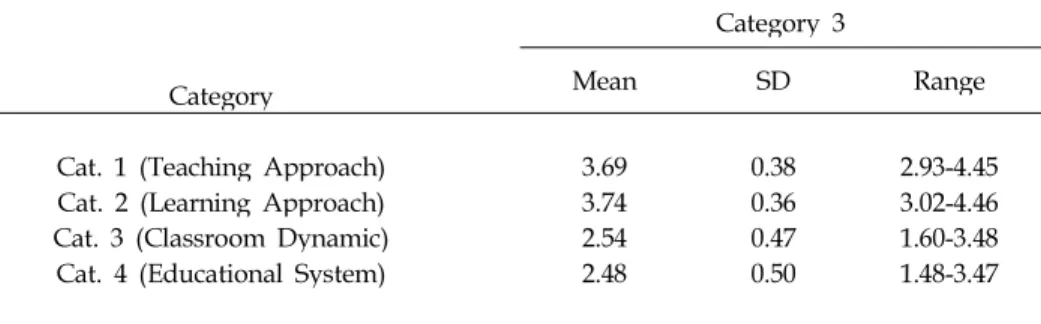
Analysis of Students’ Behaviors: As compared to the students’perceptions on English teaching and learning, their real behaviors of engaging in teaching and learning in the four pedagogical area differed widely, indicating the apparent gaps existing between what they viewed and what they did in class. The students’ responses to their behaviors and experiences on the four categorical areas did not demonstrate a large variation as shown in Table 4, which summarizes means, standard deviations, and ranges for each category. The students’ responses were measured on a 5-point scale, with 1 (strongly disagree) as the minimum and 5 (strongly agree) as the maximum.
With regard to the teaching approach the students experienced in classes, their experiences appeared to describe the strong tendency toward the teacher-centered approach, with the mean score 3.69 and the range 2.93-4.45.
Given that their perception score in the same category was 2.43, there was a wide discrepancy between students’ perceptions on good teaching approach and their actual experiences. It provides the evidence supporting Eastern conceptions of teaching approach reported in the literature. Specifically, the responses, on average, described the students’ experiences as ‘holder of power’ (Item 1),
‘knowledge transfer’ (Item 2 and Item 3), and ‘performance-oriented teaching approach’ (Item 4).
The mean score for the learning approach was 3.74, and the overall range was skewed to the teacher-centered learning approach, with the 3.02-4.46 distribution. It indicates that their experiences in learning practices were more
Category
Category 3
Mean SD Range
Cat. 1 (Teaching Approach) 3.69 0.38 2.93-4.45
Cat. 2 (Learning Approach) 3.74 0.36 3.02-4.46
Cat. 3 (Classroom Dynamic) 2.54 0.47 1.60-3.48
Cat. 4 (Educational System) 2.48 0.50 1.48-3.47
close to the terms, such as ‘passive receiver of knowledge,’ (Item 5 and Item 6),
‘individual practices and memorization,’ (Item 7), and ‘learning from teacher only’ (Item 8).
TABLE 4 Students’ Responses to Actual Behaviors on the Four Pedagogical Categories
Note: "strongly disagree"=1; "disagree"=2; "undecided"=3; "agree"=4; "strongly agree"=5.
"Range" denotes mean plus/minus 2 standard deviations, which includes 86% of participants in the sample.
The analysis of classroom dynamic (Category 3) provided similar results in that while the students recognized the importance of classroom interaction, their actual behaviors in class were less interactive. The mean behavior score for the classroom dynamics was 2.54, which was compared with the mean perception score of 3.75. It indicates that the majority of Korean students, though engaging more in ‘individual practices,’ tended to value learning through ‘social process.’
When it comes to the education system (Category 4), the experience-based responses by Korean students evaluated it more as the competitive system that promoted competitions among students. As opposed to the perception score (3.63), the behavior score was 2.48 with the range of 2.48-3.67. The current system was evaluated by the majority of students as ‘less cooperative,’ (Item 13),
‘less social,’ (Item 14), ‘more performance-oriented,’ and ‘knowledge intensive’
(Item 15 and Item 16).
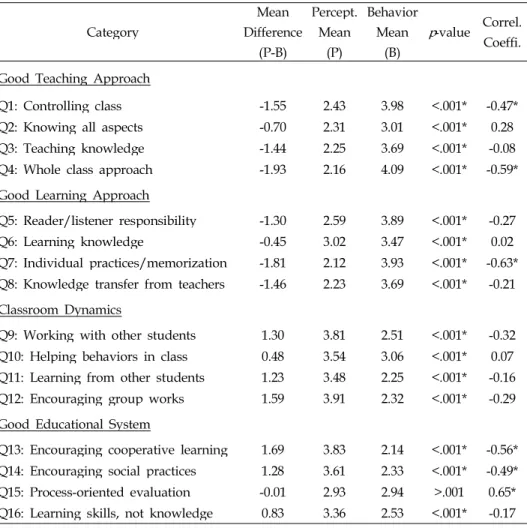
Perception-Behaviors Differences: To examine the differences between the perceptions and behaviors, correlations and t-tests were run on every item with the alpha level set at 0.05. The mean differences between the perception mean (P) and the behavior mean (B) were measured by MD (=P-B). Table 5 displays the means for the perceptions and behaviors, the mean differences, the p-values that
Category
Mean Difference
(P-B)
Percept.
Mean (P)
Behavior Mean
(B)
p-value Correl.
Coeffi.
Good Teaching Approach
Q1: Controlling class -1.55 2.43 3.98 <.001* -0.47*
Q2: Knowing all aspects -0.70 2.31 3.01 <.001* 0.28
Q3: Teaching knowledge -1.44 2.25 3.69 <.001* -0.08
Q4: Whole class approach -1.93 2.16 4.09 <.001* -0.59*
Good Learning Approach
Q5: Reader/listener responsibility -1.30 2.59 3.89 <.001* -0.27
Q6: Learning knowledge -0.45 3.02 3.47 <.001* 0.02
Q7: Individual practices/memorization -1.81 2.12 3.93 <.001* -0.63*
Q8: Knowledge transfer from teachers -1.46 2.23 3.69 <.001* -0.21 Classroom Dynamics
Q9: Working with other students 1.30 3.81 2.51 <.001* -0.32 Q10: Helping behaviors in class 0.48 3.54 3.06 <.001* 0.07 Q11: Learning from other students 1.23 3.48 2.25 <.001* -0.16 Q12: Encouraging group works 1.59 3.91 2.32 <.001* -0.29 Good Educational System
Q13: Encouraging cooperative learning 1.69 3.83 2.14 <.001* -0.56*
Q14: Encouraging social practices 1.28 3.61 2.33 <.001* -0.49*
Q15: Process-oriented evaluation -0.01 2.93 2.94 >.001 0.65*
Q16: Learning skills, not knowledge 0.83 3.36 2.53 <.001* -0.17 resulted from a single t-test, and the correlation coefficients. The test results showed the significant differences across the four pedagogical areas, indicating that the students’ perceptions on teaching and learning were widely different from what they experienced or behaved in a given educational setting. Key findings of this study are summarized in Table 5.
TABLE 5 Perception-Behavior Differences in the Four Pedagogical Categories
Note: "strongly disagree"=1; "disagree"=2; "undecided"=3; "agree"=4; "strongly agree"=5.
"*" denotes a singlet-test result that shows the significant mean difference at the 5% level (p
<.05).
In Category 1 (good teaching approach), the survey measures were structured
in the way that a negative mean difference indicated the gap toward the learner-centered teaching approach. The students, on average, viewed 4 items (i.e., controlling class, knowing all aspects, teaching knowledge, and whole class approach) as less desirable, although they lived in such an environment. The most statistically significant differences were found on ‘controlling class’ and
‘whole class approach.’
Category 2 (good learning approach)also showed the similar result in that most of the students tended to behave as a passive recipient of knowledge in class, although revealing a strong desire for speaker/writer responsibility in learning practices. The most significant difference was found on ‘learning through individual practices and memorization’ (Item 7), suggesting that a bad learning approach recognized by them was the pervasive way of learning in Korea.
In Category 3 (class dynamics), a positive mean difference indicates the students’ gap toward a more social practice in class. The students revealed a more active classroom dynamics in all of the four items (i.e., working with others in item 9, helping and learning from others in items 10 and 11, and encouraging group works in Item 12), even though they did so in their classrooms.
In Category 4 (educational system), most of the students viewed that the current educational system encouraged the competitive force relative to cooperation among peer students and less social classrooms. It suggests that most of the students viewed the competition-oriented educational system as a source of problem that constrained their behaviors in a particular way. However, an insignificant mean difference in process-oriented evaluation (Item 15) showed that their perceptions on this item were consistent with their experiences in classrooms.
In short, the results demonstrate that although Korean students, like native English speaking students, possess the well developed perceptions on English learning, their literacy behaviors are often seriously constrained by the traditional classroom cultures of learning. The analysis suggests that perceptional differences reported in other empirical studies (Cortazzi & Jin, 1996, 2002; Hammond & Gao, 2002) tended to reflect on students’ behaviors. Such confusion has helped to shape some misconceptions about Asian learners, which tends to be taken as the given attributes by many ESL/EFL teachers.
5. CONCLUSIONS
This study explored a wide range of perceptions held by Korean college students on the four pedagogical areas commonly discussed in the literature by distinguishing their perceptions from the behaviors or literacy experiences. The patterned perceptions on teaching and learning were not significantly different from those of Western students reported in prior studies (Cortazzi & Jin, 1996, 2002; Hammond & Gao, 2002).An analysis of the survey items showed that cultural values discussed in these studies were not unique characteristics to describe Western conceptions of learning. For example, Korean students viewed
‘working in groups,’ ‘communicative approaches,’ and ‘social practices’ as the desirable approach to teaching and learning, as Littlewood (2007) found in his comparative study. In particular, the value of ‘cooperative learning’ was also incorporated into the educational system of Asian culture (Datasman, Crandle, &
Kearny, 1997; Phuong-Mai, Terlouw, & Pilot, 2005).
This study argues that many empirical studies signifying the perceptional differences across cultures and countries are likely to generate misconceptions of Eastern cultures of teaching and learning in a particular way. Such an attempt to generalize the differences between Asian and Western students were often used to create and reinforce wrongly-held stereotypes, helping to evaluate Asian cultures of learning on the margin, whether it was intended or not. In this respect, we as teachers cannot accept the descriptions of Asian learners by many prior studies, suggesting that their results should not be taken as a conclusive evidence supporting the differences.
However, the results for the perception-behavior differences indicated that what Korean students perceived could differ widely from what they did in teaching and learning. Specifically, their responses to literacy behaviors were consistent with the findings from some prior studies highlighting the perceptional differences across cultures (Brown, 2009; Cortazzi & Jin, 1996;
Zhangxian, 2003). Many Korean students described their literacy behaviors as
‘less interactive,’ ‘less social,’ and ‘passive recipient of knowledge.’ These results suggest that although Korean students hold the perceptions not different from their Western counterparts, their ways of engaging in literacy practices are often constrained by the current educational settings. For example, a Korean student, viewing active participation in classroom activity as a valuable approach, is likely
to behave less interactively in class simply because such behavior is not valued as a part of curriculum.
The present study contributes to filling the gap existing in the literature; lack of distinction between the perceptions and behaviors in the field of perceptional research. Many comparative studies which emphasized the perceptional differences held by the students from different countries failed to distinguish between students’ perceptions and behaviors. These studies seemed to assume that no gap existed between the perceptions and behaviors because a student would behave according to what s/he perceived, which turns out to be problematic. Specifically, it is hardly difficult to clarify to what extent survey responses reflected on students’perceptions underlying teaching and learning or on their literacy behaviors undertaking in a given environment. If such distinction is not carefully designed at the beginning of the survey, the results are likely to be misled in the way it reinforces the stereotypes pertained to a particular culture of learning.
To provide a conclusive result, the limitations of this study should be addressed, which provides a direction for future research. First, the perceptional differences existing across the countries (i.e., East Asian students vs. Western students) were not directly examined due to the sample limited to Korean students. Future research would examine the differences in the perceptions by expanding the survey into students from Western cultures. Second, to get insights into why literacy behaviors of Korean college students are not consistent with their perceptions on teaching and learning, a qualitative study such as ethnographic approach or conversational analysis should be encouraged.
The present study provides some pedagogical issues applicable to EFL classrooms, supporting the pedagogical notion that in EFL classrooms it is important to focus on students’ perceptions on teaching and learning. Like Western students, Korean students, who possess fairly well developed perceptions about English learning, provide the unique data unattainable from any objective measurements (Hirvela, 2001) although their behaviors are often constrained by the traditional classroom. To narrow down the gap existing between students’needs and the traditional approach to English education, we as teachers need to know more about how our students view good teaching and learning.
A classroom setting should be appropriately structured for students to play
the role as active participants and as co-creators of the learning community by facilitating the classroom interaction with a teacher and peers. Such communicative interactions can occur in various ways in EFL classrooms.
Specifically, students may interact with other students through classroom activities such as reading/writing discussions, pair works, or working in small groups. In addition, the written interaction (i.e., online interaction, electronic discussion, and teachers’feedbacks) can help students gradually reshape their identity as active participants, enhancing their speaker and writer responsibilities throughout the course of teaching practices.
Another pedagogical implication applicable to EFL classrooms is that practitioners should provide a rich environment where students negotiate the perceptional and behavioral differences. This sheds light on important aspects of knowing how to coherently put the various elements together in classroom teaching (Tudor, 2003). One suggestion emerging from this study is that any approach incorporated into classroom activity should be appropriately evaluated as a part of the course curriculum. Students’ classroom behaviors, for instance, are likely to be less interactive if their participating activities are not valued by a teacher in class.
Finally, an "encapsulated instruction" that structures the class in a systematic way would seriously constrain students’ interactive behaviors by not allowing any individual differences in classroom behaviors (Kim, 2006). In many cases, the teaching approach tends to guide the scope of the interactions expected by students. In this respect, a teaching method applied to EFL classroom provides an important implication for students’ behaviors in relation to their perceptions on teaching and learning.
References
Briggs, J. 1998. Learning from the Confucian heritage: So size doesn't matter? International Journal of Educational Research, 29, 723-738.
Brosh, H. 1996. Perceived characteristics of the effective language teacher.Foreign Language Annals, 29, 125-138.
Brown, A. 2009. Students' and teachers' perceptions of effective foreign language teaching:
A comparison of ideals. The Modern Language Journal, 93, 46-60.
Bustos-Orosa, M. A. 2008. Inquiring into Filipino teachers' conceptions of good teaching: a qualitative research study. The Asia-Pacific Education Researcher, 17(2), 157-171.
Byram, M., & Feng, A. 2006. Living and studying abroad: Research and practice. Clevedon:
Multilingual Matters Ltd.
Cheng, Y. C. 2001. The strengths and future of Hong Kong education. Invited keynote speech at the conference of the leadership development network on "Facing up educational re- forms: leading schools for quality education", organized by the Asia-Pacific center for education leadership and school quality, 20. October 2001.
Coleman, J. 1998. Language learning and study abroad: The European perspective.
Frontiers, 167-203.
Cortazzi, M., & Jin, L. 1996. English teaching and learning in China. Language Teaching, 29(2), 61-80.
Cortazzi, M., & Jin, L. 2002. Cultures of learning, the social constructions of educational identities. In D. C. S. Li (ed.),Discourses in search of members in honor of Ron Scollon(pp.
47-75). New York: American Universities Press.
Cudykunst, W. B. 1994. Bridging differences: Effective intergroup communication (2nd ed.).
Thousand Oaks, CA: Sage.
Datasman, M. K., Crandle, J., and Kearny, E. D. 1997.The American ways: An introduction to American culture. Upper Saddle River, NJ: Prentice Hall.
Feng, A. 2007. Bilingual education in China: Practices, politics and concepts. Clevedon:
Multilingual Matters Ltd.
Flower, L. 1994. Literacy action. In L. Z. Bloom, D. A. Daiker, & E. M. White (Eds.), Composition in the twenty-first century: Crisis and change(pp. 249-260). Carbondale, IL:
Southern Illinois University Press.
Flower, L. 2000. The evolution of instructorial inquiry: interview with Linda Flower.
Reflections on Community-Based Writing Instruction. 1(2) Fall, 3-4.
Fullen, M. 2001. Leading in a culture of change. San Francisco: Jossey-Bass.
Fraenkel, J. R., & Wallen, N. E. 2000.How to design & evaluate research in education(4thEd.).
Boston: McGraw-Hill Higher Education.
Gallois, C., & Callan, V. 1997. Communication and culture: A guide for practice. Chichester:
John Wiley.
Hammond, S., & Gao, H. 2002. Pan Gu’a paradigm: Chinese education's return to holistic communication in learning. In X. Lu, W. Jia, & R. Heisey (Eds.), Chinese communication studies: contexts and comparisons (pp. 227-244). Westport, CT: Ablex.
Harris, A. 2002. Effective leadership for school improvement. London, Routledge.
Hirvela, A. 2001. Incorporating reading onto EAP Writing Courses. In J. Flowerdew (Ed.), Research perspectives on English for academic purposes(pp. 330-346). New York: Cambridge University Press.
Kember, D. 2000. Misconceptions about the learning approaches, motivation and study
practices of Asian students. Higher Education, 40(1), 99-121.
Kim, S. Y. 2006.Role of the ESL college learners’ perspectives on integrating L2 reading and writ- ing: Influence of those perspectives on literacy behaviors. Unpublished Ed.D. dissertation, University of Temple, Philadelphia, U.S.A.
Klopf, D. W. 1995. Intercultural encounters: The fundamentals of intercultural communication (3rd Ed.). Englewood, CO: Morton.
Littlewood, W. 2001. Students’ attitudes to classroom English learning: A cross-cultural study. Language Teaching Research, 5(1), 3-28.
Littlewood, W. 2007. Communicative and task-based language teaching in East Asian classrooms. Language Teaching, 40(3), 243-249.
Llurda, E. (Ed.). 2005.Non-native language teachers: Perceptions, challenges and contributions to the professionalism. New York: Springer.
Marton, F., & Booth, S. 1997. Learning and awareness. Hillsdale, NJ: Lawrence Erlbaum Associates.
Phuong-Mai, N., Terlouw, G., & Pilot, A. 2005. Cooperative learning vs Confucian culture’s collectivism: confrontation to reveal some cultural conflicts and mismatch. Asian European Journal, 3(1), 403-419.
Schulz, R. A. 1996. Focus on form in the foreign language classroom: Students’ and teach- ers’ views on error correction and the role of grammar. Foreign Language Annuls, 29, 343-364.
Skilton-Sylvester, E. 2001. Electronic literacies and TESOL graduate students from Korea:
New channels for navigating cultures of learning. Pan-Pacific Associate of Applied Linguistics, 5(2), 221-240.
Steffe, L., & Gale, J. 1995. Constructivism in education. Lawrence Erlbaum Associates.
Hillsdale, NJ.
Tudor, I. 2003. Learning to live with complexity: towards an ecological perspective on lan- guage teaching. System, 31, 1-12.
Tweed, R. G., & Lehman, D. R. 2002. Learning considered within a cultural context:
Confucian and Socratic approaches. American Psychologist, 57, 89-99.
Zhangxian, P. 2003. Personal considerations about bilingual education in China.Educational Research, 24(12), 77-82.
Sun-Young Kim
Dept. of English Education Mokpo National University Muan-ro 560, Chenggye-myon Muan-gun, Jeollanam-do South Korea, 534-729
Tel: (061) 450-2541 CP: (010)-2744-3067 E-mail: [email protected]
Received: 2010. 02. 01 Revised: 2010. 04. 03 Accepted: 2010. 04. 14