• 검색 결과가 없습니다.

Left Ventricular Ejection Fraction Predicts Poststroke Cardiovascular Events and Mortality in Patients without Atrial Fibrillation and Coronary Heart Disease

N/A
N/A
Protected

Academic year: 2022

Share "Left Ventricular Ejection Fraction Predicts Poststroke Cardiovascular Events and Mortality in Patients without Atrial Fibrillation and Coronary Heart Disease"

Copied!
9
0
0

로드 중.... (전체 텍스트 보기)

전체 글

(1)

ABSTRACT

Background and Objectives: It is controversial that decreased left ventricular function could predict poststroke outcomes. The purpose of this study is to elucidate whether left ventricular ejection fraction (LVEF) can predict cardiovascular events and mortality in acute ischemic stroke (AIS) without atrial fibrillation (AF) and coronary heart disease (CHD).

Methods: Transthoracic echocardiography was conducted consecutively in patients with AIS or transient ischemic attack at Soonchunhyang University Hospital between January 2008 and July 2016. The clinical data and echocardiographic LVEF of 1,465 patients were reviewed after excluding AF and CHD. Poststroke disability, major adverse cardiac events (MACE; nonfatal stroke, nonfatal myocardial infarction, and cardiovascular death) and all-cause mortality during 1 year after index stroke were prospectively captured. Cox proportional hazards regressions analysis were applied adjusting traditional risk factors and potential determinants.

Results: The mean follow-up time was 259.9±148.8 days with a total of 29 non-fatal strokes, 3 myocardial infarctions, 33 cardiovascular deaths, and 53 all-cause mortality. The cumulative incidence of MACE and all-cause mortality were significantly higher in the lowest LVEF (<55) group compared with the others (p=0.022 and 0.009). In prediction models, LVEF (per 10%) had hazards ratios of 0.54 (95% confidence interval [CI], 0.36–0.80, p=0.002) for MACE and 0.61 (95% CI, 0.39–0.97, p=0.037) for all-cause mortality.

Conclusions: LVEF could be an independent predictor of cardiovascular events and mortality after AIS in the absence of AF and CHD.

Keywords: Echocardiography; Stroke; Left ventricular function; Mortality

INTRODUCTION

Left ventricular ejection fraction (LVEF) is a widely used parameter for the assessment of left ventricular (LV) systolic function, and reduced LVEF is associated with various cardiac diseases.

1)

It has a clinical significance as a predictor for higher incidence of acute ischemic

Original Article

Received: Apr 5, 2018 Revised: Jul 18, 2018 Accepted: Jul 24, 2018 Correspondence to Kyung Bok Lee, MD, PhD

Department of Neurology, Soonchunhyang University School of Medicine, Soonchunhyang University Seoul Hospital, 59, Daesagwan-ro, Yongsan-gu, Seoul 04401, Korea.

E-mail: [email protected]

Copyright © 2018. The Korean Society of Cardiology

This is an Open Access article distributed under the terms of the Creative Commons Attribution Non-Commercial License (https://

creativecommons.org/licenses/by-nc/4.0) which permits unrestricted noncommercial use, distribution, and reproduction in any medium, provided the original work is properly cited.

ORCID iDs Jeong-Yoon Lee

https://orcid.org/0000-0002-4297-1791 Jun-Sang Sunwoo

https://orcid.org/0000-0002-8168-3127 Kyum-Yil Kwon

https://orcid.org/0000-0001-5443-0952 Hakjae Roh

https://orcid.org/0000-0002-0979-4279 Moo-Young Ahn

https://orcid.org/0000-0003-0329-5855 Min-Ho Lee

https://orcid.org/0000-0003-0748-7766

Jeong-Yoon Lee , MD 1 , Jun-Sang Sunwoo , MD 1 , Kyum-Yil Kwon , MD 1 , Hakjae Roh , MD 1 , Moo-Young Ahn , MD 1 , Min-Ho Lee , MD 2 ,

Byoung-Won Park , MD 2 , Min Su Hyon , MD 2 , and Kyung Bok Lee , MD, PhD 1

1

Department of Neurology, Soonchunhyang University School of Medicine, Seoul, Korea

2
Department of Cardiology, Soonchunhyang University School of Medicine, Seoul, Korea

Left Ventricular Ejection Fraction

Predicts Poststroke Cardiovascular

Events and Mortality in Patients

without Atrial Fibrillation and

Coronary Heart Disease

(2)

stroke (AIS) and mortality in patients with congestive heart failure (CHF) and coronary heart disease (CHD).

2)3)

Reduced LVEF irrespective of overt CHF increased the risk of AIS in the general population.

4)

However, the effect of reduced LVEF on overall outcomes after AIS is a debated issue.

A previous study reported that reduced LVEF was associated with the early and long-term poor functional outcome and mortality in AIS.

5)6)

LVEF was an independent predictor of 5-year mortality in young adult patients with first-ever AIS.

7)

In contrast, in the absence of atrial fibrillation (AF), reduced LVEF itself was not related to higher mortality rate at long- term follow-up in AIS.

8)

These inconsistent results of the previous studies could be attributed to the presence of concomitant cardiac diseases and different assessments of mortality and functional disability.

AF and CHD are major two cardiac diseases which lead recurrent cardiovascular events and mortality after AIS.

9)

The aim of this study is to identify whether reduced LVEF per se, in the absence of AF or CHD, is related to the long-term functional and cardiovascular events in AIS.

METHODS

Patients and case ascertainment

We screened the 2,289 patients with AIS (within 7 days from the onset) or transient ischemic attack (TIA) who were prospectively registered in Soonchunhyang University Hospital from January 2008 to July 2016. The patients with AF (n=484), CHD (n=128) and cardiomyopathy (n=15) were excluded. CHD was defined as any history of myocardial infarction (MI), coronary stenting or ischemic change of cardiac muscle detected by transthoracic echocardiography (TTE) at admission. Cardiomyopathies were diagnosed in the absence of abnormal loading conditions or CHD to cause systolic impairment by the cardiologist.

10)

The followings were also excluded: stroke of other determined etiologies including arterial dissection, Moyamoya disease, cerebral venous thrombosis and vasculitis (n=74); patients without magnetic resonance angiography or computed tomography angiography (n=52);

patients without TTE (n=71). Finally, a total of 1,465 patients with AIS (n=1,342; 91.6%) or TIA (n=123; 8.4%) participated in the analysis. This study was approved by the local Institutional Review Board (No. 2017-01-032) before the study initiation, and all of the subjects agreed on the consent form for the poststroke outcome catchment.

Variables and other risk factors

Data were systematically collected including demographic data, medical history, vascular risk factors, laboratory findings and poststroke outcomes in a web-based registry.

11)

Hypertension was defined as current use of any antihypertensive medication or a systolic blood pressure of at least 140 mm Hg and/or a diastolic blood pressure of at least 90 mm Hg on the seventh day after stroke onset. Diabetes mellitus was defined as current medication of oral hypoglycemic agents or fasting serum glucose ≥126 mg/dL or HbA1c ≥6.5%. Sampling of serum lipid profiles was conducted on the day after the admission with the patients fasting overnight.

Presence of smoking habit meant current smoker or former smoker who had quit within 6 months before the stroke onset. Stroke severity was assessed by National Institutes of Health Stroke Scale (NIHSS) by a neurologist. The uses of antithrombotics, antihypertensives, and statins were counted when information of ≥80% adherence to prescribed drug was collected by patients or caregivers during the follow up period. The 24-channel elecrocardiography Byoung-Won Park

https://orcid.org/0000-0001-6986-2803 Min Su Hyon

https://orcid.org/0000-0001-9057-8700 Kyung Bok Lee

https://orcid.org/0000-0003-2663-7483 Funding

This study was supported by 1) CJ Healthcare Corp. and 2) Soonchunhyang University Research Fund.

Conflict of Interest

The authors have no financial conflicts of interest.

Author Contributions

Conceptualization: Lee JY, Sunwoo JS, Kwon KY, Roh H, Ahn MY, Lee MH, Park BW, Hyon MS, Lee KB; Data curation: Lee JY, Lee KB;

Formal analysis: Lee KB; Funding acquisition:

Lee KB; Methodology: Lee MH, Park BW, Hyon MS, Lee KB; Project administration: Lee KB; Resources: Lee KB; Supervision: Lee KB;

Writing - original draft: Lee JY; Writing - review

& editing: Lee KB

(3)

(ECG) and Holter monitoring were performed in all patients with AIS, and additionally frequent ECG and Holter monitoring were repeated during hospitalization when a cardioembolic stroke is highly suspicious by neuroimaging.

Echocardiographic data

Among the patients without AF or CHD, transthoracic echocardiography was conducted in 95.4% which was relatively higher than that of whole registered patients within 7 days after the stroke onset.

12)

The Philips iE33 (Philips Medical Systems, Bothell, WA, USA) with 5-MHz transduce was used for M-mode and Doppler by 3 cardiologists (Hyon MS, Park BW, and Lee MH) who were blind to the information of this study. With the subjects on the left lateral decubitus position, M-mode based parasternal long-axis left atrial diameter and LV posterior wall thickness were obtained. LVEF was measured by Simpson biplane method. If technically unavailable, Teichholz method or visual estimation was used. Doppler mitral valve inflow was obtained by pulsed wave from the apical window, with a 1- to 3-mm sample volume placed between the tips of the mitral leaflets during diastole. Mitral peak E velocity was measured from the transmitral flow tracing. Early diastolic mitral peak E′ velocity was estimated by tissue Doppler imaging measurements at the mitral annulus. The ratio of transmitral early LV filling velocity to early diastolic tissue Doppler imaging velocity of the mitral annulus (E/E′) was calculated.

Outcome catchments

Modified Rankin Scale (mRS) was used to estimate the functional disability.

13)

We defined the poor functional status as mRS ≥3 (moderate disability; requires some help, but able to walk without assistance). Major adverse cardiovascular events (MACE) included an occurrence of nonfatal stroke, nonfatal MI or cardiovascular death. Cardiovascular death was defined as a death resulting from MI, CHF, stroke, cardiovascular procedures, cardiovascular hemorrhage, and other cardiovascular causes. When death is clearly due to a noncardiovascular cause, a cardiovascular cause of death was excluded.

14)

The physician or clinical researcher rated mRS, and identified cardiovascular outcomes of the subjects at every visit of outpatient clinic and by telephone interview at 3 months and 1 year. In case of missing data, we investigated the data from National Health Insurance Service to check whether a subject had expired or not. The cause of death was identified by the medical record or telephone interview with the caregivers.

Statistical analysis

Statistical analysis was performed with IBM SPSS Statistics 18.0 (SPSS Inc., Chicago, IL,

USA). Sample size was calculated according to the 1-year all-cause mortality rate of about

23% in AIS.

15)

We estimated that the enrollment of 1,434 cases would provide statistical power

of 80% to detect a relative increase of 20% in the fraction of cardiovascular mortality in the

patients with reduced LVEF. We used paired t-test for the continuous variables and χ

2

test for

the categorical variables to examine the differences of each variable. The LVEF were divided

by 10% interval from 55% (the lowest cutoff value of normal range). Mean survival times

of each subgroup were presented with 95% confidence interval (CI) based on the Kaplan-

Meier estimates. Survival curve was plotted for each subgroup, and p value was calculated

by log-rank test between LVEF <55% compared with the remainder. Cox proportion hazards

regression analyses were conducted to evaluate the predictors for MACE and all-cause

mortality. We assessed the incremental value from LVEF by increase of area under curve

(AUC) and net reclassification improvement (NRI) in survival analysis to evaluate a new risk

model for predicting MACE and all-cause mortality.

(4)

RESULTS

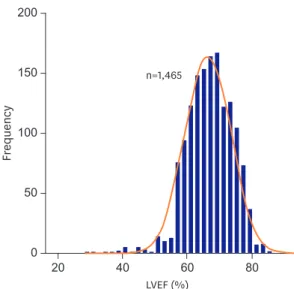
A number of 1,465 patients were followed up for functional disability and cardiovascular outcomes. The mean follow-up time was 259.9±148.8 days. During follow-up period, a total of 29 non-fatal strokes, 3 MIs and 33 cardiovascular deaths occurred. There were 60 MACE and 53 all-cause mortalities. The mean LVEF was 66.3±7.1 (range, 29–84) for study subjects (Figure 1). The proportion of poor mRS and the incidence of MACE are shown among LVEF groups divided by 10% interval (Table 1). The functional disability were not different among 4 LVEF subgroups (p=0.553). The crude incidence of MACE and all-cause mortality within 1 year of the index stroke was higher in the lowest LVEF group. The cumulative incidence of MACE and all-cause mortality were significantly higher in the group of LVEF <55 compared with the remainder (p=0.022 and 0.009 in log-rank test; Figure 2).

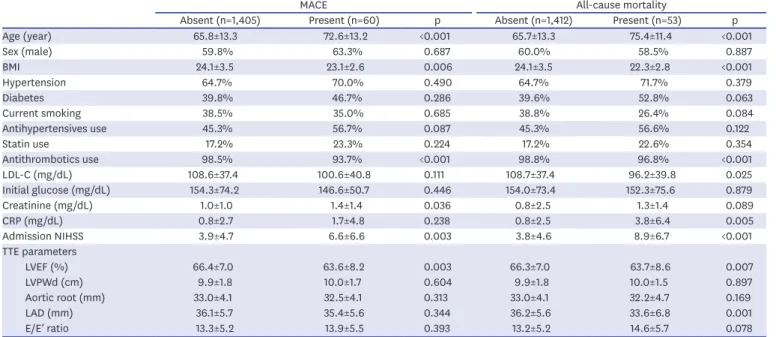
Baseline characteristics with echocardiographic parameters are given by the occurrence of MACE and all-cause mortality (Table 2). The mean intervals from stroke onset to timing of echocardiographic measurement were not different between without and with all-cause mortality (1.3±0.7 vs. 1.5±0.8 days, p=0.095). The means of LVEF was lower in event groups

20 40 60 80

Fr equency

200

150

100

50

0

n=1,465

LVEF (%)

Figure 1. The distribution of LVEF in the subjects of this study.

LVEF = left ventricular ejection fraction.

Table 1. Poststroke outcomes in LVEF subgroups

LVEF p *

≤54 (n=50) 55–64 (n=537) 65–74 (n=700) ≥75 (n=178)

Poor function (mRS>2) 42.9% 31.1% 32.4% 31.2% 0.553

Nonfatal stroke 1 (2.0%) 11 (2.0%) 14 (2.0%) 3 (1.7%) 0.993

Nonfatal MI 0 (0%) 0 (0%) 1 (0.1%) 2 (1.1%) 0.034

Cardiovascular death 4 (8.0%) 14 (2.6%) 11 (1.6%) 4 (2.2%) 0.026

MACE 0.067

No. of event 5 24 25 6

Mean MACE-free time 333.7 (306.1–361.3) 352.2 (356.6–357.8) 354.2 (349.7–358.6) 354.0 (344.9–363.1)

All-cause mortality 0.030

No. of event 5 21 21 6

Mean survival time 333.3 (305.3–361.2) 353.9 (348.6–359.1) 355.8 (351.6–359.9) 353.6 (344.2–363.1) LVEF = left ventricular ejection fraction; MACE = major adverse cardiovascular events; MI = myocardial infarction; mRS = modified Rankin Score.

* p values were calculated by χ

2

test for comparison of ratio and log-rank test for survival analysis.

(5)

(p=0.003 and 0.007), but the other echocardiographic parameters were not different between the two groups. The mean left atrial diameter (LAD) was rather smaller in the survivors.

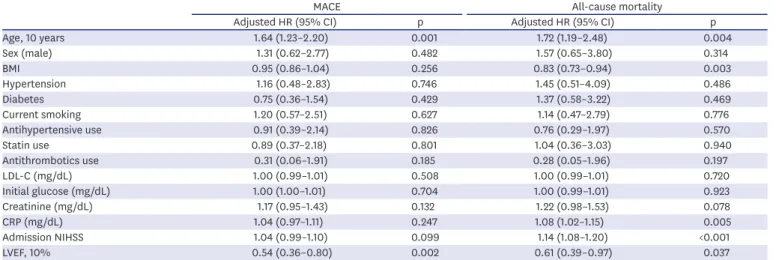
Regarding the prediction of MACE and all-cause mortality, older age (per 10 years) was associated with an increased rate of MACE (hazard ratio [HR], 1.64; 95% CI, 1.23–2.20) and all-cause mortality (HR, 1.72; 95% CI, 1.19–2.48). NIHSS (HR, 1.14; 95% CI, 1.08–1.20) and C-reactive protein (HR, 1.08; 95% CI, 1.02–1.15) significantly increased hazards for all- cause mortality, but body mass index (HR, 0.83; 95% CI, 0.73–0.94) decreased the hazards.

In terms of LVEF (per 10%), HRs were 0.54 (95% CI, 0.36–0.80) for MACE and 0.61 (95%

A

0 100

0.80 0.95

0.90

0.85 1.00

Pr obability of MA CE- free (%)

Time from stroke onset (days) MACE

400 300

200

p=0.022 LVEF≥75

LVEF 65–74 LVEF 55–64 LVEF≤54

All-cause mortality

Time from stroke onset (days)

p=0.009

0.80 0.95

0.90

0.85

B 1.00

100

Cumulativ e survival r at e (%)

400 300

200 LVEF≥75

LVEF 65–74 LVEF 55–64 LVEF≤54

Figure 2. Cumulative incidence of MACE (A) and all-cause mortality (B) in LVEF subgroups.

LVEF = left ventricular ejection fraction; MACE = major adverse cardiovascular events.

Table 2. Baseline characteristics according to the presence of MACE and all-cause mortality

MACE All-cause mortality

Absent (n=1,405) Present (n=60) p Absent (n=1,412) Present (n=53) p

Age (year) 65.8±13.3 72.6±13.2 <0.001 65.7±13.3 75.4±11.4 <0.001

Sex (male) 59.8% 63.3% 0.687 60.0% 58.5% 0.887

BMI 24.1±3.5 23.1±2.6 0.006 24.1±3.5 22.3±2.8 <0.001

Hypertension 64.7% 70.0% 0.490 64.7% 71.7% 0.379

Diabetes 39.8% 46.7% 0.286 39.6% 52.8% 0.063

Current smoking 38.5% 35.0% 0.685 38.8% 26.4% 0.084

Antihypertensives use 45.3% 56.7% 0.087 45.3% 56.6% 0.122

Statin use 17.2% 23.3% 0.224 17.2% 22.6% 0.354

Antithrombotics use 98.5% 93.7% <0.001 98.8% 96.8% <0.001

LDL-C (mg/dL) 108.6±37.4 100.6±40.8 0.111 108.7±37.4 96.2±39.8 0.025

Initial glucose (mg/dL) 154.3±74.2 146.6±50.7 0.446 154.0±73.4 152.3±75.6 0.879

Creatinine (mg/dL) 1.0±1.0 1.4±1.4 0.036 0.8±2.5 1.3±1.4 0.089

CRP (mg/dL) 0.8±2.7 1.7±4.8 0.238 0.8±2.5 3.8±6.4 0.005

Admission NIHSS 3.9±4.7 6.6±6.6 0.003 3.8±4.6 8.9±6.7 <0.001

TTE parameters

LVEF (%) 66.4±7.0 63.6±8.2 0.003 66.3±7.0 63.7±8.6 0.007

LVPWd (cm) 9.9±1.8 10.0±1.7 0.604 9.9±1.8 10.0±1.5 0.897

Aortic root (mm) 33.0±4.1 32.5±4.1 0.313 33.0±4.1 32.2±4.7 0.169

LAD (mm) 36.1±5.7 35.4±5.6 0.344 36.2±5.6 33.6±6.8 0.001

E/E′ ratio 13.3±5.2 13.9±5.5 0.393 13.2±5.2 14.6±5.7 0.078

BMI = body mass index; CRP = C-reactive protein; LAD = left atrial diameter; LDL-C = low-density lipoprotein cholesterol; LVEF = left ventricular ejection fraction;

LVPWd = left ventricular posterior wall dimension; MACE = major adverse cardiovascular events; NIHSS = National Institutes of Health Stroke Scale; TTE =

transthoracic echocardiography.

(6)

CI, 0.39–0.97) for all-cause mortality after adjusting traditional risk factors and potential determinants (Table 3). LAD (HR, 0.95; 95% CI, 0.90–1.00; p=0.055) and E/e (HR, 1.01;

95% CI, 0.94–1.09; p=0.692) were not significant when they participated in the same Cox hazard regression models instead of LVEF. AUC was improved from 0.697 to 0.718 for MACE (p=0.149) and from 0.909 to 0.910 (p=0.842) for all-cause mortality in the new model. An estimated overall NRI was 0.009 (95% CI, −0.108, 0.127) for MACE and 0.036 (95% CI,

−0.245, 0.319) for all-cause mortality.

DISCUSSION

A few studies had been conducted to evaluate the relationship between reduced LVEF and outcomes in AIS. Reduced LVEF was found to be related to the poor functional outcome (mRS ≥3) and mortality within 3 months after AIS in patients with preexisting CHF.

6)

But, this study had small cases of 503, and did not investigate long-term outcomes. Moreover, echocardiography was examined only in patients diagnosed with CHF based on clinical criteria.

6)

Milionis et al.

5)

proposed that low LVEF could identify a subset of AIS patients at high risk of early and long-term stroke-related disability and mortality. In this study, however, the patients with AF or CHD which can heavily influence on cardiovascular events and mortality after AIS

16)

were not excluded. Therefore, it was still unclear whether LV systolic dysfunction itself, in the absence of cardiac disease, is associated with poststroke outcomes.

AF is not only a cause but a consequence of reduced LVEF.

17)

Patients with CHD are at high risk for reduced LVEF and the mortality rate correlates highly with the degree of LV dysfunction.

1)18)

Because AF and CHD is closely related with mortality, stroke risk and quality of life in patients with CHF,

9)

the independent impact of LVEF on outcomes in AIS should be assessed by excluding the interaction between the cardiac diseases and LVEF. Holmström et al.

8)

revealed that reduced LVEF in the absence of AF was not associated with long-term all- cause mortality in AIS. However, relatively small sample size of 132 cases were analyzed, and outcome measurement contained only long-term all-cause mortality without measurement of functional disability and causes of death.

Table 3. Adjusted HRs for the presence of MACE and all-cause mortality during 1 year

MACE All-cause mortality

Adjusted HR (95% CI) p Adjusted HR (95% CI) p

Age, 10 years 1.64 (1.23–2.20) 0.001 1.72 (1.19–2.48) 0.004

Sex (male) 1.31 (0.62–2.77) 0.482 1.57 (0.65–3.80) 0.314

BMI 0.95 (0.86–1.04) 0.256 0.83 (0.73–0.94) 0.003

Hypertension 1.16 (0.48–2.83) 0.746 1.45 (0.51–4.09) 0.486

Diabetes 0.75 (0.36–1.54) 0.429 1.37 (0.58–3.22) 0.469

Current smoking 1.20 (0.57–2.51) 0.627 1.14 (0.47–2.79) 0.776

Antihypertensive use 0.91 (0.39–2.14) 0.826 0.76 (0.29–1.97) 0.570

Statin use 0.89 (0.37–2.18) 0.801 1.04 (0.36–3.03) 0.940

Antithrombotics use 0.31 (0.06–1.91) 0.185 0.28 (0.05–1.96) 0.197

LDL-C (mg/dL) 1.00 (0.99–1.01) 0.508 1.00 (0.99–1.01) 0.720

Initial glucose (mg/dL) 1.00 (1.00–1.01) 0.704 1.00 (0.99–1.01) 0.923

Creatinine (mg/dL) 1.17 (0.95–1.43) 0.132 1.22 (0.98–1.53) 0.078

CRP (mg/dL) 1.04 (0.97–1.11) 0.247 1.08 (1.02–1.15) 0.005

Admission NIHSS 1.04 (0.99–1.10) 0.099 1.14 (1.08–1.20) <0.001

LVEF, 10% 0.54 (0.36–0.80) 0.002 0.61 (0.39–0.97) 0.037

BMI = body mass index; CI = confidence interval; CRP = C-reactive protein; HR = hazard ratio; LDL-C = low-density lipoprotein cholesterol; LVEF = left ventricular

ejection fraction; MACE = major adverse cardiovascular events; NIHSS = National Institutes of Health Stroke Scale.

(7)

Several hypotheses could be proposed for the relationship between LV systolic dysfunction and poststroke mortality. Reduced LV function is a risk factor for the higher rate of recurrent stroke and MI.

2)

The higher prevalence of underlying risk factors in patients with reduced LVEF might contribute to the increased cardiovascular mortality.

19)

Although we excluded the patients with CHD by clinical history and echocardiography, the presence of asymptomatic CHD which is very prevalent in AIS

20)

might have influence on the cardiovascular events.

Furthermore, even in normal range of LV function, reduced LVEF had an independent association with poststroke cardiovascular events in our study. This may suggest a possibility that subclinical LV dysfunction may exist in patients with AIS. Increased incidence of thromboembolic events in patients with reduced LVEF could affect the cardiovascular outcome.

21)

Cognitive impairment is more common in patients with reduced LV function,

22)

which could have some impact on higher mortality rate.

23)

The negative effect of CHF on functional outcome in AIS has been considerably investigated.

6)19)

Decreased exercise capacity in patients with CHF could be an obstacle to the rehabilitation and finally induce poor functional outcome.

6)

In our study, however, reduced LVEF was not an independent predictor for poor functional outcome. This might be because reduced LVEF, as long as it does not cause symptoms of CHF, could not lead to the poor functional disability. The absence of clinical symptoms of CHF in patients with reduced LVEF is common and considered as a precursor to overt CHF.

24)

Exclusion of patients with AF and CHD which are related to the severe functional deficits in AIS could also have affected the results.

25)

There are some advantages in our study. First, though there is insufficient consensus of performing echocardiography in all of the patients with AIS,

26)

the performance rate of echocardiography in our study is much higher than other centers.

27)

Second, most previous reports had categorized LVEF into inconsistently dichotomized two (preserved and reduced) groups,

2)4-8)

and led to very small number of the patients with low LVEF. Regression analysis of interesting factor as continuous variable like our study can reflect statistically more accurate results.

28)

It is also noteworthy to address the limitations in this study. First, the study was retrospectively designed in a single center although all of the data including LVEF was collected prospectively. Biases of selection, misclassification or information are possible.

Second, although we excluded the patients with AF by frequent ECG and Holter monitoring, implantation of loop recorder was not applied in this study population. The existence of undetected paroxysmal AF could have affected the cardiovascular outcomes. Third, LVEF could be reduced transiently by the cerebral infarct itself or severity of symptoms.

29)

Our study did not include the information of the location of cerebral infarct which could cause cardiac autonomic derangement. Fourth, various echocardiographic parameters for LV dysfunction, especially LV global longitudinal strain and LV geometric pattern, were not assessed. And, data measured by Teichholz formula or visual estimation in some patients could contain inaccurate values of LVEF. Finally, given that a slight improvement of AUC and NRI was not statistically significant, the additional prognostic value of LVEF would be limited in predicting poststroke cardiovascular outcomes.

In conclusion, reduced LVEF could be an independent predictor of cardiovascular events

and mortality after AIS even without AF or CHD. Routine echocardiography in patients with

AIS may provide a prediction of poststroke cardiovascular outcome as well as additional

information about the strategies for secondary prevention. A larger prospective study is

(8)

warranted for the clinical implication of echocardiographic parameters for the prognosis of the patients with AIS.

REFERENCES

1. Kelly R, Struthers AD. Screening for left ventricular systolic dysfunction in patients with stroke, transient ischaemic attacks, and peripheral vascular disease. QJM 1999;92:295-7.

PUBMED | CROSSREF

2. Pullicino PM, Halperin JL, Thompson JL. Stroke in patients with heart failure and reduced left ventricular ejection fraction. Neurology 2000;54:288-94.

PUBMED | CROSSREF

3. Di Tullio MR, Qian M, Thompson JL, et al.WARCEF Investigators. Left ventricular ejection fraction and risk of stroke and cardiac events in heart failure: data from the warfarin versus aspirin in reduced ejection fraction trial. Stroke 2016;47:2031-7.

PUBMED | CROSSREF

4. Hays AG, Sacco RL, Rundek T, et al. Left ventricular systolic dysfunction and the risk of ischemic stroke in a multiethnic population. Stroke 2006;37:1715-9.

PUBMED | CROSSREF

5. Milionis H, Faouzi M, Cordier M, D'Ambrogio-Remillard S, Eskandari A, Michel P. Characteristics and early and long-term outcome in patients with acute ischemic stroke and low ejection fraction. Int J Cardiol 2013;168:1082-7.

PUBMED | CROSSREF

6. Ois A, Gomis M, Cuadrado-Godia E, et al. Heart failure in acute ischemic stroke. J Neurol 2008;255:385-9.

PUBMED | CROSSREF

7. Putaala J, Curtze S, Hiltunen S, Tolppanen H, Kaste M, Tatlisumak T. Causes of death and predictors of 5-year mortality in young adults after first-ever ischemic stroke: the Helsinki Young Stroke Registry. Stroke 2009;40:2698-703.

PUBMED | CROSSREF

8. Holmström A, Fu ML, Hjalmarsson C, Bokemark L, Andersson B. Heart dysfunction in patients with acute ischemic stroke or TIA does not predict all-cause mortality at long-term follow-up. BMC Neurol 2013;13:122.

PUBMED | CROSSREF

9. Cherian TS, Shrader P, Fonarow GC, et al. Effect of atrial fibrillation on mortality, stroke risk, and quality- of-life scores in patients with heart failure (from the Outcomes Registry for Better Informed Treatment of Atrial Fibrillation [ORBIT-AF]). Am J Cardiol 2017;119:1763-9.

PUBMED | CROSSREF

10. Elliott P, Andersson B, Arbustini E, et al. Classification of the cardiomyopathies: a position statement from the European Society of Cardiology Working Group on Myocardial and Pericardial Diseases. Eur Heart J 2008;29:270-6.

PUBMED | CROSSREF

11. Kim BJ, Park JM, Kang K, et al. Case characteristics, hyperacute treatment, and outcome information from the clinical research center for stroke-fifth division registry in South Korea. J Stroke 2015;17:38-53.

PUBMED | CROSSREF

12. Seo JY, Lee KB, Lee JG, et al. Implication of left ventricular diastolic dysfunction in cryptogenic ischemic stroke. Stroke 2014;45:2757-61.

PUBMED | CROSSREF

13. Sulter G, Steen C, De Keyser J. Use of the Barthel index and modified Rankin Scale in acute stroke trials.

Stroke 1999;30:1538-41.

PUBMED | CROSSREF

14. Hicks KA, Tcheng JE, Bozkurt B, et al. 2014 ACC/AHA key data elements and definitions for

cardiovascular endpoint events in clinical trials: a report of the American College of Cardiology/American Heart Association Task Force on Clinical Data Standards (Writing Committee to Develop Cardiovascular Endpoints Data Standards). Circulation 2015;132:302-61.

PUBMED | CROSSREF

15. Bamford J, Sandercock P, Dennis M, Burn J, Warlow C. A prospective study of acute cerebrovascular disease in the community: the Oxfordshire Community Stroke Project--1981-86. 2. Incidence, case fatality rates and overall outcome at one year of cerebral infarction, primary intracerebral and subarachnoid haemorrhage. J Neurol Neurosurg Psychiatry 1990;53:16-22.

PUBMED | CROSSREF

(9)

16. Sacco RL, Shi T, Zamanillo MC, Kargman DE. Predictors of mortality and recurrence after hospitalized cerebral infarction in an urban community: the Northern Manhattan Stroke Study. Neurology 1994;44:626-34.

PUBMED | CROSSREF

17. Holmström A, Sigurjonsdottir R, Edner M, Jonsson A, Dahlström U, Fu ML. Increased comorbidities in heart failure patients ≥85 years but declined from >90 years: data from the Swedish Heart Failure Registry.

Int J Cardiol 2013;167:2747-52.

PUBMED | CROSSREF

18. Pfeffer MA, Braunwald E, Moyé LA, et al. Effect of captopril on mortality and morbidity in patients with left ventricular dysfunction after myocardial infarction. Results of the survival and ventricular enlargement trial. N Engl J Med 1992;327:669-77.

PUBMED | CROSSREF

19. Cuadrado-Godia E, Ois A, Roquer J. Heart failure in acute ischemic stroke. Curr Cardiol Rev 2010;6:202-13.

PUBMED | CROSSREF

20. Adams RJ, Chimowitz MI, Alpert JS, et al. Coronary risk evaluation in patients with transient ischemic attack and ischemic stroke: a scientific statement for healthcare professionals from the Stroke Council and the Council on Clinical Cardiology of the American Heart Association/American Stroke Association.

Circulation 2003;108:1278-90.

PUBMED | CROSSREF

21. Lip GY, Gibbs CR. Does heart failure confer a hypercoagulable state? Virchow's triad revisited. J Am Coll Cardiol 1999;33:1424-6.

PUBMED | CROSSREF

22. Zuccalà G, Cattel C, Manes-Gravina E, Di Niro MG, Cocchi A, Bernabei R. Left ventricular dysfunction: a clue to cognitive impairment in older patients with heart failure. J Neurol Neurosurg Psychiatry 1997;63:509-12.

PUBMED | CROSSREF

23. Appelros P, Nydevik I, Seiger A, Terént A. Predictors of severe stroke: influence of preexisting dementia and cardiac disorders. Stroke 2002;33:2357-62.

PUBMED | CROSSREF

24. Bröckel U, Hense HW, Muscholl M, Döring A, Riegger GA, Schunkert H. Prevalence of left ventricular dysfunction in the general population. J Am Coll Cardiol 1996;27:25.

CROSSREF

25. Lin HJ, Wolf PA, Kelly-Hayes M, et al. Stroke severity in atrial fibrillation. The Framingham Study. Stroke 1996;27:1760-4.

PUBMED | CROSSREF

26. Furie KL, Jayaraman MV. 2018 guidelines for the early management of patients with acute ischemic stroke. Stroke 2018;49:509-10.

PUBMED | CROSSREF

27. Grau AJ, Weimar C, Buggle F, et al. Risk factors, outcome, and treatment in subtypes of ischemic stroke:

the German stroke data bank. Stroke 2001;32:2559-66.

PUBMED | CROSSREF

28. Altman DG, Royston P. The cost of dichotomising continuous variables. BMJ 2006;332:1080.

PUBMED | CROSSREF

29. Colivicchi F, Bassi A, Santini M, Caltagirone C. Cardiac autonomic derangement and arrhythmias in right- sided stroke with insular involvement. Stroke 2004;35:2094-8.

PUBMED | CROSSREF

수치

Figure 1. The distribution of LVEF in the subjects of this study.
Table 2. Baseline characteristics according to the presence of MACE and all-cause mortality
Table 3. Adjusted HRs for the presence of MACE and all-cause mortality during 1 year

참조

관련 문서

The Incomplete diffuse type PVD found primarily in patients with diabetic retinopathy and retinal detachment and complete diifuse type PVD found primarily in patients

period was prolonged unavoidably, (3) by explaining the risk factors associated with the failure to patients honestly, and subsequently performing

The purpose of this study was to identify the frequency and related factors of advanced airway management for patients with cardiac arrest by the

Results: In this research, in the group with fibromyalgia patients group, systemic lupus erythematosus patients group and without systemic autoimmune

Mortality and clinical signs in SD rats about single oral administration after 3 weeks with callus extract ..... Hematological values in SD rats administered orally

The associations of hepatic steatosis and fibrosis using fatty liver index and BARD score with cardiovascular outcomes and mortality in patients with new‑onset type 2

Incident major cardiovascular events (coronary artery disease, ischemic stroke, hemorrhagic stroke and cardiovascular mortality) were set as primary end points.

Keywords: Trabecular bone score, End stage renal disease, Hemodialysis, Chronic kidney disease-mineral and bone disorder, Fracture, Cardiovascular