carries the epitopes that are critical for inducing the immune response. In an attempt to enhance the specific immune response, plasmid DNA was constructed to express VP1/interleukin-1 α (IL-1 α ) and precursor capsid (P1) in combination with 2A (P1-2A)/IL-1 α under the control of the human cytomegalovirus (HCMV) immediate- early promoter and intron. After DNA transfection into MA104 (monkey kidney) cells, Western blotting and an immunofluorescence assay were used to confirm the expression of VP1 or P1-2A and IL-1 α . Mice were inoculated with the encoding plasmids via the intradermal route, and the IgG1 and IgG2a levels were used to determine the immune responses. These results show that although the immunized groups did not carry a high level of neutralizing antibodies, the plasmids encoding the VP1/
IL-1 α , and P1-2A /IL-1 α fused genes were effective in inducing an enhanced immune response.
Key words: foot and mouth disease, immunogenicity, inter- leukin-1
Introduction
Foot and mouth disease (FMD) is one of the most devastating diseases in cattle, swine, sheep, goats, and many wild cloven-hoofed animal species [2]. The causative agent of the disease belongs to the Aphthoviruses genus of the
Picornaviridae Family.
In recent years, DNA vaccination has become one of the most promising routes for a recombinant vaccine [8,12], allowing a safe and efficient alternative to conventional vaccination. DNA vaccine technology facilitates the use of cytokines as modulators in vaccination to manipulate the immune responses. In particular, IL-1 production by
derived cytokines such as tumor necrosis factor (TNF) or Interleukin-1 (IL-1), as well as by contact with CD4
+T cells.
IL-1 α is a major immunoregulatory and proinflammatory cytokine that also affects the proliferation and function of fibroblast [3,6]. Recently, we observed that DNA vaccination using both IL-1 α and the porcine reproductive and respiratory syndrome virus (PRRSV) ORF5 gene induced a stronger immune response compared with IL-1 β administered through the intradermal route in the tail (data not shown).
The DNA vaccines are generally used at high concentrations in mouse immunizations, approximately 100-200 µ g per animal, as well as in a highly purified form to remove endotoxins derived from E. coli. Therefore, a low administration dose is important for clinical applications.
The aim of the study was to examine the efficiency of a DNA immunization system using plasmids at low doses in mice, and to enhance the immunogenicity against FMD by constructing plasmids containing the swine IL-1 α gene in addition to the viral capsid (P1) gene including 2A or VP1 containing the major epitopes of the virus.
Materials and Methods
Construction of plasmids
The vector pSLIA, which was kindly supplied by VIDO (Vaccine and Infectious Disease Organization, Canada), is a stable mammalian expression vector that contains the CMV promoter for expression in mammalian cells. Swine IL-1 α , as a molecular adjuvant, was cloned from the whole blood of pigs. The VP1 and P1-2A (P1 and 2A) cDNA from the O/
SKR/2002 strain (AY312588) were amplified by a polymerase chain reaction (PCR). The sense and anti-sense primers used for VP1 were 5'-AACTGCAGATGACCACCTCCACAGG TGAGT-3' and 5’-CGGGATCCCAACAGCTGTTTCACA GGCGCC-3', respectively. The sense and anti-sense primers used for P1-2A (truncated form of 5' region) 5'-GCTCTAG AATGAACACTGGAAGCATTATCA-3' and 5'-CGGGAT CCCCCAGGGTTGGGCTCGACGTCT-3', respectively. The amplified PCR products corresponding to VP1 or P12A
*Corresponding author
Tel: +82-31-467-1719; Fax: +82-31-449-5882
E-mail: [email protected]
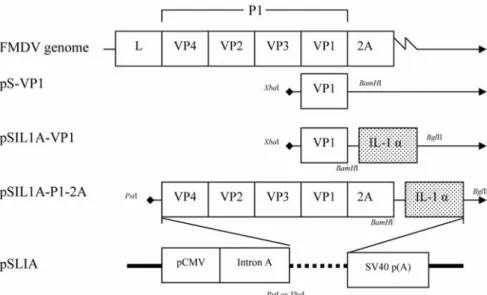
were purified from a gel using Gene Clean Turbo kit (Q- BIO Gene, USA) and cloned into the Pst I and BamH I, or Xba I and BamH I sites of pSLIA. The resulting plasmids were named pS-VP1, pSIL1A-VP1 and pSIL1A-P12A (Fig. 1).
Identification of expressed viral protein
MA104 cells, a monkey kidney cell line, were transfected using Lipofectamine plus (Gibco, USA) according to the manufacturer's instructions. The cells were incubated with bovine FMDV antiserum. After incubation, the cells were washed with PBS and incubated with the fluorescein isothiocyanate (FITC)-conjugated goat anti-bovine antibody (Cappel, USA). The cells were kept in PBS and observed by fluorescence microscopy.
For Western blotting, the MA104 cells were cultured on a tissue culture dish (100mm) and transfected with Lipofectamine plus, as described above. After 48 h of transfection, the cells were harvested using centrifugation, and disrupted with a lysis buffer and sonication. After electrophoresis in SDS- PAGE gel, the gels were transferred onto a nitrocellulose membrane, and the membrane was reacted with either the bovine FMDV antibody (NVRQS, Korea) or rabbit anti- swine IL-1 α antibody (Biosource, USA). The first antibody was detected by horseradish peroxidase (HRPO)-anti- immunoglobulin conjugate and visualized by diamino- benzidine staining of the nitrocellulose membrane.
Immunizations to mice
A total of twenty specific pathogen free (SPF) C57BL/6 mice (4-8 week olds, male), which were grown according to the animal management guideline of the National Veterinary Research and Quarantine Service (NVRQS) in Korea, were divided into 4 groups (5mice/group) for the DNA immunization
clinical trial. One week prior to the experiment, the mice were isolated, and kept under controlled conditions for the duration of the study. The control group mice were inoculated with pSLIA and each of the three experimental groups were administered with pS-VP1, pSIL1A-VP1 or pSIL1A-P12A, respectively. The mice were immunized three times with a low dose of the plasmids (10 µ g) by a tail injection. The antibody response was examined from blood samples collected from the four groups of mice over a 7 day period before inoculation, and at 2 or 3 week intervals after inoculation.
Measurement of Anti-VP1 or anti-P12A antibody level The immune responses after DNA vaccination were determined by indirect ELISA as described by Abu Elzein and Crowther [1]. Ninety-six well plates (Nunc, Denmark) were coated with inactive purified FMDV serotype O antigen (10
5tissue culture infectious dose (TCID)
50/ml) overnight and incubated with the serum samples [1 : 50 diluted in 0.1 M PBS containing 0.5% Tween 20 and 0.5% gelatin] for 1 h at 37
oC. For each mouse IgG subtyping, biotinylated goat IgG specific to either mouse IgG or IgG1/IgG2a (Zymed Laboratory, USA) was reacted for 30 min at 37
oC.
After the reaction with the HRP-streptavidin conjugate for 30 min at 37
oC, the color reaction was developed with 100
µ l/well of 2,2'-azino-bis(3-ethylbenzthiazoline-6-sulfonic acid) (ABTS) for 30 min at room temperature, and the absorbance was examined at a wavelength of 405 nm. The results are expressed as the reciprocal of the highest serum dilution resulting in a reading of two standard deviations above the value of the control sera. The serum neutralizing antibody test and liquid-phase blocking (LPB) ELISA was carried out according to the OIE Terrestrial Manual [4].
Fig. 1. Schematic diagram of plasmid constructs expressing various FMDV proteins in the DNA-based mammalian expression vectors
pCMV: human cytomegalovirus immediate-early promoter. SV40 p(A): SV40 polyadenylation signal.
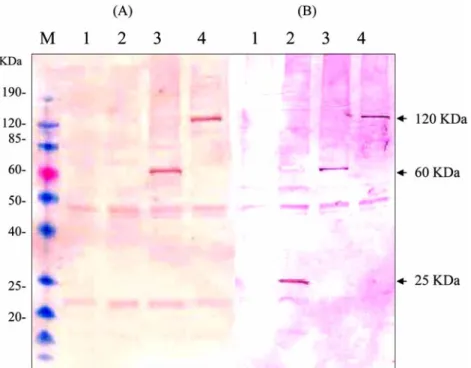
transferred onto a nitrocellulose membrane. The proteins in the cell lysates of the transfected MA104 cells were immunodetected by Western blot analysis, using rabbit anti- swine IL-1 α and bovine antiserum. Fig. 3 shows that the cell lysates of the pS-VP1, pSIL1A-VP1 and pSIL1A-P12A transfected MA104 cells expressed a detectable level of the recombinant proteins. The VP1, VP1-IL1 α and P12A-IL1 α fusion protein bands were detected with a molecular weight corresponding to 25 kDa (lane 2), 65 kDa (lane 3) and 120 kDa (lane 4), respectively.
Fig. 2. Detection of recombinant proteins in pS-VP1, pSIL1A- VP1 and pSIL1A-P12A transfected cells by immunofluorescent assay with bovine anti-FMDV serum. A. pSLIA transfected MA104 cells as a control, B. pS-VP1 transfected MA104 cells C.
pSIL1A-VP1 transfected MA104 cells, D. pSIL1A-P12A transfected MA104 cells.
Fig. 3. Expression of recombinant proteins in transfected cells as detected by Western blot analysis with swine IL-1 α antibody (A) or bovine FMDV- antiserum (B). Lysates of MA104 cells transfected with recombinant plasmids were analysis by electrophoretically transferred to nitrocellulose membrane for Western blot analysis. M; Protein molecular weight marker (Invitrogen), lane 1; pSLIA transfected MA104 cells as a control, lane 2; pS-VP1 transfected MA104 cells, lane 3; pSIL1A-VP1 transfected MA104 cells, lane 4;
pSIL1A-P12A transfected MA104 cells.
Immunogenicity in mice
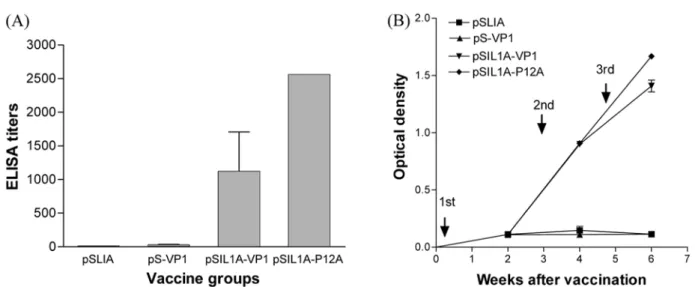
The mice (C57BL/6) were immunized through the tail with 10 µ g of either pSLIA (control group), pS-VP1, pSIL1A- VP1 and pSIL1A-P12A. ELISA was used to determine the level of the humoral antibody, and the anti-VP1 antibodies one week after the third immunization. The group immunized with the recombinant plasmids encoding IL-1 α showed higher titers than the group immunized without IL-1 α (Fig.
4). The mice immunized with pSIL1A-P12A had a higher titer than the mice immunized with pSIL1A-VP1 (Fig. 4A).
Fig. 4B shows a weak reaction in the sera of all four groups one week after the first immunization. In the pSIL1A-VP1 and pSIL1A-P12A groups, an increase in the immune response was detected in the sera one week after the second immunization. However, no increase in the immune response was detected in the pSLIA and pS-VP1 groups.
The changes in the immune response were detected by IgG subclass analysis in the sera at one week after the third
immunization (Table 1). Immunizing the mice with pSIL1A- VP1 and pSIL1A-P12A produced a specific IgG1 and IgG2a response and showed an increased response by a ratio of IgG1/IgG2a (Fig. 5).
Discussion
These results show that recombinant plasmids were constructed with VP1, which contained the critical epitopes for inducing an immune response to the FMDV [13] or the capsid (P1) gene including 2A of the FMDV, which is a mixture of genes encoding structural and non-structural proteins. It was reported that the viral structural proteins induce a humoral response, whereas the non-structural proteins appear to be more effective in inducing the cellular immune system [7]. Some recombinant plasmids were also constructed to encode IL-1 α in order to enhance the immune response.
Fig. 4. Immune responses in the mice immunized with FMDV plasmids. (A) The ELISA was carried out with the sera from C57BL/6 mice (five per group). The test was determined at 1 week after the third immunization. The mice immunized with recombinant plasmids encoding IL-1 α showed high titers. The optical densitiy was measured at 405 nm. (B) C57BL/6 mice (five per group) were immunized three times with 10 µ l of plasmids by tail injection. ELISA was carried out with each serum from five mice. The test sera from the vaccinated animals were diluted 1 : 300 and optical density read at 405 nm. Similarly increased immune response in the pSIL1A-VP1 and pSIL1A-P12A group were detected in the sera at one week after the 2nd immunization.
Table 1. Properties of immune responses in mice immunized with various FMDV plasmids
Immunized groups Ratio of IgG1:IgG2a SN* Mean titers for FMDV antibody
LPB** SPC
†Indirect ELISA
‡pSLIA
§-
§<4 <50 <50 <10
pS-VP1 - <4 <50 <50 28 ± 7.3
pSIL1A-VP1 3.5:1 <4 <50 <50 1,120 ± 587.8.
pSIL1A-P12A 3.6:1 4 <50 <50 2,560
*Pooled sera of five mice was tested for serum neutralizing (SN) activity.
** Percent inhibition (%) by liquid-phase blocking (LPB) ELISA for O type (Pirbright Institute, UK).
†
Percent inhibition (%) by solid-phase competitive (SPC) ELISA for O type structural protein detection (Cedi-Diagnostics B.V., Netherland).
‡
Reciprocal titer of highest serum dilution by indirect ELISA as described in material and methods (NVRQS, Korea).
§