Veterinary Science Efficacy of VP2 protein expressed in E. coli for protection against highly virulent infectious bursal disease virus
Abdul Rahman Omar
1,2,*, Chong Lee Kim
2, Mohd Hair Bejo
2, Aini Ideris
1,21
Institute of Bioscience and
2Faculty of Veterinary Medicine, University Putra Malaysia, 43400 UPM Serdang, Selangor Darul Ehsan, Malaysia
The ability of a heat-inactivated whole virus from a highly virulent infectious bursal disease virus (hvIBDV) and VP2 protein from hvIBDV expressed in E. coli provided protection against a hvIBDV challenge in specific- pathogen-free (SPF) chickens. Six out of seven chickens that were injected three times with crude VP2 protein developed significant antibody titer against IBDV. However, only four out of the seven chickens survived the hvIBDV challenge. Despite showing low antibody titer profiles, all chickens immunized with the heat-inactivated whole virus also survived the challenged with hvIBDV. However, all of these chickens had bursal atrophy and mild to moderate depletion of lymphocytes. Thus, antibodies raised against IBDV VP2 protein expressed in E. coli and denatured IBDV proteins induced some degree of protection against mortality but not against bursal damage following challenge with hvIBDV.
Key words: antibody response, E. coli, heat-inactivated, infectious bursal disease virus, VP2 subunit vaccine
Introduction
Infectious bursal disease virus (IBDV) is one of the most important poultry viruses threatening the chicken industry worldwide. The immunosuppressive effect of this virus leads to concurrent secondary infection in the presence of other viruses or bacteria [18]. The most prominent resulting lesions are hemorrhage and necrosis of the bursa of Fabricius, followed by bursal atrophy [20]. The spread of the classical and variant strains of IBDV has not been fully controlled by the introduction of attenuated live and killed variant virus vaccines [18].
Currently, the major problem of IBD is controlling the highly virulent IBDV (hvIBDV) strains which cause more
severe damage to the bursa and a higher mortality rate. Due to its markedly different pathogenicity compared to classical strains [22], it can overcome high levels of maternally derived antibodies induced by vaccines protective against previously circulating classical strains of IBDV [31]. The live intermediate plus vaccines are recommended for farms where highly virulent strains are found. However, it has been reported the chickens immunized with intermediate live vaccines develop a certain degree of bursal atrophy and immunosuppression [11]. In addition, the commercially available vaccines have been unable to provide full protection against a hvIBDV challenge [26].
Infectious bursal disease virus VP2 protein is the major antigenic component that encodes for at least two epitopes which induce protective neutralizing antibodies [9]. Hence, numerous studies have been performed to develop an alternative IBDV vaccine by expressing the VP2 protein in various expression systems such as E. coli [3,28], bacteriophages [6], yeast [25], plant [32], fowlpox virus [4], herpesvirus [8], adenovirus [10], Semilik Forest virus [23], baculovirus [30] and plasmid DNA [13]. Vaccination of chickens with these expression products have resulted in variable levels of active or passive protection against mortality and/or bursal damage. However, most of these studies have focused on the use of a standard classical challenge (STC) IBDV as challenge virus to test the recombinant vaccines.
The E. coli expression system is known to be the fastest, easiest as well as an inexpensive technique for expression of usable amounts of recombinant protein. Recombinant VP2 expressed in E. coli reacted with a range of monoclonal antibodies [2,14]. However, it has been reported that VP2 protein expressed in E. coli is not suitable for the production of subunit vaccine [3,14]. However, a recent study reported that VP2 protein expressed in E. coli can induce up to 100%
protection against both mortality and bursal damage caused by STC IBDV [28]. Hence, the efficacy of VP2 protein expressed in E. coli for protection against virulent IBDV has not been fully resolved. In addition, the importance of VP2 protein expressed in E. coli for protection against a hvIBDV
*Corresponding author
Tel: +603-8947-2102, Fax: +603-8947-2101
E-mail: [email protected]
challenge remains unclear. In this study, we studied the efficacy of heat-inactivated whole virus, of hvIBDV strain UPM97/61, and its recombinant VP2 protein expressed in
E. coli for protection against a hvIBDV challenge in specific-pathogen-free (SPF) chickens.
Materials and Methods
Amplification of VP2 gene
The VP2 gene used in this study was obtained from the local hvIBDV strain UPM97/61 [12]. The amplification, cloning and sequencing of the VP2 gene was performed using methods previously described [7]. The putative complete open reading of the VP2 gene (1351 bp) from position 132 to 1483 followed the nucleotide numbering system of Bayliss et al. [5]; it was cloned in the TOPO cloning vector (Invitrogen, USA) following the methods recommended by the manufacturer.
Construction of VP2 expression vector
The TOPO cloning vector containing the VP2 gene was subcloned into a pRSET vector version A (Invitrogen, USA) using Bgl II and Eco RI restriction enzyme sites (MBI Fermentas, USA). The ligation mixtures were transformed into competent E. coli BL21-SI. Five clones were picked at random from LB plates and screened for positive clones as well as the orientation of the inserted VP2 gene using PCR methods. The recombinant plasmid was confirmed by restriction digestion and sequencing of flanking regions.
Analysis of VP2 protein expression
A positive clone was selected for expression in LBON medium containing 100 µ g/ml ampicillin. Expression was induced by adding sterile NaCl to 0.3 M and incubation was continued for 5 h before harvesting. The expression of VP2 protein was confirmed by Western blot analysis. Briefly, the cells were centrifuged at 3500 g for 10 min and the pellet was resuspended in 1X loading buffer. The mixtures were subjected to 12% sodium dodecyl sulphate -polyacrylamide gel electrophoresis (SDS-PAGE) [17] using the vertical slab gel Mini Protean II (Bio-Rad, USA). The gels were then stained with Coomasie brilliant blue. For Western blot analysis, the separated proteins from SDS-PAGE were transferred to the polyvinylidene difluoride (PVDF) membrane (Immun- Blot, Bio-Rad, USA). The membranes were incubated with rabbit IBDV polyclonal anti-sera (1 : 80,000) for 45 min at room temperature with agitation. The membranes were then washed in washing buffer and followed by the incubation of alkaline phosphatase-conjugated antibody to rabbit IgG (1 : 5000) (KPL, USA). Finally, the blots were developed with BCIP/NBT color reagents according to manufacturer’s instructions (KPL, USA).
Optimization, production and purification of the VP2 recombinant protein
Prior to the production of large-scale recombinant protein, a small scale optimization was carried out to estimate the optimum conditions for expression. The parameters being studied were the concentration of NaCl (0.2 M, 0.3 M, 0.4 M), the cell incubation temperature (27
oC, 30
oC, 33
oC) and the incubation time (1 h, 2 h, 3 h). The production of large-scale recombinant protein was carried out in one flask under optimal conditions. The VP2 recombinant protein was purified from the crude protein using the ProBond Purification System (Invitrogen, USA) as described by the manufacturer’s manual. The quantification of the total protein concentration was determined using Bio-Rad Protein Assay (Bio-Rad, USA).
Vaccination trial
A total of 43 one-week-old SPF chicks were randomly allocated to six groups. The first two groups were uninfected and used as a negative control; the third to sixth groups were inoculated intramuscularly with 150 µ g of crude E. coli protein, 150 µ g of crude VP2 protein, 50 µ g of purified VP2 protein and heat-inactivated 10
6EID
50of UPM97/61 virus.
The inoculums were mixed vigorously with equal amounts of Freund’s complete adjuvant (Sigma, USA) during the first immunization while Freund’s incomplete adjuvant (Sigma, USA) was used for subsequent immunizations.
The immunizations were boosted twice at two week intervals. Blood for serum was collected from each group at day 0, 7, 14, 21, 28 and 35 post-immunization. One week after the last immunization (day 35), all the chickens except chickens in the second group were challenged orally with 10
4.8EID
50of UPM97/61 [12]. Chickens in the second group served as unchallenged negative controls and were used for scoring bursal lesions. All of the chickens were monitored daily for mortality, and the bursas were collected for scoring lesions.
Scoring bursal lesions
On day eight post-challenge all of the surviving chickens were sacrificed and the bursa to body weight ratios were determined. The bursal tissues from both dead and surviving chickens were also processed for histopathological examination using a lesion scoring system previously described [12]. The lesions were defined as: 0 (normal), 1 (mild), 2 (mild to moderate), 3 (moderate), 4 (moderate to severe) and 5 (severe).
Antibody production assay
An enzyme linked immunosorbent assay (ELISA; IDEXX,
USA) was used to assay the antibody levels produced to
IBDV using the methods recommended by the manufacturer.
The antibody titers were calculated based on the following calculation, log
10titer = 1/09(log
10SP) + 3.36. Samples with antibody titer greater than log
102.60, which is equal to 396, were considered positive.
Results
Expression of VP2 recombinant protein
The pRSET vector expressed the VP2 protein together with polyhistidine taq at the C-terminus. It was estimated that the VP2 protein constituted about 3.8% of the total expressed protein. Based on the Western blot analysis an expected protein band of VP2 protein was detected with the approximate size of 50 kDa (Fig. 1). Solubility testing also indicated that most of the protein was expressed in soluble form (data not shown).
Optimization of protein expression
Optimal conditions for expression vary depending on the specific protein being expressed. The main factors affecting protein expression are the concentration of NaCl, temperature and the incubation time. Protein expression occurred at 27
oC, 30
oC and 33
oC without a significant difference in the amount of protein being expressed based on the results of the Western blot analysis (data not shown).
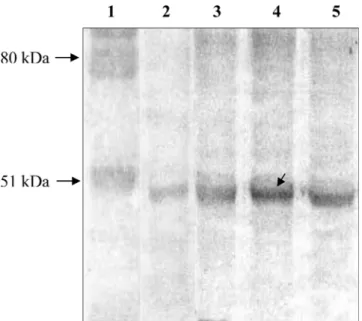
There was a reduced amount of recombinant protein produced in 0.1 M NaCl. At 0.2 M to 0.4 M of NaCl, the amount of protein produced was not significantly different
(Fig. 2). There was no difference at incubation times of 2 h, 3 h and 4 h (data not shown). In general, an incubation temperature of 30
oC for 3 h and with 0.3 M of NaCl provided the optimal condition for expression of VP2 protein in the BL21-SI cells.
Induction of antibody responses
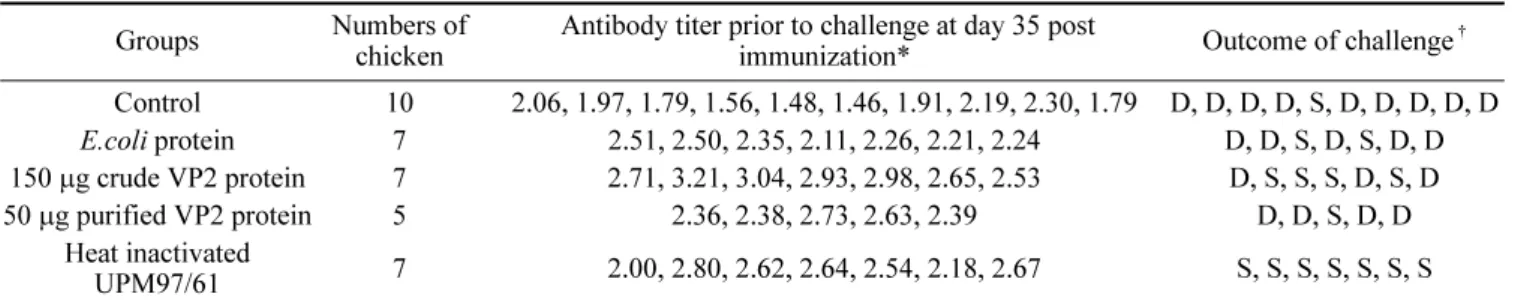
The mean IBDV antibody titers for each group were measured by ELISA from day 0 to 35 days post-immunization (Table 1). All of the antibody titers were below significant levels on day 0 indicating that the birds were not infected with IBDV. The uninfected control birds had no significant detectable antibody titers throughout the experiment. Six out of seven chickens that were injected with 150 µ g of crude VP2 protein developed antibody titers against IBDV by day 35 (Table 1 and 2). Compared to the other groups, only chickens immunized with crude VP2 recombinant protein had antibody titers more than log
103.0. As shown in Table 2, two out of seven chickens in this group had the highest antibody titers which were log
103.04 and log
103.21.
As shown in Table 1, even though the mean antibody titers at day 21 and 28 were higher than at day 14, the titers were considered low or negative for IBDV. In order to confirm that the production of antibodies was not due to the interference of E. coli proteins present in the cell lysate, a group of chickens injected with E. coli protein only was included in the experiment. Results showed that the E. coli protein did not stimulate the production of antibody above a significant level (Table 1). None of the chickens had a
Fig. 1. Western blot analysis of VP2 protein. Lane 1, standard protein marker; lane 2, BL21-SI host cells only and lane 3, cell lysate sample of 3 h induced recombinant plasmid. Arrow indicates the evidence of ~50 kDa VP2 protein detected by rabbit polyclonal antibody against IBDV.
Fig. 2. Optimization of NaCl concentration for expression of
VP2 protein in the E. coli strain BL21-SI. Lane 1, standard
protein marker; lane 2, 0.1 M NaCl; lane 3, 0.2 M NaCl; lane 4,
0.3 M NaCl and lane 5, 0.4 M NaCl. Arrow indicates that the
highest expression of VP2 protein was achieved with 0.3 M
NaCl.
positive antibody titer prior to challenge by day 35 post immunization (Table 2). In the case of chickens immunized with purified VP2 protein, production of antibodies throughout the study was below significant antibody titers except for one chicken that was positive for IBDV on day 21 and 28 (Table 1). By day 35 post immunization, two of the chickens developed a positive antibody titer measuring log
102.63 and log
102.73 (Table 2). However, chickens immunized with heat-inactivated UPM97/61 virus had different antibody titer profiles compared to the other groups. The antibody titers of two to three chickens in this group were positive for IBDV at day 14, 21 and 28 (Table 1). By day 35 post immunization, however, the antibody titers remained low ranging from log
102.62 to log
102.80 (Table 2).
Rate of mortality and protection against hvIBDV challenge
All of the chickens in the groups that were challenged with hvIBDV showed signs of inactivity and depression.
Except for the chickens that were immunized with the heat- inactivated virus, chickens in the other groups began to die on the third day after being challenged. All of the chickens immunized with heat-inactivated IBDV survived the challenge; however, four out of the seven (57%) chickens
that were immunized with 150 µ g of crude VP2 protein remain alive throughout the experiment (Table 1). Only 10
% of the chickens that were not immunized survived the challenge while two out of seven chickens (28%) survived the challenge following immunization with E. coli protein.
Post-mortem and histopathological examinations Post-mortem analysis confirmed that all of the dead chickens had obvious hvIBDV infection characterized by moderate to severe bursal edema, hemorrhage and/or necrosis. Even though all of the chickens immunized with heat-inactivated virus survived the challenge, they had a reduced bursa to body weight ratio (Table 3). No observable significant lesions (score 0) were present in the control birds throughout the experiment. The majority of chickens that survived the challenge showed the presence of mild (score 1) and mild to moderate (score 2) bursal lymphoid depletion (Table 3).
However, histopathological examination of the bursa from dead chickens showed evidence of moderate to severe (score 4) and severe (score 5) lymphoid necrosis and depletion both in the medulla and cortex of the follicles of the bursal tissues (data not shown). Severe edema with heavy infiltration of heterophils was also observed in the interstitial area.
Table 1. Antibody titers, number of chickens with positive antibody titers and percentage of chickens protected against a challenge with highly virulent IBDV
Group Titers (No. of chickens with positive titers) * No survived/
No challenged (% protection)
Day 0 Day 7 Day 14 Day 21 Day 28 Day 35
Control 1.63 ± 0.21 (0) 1.49 ± 0.17 (0) 1.67 ± 0.16 (0) 1.66 ± 0.23 (0) 1.75 ± 0.21 (0) 1.85 ± 1.29 (0) 1/10 (10%)
E. coli protein 1.62 ± 0.14 (0) 1.61 ± 0.30 (0) 1.69 ± 0.16 (0) 2.03 ± 0.15 (0) 1.90 ± 0.24 (0) 2.31 ± 0.15 (0) 2/7 (29%) 150 µ g crude
VP2 protein 1.83 ± 0.15 (0) 2.02 ± 0.17 (0) 2.12 ± 0.26 (0) 2.48 ± 0.26 (1) 2.49 ± 0.29 (2) 2.86 ± 0.24 (6) 4/7 (57%) 50 µ g purified
VP2 protein 1.73 ± 0.21 (0) 1.73 ± 0.09 (0) 1.73 ± 0.25 (0) 2.17 ± 0.38 (1) 2.26 ± 0.25 (1) 2.50 ± 0.25 (2) 1/5 (20%) Heat inactivated
UPM97/61 1.68 ± 0.20 (0) 2.07 ± 0.26 (0) 2.42 ± 0.26 (2) 2.60 ± 0.23 (3) 2.53 ± 0.30 (2) 2.49 ± 0.21 (4) 7/7 (100%)
*The ELISA was carried out using IDEXX Infectious bursal disease antibody test kit at serum dilution of 1 : 500. The antibody titers were calculated based on the following calculation, log
10titer = 1/09(log
10SP) + 3.36. Samples with antibody titer greater than log
102.60 which is equal to 396 were considered positive. The titers were expressed as mean log
10± SD.
Table 2. Antibody titer and outcome of a challenge with highly virulent IBDV
Groups Numbers of
chicken Antibody titer prior to challenge at day 35 post
immunization* Outcome of challenge
†Control 10 2.06, 1.97, 1.79, 1.56, 1.48, 1.46, 1.91, 2.19, 2.30, 1.79 D, D, D, D, S, D, D, D, D, D
E.coli protein 7 2.51, 2.50, 2.35, 2.11, 2.26, 2.21, 2.24 D, D, S, D, S, D, D 150 µ g crude VP2 protein 7 2.71, 3.21, 3.04, 2.93, 2.98, 2.65, 2.53 D, S, S, S, D, S, D
50 µ g purified VP2 protein 5 2.36, 2.38, 2.73, 2.63, 2.39 D, D, S, D, D
Heat inactivated
UPM97/61 7 2.00, 2.80, 2.62, 2.64, 2.54, 2.18, 2.67 S, S, S, S, S, S, S
*The titers were expressed as log
10. Samples with antibody titer greater than log
102.60 which is equal to 396 were considered positive.
†