6
책임저자:김소연, 경기도 성남시 분당구 구미로 166
463-707, 분당서울대학교병원 영양실 Tel: 031-787-3915, Fax: 031-787-4021 E-mail: [email protected]
접수일:2009년 11월 20일, 게재승인일:2009년 12월 15일
영양검색 도구에 따른 영양검색 결과의 비교 분석
분당서울대학교병원 영양실,
1외과
김소연ㆍ염혜선ㆍ박영미ㆍ정수현ㆍ신아름ㆍ한호성
1ㆍ박도중
1Comparison of Tools for Nutritional Risk Screening at Hospital Admission
So-Youn Kim, R.D., Hae-Sun Yeom, R.D., Young-Mi Park, R.D., Su-Hyun Chung, R.D., Ah-Reum Shin, R.D., Ho-Seong Han, M.D.1, Do-Joong Park, M.D.1 Departments of Nutrition Care Services and 1Surgery, Seoul National University Bundang Hospital, Seongnam, Korea Purpose: Nutritional risk screening has been emphasized to predict those patients who are malnourished or at high nutritional risk. In 2006, we developed the Seoul National University Bundang Hospital Nutrition Screening Tool (SNUBH- NST) using a nutritional screening index (NSI) based on the predictors of the nutritional status. The aim of this study was to compare the SNUBH-NST and the Nutritional Risk Screening 2002 (NRS 2002) recommended by the European Society for Parenteral and Enteral Nutrition (ESPEN) as the preferred nutritional risk screening tool for hospitalized patients.
Methods: Three hundred and eighty two patients hospi- talized in medical and surgical wards were screened and classified as being well nourished or at nutritional risk by the SNUBH-NST and the NRS 2002 within 48 h of admission.
The anthropometric measurements and laboratory data were assessed and the length of hospital stay was obtained from the medical chart. Differences between independent groups were assessed with Student's t test and the agree- ment between both tools was analyzed by the χ2-test.
Spearman's rank correlation coefficients were calculated for the correlation between the nutritional risk and the variables.
Results: The SNUBH-NST and the NRS 2002 identified 14.7% and 20.9% of all the assessed patients as being at nutritional risk, respectively, and agreement was ob- served for 340 of the 382 (89%) patients with using both tools (κ=0.627, P<0.001). The anthropometrics and lab- oratory data were lower and the length of hospital stay was longer for the patients who were screened as being at nutritional risk by both tools (P<0.001).
Conclusion: The nutritional risk screened by the SNUBH- NST correlated significantly with age, the anthropometrics, the laboratory data and the length of stay. Agreement was substantial between the SNUBH-NST and the NRS 2002.
Therefore, the SNUBH-NST can be used to screen patients who are at nutritional risk on admission. This study sug- gested that nutritional information and nutrition care plans should be shared with clinicians. Further studies are needed to investigate whether the SNUBH-NST can predict the clinical outcomes. (KJPEN 2009;2(1):6-12)
Key Words: Nutritional risk screening, Malnutrition, Clinical outcome
중심 단어: 영양불량 검색, 영양불량, 임상결과
서 론
입원환자의 영양불량률은 20∼50%로 보고되고 있으 며,1-3 특히 입원환자에서 영양불량으로 인해 합병증과 감염 이 증가하고 사망률, 재원 기간, 의료비용이 상승됨은 이미 다양한 연구를 통해 증명된 바 있다.4-8 Joint Commission for Accreditation of Healthcare Organizations (JCAHO)에서는 입 원환자의 영양적 위험을 입원 초기부터 관리하기 위해 입 원 후 24시간 이내에 영양평가를 실시할 것을 권고하고 있 다.9 영양판정은 환자의 영양상태를 평가하기 위한 포괄적 이고 구체적인 접근법으로, 신체계측치, 생화학적 지표, 병 력, 약물복용, 식사력 등의 자료를 조직화하여 종합적으로 평가하는 과정으로서 이를 바탕으로 영양지원 및 영양관리 계획을 결정한다.10,11 영양불량 환자의 효율적인 관리를 위 해 원칙적으로는 모든 입원환자를 대상으로 영양판정을 시 행하여야 하나, 시간적, 인력적 측면에서 제한점이 있으므 로 효율적이고 신속하게 영양불량 위험환자를 선별하기 위 해 영양판정의 전 단계로서 영양검색의 필요성이 강조되고 있다.
영양검색이란 전 입원환자를 대상으로 영양상태가 불량 하거나 영양불량위험이 있는 환자를 선별한 후 포괄적인 영양판정 실시 여부를 판단하는 과정이다.12 영양검색도구
Table 1. Nutrition screening index in SNUBH-NST NSI=age×1+BMI×1.5+serum albumin×2+TLC×1.5
Age (years) >65; 1, ≤65; 2 BMI (kg/m2) <18.5; 1, ≥18.5; 2 Serum albumin (g/dl) <3.5; 1, ≥3.5; 2 TLC (cells/mm3) <900; 1, ≥900; 2
NSI = nutritional screening index; BMI = body mass index; TLC
= total lymphocyte count.
는 각 의료기관의 실정에 따라 적합한 것을 선택하되 도구 의 효율성, 타당성, 신뢰성, 비용효과 등이 검증되어야 하 며, 일반적이고 즉시 사용할 수 있는 영양지표들을 이용하 여야 하며, 재원일수, 합병증, 사망률 등의 객관적 임상지표 들과 관련성이 있어야 한다.13 20여 년 동안 다양한 영양검 색도구들이 개발되어 왔으나 타당성과 신뢰성이 검증되지 않은 채 사용되는 경우가 많았으며, NRS 2002 (Nutritional Risk Screening 2002), SNAQ (Short Nutritional Assessment Questionnaire), MST (Malnutrition Screening Tool) 등 기존에 사용되어온 검증된 영양검색도구들 또한 외국 환자들을 대 상으로 개발되어 우리나라의 환자들에게 일괄적으로 적용 하기에는 제한점이 있으므로 시간적, 인력적 측면 등을 고 려하였을 때 국내 실정에 맞는 영양검색 도구의 마련이 필 요하다. 이러한 요구에 따라 2006년에 다양한 질환의 환자 를 대상으로 한 연구들에 의해서 그 타당성이 입증된 영양 판정도구인 Patient-Generated Subjective Global Assessment (PG-SGA)를 표준으로 하여,14,15 회귀분석을 통해 입원환자 의 영양상태를 가장 정확하게 예측하는 지표들을 선정하고 이를 이용하여 영양검색도구인 Seoul National University Bundang Hospital Nutrition Screening Tool (SNUBH-NST)을 개발한 바 있다.16
한편, 2003년에 유럽 경장정맥영양학회(European Society for Parenteral & Enteral Nutrition, ESPEN)에서는 128개의 임 상실험 결과를 토대로 NRS 2002를 개발하였으며, 이는 실 제 입원환자를 대상으로 한 연구를 통해 입원환자에게 적 합한 영양검색도구로서 그 타당성이 검증되었다.17,18 따라 서, 저자들은 PG-SGA를 기준으로 하여 개발된 SNUBH-NST 와 공인된 영양검색도구로 널리 사용되고 있는 NRS 2002 를 비교 분석하여 SNUBH-NST의 타당성을 재검증하고, 두 영양검색도구를 이용하여 입원환자의 영양불량률을 평가 하기 위해 본 연구를 시행하였다.
대상 및 방법
1. 대상
본 연구는 2009년 4월 6일부터 4월 15일까지 분당서울대학 교병원에 입원한 20세 이상의 성인 환자 382명을 대상으로 하였으며, 소아과, 산부인과, 정신과에 입원한 환자는 제외하 였다.
2. 방법
입원환자를 대상으로 입원 48시간 이내에 SNUBH-NST 와 NRS 2002를 이용하여 영양검색을 시행하였다. SNUBH- NST는 영양검색지표(nutrition screening index, NSI)를 이용
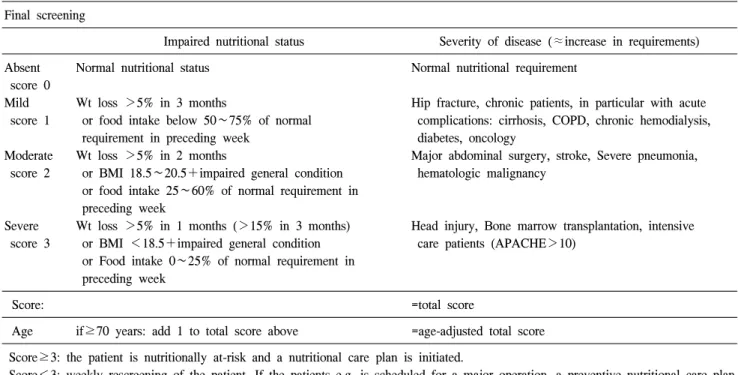
하며, 이에 따른 영양검색 결과는 자동화된 영양검색 프로 그램에 의해 시행된 결과를 이용하였다. NSI는 Table 1에 나타낸 바와 같으며, 2006년에 자동화된 영양검색 프로그 램으로 개발된 이후 본원의 영양불량환자 검색에 이용되고 있다. 이는 PG-SGA의 결과를 표준으로 하여 회귀분석을 통 해 영양상태를 가장 잘 반영하는 것으로 선정된 나이, 체질 량지수, 혈청 알부민, 총 림프구수를 회귀계수에 따라 점수 화한 지표로서 가장 높은 Yoden index (민감도+특이도−1) 를 나타내는 NSI 8.75점을 영양불량군을 정의하는 기준으 로 삼았다.16 NRS 2002는 체중, 식사섭취량, 체중 감소 등의 영양적 요인와 영양요구량 증가를 반영하는 질병의 중증도 를 지표로 사용한 영양검색 도구로서, 입원 환자를 대상으 로 영양불량 여부뿐만 아니라 향후의 영양불량 위험을 선 별하는 것을 목적으로 개발되었다. NRS 2002를 이용한 영 양검색은 Table 2에 나타낸 바와 같이 1차 검색과 2차 검색 으로 나누어져 순차적으로 진행되었다. 1차 검색에서 체질 량지수와 최근의 식사 및 체중 감소 여부, 집중치료 여부를 평가하여 한 가지 이상에 해당될 경우 2차 검색을 진행하였 다. 2차 검색에서는 영양불량 정도, 질병의 중증도에 따른 영양요구량 증가 정도를 평가하며, 마지막으로 연령을 고 려한 점수를 합산하여 총점 3점 이상인 환자를 영양불량위 험군으로 하였다.18
NRS 2002에 포함된 항목인 최근의 체중 감소, 식사섭취 와 신체계측 자료는 영양사의 개별 면담에 의해 조사되었 으며, 나이, 연령, 성별, 입원 시 진단명, 생화학적 검사 결 과, 재원 일수는 전자의무기록(electronic medical records, EMR)의 정보를 이용하였다. 신체계측 결과 중 mid-arm cir- cumference (MAC), triceps skinfold (TSF)는 직접 측정하였 으며, MAC, TSF를 이용하여 mid-arm muscle circumference (MAMC (cm)=MAC (cm)−[π×TSF (cm)])를 산출하였다.
3. 통계자료 분석
본 연구의 통계분석은 통계 프로그램인 PASW Statistics 17.0 (SPSS Inc., Chicago, IL, USA)을 이용하였다. 일반적 사항, 신체계측치와 생화학적 검사결과는 평균±표준편차로 표시
Table 2. Nutritional risk screening 2002 (NRS 2002) Initial screening
Yes No
1. Is BMI <20.5?
2. Has the patients lost weight within the last 3 months?
3. Has the patients had a reduced dietary intake in the last week?
4. Is the patient severely ill? (e.g. in intensive therapy)
Yes: If the answer is ‘Yes’ to any question, the screening in final screening performed.
No: If the answer is ‘No’ to all questions, the patients is re-screened at weekly intervals. If the patient e.g. is scheduled for a major operation, a preventive nutritional care plan is considered to avoid the associated risk status.
Final screening
Impaired nutritional status Severity of disease (≈increase in requirements) Absent
score 0 Mild score 1
Moderate score 2
Severe score 3
Normal nutritional status
Wt loss >5% in 3 months
or food intake below 50∼75% of normal requirement in preceding week
Wt loss >5% in 2 months
or BMI 18.5∼20.5+impaired general condition or food intake 25∼60% of normal requirement in preceding week
Wt loss >5% in 1 months (>15% in 3 months) or BMI <18.5+impaired general condition or Food intake 0∼25% of normal requirement in preceding week
Normal nutritional requirement
Hip fracture, chronic patients, in particular with acute complications: cirrhosis, COPD, chronic hemodialysis, diabetes, oncology
Major abdominal surgery, stroke, Severe pneumonia, hematologic malignancy
Head injury, Bone marrow transplantation, intensive care patients (APACHE>10)
Score: =total score
Age if≥70 years: add 1 to total score above =age-adjusted total score Score≥3: the patient is nutritionally at-risk and a nutritional care plan is initiated.
Score<3: weekly rescreening of the patient. If the patients e.g. is scheduled for a major operation, a preventive nutritional care plan is considered to avoid the associated risk status.
하였으며, 영양불량률은 백분율로 나타내었다. 영양검색 결 과에 따른 각 변수들의 유의적인 차이는 t-test에 의해 검증하 였으며, 두 영양검색도구에 의한 검색결과의 일치도는 χ2- test를 이용하여 평가하였다. 영양불량위험과 각 변수들의 상관관계는 Spearman's rank test를 이용하여 검증하였다.
결 과
1. 입원 환자의 일반적 특성총 382명의 조사 대상자 중 남자 203명(53.1%), 여자 179 명(46.9%)으로, 평균 연령은 58.4±16.3세였다. 또한, 대상 환 자의 입원 시 진단명은 악성 종양이 147명(38.5%)으로 가장 많았으며 식도, 위, 소장, 대장 등 소화기 관련 질환 8.1%, 간, 담도, 췌장질환 7.3%, 신경계질환 5.8% 등의 순으로 나 타났다. 그 외 심장질환, 당뇨, 비뇨기계질환 등 다양한 질
환의 환자들로 구성되었다. 또한 SNUBH-NST와 NRS 2002 에 의해 영양불량위험 환자로 검색된 환자 중 입원 시 진단 명이 악성 종양인 환자는 각각 50.9%와 52.5%로 나타나 가 장 높은 비율을 차지하였다(Table 3).
2. 영양검색 결과 및 일치도
SNUBH-NST와 NRS 2002를 이용하여 검색된 영양불량 위험군 환자는 각각 14.7% (56명)와 20.9% (80명)로, NRS 2002보다 SNUBH-NST를 이용한 경우 영양불량률이 다소 낮은 것으로 조사되었다. 총 대상자 382명 중 340명에서 두 영양검색도구의 결과가 일치하여 89%의 일치도를 나타내 었으며 κ값은 0.627로 조사되어 두 영양검색도구에 의한 결과가 상당 수준(substantial) 일치하는 것으로 평가되었다.
반면, SNUBH-NST에 의해 영양상태양호군으로 검색되었 으나 NRS 2002에 의해서는 영양불량위험군으로 검색된 환
Table 3. Numbers of subjects grouped by diagnosis and prevalence of malnutrition risk
Diagnosis Total subjects
Subjects at risk of malnutrition by SNUBH-NST by NRS 2002 Cancer
GI H.G.P CV
Renal disease Lung disease DM OG
Neurologic disease Others
147 (38.5) 31 (8.1) 28 (7.3) 20 (5.2) 19 (5.0) 15 (3.9) 6 (1.6) 10 (2.6) 22 (5.8) 84 (22.0)
29 (50.9) 5 (8.8) 5 (8.8) 1 (1.8) 1 (1.8) 7 (12.3)
1 (1.8) 0 (0.0) 2 (3.5) 6 (10.5)
42 (52.5) 7 (8.8) 7 (8.8) 4 (5.0) 3 (3.8) 6 (7.5) 0 (0.0) 3 (3.8) 3 (3.8) 5 (6.3) Total 382 (100.0) 57 (100.0) 80 (100.0) Values are presented as frequencies (percentages). GI = gastro-in- testinal disease; H.G.P = hepatic, gallbladder and pancreatic dis- ease; CV = cardiovascular disease; DM = diabetes mellitus; OG = obstetrics and gynecologic disease.
Table 4. Cross-classification of nutrition risk using both nutritional risk screening tools
SNUBH-NST
NRS 2002
Well nourished At risk of
malnutrition Total Well nourished
At risk of malnutrition
293 (76.7) 9 (2.4)
33 (8.6) 47 (12.3)
326 (85.3) 56 (14.7)
Total 302 (79.1) 80 (20.9) 382 (100)
Values are presented as frequencies (percentages). κ=0.627, P
<0.001.
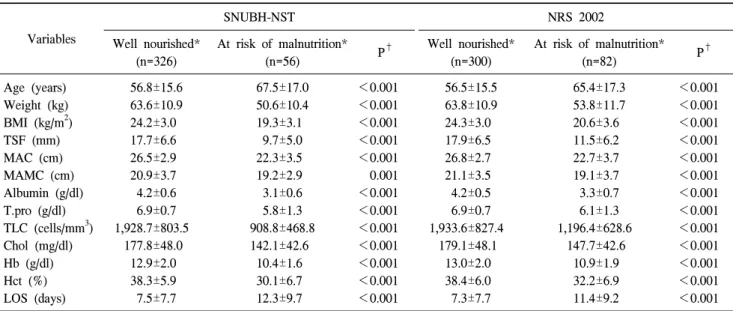
Table 5. Patient characteristics, anthropometrics, laboratory data and length of stay by malnutrition risk
Variables
SNUBH-NST NRS 2002
Well nourished*
(n=326)
At risk of malnutrition*
(n=56) P† Well nourished*
(n=300)
At risk of malnutrition*
(n=82) P†
Age (years) Weight (kg) BMI (kg/m2) TSF (mm) MAC (cm) MAMC (cm) Albumin (g/dl) T.pro (g/dl) TLC (cells/mm3) Chol (mg/dl) Hb (g/dl) Hct (%) LOS (days)
56.8±15.6 63.6±10.9 24.2±3.0 17.7±6.6 26.5±2.9 20.9±3.7 4.2±0.6 6.9±0.7 1,928.7±803.5
177.8±48.0 12.9±2.0 38.3±5.9 7.5±7.7
67.5±17.0 50.6±10.4 19.3±3.1
9.7±5.0 22.3±3.5 19.2±2.9 3.1±0.6 5.8±1.3 908.8±468.8 142.1±42.6
10.4±1.6 30.1±6.7 12.3±9.7
<0.001
<0.001
<0.001
<0.001
<0.001 0.001
<0.001
<0.001
<0.001
<0.001
<0.001
<0.001
<0.001
56.5±15.5 63.8±10.9 24.3±3.0 17.9±6.5 26.8±2.7 21.1±3.5 4.2±0.5 6.9±0.7 1,933.6±827.4
179.1±48.1 13.0±2.0 38.4±6.0 7.3±7.7
65.4±17.3 53.8±11.7 20.6±3.6 11.5±6.2 22.7±3.7 19.1±3.7 3.3±0.7 6.1±1.3 1,196.4±628.6
147.7±42.6 10.9±1.9 32.2±6.9 11.4±9.2
<0.001
<0.001
<0.001
<0.001
<0.001
<0.001
<0.001
<0.001
<0.001
<0.001
<0.001
<0.001
<0.001
*Values are presented as mean±standard deviation; †Well nourished versus at risk of malnutrition patients with the same screening tool;
BMI = body mass index; TSF = triceps skinfold; MAC = mid-arm circumference; MAMC = mid-arm muscle circumference; T.pro = serum total protein; TLC = total lymphocyte count; Chol = serum total cholesterol; Hb = hemoglobin; Hct = hematocrit; LOS = length of stay.
자가 8.6% (33명), NRS 2002에 의해 영양상태양호군으로 검색되었으나 SNUBH-NST에 의해서는 영양불량위험군으 로 검색된 환자는 2.4% (9명)로 나타나 총 대상의 11% (42 명)에서는 상반되는 결과를 나타내었다(Table 4).
3. 신체계측치, 생화학적 지표, 재원 기간 비교 두 영양검색도구에 의해 분류된 그룹별 신체계측, 생화학
적 지표는 Table 5에 나타내었다. 체중, 체질량지수, TSF, MAC, MAMC 등의 신체계측치는 두 영양검색도구 모두에 서 영양상태 양호군과 영양불량위험군 간에 유의적인 차이 를 나타내었으며 혈청 알부민, 총 단백질, 총 림프구수, 총 콜레스테롤 등의 생화학적 검사 결과 또한 두 영양검색 도 구 모두에서 영양상태양호군보다 영양불량위험군에서 유 의적으로 낮은 것으로 나타났다(P<0.001). SNUBH-NST와 NRS 2002에 의한 영양검색 결과와 임상결과들과의 연관성 을 평가하기 위해 그룹별 재원 기간을 조사하였다. 재원 기 간은 SNUBH-NST (7.5±7.7 vs 12.3±9.7)와 NRS 2002 (7.3±7.7 vs 11.4±9.2)에 의한 영양검색 결과에서 영양상태양호군에 비해 영양불량위험군의 경우 유의적으로 긴 것으로 조사되 어(P<0.001) 두 영양검색 도구에서 비슷한 결과를 나타내 었다.
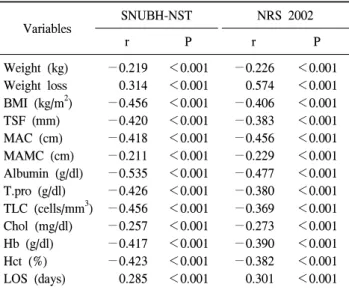
Table 6. Correlation of anthropometrics, laboratory data, length of stay and nutritional risk
Variables SNUBH-NST NRS 2002
r P r P
Weight (kg) Weight loss BMI (kg/m2) TSF (mm) MAC (cm) MAMC (cm) Albumin (g/dl) T.pro (g/dl) TLC (cells/mm3) Chol (mg/dl) Hb (g/dl) Hct (%) LOS (days)
−0.219 0.314
−0.456
−0.420
−0.418
−0.211
−0.535
−0.426
−0.456
−0.257
−0.417
−0.423 0.285
<0.001
<0.001
<0.001
<0.001
<0.001
<0.001
<0.001
<0.001
<0.001
<0.001
<0.001
<0.001
<0.001
−0.226 0.574
−0.406
−0.383
−0.456
−0.229
−0.477
−0.380
−0.369
−0.273
−0.390
−0.382 0.301
<0.001
<0.001
<0.001
<0.001
<0.001
<0.001
<0.001
<0.001
<0.001
<0.001
<0.001
<0.001
<0.001 SNUBH-NST grade = well nourished: 0, at risk of malnutrition:
1; NRS 2002 grade = well nourished: 0, at risk of malnutrition:
1; Weight loss grade = no weight loss: 0, weight loss >5% in 3 months: 1, weight loss >5% in 2 months: 2, weight loss >5%
in 1 month (>15% in 3 months): 3; BMI = body mass index;
TSF = triceps skinfold; MAC = mid-arm circumference; MAMC
= mid-arm muscle circumference; T.pro = serum total protein; TLC
= total lymphocyte count; Chol = serum total cholesterol; Hb = hemoglobin; Hct = hematocrit; LOS = length of stay.
4. 영양위험도와 신체계측치, 생화학적 지표, 재원 기 간의 상관관계
SNUBH-NST와 NRS 2002 결과에 따른 영양위험도와 신체계 측치, 생화학적 지표, 재원 기간의 상관관계는 Table 6과 같다.
두 영양검색 도구 모두에서 영양불량위험도와 신체계측지표 인 체질량지수(r=−0.456 (SNUBH-NST), −0.406 (NRS 2002)), TSF (r=−0.420 (SNUBH-NST), −0.383 (NRS 2002)), MAC (r=−0.418 (SNUBH-NST), −0.456 (NRS 2002)), MAMC (r=−
0.211 (SNUBH-NST), r=−0.229 (NRS 2002))가 음의 상관관계 를 가지는 것으로 나타났으며, 혈청 알부민, 총 단백질, 총 림프구수 등의 생화학적 지표와도 동일한 결과를 나타내었다 (P<0.001). 체중 감소율을 NRS 2002에서 영양상태불량을 평가하는 기준에 따라 점수화하여 두 영양검색도구에 따른 영양불량위험과의 상관관계를 조사한 결과, 통계적으로 유 의한 양의 상관관계를 보여(r=0.314 (SNUBH-NST), r=0.574 (NRS 2002), P<0.001), 영양불량위험도가 높을수록 체중 감 소율이 증가하는 것으로 나타났다. 체중 감소율은 체중 감소 가 없는 경우 0점, 3개월간 >5%인 경우 1점, 2개월간 >5%인 경우 2점, 1개월간 >5%이거나 3개월간 >15%인 경우 3점으
로 점수화하였다. 영양불량위험과 재원일수와의 관계는 양 의 상관관계를 나타내어 영양불량위험도가 높은 경우 재원 기간이 길어짐을 알 수 있었다.
고 찰
입원환자의 영양불량은 환자의 향후 임상적 결과에 영향 을 미치는 것으로 알려져 있으며, 영양불량에 따라 합병증 과 감염이 증가하고 사망률, 재원 기간, 의료비용이 상승함 이 밝혀짐에 따라 영양불량 환자를 대상으로 적절한 영양 지원을 시행하기 위해 영양판정의 전 단계로서 영양검색의 중요성이 대두되고 있다.4-8 특정 영양검색도구를 사용하기 이전에 영양평가 지표, 합병증, 재원일수 등과의 관련성이 검증되어야 하며 이와 관련된 일정 수준의 타당성, 신뢰성 을 갖추었는지에 대한 평가가 이루어질 필요가 있다.13 이에 본 연구에서는 영양판정도구인 PG-SGA를 표준으로 하여 자동화된 프로그램으로 개발된 SNUBH-NST를 공인된 영 양검색도구인 NRS 2002와 비교 분석함으로써 SNUBH- NST의 타당성을 재검증하고자 하였다.
여러 연구들에도 다른 영양검색지표들에 비해 NRS 2002 가 입원환자를 대상으로 하는 영양검색 지표로서 높은 타 당성을 가진 것으로 나타났는데,19,20 그 중 Raslan 등19은 NRS 2002와 MNA-SF (Mini-Nutritional Assessment-Short Form), Malnutrition Universal Screening Tool (MUST)을 이용하여 질 병이환율, 사망률 등의 임상 결과를 평가하였으며 NRS 2002가 가장 높은 예측력을 가지는 것으로 나타났다. 최근 국내에서도 NRS 2002를 표준으로 하여 새로운 영양검색도 구를 개발하거나 기존의 영양검색도구의 타당성을 검증하 고자 하는 시도가 활발해지고 있다.21-24 한 등21은 재원 기간 내의 임상결과를 유의하게 예측하며 NRS 2002와 비교하여 일정 수준의 타당도를 가지는 영양검색도구를 개발하기 위 해 영양검색 결과에 따른 재원일수, 합병증 여부, 질병 예 후, 사망 여부를 종속변수로 하여 영양검색 기준지표를 선 정하였는데, 이는 영양검색도구의 임상결과에 대한 예측력 을 검증하는데 있어서 일정 수준 만족할만한 결과를 얻었 다는 측면에서 흥미로운 연구라고 생각한다. 라 등22은 NRS 2002와 기존에 사용하고 있던 영양검색도구를 비교 분석하 여 신뢰성을 평가하는 연구를 시행하였는데, 이러한 연구 결과들을 바탕으로 향후 각 의료기관의 실정에 맞는 영양 검색도구들의 개발이 활성화될 수 있을 것으로 기대된다.
본 연구에서 SNUBH-NST를 이용한 검색된 영양불량 환 자는 총 대상 환자 382명 중 56명으로, 영양불량률은 14.7%
로 조사되었다. 이는 NRS 2002를 이용한 영양불량위험률인 20.9%에 비해 다소 낮은 비율이며, 2006년에 201명의 환자
를 대상으로 PG-SGA를 이용하여 시행한 영양불량률인 11.9%와는 비슷한 수준인 것으로 평가된다.16 영양검색 기 준에 따라 다르나 국내 입원환자를 대상으로 한 관련 연구 들에서 조사된 영양불량률이 30∼60%인 것에 비하면 다소 낮은 비율로 판단되는데,21,25 이러한 결과는 영양불량을 규 정하는 기준과 구성요소의 차이로 인한 것으로 생각한다.
SNUBH-NST와 NRS 2002에 의해 영양불량위험 환자로 분 류된 환자 중 입원 시 진단명이 악성 종양인 환자는 각각 50.9%와 52.5%로 가장 높은 비율을 차지하였으며, 이는 국 내외 여러 연구의 결과들과 유사한 경향을 나타내었다.13,25 두 영양검색도구를 이용한 영양검색 결과가 총 382명의 대상자 중 340명에서 일치하여 89%의 비교적 높은 일치도 를 보였고 κ값은 0.627로 측정되어 두 영양검색도구에 따 른 결과가 상당 수준 일치하는 것을 알 수 있었다. 전체 대 상 환자 중 42명(11%)에서는 상반된 결과를 나타내었는데, 이는 영양검색도구의 개발 목적의 차이에 기인한 것으로 생각한다. SNUBH-NST는 고위험도 영양불량 환자의 집중 영양관리를 그 목적으로 하여 영양불량을 규정하는 기준이 다소 엄격하게 적용되었으며 NRS 2002는 영양평가 관련 지표뿐만 아니라 대사율 증가에 따른 영양요구량 증가 요 인으로서 질병의 중증도를 포함시켜 향후 영양불량이 악화 될 위험이 높은 환자를 선별하는 것을 목적으로 개발되었 는데, 이러한 차이에 따라 일부 상반된 결과가 나타난 것으 로 추정된다. 포함되는 영양불량지표 또한 달라, SNUBH- NST는 신체계측치와 생화학적 검사 결과를 이용하는 반면 NRS 2002는 생화학적 검사 결과를 포함하지 않으며 신체 계측치와 더불어 식사 섭취량 감소, 체중 감소, 질병의 중증 도 등 SNUBH-NST와는 다른 평가 지표들을 이용한다.
체중, BMI, MAC, MAMC 등의 신체계측치는 두 검색도 구 모두에서 영양상태양호군과 영양불량위험군 간에 유의 한 차이를 나타내었으며, 혈청 알부민, 혈청 단백질, 혈청 헤모글로빈, 총 림프구수, 총 콜레스테롤 등의 생화학적 검 사 또한 두 영양검색도구 모두에서, 영양상태양호군보다 영양불량위험군의 결과가 유의하게 낮은 것으로 나타났다.
한편, SNUBH-NST에 의한 영양불량위험과 NRS 2002의 구성 요소인 체중 감소율이 양의 상관관계를 나타내어 SNUBH- NST가 체중 감소율이 높은 영양불량위험군 또한 효율적으 로 검색할 수 있을 것으로 판단된다. 또한 두 영양검색도구 에 의한 영양불량위험 결과의 일치도는 89%로서 통계적으 로도 상당 수준 일치하는 것으로 조사되어 SNUBH-NST가 공인된 영양검색 도구인 NRS 2002와 비교하였을 때도 그 정확도가 높은 것으로 판단된다.
영양검색의 궁극적 목적은 합병증, 재원일수, 사망률 등의 임상적 결과를 개선시키기 위함이라는 점을 상기해 볼 때,
영양검색 도구를 개발하고 사용하는데 있어서 장기적인 임 상적 결과와의 연관성을 검증하는 것은 매우 중요한 일이라 할 수 있다. 본 연구에서는 연구 시점으로부터의 기간이 길 지 않아 영양불량이 질병 이환율, 합병증 발생률, 사망률에 미치는 영향은 조사하지 못하였으나, 재원 기간의 경우 영 양상태양호군에 비해 영양불량위험군에서 유의하게 긴 것 으로 조사되어 제한적이나마 영양검색도구에 의한 영양위 험 여부가 임상 결과에 영향을 미치는 것으로 나타났다.
본 연구의 결과, SNUBH-NST가 여러 영양지표들을 적절 히 반영하며 재원 기간과 같은 임상결과와도 일정 수준의 상관관계를 가지며 NRS 2002와 같은 공인된 영양검색도구 와 비교하여서도 높은 일치도를 나타내어 입원환자를 대상 으로 한 영양검색도구로서의 타당성이 인정되므로, 이를 이용하여 단시간에 영양불량위험 환자를 검색하고 나아가 효율적인 임상영양치료에 기여할 수 있을 것으로 판단된 다. 영양불량 환자의 적절한 영양관리라는 영양검색의 궁 극적 목표를 달성하기 위해서는 신뢰성과 타당성을 갖춘 영양검색도구의 마련과 더불어, 질환 및 환자 상태를 고려 한 구체적이고 세분화된 영양불량환자 관리 프로토콜과 환 자의 영양검색 및 영양판정 결과 및 구체적인 영양치료 계 획을 의료진과 공유할 수 있는 시스템이 마련되어야 할 것 으로 생각한다.
결 론
본 연구에서는 PG-SGA를 표준으로 하여 개발된 SNUBH- NST와 ESPEN에서 공인된 영양검색 도구인 NRS 2002를 비 교 분석함으로써 SNUBH-NST의 타당성을 재검증하고자 하였다. 두 영양검색도구에 따른 신체계측지표, 생화학적 지표, 재원 기간을 비교한 결과, SNUBH-NST가 입원환자의 영양불량위험을 조기에 검색하는데 유용하게 이용될 수 있 을 것으로 생각하며 이는 적절한 임상영양치료를 위한 기 초 자료로 이용될 수 있을 것으로 기대된다. 향후 질환의 이환율, 사망률 등의 임상 결과에 대한 예측도와 영양검색 의 비용효과를 규명하기 위한 추가 연구가 요구된다.
REFERENCES
1. Waitzberg DL, Caiaffa WT, Correia MI. Hospital malnutrition;
the Brazilian national survey (IBRANUTRI): a study of 4000 patients. Nutrition 2001;17(7-8):573-80.
2. Edington J, Boorman J, Durrant ER, Perkins A, Giffin CV, James R, et al. Prevalence of malnutrition on admission to four hospitals in England. The malnutrition prevention group. Clin Nutr 2000;19(3):191-5.
3. Sungurtekin H, Sungurtekin U, Hanci V, Erdem E. Comparison of two nutrition assessment techniques in hospitalized patients.
Nutrition 2004;20(5):428-32.
4. Schneider SM, Veyress P, Pivox X, Soummer AM, Jambou P, Filippi J, et al. Malnutrition in an independent factor associated with nosocomial infections. Br J Nutr 2004;92(1):105-11.
5. Pichard C, Kyle UG, Moria A, Perrier A, Vermeulen B, Unger P. Nutrition assessment: lean body mass depletion at hospital admission is associated with and increased length of stay. Am J Clin Nutr 2004;79(4):613-8.
6. Correia MI, Waitzberg DL. The impact of malnutrition on mor- bidity, mortality, length of stay and costs evaluated through a multivariate model analysis. Clin Nutr 2003;22(3):235-9.
7. Tomkins A. Nutrition and maternal morbidity and mortality.
Br J Nutr 2001;85(Suppl 2):S93-9.
8. Goiburu ME, Goiburu MM, Bianco H, Diaz JR, Alderete F, Palacios MC, et al. The impact of malnutrition on morbidity, mortality and length of hospital stay in trauma patients. Nutr Hosp 2006;21(5):604-10.
9. Brugler L, Stankovic AK, Schlefer M, Bernstein L. Simplified nutrition screen for hospitalized patients using readily avail- able laboratory and patient information. Nutrition 2005;21(6):
650-8.
10. Hammond KA. Dietary and clinical assessment. In: Mahan K, Escott-Stump S eds. Krause's food, nutrition, and diet therapy.
11th ed. Philadelphia:Saunders;2004:407-35.
11. Kushner RF, Ayello EA, Beyer PL, Skipper A, Van Way CW 3rd, Young EA, et al. National coordinating committee for nu- trition standards clinical indicators of nutrition care. J Am Diet Assoc 1994;94(10):1168-77.
12. Pesse-Hammond KP, Wessel J. Nutrition assessment and deci- sion making. The ASPEN nutrition support practice manual.
2nd ed. 2005:3-26.
13. Ferguson M, Capra S, Bauer J, Banks M. Development of a valid and reliable malnutrition screening tool for adult acute hospital patients. Nutrition 1999;15(6):458-64.
14. Bauer J, Capra S, Ferguson M. Use of the scored patient-gen- erated subjective global assessment (PG-SGA) as a nutrition assessment tool in patients with cancer. Eur J Clin Nutr 2002;
56(8):779-85.
15. Isenring E, Bauer J, Capra S. The scored patient-generated sub- jective global assessment (PG-SGA) and its association with
quality of life in ambulatory patients receiving radiotherapy.
Eur J Clin Nutr 2003;57(2):305-9.
16. Kim S, Kim S, Sohn J. Development of nutrition screening index for hospitalized patients. Korean J Community Nutr 2006;
11(6):779-84.
17. Kondrup J, Allison SP, Elia M, Vellas B, Plauth M; Educational and Clinical Practice Committee, European Society of Parenteral and Enteral Nutrition (ESPEN). ESPEN guidelines for nutrition screening 2002. Clin Nurt 2003;22(4):415-21.
18. Kondrup J, Rammusen HH, Hanberg O, Stanga Z; Ad Hoc ESPEN Working Group. Nutritional risk screening (NRS 2002):
a new method based on an analysis of controlled clinical trials.
Clin Nutr 2003;22(3):321-36.
19. Raslan M, Gonzalez MC, Gonçalves Dias MC, Nascimento M, Castro M, Marques P, et al. Comparison of nutritional risk screening tools for predicting clinical outcomes in hospitalized patients. Nutrition 2009.
20. Kyle UG, Kossovsky MP, Karsegard VL, Pichard C. Comparison of tools for nutritional assessment and screening at hospital ad- mission: a population study. Clin Nutr 2006;25(3):409-17.
21. Han JS, Lee SM, Chung HK, Ahn HS, Lee SM. Development and evaluation of a nutritional risk screening tool (NRST) for hospitalized patients. Korean J Nutr 2009;42(2):119-27.
22. Rha M, Kim U, Cho Y. Comparison of tools for nutrition as- sessment and screening at hospital admission. Clin Nutr Suppl 2009;4(2):99-100.
23. Kim JY, Wie GA, Cho YA, Kim SY, Kim SM, Son KH, et al. Development of a nutrition screening tool for korean cancer patients. Poster session presented at: Energizing nutrition sup- port practice for life. 13th Congress of the Parenteral and Enteral Nutrition Society of Asia; 2009 June 5-7; Kuala Lumpur:Malaysia.
24. Chon YN, Lee JS, Park S, Lee MD. Developing effective nu- trition screening tool for malnutrition patients. Poster session presented at: Energizing nutrition support practice for life. 13th Congress of the Parenteral and Enteral Nutrition Society of Asia; 2009 June 5-7; Kuala Lumpur:Malaysia.
25. Kim YH, Seo AR, Kim MK, Lee YM. Relationship of nutritional status at the time of admission to length of hospital stay (LOS) and mortality: a prospective study based on computerized nu- trition screening. J Korean Diet Assoc 1999;5(1):48-53.