Ⅰ. 서 론
자해행동(self-injurious behavior)은 자기 자신에게 물리 적인 상해를 입히는 행동이라고 한다(Tate & Baroff, 1966). 이러한 행동은 자신의 신체에 출혈이 발생하고, 행동이 반복되면서 조직 손상이나 감염과 골절 및 감각기능의 소실
등 자신의 신체에 상해를 입힐 수 있으며 심각하면 사망에 이르기도 한다(Minshawi, Hurwitz, Fodstad, Biebl, Morris, & McDougle, 2014). 또한 자해행동은 발달과정에 서 필요한 적절한 기술과 사람들과 관계 맺으며 살아갈 수 있 도록 하는 사회적인 기술의 습득을 방해하여, 학교생활의 어 려움뿐만 아니라 나아가 직장을 선택하고 일을 하는데 어려 움이 생길 수 있다. 이들을 양육하는 보호자들에게 자해행 대한감각통합치료학회지 제17권 1호
The Journal of Korean Academy of Sensory Integration 2019 Vol. 17. No. 1
http://dx.doi.org/10.18064/JKASI.2019.17.1.030
자폐스펙트럼장애의 자해행동 중재에 관한 체계적 고찰 : 비약물치료 중심으로
김슬기*, 최정실**
*함께웃는가족지원센터 작업치료사, **충북보건과학대학교 작업치료과 교수
국문초록
목적 : 본 연구는 자해행동을 보이는 자폐스펙트럼장애의 비약물적 치료 중심으로 실시한 연구를 대상으로 체계적으로 분석하여 작업치료 임상현장에서 동일한 문제를 보이는 자폐스펙트럼장애 아동에게 적절한 서비스를 제공하기 위한 근거를 마련하고자 한다.
연구방법 : 전자데이터 베이스인 PubMed, Medline, DBpia, RISS, KISS, NDSL을 사용하여 2008년 10월부터 2018년 11월까지 국내외 학회지에 게재된 연구를 대상으로 검색하였다. 주요 용어는“ (Autism OR Autism Spectrum Disorder) AND (Therapy OR Treatment OR Intervention) AND (Self Injurious Behavior)”으로 검색하였고, PICO형식과 근거수준을 사용해 분석하였다.
연구결과 : 총 12편의 논문이 선정되었고, 근거의 질적 수준은 대상연구 논문 12편 중 수준 Ⅳ와 수준 Ⅴ가 가장 많았으며, 실험설계는 단일대상연구가 많았다. 중재의 종류는 행동치료가 가장 많았다. 분석결과 자폐스펙트럼장애의 자해행동은 행동치료와 뇌자극 및 조절기법, 행동치료와 병행한 감각통합치료로 자해행동을 감소시켰으며 통계적으로도 유의한 결과를 보였다.
결론 : 자해행동을 보이는 자폐스펙트럼 장애 아동에게 적용한 비약물적 중재에 대한 근거자료를 제시하였다. 앞으로 자폐스펙트럼 장애 아동의 자해행동에 대한 중재효과성을 증명하기 위하여 근거수준이 높은 연구 설계와 다양한 비약물 적 중재간의 차이점을 밝히는 연구가 지속적으로 이루어져야 할 것이다.
주제어 : 자폐스펙트럼장애, 자해행동, 치료
동은 양육에 대한 스트레스와 우울감을 증가시키며, 아이를 양육함에 있어서 재정적인 부담도 녹녹하지 않다고 한다 (Minshawi, Hurwitz, Morris, & McDougle, 2015).
임상에서 자해행동의 증상은 정신과 질환, 신경학적 질환, 대사 장애 질환 등에 따라 다양하게 나타난다. 기존의 많은 연구에서 자폐스펙트럼장애, 심각한 지적장애, 뚜렛장애, 발모광(모발뽑기 장애), 강박장애, 경계선 성격장애, 주요 우울장애, 레시니한 증후군(Lesch-Nyhan syndrome)의 질환의 자해행동 양상과 원인, 중재전략에 대하여 연구해 왔다(Minshawi, Hurwitz, Morris, & McDougle, 2015).
예를 들어, 뚜렛 장애아동들은 틱(tic)의 형태, 강박장애의 한 형태인 발모광(모발뽑기 장애)은 충동적 행동(compulsion), 경계성 인격 장애는 습관적인(ritual) 행동으로 나타나는 경향이 있다. 지적장애는 의사소통의 수단이나 자기자극 행동(self-stimulation)으로 나타날 수 있고 중등도~최 중도의 자폐스펙트럼장애 아동은 상동행동(stereotypy) 과 자기자극행동을 주로 보이는 편이다(Harris, 1992).
2013년에 개정된 정신질환 진단 및 통계 편람인 DSM-5 에 의하면 신경발달장애 중 하나인 자폐스펙트럼장애는 사 회적 상호작용 및 사회적 의사소통의 결함과 제한적이고 반 복적인 행동, 흥미 및 활동패턴으로 두 가지의 핵심 진단기 준이 제시되었다(APA, 2013). 자폐스펙트럼장애의 경우 자신이 원하는 표현을 기능적인 언어로 표현하기가 어렵기 도 하고, 상동행동의 하나로 자기자극행동이나 자해행동을 보이며(Gallagher, 1999), 이러한 자해행동은 독립적인 일 상생활의 어려움 및 학교생활의 부적응, 친구관계의 어려움 뿐만 나아가 취업을 해서 사회생활을 할 때에도 적응 문제 에 부정적인 영향을 미치게 되어 자폐스펙트럼장애의 자해 행동은 매우 중요한 문제이고 해결해야할 과제이다(Kim, Jung, & Jo, 2010). 또한 자폐스펙트럼 장애의 자해행동 은 사회적, 기능적 행동과 자기강화(self-reinforcing) 또 는 자기자극(self-stimulatory)의 두 가지 범주로 분류할 수 있다(O'Nell, Jebson, & Radley, 2014). 자폐스펙트럼 장애의 자해행동을 보일 때 대표적인 증상으로 공격성을 동 반한 자해행동과 같은 다른 문제행동과 동시에 발생할 수 있는 경우가 있다. 공격행동을 동반한 자해행동은 자페스펙 트럼장애보다는 주의력결핍과 과잉행동장애에서 빈번하게 동반하는 문제행동이기 때문에 본 연구에서는 임상에서 주 로 다루고 있는 자폐스펙트럼장애아동의 자기강화 혹은 자 기자극과 사회적 및 기능적 행동으로의 자해행동에 초점을
두어 문헌고찰 하고자 하였다.
대표적인 자폐스펙트럼장애 아동의 자해행동은 머리 돌리 기(head banging), 신체절단(self-cutting), 신체물기 (self-biting), 조르기(self-choking), 신체 긁기 (self-scratching), 머리, 치아, 손톱 누르기(hair, teeth, fingernail pulling), 눈 압박(eye pressing), 이식증(pica)이 있다(Falcomata, Roane, & Pabico, 2007; Wachtel, Edward, & Max, 2018). 이러한 자해행동의 원인을 정확히 분석해야 중재전략을 수립할 수 있다. 자해행동의 원인은 설 명하는 모델에 따라 차이가 있다. 자기자극행동 모델은 사회 적 분리(social isolation)의 환경적 요인이 자기자극 행동을 유발한다고 보고 있다(Jones & Barraclough, 1978). 발달 적 모델은 뇌성숙이 미숙하여 초기발달의 행동을 보인 형태 를 자해행동이라고 설명하고 있다. 인지모델에서는 학습된 행 동은 대뇌 겉질의 고차원적 인지기능을 담당하는 부위나 바닥 핵의 비정상적 기능으로 설명하고 있다(Ernst, 2000).
위에서 언급된 자해행동의 원인에 따라 중재법이 다르게 선택될 수 있다. 기존의 연구 의하면 자기자극 행동모델에 따른 해석한 경우에는 심리적 접근을 선택하게 된다.
발달적 모델에서 해석한 경우는 감각통합중재를 선택하는 편이다. 인지모델로 해석한 경우는 행동치료와 약물치료를 선택한다. 특히 의미있는 행동을 습득하는데 초점을 두면 행동치료(behavioral intervention) 선택한다. 그리고, 비정상적 운동기능을 치료하는 데는 약물치료(pharmacological approach)를 선호해왔다(Ernst, 2000).
기존의 많은 연구에서 자폐스펙트럼장애의 자해행동관련 중재효과를 증명한 연구는 대부분 약물치료에 관한 것이 많다. 대부분 향정신약제, 항우울제, 항불안제, 항경련제, 아편유사제대항제, 항고혈압제의 효과성을 연구해왔고, 이러한 약물들은 심각하게 짜증을 부리는 것(tantrum), 공격적인 행동, 자해행동과 같이 특이한 행동출현의 빈도를 감소시키는데 효과가 있다고 한다(Aman, Collier-Crespin,
& Lindsay, 2000; Buitelaar & Williemsen-Swinkels, 2000; Matson et al., 2000). 그러나, 이러한 약물들은 종 류에 따라 다르지만 수면장애, 식욕장애, 저혈압, 활동 감소 와 같은 부작용을 일으킬 수 있다(Stigler & Mcdougle, 2008).
국내의 자폐스펙트럼장애 자녀를 둔 보호자들은 약물 치료의 긍정적인 측면이 있음에도 불구하고 약물의 부작 용을 염려하여 비약물적 중재를 선호하는 경향이 있다.
또한 보호자들은 아동의 약복용 거부행동으로 인하여 강
제로 약 복용시켜야 하는 것에 스트레스를 받을 수 있다 (Kim et al., 2014). 자폐스펙트럼장애아동은 작업치료 를 받는 경우가 많은데, 아동작업치료사들은 비약물적 치 료를 선호하는 보호자와 대상자에게 서비스를 제공해야 하는 경우가 많다. 그러나 자폐스펙트럼장애의 자해행동은 직접적인 사망에 이르게 하는 응급상황이 발생할 수 있는 위험한 행동이지만(Lim, Kim, Chung, Cho, & Hong, 1999) 이에 대한 국내 작업치료 내에 근거기반과 중재전 략이 미흡한 게 사실이다. 다만 많은 임상가들이 개인적 인 임상경험을 바탕으로 보호자 및 자폐스펙트럼장애에 게 행동지도를 해왔다. 이러한 중재전략은 장애인의 인권 교육을 강화하는 추세에서 보다 합리적이고 근거기반을 둔 중재전략이 필요하다. 이에 본 연구의 목적은 체계적 고찰을 통하여 임상에서는 작업치료사들이 개인적 차원 이 아닌 자폐스펙트럼 장애의 자해행동에 대한 대처요령 및 가이드를 마련하기 위한 기초자료를 제공하고자 한다.
Ⅱ. 연구방법 1. 데이터 수집 방법 및 연구대상
2003년 12월부터 2018년 11월까지 15년 동안 국․내외 학회 지에 게재된 논문들 중 자폐스펙트럼장애를 대상으로 자해행동 의 중재를 적용한 연구를 검색하였다. 연구주제에 적합한 연구 선정을 위하여 PICO(Patient, Intervention, Comparison, Outcome)형식을 적용하여 대상자(P) AND 중재(I) AND 결과 (O)의 조합으로 검색을 하였다. 국외논문은 MeSH term으로 P는 “Autism OR Autism Spectrum Disorder”, I는
“Therapy OR Treatment OR Intervention” 이었고, O는
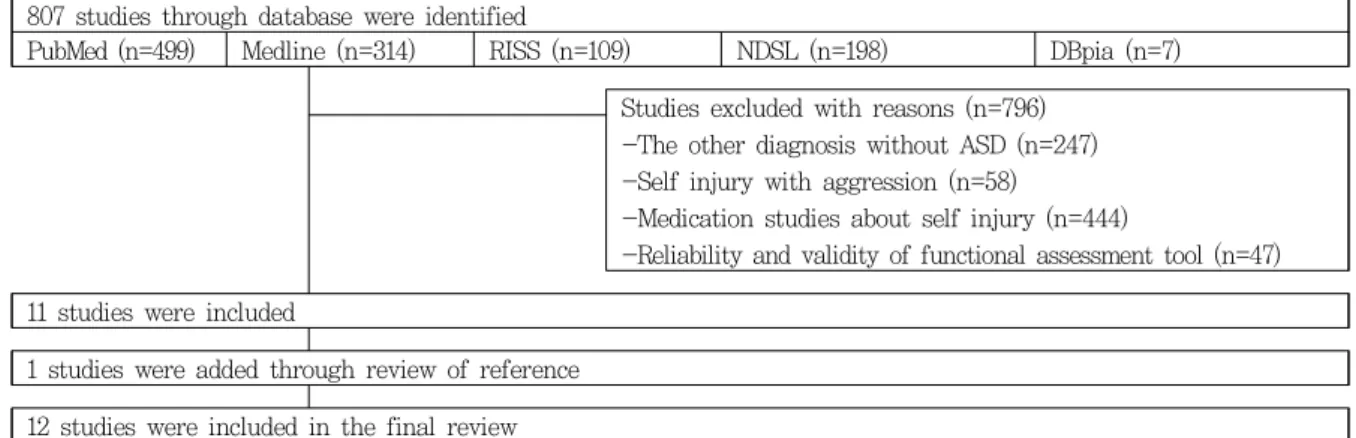
“Self Injurious Behavior"이었다. 국외 검색원은 PubMed, Medline(ProQuest)를 이용하였다. 국내 논문은 P는 “자폐 OR 자폐스펙트럼장애 OR 전반적발달장애 OR 아스퍼거장애”, I는 “치료 OR 중재”, O는 “자해행동”을 사용하였다. 주요 검색 원은 학술연구정보서비스(Research Information Sharing Service; RISS)와 과학기술정보통합서비스(National Digital Science Library; NDSL), 학술데이터 베이스서비스 (Database Periodical Sharing Service; DBpia)를 이용하였 다. 검색결과 총 807편의 논문이 검색되었고 본 연구자와 1명 의 작업치료과 교수가 초록과 전문을 검토하여 연구 선정의 포 함기준과 배제기준을 토대로 11편의 논문이 선정되었다. 추가 적으로 참고문헌을 검토하여 1편의 논문이 추가되어 최종적으 로 12편의 논문이 선정되었다(Figure 1).
본 연구의 분석에 사용한 연구 선정의 배제기준은 다음과 같다. (1) 자폐스펙트럼이 아닌 다른 진단명을 포함한 연구 (지적장애, 뚜렛 장애, 양극성 장애, 우울장애) (2) 공격성을 동반한 자해행동 연구 (3) 약물치료 연구 (4) 기능적 행동 평가도구의 신뢰도와 타당도 연구
2. 분석방법
대상연구의 질적 수준을 분석하기 위해 Arbesman, Scheer와 Liverman(2008)이 개발된 질적 근거 수준(hierarchy of levels of evidence for evidence-based practice) 분석 모델을 사용 하였다. 또한 최종 선정된 12편의 연구는 대상자별 자해행동 증상 (target symptoms), 중재유형(intervention type), 제공환경 (context: home, school, clinic), 치료회기(sessions), 치료결 과(outcome)을 분석하였다.
807 studies through database were identified
PubMed (n=499) Medline (n=314) RISS (n=109) NDSL (n=198) DBpia (n=7) Studies excluded with reasons (n=796)
-The other diagnosis without ASD (n=247) -Self injury with aggression (n=58)
-Medication studies about self injury (n=444)
-Reliability and validity of functional assessment tool (n=47) 11 studies were included
1 studies were added through review of reference 12 studies were included in the final review
Figure 1. Flowchart for the selection of studies ASD: Autism Spectrum Disorder
Ⅲ. 연구결과 1. 선정된 논문
자폐스펙트럼이 아닌 다른 진단명을 포함한 연구(지적 장애, 뚜렛장애, 양극성 장애, 우울장애) ,공격성을 동반한
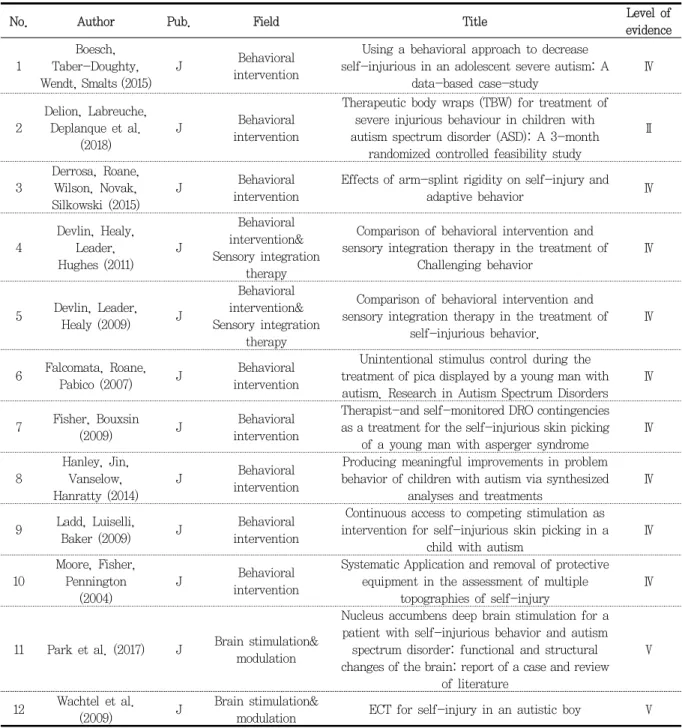
자해행동 연구, 약물치료 연구, 기능적 행동 평가도구의 신뢰도와 타당도 연구를 제외한 연구들로 선정하여 총 12 편이 선정되었다. 선정된 연구는 모두 학술논문이었으며, 행동치료분야가 8편, 행동치료와 감각통합치료를 병행한 논문이 2편, 뇌자극 및 조절분야가 2편이었다(Table 1).
Table 1. Summary of included studies
Pub.: Publication, J: Journal, DRO: Differential reinforcement, TBW: Therapeutic body wraps, ASD: Autism spectrum disorder, ECT: Electroconvulsive therapy
No. Author Pub. Field Title Level of
evidence
1
Boesch, Taber-Doughty, Wendt, Smalts (2015)
J Behavioral intervention
Using a behavioral approach to decrease self-injurious in an adolescent severe autism: A
data-based case-study
Ⅳ
2
Delion, Labreuche, Deplanque et al.
(2018)
J Behavioral intervention
Therapeutic body wraps (TBW) for treatment of severe injurious behaviour in children with autism spectrum disorder (ASD): A 3-month
randomized controlled feasibility study
Ⅱ
3
Derrosa, Roane, Wilson, Novak, Silkowski (2015)
J Behavioral intervention
Effects of arm-splint rigidity on self-injury and
adaptive behavior Ⅳ
4
Devlin, Healy, Leader, Hughes (2011)
J
Behavioral intervention&
Sensory integration therapy
Comparison of behavioral intervention and sensory integration therapy in the treatment of
Challenging behavior
Ⅳ
5 Devlin, Leader, Healy (2009) J
Behavioral intervention&
Sensory integration therapy
Comparison of behavioral intervention and sensory integration therapy in the treatment of
self-injurious behavior.
Ⅳ
6 Falcomata, Roane,
Pabico (2007) J Behavioral intervention
Unintentional stimulus control during the treatment of pica displayed by a young man with autism. Research in Autism Spectrum Disorders
Ⅳ
7 Fisher, Bouxsin
(2009) J Behavioral
intervention
Therapist-and self-monitored DRO contingencies as a treatment for the self-injurious skin picking
of a young man with asperger syndrome
Ⅳ
8
Hanley, Jin, Vanselow, Hanratty (2014)
J Behavioral intervention
Producing meaningful improvements in problem behavior of children with autism via synthesized
analyses and treatments
Ⅳ
9 Ladd, Luiselli,
Baker (2009) J Behavioral intervention
Continuous access to competing stimulation as intervention for self-injurious skin picking in a
child with autism
Ⅳ
10
Moore, Fisher, Pennington
(2004)
J Behavioral intervention
Systematic Application and removal of protective equipment in the assessment of multiple
topographies of self-injury
Ⅳ
11 Park et al. (2017) J Brain stimulation&
modulation
Nucleus accumbens deep brain stimulation for a patient with self-injurious behavior and autism spectrum disorder: functional and structural changes of the brain: report of a case and review
of literature
Ⅴ
12 Wachtel et al.
(2009) J Brain stimulation&
modulation ECT for self-injury in an autistic boy Ⅴ
2. 분석 대상 연구의 근거 수준
근거수준으로 분석되는 연구는 총 12편이고, 그 중 수 준 Ⅳ가 9편, 75%으로 가장 많았으며, 수준 Ⅴ가 2편, 수준 Ⅱ가 1편순으로 나타났다. 연구 설계는 단일사례연 구가 가장 많았고, 사례보고, 무작위가 아닌 두 그룹 실험 대조군 연구 순으로 나타났다(Table 2).
3. 자해행동에 대한 중재와 결과
1) 대상자별 자해행동 증상
연구대상자는 아스퍼거 증후군을 포함한 자폐스펙트럼장 애를 진단받았으며 주요 자해행동 증상은 자신의 머리를 때 리거나 얼굴을 때리는 행동을 보이는 경우(head or face hitting)가 가장 많았다. 그 다음으로 손 물기(hand bitting), 신체에 상처내기(scarring), 피부 뜯기(skin picking), 얼굴 문지르기(face slapping), 손을 입에 넣기 (hand-mouthing)의 행동을 보이는 경우가 많았으며 신체 긁기(scratching), 출혈행동(bleeding), 이식증(pica)의 행 동도 보였다(Table 3).
2) 중재환경과 중재회기
연구대상에게 제공한 중재환경은 다양했다. 치료실에서 이루어진 경우가 가장 많았고, 그 다음으로 학교 내 교실, 클리닉과 병원, 가정 순으로 중재가 제공되었다. 치료회기
도 중재마다 달랐는데, 20~30사이의 회기가 가장 많았고, 그 다음으로 50~60회기, 15회기, 70~80회기 순으로 많았 으며 회기가 아닌 기간으로 3개월, 2년 동안 치료를 한 연 구도 있었다(Table 3).
3) 중재유형과 중재결과
자해행동에 대한 중재는 행동치료가 8편(66.6%)으로 가 장 많았고, 뇌자극 및 조절 2편(16.7%), 행동치료와 병행한 감각통합치료가 2편(16.7%)이었다. 행동치료에는 스플린트 착용하기, TBW(Therapeutic body wrap), 웨이트 착용 등 자해행동을 하는 신체부위에 보호 장비를 착용하는 논문이 많았고. 신체에 다른 자극주기, 차별된 강화법(DRO), 기능적 의사소통훈련(FCT), 강화환경(Enriched environment), 타임아웃(Time-out) 등이 있었다. 뇌 자극 및 조절에서는 뇌심부 자극(DBS)과 전기충격치료(ECT)를 사용하였다. 행 동치료와 감각통합치료를 병행한 논문은 감각통합치료 후 행동치료(스케줄에 맞춰 강화를 제공)를 제공하여 자해행동 추이를 살펴보았다. 감각통합치료보다 행동치료 후 자해행 동이 감소되었다고 하였다.
자해행동에 대한 치료결과로 대상자의 자해행동 증상 중 손 물기, 머리 때리기, 신체 긁기, 상처내기, 피부 뜯기, 이식 증 등의 행동이 줄어들거나 감소하였던 것으로 나타났다. 그 외에 언어적 표현이 증가하거나 놀이와 교육에 참여도가 증 가됨을 보여주었다(Table 3).
Table 2. Level of quality among each study (N =12) Evidence
level Definition Frequency
n (%)
Ⅰ Systematic reviews, meta-analyses, randomized controlled trials 0 (0.0)
Ⅱ Two groups non-randomized studies 1 (8.3%)
Ⅲ One group non-randomized studies 0 (0.0)
Ⅳ Single subject designs 9 (75%)
Ⅴ Case reports 2 (16.7%)
Total 12 (100%)
Table 3. Analysis of symptoms, treatment and outcome for self-injury behavior among each study No. Author
(year)
Population
Intervention type Context Sessions Outcomes
Subjects Symptoms Results
1
Derrosa, Roane, Wilson, Novak, Silkowski (2015)
2 Autistic boys
8yrs. M.
hand biting,
head hitting Behavioral intervention : Arm-splint
rigidity
Out patient
clinic
2hr. per day 5 days
per week
Reduced hand biting, head
hitting, self-scratching,
scarring, bleeding his body 18yrs. M.
self-scratching, scarring, bleeding his
body
2
Ladd, Luiselli, Baker (2009)
1 Autistic girl (8yrs.)
Skin picking, bleeding, visible
tissue damage
Behavioral intervention : manipulate objects provide
alternative sensory stimulation to
skin picking
Home 27
sessions
Decreased skin picking, pleasured
sensory stimulation
3
Fisher, Bouxsin (2009)
1 Asperger syndrome
male (19yrs.)
Chronic skin picking, scarring his
body
Behavioral intervention : differential reinforcement
(DRO)
Small therapy
room
50 sessions
Reduced skin picking
4
Boesch, Taber- Doughty,
Wendt, Smalts
(2015)
1 Autistic adolescent
male (14yrs.
severe autism)
Face slapping
Behavioral intervention : behavioral training package
and functional communication training (FCT)
Class room
22 sessions
Decreased Self injurious behavior (SIB)
5
Delion, Labreuc
-he, Deplanq -ue et al.
(2018)
48 Autistic
and Asperger syndrome children
(5;9- 9.9yrs.)
Severe behavioral disturbance (heteo, self-injurious
behaviors)
Behavioral intervention : Dry-sheet TBW (Therapeutic body
wrap) vs. wet-sheet TBW (Therapeutic body
wrap)
13 specializ
-ed clinics
Twice a week,
3 months
Decreased stereotypic behavior, not
significantly
6
Falcoma ta, Roane, Pabico (2007)
1 Autistic boy (12yrs.)
Pica(ingest inediblr objects;
rocks, plastic, metal)
Behavioral intervention : EE (enriched
environment) +TO (time-out)
Therapy room
70 sessions
Reduced pica (various environment)
DRO: Differential reinforcement, SIB: Self injurious behavior, FCT: Functional communication training,
TBW: Therapeutic body wrap, EE: Enriched environment, TO: time-out, PDD-NOS: Pervasive developmental disorder not otherwise specified, ASD: Autism spectrum disorder, DBS: Deep brain stimulation,
ECT: Electroconvulsive therapy, MR: Mental retardation 7
Moore, Fisher, Penningt on(2004)
1 Autistic girl (12yrs.)
Shoulder, hand contact his head, objects
Behavioral intervention
: sensory extinction
Padded room
2-10m.
per session
59, 82 sessions
Reduced self injurious behavior
(SIB)
8
Hanley, Jin, Vanselow, Hanratty (2014)
1 PDDNOS
girl and 2 Autistic
boys
Problem behavior, meltdown
Behavioral intervention : parent-validated
functional treatment
Therapy room
3-4 days per
week
No problem behavior
9
Devlin, Leader,
Healy (2009)
1 Autistic boy (9yrs.)
Hand- mouthing, hand-biting visible tissue
damage
Behavioral intervention&
sensory integration
therapy
Class room, therapy
room
20 sessions
Reduced self injurious behavior,
Behavioral intervention more
effective than sensory integration
therapy
10
Devlin, Healy, Leader, Hughes (2011)
4 Boys with ASD
6:7 yrs.
kicking, hitting, head-hitting,
stamping feet Behavioral intervention&
sensory integration
therapy
Class room, occu- pational therapy
room
21 sessions
Reduced challenge
behavior 11 yrs.
stamping feet 10:1yrs.
hand-mouthing , hand-biting
9:11yrs.
biting his fingers
11 Park et al (2017)
1 Boy with ASD
(14yrs.
IQ 60)
Hitting his face, multiple fracture, deformity
Brain stimulation&
modulation : deep brain
stimulation (DBS)
Hospital
2yr follow-
up
Decreased in SIB (hitting his head) and improvement
in expression
12
Wachtel et al.
(2009)
1 Autistic boy with
MR (8yrs.)
Slapping, punching his head, banging his on his knee,
shoulder
Brain stimulation&
modulation : lectroconvulsive
therapy (ECT)
Hospital 15 treat ment
Reduced his self injurious behavior, engage
in play and education
Ⅳ. 고 찰
본 연구는 자해행동을 보이는 자폐스펙트럼장애의 비약물 적 중재의 효과성을 연구한 논문을 대상으로 체계적으로 고 찰을 하였다. 이를 통해 작업치료 임상현장에서 동일한 문제 를 보이는 자폐스펙트럼장애 아동에게 적절한 서비스를 제 공하기 위한 근거를 마련하고자 하였다. 본 연구에서 분석한 논문은 총 12편으로 선정된 논문을 Arbesman, Scheer와 Liverman(2008)이 개발된 질적 근거 수준(hierarchy of levels of evidence for evidence-based practice) 분석 모델을 사용하여 질적 수준을 분석하였고, 대상자 별 자해행 동증상, 중재환경과 중재회기, 중재유형과 중재결과로 분석 하였다.
자폐스펙트럼장애의 자해행동에 대한 중재 논문을 근거수 준에 따라 분석한 결과 수준 Ⅳ단계의 단일사례연구가 75%
로 가장 많은 비중을 차지하였다. 수준 Ⅴ단계 사례보고는 16.7%, 수준Ⅱ단계의 무작위가 아닌 두 그룹 실험-대조군 연구가 8.3%로 비교적 낮은 비율을 나타내었다.
대상자별 자해해동의 증상의 종류는 자신의 머리를 때리 거나 얼굴을 때리는 행동(head or face hitting), 손 물기 (hand bitting), 신체에 상처내기(scarring), 피부 뜯기 (skin picking), 얼굴 문지르기(face slapping), 손을 입에 넣는(hand-mouthing) 행동, 신체 긁기(scratching), 출혈 행동(bleeding), 이식증(pica)행동 등 대상자마다 매우 다양 하게 나타났기 때문에 근거수준이 높은 Ⅰ, Ⅱ에 해당하는 연구가 부족한 것으로 보인다. 자폐스펙트럼의 자해행동을 위한 행동치료관련 체계적 고찰논문에서도 대부분의 연구가 단일사례 연구가 대부분이었고, 향후 질적 근거 수준이 높은 연구가 필요함을 언급한 바 있다(Matson & LoVullo, 2008). 앞으로 자폐스펙트럼장애의 자해행동에 대한 근거마 련을 위하여 객관적이고 타당성이 높은 근거수준 Ⅰ과 Ⅱ단 계의 연구가 진행되어야할 것이다(Lee & Park, 2017).
중재가 제공된 환경은 치료실에서 제일 많이 중재가 이루 어졌고 대상논문이 단일사례연구가 주를 이루었다. 향후 단 일사례연구를 설계할 때 자해행동의 중재회기는 최소 20~
30회기로 설계하며, 분석한 연구들의 대부분 1명의 대상자 를 연구한 결과로 나이, 진단명, 장애의 심각성, 배경정보, 자해행동의 행동의 양상이 다르게 나타났다. 연구결과가 근 거기반을 확보하기 위해서는 향후 연구에서는 단일사례연구
일지라도 대상자가 최대 4명이 포함된 multiple design으로 연구하는 방향도 고려해볼 필요가 있겠다.
중재유형은 행동치료가 66.7%의 비율로 가장 많았고, 뇌 자극 및 조절, 행동치료와 병행한 감각통합치료가 있었다.
행동치료에는 보호장비를 착용하는 중재법, 신체에 다른 자 극을 주거나 강화를 사용하는 방법, 기능적 의사소통훈련법, 타임아웃 등이 있었고, 뇌 자극 및 조절에는 뇌심부자극과 전기충격치료를 사용하였다. 자폐스펙트럼장애의 자해행동 의 조절을 위한 행동치료를 분석 연구결과에서 대부분의 연 구가 강화와 벌을 조합한 중재를 사용하였고 기능적인 평가 를 통해 더 긍정적인 효과를 이끌어내기 위하여 벌의 사용을 줄이려고 하였다(Matson & LoVullo, 2008). 본 연구의 분 석결과도 다양한 행동치료법을 소개하고 있으나 처벌이 없 다는 것은 기존의 연구와 동일한 결과였다. 자폐스펙트럼장 애의 자해행동과 같은 문제행동을 감소하기 위한 초기 연구 에서는 행동주의 심리학자들이 문제행동을 자극과 반응에 대한 관계 분석을 하여 효과적인 행동수정 전략을 제시하였 다(Won, 2002).
다른 치료방법으로 뇌자극 방법은 전기충격치료(ECT), 경두개자기자극법(rTMS), 미주신경자극(VNS), 뇌심부자극 (DBS) 등이 있는데 파킨슨장애, 우울장애, 자폐스펙트럼 장 애 등 다양한 신경학적 장애나 정신의학적 장애를 가진 사람 들에게 뇌 자극 및 조절을 통해 효과성이 입증된 바 있다 (Kim et al., 2014). 그러나 이 치료법을 소아에게 적용할 경우 인권과 안정성, 효과성 검증을 위한 대상자 모집에 어 려움이 있는 한계가 있다. 또한 자해행동의 원인이 비정상적 인 감각처리로 감각을 추구하기 위한 반복적이고 습관적인 행동이라면 그에 맞는 감각을 제공해야 하고, 자기강화나 사 회적 혹은 기능적 행동으로 나타나는 자해행동이라면 중재 전에 정확한 기능행동평가를 통해 그 기능과 상황에 맞는 중 재방법을 선택해야 한다고 하였다(Lee & Kim, 2015). 본 연구에서도 행동치료와 감각통합치료를 병행한 연구가 있었 는데, 감각통합치료를 통해서 감각적인 예민함과 새로운 환 경에 대한 적응은 좋아졌으나 행동치료를 통하여 자신의 얼 굴을 때리거나 손가락을 물거나 머리를 때리는 자해행동이 감소된 결과를 보여주기도 하였다. 이는 자해행동의 원인이 사회적 혹은 기능적 행동으로 습관화된 행동이면 행동치료 가 감각통합치료보다 더 효과적일 수 있음을 시사하고 있다.
따라서 임상가들은 자신에게 익숙한 자해행동 중재기술보다 는 자해행동의 원인과 장애유형에 따른 증상들이 다양하기
때문에, 자해행동 증상 유형, 증상이 나타나는 시간 및 정도 등을 세밀하게 분석 한 후 가장 적절한 치료전략을 선택해야 한다(Ernst, 2000). 자해행동을 조절하고 문제를 해결하는 것도 중요하지만 개인의 인권, 기본권을 침해할 수 있거나 윤리적인 문제가 있기 때문에 자해행동의 문제점에만 초점 을 맞추기보다 자해행동을 일으키는 원인과 이에 대한 이해 와 정확한 평가 후 혐오자극, 과잉교정, 차별강화 등의 방법 보다 보다 효과적이고 윤리적인 다양한 접근방법을 적용할 것을 권고하고 있다(Kim, Ryu & Bhan, 2016; Ernst, 2000). 국내의 특수교육과 행동치료분야에서는 자폐스펙트 럼의 자해행동과 같이 나타나고 있는 상동행동, 공격행동을 조절하기 위해 기능적 의사소통훈련(functional communication training)과 강점중심 중재(strength-oriented intervention), 자기교시훈련프로그램(self-instructional training), 수영 프로그램, 음악프로그램을 사용하고 있다(Won, 2002; Joo
& Yoo, 2013; Lee & Jung, 2012; Kim, 2012; Lee &
Kang, 2011). 앞으로 작업치료 분야에서도 이러한 자폐스펙 트럼의 나이, 장애의 심각성, 배경정보, 다양하고 각기 다른 자해행동의 증상을 고려하여 중재 및 연구를 할 필요가 있다.
또한 임상가로서 자해행동을 조절하기 위하여 한 가지 중재 법만 사용하지 않고 다각적인 차원으로 자해행동의 원인을 분석하여 다른 학문과 협업하는 것도 필요할 것이다.
Ⅴ. 결 론
본 연구에서는 자해행동을 보이는 자폐스펙트럼장애의 비 약물적 치료 중심으로 실시한 연구를 대상으로 체계적으로 고찰을 하여 작업치료 임상현장에서 적절한 서비스를 제공 하기 위한 근거를 마련하고자 하여 12편의 논문을 분석하였 다. 중재방법은 대부분 행동치료를 많이 사용하였고, 치료실 에서 중재를 실시하는 경우가 많았다. 자폐스펙트럼장애의 증상은 다양할 뿐만 아니라 자해행동 또한 증상이 매우 다양 하고 범위가 넓으며 이에 대한 원인도 매우 다양하다. 그렇 기 때문에 장애 및 증상에 대한 이해와 치료를 위해서는 하나 의 치료법으로 해결하기보다 자해행동을 세밀하게 분석하여 꼭 필요하고 맞는 치료 전략을 세우며 다각적인 접근이 필요 할 것으로 사료된다. 본 연구는 작업치료 임상현장에서 자해 행동을 보이는 자폐스펙트럼아동에게 적절한 중재를 제공함 에 있어서 근거자료가 될 것이다. 앞으로 자폐스펙트럼 장애 아동의 자해행동에 대한 중재방법에 대한 연구와 근거수준
이 높은 연구가 꾸준히 이루어져야 할 것이다.
참고 문헌
American Psychiatric Association. (2013).
Diagnostic and statistic manual of mental disorder
(5th ed).Washington DC: Authors.
Aman, M. G., Collier-Crespin, A., & Lindsay R. L.
(2000). Pharmacotherapy of disorders in mental retardation.
European Child & Adolescent Psychiatry, 9
(S98), 198-1107.Arbesman, M., Scheer, J., & Lieberman, D. (2008).
Using AOTA’s critically appraised topic (CAT) and critically appraised paper (CAP) series to link evidence to practice.
Occupational Therapy Practice, 13
(5), 18-22.Boesch, M. C., Taber-Doughty, T., Wendt, O., &
Smalts, S. S. (2015). Using a behavioral approach to decrease self-injurious in an adolescent severe autism: A data-based case-study.
Education and Treatment of Children, 38
(3), 305-328.Buitelaar, J. K., & Williemsen-Swinkels S. H. N.
(2000). Medication treatment in subjects with autism spectrum disorder.
European Child &
Adolescent Psychiatry, 9
(S1), 85-197.Delion, P., Labreuche, J., Deplanque, D., Cohen, D., Duhamel, A., & LallieÂ, C., et al. (2018).
Therapeutic body wraps (TBW) for treatment of severe injurious behaviour in children with autism spectrum disorder (ASD): A 3-month randomized controlled feasibility study.
PLos ONE, 13
(6), 1-17.https://doi.org/10.1371/journal.pone.0198726 Derosa, L. M., Roane, H. S., Wilson, J. L., Novak,
M. D., & Silkowski, E. L. (2015). Effects of arm-splint rigidity on self-injury and adaptive behavior.
Journal of Applied Behavior Analysis,
48
(4), 860-864. https://doi.org/10.1002/jaba.250 Devlin, S., Healy, O., Leader, G., & Hughes, B. M.(2011). Comparison of behavioral intervention and sensory integration therapy in the treatment of Challenging behavior.
Journal of Autism and Developmental Disorders, 41
(10), 1303-1320.Devlin, S., Leader, G., & Healy, O. (2009). Comparison of behavioral intervention and sensory integration therapy in the treatment of self-injurious behavior.
Research in Autism Spectrum Disorders, 3
(1), 223-231. https://doi.org/10.1016/j.rasd.2008.06.004 Ernst, M. (2000). Commentary: Considerations on theCharacterization and treatment of self-injurious behavior.
Journal of Autism and Developmental Disorders, 30
(5), 447-450.Falcomata, T. S., Roane, H. S., & Pabico, R. R. (2007).
Unintentional stimulus control during the treatment of pica displayed by a young man with autism.
Research in Autism Spectrum Disorders, 1
(4), 350-359. https://doi.org/10.1016/j.rasd.2006.12.004 Fisher, W. W., & Bouxsein., K. J. (2009). Therapist andself-monitored DRO contingencies as a treatment for the self-injurious skin picking of a young man with asperger syndrome.
Journal of Applied Behavior Analysis, 42
(2), 315-319.Gallagher, T. M. (1999). Interrelationships among children's language, behavior, and emotional problems.
Topics in Language Disorders, 19
(2), 1-15. http://dx.doi.org/10.1097/000113631999 2000-00003 Hanley, P. G., Jin, C. S., Vanselow, R. N., &Hanratty, A. L. (2014). Producing meaningful improvements in problem behavior of children with autism via synthesized analyses and treatments.
Journal of Applied Behavior Analysis, 47
(1), 16-36.Harris, J. C. (1992). Neurobiological factors involved in self-injurious behavior. In J. K. Luiselli, J. L.
Matson, & N. N. Singh (Eds.),
Self-injurious
behavior: Analysis, assessment and treatment
(pp. 59-92). New York: Springer Verlag.Jones, I. H., & Brraclough, B. M. (1978). Auto-mutilation in animals and its relevance to self-injury in man.
Acta Psychiatrical Scandinavica, 58
(1), 40-47.https://doi.org/10.1111/j.1600-0447.1978.tb06918.x Joo, Y. J., & Yoo, J, S. (2013). Effects of
strength-oriented intervention on self-injurious and aggressive behaviors of students with autism spectrum disorder.
Journal of Special Education, 20
(2), 179-201.Kim, D. B., Jung, H. Y., & Jo. J. G. (2010). Effect on social adaptation behavior of students with autistic disorder by vocational life program.
Journal of Emotional & Behavioral Disorders, 26
(3), 209-229.Kim, K. M. (2012). The effects of swimming program on stereotyped behaviors in children with high-functioning autism.
Journal of Emotional
& Behavioral Disorder, 28
(4), 425-446.Kim, T., Ryu, J. E., & Bahn, G. H. (2016). Brain Stimulation and modulation for autism spectrum disorder.
Hanyang Medical Reviews, 36
, 65-71.https://doi.org/10.7599/hmr.2016.36.36.1.65 Ladd, M. V., Luiselli, J. K., & Baker, L. (2009).
Continuous access to competing stimulation as intervention for self-injurious skin picking in a child with autism.
Child & Family Behavior Therapy, 31
(1), 54-60. https://doi.org/10.1080/07317100802701400 Lee, E. H., & Kang, K. S. (2011). The effects of musictherapy based on an improvisation program using imitation and reflection techniques on the stereotyped behavior of autistic children.
Journal of Developmental Disabilities, 15
(3), 47-68.Lee, J. H., & Kim E. K. (2015). Restricted, repetitive interests and activities of students with autism spectrum disorders: A survey of special educator's perceptions and practicing interventions.
Journal
of Korean Association for Persons with Autism, 15
(1), 121-146.Lee, S. D., & Jung, H. Y. (2012). The effects of self-instruction training program on problem behaviors of autistic disorder student.
Journal of Emotional & Behavioral Disorders, 28
(4), 403-424.Lee, S. H., & Park, H. Y. (2017). Occupational therapy for improving play of children: A systematic review.
Journal of Korean Academy of Sensory Integration, 15
(2), 93-106.Lim, M. H., Kim, J. L., Chung, B. I., Cho, S. C.,
& Hong, K. E. (1999). A case of pervasive developmental disorder nos with repeatative self-injurious behavior.
Journal of the Korean Academy of Child and Adolescent Psychiatry, 10
(2), 244-251.Matson, J. L., Bamburg, J. W., Mayville, E. A., Pinkston, J., Bielecki, J., & Kuhn, D., et al.
(2000). Psychopharmachology and mental retardation: A 10 year review.
Research in Developmental Disabilities, 21
(4), 263-396.https://doi.org/10.1016/S0891-4222(00)00042-1 Matson, J. L., & LoVullo, S. V. (2008). A review of
behavioral treatment for self-injurious behaviors of persons with autism spectrum disorder.
Behavior Modification, 21
(1), 61-76.Minshawi, N. F., Hurwitz, S., Fodstad, ,J. C., Biebl, S., Morris, D. H., & McDougle, C. J. (2014). The association between self-injurious behaviors and autism spectrum disorders.
Psychology Research and Behavior Management, 7
, 125-136.https://doi.org/10.2147/PRBM.S44635
Minshawi, N. F., Hurwitz, S., Morris, D., & McDougle, C.
J. (2015). Multidisciplinary assessment and treatment of self-injurious behavior in autism spectrum disorder and intellectual disability: Integration of psychological and biological theory and approach.
Journal of Autism and Developmental Disorders, 45
(6), 1541-1568.https://doi.org/10.1007/s10803-014-2307-3
Moore, J. W., Fisher, W. W., & Pennington, A. (2004).
Systematic application and removal of protective equipment in the assessment of multiple topographies of self-injury.
Journal of Applied Behavior Analysis, 37
(1), 73-77. https://doi.org/10.1901/jabaO'Nell, R. E., Jenson, W. R., & Radley, K. C. (2014).
Interventions for challenging behaviors. In F. R.
Volkmar, R. Paul, & A. Klin, & D. J. Cohen (2nd ed., pp. 826-837).
Handbook of autism and pervasive developmental disorder
. Hoboken, NJ:John Wiley & Sons Inc.
Park, H. R., Kim, I. H., Kang, H. J., Lee, D. S., Kim, B, N., & Kim, D. G., et al. (2017). Nucleus accumbens deep brain stimulation for a patient with self-injurious behavior and autism spectrum disorder: Functional and structural changes of the brain: Report of a case and review of literature.
Acta Neurochirurgica, 159
(1), 137-143.Stigler, K. A. & Mcdougle, C. J. (2008). Pharmacotherapy of irritability in pervasive developmental disorder.
Child and Adolescent Psychiatric Clinics of North America. 17
(4), 739-752. https://doi.org/10.1016/j.chc.2008.06.002 Tate, B. G., & Baroff, G. S. (1966). Aversive controlof self-injurious behavior in a psychotic boy.
Behavior Research Therapy, 4
(4), 281-287.https://doi.org/10.1016/0005-7967(66)90024-6 Wachtel, L. E., Contrucci-Kuhn, S. A., Griffin, M.,
Thompson, A. Dhossche, D. M. & Reti, I. M. (2009).
ECT for self-injury in an autistic boy.
Europe Child
& Adolescent Psychiatry, 18
(7), 458-463.Wachtel, L. E., Edward, S. & Max, F. (2018).
Electroconvulsive therapy for self-injurious behavior in autism spectrum disorders: Recognizing catatonia is key.
Current Opinion in Psychiatry, 31
(2), 116-122.https://doi.org/10.1097/YCO.0000000000000393 Won, J. R. (2002). Effects of functional communication
training on the reduction of self-injurious and
aggressive behaviors of students with autism.
Communication Sciences and Disorders, 7
(3), 252-272.Abstract
A Systematic Review on Non-Medication Intervention for Self- Injurious Behavior of Individuals
With Autism Spectrum Disorders
Kim, Seul-kee*, M., Ed., Choi, Jeong-sil**, Ph.D., O.T.
*Family Support Center with Together Smiling,
**Dept. of Occupational Therapy, Chungbuk Health & Science University
Objective : The purpose of this study is to analyze non-medication interventions for self-injurious behavior of individuals with autism spectrum disorders, using a systematic review, and to provide evidence of appropriate services for individuals with autism spectrum disorders with self-injury behaviors in the clinical practice of occupational therapy.
Methods : Using the electronic databases PubMed, Medline (ProQuest), DBpia, RISS, KISS, and NDSL, we searched for articles published in Korean and international journals from December 2004 to November 2018.
The main search term were “Autism OR Autism Spectrum Disorder AND Therapy OR Treatment Or Intervention AND Self Injurious Behavior.” Qualitative analysis was performed, and the results are presented in the PICO format.
Results : A total of 12 articles were selected. The quality of the evidence was highest in levelⅣ and level Ⅴ.
Single studies with an experimental design were the most common. Behavior therapy was the most common type of intervention. The next most common interventions were behavioral therapy, brain stimulation and control, and sensory integration therapy with behavioral therapy. The self-injury behaviors of individuals autism spectrum disorders were decreased, and was statistically significant.
Conclusion : This study investigated the use of non-medication interventions for children with autism spectrum disorders who showed self-injury behavior. Future research should use higher-level designs, and investigate differences between various non-medication interventions.
Key words : autism spectrum disorder, self-injury behavior, treatment