Research Article
Nutrient Digestibility and Greenhouse Gas Emission in Castrated Goats (Capra hircus) Fed Various Roughage Sources
Youngjun Na, Seokjin Hwang, Yongjun Choi, Geetae Park and Sangrak Lee * Department of Animal Science and Technology, Konkuk University, Seoul 05029, Republic of Korea
조사료원 종류가 거세 염소(Capra hircus)의 영양소 소화율 및 온실가스 발생량에 미치는 영향
나영준 , 황석진, 최용준, 박기태, 이상락 *
건국대학교 동물자원과학과 , 서울 05029
ABSTRACT
The objective of this study was to determine the effect of various roughage sources on nutrient digestibility and enteric methane (CH4), and carbon dioxide (CO2) production in goats. Four castrated black goats (48.5 ± 0.6 kg) were individually housed in environmentally controlled respiration-metabolism chambers. The experiment design was a 4 × 4 balanced Latin square design with 4 roughage types and 4 periods. Alfalfa, tall fescue, rice straw, and corn silage was used as representative of legume, grass, straw, and silage, respectively. Dry matter digestibility was higher (p < 0.001) in corn silage than in alfalfa hay. Dry matter digestibility of alfalfa hay was higher than those of tall fescue or rice straw (p < 0.001). Neutral detergent fiber digestibility of tall fescue was lower (p < 0.001) than those of alfalfa, rice straw, or corn silage. Daily enteric CH4 production and the daily enteric CH4 production per kilogram of BW0.75, dry matter intake (DMI), organic matter intake (OMI), digested DMI, and digested OMI of rice straw did not differ from those of tall fescue but were higher (p < 0.001) than those of alfalfa or corn silage. Roughage type had no effect on enteric CO2 emission in goats. Straw appeared to generate more enteric CH4 production than legume or silage, but similar to grass.
(Key words : Capra hircus, Roughage, Goats, Methane)
Ⅰ. INTRODUCTION
Enteric methane (CH
4) and carbon dioxide (CO
2) productions from the ruminant are recognized as the major sources of greenhouse gas (GHG) worldwide. In addition, enteric CH
4represents an energy loss of animals ranging from 2 to 12%
of gross energy intake (Johnson and Johnson, 1995). Although cattle and buffalo are the main generators of GHG emission, about 4.4% of the total GHG from livestock was produced from the goats (Food and Agricultural Organization of the United Nations). Roughages are the primary feeds for all ruminant animals. In general, enteric CH
4emission is affected by roughage maturity (Benchaar et al., 2001), quality (Westberg et al., 2001), proportion (Blaxter and Wainman, 1964; Harper et al., 1999;
Hales et al., 2014), carbohydrate fraction (Dong and Zhao, 2013),
and roughage type (Meale et al., 2012). Ruminant animals fed with legume usually produce lower enteric CH
4production than those of grass feeding animals (McCaughey et al., 1999;
Waghorn et al., 2002; Beauchemin et al., 2008). Ulyatt et al.
(2002) have reported that subtropical C4 grasses yield greater CH
4emission than those of temperate C3 grasses in the ruminant.
A modeling study has shown that the CH
4emission of animals with grass was greater than those with legume (Benchaar et al., 2001). Although there were some attempts to determine the effect of roughage type on enteric GHG production in cows and beef cattle, more in vivo work in goats is needed. Therefore, the objective of this study was to determine the effect of various roughage sources on nutrient digestibility and enteric CH
4and CO
2production in goats using whole-body respiration- metabolism chamber system.
* Corresponding author : Sang-rak Lee, Department of Animal Science and Technology, Konkuk University, Seoul 05029, Republic of Korea Tel: +82-2-450-3696, Email: [email protected]
Ⅱ. MATERIALS AND METHODS
The protocols used in this study were approved by the Institutional Animal Care and Use Committee of Konkuk University (Approved number: KU13092).
1. Animals, diets, and experimental design
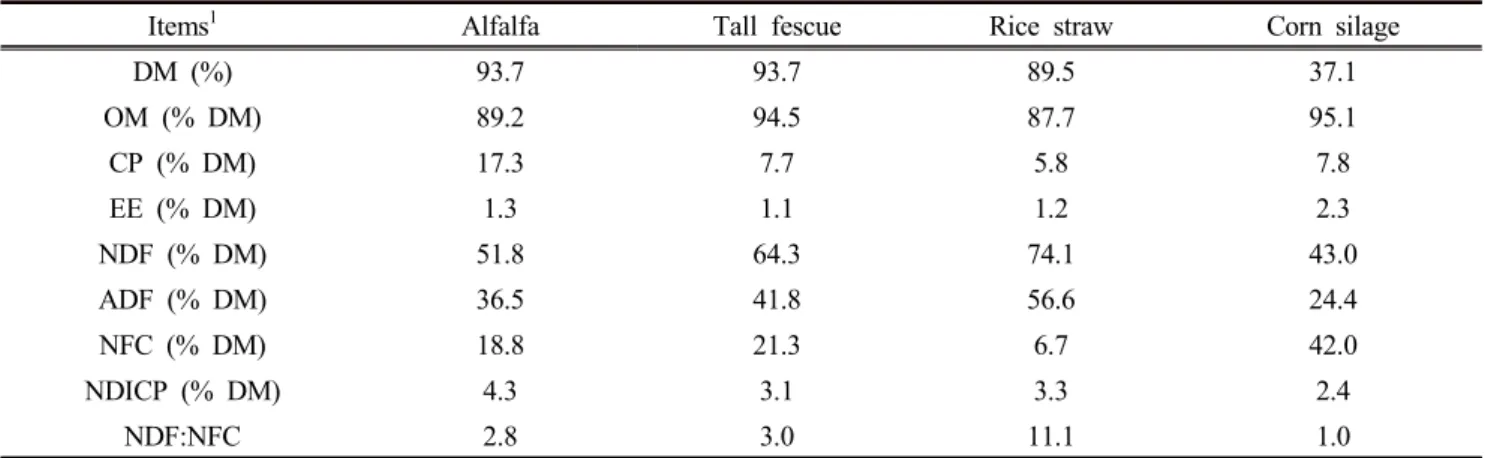
Four castrated black goats (Capra hircus) with an initial body weight of 48.5 ± 0.6 kg were individually housed in environmentally controlled (20.4 ± 2.0°C) respiration-metabolism chambers as described by Li et al. (2010). Animals were randomly allotted to a 4 × 4 balanced Latin square design with 4 roughage type and 4 periods (Kim and Stein, 2009). Each period consisted of a 10-d of diet adaptation period and a 4-d of data and sample collection period. Four experimental diets were prepared (Table 1). Alfalfa hay, tall fescue hay, rice straw, and corn silage were used to represent legume, grasses, straw, and silage, respectively. Experimental diets were fed to animals at 1.5% of the initial body weight (DM basis). They were offered once daily at 1100 h. Water and mineral blocks were available at all times. Orts were removed daily and weighted at 1000 h for DM intake calculation. Fecal samples were collected daily using a total collection method. They were dried immediately and stored at –20°C before chemical analysis.
2. Chemical analysis
All roughages and frozen fecal samples were dried at 60°C
in a forced air oven for 48 h and ground to pass a 1-mm Wiley mill screen. All samples were analyzed in duplication for crude protein (CP), ether extract (EE), and ash contents using AOAC methods (AOAC International and Cunniff, 1995). Amylase-treated neutral detergent fiber (NDF) was determined with the method of Mertens (Mertens, 2002) using sodium sulfite and heat stable α-amylase (Sigma-Aldrich, Steinheim, Germany). Acid detergent fiber (ADF) was measured according to the methods of Van Soest et al. (Van Soest et al., 1991). Neutral detergent insoluble CP was determined according to the method of Licitra et al. (Licitra et al., 1996).
3. Gas production measurement
Gas concentrations of both CH
4and CO
2were measured using the respiration-metabolism chamber system (Li et al., 2010). Before each period, a recovery test was performed using standard CH
4gas (1.67%, v/v). Inlet and outlet gas flow were measured with a flow meter (GFM57, Aalborg Instruments & Controls Inc., Orangeburg, NY, USA). A sample pump (Columbus Instruments, Columbus, OH, USA) was used to collect gas samples. The gas samples passed through desiccants CaSO
4, before the samples flew into the gas analyzer for dehumidification. Non-dispersive infrared gas analyzer (VA-3000, Horiba Stec Co., Kyoto, Japan) was used to analyze the concentration of CH
4and CO
2.
4. Statistical analysis
Items
1Alfalfa Tall fescue Rice straw Corn silage
DM (%) 93.7 93.7 89.5 37.1
OM (% DM) 89.2 94.5 87.7 95.1
CP (% DM) 17.3 7.7 5.8 7.8
EE (% DM) 1.3 1.1 1.2 2.3
NDF (% DM) 51.8 64.3 74.1 43.0
ADF (% DM) 36.5 41.8 56.6 24.4
NFC (% DM) 18.8 21.3 6.7 42.0
NDICP (% DM) 4.3 3.1 3.3 2.4
NDF:NFC 2.8 3.0 11.1 1.0
1DM: Dry matter, OM: Organic matter, CP: Crude protein, EE: Ether extract, NDF: Neutral detergent fiber, ADF: Acid detergent fiber, NFC:
Non-fiber carbohydrate, NDICP: Neutral detergent insoluble crude protein.
Table 1. Chemical composition of roughages used in this study
Data were analyzed with SAS PROC MIXED (Version 9.3, SAS Institute Inc., USA). The model included roughage type as a fixed effect with animal and period as a random effect.
Differences among least squares means were tested using the PDIFF option with Tukey’s adjustment. The individual animal was the experimental unit. Treatment effects are considered as statistically significant at p < 0.05. Trends were considered at 0.05 ≤ p < 0.10.
Ⅲ. RESULTS AND DISCUSSION
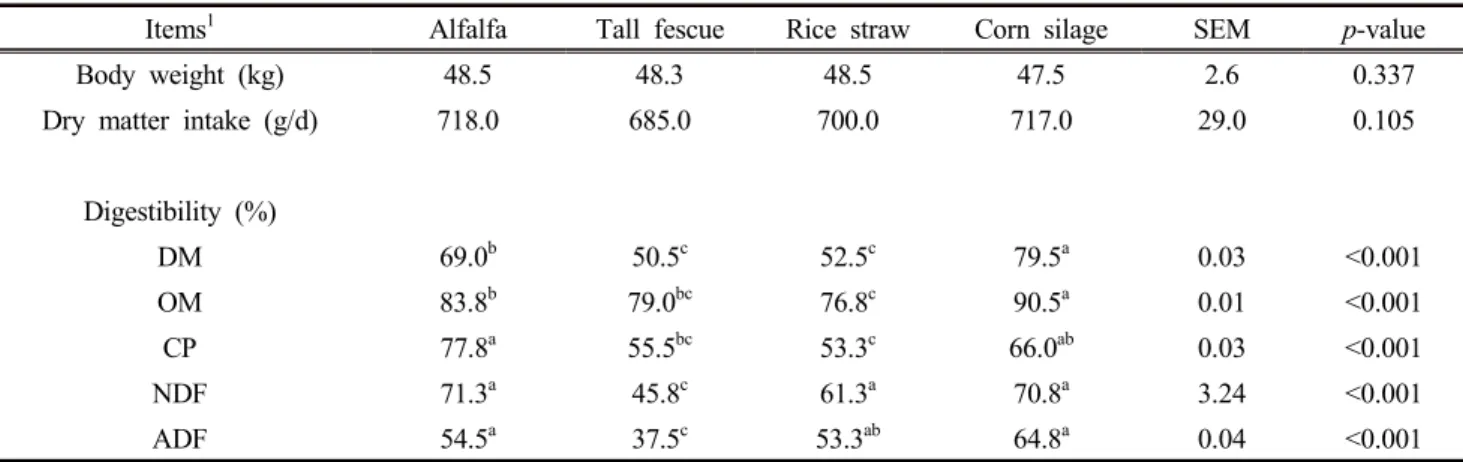
Results of dry matter intake (DMI) and nutrient digestibility of goats are given in Table 2. Dry matter intake did not differ (p = 0.105) among treatments because experimental diets were restrictedly offered to animals in this study. In general, feed intake directly affects the enteric CH
4emission in the ruminant. Therefore, in the current study, we restricted the level of feed intake to minimize the effect of feed intake difference on enteric CH
4emission. Dry matter digestibility was higher (p < 0.001) in the group fed with corn silage than those fed of alfalfa. The DM digestibility in the group fed with alfalfa was higher than those fed with tall fescue and rice straw (p < 0.001). Neutral detergent fiber digestibility was lower (p < 0.001) in the group fed with tall fescue than those fed with alfalfa, rice straw, or corn silage. It seems that tall fescue has low NDF digestibility because it has more indigestible fiber contents (e.g. ADF) than alfalfa and corn silage. Nutrient digestibility values of roughages in goats in
this study were in agreement with previously reported values (Antoniou and Hadjipanayiotou, 1985; Nishida et al., 2007;
Puchala et al., 2012). The reduced DM digestibility in the group fed with tall fescue or rice straw compared to that fed with alfalfa or corn silage might be due to different cell wall contents in roughages. Due to the differences in chemical compositions of roughages, NDF and ADF intakes were lower in the group fed with alfalfa or corn silage than those in the group fed with tall fescue or rice straw. As structural carbohydrate is less digestible than non-structural carbohydrate, the concentration of NDF and ADF in roughages is inversely related to the DM digestibility.
Results of the enteric CH
4and CO
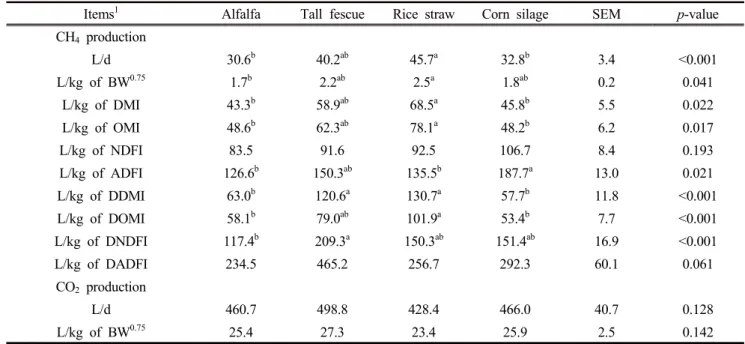
2productions expressed as the daily amount and per unit of nutrient intake and digested nutrient intake are given in Table 3. The daily enteric CH
4or CH
4production per kilogram of BW
0.75, DMI, OM intake (OMI), digested DMI, digested OMI (DOMI), and digested NDFI (DNDFI) of the rice straw feeding group were similar with tall fescue feeding group. The enteric CH
4production per kg of NDF intake was similar (p = 0.193) among all treatments. The roughage type had no effect (p = 0.128) on enteric CO
2emission in goats. In general, a diet containing high non-fiber carbohydrate can derive propionate production in the rumen, thereby inhibiting rumen methanogen growth (Van Kessel and Russell, 1996). In the current study, although grass (tall fescue) has high non-fiber carbohydrate (NFC) than legume (alfalfa), the NDF:NFC ratio was lower in alfalfa hay than in tall fescue. Previous studies reported that the enteric CH
4production from ruminant consuming legume was lower compared to grass (Varga et al., 1985; Benchaar et
Items
1Alfalfa Tall fescue Rice straw Corn silage SEM
p-valueBody weight (kg) 48.5 48.3 48.5 47.5 2.6 0.337
Dry matter intake (g/d) 718.0 685.0 700.0 717.0 29.0 0.105
Digestibility (%)
DM 69.0
b50.5
c52.5
c79.5
a0.03 <0.001
OM 83.8
b79.0
bc76.8
c90.5
a0.01 <0.001
CP 77.8
a55.5
bc53.3
c66.0
ab0.03 <0.001
NDF 71.3
a45.8
c61.3
a70.8
a3.24 <0.001
ADF 54.5
a37.5
c53.3
ab64.8
a0.04 <0.001
1DM: Dry matter, OM: Organic matter, CP: Crude protein, NDF: Neutral detergent fiber, ADF: Acid detergent fiber.
Table 2. Effect of roughage sources on dry matter intake and nutrient digestibility of goats
al., 2001), however, the enteric CH
4production (L/d) in the current study was similar between alfalfa and tall fescue. On the other hands, the enteric CH
4production per DDMI was greater (p < 0.001) in tall fescue or rice straw feeding group than in legume or corn silage feeding group. The straw feeding group had greater (p < 0.001) daily enteric CH
4production and daily CH
4production per unit of nutrient intake and digested nutrient intake than legume or silage feeding group. These results could be assumed that the high NDF:NFC ratio of straw increase the enteric CH
4production for goats. Therefore, the straw feeding group produced more enteric CH
4gas production than legume or silage feeding group, but it had a similar amount of enteric CH
4production to the grasses group.
Goats are an intermediate type ruminant, whereas cattle are grass and roughage eaters (Hofmann, 1989). Despite mor- phological and physiological differences, similar results have been found for CH
4production in both goats and cattle.
Ⅳ. CONCLUSION
The objective of this study was to determine the effect of various roughage sources on nutrient digestibility and enteric
CH
4and CO
2production in goats. In conclusion, rice straw which contains high NDF:NFC generated more enteric CH
4gas emission than those of alfalfa hay or corn silage, but similar to grass. The roughage types had no effect on enteric CO
2emission in goats.
Ⅴ. ACKNOWLEDGEMENT
This work was supported by Korea Institute of Planning and Evaluation for Technology in Food, Agriculture, Forestry and Fisheries (IPET) through Agri-Bio Industry Technology Development Program, funded by Ministry of Agriculture, Food and Rural Affairs (MAFRA) (314010-4).
Ⅵ. REFERENCES
Antoniou, T., and M. Hadjipanayiotou. 1985. The digestibility by sheep and goats of five roughages offered alone or with concentrates.
Journal of Agricultural Science. 105:663-671.
AOAC International, and P. Cunniff. 1995. Official methods of analysis of AOAC International. AOAC International, Arlington, VA.
Items
1Alfalfa Tall fescue Rice straw Corn silage SEM
p-valueCH
4production
L/d 30.6
b40.2
ab45.7
a32.8
b3.4 <0.001
L/kg of BW
0.751.7
b2.2
ab2.5
a1.8
ab0.2 0.041
L/kg of DMI 43.3
b58.9
ab68.5
a45.8
b5.5 0.022
L/kg of OMI 48.6
b62.3
ab78.1
a48.2
b6.2 0.017
L/kg of NDFI 83.5 91.6 92.5 106.7 8.4 0.193
L/kg of ADFI 126.6
b150.3
ab135.5
b187.7
a13.0 0.021
L/kg of DDMI 63.0
b120.6
a130.7
a57.7
b11.8 <0.001
L/kg of DOMI 58.1
b79.0
ab101.9
a53.4
b7.7 <0.001
L/kg of DNDFI 117.4
b209.3
a150.3
ab151.4
ab16.9 <0.001
L/kg of DADFI 234.5 465.2 256.7 292.3 60.1 0.061
CO
2production
L/d 460.7 498.8 428.4 466.0 40.7 0.128
L/kg of BW
0.7525.4 27.3 23.4 25.9 2.5 0.142
1BW: Body weight, DMI: Dry matter intake, OMI: Organic matter intake, NDFI: Neutral detergent fiber intake, ADFI: Acid detergent fiber intake, DDMI: Digested dry matter intake, DOMI: Digested organic matter intake, DNDFI: Digested neutral detergent fiber intake, DADFI:
Digested acid detergent fiber intake.
Table 3. Effect of various roughage sources on enteric methane and carbon dioxide emission in goats
Beauchemin, K.A., Kreuzer, M., O’Mara, F. and McAllister, T. A. 2008.
Nutritional management for enteric methane abatement: a review.
Aust. American Journal of Experimental Agriculture. 48:21-27.
Benchaar, C., Pomar, C. and Chiquette, J. 2001. Evaluation of dietary strategies to reduce methane production in ruminants: a modelling approach. Canadian Journal of Animal Science. 81:563-574.
Blaxter, K.L. and Wainman, F.W. 1964. The utilization of the energy of different rations by sheep and cattle for maintenance and for fattening. Journal of Agricultural Science. 63:113-128.
Dong, R. and Zhao, G. 2013. Relationship between the Methane Production and the CNCPS Carbohydrate Fractions of Rations with Various Concentrate/roughage Ratios Evaluated Using In vitro Incu- bation Technique. Asian-Australasian Journal of Animal Sciences.
26:1708-1716.
Food and Agricultural Organization of the United Nations. FAO Statistical Database. FAOSTAT. Available from: http://www.fao.
org/faostat
Hales, K.E., Brown-Brandl, T.M. and Freetly, H.C. 2014. Effects of decreased dietary roughage concentration on energy metabolism and nutrient balance in finishing beef cattle. Journal of Animal Science.
92:264-271.
Harper, L.A., Denmead, O.T. Freney, J.R. and Byers, F.M. 1999. Direct measurements of methane emissions from grazing and feedlot cattle.
Journal of Animal Science. 77:1392-1401.
Hofmann, R.R. 1989. Evolutionary steps of ecophysiological adaptation and diversification of ruminants: a comparative view of their digestive system. Oecologia. 78:443-457.
Johnson, K.A. and Johnson, D.E. 1995. Methane emissions from cattle.
Journal of Animal Science. 73:2483-2492.
Kim, B.G., and Stein, H.H. 2009. A spreadsheet program for making a balanced Latin square design. Revista Colombiana de Ciencias Pecuarias. 22:591-596.
Li, D.H., Kim, B.K. and Lee, S.R. 2010. A respiration-metabolism chamber system for measuring gas emission and nutrient digestibility in small ruminant animals. Revista Colombiana de Ciencias Pecuarias.
23:444-450.
Licitra, G., Hernandez, T.M. and Van Soest, P.J. 1996. Standardization of procedures for nitrogen fractionation of ruminant feeds. Animal Feed Science and Technology. 57:347-358.
McCaughey, W.P., Wittenberg, K. and Corrigan, D. 1999. Impact of pasture type on methane production by lactating beef cows. Canadian Journal of Animal Science. 79:221-226. doi:10.4141/A98-107.
Meale, S.J., Chaves, A.V. Baah, J. and McAllister, T.A. 2012. Methane Production of Different Forages in In vitro Ruminal Fermentation.
Asian-Australas. Journal of Animal Science. 25:86-91. doi:10. 5713/
ajas.2011.11249.
Mertens, D.R. 2002. Gravimetric determination of amylase-treated neutral detergent fiber in feeds with refluxing in beakers or crucibles:
collaborative study. Journal of AOAC International. 85:1217-1240.
Nishida, T., Eruden, B., Hosoda, K., Matsuyama, H., Xu, C. and Shioya, S. 2007. Digestibility, methane production and chewing activity of steers fed whole-crop round bale corn silage preserved at three maturities. Animal Feed Science and Technology. 135:42-51.
Puchala, R., Animut, G., Patra, A.K., Detweiler, G.D., Wells, J.E., Varel, V.H., Sahlu, T. and Goetsch, A.L. 2012. Methane emissions by goats consuming Sericea lespedeza at different feeding frequencies.
Animal Feed Science and Technology. 175:76-84.
Ulyatt, M.J., Lassey, K.R., Shelton, I.D. and Walker, C.F. 2002.
Methane emission from dairy cows and wether sheep fed subtropical grass-dominant pastures in midsummer in New Zealand.
New Zealand Journal of Agricultural Research. 45:227-234.
Van Kessel, J.A.S. and Russell, J.B. 1996. The effect of pH on ruminal methanogenesis. FEMS Microbiology Ecology. 20:205-210.
Van Soest, P.J., Robertson, J.B. and Lewis, B.A. 1991. Methods for Dietary Fiber, Neutral Detergent Fiber, and Nonstarch Poly- saccharides in Relation to Animal Nutrition. Journal of Dairy Science.
74:3583-3597.
Varga, G.A., Tyrrell, H.F., Waldo, D.R., Huntington, G.B. Huntington, and Glenn, B.P. 1985. Effect of alfalfa or orchard grass silages on energy and nitrogen utilization for growth by Holstein steers.
Energy Metab. Farm Anim. PW Mue HF Tyrell PJ ReynoldsEds Ronman Littlefield Totawa NJ. pp. 86-89.
Waghorn, G.C., Tavendale, M.H. and Woodfield, D.R. 2002.
Methanogenesis from forages fed to sheep. In: Proceedings of the New Zealand Grassland Association. 64:167-171.
Westberg, H., Lamb, B., Johnson, K.A. and Huyler, M. 2001. Inventory of methane emissions from U. S. cattle. Journal of Geophysical Research Atmospheres. 106:12.
(Received : February 8, 2018 | Revised : March 9, 2018 | Accepted : March 12, 2018)