Copyright © 2014 Korean Neurological Association
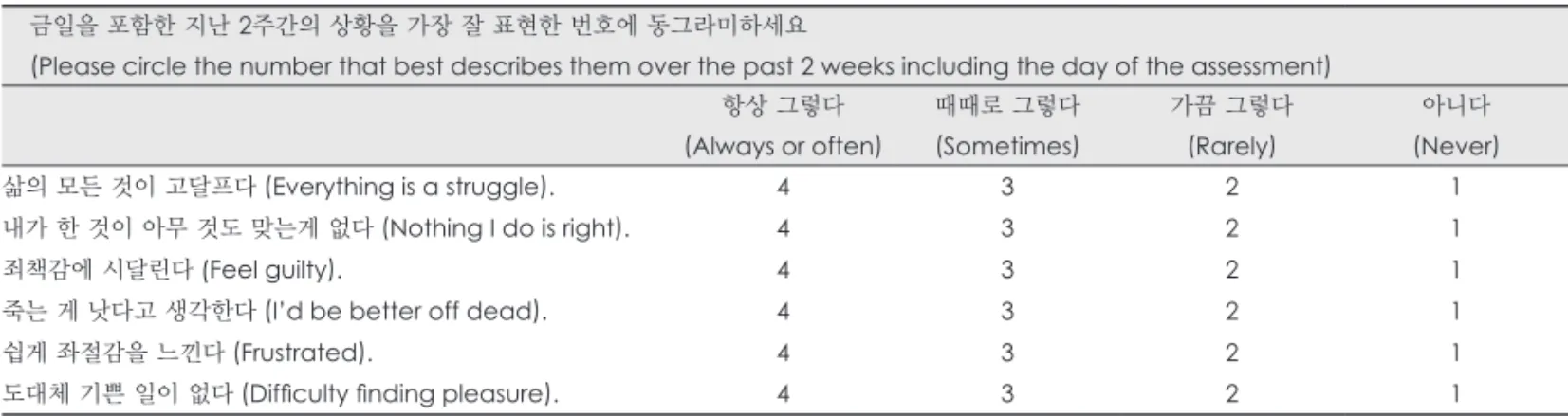
375 The Korean version of Neurological Disorders Depression Inventory for Epilepsy in Table 3 was inadvertently omitted from the original publication of this article. The errors took place during publication process. The editor-in-chief apologizes for the mis- take. The revised Table 3 is presented here:
Erratum: Depression and Anxiety in People with Epilepsy
Oh-Young Kwon,
aSung-Pa Park
baDepartment Neurology and Institute of Health Science, Gyeongsang National University School of Medicine, Jinju, Korea
bDepartment of Neurology, School of Medicine, Kyungpook National University, Daegu, Korea J Clin Neurol 2014;10(3):175-188
http://dx.doi.org/10.3988/jcn.2014.10.3.175
Print ISSN 1738-6586 / On-line ISSN 2005-5013 http://dx.doi.org/10.3988/jcn.2014.10.4.375 ERRATUM
J Clin Neurol 2014;10(4):375-375
Open Access
cc This is an Open Access article distributed under the terms of the Creative Commons Attribution Non-Commercial License (http://creativecommons.org/
licenses/by-nc/3.0) which permits unrestricted non-commercial use, distribution, and reproduction in any medium, provided the original work is properly cited.
Table 3. The Korean version of Neurological Disorders Depression Inventory for Epilepsy 금일을 포함한 지난 2주간의 상황을 가장 잘 표현한 번호에 동그라미하세요
(Please circle the number that best describes them over the past 2 weeks including the day of the assessment) 항상 그렇다
(Always or often)
때때로 그렇다 (Sometimes)
가끔 그렇다 (Rarely)
아니다 (Never)
삶의 모든 것이 고달프다 (Everything is a struggle). 4 3 2 1
내가 한 것이 아무 것도 맞는게 없다 (Nothing I do is right). 4 3 2 1
죄책감에 시달린다 (Feel guilty). 4 3 2 1
죽는 게 낫다고 생각한다 (I’d be better off dead). 4 3 2 1
쉽게 좌절감을 느낀다 (Frustrated). 4 3 2 1
도대체 기쁜 일이 없다 (Difficulty finding pleasure). 4 3 2 1